Which Words Should Your Marketers Use? My Four Suggestions.

I’ve talked about the words “why,” “how,” and “what” and their relation to writing, but I haven’t talked about the word “which.”

Not in relation to sandwiches, but in relation to words.

If you are a marketing executive, you know that the words you use in your marketing content can make or break your success. When your company asks employees or consultants to write marketing content for you, which words should they use?

Here are four suggestions for you and your writers to follow.

  1. Your writers should use the right words for your brand.
  2. Your writers should use the right words for your industry.
  3. Your writers should use words that get results.
  4. Your writers should be succinct.

Your writers should use the right words for your brand

Your company has a tone of voice, and your writers should know what it is. If you can’t tell them what it is, they will figure it out themselves.

Your company has a particular writing style—hopefully one that engages your prospects and customers. Regardless of your writer’s personal style, they must create copy that aligns with your own style. In effect, they put on a “mask” that aligns the words they create with the words that your company needs.

Your writers should use the right words for your industry

Similarly, your company provides products and services in one or more industries, and your copy must align with the terms those industries use, and the way industry participants express themselves.

For example, a writer who is writing content for the biometric industry will use different terms than a writer who is writing content for art collectors because of the differences in the two target audiences.

  • Biometric readers (the people, not the devices) care about matching accuracy measurements, such as those compiled by the U.S. National Institute of Standards and Technology (NIST) in its Face Recognition Vendor Test, or as measured in agency-managed benchmarks. (Mike French’s example.) They often respond to quantitative things, although more high-level concepts like “keeping citizens safe from repeat offenders” (a public safety-related benefit) also resonate.
  • Art collectors care about more qualitative things, such as not being scared of handing over their dream to a commissioned artist whose work will inspire affection. (Well, unless the collector is an art investor and not an art lover; investors use different terminology than lovers.)

So make sure your writers get the words right. Otherwise, it’s as if someone is speaking Italian to a bunch of French speakers. (Kaye Putnam’s example.) Your prospects will tune you out if you use words they don’t understand.

Your writers should use words that get results

There is one important exception to my suggestions above. If your company’s current words don’t result in action, quit using your current words and use better ones that support your awareness, consideration, conversion, or other goals.

If you start talking about your solution without addressing your prospect’s pain points or problems, they won’t know why they should care about your solution.

For example, let’s say that the message you want to give to your prospects is that your company makes wireless headphones.

So what?

The prospect doesn’t care about wireless headphones per se. The prospect cares about the troubles they face with tangled cords, and how your company offers a solution to their problem of tangled cords.

Features are important to you. Benefits are important to your prospects. Since the prospects are the ones with the money, listen to them and talk about benefits that change their lives, not how great your features are.

Your writers should be succinct

I have struggled with succinctness for decades. I could give you countless examples of my long-windedness, but…that wouldn’t be appropriate.

So how do I battle this personally? By creating a draft 0.5 before I create my draft 1. I figure out what I’m going to say, say it, and then sleep on the text—sometimes literally. When I take a fresh look at the text, I usually ruthlessly chop a bunch of it out and focus on the beef.

Now there are times in which detail is appropriate, but there are also times in which a succinct message gets better results.

Selecting your content marketer

If your company needs employees or consultants to write marketing content for you, make sure they create the right content.

If your company’s views on content creation parallel my own, maybe I can help you.

If you need a full-time employee on your staff to drive revenue as your personal Senior Product Marketing Manager or Senior Content Marketing Manager, take a look at my 29 years of technology (identity/biometric) and marketing experience on my LinkedIn profile. If you like what you see, contact me via LinkedIn or at jebredcal@gmail.com.

If you need a marketing consultant for a single project, then you can reach me via my Bredemarket consultancy.

Applying the “Six Questions” to LinkedIn Self-promotion

(UPDATE OCTOBER 23, 2023: “SIX QUESTIONS YOUR CONTENT CREATOR SHOULD ASK YOU IS SO 2022. DOWNLOAD THE NEWER “SEVEN QUESTIONS YOUR CONTENT CREATOR SHOULD ASK YOU” HERE.)

I’ve previously talked about the six questions your content creator should ask you. And I eat my own wildebeest food. I used the six questions to create a self-promotion blog post and LinkedIn post.

But since you care about YOUR self-promotion rather than mine, I’ll provide three tips for writing and promoting your own LinkedIn post.

How I promoted my content

Before I wrote the blog post or the LinkedIn post, I used my six questions to guide me. For my specific example, here are the questions and the answers.

QuestionPrimary AnswerSecondary Answer (if applicable)
Why?I want full-time employmentI want consulting work
How?State identity and marketing qualifications, ask employers to hire meState identity and marketing qualifications, ask consulting clients to contract with me
What?Blog post (jebredcal), promoted by a personal LinkedIn postBlog post (jebredcal), promoted by a Bredemarket Identity Firm Services LinkedIn post
Goal?Employers contact me for full-time employmentConsulting prospects contact me for contract work
Benefits?(1) No identity learning curve
(2) No content learning curve
(3) Proven results
(same)
Target Audience?Identity companies hiring Senior Product Marketing Managers and Senior Content Marketing ManagersIdentity companies contracting with content marketing consultants
For more information on the six questions, see https://bredemarket.com/2022/12/18/six-questions-your-content-creator-should-ask-you-the-e-book-version/.

You’ll notice that I immediately broke a cardinal rule by having both a primary goal and a secondary goal. When you perform your own self-promotion, you will probably want to make things less messy by having only a single goal.

So based upon these responses, I created…

First, the blog post

The Bredemarket blog is primarily to promote my consulting work. I have a different blog (jebredcal) to promote my full-time employment (or attempts to secure full-time employment).

Because the primary goal was to secure full-time employment, I posted to jebredcal instead of Bredemarket.

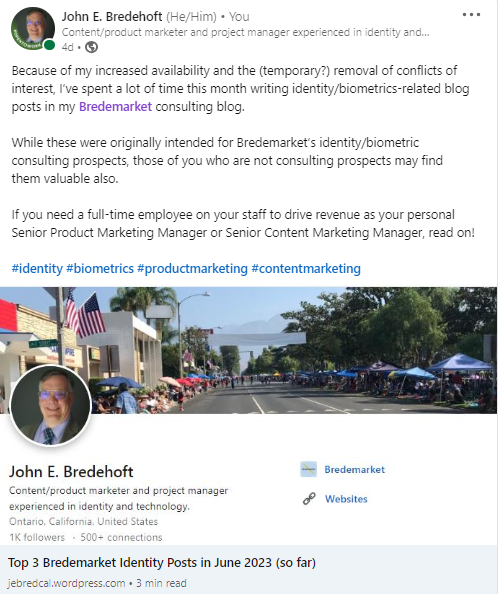
After the introduction (pictured above) with its “If you need a full-time employee” call to action, I then shared three identity-related blog posts from the Bredemarket blog to establish my “biometric content marketing expert” (and “identity content marketing expert”) credentials. I then closed with a dual call to action for employers and potential consulting clients. (I told you it is messy to have two goals.)

If you want to see my jebredcal post “Top 3 Bredemarket Identity Posts in June 2023 (so far),” click here.

So how did I get the word out about this personal blog post? I chose LinkedIn. (In my case, hiring managers probably aren’t going to check my two Instagram accounts.)

Second, the LinkedIn post

I often reshare my Bredemarket blog posts on various Bredemarket social media accounts. In this instance I only reshared it on LinkedIn, since that’s where the hiring managers are. While I shared the blog post to my Bredemarket Identity Firm Services LinkedIn page (since the post talked about identity), my primary goal was to share it to my personal LinkedIn feed.

It was simple to write the LinkedIn text, since I repurposed the introduction of the blog post itself. I added four hashtags, and then the post went live. You can see it here.

And by the way, feel free to like the LinkedIn post, comment on it, or even reshare it. I’ll explain why below.

Third, the “LinkedIn Love” promotion

So how did I promote it? Via the “LinkedIn Love” concept. (Some of you know where I learned about LinkedIn Love.)

To get LinkedIn love, I asked a few trusted friends in the identity industry to like, comment, or reshare the post. This places the post on my friends’ feeds, where their identity contacts will see it.

A few comments:

  • I don’t do this for every post, or else I will have no friends. In fact, this is the first time that I’ve employed “LinkedIn Love” in months.
  • I only asked friends in the identity industry, since these friends have followers who are most likely to hire a Senior Product Marketing Manager or Senior Content Marketing Manager.
  • I only asked a few friends in the identity industry, although eventually some friends that I didn’t ask ended up engaging with the post anyway.

I have wonderful friends. After several of them gave “LinkedIn Love,” The post received significant engagement. As of Friday morning, the post had acquired over 1,700 impresions. That’s many, many more than my posts usually acquire.

I don’t know if this activity will directly result in full-time employment or increased consulting work. But it certainly won’t hurt.

Three steps to promote YOUR content

But the point of this post isn’t MY job search. It’s YOURS (or whatever it is you want to promote).

For example, one of my friends who is also seeking full-time employment wanted to know how to use a LinkedIn post to promote THEIR OWN job search.

Now you don’t need to use my six questions. You don’t need to create a blog post before creating the LinkedIn post. And you certainly don’t need to create two goals. (Please don’t…unless you want to.)

In fact, you can create and promote your own LinkedIn post in just THREE steps.

Step One: What do you want to say?

My six questions obviously aren’t the only method to collect your thoughts. There are many, many other tools that achieve the same purpose. The important thing is to figure out what you want to say.

  • Start at the end. What action do you want the reader to take after reading your LinkedIn post? Do you want them to read your LinkedIn profile, or download your resume, or watch your video, or join your mailing list, or email or call you? Whatever it is, make sure your LinkedIn post includes the appropriate “call to action.”
  • Work on the rest. Now that you know how your post will end, you can work on the rest of the post. Persuade your reader to follow your call to action. Explain how you will benefit them. Address the post to the reader, your customer (for example, a potential employer), and adopt a customer focus.

Step Two: Say it.

If you don’t want to write the post yourself, then ask a consultant, a friend, or even a generative AI tool to write something for you. (Just because I’m a “get off my lawn” guy regarding generative AI doesn’t mean that you have to be.)

(And before you ask, there are better consultants than Bredemarket for THIS writing job. My services are designed and priced for businesses, not individuals.)

After your post is written by you or someone (or something) else, have one of your trusted friends review it and see if the written words truly reflect how amazing and outstanding you are.

Once you’re ready, post it to LinkedIn. Don’t delay, even if it isn’t perfect. (Heaven knows this blog post isn’t perfect, but I posted it anyway.) Remember that if you don’t post your promotional LinkedIn post, you are guaranteed to get a 0% response to it.

Step Three: Promote it.

Your trusted friends will come in handy for the promotion part—if they have LinkedIn accounts. Privately ask your trusted friends to apply “LinkedIn Love” to your post in the same way that my trusted friends did it for me.

By the way—if I know you, and you’d like me to promote your LinkedIn post, contact me via LinkedIn (or one of the avenues on the Bredemarket contact page) and I’ll do what I can.

And even if I DON’T know you, I can promote it anyway.

I’ve never met Mary Smith in my life, but she says that she read my Bredemarket blog post “Applying the “Six Questions” to LinkedIn Self-promotion.” Because she selects such high-quality reading material, I’m resharing Mary’s post about how she wants to be the first human to visit Venus. If you can help her realize her dream, scroll to the bottom of her post and donate to her GoFundMe.

Hey, whatever it takes to get the word out.

Let me know if you use my tips…or if you have better ways to achieve the same purpose.

Three Ways to Identify and Share Your Identity Firm’s Differentiators

(Part of the biometric product marketing expert series)

Are you an executive with a small or medium sized identity/biometrics firm?

If so, you want to share the story of your identity firm. But what are you going to say?

How will you figure out what makes your firm better than all the inferior identity firms that compete with you?

How will you get the word out about why your identity firm beats all the others?

Are you getting tired of my repeated questions?

Are you ready for the answers?

Your identity firm differs from all others

Over the last 29 years, I (John E. Bredehoft of Bredemarket) have worked for and with over a dozen identity firms, either as an employee or as a consultant.

You’d think that since I have worked for so many different identity firms, it’s an easy thing to start working with a new firm by simply slapping down the messaging that I’ve created for all the other identity firms.

Nothing could be further from the truth.

Designed by Freepik.

Every identity firm needs different messaging.

  • The messaging that I created in my various roles at IDEMIA and its corporate predecessors was dramatically different than the messaging I created as a Senior Product Marketing Manager at Incode Technologies, which was also very different from the messaging that I created for my previous Bredemarket clients.
  • IDEMIA benefits such as “servicing your needs anywhere in the world” and “applying our decades of identity experience to solve your problems” are not going to help with a U.S.-only firm that’s only a decade old.
  • Similarly, messaging for a company that develops its own facial recognition algorithms will necessarily differ from messaging for a company that chooses the best third-party facial recognition algorithms on the market.

So which messaging is right?

It depends on who is paying me.

How your differences affect your firm’s messaging

When creating messaging for your identity firm, one size does not fit all, for the reasons listed above.

The content of your messaging will differ, based upon your differentiators.

  • For example, if you were the U.S.-only firm established less than ten years ago, your messaging would emphasize the newness of your solution and approach, as opposed to the stodgy legacy companies that never updated their ideas.
  • And if your firm has certain types of end users, such as law enforcement users, your messaging would probably feature an abundance of U.S. flags.

In addition, the channels that you use for your messaging will differ.

Identity firms will not want to market on every single social media channel. They will only market on the channels where their most motivated buyers are present.

  • That may be your own website.
  • Or LinkedIn.
  • Or Facebook.
  • Or Twitter.
  • Or Instagram.
  • Or YouTube.
  • Or TikTok.
  • Or a private system only accessible to people with a Top Secret Clearance.
  • Or display advertisements located in airports.
From https://www.youtube.com/watch?v=H02iwWCrXew

It may be more than one of these channels, but it probably won’t be all of them.

But before you work on your content or channels, you need to know what to say, and how to communicate it.

How to know and communicate your differentiators

As we’ve noted, your firm is different than all others.

  • How do you know the differences?
  • How do you know what you want to talk about?
  • How do you know what you DON’T want to talk about?

Here are three methods to get you started on knowing and communicating your differentiators in your content.

Method One: The time-tested SWOT analysis

If you talk to a marketer for more than two seconds about positioning a company, the marketer will probably throw the acronym “SWOT” back at you. I’ve mentioned the SWOT acronym before.

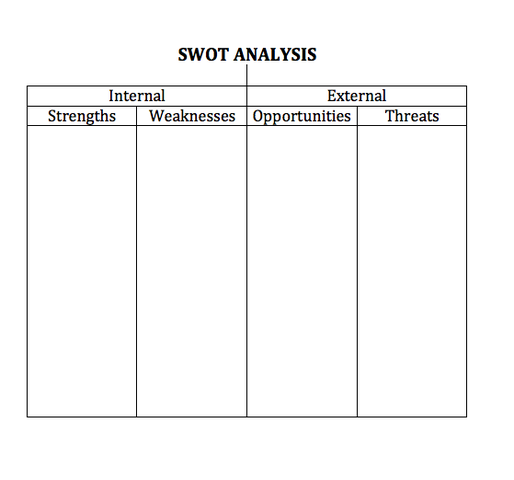
For those who don’t know the acronym, SWOT stands for

  • Strengths. These are internal attributes that benefit your firm. For example, your firm is winning a lot of business and growing in customer count and market share.
  • Weaknesses. These are also internal attributes, but in this case the attributes that detract from your firm. For example, you have very few customers.
  • Opportunities. These are external factors that enhance your firm. One example is a COVID or similar event that creates a surge in demand for contactless solutions.
  • Threats. The flip side is external factors that can harm your firm. One example is increasing privacy regulations that can slow or halt adoption of your product or service.

If you’re interested in more detail on the topic, there are a number of online sources that discuss SWOT analyses. Here’s TechTarget’s discussion of SWOT.

The common way to create the output from a SWOT analysis is to create four boxes and list each element (S, W, O, and T) within a box.

By Syassine – Own work, CC BY-SA 3.0, https://commons.wikimedia.org/w/index.php?curid=31368987

Once this is done, you’ll know that your messaging should emphasize the strengths and opportunities, and downplay or avoid the weaknesses and threats.

Or alternatively argue that the weaknesses and threats are really strengths and opportunities. (I’ve done this before.)

Method Two: Think before you create

Personally, I believe that a SWOT analysis is not enough. Before you use the SWOT findings to create content, there’s a little more work you have to do.

I recommend that before you create content, you should hold a kickoff of the content creation process and figure out what you want to do before you do it.

During that kickoff meeting, you should ask some questions to make sure you understand what needs to be done.

I’ve written about kickoffs and questions before, and I’m not going to repeat what I already said. If you want to know more:

Method Three: Send in the reinforcements

Now that you’ve locked down the messaging, it’s time to actually create the content that differentiates your identity firm from all the inferior identity firms in the market. While some companies can proceed right to content creation, others may run into one of two problems.

  • The identity firm doesn’t have any knowledgeable writers on staff. To create the content, you need people who understand the identity industry, and who know how to write. Some firms lack people with this knowledge and capability.
  • The identity firm has knowledgeable writers on staff, but they’re busy. Some companies have too many things to do at once, and any knowledgeable writers that are on staff may be unavailable due to other priorities.
Your current staff may have too much to do. By Backlit – Own work, CC BY-SA 3.0, https://commons.wikimedia.org/w/index.php?curid=12225421

This is where you supplement you identity firm’s existing staff with one or more knowledgeable writers who can work with you to create the content that leaves your inferior competitors in the dust.

What is next?

So do you need a knowledgeable biometric content marketing expert to create your content?

One who has been in the biometric industry for 29 years?

One who has been writing short and long form content for more than 29 years?

Are you getting tired of my repeated questions again?

Well then I’ll just tell you that Bredemarket is the answer to your identity/biometric content marketing needs.

Are you ready to take your identity firm to the next level with a compelling message that increases awareness, consideration, conversion, and long-term revenue? Let’s talk today!

I’m still the biometric content marketing and proposal writing expert…but who benefits?

Beginning about a year ago, I began marketing myself as the biometric proposal writing expert and biometric content marketing expert. From a search engine optimization perspective, I have succeeded at this, so that Bredemarket tops the organic search results for these phrases.

Well, it seemed like a good idea at the time.

And maybe it still is.

Let’s look at why I declared myself the biometric proposal writing expert (BPWE) and biometric content marketing expert (BCME) in mid-2021, what happened over the last few months, why it happened, and who benefits.

Why am I the BPWE and BCME?

At the time that I launched this marketing effort, I wanted to establish Bredemarket’s biometric credentials. I was primarily providing my expertise to identity/biometric firms, so it made sense to emphasize my 25+ years of identity/biometric expertise, coupled with my proposal, marketing, and product experience. Some of my customers already knew this, but others did not.

So I coupled the appropriate identity words with the appropriate proposal and content words, and plunged full-on into the world of biometric proposal writing expert (BPWE within Bredemarket’s luxurious offices) and biometric content marketing expert (BCME here) marketing.

What happened?

There’s been one more thing that’s been happening in Bredemarket’s luxurious offices over the last couple of months.

I’ve been uttering the word “pivot” a lot.

Since March 2022, I’ve made a number of changes at Bredemarket, including pricing changes and modifications to my office hours. But this post concentrates on a change that affects the availability of the BPWE and BCME.

Let’s say that it’s December 2022, and someone performs a Google, Bing, or DuckDuckGo search for a biometric content marketing expert. The person finds Bredemarket, and excitedly goes to Bredemarket’s biometric content marketing expert page, only to encounter this text at the top of the page:

Update 4/25/2022: Effective immediately, Bredemarket does NOT accept client work for solutions that identify individuals using (a) friction ridges (including fingerprints and palm prints), (b) faces, and/or (c) secure documents (including driver’s licenses and passports). 

“Thanks a lot,” thinks the searcher.

Granted, there are others such as Tandem Technical Writing and Applied Forensic Services who can provide biometric consulting services, but the searcher won’t get the chance to work with ME.

Should have contacted me before April 2022.

Sheila Sund from Salem, United States, CC BY 2.0 https://creativecommons.org/licenses/by/2.0, via Wikimedia Commons

Why did it happen?

I’ve already shared some (not all) details about why I’m pivoting with the Bredemarket community, but perhaps you didn’t get the memo.

I have accepted a full-time position as a Senior Product Marketing Manager with an identity company. (I’ll post the details later on my personal LinkedIn account, https://www.linkedin.com/in/jbredehoft/.) This dramatically decreases the amount of time I can spend on my Bredemarket consultancy, and also (for non-competition reasons) limits the companies with which I can do business. 

Those of you who have followed Bredemarket from the beginning will remember that Bredemarket was only one part of a two-pronged approach. After becoming a “free agent” (also known as “being laid off”) in July 2020, my initial emphasis was on finding full-time employment. Within a month, however, I found myself accepting independent contracting projects, and formally established Bredemarket to handle that work. Therefore, I was simultaneously (a) looking for full-time work, and (b) growing my consulting business. And I’ve been doing both simultaneously for over a year and a half. 

Now that I’ve found full-time employment again, I’m not going to give up the consulting business. But it’s definitely going to have to change, as outlined in my April 25, 2022 update.

So now all of this SEO traction will not benefit you, the potential Bredemarket finger/face client, but it obviously will benefit my new employer. I can see it now when people talk about my new employer: “Isn’t that the company where the biometric content marketing expert is the Senior Product Marketing Manager?”

At least somebody will benefit.

P.S. There’s a “change” Spotify playlist. Unlike Kevin Meredith, I don’t use my playlists to make sure my presentation is within the alloted time. Especially when I create my longer 100-plus song playlists; no one wants to hear me speak for that long. Thankfully for you, this playlist is only a little over an hour long, and includes various songs on change, moving, endings, beginnings, and time.

How “Omni” is your Omnichannel?

One of Bredemarket’s clients is a consulting firm that advises other companies on the use of a particular enterprise content management system. Among other things, this consulting firm can help its client companies configure the outbound information the companies’ systems provide.

Which leads us to our word for today, omnichannel.

In marketing, “omnichannel” refers to “the process of driving customer engagement across all channels with seamless, targeted messaging.”

Across ALL marketing channels. That’s what omnichannel talks about.

Here’s what Erin O’Connor says:

Omnichannel marketing lets marketers create seamless, integrated customer experiences spanning both online and offline channels to connect with customers as they move through the buying cycle. Omnichannel marketing focuses on the life cycle of the customer. For example, when a customer is in the acquisition phase, the marketer will send a different type of message compared to a loyal customer

Omnichannel marketing is …a holistic approach in the sense that it’s looking at all of the potential touchpoints customers can use to communicate with brands, both online and offline.

From https://business.adobe.com/glossary/omnichannel-marketing.html

An omnichannel marketing strategy may encompass a number of marketing tools, including email, white paper downloads, videos, mobile SMS responses, automated call centers, and anything else that marketers use to communicate with clients.

One of the key benefits of an omnichannel marketing strategy is, or should be, consistency. If your emails say that your product is supported on Windows 11, your data sheets had better not say that your product is only supported up to Windows 10. This is a definite problem; see my checklist item 2 in this post.

(Incidentally, I recently ran across a company that is still talking about NIST FRVT results from several years ago. Since the NIST FRVT tests are ongoing, any reference to old results is outdated because of all the new algorithms that have been submitted and that have better performance.)

So factual consistency is important. Omnichannel marketing also allows for visual consistency (well, not in the automated call center) in which all of the company’s content looks like it came from the same company.

Obviously there are a number of benefits from omnichannel marketing, including easier management and consistency of marketing messages. But all of this raises a question:

Is omnichannel marketing truly OMNIchannel? Or does omnichannel marketing leave some things out?

Before you point me to the definition of “omni” and say that omnichannel marketing by definition can’t exclude anything, read on.

When product marketers don’t market

If you’re a marketer, I hope you’re sitting down.

The world does not revolve around marketing.

(My college roommates who were physics majors made sure to remind me of this.)

Thus, anything that isn’t marketing is automatically excluded from omnichannel marketing. And there are a number of things that companies do that aren’t marketing per se.

I recently held a discussion with a product marketer which got me thinking. We were talking about the things product marketers do, which include content creation (case studies/testimonials, white papers, social media content, and the like) and other product-related tasks such as competitive analysis of other products.

But then the product marketer mentioned something else.

What about having the product marketer author product technical documentation, such as user guides?

(By the way, I’ve written technical documentation in the past; see the “Benefiting from my experience and expertise” section of the Bredemarket “Who I Am” page.)

Now technical documentation is (usually) not the place for overt marketing messaging, but at the same time technical documentation authorship benefits the product marketer and the company by immersing the product marketer into the details of the product, thus increasing the marketer’s product understanding.

I’ll grant you need a different writing style when writing technical documentation; after all, there are no earthshaking benefits from clicking on the “Save As” button.

By Later version were uploaded by Bruce89 at en.Wikipedia. – Transfered from en.Wikipedia; en:File:Dialog1.pngtransfered to Commons by User:IngerAlHaosului using CommonsHelper., GPL, https://commons.wikimedia.org/w/index.php?curid=8988455

But you need different writing styles for the different types of marketing output anyway. The mechanics of writing a tweet differ from the mechanics of filming a video. So a marketer who isn’t experienced in technical documentation can adjust to the new style.

However, finding marketers slash technical documentation writers in the wild is unusual. Every company that I’ve worked with since 1991 has built some type of wall between the marketing function and the technical documentation function. But oddly enough, one of my former employers (MorphoTrak) moved managers around between the different functions. One manager in particular headed up the technical documentation group, then headed up the proposals group (where I worked for her), then headed up a multi-functional marketing team (where I worked for her again), then specialized in product marketing.

And now the product marketer (not the one from MorphoTrak, but the one I had been talking to) got the hamster in my brain to start generating ideas.

If omnichannel marketing is limited, and your omnichannel efforts should include activities outside of marketing such as technical documentation, what else should be included in your omnichannel efforts?

Including proposal writing in omnichannel efforts

OK, the subtitle gave it away. (But I refused to write the subtitle “This marketer wrote a user guide. You won’t believe what he did next!”)

If anything, proposal writing is closer to marketing than technical documentation is to marketing. While proposal writing is often considered a sales function (though some would disagree), there are obvious overlaps between the benefits that you espouse in a proposal and the benefits that you espouse in a case study.

Including standard proposal text/template creation as part of your omnichannel efforts also helps to ensure consistency in your product messaging. Again, if your data sheet says one thing, and your user guide says the same thing, then your proposal had better say the same thing also. (Unless you’re proposing something that won’t be implemented for another one or two years, in which case the proposal will discuss things that won’t appear in the present data sheets and user guides, but in future versions.)

Now those of you who are familiar with what Bredemarket does can appreciate why I love this idea.

By Loudon dodd – Own work, CC BY-SA 3.0, https://commons.wikimedia.org/w/index.php?curid=7404342

I’ve positioned Bredemarket as a two-headed (but not two-faced) marketing and writing service provider: for example, with separate descriptions of my status as a biometric content marketing expert and a biometric proposal writing expert. And that pretty much mirrors how I work. With one exception, most of my clients only use me for either my proposal services or my content marketing services.

What if companies entrusted Bredemarket with their total solution, both inside and outside of traditional marketing?

Of course there are complications in implementing this.

But when can you implement true omnichannel efforts?

Now most companies are ill-fitted to have one person, or even one department, handle all the omnichannel marketing (case studies, white papers, data sheets, tweets, LinkedIn posts, competitive intelligence, etc.) AND all the omnichannel non-marketing (technical documentation, proposals, and all the other stuff that my hamster brain didn’t realize yet).

So how do you get multiple departments to communicate the same messaging? It’s a difficult task, especially since most department members are so focused on their own work that they don’t have the bandwidth to worry about what another department is doing. (“I don’t care about the data sheet error. I just write the manuals.”)

There are several ways to achieve this: central ownership of the messaging for all departments, outside quality audits, and peer-to-peer interdepartmental review come to mind.

But you’re not going to solve the problem of inconsistent messaging between your departments unless you realize that the problem exists…and that “omnichannel marketing” won’t solve it.

My minority opinion on the APMP-AWBP brouhaha

About a month ago, the Association of Proposal Management Professionals posted this video on its YouTube channel.

It did not go over well.

Before discussing what the video said and why it’s controversial, I’ll explain my perspective on proposals, which helps to explain why I am happier about the move than some other people.

My five year itch, times two

Back in the summer of 1994 I had left my previous job and was consulting when I learned about an opportunity to write proposals for a company called Printrak. I had never written a proposal before, and the one Request for Proposal (RFP) that I had written basically consisted of a long checklist for which prospective vendors indicated what they could and couldn’t do. (Some vendors checked every box without reading them. None of them won the bid.)

I didn’t get that consulting opportunity, but Printrak had a second opportunity later in the year and I got that one. (Yes, proposal manager Laurel Jew was so outstanding that it took two people to replace her when she went on maternity leave.)

As it turned out, both myself and the other consultant ended up becoming employees at Printrak, and (if I may say so myself) valuable members of Printrak’s Proposals Department. The company was winning bids, and after a few years I joined the Association for Proposal Management Professionals, eventually going to the San Diego conference.

But after five years, I got an itch. (Five years, not seven years.)

By Published by Corpus Christi Caller-Times-photo from Associated Press – Corpus Christi Caller-Times page 20 via en:Newspapers.com, Public Domain, https://commons.wikimedia.org/w/index.php?curid=37860629

I began to feel that there were limitations in proposals. The process that LEADS to a proposal is a long process; those familiar with the 96-step Shipley Business Development Process know that the Request for Proposal isn’t even released until around step 64. Yet in most cases, the proposals team didn’t even get involved until step 64, when the salesperson announced, “Hey, here’s an RFP. Win it.”

I wanted to move to the left of the timeline.

So I became a product manager.

I was a product manager for about a decade, but due to a corporate reorganization, I landed back in Proposals again. I enjoyed the work, and got to manage proposals for some new products, including my company’s first cloud solutions. My APMP membership had long since lapsed, but I rejoined the organization, ending up at the Chicago conference. I also participated in local chapter events, first via ESRI headquarters in Redlands, and later at my own company’s headquarters in Anaheim.

But after five years…I got the itch again.

This time I ended up in strategic marketing, and also performed significant work in product marketing, event marketing, and later competitive analysis and corporate strategy.

After leaving IDEMIA, I’ve found myself doing a variety of things, some of which involves proposal work. In some cases I’ve been confined to responding to RFPs or writing sole source letters, but at other times I’ve been able to perform more strategic duties that affect in the long term how companies…um, win business.

So from my perspective, the name change of the Association of Proposal Management Professionals to the Association of Winning Business Professionals appealed to me. There are a variety of ways to win business, and proposals is just one of them. From my perspective, it even tied in to past APMP efforts, including the 2013 creation of the Center for Business Development Excellence.

So I was delighted with the news.

But others weren’t.

The majority opinion on the APMP-ABWP brouhaha (but is it truly the majority?)

In this section of my post, I will be quoting liberally from a petition entitled “Call to stop rebranding and to commission an external audit.”

Note that this isn’t just a call to stop the rebranding. It’s one thing to object to an organization’s decision. It’s another thing when there’s a demand for “an external audit.” Money talks.

This is the expressed opinion of a number of APMP members. As you’ll see below, it’s not necessarily the opinion of ALL of the APMP members. Nevertheless, the petition writers are not happy.

To set the stage, the video at the beginning of my blog post appeared with great fanfare on June 21….and appears to be a surprise to the petition writers and the APMP members in general.

The APMP Board of Directors (BoD) led by the CEO (‘the Leadership Team’) has attempted to change APMP’s long-established name, brand, and positioning – the name change undermines the very purpose of the organization and the voluntary work that many of us have done over more than 20 years to promote the profession of proposal management….They announced this fundamental ‘rebrand’ through a faceless, poorly crafted 2-minute-video on social media. When members began airing their concerns on the very same platforms, the Leadership Team largely refused to openly address these concerns.

For what it’s worth, that original 2-minute video currently has 6 likes and 23 dislikes. Not a huge sample, but clearly those 29 people who chose to express an opinion expressed a negative one.

Incidentally, as of today, the most recently posted minutes for the Board of Directors dates from March 2021. The rebrand was NOT mentioned in those minutes.

By June 24 (three days after the original 2-minute video announcement) another video was posted to the APMP account, announcing a “pause” in the rebranding and the establishment of a “brand transition council.”

That video currently has 36 likes and 4 dislikes. Of course, it’s impossible to tell whether people liked it because of the promise of more deliberation, or that the people liked it because they hoped that the APMP would stay the APMP.

But wait, there’s a more!

A new video was posted on June 28, with twice the number of speakers (Rick Harris joined Krystn Macomber). Macomber repeated her comments from June 24, and Harris emphasized this, while using the words “moving forward” to describe where the APMP (or whatever it will be called) is going.

That video currently has 16 likes and 2 dislikes. The one thing that you can conclude from this is that there is now YouTube fatigue from all of these videos being posted.

But the positive reactions (albeit in limited numbers) to the most recent videos didn’t stop the petitioners from developing their petition.

Even after the members voted “no” to the proposed name change, the Leadership Team wants the Brand Transition Council to come up with suggestions on next steps to find a ‘compromise middle ground solution’. The survey results and the reaction of a large number of members on social media channels should be enough to illustrate to the leadership that this proposed change is ill-considered and ill-judged to say the least.

The petition goes on to request “an immediate and complete stop of the entire rebranding initiative for at least 1 year,” and also requests that the Brand Transition Council appoint an independent auditor. (It’s not exactly clear how the Brand Transition Council can do anything if all rebranding activities are being stopped, but that’s a semantic quibble. And why should proposal/winning business professionals care about semantics?)

As of now, the petition has 185 signatures.

As of 2019. the APMP had 9,487 members. Even if all the YouTube likes, LinkedIn votes. and petition signatures are all added up, the vast majority of the thousands of APMP members has not expressed ANY opinion on the issue.

It’s a safe bet that a large number of the members aren’t aware of either the proposed name change or the controversy surrounding it, since they’re busy…writing proposals and winning business (in one order, or in the opposite order).

But as more and more members hear about the controversy, I expect that there will be renewed interest in this October’s Bid & Proposal Con in Denver.

By Billy Hathorn – Own work, CC BY-SA 3.0, https://commons.wikimedia.org/w/index.php?curid=11357434

This year’s conference will be…interesting.

My prediction of the death of tangible collateral was premature

I love it when I am SPECTACULARLY wrong.

Just a few days ago I wrote a post dedicated to marketing intangible products, in which I said things like this:

…when I started attending trade shows in the mid 1980s, I would go by booths and pick up company case studies and white papers and stuff them into a bag. (Booths and sponsors that provided such bags were VERY important.) Today, some vendors don’t even have printed case studies and white papers in their booths any more; the attendees simply request electronic copies.

and:

In the old days of product marketing collateral, you could get into big discussions about the quality, weight, and finish of the paper that you used to print your collateral. Today, those discussions are for the most part irrelevant, since the recipients print the collateral on their own printers, if they print the collateral at all.

My prior post definitively stated that all of that printed collateral stuff was a relic of the past.

Then I went to an event on Friday.

The event was here in the city of Ontario, although it was way on the other side of the city and it took me 25 minutes to drive there. It was called “Tech on Tap,” and was held at the New Haven Marketplace, a shopping center next to a new residential development in the former agricultural reserve.

The event started with a half hour of speeches, followed by the ribbon cutting for a new microbrewery. Rather than listening to all the speeches, I spent my time visiting all the “Tech on Tap” booths.

When I went home, I realized that I had accumulated a BIT of tangible collateral.

OK, a LOT of tangible collateral.

So much for Mr. “Everything is Intangible.”

So WHY was I spectacularly wrong? I think there were two reasons:

  • I am normally used to attending events in the B2G/B2B space. The city’s event was clearly a B2C event, and individual consumers have different expectations than business/government attendees. (Even for B2G/B2B events, how many attendees end up snatching booth swag for their kids?)
  • While a number of the booths at “Tech on Tap” were staffed by tech companies (robots, ISPs, and the like), about half of the booths were staff by departments of the city of Ontario. Sometimes cities do not rush into tech as quickly as businesses do, and sometimes the citizens of a government do not EXPECT cities to rush into tech.

If you look closely at my loot, you will see that most of it is from city agencies. And there were a lot of agencies represented, including city utilities, police, fire, and recreation.

Oh, and if you look closely at my loot, you will see that I ended up with TWO bags, BOTH from the same agency, the Ontario Municipal Utilities Company. This agency had two separate booths on opposite ends up the area, one staffed by the recycling/trash folks, the other by the water folks. After I had already obtained the green bag from the recycling/trash booth, the person at the water booth insisted on giving me the blue bag (which folds up; nice). And when I started to put the blue bag inside my already-filled green bag, he convinced me that I should do the opposite.

I’m still amused that I, the proclaimer that there will be no “death of passwords,” was myself equally insistent about the “death of tangible collateral.” Neither is going to happen.

On marketing intangible products

These days, more and more of us are marketing products that are intangible. But most of the essentials of marketing intangible products don’t differ much from marketing tangible ones.

Many, many years ago, the phrase “intangible product” seemed like a lot of nonsense. How could something be a product if you couldn’t touch it? Could you grab a product out of thin air?

By Hoodedwarbler12 (talk) – I (Hoodedwarbler12 (talk)) created this work entirely by myself., Public Domain, https://en.wikipedia.org/w/index.php?curid=26933846

Obviously that is no longer the case.

I’m not even going to, um, touch the NFT world, but clearly things that we used to think of as tangible products are now moving to the intangible realm. I’ll give you two examples from my experience:

  • When I started selling automated fingerprint identification systems (AFIS) in the 1990s, a law enforcement agency’s AFIS consisted of a set of computer servers in the agency’s computer room, coupled with a set of some fairly expensive workstations in the agency’s work areas. But even then, there were several states that had minimal computer servers at the state agencies, with most of the servers located in the state of California. The Western Identification Network model was duplicated in later years by other agencies who would host their biometric server “products” at faraway Amazon or Microsoft locations.
  • Similarly, when I started attending trade shows in the mid 1980s, I would go by booths and pick up company case studies and white papers and stuff them into a bag. (Booths and sponsors that provided such bags were VERY important.) Today, some vendors don’t even have printed case studies and white papers in their booths any more; the attendees simply request electronic copies.
By Silverije – Own work, CC BY-SA 4.0, https://commons.wikimedia.org/w/index.php?curid=63431852

Yet for the most part the marketing of these intangible products isn’t much different from the way that the old tangible versions were marketed. The differences are minor:

  • When Printrak sold AFIS servers, care was taken to place a Printrak logo prominently on the server, where it would compete with the Digital Equipment Corporation logo from the server manufacturer. The logo even appeared as a component on an extended Bill of Materials. Now, purchasers of cloud solutions from the biometric companies don’t need to worry about placing logos on physical servers.
  • In the old days of product marketing collateral, you could get into big discussions about the quality, weight, and finish of the paper that you used to print your collateral. Today, those discussions are for the most part irrelevant, since the recipients print the collateral on their own printers, if they print the collateral at all.

The important thing in each case is the content. Fewer and fewer law enforcement agencies care WHERE their biometric data is stored, as long as it meets certain security, accuracy, and response time requirements. Similarly, people who collect marketing collateral are much more concerned with WHAT the collateral says than the weight of the paper used to print it.

By Rick Dikeman at the English Wikipedia, CC BY-SA 3.0, https://commons.wikimedia.org/w/index.php?curid=164188

I have been accused of preferring substance over style, and I plead guilty. While style is clearly important, the substance of the product must excel or the style is wasted.

Sometimes this requires the product creator to take a step back from the nitty gritty of collateral creation, and decide what the collateral is supposed to do, and why the customer should care. Rather than saying “give me a case study that tells how the widget is exactly 70 mm high,” my clients are now asking to “give me a case study that tells our customers why our product will let them sleep securely at night.”

If you would like to explore these topics for your next piece of collateral, whether it be a case study, white paper, proposal, or some other marketing written work, Bredemarket can help you explore. Bredemarket uses a collaborative process with its clients to ensure that the final written product communicates the client’s desired message. Often the client provides specific feedback at certain stages of the process to ensure that the messaging is on track. I combine the client’s desires with my communications expertise to create a final written product that pleases both of us.

Contact me and we can discuss how to work together to realize your goals.