Although Bredemarket is a small business, I’m not doing anything for Small Business Saturday.
Why not? Because Bredemarket is a B2B business and not a B2C business, most if not all of my clients have been closed since Wednesday afternoon enjoying the U.S. Thanksgiving holiday.
Breakfast.
So I’m celebrating a mostly non-business Saturday. Instead of filming Bredemarket content, I enjoyed a not-so-nutritious breakfast (skipping Starbucks AND Del Taco) and bought TWO birthday cards for my wife. (At 50¢ each, that’s an entire dollar!)
Last Saturday I hoped to gain inspiration so that I could shoot a video or capture an image to promote Bredemarket’s technology writing services—namely, writing blog posts, case studies, white papers, or other content to empower technology firms.
By mid-morning, with no inspiration, I captured a technology image of…something.
Chaffey High School, Ontario, California, November 11, 2023.
As I confessed in my “behind the scenes” video that day, I have no idea what this thing is, or whether this is used for water, gas, or something else entirely.
Chaffey High School, Ontario, California, November 11, 2023.
Why I did not know
And do you want to know WHY I couldn’t describe what I saw?
Because I failed to get a collaborator to work with me.
If an appropriate person from Chaffey High School presented themselves to me, they could have described:
Why this technology was necessary.
How the technology worked.
What the technology was.
You’ll notice that I asked the “why” question BEFORE I asked the “how” and “what” questions. Because “why” is most important. If a student or staff member sees this thing on the Chaffey campus, they naturally want to know why it’s there. They don’t really care if it pumps 100 liters of whatever per second.
How I can produce the right words for your technology firm
And that’s how I will work with YOUR technology firm when Bredemarket creates content. We work TOGETHER to create the content you need.
Do you need to create content that converts prospects for your technology product/service and drives content results?
This coming year will be the fourth year of Bredemarket’s existence. I started in August 2020, but it took a few weeks for the city business license and other paperwork to complete.
Now while the City of Ontario (California, not Canada) business license renewal entitles me to conduct business in the city as Bredemarket (when coupled with the Fictitious Business Name statement I filed with San Bernardino County), it is not an official endorsement of my activity by the city, and is definitely NOT an endorsement of the call to action at the end of this post.
More importantly, the City of Ontario has imposed four significant restrictions on the way that Bredemarket conducts business. Do they affect how I do business with you? We’ll see.
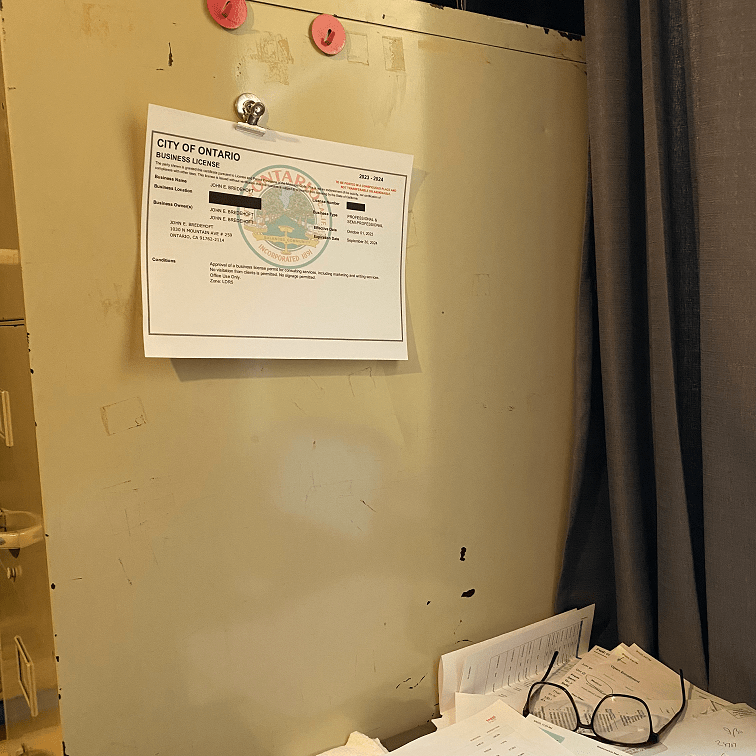
First: I must post the business license in a conspicuous place
Done.
City of Ontario business license, posted in a conspicuous place in an undisclosed location. And no, I don’t wear my glasses all the time.
Although as we will see when we get to the third restriction, the whole meaning of “conspicuous place” is irrelevant to Bredemarket’s business.
Second: I can’t conduct just ANY business
The business license is issued “for consulting services, including marketing and writing services.” The license does NOT allow me to bake pies, perform auto maintenance, launch rockets into space, or perform heart surgery.
You won’t see the Bredemarket 33410 Aortic Valve Surgery Service any time soon. The city won’t let me offer it. (33410, by the way, is the medical code for Under Surgical Procedures on the Aortic Valve.)
Dang guvmint.
Third: No visitation from clients
Remember how the city requires that I post my license in a conspicuous place? Well, the city also prohibits me from having clients visit me at my work location. This makes sense, since residential neighborhoods aren’t really built to have a bunch of cars park outside a house where business is conducted.
No, Bredemarket clients cannot park their cars in front of my house. And no, this is not my house. (And they’re not your cars either.) Fair use. The Verge, “Multimillion-dollar Ferraris, Jaguars, Astons, and a fine cup of tea.” The cast of cars and characters from the first Goodwood press day in 1993. Lord Charles March is by the front door of the house with his light blue AC 16/80 designed by his grandfather.
This means that when I do have a person-to-person meeting (rather than a videoconference) to conduct business, the meeting has to be offsite. For example, a couple of years ago I met with an advisor at Brandon’s Diner in Upland. (And the lunch was tax deductible!)
Fourth: No signage permitted
Again, because my work location is in a residential neighborhood, I can’t put a huge neon sign in my front yard with the Bredemarket logo.
Imagine this in my front yard.
And no, I can’t put a small neon sign in my front yard.
Or any neon sign.
I wonder if the city will let me put signage on my mailbox? Actually, the UPS Store probably won’t allow that either.
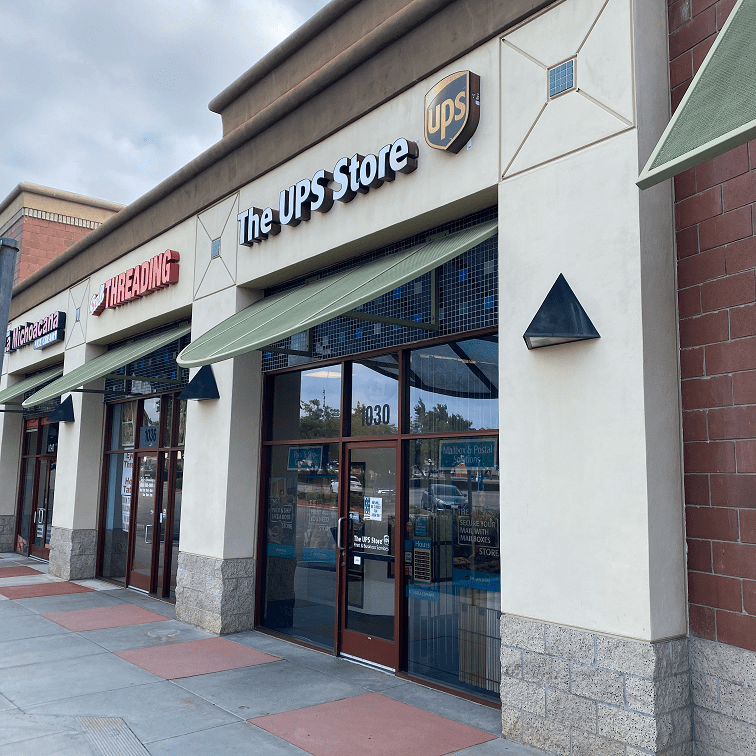
Bredemarket’s mailing address is 1030 N Mountain Ave #259, Ontario CA 91762-2114. If you read my previous post, you know that “MBE” stands for Mailboxes Etc.
So what?
The reason that these city restrictions don’t matter to you is because (since we still have the Internet) Bredemarket is perfectly capable of conducting its business online.
You don’t have to look for my business sign, or a parking place in front of the place where I conduct business. Why not? Because I can meet with you via Google Meet or another videoconferencing service, or we can talk on the phone, or even exchange emails with each other.
I’ve worked from home since March 2020—first for IDEMIA, then for Bredemarket, then for Incode Technologies, then for Bredemarket again. During that time I’ve been able to meet all of the needs of Bredemarket clients remotely, despite no public parking and no signage.
Well, almost all the needs. I haven’t been able to perform aortic valve surgery for my clients.
Dang guvmint.
The city does not endorse this call to action
Do you want to use the marketing and writing services of a government-licensed consulting firm?
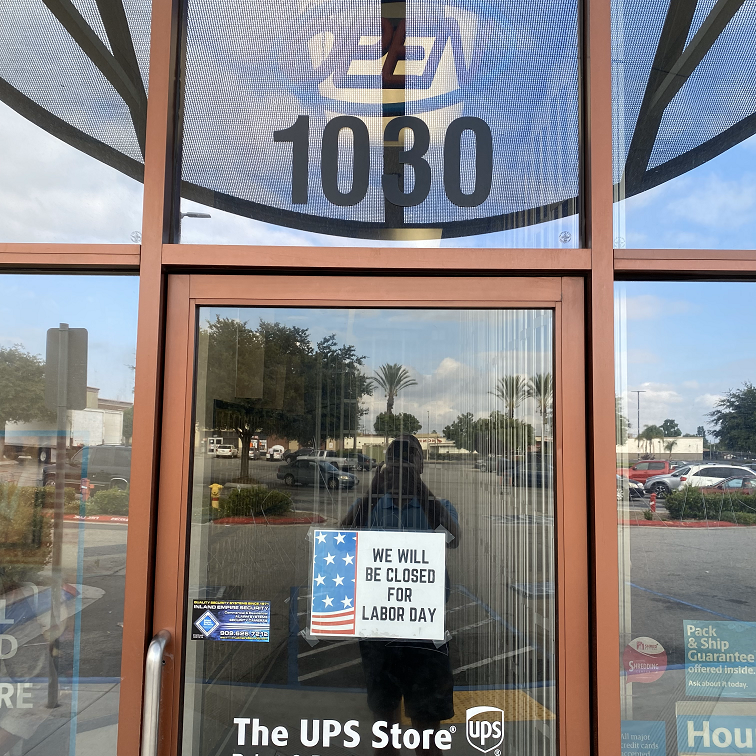
I wasn’t going to labor on this Labor Day, but I ended up renewing my City of Ontario business license. (This coming year will be the fourth that Bredemarket has conducted business in Ontario.)
The UPS Store, 1030 N Mountain Ave, Ontario CA 91762.They WERE closed for Labor Day (but boxholders have keys).Bredemarket’s mailing address is 1030 N Mountain Ave #259, Ontario CA 91762-2114.
Now most people don’t interact with Bredemarket via my physical mailing address. The few that do include the City of Ontario, and three of my clients who have chosen to pay me via paper checks. (I’m flexible.)
This got me curious.
What if?
What if the Internet were to disappear tomorrow? What if the only way my clients could interact with Bredemarket was through my Bredemarket physical mailing address? Could Bredemarket still conduct business?
Possibly.
Some of my business would disappear overnight. Blog posts, for example, are meaningless in a non-Internet world, unless companies choose to post long text-based communications on utility poles. Or in laundromats.
This used to be my laundromat. 454 N Mountain Ave, Ontario, CA 91762.
Even if the Internet were to disappear, I could still write text for case studies (maintaining my Inland Empire case study writing business) and white papers. I could send my client a Microsoft Word file (perhaps an old version of Word), and the firm could send the file to their printer. But how would I send the file? Put a CD in the mail?
If your Inland Empire company doesn’t have an online presence, one quick way to create one is to create a business page on Facebook.
This post outlines the benefits of establishing an online presence via a Facebook business page. It also provides four examples of Facebook business pages. Finally, the post addresses the thorny question of creating content for your Facebook business page.
Why Faceboook may be the best online presence for your business
For the first time in years, I attended an Ontario IDEA Exchange meeting at AmPac Business Capital on Tuesday afternoon. There was a mixture of attendees: some who had established several businesses, some like me who had run one business for some time, and a few who were just starting out in business.
The ones who were starting out were still trying to figure out all the things you need to do to start a business: figuring out why the business exists in the first place, getting the appropriate business licenses (and in some cases professional licenses), printing business cards (or creating the online equivalent), setting up SOME kind of way to track prospects and customers…and establishing an online presence.
Now some businesses choose to establish their online presence by creating a website.
But even the simplest website can involve a lot of complexity—bredemarket.com currently has 57 pages, not counting tag pages and individual blog post pages.
For many small businesses, it may be much easier to create a Facebook business page then to create an entire website.
Facebook business pages are free. (Well, unless you run ads.)
Facebook business pages are easy to create.
Facebook business pages potentially reach billions of people, including your prospects and customers.
Creating a Facebook business page
So how do you create a Facebook business page?
There’s no need for me to document all of that in detail, since many have already done so.
Don’t worry if you don’t have all the optional items, such as a page cover picture. You can add them later. This will get you going.
Other guides to creating Facebook business pages are available from Buffer (with pictures), Hootsuite (with pictures). Sprout Social (with pictures), and a number of other sources.
But before you create YOUR Facebook business page, let me show you four varied examples of EXISTING Facebook business pages.
Four examples of Facebook business pages
Let’s take a look at some pages that already exist. Perhaps one or more of these will give you ideas for your own page.
The artist page (Paso Artis)
Paso Artis is a European business whose proprietor is a painter who sells her paintings.
The menu options at the bottom of the picture above (some of which cannot be seen) illustrate some of the elements you can include in a Facebook page. Here are just a few of the page elements that Paso Artis uses:
Posts. This is the equivalent of a blog on a website, and allows you to post text, images, videos, and other types of content.
About. This is where you provide contact and other basic information about your business.
Shop. Facebook allows you to include a shop, which Paso Artis uses to sell her paintings.
Photos. As you can imagine for an artist’s page, photos of the artwork are essential.
The shirtmaker page (Shirts by Kaytie)
(UPDATE 10/20/2023: Because Shirts by Kaytie is sadly no longer in business, I have removed the, um, live links to her Facebook page.)
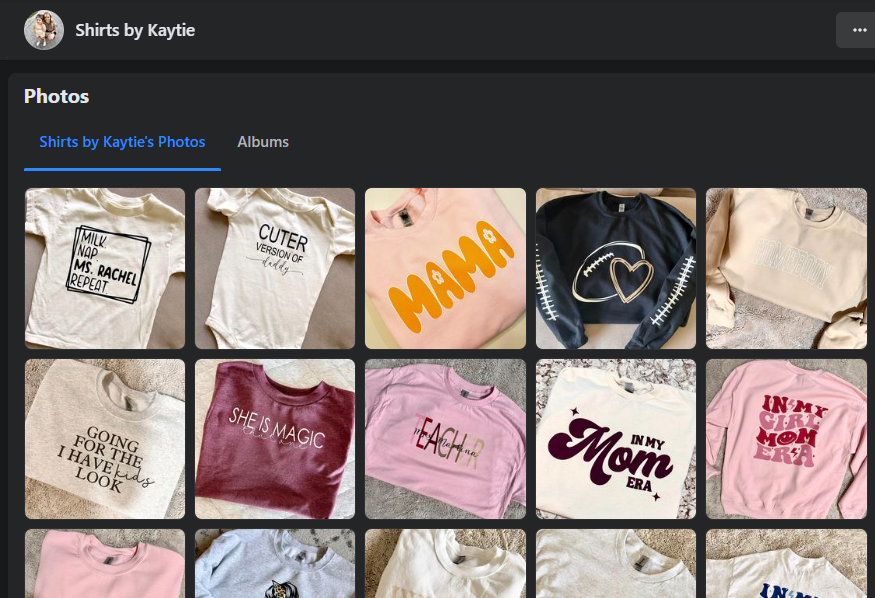
Let’s leave Europe and go to Illinois where we find another artist, but her work is not displayed on paintings, but on shirts. Here is the Shirts by Kaytie Facebook page.
You’ll notice that Shirts by Kaytie has a different menu item order (and different menu items) than Paso Artis. For example, Shirts by Kaytie doesn’t have a Facebook “shop” element; you need to contact her directly to purchase items.
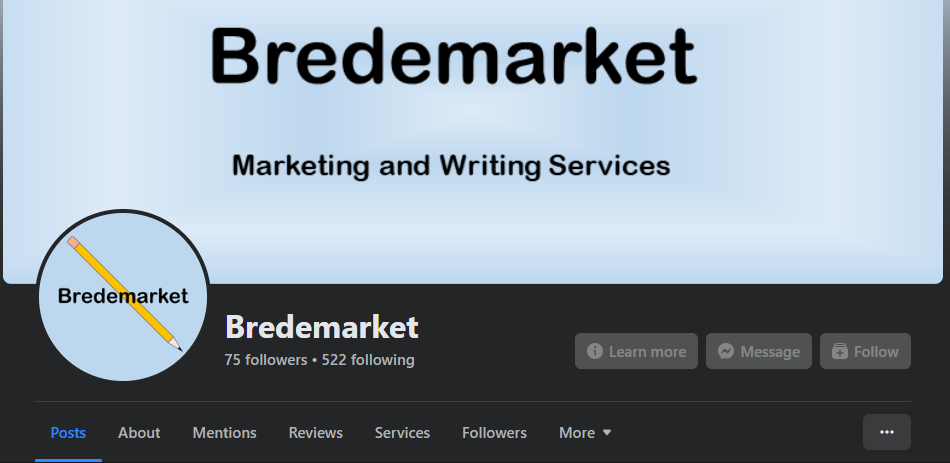
Enough of such exotic locations as Europe and Illinois. Let’s head to California’s Inland Empire and look at my favorite marketing/writing services Facebook page, the Bredemarket Facebook page.
First, Bredemarket (unlike Paso Artis and Shirts by Kaytie) provides services rather than tangible products. Therefore, I chose to include a “Services” element as part of my Facebook page.
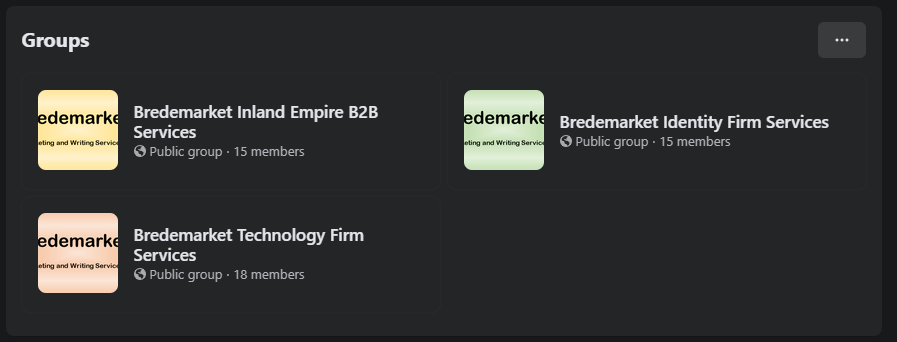
Second, Bredemarket has chosen to implement Facebook’s “groups” feature. In Bredemarket’s case, there are three separate groups that focus on various aspects of Bredemarket’s business. Inland Empire businesses can read the content in the Bredemarket Inland Empire B2B Services group and not get bogged down in out-of-area identity discussions about the change from FRVT to FRTE. (They’re missing out.)
By the way, if you are an Inland Empire business—especially an Inland Empire startup technology business—and you have never heard of Startempire Wire, STOP READING MY POST and go follow Startempire Wire’s Facebook pageNOW. Startempire Wire is THE news source for Inland Empire startup tech information, and is a strong champion of the IE tech community.
So what does Startempire Wire’s Facebook page offer? Posts, photos, weekly videos, and the “Inland Empire Startup Scene” group. All of the content is jam-packed with information.
Facebook pages are essential to these firms’ strategies
Now in some cases the Facebook pages are only part of the online presence for these firms. Both Bredemarket and Startempire Wire have their own web pages, and both firms are also active on other online properties such as LinkedIn. (Bredemarket is almost everywhere, but not on Snapchat.) But Facebook is an essential part of the outreach for all four of these firms, allowing them to reach prospects and clients who are only on Facebook and nowhere else.
Perhaps a Facebook page is a perfect solution for YOUR firm’s online presence.
Let’s talk about content
But creating a Facebook page is not enough.
You need to populate it with content, such as images, videos…and posts.
Now I’m not saying that you HAVE to update your Facebook page daily, but it’s a good idea to add new content at least once a month.
But what if you aren’t a writer, or don’t have time to write? Do you have to resort to ChatGPT?
Heavens no. (I’ll say more about that later.)
Well, online content creation is where Bredemarket comes in. I help firms create blog posts, Facebook posts, LinkedIn articles, case studies, white papers, and other content (22 different types of content at last count).
Does your product (or company) need these 22 content types?
Let me help you populate your Facebook page (or other online content).
Authorize Bredemarket, Ontario California’s content marketing expert, to help your firm produce words that return results.
Illogical marketing slogans like “coldest beer in town” are fascinating.
If you take a moment to think about it, every mini mart and liquor store in town has to chill beer to the exact same temperature before it freezes, so no store will have colder beer than any other store. (For the specifics, including the effect of ABV on alcohol freezing temperature, see Oxbow Tavern’s blog post.)
But liquor store marketers know that we DON’T take a moment to think about it. When it’s hot and we want beer, we want the “coldest beer in town.”
Well, while it was hot this morning, and while the HK Food Store was open (unlike the C & M Classy Mart a couple of miles northwest), I opted NOT to get the coldest beer in town. I wasn’t carrying a beer bottle opener, and I didn’t feel like breaking the law by walking down Grove Avenue with a beer bottle hidden in a paper bag.
Companies always strive to obtain some sort of recognition. I tried to do the same for Bredemarket, but my effort got derailed into a common local Inland Empire joke.
Aware’s biometric blog recognition
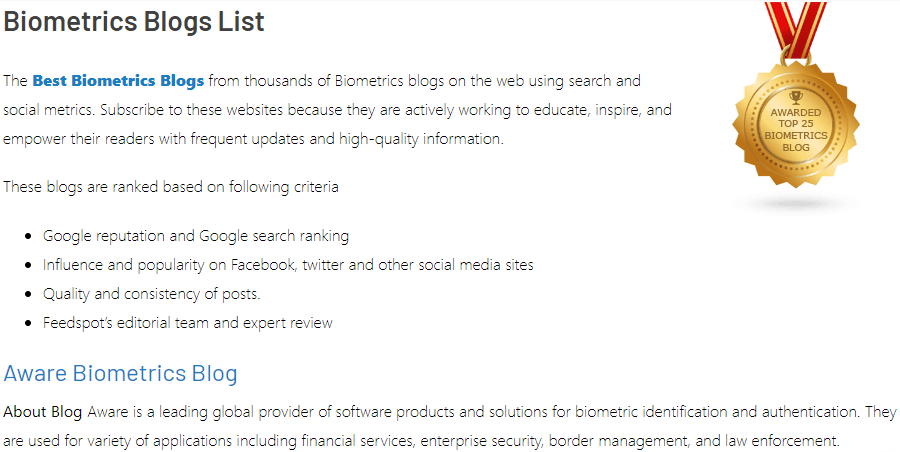
So what recognition did I want to receive? The same recognition that noted biometric company Aware received in 2020.
The Best Biometrics Blogs from thousands of Biometrics blogs on the web using search and social metrics. Subscribe to these websites because they are actively working to educate, inspire, and empower their readers with frequent updates and high-quality information.
Not that I necessarily consider myself equal to Aware or some of the other noted companies on the current list, but as the self-acknowledged identity/biometric blog expert, with hundreds of identity posts over the last three years, I figured I had a shot of making the list. The benefit to me, of course, is that if I made the list, I had a better chance of securing identity blog post writing clients and other clients.
So far I haven’t made the biometric blogs list.
But I did make another list.
Which is somewhat problematic.
Ontario blogs? True.
You see, earlier this morning I received an email that stated the following.
I would like to personally congratulate you as your blog Bredemarket Blog has been selected by our panelist as one of the Top 45 Ontario Bloggers on the web.
I personally give you a high-five and want to thank you for your contribution to this world. This is the most comprehensive list of Top 45 Ontario Bloggers on the internet and I’m honored to have you as part of this!
We’d be grateful if you can help us spread the word by briefly mentioning about the Top 45 Ontario Bloggers list in any of your upcoming post.
Yup. The people who created the feed think that I’m in CANADA.
But if you think my listing is messed up, take a look at the number 1 listing, for the official news site for the Government of Ontario. This IS a Canadian website, as evidenced by its URL of https://news.ontario.ca/newsroom/en, and the fact that it discusses people like Doug Ford. But take a real close look at the logo at the left of the listing.
And our websites down here don’t offer French as one of the two main languages.
If you live in Canada, don’t read this section
But at least the Bredemarket blog is listed SOMEWHERE, because I help a lot of U.S. companies (sorry, no Canadian companies) create the words they need to drive awareness and eventually revenue. Services such as the Bredemarket 400 Short Writing Service let Bredemarket collaborate with you to create the text your firm needs.
Whether a student is attending a preschool, a graduate school, or something in between, the educational institution needs to know who is accessing their services. This post discusses the types of identity verification and authentication that educational institutions may employ.
Why do educational institutions need to verify and authenticate identities?
Whether little Johnny is taking his blanket to preschool, or Johnny’s mother is taking her research notes to the local university, educational institutions such as schools, colleges, and universities need to know who the attendees are. It doesn’t matter whether the institution has a physical campus, like Chaffey High School’s campus in the video above, or if the institution has a virtual campus in which people attend via their computers, tablets, or phones.
Access boils down to two questions:
Who is allowed within the educational institution?
Who is blocked from the educational institution?
Who is allowed within the educational institution?
Regardless of the type of institution, there are certain people who are allowed within the physical and/or virtual campus.
Students.
Instructors, including teachers, teaching assistants/aides, and professors.
Administrators.
Staff.
Parents of minor students (but see below).
Others.
All of these people are entitled to access to at least portions of the campus, with different people having access to different portions of the campus. (Students usually can’t enter the teacher’s lounge, and hardly anybody has full access to the computer system where grades are kept.)
Before anyone is granted campus privileges, they have to complete identity verification. This may be really rigorous, but in some cases it can’t be THAT rigorous (how many preschoolers have a government ID?). Often, it’s not rigorous at all (“Can you show me a water bill? Is this your kid? OK then.”).
Once an authorized individual’s identity is verified, they need to be authenticated when they try to enter the campus. This is a relatively new phenomenon, in response to security threats at schools. Again, this could be really rigorous. For example, when students at a University of Rhode Island dining hall want to purchase food from the cafeteria, many of then consent to have their fingerprints scanned.
But some authentiation is much less rigorous. In these cases, people merely show an ID (hopefully not a fake ID) to authenticate themselves, or a security guard says “I know Johnny.”
(Again, all this is new. Many years ago, I accompanied a former college classmate to a class at his new college, the College of Marin. If I had kept my mouth shut, the professor wouldn’t have known that an unauthenticated student was in his class.)
Who is blocked from the educational institution?
At the same time, there are people who are clearly NOT allowed within the physical and/or virtual campus. Some of these people can enter campus with special permission, while some are completely blocked.
Former students. Once a student graduates, their privileges are usually revoked, and they need special permission if they want to re-enter campus to visit teachers or friends. (Admittedly this isn’t rigorously enforced.)
Expelled students. Well, some former students have a harder time returning to campus. If you brought a gun on campus, it’s going to be much harder for you to re-enter.
Former instructors, administrators, and staff. Again, people who leave the employ of the institution may not be allowed back, and certain ones definitely won’t be allowed back.
Non-custodial parents of minor students. In some cases, a court order prohibits a natural parent from contact with their child. So the educational institutions are responsible for enforcing this court order and ensuring that the minor student leaves campus only with someone who is authorized to take the child.
Others.
So how do you keep these people off campus? There are two ways.
If they’re not on the allowlist, they can’t enter campus anyway. As part of the identity verification process for authorized individuals, there is a list of people who can enter the campus. By definition, the 8 billion-plus people who are not on that “allowlist” can’t get on campus without special permission.
Sometimes they can be put on a blocklist. Or maybe you want to KNOW that certain people can’t enter campus. The inverse of an allowlist, people who are granted access, is a blocklist, people who are prevented from getting access. (You may know “blocklist” by the older term “blacklist,” and “allowlist” by the older term “whitelist.” The Security Industry Association and the National Institute of Standards and Technology recommend updated terminology.)
There’s just one teeny tiny problem with blocklists. Sometimes they’re prohibited by law.
In some cases (but not in others), a person is required to give consent before they are enrolled in a biometric system. If you’re the ex-student who was expelled for brining a gun on campus, how motivated will you be to allow that educational institution to capture your biometrics to keep you off campus?
And yes, I realize that the expelled student’s biometrics were captured while they were a student, but once they were no longer a student, the institution would have on need to retain those biometrics. Unless they felt like it.
This situation becomes especially sticky for campuses that use video surveillance systems. Like Chaffey High School.
Chaffey High School, Ontario, California.
Now the mere installation of a video surveillance system does not (usually) result in legally prohibited behavior. It just depends upon what is done with the video.
If the video is not integrated with a biometric facial recognition system, there may not be an issue.
If Chaffey High School has its own biometric facial recognition system, then a whole host of legal factors may come into play.
If Chaffey High School does not have a biometric facial recognition system, but it gives the video to a police agency or private entity that does have a biometric facial recognition system, then some legal factors may emerge.
As you can see, educational identity is not as clear-cut as financial identity, both because financial institutions are more highly regulated and because blocklists are more controversial in educational identity. Vladimir Putin may not be able to open a financial account at a U.S. bank, but I bet he’d be allowed to enroll in an online course at a U.S. community college.
So if you are an educational institution or an identity firm who serves educational institutions, people who write for you need to know all of these nuances.
You need to provide the right information to your customers, and write it in a way that will motivate your customers to take the action you want them to take.
Speaking of motivating customers, are you with an identity firm or educational institution and need someone to write your marketing text?
Someone with 29 years of identity/biometric marketing experience?
Someone who understands that technological, organizational, and legal issues surrounding the use of identity solutions?
Someone who will explain why your customers should care about these issues, and the benefits a compliant solution provides to them?
If I can help you create your educational identity content, we need to talk.
Bank of America, Euclid Avenue, Ontario, California.
Here’s a sign of the times from Ontario, California. The sign at the end of this video appears on the door of a bank branch in downtown Ontario, and basically says that if you wanted to go to THIS branch on Saturday, you’re out of luck.
Of course, that assumes that you actually WANT to go to a physical bank branch location. Unlike the old days, when banks were substantive buildings that you visited to deposit and withdraw money, now banks can be found in our smartphones.
What locational, technological, and organizational changes have taken place at banks over the last 50 years? And now that you can open an account to buy crypto on your smartphone, does your financial institution’s onboarding solution actually WORK in determining financial identity?
Three changes in banking over the last fifty years
Over the last fifty years, banking has changed to the point where someone from 1973 wouldn’t even recognize “banking” today. Stick around to see a video from a company called “Apple” showing you how to use a “wallet” on a “smartphone” to pay for things even if you’re not carrying your “chip card.” Karl Malden would be spinning in his grave. So let’s talk about the three changes:
The locational change.
The technological change.
The organizational change.
The locational change: from stand-alone buildings to partitioned grocery store sections
When I was growing up, a “bank” (or a “savings & loan,” which we will discuss later) was located in a building where you would go on weekdays (or even Saturdays!) and give money to, or get money from, a person referred to as a teller.
There was this whole idea of “going to the bank,” perhaps on your lunch hour because you couldn’t go to the bank on Sunday at midnight, could you?
The first crack in the whole idea of “going to the bank” was the ability to bank without entering the door of the bank…and being able to bank on Sunday at midnight if you felt like it. Yes, I’m talking about Automated Teller Machines (ATMs), where the “teller,” instead of being a person, was a bunch of metal and a TV screen. The first ATM appeared in 1967, but they didn’t really become popular until several years later.
For the most part, these ATMs were located at the bank buildings themselves. But those buildings were costly, and as competition between banks increased, banks sought alternatives. By 1996, a new type of banking location emerged (PDF):
The largest U.S. commercial banks are restructuring their retail operations to reduce the cost disadvantage resulting from a stagnant deposit base and stiffer competition. As part of this effort, some banks are opening “supermarket,” or “in-store,” branches: a new type of banking office within a large retail outlet. An alternative to the traditional bank office, the supermarket branch enables banks to improve the efficiency of the branch network and offer greater convenience to customers.
To traditionalists, these bank branches looked pretty flimsy. Where are the brick and (fake) marble walls that protect my cash? Heck, anyone can walk into the store and just steal all my money, right?
Well, these newfangled bank branches apparently WERE able to protect our cash, and the idea of banking right in the grocery store proved to be very popular because of its convenience.
But the changes were just beginning.
The technological change: from store sections to smartphones
As banks changed where they were located, there were technological changes also.
During the 1990s, more and more people were using home computers. As the computers and their security became more and more sophisticated, some people asked why we needed to “go to the bank” (either a stand-alone building or a partitioned area next to the cigarettes) at all. Why not just bank at the computer? So PC banking emerged.
The term “PC banking” refers to the online access of banking information from a personal computer. A solution for both personal or business banking needs, this type of financial management allows you to conduct transactions using an Internet connection and your computer in lieu of a trip to the local bank branch or the use of an ATM. PC banking enables an account holder to perform real-time account activities and effectively manage finances in a way that avoids the hassle of daytime bank visits and eliminates the postage required to pay bills by mail.
Ah yes; there was another benefit. You could use the computer to pay your bills electronically. The U.S. Postal Service was NOT a fan of this change.
As we crossed into the new millennium, the online banking ideas got even wilder. Cellular telephones, which followed a modified version of the “Princess phone” form factor, became more complex devices with their own teeny-tiny screens, just like their larger computer cousins. Eventually, banks began offering their services on these “smartphones,” so that you didn’t even need a computer to perform your banking activities.
Imagine putting the video below on 8mm film and traveling back in time to show it to a 1973 banking customer. They would have no idea what was going on in the film.
But are PC and smartphone banking secure? After all, smartphones don’t have brick or (fake) marble walls. We’ll get to that question.
The organizational change: from banks to…who knows what?
The third change was not locational or technological, but a change in terms of business organization. Actually, many changes.
Back in 1973, the two major types of banks were banks, and something called “savings & loans.” Banks had been around for centuries, but savings & loans were a little newer, having started in 1831. They were regulated a little differently: banks were insured by the FDIC, S&Ls by the FSLIC.
Everything was all hunky dory until the 1980s, when the S&Ls started collapsing. This had monumental effects; for example, this PDF documenting the S&L crisis is hosted on the FDIC website, because the FSLIC was abolished many years ago.
After savings & loans became less popular, other “banks” emerged.
Members-only associations called credit unions had started in 1864, and in the United States they had their own government-sponsored insurance, separate from the FDIC and FSLIC.
But there was one similarity between banks, savings & loans, credit unions, and payday loans. They all dealt in U.S. dollars (or the currency of the nation where they were located).
Enter the crypto providers, who traded cryptocurrencies that weren’t backed by any government. Since they were very new entrants, they didn’t have to make the locational and technological changes that banks and related entities had to make; they zoomed straight to the newest methods. Everything was performed on your smartphone (or computer), and you never went to a physical place.
Now, let’s open a financial account
Back in 1973, the act of opening an account required you to travel to a bank branch, fill out some forms, and give the teller some form of U.S. dollars.
You can still do that today, for the most part. But it was hard to do that in the summer and fall of 2020 when Bredemarket started.
Bredemarket pretty much started because of the COVID-19 pandemic, and those first few months of Bredemarket’s existence were adversely affected by COVID-19. When I wanted to start a bank account for Bredemarket, I COULDN’T travel to my nearby bank branch to open an account. I HAD to open my account with my computer.
So, without a teller (human or otherwise) even meeting me, I had to prove that I was a real person, and give my bank enough information during onboarding so that they knew I wasn’t a money-laundering terrorist. Banks had to follow government regulations (know your customer, anti-money laundering, know your business), even in the midst of a worldwide pandemic.
This onboarding process had to be supported whether you were or were not at a physical location of a financial institution.
Whether you were conducting business in person, on a computer, or on a smartphone.
Whether you were working with U.S. dollars or (as crypto regulations tightened) something named after a dog or an entire planet or whatever.
How can you support all that?
Liminal’s “Link™ Index for Account Opening in Financial Services”
Back in 2020 when I was onboarding the new-fashioned way, I had no way of predicting that in less than two years, I would be working for a company that helped financial institutions onboard customers the new-fashioned way.
At the time, I estimated that there were over 80 companies that provided such services.
According to Liminal, my estimate was too low. Or maybe it was too high.
Liminal’s July 2023 report, “Link™ Index for Account Opening in Financial Services,” covers companies that provide onboarding services that allow financial institutions to use their smartphone apps (or web pages) to sign up new clients.
Account opening solutions for the financial services industry are critical to ensuring compliance and preventing fraud, enabling companies to effectively identify new users during customer registration and deliver a seamless onboarding experience. The primary purpose of these solutions is to facilitate mandatory compliance checks, with a particular emphasis on the Know Your Customer (KYC) process.
If I can summarize KYC in layperson terms, it basically means that the person opening a financial institution account is who they say they are. For example, it ensures that Vladimir Putin can’t open a U.S. bank acccount under the name “Alan Smithee” to evade U.S. bans on Russian national transctions.
Remember how I found over 80 identify proofing vendors? Liminal found a few more who claimed to offer identity proofing, but thinks that less than 80 firms can actually deliver.
Around 150 vendors claim to offer account opening compliance and fraud solutions in banking, but only 32 (21.3%) have the necessary product features to meet buyer demands.
Now I have not purchased the entire Liminal report, and even the Executive Summary (which I do have) is “privileged and confidential” so I can’t reprint it here. But I guess that I can say that Liminal used something called the “Link Score” to determine which vendors made the top category, and which didn’t.
I’m not sure how the vendors who DIDN’T make the top category are reacting to their exclusion, but I can bet that they’re not happy.
Writing about Financial Identity
As you can gather, there are a number of issues that you have to address if you want to employ identity proofing at a financial institution.
And if you’re an identity firm or financial institution, you need to provide the right information to your customers, and write it in a way that will motivate your customers to take the action you want them to take.
Speaking of motivating customers, are you with an identity firm or financial institution and need someone to write your marketing text?
Someone with 29 years of identity/biometric marketing experience?
Someone who consistently tosses around acronyms like ABM, FRVT, KYB, KYC, and PAD, but who would never dump undefined acronyms on your readers? (If you’re not a financial/identity professional and don’t know these acronyms, they stand for anti-money laundering, Face Recognition Vendor Test, Know Your Business, Know Your Customer, and Presentation Attack Detection.)
Someone who will explain why your customers should care about these acronyms, and the benefits a compliant solution provides to them?
If I can help you create your financial identity content, we need to talk.



















 Bredemarket