Companies always strive to obtain some sort of recognition. I tried to do the same for Bredemarket, but my effort got derailed into a common local Inland Empire joke.
Aware’s biometric blog recognition
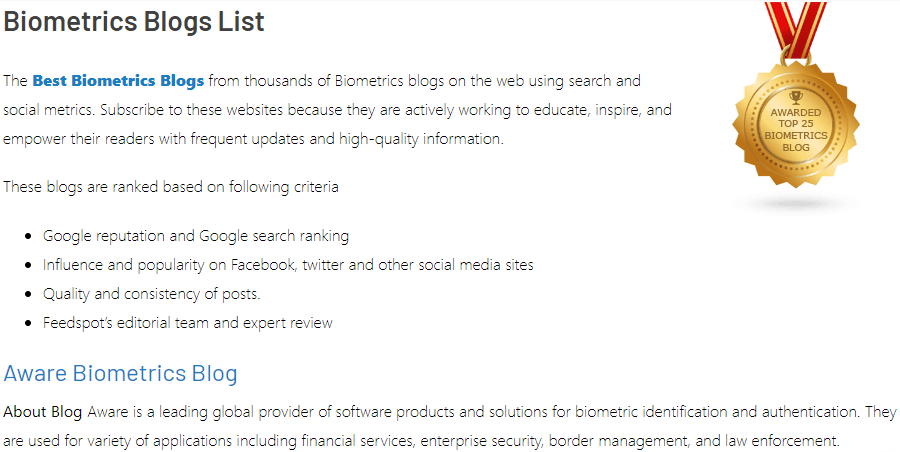
So what recognition did I want to receive? The same recognition that noted biometric company Aware received in 2020.
The Best Biometrics Blogs from thousands of Biometrics blogs on the web using search and social metrics. Subscribe to these websites because they are actively working to educate, inspire, and empower their readers with frequent updates and high-quality information.
Not that I necessarily consider myself equal to Aware or some of the other noted companies on the current list, but as the self-acknowledged identity/biometric blog expert, with hundreds of identity posts over the last three years, I figured I had a shot of making the list. The benefit to me, of course, is that if I made the list, I had a better chance of securing identity blog post writing clients and other clients.
So far I haven’t made the biometric blogs list.
But I did make another list.
Which is somewhat problematic.
Ontario blogs? True.
You see, earlier this morning I received an email that stated the following.
I would like to personally congratulate you as your blog Bredemarket Blog has been selected by our panelist as one of the Top 45 Ontario Bloggers on the web.
I personally give you a high-five and want to thank you for your contribution to this world. This is the most comprehensive list of Top 45 Ontario Bloggers on the internet and I’m honored to have you as part of this!
We’d be grateful if you can help us spread the word by briefly mentioning about the Top 45 Ontario Bloggers list in any of your upcoming post.
Yup. The people who created the feed think that I’m in CANADA.
But if you think my listing is messed up, take a look at the number 1 listing, for the official news site for the Government of Ontario. This IS a Canadian website, as evidenced by its URL of https://news.ontario.ca/newsroom/en, and the fact that it discusses people like Doug Ford. But take a real close look at the logo at the left of the listing.
And our websites down here don’t offer French as one of the two main languages.
If you live in Canada, don’t read this section
But at least the Bredemarket blog is listed SOMEWHERE, because I help a lot of U.S. companies (sorry, no Canadian companies) create the words they need to drive awareness and eventually revenue. Services such as the Bredemarket 400 Short Writing Service let Bredemarket collaborate with you to create the text your firm needs.
Gambling is becoming acceptable in more and more places.
When I was young, and even when I got older, the idea of locating a pro sports team in Las Vegas, Nevada was unthinkable. In the last few years, that has changed dramatically.
The Roblox “Robux” gambing lawsuit
Well, now that gambling for adults has become more and more acceptable (although adults in my home state of California still can’t gamble by phone), now attention is focusing on child gambling.
In a new class action lawsuit filed in the Northern District of California this week, two parents accuse Roblox of illegally facilitating child gambling.
While gambling is not allowed on the platform, which hosts millions of virtual games that cater to children and teens, the lawsuit points to third-party gambling sites that invite users to play blackjack, slots, roulette and other games of chance using Roblox’s in-game currency.
But the gambling sites’ terms of service prohibit underage gambling!
I’m not going to concentrate on Roblox here, but on the other defendants—the ones who actually operate the sites that allegedly allow child gambling.
The lawsuit specifically names RBXFlip, Bloxflip and RBLXWild as participants in “an illegal gambling operation that is preying on children nationwide.”
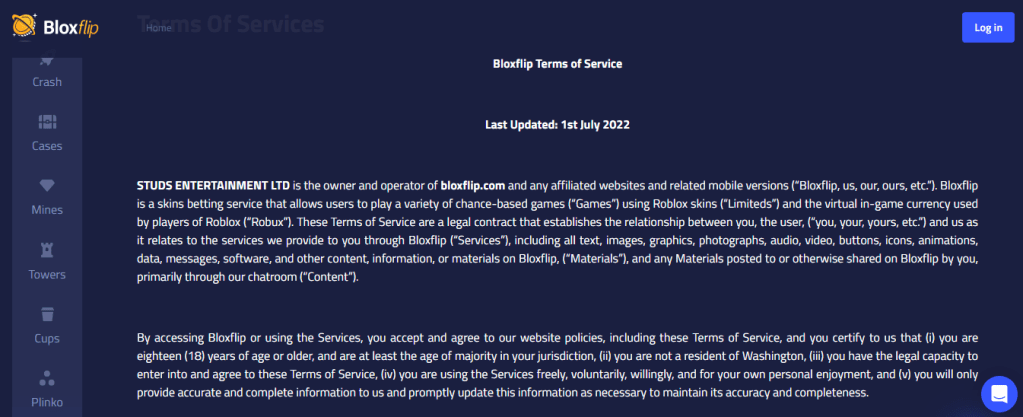
But according to Bloxflip’s Terms of Service, it’s impossible that children can be using the site, because the Terms of Service prohibit this.
By accessing Bloxflip or using the Services, you accept and agree to our website policies, including these Terms of Service, and you certify to us that (i) you are eighteen (18) years of age or older, and are at least the age of majority in your jurisdiction, (ii) you are not a resident of Washington, (iii) you have the legal capacity to enter into and agree to these Terms of Service, (iv) you are using the Services freely, voluntarily, willingly, and for your own personal enjoyment, and (v) you will only provide accurate and complete information to us and promptly update this information as necessary to maintain its accuracy and completeness.
However, stating a minimum age in your TOS is even less effective than other common age verification methods, such as
Asking your customer to check a box to say that they are over 18 years old.
Asking your customer to type in their birthday.
Requiring your customer to read a detailed description of IRA/401(k) funding strategies and the medical need for colonoscopies. (This would be more effective than the first two methods.)
A better way to verify and estimate ages
As more and more companies are realizing, however, there are other ways to measure customer ages, including a comparison of a live face with a government-issued identification card (driver’s license or passport), or the use of “age estimation” software to ensure that a 12 year old isn’t gambling. (And don’t forget that NIST will test age estimation software as part of its FATE testing.)
Even when the kids aren’t gambling legal currency.
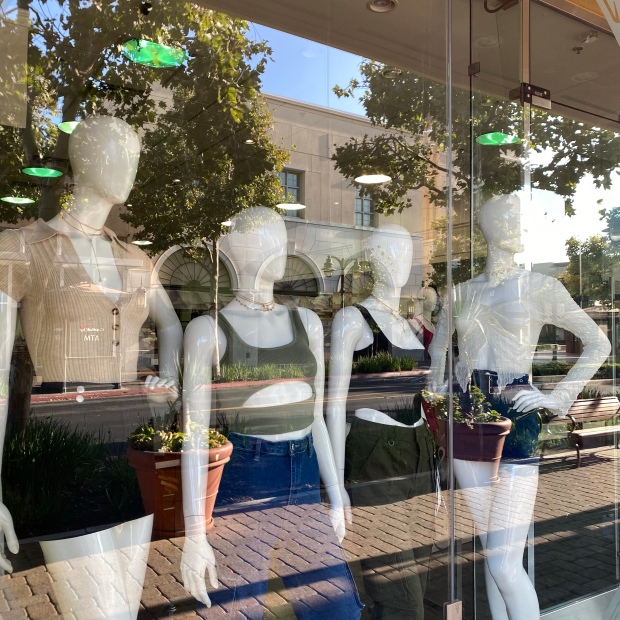
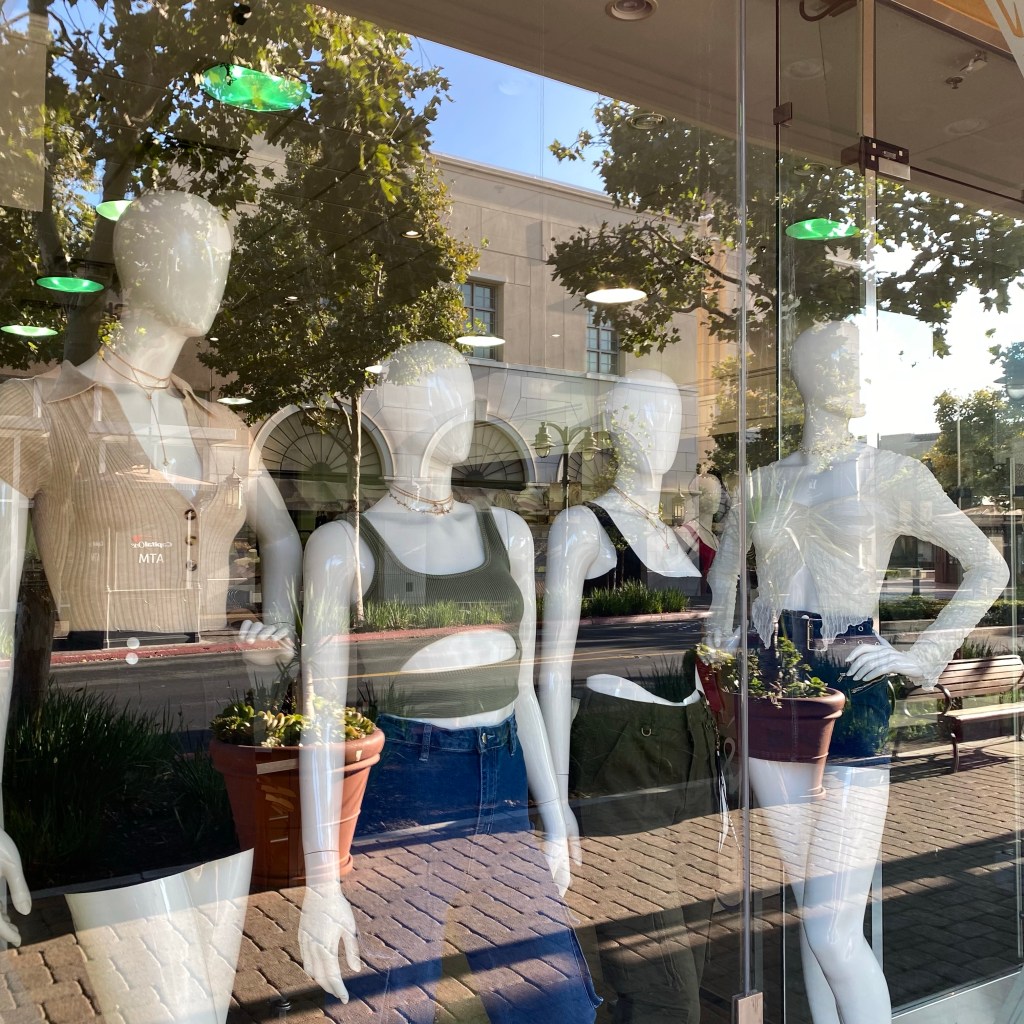
Victoria Gardens, Rancho Cucamonga, California, August 12, 2023.
Can someone pretend to be you if they have no idea who you are?
It’s been a couple of weeks since I last addressed Worldcoin’s activities, but a lot has happened in Kenya, and now in Argentina also. Here’s a succinct (I hope) update that looks beyond the blaring headlines to see what is REALLY happening.
And, at the end of this post, I address what COULD happen if a fraudster “cut off someone’s face, including gouging out their eyes, and then you draped it all over your own face.” Hey, you have to consider ALL the use cases.
According to the AAIP, an entity like Worldcoin must register with the AAIP, provide information about its data processing policy, and indicate the purpose for collecting sensitive data and the retention period for such data. Additionally, the agency requires details of the security and confidentiality measures applied to safeguard personal information. The AAIP did not confirm whether Worldcoin complies with the standards.
Worldcoin told CoinDesk in an emailed statement that “the project complies with all laws and regulations governing the processing of personal data in the markets where Worldcoin is available, including but not limited to Argentina’s Personal Data Protection Act 25.326.”
But what is this “personal data” that concerns Argentina so much?
The data that Worldcoin collects
Now a number of companies need to comply with local privacy regulations in numerous countries, and Worldcoin obviously must obey the law in the countries where it conducts business, including laws about personally identifiable information (PII). For illustration, here is an incomplete list of examples of PII, compiled by the University of Pittsburgh:
Name: full name, maiden name, mother’s maiden name, or alias
Personal identification numbers: social security number (SSN), passport number, driver’s license number, taxpayer identification number, patient identification number, financial account number, or credit card number
Personal address information: street address, or email address
Personal telephone numbers
Personal characteristics: photographic images (particularly of face or other identifying characteristics), fingerprints, or handwriting
Biometric data: retina scans, voice signatures, or facial geometry
Information identifying personally owned property: VIN number or title number
Asset information: Internet Protocol (IP) or Media Access Control (MAC) addresses that consistently link to a particular person
To my knowledge, Worldcoin acquires PII in two separate instances: when downloading the World App, and when registering at an Orb.
Data collected by the World App
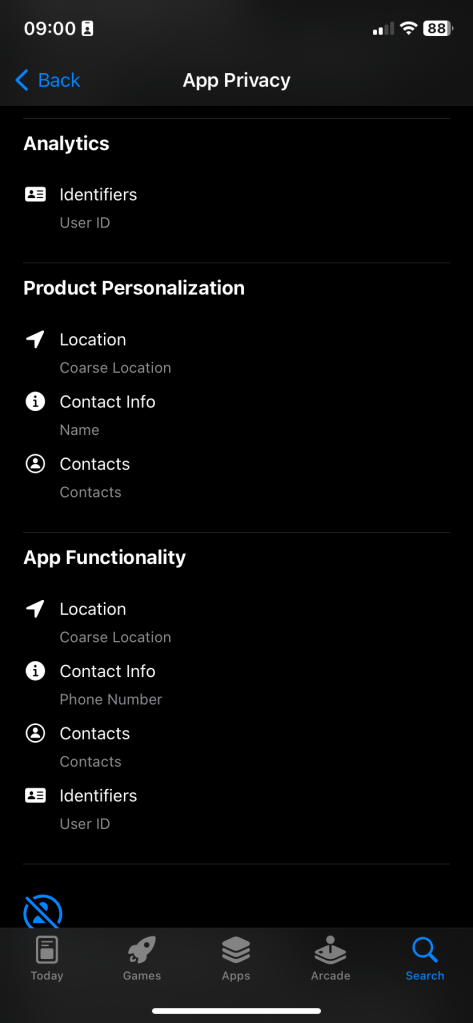
First, Worldcoin collects data when you download the World App. The data that is collected by the iOS version of the World App includes a user ID, the user’s coarse location, a name, contacts, and a phone number. I’ll admit that the collection of contacts is a little odd, but let’s see what happens to that data later in the process.
Your biometric data is first processed locally on the Orb and then permanently deleted. The only data that remains is your iris code. This iris code is a set of numbers generated by the Orb and is not linked to your wallet or any of your personal information. As a result, it really tells us — and everyone else — nothing about you. All it does is stop you from being able to sign up again.
But what about the second use case, in which the user consents to have Worldcoin retain information (so that the user does not have to re-enroll if they get a new phone)?
Your biometric data is first processed locally on the Orb and then sent, via encrypted communication channels, to our distributed secure data stores, where it is encrypted at rest. Once it arrives, your biometric data is permanently deleted from the Orb.
Regardless of whether biometric data is retained or not, other PII isn’t even collected at the Orb:
Since you are not required to provide personal information like your name, email address, physical address or phone number, this means that you can easily sign up without us ever knowing anything about you.
“But John,” you’re saying, “names and phone numbers are not collected at the Orb, but names and phone numbers ARE collected by the World App. So how are the name, phone number, user ID, and ‘iris code’ linked together?” Let me reprint what Worldcoin says about the app:
Your Worldcoin App is your self-custodial wallet. That means, just like a physical wallet, that no banks, governments or corporations can do anything to it — like lose or freeze your money — you’re in complete control.
You also don’t need to enter any personal information to get or use the App. But even if you do, you can rest assured that, unlike others, we will never sell or try to profit from your personal information.
So apparently, while the World App asks for your name, it is not a mandatory field. I just confirmed this on my World App (which I enabled on May 16, without orb verification); the only identifying information that I could find was my phone number and my user ID.
And I’m assuming that if I were to enroll at an Orb, the iris code would be linked to my user ID.
Depending upon Worldcoin’s internal architecture:
It’s possible that the iris code could be linked to my phone number, either intentionally or unintentionally. But even if it is, an iris code in and of itself is useless outside of the Worldcoin ecosystem. In the same way that an Aware, IDEMIA, NEC, or Thales fingerprint template (not the fingerprint image) can’t be used to generate a full fingerprint image, a Worldcoin iris code can’t be used to generate a full iris image.
If I choose the “with data custody” option, my biometric images could be linked to my phone number. Again, they could be linked either intentionally or unintentionally. If such a linkage exists, then that IS a problem. If a user chooses to back up both their World App data and their Orb biometric image data with Worldcoin (and again, the user must CHOOSE to back up both sets of data), how does Worldcoin ensure that the two sets of data can’t be linked?
Presumably Argentina’s AAIP will investigate Worldcoin’s architecture to ensure that there are no financial identity threats.
Which leads us to Kenya.
Kenya and data protection laws
When we last visited Kenya and Worldcoin on August 2, the government had announced that “(r)elevant security, financial services and data protection agencies have commenced inquiries and investigations to establish the authenticity and legality of the aforesaid activities, the safety and protection of the data being harvested, and how the harvesters intend to use the data.”
Those investigations continue, Worldcoin’s Kenya offices have been raided, and Parliament is angry at the regulatory authorities…for not doing enough. The article that reports this states that the Data Protection Unit feels it is not responsible for investigating the “core business” of the registered companies, but Parliament feels otherwise.
The article also makes another interesting statement:
…the office failed to conduct background checks on the company, whose operations have been banned in both the United States of America (USA) and Germany.
Now what I CAN’T do is obtain some Worldcoin when I register my irises.
In addition, Worldcoin tokens (“WLD”) are not intended to be available for use, purchase, or access by US persons, including US citizens, residents, or persons in the United States, or companies incorporated, located, or resident in the United States, or who have a registered agent in the United States. We do not make WLD available to such US persons. Furthermore, you agree that you will not sell, transfer or make available WLD to US persons.
I continued on a darker vein: What if a criminal mastermind decided to cut out someone’s eyes, and use them to steal their identity?
The Orb engineer told me that it wouldn’t work. This Orb needs to see alive, blinking eyes, and a human face that is real attached to them. A picture of someone’s eyes won’t scan, robot eyes won’t scan, canine eyes won’t scan.
But then I got him.
If you cut off someone’s face, including gouging out their eyes, and then you draped it all over your own face, could you register as them with a Worldcoin scanner and steal their identity?
Yes.
Although he promised that the Worldcoin R&D team has not tested this particular edge case.
Does your firm fight crooks who try to fraudulently use synthetic identities? If so, how do you communicate your solution?
This post explains what synthetic identities are (with examples), tells four ways to detect synthetic identities, and closes by providing an answer to the communication question.
While this post is primarily intended for identity firms who can use Bredemarket’s marketing and writing services, anyone else who is interested in synthetic identities can read along.
What are synthetic identities?
To explain what synthetic identities are, let me start by telling you about Jason Brown.
Jason Brown wasn’t Jason Brown
You may not have heard of him unless you lived in Atlanta, Georgia in 2019 and lived near the apartment he rented.
Jason Brown’s renting of an apartment isn’t all that unusual.
If you were to visit Brown’s apartment in February 2019, you would find credit cards and financial information for Adam M. Lopez and Carlos Rivera.
Now that’s a little unusual, especially since Lopez and Rivera never existed.
For that matter, Jason Brown never existed either.
A Georgia man was sentenced Sept. 1 (2022) to more than seven years in federal prison for participating in a nationwide fraud ring that used stolen social security numbers, including those belonging to children, to create synthetic identities used to open lines of credit, create shell companies, and steal nearly $2 million from financial institutions….
Cato joined conspiracies to defraud banks and illegally possess credit cards. Cato and his co-conspirators created “synthetic identities” by combining false personal information such as fake names and dates of birth with the information of real people, such as their social security numbers. Cato and others then used the synthetic identities and fake ID documents to open bank and credit card accounts at financial institutions. Cato and his co-conspirators used the unlawfully obtained credit cards to fund their lifestyles.
Talking about synthetic identity at Victoria Gardens
Here’s a video that I created on Saturday that describes, at a very high level, how synthetic identities can be used fraudulently. People who live near Rancho Cucamonga, California will recognize the Victoria Gardens shopping center, proof that synthetic identity theft can occur far away from Georgia.
Note that synthetic identity theft different from stealing someone else’s existing identity. In this case, a new identity is created.
So how do you catch these fraudsters?
Catching the identity synthesizers
If you’re renting out an apartment, and Jason Brown shows you his driver’s license and provides his Social Security Number, how can you detect if Brown is a crook? There are four methods to verify that Jason Brown exists, and that he’s the person renting your apartment.
Method One: Private Databases
One way to check Jason Brown’s story is to perform credit checks and other data investigations using financial databases.
Did Jason Brown just spring into existence within the past year, with no earlier credit record? That seems suspicious.
Does Jason Brown’s credit record appear TOO clean? That seems suspicious.
Does Jason Brown share information such as a common social security number with other people? Are any of those other identities also fraudulent? That is DEFINITELY suspicious.
This is one way that many firms detect synthetic identities, and for some firms it is the ONLY way they detect synthetic identities. And these firms have to tell their story to their prospects.
If your firm offers a tool to verify identities via private databases, how do you let your prospects know the benefits of your tool, and why your solution is better than all other solutions?
Method Two: Check That Driver’s License (or other government document)
What about that driver’s license that Brown presented? There are a wide variety of software tools that can check the authenticity of driver’s licenses, passports, and other government-issued documents. Some of these tools existed back in 2019 when “Brown” was renting his apartment, and a number of them exist today.
Maybe your firm has created such a tool, or uses a tool from a third party.
If your firm offers this capability, how can your prospects learn about its benefits, and why your solution excels?
Method Three: Check Government Databases
Checking the authenticity of a government-issued document may not be enough, since the document itself may be legitimate, but the implied credentials may no longer be legitimate. For example, if my California driver’s license expires in 2025, but I move to Minnesota in 2023 and get a new license, my California driver’s license is no longer valid, even though I have it in my possession.
Why not check the database of the Department of Motor Vehicles (or the equivalent in your state) to see if there is still an active driver’s license for that person?
The American Association of Motor Vehicle Administrators (AAMVA) maintains a Driver’s License Data Verification (DLDV) Service in which participating jurisdictions allow other entities to verify the license data for individuals. Your firm may be able to access the DLDV data for selected jurisdictions, providing an extra identity verification tool.
If your firm offers this capability, how can your prospects learn where it is available, what its benefits are, and why it is an important part of your solution?
Method Four: Conduct the “Who You Are” Test
There is one more way to confirm that a person is real, and that is to check the person. Literally.
If someone on a smartphone or videoconference says that they are Jason Brown, how do you know that it’s the real Jason Brown and not Jim Smith, or a previous recording or simulation of Jason Brown?
This is where tools such as facial recognition and liveness detection come to play.
You can ensure that the live face matches any face on record.
You can also confirm that the face is truly a live face.
In addition to these two tests, you can compare the face against the face on the presented driver’s license or passport to offer additional confirmation of true identity.
Now some companies offer facial recognition, others offer liveness detection, others match the live face to a face on a government ID, and many companies offer two or three of these capabilities.
One more time: if your firm offers these capabilities—either your own or someone else’s—what are the benefits of your algorithms? (For example, are they more accurate than competing algorithms? And under what conditions?) And why is your solution better than the others?
This is for the firms who fight synthetic identities
While most of this post is of general interest to anyone dealing with synthetic identities, this part of this post is specifically addressed to identity and biometric firms who provide synthetic identity-fighting solutions.
When you communicate about your solutions, your communicator needs to have certain types of experience.
Industry experience. Perhaps you sell your identity solution to financial institutions, or educational institutions , or a host of other industries (gambling/gaming, healthcare, hospitality, retailers, or sport/concert venues, or others). You need someone with this industry experience.
Solution experience. Perhaps your communications require someone with 29 years of experience in identity, biometrics, and technology marketing, including experience with all five factors of authentication (and verification).
Communication experience. Perhaps you need to effectively communicate with your prospects in a customer focused, benefits-oriented way. (Content that is all about you and your features won’t win business.)
If you haven’t read a Bredemarket blog post before, or even if you have, you may not realize that this post is jam-packed with additional information well beyond the post itself. This post alone links to the following Bredemarket posts and other content. You may want to follow one or more of the 13 links below if you need additional information on a particular topic:
Here’s my latest brochure for the Bredemarket 400 Short Writing Service, my standard package to create your 400 to 600 word blog posts and LinkedIn articles. Be sure to check the Bredemarket 400 Short Writing Service page for updates.
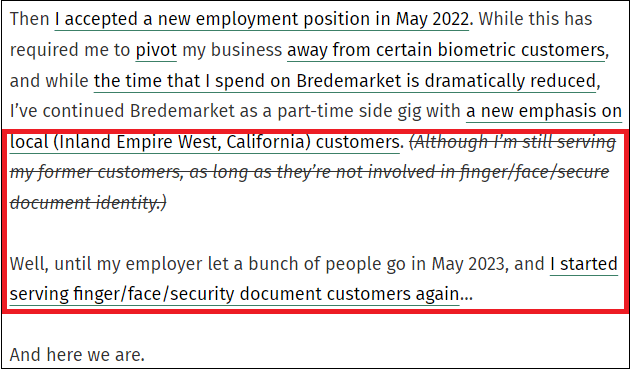
Basically, I had gone through great trouble to document that Bredemarket would NOT take identity work, so I had to reverse a lot of pages to say that Bredemarket WOULD take identity work.
I may have found a few additional pages after June 1, but eventually I reached the point where everything on the Bredemarket website was completely and totally updated, and I wouldn’t have to perform any other changes.
You can predict where this is going.
Who I…was
Today it occurred to me that some of the readers of the LinkedIn Bredemarket page may not know the person behind Bredemarket, so I took the opportunity to share Bredemarket’s “Who I Am” web page on the LinkedIn page.
So yes, this biometric content marketing expert/identity content marketing expert IS available for your content marketing needs. If you’re interested in receiving my help with your identity written content, contact me.
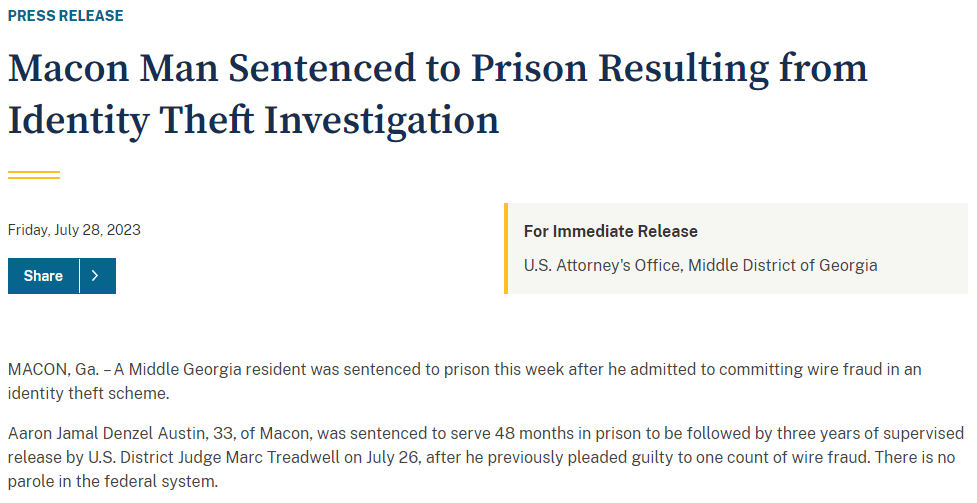
Monroe County Sheriff’s deputies found eight debit cards and three driver’s licenses belonging to other people in (Jamal Denzel) Austin’s possession during a traffic stop for reckless driving and failing to maintain lane on Jan. 19, 2020. A subsequent investigation revealed that Austin, who worked at an Atlanta club, had used two stolen identities to register two separate fictious (sic) businesses with the Georgia Secretary of State’s Office to obtain two Capital One business credit cards with credit limits of $30,000 and $20,000.
The investigation, which also included participation by the United States Secret Service and other local, state, and federal agencies, also uncovered a stolen $49,000 check.
Well, Austin lost the stolen money and his freedom. He was sentenced to 48 months in federal prison.
Now I’ll grant the early stages of this investigation aren’t as sexy as other fraud detection methods, but it worked.
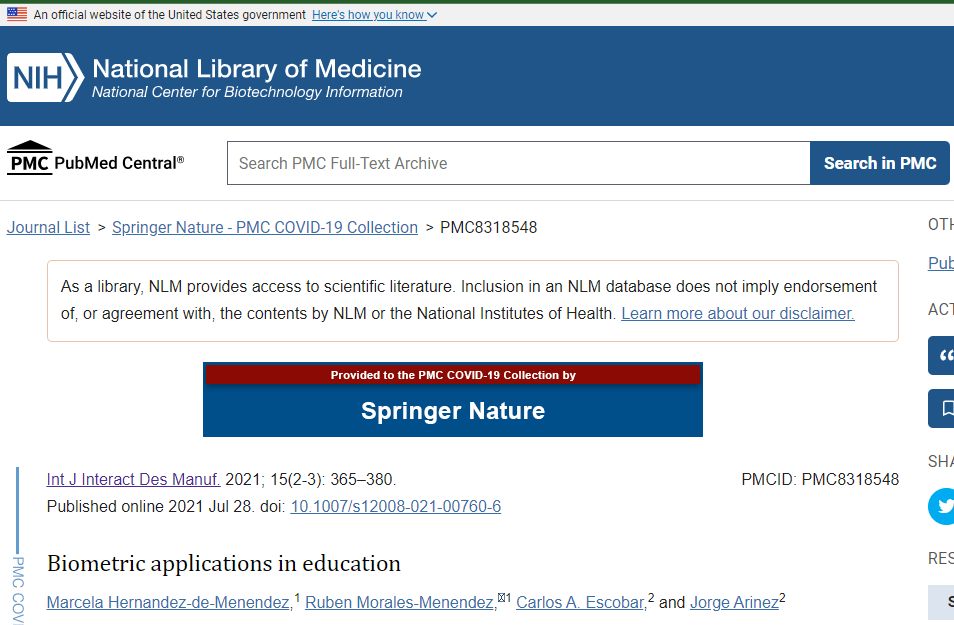
While searching for a post-COVID article that discussed the use of biometrics in education (to supplement my existing educational identity information), I found an entire scientific paper on the topic.
Educational institutions are acquiring novel technologies to help make their processes more efficient and services more attractive for both students and faculty. Biometric technology is one such example that has been implemented in educational institutions with excellent results. In addition to identifying students, access control, and personal data management, it has critical applications to improve the academic domain’s teaching/learning processes. Identity management system, class attendance, e-evaluation, security, student motivations, and learning analytics are areas in which biometric technology is most heavily employed.
Hmm…I didn’t even think about class attendance. But a camera capturing faces that walk into the classroom or join the online webinar should do the trick.
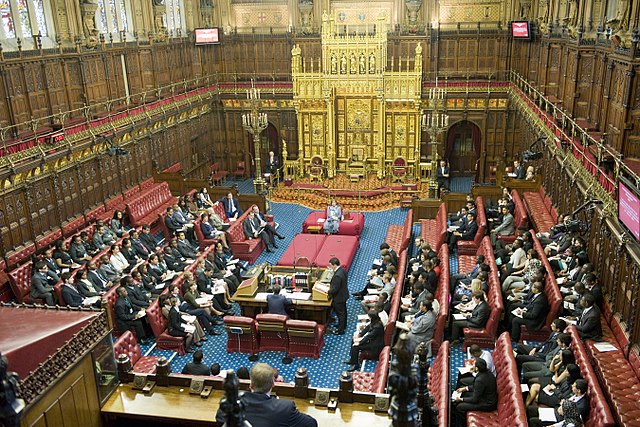
Approximately 2,700 years ago, the Greek poet Hesiod is recorded as saying “moderation is best in all things.” This applies to government regulations, including encryption and age verification regulations. As the United Kingdom’s House of Lords works through drafts of its Online Safety Bill, interested parties are seeking to influence the level of regulation.
In Allan’s assessment, he wondered whether the mandated encryption and age verification regulations would apply to all services, or just critical services.
Allan considered a number of services, but I’m just going to hone in on two of them: WhatsApp and Wikipedia.
The Online Safety Bill and WhatsApp
WhatsApp is owned by a large American company called Meta, which causes two problems for regulators in the United Kingdom (and in Europe):
Meta is a large company.
Meta is an American company.
WhatsApp itself causes another problem for UK regulators:
WhatsApp encrypts messages.
Because of these three truths, UK regulators are not necessarily inclined to play nice with WhatsApp, which may affect whether WhatsApp will be required to comply with the Online Safety Bill’s regulations.
Allan explains the issue:
One of the powers the Bill gives to OFCOM (the UK Office of Communications) is the ability to order services to deploy specific technologies to detect terrorist and child sexual exploitation and abuse content….
But there may be cases where a provider believes that the technology it is being ordered to deploy would break essential functionality of its service and so would prefer to leave the UK rather than accept compliance with the order as a condition of remaining….
If OFCOM does issue this kind of order then we should expect to see some encrypted services leave the UK market, potentially including very popular ones like WhatsApp and iMessage.
Speaking during a UK visit in which he will meet legislators to discuss the government’s flagship internet regulation, Will Cathcart, Meta’s head of WhatsApp, described the bill as the most concerning piece of legislation currently being discussed in the western world.
He said: “It’s a remarkable thing to think about. There isn’t a way to change it in just one part of the world. Some countries have chosen to block it: that’s the reality of shipping a secure product. We’ve recently been blocked in Iran, for example. But we’ve never seen a liberal democracy do that.
“The reality is, our users all around the world want security,” said Cathcart. “Ninety-eight per cent of our users are outside the UK. They do not want us to lower the security of the product, and just as a straightforward matter, it would be an odd choice for us to choose to lower the security of the product in a way that would affect those 98% of users.”
In passing, the March Guardian article noted that WhatsApp requires UK users to be 16 years old. This doesn’t appear to be an issue for Meta, but could be an issue for another very popular online service.
The Online Safety Bill and Wikipedia
So how does the Online Safety Bill affect Wikipedia?
It depends on how the Online Safety Bill is implemented via the rulemaking process.
As in other countries, the true effects of legislation aren’t apparent until the government writes the rules that implement the legislation. It’s possible that the rulemaking will carve out an exemption allowing Wikipedia to NOT enforce age verification. Or it’s possible that Wikipedia will be mandated to enforce age verification for its writers.
If they do not (carve out exemptions) then there could be real challenges for the continued operation of some valuable services in the UK given what we know about the requirements in the Bill and the operating principles of services like Wikipedia.
For example, it would be entirely inconsistent with Wikipedia’s privacy principles to start collecting additional data about the age of their users and yet this is what will be expected from regulated services more generally.
Left unsaid is the same issue that affects encryption: age verification for Wikipedia may be required in the United Kingdom, but may not be required for other countries.
(Wales) used the example of Wikipedia, in which none of its 700 staff or contractors plays a role in content or in moderation.
Instead, the organisation relies on its global community to make democratic decisions on content moderation, and have contentious discussions in public.
By contrast, the “feudal” approach sees major platforms make decisions centrally, erratically, inconsistently, often using automation, and in secret.
By regulating all social media under the assumption that it’s all exactly like Facebook and Twitter, Wales said that authorities would impose rules on upstart competitors that force them into that same model.
One common thread between these two cases is that implementation of the regulations results in a privacy threat to the affected individuals.
For WhatsApp users, the privacy threat is obvious. If WhatsApp is forced to fully or partially disable encryption, or is forced to use an encryption scheme that the UK Government could break, then the privacy of every message (including messages between people outside the UK) would be threatened.
For Wikipedia users, anyone contributing to the site would need to undergo substantial identity verification so that the UK Government would know the ages of Wikipedia contributors.
This is yet another example of different government agencies working at cross purposes with each other, as the “catch the pornographers” bureaucrats battle with the “preserve privacy” advocates.
Meta, Wikipedia, and other firms would like the legislation to explicitly carve out exemptions for their firms and services. Opponents say that legislative carve outs aren’t necessary, because no one would ever want to regulate Wikipedia.
Yeah, and the U.S. Social Security Number isn’t an identificaiton number either. (Not true.)
Whether a student is attending a preschool, a graduate school, or something in between, the educational institution needs to know who is accessing their services. This post discusses the types of identity verification and authentication that educational institutions may employ.
Why do educational institutions need to verify and authenticate identities?
Whether little Johnny is taking his blanket to preschool, or Johnny’s mother is taking her research notes to the local university, educational institutions such as schools, colleges, and universities need to know who the attendees are. It doesn’t matter whether the institution has a physical campus, like Chaffey High School’s campus in the video above, or if the institution has a virtual campus in which people attend via their computers, tablets, or phones.
Access boils down to two questions:
Who is allowed within the educational institution?
Who is blocked from the educational institution?
Who is allowed within the educational institution?
Regardless of the type of institution, there are certain people who are allowed within the physical and/or virtual campus.
Students.
Instructors, including teachers, teaching assistants/aides, and professors.
Administrators.
Staff.
Parents of minor students (but see below).
Others.
All of these people are entitled to access to at least portions of the campus, with different people having access to different portions of the campus. (Students usually can’t enter the teacher’s lounge, and hardly anybody has full access to the computer system where grades are kept.)
Before anyone is granted campus privileges, they have to complete identity verification. This may be really rigorous, but in some cases it can’t be THAT rigorous (how many preschoolers have a government ID?). Often, it’s not rigorous at all (“Can you show me a water bill? Is this your kid? OK then.”).
Once an authorized individual’s identity is verified, they need to be authenticated when they try to enter the campus. This is a relatively new phenomenon, in response to security threats at schools. Again, this could be really rigorous. For example, when students at a University of Rhode Island dining hall want to purchase food from the cafeteria, many of then consent to have their fingerprints scanned.
But some authentiation is much less rigorous. In these cases, people merely show an ID (hopefully not a fake ID) to authenticate themselves, or a security guard says “I know Johnny.”
(Again, all this is new. Many years ago, I accompanied a former college classmate to a class at his new college, the College of Marin. If I had kept my mouth shut, the professor wouldn’t have known that an unauthenticated student was in his class.)
Who is blocked from the educational institution?
At the same time, there are people who are clearly NOT allowed within the physical and/or virtual campus. Some of these people can enter campus with special permission, while some are completely blocked.
Former students. Once a student graduates, their privileges are usually revoked, and they need special permission if they want to re-enter campus to visit teachers or friends. (Admittedly this isn’t rigorously enforced.)
Expelled students. Well, some former students have a harder time returning to campus. If you brought a gun on campus, it’s going to be much harder for you to re-enter.
Former instructors, administrators, and staff. Again, people who leave the employ of the institution may not be allowed back, and certain ones definitely won’t be allowed back.
Non-custodial parents of minor students. In some cases, a court order prohibits a natural parent from contact with their child. So the educational institutions are responsible for enforcing this court order and ensuring that the minor student leaves campus only with someone who is authorized to take the child.
Others.
So how do you keep these people off campus? There are two ways.
If they’re not on the allowlist, they can’t enter campus anyway. As part of the identity verification process for authorized individuals, there is a list of people who can enter the campus. By definition, the 8 billion-plus people who are not on that “allowlist” can’t get on campus without special permission.
Sometimes they can be put on a blocklist. Or maybe you want to KNOW that certain people can’t enter campus. The inverse of an allowlist, people who are granted access, is a blocklist, people who are prevented from getting access. (You may know “blocklist” by the older term “blacklist,” and “allowlist” by the older term “whitelist.” The Security Industry Association and the National Institute of Standards and Technology recommend updated terminology.)
There’s just one teeny tiny problem with blocklists. Sometimes they’re prohibited by law.
In some cases (but not in others), a person is required to give consent before they are enrolled in a biometric system. If you’re the ex-student who was expelled for brining a gun on campus, how motivated will you be to allow that educational institution to capture your biometrics to keep you off campus?
And yes, I realize that the expelled student’s biometrics were captured while they were a student, but once they were no longer a student, the institution would have on need to retain those biometrics. Unless they felt like it.
This situation becomes especially sticky for campuses that use video surveillance systems. Like Chaffey High School.
Chaffey High School, Ontario, California.
Now the mere installation of a video surveillance system does not (usually) result in legally prohibited behavior. It just depends upon what is done with the video.
If the video is not integrated with a biometric facial recognition system, there may not be an issue.
If Chaffey High School has its own biometric facial recognition system, then a whole host of legal factors may come into play.
If Chaffey High School does not have a biometric facial recognition system, but it gives the video to a police agency or private entity that does have a biometric facial recognition system, then some legal factors may emerge.
As you can see, educational identity is not as clear-cut as financial identity, both because financial institutions are more highly regulated and because blocklists are more controversial in educational identity. Vladimir Putin may not be able to open a financial account at a U.S. bank, but I bet he’d be allowed to enroll in an online course at a U.S. community college.
So if you are an educational institution or an identity firm who serves educational institutions, people who write for you need to know all of these nuances.
You need to provide the right information to your customers, and write it in a way that will motivate your customers to take the action you want them to take.
Speaking of motivating customers, are you with an identity firm or educational institution and need someone to write your marketing text?
Someone with 29 years of identity/biometric marketing experience?
Someone who understands that technological, organizational, and legal issues surrounding the use of identity solutions?
Someone who will explain why your customers should care about these issues, and the benefits a compliant solution provides to them?
If I can help you create your educational identity content, we need to talk.









 Bredemarket