There have been many recent stories about Transportation Security Administration (TSA) capture of the facial images of travelers, an outgrowth of the same post-9/11 concerns that resulted in REAL IDs in 2008…I mean 2025. (Maybe.)
As to the “why” of its stance, here’s a succinct statement:
“Do you really want to be submitting a face scan to the current U.S. government?”
And perhaps there are good reasons to distrust the Trump Administration, or any administration.
After all, the TSA says it only retains the picture for a limited time: “Photos are not stored or saved after a positive ID match has been made, except in a limited testing environment for evaluation of the effectiveness of the technology,”
But maybe…something happens. Someone accidentally forgot to delete the files. Oops.
And if something happens, the federal government has just captured an image of your face!
Guess what? The federal government can probably already get an image of your face, even if you don’t allow TSA to take your photo.
After all, you had to show some sort of identification when you arrived at that TSA checkpoint. Maybe you showed a passport, with a picture that the U.S. State Department received at one point. No, they don’t retain them either. But maybe…something happens.
But if you are with a facial recognition company, and you want your prospects and their prospects to understand how your solution protects their privacy…
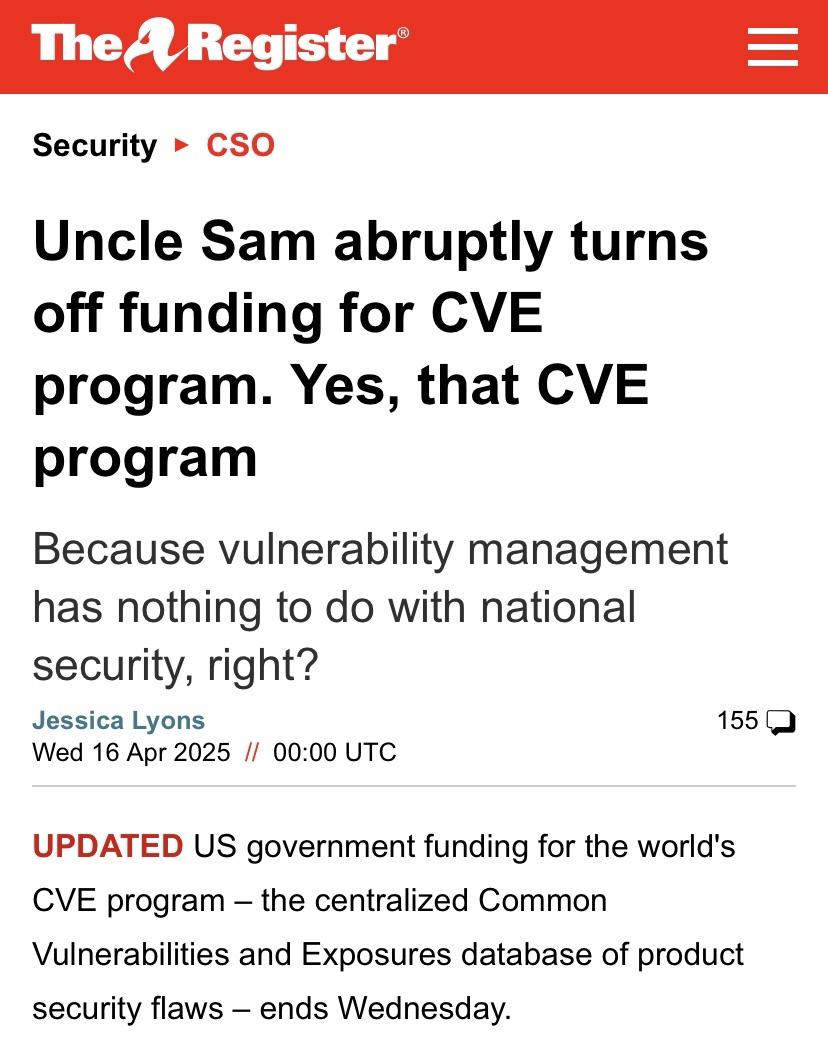
“The [CVE] program is sponsored, and largely funded by the Cybersecurity and Infrastructure Security Agency, aka CISA, under the umbrella of the US Department of Homeland Security. It appears MITRE has been paid roughly $30 million since 2023 to run CVE and associated programs.”
$30 million is peanuts.
If the U.S. government won’t fund it (and it still may), and if private firms won’t fund it, perhaps the EU will take it over. Or Canada. Or China.
The only complication is whether MITRE can run it if someone other than the feds is paying.
When then-President George W. Bush signed into law the “Real ID Act of 2005,” American adults initially had a May 11, 2008 deadline to ensure their identification documents met federal standards.
For those who didn’t notice, we didn’t all adopt REAL IDs in 2008.
In fact, a few years later I was working on a driver’s license proposal for a state I won’t identify, and the RFP clearly and emphatically stated that REAL ID compliance for the new driver’s license was not…um…OK.
The Transportation Security Administration has published a final rule which clearly states that the REAL ID enforcement date of May 7, 2025 still stands and has not been delayed.
Or perhaps it’s not so clear.
This rule ensures that Federal agencies have appropriate flexibility to implement the card-based enforcement provisions of the REAL ID regulations after the May 7, 2025, enforcement deadline by explicitly permitting agencies to implement these provisions in phases. Under this rule, agencies may implement the card-based enforcement provisions through a phased enforcement plan if they determine it is appropriate upon consideration of relevant factors including security, operational feasibility, and public impact. The rule also requires agencies to coordinate their plans with DHS, make the plans publicly available, and achieve full enforcement by May 5, 2027.
So the enforcement DEADLINE is May 7, 2025, but FULL enforcement will be achieved by May 5, 2027.
Date subject to change.
It’s not only the U.S.
But at least these decades of delays give me an excuse to share a Geico commercial.
And Europe (the continent, not the band) has its own problems with delays to its Entry/Exit System (EES)…and a graduated rollout is proposed.
When talking about the validity periods for U.S. driver’s licenses (which vary from state to state) in a February 2024 post, Veriff points out one oft-overlooked part of the REAL ID Act:
“If a document bears the typical Real ID star symbol (or some accepted adaptation of it), meaning it is a Real ID-compliant document, it cannot be valid for longer than 8 years (Section 202(d)(10) of the Real ID Act).”
At the time of Veriff’s post, the REAL ID deadline was due for enforcement on May 7, 2025 after numerous delays. Several months later, in September 2024, the Transportation Security Administration started planning to be flexible about that deadline…
I’ve worked with rapid DNA since I was in Proposals at MorphoTrak, when our corporate parent Safran had an agreement with IntegenX (now part of Thermo Fisher Scientific). Rapid DNA, when suitable for use, can process a DNA sample in 90 minutes or less, providing a quick way to process DNA in both criminal and non-criminal cases.
But as I explain below, sometimes rapid DNA isn’t so rapid. In those cases, investigators have to turn to boring biometric technologies such as fingerprints instead. Fingerprints are a much older identification modality, but they still work.
Bredemarket recently purchased access to a Journal of Forensic Sciences article entitled “Advances in postmortem fingerprinting: Applications in disaster victim identification” (https://doi.org/10.1111/1556-4029.15513) by Bryan T. Johnson MSFS of the Federal Bureau of Investigation Laboratory in Quantico. The abstract (which is NOT behind the paywall) states the following, in part:
In disaster victim identification (DVI), fingerprints, DNA, and dental examinations are the three primary methods of identification….As DNA technology continues to evolve, RAPID DNA may now identify a profile within 90 min if the remains are not degraded or comingled. When there are true unknowns, however, there is usually no DNA, dental, or medical records to retrieve for a comparison without a tentative identity.
In the body of the paper itself (which IS behind the paywall), Johnson cites one example in which use of rapid DNA would have DELAYED the process.
DVI depends upon comparison of a DNA sample from a victim with a previous DNA sample taken from the victim. If this is not available, then the victim’s DNA is compared against the DNA of a family member.
Identifying foreign nationals aboard the MV Conception
When the MV Conception boat caught fire and sank in September 2019, 34 people lost their lives and had to be positively identified.
While most of the MV Conception victims were California residents, some victims were from Singapore and India. It would take weeks to collect and transport the DNA samples from the victims’ family members back to the United States for comparison against the DNA samples from the victims. Weeks of uncertainty during which family members had no confirmation that their relatives were among the deceased.
However, because the foreign victims were visitors to the United States, they had fingerprints on file with the Department of Homeland Security. Interagency agreements allowed the investigating agencies to access the DHS fingerprints and compare them against the fingerprints of the foreign victims, providing tentative identifications within three days. (Fingerprint identification is a 100+ year old method, but it works!) These tentative identifications were subsequently confirmed when the familial DNA samples arrived.
What does this mean?
The message here is NOT that “fingerprints rule, DNA drools.” In some cases the investigators could not retrieve fingerprints from the bodies and HAD to use rapid DNA.
The message here is that when identifying people, you should use ANY biometric (or non-biometric) modality that is available: fingerprints, DNA, dental records, driver’s licenses, Radio Shack Battery Club card, or anything else that provides an investigative lead or a positive identification.
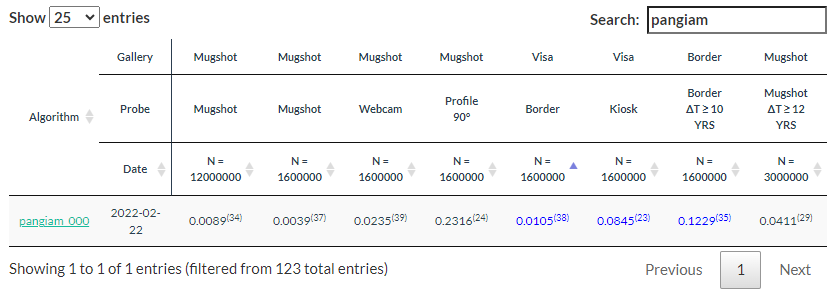
Things change. Pangiam, a company that didn’t even exist a few years ago, and that started off by acquiring a one-off project from a local government agency, is now itself a friendly acquisition target (pending stockholder and regulatory approvals).
From MWAA to Pangiam
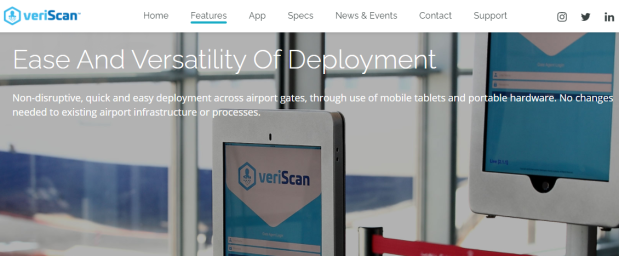
Back when I worked for IDEMIA and helped to market its border control solutions, one of our competitors for airport business was an airport itself—specifically, the Metropolitan Washington Airports Authority. Rather than buying a biometric exit solution from someone else, the MWAA developed its own, called veriScan.
2021 image from the former airportveriscan website.
ALEXANDRIA, Va., March 19, 2021 /PRNewswire/ — Pangiam, a technology-based security and travel services provider, announced today that it has acquired veriScan, an integrated biometric facial recognition system for airports and airlines, from the Metropolitan Washington Airports Authority (“Airports Authority”). Terms of the transaction were not disclosed.
So what will Pangiam work on next? Where will it expand? What will it acquire?
Nothing.
Enter BigBear.ai
Pangiam itself is now an acquisition target.
COLUMBIA, MD.— November 6, 2023 — BigBear.ai (NYSE: BBAI), a leading provider of AI-enabled business intelligence solutions, today announced a definitive merger agreement to acquire Pangiam Intermediate Holdings, LLC (Pangiam), a leader in Vision AI for the global trade, travel, and digital identity industries, for approximately $70 million in an all-stock transaction. The combined company will create one of the industry’s most comprehensive Vision AI portfolios, combining Pangiam’s facial recognition and advanced biometrics with BigBear.ai’s computer vision capabilities, positioning the company as a foundational leader in one of the fastest growing categories for the application of AI. The proposed acquisition is expected to close in the first quarter of 2024, subject to customary closing conditions, including approval by the holders of a majority of BigBear.ai’s outstanding common shares and receipt of regulatory approval.
Yet another example of how biometrics is now just a minor part of general artificial intelligence efforts. Identify a face or a grenade, it’s all the same.
Anyway, let’s check back in a few months. Because of the technology involved, this proposed acquisition will DEFINITELY merit government review.
At least in the United States, the mobile driver’s license world is fragmented.
Because driver’s license issuance in the U.S. is a state and not a federal responsibility, each state has to develop its own mobile driver’s license implementation. Subject to federal and international standards, of course.
To date there have been two parties helping the states with this:
mDL vendors such as Envoc and IDEMIA, who work with the states to create mDLs.
Operating system vendors such as Apple and Google, who work with the states to incorporate mDLs in smartphone wallets.
But because the Android ecosystem is more fragmented than the iOS ecosystem, we now have a third party that is involved in mDLs. In addition to mDL vendors and operating system vendors, we also have really large smartphone providers.
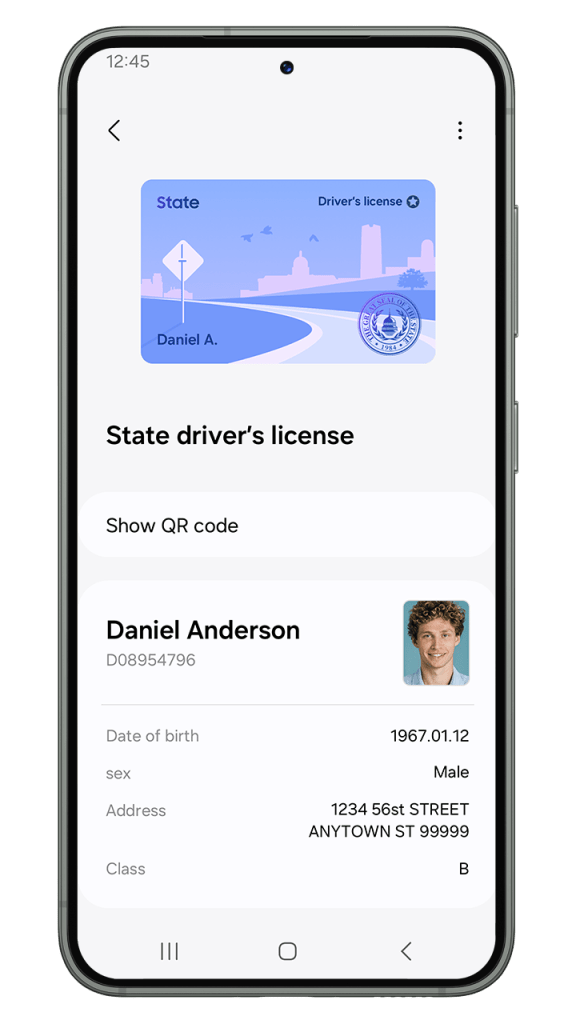
Samsung Electronics America today announced it is bringing mobile driver’s licenses and state IDs to Samsung Wallet. Arizona and Iowa will be the first states to offer a mobile version of its driver’s license to their residents. The update expands the Samsung Wallet experience by adding a convenient and secure way to use state-issued IDs and driver’s licenses
In this particular case Samsung is working with IDEMIA (the mDL provider for Arizona and Iowa), but Samsung announced that it is working with other states and with the Transportation Security Administration (TSA).
On a personal note, I’m still working on validating my driver’s license for California’s pilot mDL program. It probably didn’t help that I renewed my physical driver’s license right in the middle of the mDL validation process.
MCLEAN, Va., May 2, 2023 /PRNewswire/ — The West Virginia University Research Corporation (WVURC) and Pangiam, a leading trade a travel technology company, announced a new partnership to conduct research and develop new, cutting-edge artificial intelligence, machine learning and computer vision technologies for commercial and government applications.
Pangiam and WVURC will work together to launch Pangiam Bridge, a cutting-edge artificial intelligence driven solution for customs authorities worldwide. Pangiam Bridge will allow customs officials to automate portions of the customs inspection process for baggage and cargo. Jim McLaughlin, Pangiam Chief Technology Officer, said, “we are excited to grow Pangiam’s artificial intelligence work in partnership with West Virginia University and continued development of Pangiam Bridge for customs authorities.”
Pangiam Bridge is obviously not ready for prime time yet; it’s not even mentioned on Pangiam’s Products and Services page, nor is it mentioned anywhere else on Pangiam’s website. The only mention of Pangiam Bridge is in this press release, which isn’t surprising considering that this is a research effort. But if the research holds out, then many of the manual processes used by customs agents may be significantly reduced or eliminated entirely.
Project DARTMOUTH is the collaboration between Pangiam and Google Cloud, named after the 1956 Dartmouth Summer Research Project on Artificial Intelligence. Project DARTMOUTH utilizes AI and pattern analysis technologies to digest and analyze vast amounts of data in real-time and identify potential prohibited items in carry-on baggage, checked baggage, airline cargo and shipments.
Does your firm fight crooks who try to fraudulently use synthetic identities? If so, how do you communicate your solution?
This post explains what synthetic identities are (with examples), tells four ways to detect synthetic identities, and closes by providing an answer to the communication question.
While this post is primarily intended for identity firms who can use Bredemarket’s marketing and writing services, anyone else who is interested in synthetic identities can read along.
What are synthetic identities?
To explain what synthetic identities are, let me start by telling you about Jason Brown.
Jason Brown wasn’t Jason Brown
You may not have heard of him unless you lived in Atlanta, Georgia in 2019 and lived near the apartment he rented.
Jason Brown’s renting of an apartment isn’t all that unusual.
If you were to visit Brown’s apartment in February 2019, you would find credit cards and financial information for Adam M. Lopez and Carlos Rivera.
Now that’s a little unusual, especially since Lopez and Rivera never existed.
For that matter, Jason Brown never existed either.
A Georgia man was sentenced Sept. 1 (2022) to more than seven years in federal prison for participating in a nationwide fraud ring that used stolen social security numbers, including those belonging to children, to create synthetic identities used to open lines of credit, create shell companies, and steal nearly $2 million from financial institutions….
Cato joined conspiracies to defraud banks and illegally possess credit cards. Cato and his co-conspirators created “synthetic identities” by combining false personal information such as fake names and dates of birth with the information of real people, such as their social security numbers. Cato and others then used the synthetic identities and fake ID documents to open bank and credit card accounts at financial institutions. Cato and his co-conspirators used the unlawfully obtained credit cards to fund their lifestyles.
Talking about synthetic identity at Victoria Gardens
Here’s a video that I created on Saturday that describes, at a very high level, how synthetic identities can be used fraudulently. People who live near Rancho Cucamonga, California will recognize the Victoria Gardens shopping center, proof that synthetic identity theft can occur far away from Georgia.
Note that synthetic identity theft different from stealing someone else’s existing identity. In this case, a new identity is created.
So how do you catch these fraudsters?
Catching the identity synthesizers
If you’re renting out an apartment, and Jason Brown shows you his driver’s license and provides his Social Security Number, how can you detect if Brown is a crook? There are four methods to verify that Jason Brown exists, and that he’s the person renting your apartment.
Method One: Private Databases
One way to check Jason Brown’s story is to perform credit checks and other data investigations using financial databases.
Did Jason Brown just spring into existence within the past year, with no earlier credit record? That seems suspicious.
Does Jason Brown’s credit record appear TOO clean? That seems suspicious.
Does Jason Brown share information such as a common social security number with other people? Are any of those other identities also fraudulent? That is DEFINITELY suspicious.
This is one way that many firms detect synthetic identities, and for some firms it is the ONLY way they detect synthetic identities. And these firms have to tell their story to their prospects.
If your firm offers a tool to verify identities via private databases, how do you let your prospects know the benefits of your tool, and why your solution is better than all other solutions?
Method Two: Check That Driver’s License (or other government document)
What about that driver’s license that Brown presented? There are a wide variety of software tools that can check the authenticity of driver’s licenses, passports, and other government-issued documents. Some of these tools existed back in 2019 when “Brown” was renting his apartment, and a number of them exist today.
Maybe your firm has created such a tool, or uses a tool from a third party.
If your firm offers this capability, how can your prospects learn about its benefits, and why your solution excels?
Method Three: Check Government Databases
Checking the authenticity of a government-issued document may not be enough, since the document itself may be legitimate, but the implied credentials may no longer be legitimate. For example, if my California driver’s license expires in 2025, but I move to Minnesota in 2023 and get a new license, my California driver’s license is no longer valid, even though I have it in my possession.
Why not check the database of the Department of Motor Vehicles (or the equivalent in your state) to see if there is still an active driver’s license for that person?
The American Association of Motor Vehicle Administrators (AAMVA) maintains a Driver’s License Data Verification (DLDV) Service in which participating jurisdictions allow other entities to verify the license data for individuals. Your firm may be able to access the DLDV data for selected jurisdictions, providing an extra identity verification tool.
If your firm offers this capability, how can your prospects learn where it is available, what its benefits are, and why it is an important part of your solution?
Method Four: Conduct the “Who You Are” Test
There is one more way to confirm that a person is real, and that is to check the person. Literally.
If someone on a smartphone or videoconference says that they are Jason Brown, how do you know that it’s the real Jason Brown and not Jim Smith, or a previous recording or simulation of Jason Brown?
This is where tools such as facial recognition and liveness detection come to play.
You can ensure that the live face matches any face on record.
You can also confirm that the face is truly a live face.
In addition to these two tests, you can compare the face against the face on the presented driver’s license or passport to offer additional confirmation of true identity.
Now some companies offer facial recognition, others offer liveness detection, others match the live face to a face on a government ID, and many companies offer two or three of these capabilities.
One more time: if your firm offers these capabilities—either your own or someone else’s—what are the benefits of your algorithms? (For example, are they more accurate than competing algorithms? And under what conditions?) And why is your solution better than the others?
This is for the firms who fight synthetic identities
While most of this post is of general interest to anyone dealing with synthetic identities, this part of this post is specifically addressed to identity and biometric firms who provide synthetic identity-fighting solutions.
When you communicate about your solutions, your communicator needs to have certain types of experience.
Industry experience. Perhaps you sell your identity solution to financial institutions, or educational institutions , or a host of other industries (gambling/gaming, healthcare, hospitality, retailers, or sport/concert venues, or others). You need someone with this industry experience.
Solution experience. Perhaps your communications require someone with 29 years of experience in identity, biometrics, and technology marketing, including experience with all five factors of authentication (and verification).
Communication experience. Perhaps you need to effectively communicate with your prospects in a customer focused, benefits-oriented way. (Content that is all about you and your features won’t win business.)
If you haven’t read a Bredemarket blog post before, or even if you have, you may not realize that this post is jam-packed with additional information well beyond the post itself. This post alone links to the following Bredemarket posts and other content. You may want to follow one or more of the 13 links below if you need additional information on a particular topic:
Here’s my latest brochure for the Bredemarket 400 Short Writing Service, my standard package to create your 400 to 600 word blog posts and LinkedIn articles. Be sure to check the Bredemarket 400 Short Writing Service page for updates.







 Bredemarket