An authentication factor is a discrete method of authenticating yourself. Each factor is a distinct category.
For example, authenticating with fingerprint biometrics and authenticating with facial image biometrics are both the same factor type, because they both involve “something you are.”
But how many factors are there?
Three factors of authentication
There are some people who argue that there are only really three authentication factors:
Something you know, such as a password, or a personal identification number (PIN), or your mother’s maiden name.
Something you have, such as a driver’s license, passport, or hardware or software token.
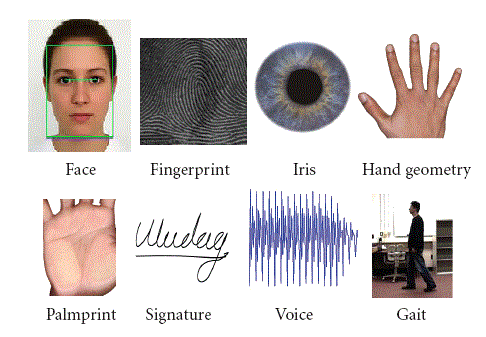
Something you are, such as the aforementioned fingerprint and facial image, plus others such as iris, voice, vein, DNA, and behavioral biometrics such as gait.
Somewhat you why, or a measure of intent and reasonableness.
For example, take a person with a particular password, ID card, biometric, action, and geolocation (the five factors). Sometimes this person may deserve access, sometimes they may not.
The person may deserve access if they are an employee and arrive at the location during working hours.
That same person may deserve access if they were fired and are returning a company computer. (But wouldn’t their ID card and biometric access have already been revoked if they were fired? Sometimes…sometimes not.)
That same person may NOT deserve access if they were fired and they’re heading straight for their former boss’ personal HR file.
Or maybe just five factors of authentication
Now not everyone agrees that this sixth factor of authentication is truly a factor. If “not everyone” means no one, and I’m the only person blabbering about it.
So while I still work on evangelizing the sixth factor, use the partially accepted notion that there are five factors.
I’m admittedly fascinated by the parallels between people and non-person entities (NPEs), to the point where I asked at one point whether NPEs can use the factors of authentication. (All six. Long story.)
When I got to the “something you are” factor, which corresponds to biometrics in humans, here is what I wrote:
Something you are. For simplicity’s sake, I’ll stick to physical objects here, ranging from pocket calculators to hand-made ceramic plates. The major reason that we like to use “something you are” as a factor is the promise of uniqueness. We believe that fingerprints are unique (well, most of us), and that irises are unique, and that DNA is unique except for identical twins. But is a pocket calculator truly unique, given that the same assembly line manufactures many pocket calculators? Perhaps ceramic plates exhibit uniqueness, perhaps not.
But I missed one thing in that discussion, so I wanted to revisit it.
Understanding IMEI Numbers
Now this doesn’t apply to ceramic plates or pocket calculators, but there are some NPEs that assert uniqueness.
Our smartphones, each of which has an International Mobile Equipment Identity (IMEI) number.
IMEI stands for International Mobile Equipment Identity. It’s a unique identifier for mobile devices, much like a fingerprint for your phone’s IMEI number.
Now some of you who are familiar with biometrics are saying, “Hold it right there.”
Can someone assert that there has NEVER been two people with the same fingerprint in all of human history?
But let’s stick to phones, Johnny.
Each IMEI number is a 15-digit code that’s assigned to every mobile phone during its production. This number helps in uniquely identifying a device regardless of the SIM card used.
This is an important point here. Even Americans understand that SIM cards are transient and can move from one phone to another, and therefore are not valid to uniquely identify phones.
What about IMEIs?
Are IMEIs unique?
I won’t go into the specifics of the 15-digit IMEI number format, which you can read about here. Suffice it to say that the format dictates that the number incorporate the make and model, a serial number, and a check digit.
Therefore smartphones with different makes and models cannot have the same IMEI number by definition.
And even within the make and model, by definition no two phones can have the same serial number.
Why not? Because everyone says so.
It’s even part of the law.
Changing an IMEI number is illegal in many countries due to the potential misuse, such as using a stolen phone. Tampering with the IMEI can lead to severe legal consequences, including fines and imprisonment. This regulation helps in maintaining the integrity of mobile device tracking and discourages the theft and illegal resale of devices.
IMEIs in India
To all of the evidence above about the uniqueness of IMEI numbers, I only have two words:
So what?
A dedicated person can create or modify multiple smartphones to have the exact same IMEI number if desired. Here’s a recent example:
The Indore Police Crime Branch has dismantled two major digital arrest fraud rackets operating in different parts of the country, seizing a massive database containing private details of 20,000 pensioners in Indore….
A dark room in the flat functioned as the nerve centre of the cyber fraud operation, which had been active since 2019. The group specialised in IMEI cloning and used thousands of SIM cards from select mobile networks.
IMEIs in Canada
“Oh, but that’s India,” you say. “That couldn’t happen in a First World country.”
A Calgary senior is warning others after he was scammed out of $1,000 after buying what he thought was a new iPhone 15 Pro Max.
“I didn’t have any doubt that it was real,” Boyd told Global News….
The seller even provided him with the “original” receipt showing the phone had been purchased down east back in October 2023. Boyd said he also checked the phone’s serial number and the International Mobile Equipment Identity (IMEI). All checked out fine.
Boyd said the first sign of a problem was when he tried to update the phone with his own information and it wouldn’t update. It was only after he took it to a representative at a local Apple retailer, that he realized he had been duped.
IMEIs in general
Even IMEICheck.net, which notes that the threat of stealing one’s phone information is overrated, admits that it is possible (albeit difficult) to clone an IMEI number.
In theory, hackers can clone a phone using its IMEI, but this requires significant effort. They need physical access to the device or SIM card to extract data, typically using specialized tools.
The cloning process involves copying the IMEI and other credentials necessary to create a functional duplicate of the phone. However, IMEI number security features in modern devices are designed to prevent unauthorized cloning. Even if cloning is successful, hackers cannot access personal data such as apps, messages, photos, or passwords. Cloning usually only affects network-related functions, such as making calls or sending messages from the cloned device.
Again, NOTHING provides 100.00000% security. Not even an IMEI number.
What this means for IMEI uniqueness claims
So if you are claiming uniqueness of your smartphone’s IMEI, be aware that there are proven examples to the contrary.
Perhaps the shortcomings of IMEI uniqueness don’t matter in your case, and using IMEIs for individualization is “good enough.”
(Imagen 3 image. Oddly enough, Google Gemini was unable, or unwilling, to generate an image of three smartphones displaying the exact same 15-digit string of numbers, or even a 2-digit string. I guess Google thought I was a fraudster.)
Do you believe in intentional ignorance, stupidity, and idiocy?
Let me put it another way:
Do you believe in the “death of passwords”?
The rationale behind the decades-long death of passwords movement is that passwords do not provide 99.99999% security, therefore NO ONE should EVER EVER EVER use a password, or ANY other form of knowledge (PIN, first pet, what a traffic light looks like, college GPA, favorite RGB value).
I have a different view.
Knowledge CAN be part of a robust multi-factor identity verification or authentication solution.
Just like biometrics CAN be part of a robust multi-factor identity verification or authentication solution. Oh, you think biometrics should be the SOLE (geddit?) factor? I hate to break this to you, but biometrics do not provide 99.99999% security either.
And for the simpler use cases (such as garage sale money boxes), knowledge-based authentication such as a combination lock is a viable security system.
Don’t rely on passwords alone…
…but don’t completely ban them either. Knowledge ain’t dead.
In “On Attribute-Based Access Control,” I noted that NIST defined a subject as “a human user or NPE (Non-Person Entity), such as a device that issues access requests to perform operations on objects.” Again, there’s a need to determine that the NPE has the right attributes, and is not a fake, deep or shallow.
There’s clearly a need to identify non-person entities. If I work for IBM and have a computer issued by IBM, the internal network needs to know that this is my computer, and not the computer of a North Korean hacker.
But I was curious. Can the five (or six) factors identify non-person entities?
Let’s consider factor applicability, going from the easiest to the hardest.
The easy factors
Somewhere you are. Not only is this extremely applicable to non-person entities, but in truth this factor doesn’t identify persons, but non-person entities. Think about it: a standard geolocation application doesn’t identify where YOU are. It identities where YOUR SMARTPHONE is. Unless you have a chip implant, there is nothing on your body that can identify your location. So obviously “somewhere you are” applies to NPEs.
Something you have. Another no brainer. If a person has “something,” that something is by definition an NPE. So “something you have” applies to NPEs.
Something you do. NPEs can do things. My favorite example is Kraftwerk’s pocket calculator. You will recall that “by pressing down this special key it plays a little melody.” I actually had a Casio pocket calculator that did exactly that, playing a tune that is associated with Casio. Later, Brian Eno composed a startup sound for Windows 95. So “something you do” applies to NPEs. (Although I’m forced to admit that an illegal clone computer and operating system could reproduce the Eno sound.)
Something you know. This one is a conceptual challenge. What does an NPE “know”? For artificial intelligence creations such as Kwebbelkop AI, you can look at the training data used to create it and maintain it. For a German musician’s (or an Oregon college student’s) pocket calculator, you can look at the code used in the device, from the little melody itself to the action to take when the user enters a 1, a plus sign, and another 1. But is this knowledge? I lean toward saying yes—I can teach a bot my mother’s maiden name just as easily as I can teach myself my maiden name. But perhaps some would disagree.
Something you are. For simplicity’s sake, I’ll stick to physical objects here, ranging from pocket calculators to hand-made ceramic plates. The major reason that we like to use “something you are” as a factor is the promise of uniqueness. We believe that fingerprints are unique (well, most of us), and that irises are unique, and that DNA is unique except for identical twins. But is a pocket calculator truly unique, given that the same assembly line manufactures many pocket calculators? Perhaps ceramic plates exhibit uniqueness, perhaps not.
That’s all five factors, right?
Well, let’s look at the sixth one.
Somewhat you why
You know that I like the “why” question, and some time ago I tried to apply it to identity.
Why is a person using a credit card at a McDonald’s in Atlantic City? (Link) Or, was the credit card stolen, or was it being used legitimately?
Why is a person boarding a bus? (Link) Or, was the bus pass stolen, or was it being used legitimately?
Why is a person standing outside a corporate office with a laptop and monitor? (Link) Or, is there a legitimate reason for an ex-employee to gain access to the corporate office?
The first example is fundamental from an identity standpoint. It’s taken from real life, because I had never used any credit card in Atlantic City before. However, there was data that indicated that someone with my name (but not my REAL ID; they didn’t exist yet) flew to Atlantic City, so a reasonable person (or identity verification system) could conclude that I might want to eat while I was there.
But can you measure intent for an NPE?
Does Kwebbelkop AI have a reason to perform a particular activity?
Does my pocket calculator have a reason to tell me that 1 plus 1 equals 3?
Does my ceramic plate have a reason to stay intact when I drop it ten meters?
In my circles, people generally understand ‘biometrics’ to refer to one of several ways to identify an individual.
But for the folks at Merriam-Webster, this is only a secondary definition of the word “biometrics.” From their perspective, biometrics is primarily biometry, which can refer to “the statistical analysis of biological observations and phenomena” or to “measurement (as by ultrasound or MRI) of living tissue or bodily structures.” In other words, someone’s health, not someone’s identity.
Fun fact: if you go to the International Biometric Society and ask it for its opinion on the most recent FRVT 1:N tests, it won’t have an answer for you.
So Abbott salespeople, real or imagined, won’t be interested in what I’ve been doing for the last 30 years. ‘Cause you know sometimes words have two meanings.
But those of you who use biometrics (and other factors) for individualization WILL be interested. Click on the image to find out more.
Drive content results with Bredemarket Identity Firm Services.
I wanted to share the latter on NextDoor, but that service wouldn’t accept the video.
Thinking the 45 second length was the issue, I decided to create a 15 second version of the Inland Empire video…and a 15 second version of the (50 second) identity/biometrics video while I was at it.
For those of you who would like to”a nice surprise…every once in a while.”
Identity/biometric.
Inland Empire.
By the way, I’m considering creating a new Inland Empire video…with an agricultural theme. (Fruits, not cows.)
Something You Are. This is the factor that identifies people. It includes biometrics modalities (finger, face, iris, DNA, voice, vein, etc.). It also includes behavioral biometrics, provided that they are truly behavioral and relatively static.
Something You Have. While this is used to identify people, in truth this is the factor that identifies things. It includes driver’s licenses and hardware or software tokens.
Actually more than a decade, since my car’s picture was taken in Montclair, California a couple of decades ago doing something it shouldn’t have been doing. I ended up in traffic school for that one.
Now license plate recognition isn’t that reliable of an identifier, since within a minute I can remove a license plate from a vehicle and substitute another one in its place. However, it’s deemed to be reliable enough that it is used to identify who a car is.
Note my intentional use of the word “who” in the sentence above.
Because when my car made a left turn against a red light all those years ago, the police didn’t haul MY CAR into court.
Using then-current technology, it identified the car, looked up the registered owner, and hauled ME into court.
These days, it’s theoretically possible (where legally allowed) to identify the license plate of the car AND identify the face of the person driving the car.
But you still have this strange merger of who and what in which the non-human characteristics of an entity are used to identify the entity.
What you are.
But that’s nothing compared to what’s emerged over the past few years.
We Are The Robots
When the predecessors to today’s Internet were conceived in the 1960s, they were intended as a way for people to communicate with each other electronically.
And for decades the Internet continued to operate this way.
Until the Internet of Things (IoT) became more and more prominent.
Application programming interfaces (APIs) are the connective tissue behind digital modernization, helping applications and databases exchange data more effectively. The State of API Security in 2024 Report from Imperva, a Thales company, found that the majority of internet traffic (71%) in 2023 was API calls.
Couple this with the increasing use of chatbots and other artificial intelligence bots to generate content, and the result is that when you are communicating with someone on the Internet, there is often no “who.” There’s a “what.”
What you are.
Between the cars and the bots, there’s a lot going on.
What does this mean?
There are numerous legal and technical ramifications, but I want to concentrate on the higher meaning of all this. I’ve spent 29 years professionally devoted to the identification of who people are, but this focus on people is undergoing a seismic change.
The science fiction stories of the past, including TV shows such as Knight Rider and its car KITT, are becoming the present as we interact with automobiles, refrigerators, and other things. None of them have true sentience, but it doesn’t matter because they have the power to do things.
When marketing your facial recognition product (or any product), you need to pay attention to your positioning and messaging. This includes developing the answers to why, how, and what questions. But your positioning and your resulting messaging are deeply influenced by the characteristics of your product.
If facial recognition is your only modality
There are hundreds of facial recognition products on the market that are used for identity verification, authentication, crime solving (but ONLY as an investigative lead), and other purposes.
Some of these solutions ONLY use face as a biometric modality. Others use additional biometric modalities.
Similarly, a face-only company will argue that facial recognition is a very fast, very secure, and completely frictionless method of verification and authentication. When opponents bring up the demonstrated spoofs against faces, you will argue that your iBeta-conformant presentation attack detection methodology guards against such spoofing attempts.
Of course, if you initially only offer a face solution and then offer a second biometric, you’ll have to rewrite all your material. “You know how we said that face is great? Well, face and gait are even greater!”
It seems that many of the people that are waiting the long-delayed death of the password think that biometrics is the magic solution that will completely replace passwords.
For this reason, your company might have decided to use biometrics as your sole factor of identity verification and authentication.
Or perhaps your company took a different approach, and believes that multiple factors—perhaps all five factors—are required to truly verify and/or authenticate an individual. Use some combination of biometrics, secure documents such as driver’s licenses, geolocation, “something you do” such as a particular swiping pattern, and even (horrors!) knowledge-based authentication such as passwords or PINs.
This naturally shapes your positioning and messaging.
The single factor companies will argue that their approach is very fast, very secure, and completely frictionless. (Sound familiar?) No need to drag out your passport or your key fob, or to turn off your VPN to accurately indicate your location. Biometrics does it all!
The multiple factor companies will argue that ANY single factor can be spoofed, but that it is much, much harder to spoof multiple factors at once. (Sound familiar?)
So position yourself however you need to position yourself. Again, be prepared to change if your single factor solution adopts a second factor.
A final thought
Every company has its own way of approaching a problem, and your company is no different. As you prepare to market your products, survey your product, your customers, and your prospects and choose the correct positioning (and messaging) for your own circumstances.
And if you need help with biometric positioning and messaging, feel free to contact the biometric product marketing expert, John E. Bredehoft. (Full-time employment opportunities via LinkedIn, consulting opportunities via Bredemarket.)
In the meantime, take care of yourself, and each other.
It discussed both large language models and large multimodal models. In this case “multimodal” is used in a way that I normally DON’T use it, namely to refer to the different modes in which humans interact (text, images, sounds, videos). Of course, I gravitated to a discussion in which an image of a person’s face was one of the modes.
In this post I will look at LMMs…and I will also look at LMMs. There’s a difference. And a ton of power when LMMs and LMMs work together for the common good.
When Google announced its Gemini series of AI models, it made a big deal about how they were “natively multimodal.” Instead of having different modules tacked on to give the appearance of multimodality, they were apparently trained from the start to be able to handle text, images, audio, video, and more.
Other AI models are starting to function in a TRULY multimodal way, rather than using separate models to handle the different modes.
So now that we know that LLMs are large multimodal models, we need to…
…um, wait a minute…
Introducing the Large Medical Model (LMM)
It turns out that the health people have a DIFFERENT definition of the acronym LMM. Rather than using it to refer to a large multimodal model, they refer to a large MEDICAL model.
Our first of a kind Large Medical Model or LMM for short is a type of machine learning model that is specifically designed for healthcare and medical purposes. It is trained on a large dataset of medical records, claims, and other healthcare information including ICD, CPT, RxNorm, Claim Approvals/Denials, price and cost information, etc.
I don’t think I’m stepping out on a limb if I state that medical records cannot be classified as “natural” language. So the GenHealth.AI model is trained specifically on those attributes found in medical records, and not on people hemming and hawing and asking what a Pekingese dog looks like.
But there is still more work to do.
What about the LMM that is also an LMM?
Unless I’m missing something, the Large Medical Model described above is designed to work with only one mode of data, textual data.
But what if the Large Medical Model were also a Large Multimodal Model?
Rather than converting a medical professional’s voice notes to text, the LMM-LMM would work directly with the voice data. This could lead to increased accuracy: compare the tone of voice of an offhand comment “This doesn’t look good” with the tone of voice of a shocked comment “This doesn’t look good.” They appear the same when reduced to text format, but the original voice data conveys significant differences.
Rather than just using the textual codes associated with an X-ray, the LMM-LMM would read the X-ray itself. If the image model has adequate training, it will again pick up subtleties in the X-ray data that are not present when the data is reduced to a single medical code.
In short, the LMM-LMM (large medical model-large multimodal model) would accept ALL the medical outputs: text, voice, image, video, biometric readings, and everything else. And the LMM-LMM would deal with all of it natively, increasing the speed and accuracy of healthcare by removing the need to convert everything to textual codes.
A tall order, but imagine how healthcare would be revolutionized if you didn’t have to convert everything into text format to get things done. And if you could use the actual image, video, audio, or other data rather than someone’s textual summation of it.
Obviously you’d need a ton of training data to develop an LMM-LMM that could perform all these tasks. And you’d have to obtain the training data in a way that conforms to privacy requirements: in this case protected health information (PHI) requirements such as HIPAA requirements.
But if someone successfully pulls this off, the benefits are enormous.
You’ve come a long way, baby.
Robert Young (“Marcus Welby”) and Jane Wyatt (“Margaret Anderson” on a different show). By ABC TelevisionUploaded by We hope at en.wikipedia – eBay itemphoto informationTransferred from en.wikipedia by SreeBot, Public Domain, https://commons.wikimedia.org/w/index.php?curid=16472486.












 Bredemarket