Educating the Fake Abbott Salesperson

A salesperson from Abbott just contacted me via LinkedIn InMail.

Well, she CLAIMED to be from Abbott. I’m not sure.

Anyway, she said she wanted to “get to know each other” because we are “in the same industry.”

Rather than dismissing the InMail out of hand as a #fraud #scam attempt with a #fakefakefake identity, I embraced the opportunity of a teachable moment and shared Bredemarket’s 2021 post on the difference between biometrics and biometrics. Excerpt:

In my circles, people generally understand ‘biometrics’ to refer to one of several ways to identify an individual.

But for the folks at Merriam-Webster, this is only a secondary definition of the word “biometrics.” From their perspective, biometrics is primarily biometry, which can refer to “the statistical analysis of biological observations and phenomena” or to “measurement (as by ultrasound or MRI) of living tissue or bodily structures.” In other words, someone’s health, not someone’s identity.

Fun fact: if you go to the International Biometric Society and ask it for its opinion on the most recent FRVT 1:N tests, it won’t have an answer for you.

Yeah, “FRVT.” Told you I wrote it in 2021, before the great renaming.

So Abbott salespeople, real or imagined, won’t be interested in what I’ve been doing for the last 30 years. ‘Cause you know sometimes words have two meanings.

But those of you who use biometrics (and other factors) for individualization WILL be interested. Click on the image to find out more.

Drive content results with Bredemarket Identity Firm Services.

Always Trust Anyone Over 30

I shouldn’t be telling you this, but…

…well, you’ll have to watch the video for my deep dark secret.

Thirty.

Contact me if I can help with the product marketing for your identity/biometric company.

#biometricproductmarketingexpert 

#id30and9 

My LinkedIn profile: https://www.linkedin.com/in/jbredehoft

Proven

This video is, in marcom words, “for immediate release.”

Proven.

It was fun to convert my Never Search Alone “candidate-market fit” text statement into a video with AI-generated music.

The text version:

“Proven Senior Product Marketing Manager who drives growth. Expert in identity/biometrics. Seeking an individual contributor role on a co-creative team delivering exceptional business results.”

Except that’s not the COMPLETE version. 

To see the full version, you’ll have to watch the video. Then you will know why I had to change one of my hashtags this month.

#biometricproductmarketingexpert 

#id30and9 

My LinkedIn profile: https://www.linkedin.com/in/jbredehoft

Go-to-Market Partners

The next paragraph is inaccurate.

Go-to-market initiatives have ONLY two audiences: the external prospects who are the hungry people (hopefully) wanting the product, and the internal staff in the company who deliver the product.

You know who I forgot? The partners. 

Such as the very important partner for MorphoTrak’s Morpho Cloud back in 2015:

“Morpho worked with Microsoft Corporation to develop a cloud service for Morpho’s flagship Biometric Identification Solution (MorphoBIS). Morpho Cloud is hosted on Microsoft Azure Government, the cloud platform with a contractual commitment to support several U.S. government standards for data security, including the FBI’s CJIS Security Policy. Backed by the Microsoft Azure Government platform, Morpho Cloud complies with the stringent security standards for storage, transmission, monitoring, and recovery of digital information.”

When Names Infringe (Biometric Products Coming to America)

Then there was the time I was performing U.S. go-to-market activities for a global identity/biometric offering.

The product marketing launch went great…

…until the home office received a communication from a competitor.

A competitor with a previously existing product with a name VERY similar to that of our subsequently launched solution.

Oops. 

We definitely made a mistake by not thoroughly checking the name.

Of course, with the way that some companies want to imitate the things their competitors do, I’m sure some firms perform this intentionally, rather than accidentally.

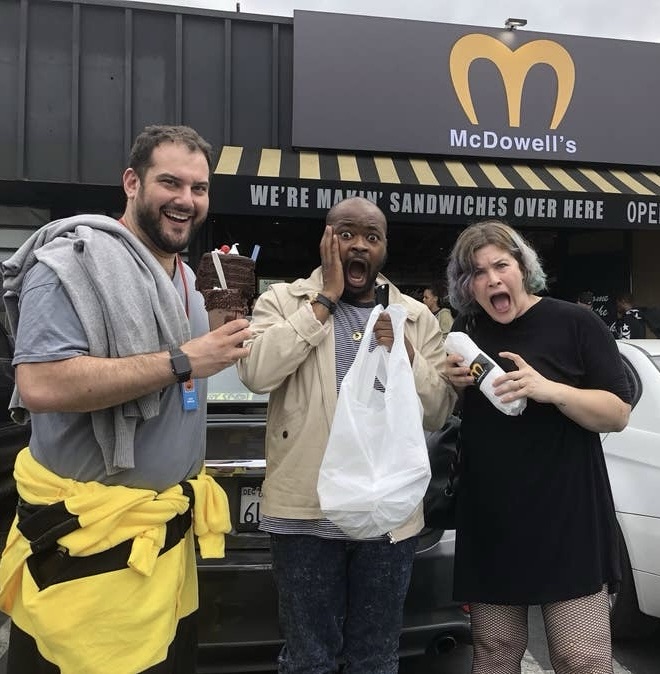
(McDowell’s 2017 West Hollywood pop-up image from Buzzfeed, https://www.buzzfeed.com/morganshanahan/we-went-to-a-real-life-mcdowells-from-coming-to-america-and)

In Case You Missed My Incessant “Biometric Product Marketing Expert” Promotion

Biometric product marketing expert.

Modalities: Finger, face, iris, voice, DNA.

Plus other factors: IDs, data.

John E. Bredehoft has worked for Incode, IDEMIA, MorphoTrak, Motorola, Printrak, and a host of Bredemarket clients.

(Some images AI-generated by Google Gemini.)

Biometric product marketing expert.

Friction Is Bad

(NOT part of the biometric product marketing expert series)

Friction is bad.

I know some people think that friction is good, because if you tolerate the friction to get to the thing, then you must really want it.

But more often than not, friction is bad.

Which is why when I create a reel, I try to post the native reel in all places where appropriate.

Take my most recent 8 second “biometric product marketing expert” reel.

But you don’t have to leave this blog post to see the original reel.

See how easy a frictionless experience can be?

More here.

Biometric Product Marketing Expert.

Biometric Product Marketers, BIPA Remains Unaltered

(Part of the biometric product marketing expert series)

You may remember the May hoopla regarding amendments to Illinois’ Biometric Information Privacy Act (BIPA). These amendments do not eliminate the long-standing law, but lessen its damage to offending companies.

Back on May 29, Fox Rothschild explained the timeline:

The General Assembly is expected to send the bill to Illinois Governor JB Pritzker within 30 days. Gov. Pritzker will then have 60 days to sign it into law. It will be immediately effective.

According to the Illinois General Assembly website, the Senate sent the bill to the Governor on June 14.

While the BIPA amendment has passed the Illinois House and Senate and was sent to the Governor, there is no indication that he has signed the bill into law within the 60-day timeframe.

So BIPA 1.0 is still in effect.

As Photomyne found out:

A proposed class action claims Photomyne, the developer of several photo-editing apps, has violated an Illinois privacy law by collecting, storing and using residents’ facial scans without authorization….

The lawsuit contends that the app developer has breached the BIPA’s clear requirements by failing to notify Illinois users of its biometric data collection practices and inform them how long and for what purpose the information will be stored and used.

In addition, the suit claims the company has unlawfully failed to establish public guidelines that detail its data retention and destruction policies.

From https://www.instagram.com/p/C7ZWA9NxUur/.

Let’s Explain the MINEX Acronyms

(Part of the biometric product marketing expert series)

Any endeavor, scientific or non-scientific, tends to generate a host of acronyms that the practitioners love to use.

For people interested in fingerprint identification, I’ve written this post to delve into some of the acronyms associated with NIST MINEX testing, including ANSI, INCITS, FIPS, and PIV.

And, of course, NIST and MINEX.

After defining what the acronyms stand for, I’ll talk about the MINEX III test. Because fingerprints are still relevant.

Common MINEX acronyms

NIST

We have to start with NIST, of course. NIST is the National Institute of Standards and Technology, part of the U.S. Department of Commerce.

NIST was involved with fingerprints before NIST even existed. Back when NIST was still the NBS (National Bureau of Standards), it issued its first fingerprint interchange standard back in 1986. I’ve previously talked about the 1993 version of the standard in this post, “When 250ppi Binary Fingerprint Images Were Acceptable.”

But let’s move on to another type of interchange.

MINEX

It’s even more important that we define MINEX, which stands for Minutiae (M) Interoperability (IN) Exchange (EX).

From NIST, 2006.

You’ll recall that the 1993 (and previous, and subsequent) versions of the ANSI/NIST standard included a “Type 9” to record the minutiae generated by the vendor for each fingerprint. However, each vendor generated minutiae according to its own standard. Back in 1993 Cogent had its standard, NEC its standard, Morpho its standard, and Printrak its standard.

So how do you submit Cogent minutiae to a Printrak system? There are two methods:

First, you don’t submit them at all. Just ignore the Cogent minutiae, look at the Printrak image, and use an algorithm regenerate the minutiae to the Printrak standard. While this works with high quality tenprints, it won’t work with low quality latent (crime scene) prints that require human expertise.

The second method is to either convert the Cogent minutiae to the Printrak minutiae standard, or convert both standards into a common format.

Something like ANSI INCITS 378-2009 (S2019).

So I guess we need to define two more acronyms.

ANSI

Actually, I should have defined ANSI earlier, since I’ve already referred to it when talking about the ANSI/NIST data interchange formats.

ANSI is the American National Standards Institute. Unlike NIST, which is an agency of the U.S. government, ANSI is a private entity. Here’s how it describes itself:

The American National Standards Institute (ANSI) is a private, non-profit organization that administers and coordinates the U.S. voluntary standards and conformity assessment system. Founded in 1918, the Institute works in close collaboration with stakeholders from industry and government to identify and develop standards- and conformance-based solutions to national and global priorities….

ANSI is not itself a standards developing organization. Rather, the Institute provides a framework for fair standards development and quality conformity assessment systems and continually works to safeguard their integrity.

So ANSI, rather than creating its own standards, works with outside organizations such as NIST…and INCITS.

INCITS

Now that’s an eye-catching acronym, but INCITS isn’t trying to cause trouble. Really, they’re not. Believe me.

INCITS, or the InterNational Committee for Information Technology Standards, is another private organization. It’s been around since 1961, and like NIST has been known under different names in the past.

Back in 2004, INCITS worked with ANSI (and NIST, who created samples) to develop three standards: one for finger images (ANSI INCITS 381-2004), one for face recognition (ANSI INCITS 385-2004), and one for finger minutiae (ANSI INCITS 378-2004, superseded by ANSI INCITS 378-2009 (S2019)).

When entities used this vendor-agnostic minutiae format, then minutiae from any vendor could in theory be interchanged with those from any other vendor.

This came in handy when the FIPS was developed for PIV. Ah, two more acronyms.

FIPS and PIV

One year after the three ANSI INCITS standards were released, this happened (the acronyms are defined in the text):

Federal Information Processing Standard (FIPS) 201 entitled Personal Identity Verification of Federal Employees and Contractors establishes a standard for a Personal Identity Verification (PIV) system (Standard) that meets the control and security objectives of Homeland Security Presidential Directive-12 (HSPD-12). It is based on secure and reliable forms of identity credentials issued by the Federal Government to its employees and contractors. These credentials are used by mechanisms that authenticate individuals who require access to federally controlled facilities, information systems, and applications. This Standard addresses requirements for initial identity proofing, infrastructure to support interoperability of identity credentials, and accreditation of organizations issuing PIV credentials.

So the PIV, defined by a FIPS, based upon an ANSI INCITS standard, defined a way for multiple entities to create and support fingerprint minutiae that were interoperable.

But how do we KNOW that they are interoperable?

Let’s go back to NIST and MINEX.

Testing interoperability

So NIST ended up in charge of figuring out whether these interoperable minutiae were truly interoperable, and whether minutiae generated by a Cogent system could be used by a Printrak system. Of course, by the time MINEX testing began Printrak no longer existed, and a few years later Cogent wouldn’t exist either.

You can read the whole history of MINEX testing here, but for now I’m going to skip ahead to MINEX III (which occurred many years after MINEX04, but who’s counting?).

  • Like some other NIST tests we’ve seen before, vendors and other entities submit their algorithms, and NIST does the testing itself.
  • In this case, all submitters include a template generation algorithm, and optionally can include a template matching algorithm.
  • Then NIST tests each algorithm against every other algorithm. So the “innovatrics+0020” template generator is tested against itself, and is also tested against the “morpho+0115” algorithm, and all the other algorithms.
From NIST. Retrieved July 29, 2024.

NIST then performs its calculations and comes up with summary values of interoperability, which can be sliced and diced a few different ways for both template generators and template matchers.

From NIST. Top 10 template generators (Ascending “Pooled 2 Fingers FNMR @ FMR≤10-2) as of July 29, 2024.

And this test, like some others, is an ongoing test, so perhaps in a few months someone will beat Innovatrics for the top pooled 2 fingers spot.

Are fingerprints still relevant?

And entities WILL continue to submit to the MINEX III test. While a number of identity/biometric professionals (frankly, including myself) seem to focus on faces rather than fingerprints, fingers still play a vital role in biometric identification, verification, and authentication.

Fingerprints are clearly a 21st century tool.

Even if one vendor continues its obsession with 1970s crime fighters.

And no, I’m NOT going to explain what the acronym FAP means. This post has too many acronyms already (TMAA).

Can Your Firm Use Bredemarket’s Analysis Work?

(Part of the biometric product marketing expert series)

Is your firm asking the following questions?

  • Who are the competitors in the market for my product?
  • Which features do competitive products offer? How do they compare to the features my product offers?
  • Which industries do competitors target? How do they compare with the industries my company targets?
  • Which contracts have the competitors won? How do they compare with the contracts my company has won?
  • How effective is my company’s product marketing? My website? My social media? My key employees’ social media?

Bredemarket can help you answer these questions.

Types of analyses Bredemarket performs

For those who don’t know, or who missed my previous discussion on the topic, Bredemarket performs analyses that contain one or more of the following:

  • Analysis of one or more markets/industries for a particular product or product line.
  • Analysis of one or more (perhaps tens or hundreds) of competitors and/or competitive products for a particular product or product line.
  • Analysis of a firm’s own product or product line, including how it is marketed.

How Bredemarket conducts its analyses

Bredemarket analyses only use publicly available data.

  • I’m not hacking websites to get competitor prices or plans.
  • I’m not asking past employees to violate their non-disclosure agreements.

How Bredemarket packages its analyses

These analyses can range in size from very small to very large. On the very small side, I briefly analyzed the markets of three prospect firms in advance of calls with them. On the large side, I’ve performed analyses that take between one and six weeks to complete.

  • For the small self-analyses (excluding the very small quick freebies before a prospect call), I deliver these under my Bredemarket 404 Web/Social Media Checkup banner. When I first offered this service in 2020, I had a complex price calculation mechanism that depended upon the number of pages I had to analyze. Now I’ve simplified it and charge one of two flat rates.
  • Because the larger analyses are of undetermined length, I offer these at an hourly rate under my Bredemarket 4000 Long Writing Service banner. These reports can number 40 pages or more in length, sometimes accompanied by a workbook describing 700 or more competitor products or contracts.

Obviously I can’t provide specifics upon the analyses I’ve already performed since those are confidential to my customers, but I always discuss the customers’ needs before launching the analysis to ensure that the final product is what you want. I also provide drafts along the way in case we need to perform a course correction.

Do you need a market, competitor, or self analysis? Contact me. Or book a meeting with me at calendly.com/bredemarket to talk about your needs (and check the “Market/competitor analysis” check box).