Etymologically, the opposite of impostor syndrome would be expositor syndrome. I asked my buddy Google Gemini to hallucinate a definition, and this is what I got:
“Expositor Syndrome is a hypothetical, non-clinical psychological pattern characterized by an overwhelming and often compulsive urge to explain, clarify, or elaborate upon concepts, ideas, or events, even when such detailed exposition is unsolicited, unnecessary, or redundant. Individuals exhibiting Expositor Syndrome experience a profound discomfort or anxiety if they perceive a potential for misunderstanding or an unstated implication, feeling an internal pressure to “lay bare” all facets of a topic.
“Note: This is a fictional construct, not a recognized medical or psychological condition.”
Gemini actually said a lot more, but I chose not to elaborate.
This, rather than a delusion of grandeur, is considered the opposite of impostor syndrome because an impostor HIDES their true talented self, whereas an expositor ELABORATES and goes on and on about their knowledge. Until their friends become former friends and stop speaking to them.
But can someone exhibit both expositor syndrome and a delusion of grandeur?
Perhaps such a person—if they exist—can still make positive contributions to society.
Such as the Bredemarket 2800 Medium Writing Service, approximately 2800 to 3200 words that (a) answers the WHY/HOW/WHAT questions about you, (b) advances your GOAL, (c) communicates your BENEFITS, and (d) speaks to your TARGET AUDIENCE.
“Shoppers said they preferred being able to track their spending during a shop, access receipts instantly, and easily find products—all things that are harder with a fully automated system.
“The new solution—smart trolleys known as Dash Carts—lets customers scan items as they shop, view their basket total in real time, and pay using contactless payment at the end.”
Most product marketing references to artificial intelligence are meaningless. Some companies think that they can simply promote their product by saying “We use AI,” as if this is a sufficient reason for prospects to buy.
I’ve previously observed that saying “we use AI” is the 2020s equivalent to saying “we use Pentium.”
“(Several organizations) received a three-year, $1.3 million National Science Foundation grant to teach Florida middle school teachers and students how to use artificial intelligence (AI) to identify fossil shark teeth….Florida teachers learn to use a branch of AI called “machine learning,” to teach computers how to use shape, color, and texture to identify the teeth of the extinct giant shark megalodon.”
Now I come from the identity/biometrics industry, which uses machine learning extensively. But customers in this industry don’t really care about the “how,” (machine learning). They care about the “why” (identify individuals). For all the customers care, the vendors could use Pentium for identification. Or blockchain. Or Beatrice. As Loren Feldman says, “It doesn’t matter.”
Remember this the next time you want to identify extinct megalodon shark teeth. Now I admit the exercise serves an educational purpose by exposing teachers to the capabilities of machine learning. But if your sole interest is tooth classification, you can simply purchase the non-expurgated version of Olsen’s Standard Book of Extinct Sharks and get the job done.
Marketing executives, AI is no longer a differentiator. Trust me. If you need assistance with a real differentiator, I can help.
If you want to win business, learn more about Bredemarket’s content – proposal – analysis services here.
AAL1 (some confidence). AAL1, in the words of NIST, “provides some assurance.” Single-factor authentication is OK, but multi-factor authentication can be used also. All sorts of authentication methods, including knowledge-based authentication, satisfy the requirements of AAL1. In short, AAL1 isn’t exactly a “nothingburger” as I characterized IAL1, but AAL1 doesn’t provide a ton of assurance.
AAL2 (high confidence). AAL2 increases the assurance by requiring “two distinct authentication factors,” not just one. There are specific requirements regarding the authentication factors you can use. And the security must conform to the “moderate” security level, such as the moderate security level in FedRAMP. So AAL2 is satisfactory for a lot of organizations…but not all of them.
AAL3 (very high confidence). AAL3 is the highest authenticator assurance level. It “is based on proof of possession of a key through a cryptographic protocol.” Of course, two distinct authentication factors are required, including “a hardware-based authenticator and an authenticator that provides verifier impersonation resistance — the same device MAY fulfill both these requirements.”
This is of course a very high overview, and there are a lot of…um…minutiae that go into each of these definitions. If you’re interested in that further detail, please read section 4 of NIST Special Publication 800-63B for yourself.
Which authenticator assurance level should you use?
NIST has provided a handy dandy AAL decision flowchart in section 6.2 of NIST Special Publication 800-63-3, similar to the IAL decision flowchart in section 6.1 that I reproduced earlier. If you go through the flowchart, you can decide whether you need AAL1, AAL2, or the very high AAL3.
One of the key questions is the question flagged as 2, “Are you making personal data accessible?” The answer to this question in the flowchart moves you between AAL2 (if personal data is made accessible) and AAL1 (if it isn’t).
So what?
Do the different authenticator assurance levels provide any true benefits, or are they just items in a government agency’s technical check-off list?
Perhaps the better question to ask is this: what happens if the WRONG person obtains access to the data?
Could the fraudster cause financial loss to a government agency?
Threaten personal safety?
Commit civil or criminal violations?
Or, most frightening to agency heads who could be fired at any time, could the fraudster damage an agency’s reputation?
If some or all of these are true, then a high authenticator assurance level is VERY beneficial.
(T)here were 7,887 nurses who recently ended their healthcare careers between 2018 and 2021….39% of respondents said their decision to leave healthcare was due to a planned retirement. However, 26% of respondents cited burnout or emotional exhaustion, and 21% cited insufficient staffing.
And this is ALL nurses. Not just the forensic nurses who have to deal with upsetting examinations that (literally) probe into sexual assault and child abuse. All nurses have it tough.
At Artisight we are committed to reversing this trend through AI-driven technology that is bringing the joy back to medicine!!
Can artificial intelligence bots truly relieve the exhaustion of overworked health professionals? Let’s look at two AI solutions from 3M and Artisight and see whether they truly benefit medical staff.
3M, a former competitor to MorphoTrak until 3M sold its biometric offerings (as did MorphoTrak’s parent Safran), has invested heavily into healthcare artificial intelligence solutions. This includes a solution that addresses the bane of medical professionals everywhere—keeping up with the paperwork (and checking for potentially catastrophic errors).
Our solutions use artificial intelligence (AI) to alleviate administrative burden and proactively identify gaps and inconsistencies within clinical documentation. Supporting completeness and accuracy every step of the way, from capture to code, means rework doesn’t end up on the physician’s plate before or even after discharge. That enables you to keep your focus where it needs to be – on the patient right in front of you.
But what about Artisight, whose assertion inspired this post in the first place?
A recent PYMNTS article interviewed Artisight President Stephanie Lahr to uncover Artight’s approach.
The Artisight platform marries IoT sensors with machine learning and large language models. The overall goal in a hospital setting is to streamline safe patient care, including virtual nursing. Compliance with HIPAA, according to Lahr, has been an important part of the platform’s development, which includes computer vision, voice recognition, vital sign monitoring, indoor positioning capabilities and actionable analytics reports.
In more detail, a hospital patient room is equipped with Al-powered devices such as high-quality, two-way audio and video with multiple participants for virtual care. Ultra-wideband technology tracks the movement and flow of assets throughout the hospital. Remote nurses and observers monitor patient room activity off-site and interact virtually with patients and clinicians.
At a minimum, this reduces the need for nurses to run down the hall just to check things. At a maximum, tracking of asset flows and actionable analytics reports make the job of everyone in the hospital easier.
So how can 3M’s and Artisight’s artificial intelligence offerings benefit medical facilities?
Allow medical professionals to concentrate on care. Patients don’t need medical professionals who are buried in paperwork. Patients need medical professionals who are spending time with them. The circumstances that land a patient in a hospital are bad enough, and to have people who are forced to ignore patient needs makes it worse. Maybe some day we’ll even get back to Welbycare.
Free medical professionals from routine tasks. Assuming the solutions work as advertised, they eliminate the need to double-check a report for errors, or the need to walk down the hall to capture vital signs.
Save lives. Yeah, medical professionals do that. If the Marcus Welby AI bot spots an error in a report, or if the bot detects a negative change in vital signs while a nurse is occupied with another patient, the technology could very well save a life.
There may be a variety of reasons for this. Perhaps your current employees are too busy doing other things. Or perhaps writing terrifies them so much that they think ChatGPT-generated content is actually a GOOD thing. (Read the content. It isn’t good.)
So you’re thinking about outsourcing the work to a content writer. One who has created content for multiple technology firms, including 9 returning clients. Here are four examples.
But how does outsourced content writing work?
How Bredemarket works with you to create content
Maybe you need an outsourced content writer because your current textual content is not compelling to your prospects, or perhaps it’s non-existent (for example, a LinkedIn company page with zero posts).
If you approach Bredemarket with your outsourced content writing request, here’s how we will work together:
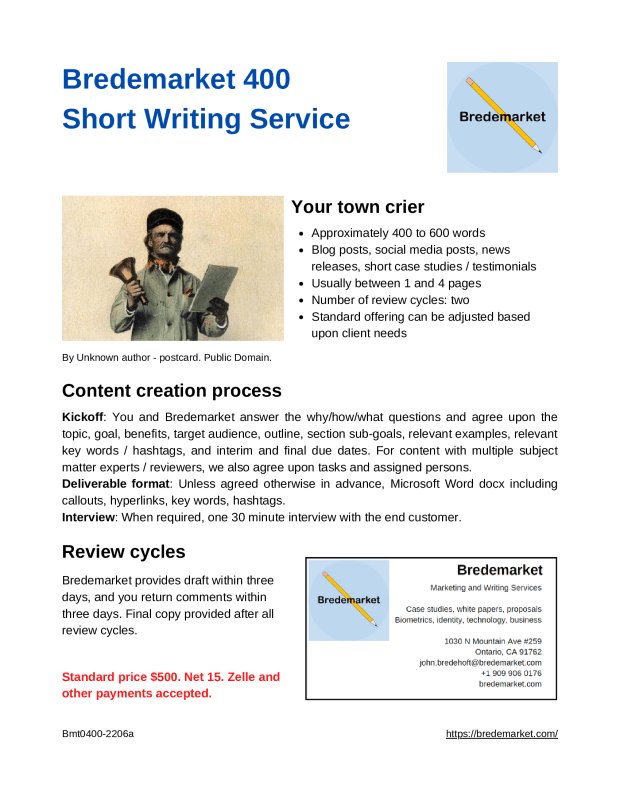
For this example, let’s assume that you need between 400 to 600 words of text to post to your company blog or to your company LinkedIn account, and therefore are purchasing my Bredemarket 400 Short Writing Service.
This is the most important step in the entire process, and I don’t write a word of text until you and I have some agreement on WHAT I am going to write.
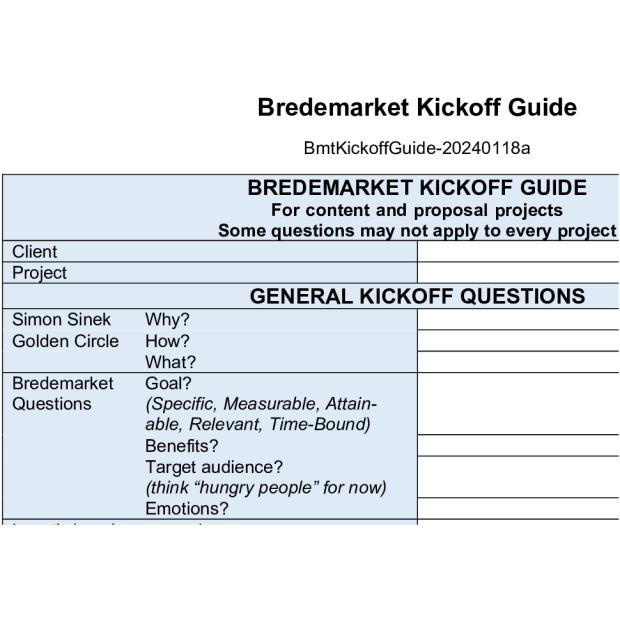
I start by asking seven questions about the content, your product, and your company.
Why?
How?
What?
Goal?
Benefits?
Target Audience?
Emotions?
I ask some additional questions which I won’t discuss in detail here. For example, you may specify the subject matter experts or articles I need to consult.
Once we’ve worked through ALL the questions, either in a synchronous meeting or asynchronously via email, I have a good idea of what the written content needs to say.
This benefits you because I love doing this, communicating your benefits to your prospects using the framework upon which we agreed in the kickoff.
Unless we agree on a different schedule, I get that first draft to you in three days for the next important step.
Step 3: First draft review
This is where you come in. Your task is to review my draft within three days and provide comments. And if I don’t hear from you within three days, you’ll hear from me. Why?
The first reason is my pure self-interest. The sooner I complete the project, the sooner I get paid. Those cold dead hands need some nice gloves.
The second reason is of mutual interest. We want to complete the project while we’re focused on thinking about it, and while it is critically important to us.
The third reason is for your own self-interest. You have a content gap, and it’s in your interest to fill that gap. If we get this draft reviewed and move forward, that gap will be filled quickly. If we don’t move forward, the gap will remain, your efforts to contract with Bredemarket will be for naught, and you’ll still have an uninteresting website and dead social media accounts.
Step 4: It depends
What happens after the first draft review varies from client to client.
Some of my clients love the first draft and don’t want to change a thing.
Some of my first drafts have embedded questions that you need to answer; once those questions are answered, the content is ready.
Some of my first drafts may need minor changes. In one case, I was asked to remove a reference to a successful hack that occurred at a well-known company; unbeknownst to me, the company was a customer of another division of the client in question. Whoops.
Occasionally more substantive changes are required, and I end up creating a second draft in three days, and you review it in three days.
In the end, we have a piece of content that is almost ready for publication.
Step 5: Finalize and publish
While the words may be ready, the entire piece is not.
I’m not a graphics person, and usually a written piece needs some accompanying images to drive the message home. I may suggest some images, or I may suggest that the client reuse an image from their website, or I may just ask the client to select an appropriate image.
Once the text and images are ready, you publish the piece. Normally I don’t have access to your website or social media accounts, so I can’t publish the piece for you. Only one client has given me such access, and even for that client I don’t have COMPLETE publishing permission.
For short projects such as a Bredemarket 400 project, I usually bill you when you publish the piece, although in certain circumstances I may bill you once the text is complete.
Are you ready to outsource your content marketing?
While other content marketers may work differently, we all have some type of process for our outsourced content writing.
If you’re ready to move forward with Bredemarket for outsourced content writing, contact me.
Last week I prepared a presentation for a conference organizer, thinking that I would give the presentation at the conference in question. Instead, the organizer emailed the presentation slides to selected conference attendees. The attendees probably liked it that way.
But I still wanted to give the presentation.
And I also wanted to generalize the presentation so that it applied to ALL technology companies, not just the ones who were attending the conference.
So I recorded myself giving the presentation “Differentiating Your Company and Your Products/Services.” It’s ten minutes long, and you can view it now.
Differentiating Your Company and Your Products/Services (April 9, 2024)
If you’re watching this video on your laptop, be sure to keep your smartphone handy because at the end of the video I display a QR code to obtain more information. Just point your phone at the QR code.
Of course, if you’re watching this video on your smartphone, you can’t read the displayed QR code. So just go to https://bredemarket.com/drive-tech/ instead.
I recall one product in particular (not a Segway, but a biometric product housed in a tower) that was an impressive fusion of algorithmic and mechanical excellence. The complex design that went into developing the tower product resulted in a device that performed its function superbly.
The complex engineering also caused the product to have such a high price that no one would ever buy it…but I digress.
But there was another issue with the product. I was writing proposals at the time, and we certainly could have written up a product description that emphasized the product’s lengthy set of features.
But the people receiving our proposals wouldn’t have cared one bit.
Prospects don’t care about lengthy feature lists
You see, prospects don’t care about lengthy feature lists.
If your product stops terrorists from boarding airplanes, then and only then will they care about your company or your product.
If your product can’t stop terrorists from boarding airplanes, or if there is another product that is better at stopping terrorists from boarding airplanes, then your prospects won’t care about your product.
So how do you get prospects to care?
You don’t get prospects to care by talking about your extensive feature lists.
Let me give you a tip. If you find an employee at the prospect’s company who wants to spend a lot of time talking about your extensive feature lists, that employee probably DOESN’T have the authority to approve the purchase.
The people who DO have the authority to approve the purchase don’t have time to talk about extensive feature lists.
The approvers want to know, in 30 seconds or less, how your solution BENEFITS them.
Do you need help explaining your benefits?
Talking about benefits rather than features is just one tactic to successfully appeal to your prospects.
If you need help ensuring that your written materials (blog posts, white papers, web pages) resonate with your prospects, you can ask Bredemarket to help you.
I’ve talked ad nauseum about the need for a firm to differentiate itself from its competitors. If your firm engages in “me too” marketing, prospects have no reason to choose you.
But what about companies that DO differentiate themselves…and suddenly stop doing so?
There are four reasons why companies could stop differentiating themselves:
Sometimes companies gain a temporary competitive advantage that disappears as other firms catch up. But more often, the company only pursues the differentiator temporarily.
In 1985, amid anxiety about trade deficits and the loss of American manufacturing jobs, Walton launched a “Made in America” campaign that committed Wal-Mart to buying American-made products if suppliers could get within 5 percent of the price of a foreign competitor. This may have compromised the bottom line in the short term, but Walton understood the long-term benefit of convincing employees and customers that the company had a conscience as well as a calculator.
Now some of you may not remember Walmart’s “Made in America” banners, but I can assure you they were prevalent in many Walmarts in the 1980s and 1990s. Sam Walton’s autobiography even featured the phrase.
But as time passed, Walmart stocked fewer and fewer “Made in America” items as customers valued low prices over everything else. And some of the “Made in America” banners in Walmarts in the 1990s shouldn’t have been there:
“Dateline NBC” produced an exposé on the company’s sourcing practices. Although Wal-Mart’s “Made in America” campaign was still nominally in effect, “Dateline” showed that store-level associates had posted “Made in America” signs over merchandise actually produced in far away sweatshops. This sort of exposure was new to a company that had been a press darling for many years, and Wal-Mart’s stock immediately declined by 3 percent.
The Walmart domestic production episodes illustrate something else. If Walmart wanted to, it could have persevered and bought from domestic suppliers, even if the supplier price differential was greater than 5%.
But the buying customers didn’t really care.
Affordability was much more important to buyers than U.S. job creation.
So while labor leaders, politicians, and others may have complained about Walmart’s increasing reliance on Chinese goods, the company’s customers continued to do business with Walmart, bringing profitability to the company.
And before you decry the actions of consumers who act against their national self-interest…where was YOUR phone manufactured? China? Vietnam? Unless you own a Librem 5 USA, your phone isn’t from around here. We’re all Commies.
The market has changed
Sometimes the market changes and consumers look at things a little differently.
I’ve previously told the story of Mita, and its 1980s slogan “all we make are great copiers.” In essence, Mita had to adopt this slogan because, unlike its competitors, it did NOT have a diversified portfolio.
This worked for a while…until the “document solutions” industry (copiers and everything else) embraced digital technologies. Well, Fuji-Xerox, Ricoh and Konica did. Mita didn’t, and went bankrupt.
Before Walmart emphasized “Made in America” products, former (and present) stand-up comedian Steve Martin was dispensing tax advice.
“Steve.. how can I be a millionaire.. and never pay taxes?” First.. get a million dollars. Now.. you say, “Steve.. what do I say to the tax man when he comes to my door and says, ‘You.. have never paid taxes’?” Two simple words. Two simple words in the English language: “I forgot!”
While the IRS will not accept this defense, there are times when people, and companies, forget things.
I know of one company that had a clear differentiator over most of its competition: the fact that a key component of its solution was self-authored, rather than being sourced from a third party.
For a time, the company strongly emphasized this differentiator, casting fear, uncertainty, and doubt against its competitors who depended upon third parties for this key component.
But time passes, priorities change, and the company’s website now buries this differentiator on a back page…making the company sound like all its competitors.
But the company has an impressive array of features, so there’s that.
Restore your differentiators
If your differentiators have faded away, or your former differentiators are no longer important, perhaps it’s time to re-emphasize them so that your prospects have a reason to choose you.
Ask yourself questions about why your firm is great, why all the other firms suck, and what benefits (not features) your customers enjoy that the competition’s customers don’t. Only THEN can you create content (or have your content creator do it for you).
A little postscript: originally I was only going to list three items in this post, but Hana LaRock counsels against this because bots default to three-item lists (see her item 4).
















 Bredemarket