Are you a technology marketing leader, struggling to market your products to your prospects for maximum awareness, consideration, and conversion?
I’m John E. Bredehoft. For over 30 years, I’ve created strategy and tactics to market technical products for over 20 B2B/B2G companies and consulting clients.
How can blog posts increase the awareness of your identity/biometric or technology company’s products and services? I’m going to explain how in this blog post.
Imagine there’s a funnel. It’s easy if you try. But this funnel doesn’t stream water, but people. (Or wombats.)
The funnel. Imagen 4.
In this funnel, the people (or wombats) who are potentially interested in your offering—your prospects—start at the very top. The few who actually buy your offering emerge from the bottom.
But how do you get people to enter the funnel and become aware of your offering?
How can blog posts help you?
One great way to let people know about your offering is by blog posts such as this one.
Blogs are a fast way to tell your prospects how your offering can help them. And you can create blog posts very quickly, within days or even hours.
If you want to make prospects aware of your company’s service, write a blog post.
What can Bredemarket offer to you?
One of Bredemarket’s offerings is…writing blog posts for other companies. I can help your identity/biometric or technology company write blog posts so you can get more people to learn about your services.
If you want to learn how I can help your company write blog posts, visit bredemarket.com/mark.
Do your technology company’s prospects know about you?
How can your technology company increase product benefit awareness right now?
(“Right Now” is a song. Keep tuned for another song reference.)
Before showing you how to do this, let’s take a closer look at three words in the title: product, benefit, and awareness.
Then we’ll get into the how: have, know, write, and publish.
And one more “how” if blogging is hard.
Three words break the code of indifference
No apologies for the section heading, but since her dad died, Kelly Osbourne’s best song (albeit with a curious history) has been on my mind.
While Osbourne’s one word breaks the code of silence, the three words that I chose for my post title break the code of indifference. And I chose each of them—product, benefit, and awareness—carefully.
Word One: Product
Companies talk about a lot of things. Their “why” story. Their great place to work award. Their social/moral/ethical conscience.
Right now I don’t care about any of that. I care about the company’s products or services: the way they make money.
Product firms need products. Imagen 4.
Because if prospects don’t buy these products and become customers, then their why story and awards and conscience count for zilch. There’s a time to share those stories, but for now let’s focus on the product story.
Word Two: Benefit
Now once you look at those products, they have a bunch of features. The ability to capture fingerprints at 1,000 pixels per inch. The ability to complete a third-party risk management analysis in hours, not months. The ability to deliver a completely vetted blog post in days, not weeks.
Right now I don’t care about any of that. I care about the benefits the product brings to the prospect: the things that will make them become a customer.
Revenue is definitely beneficial. Imagen 4.
Because prospects don’t care about you; they only care about themselves. And if your product doesn’t provide tangible benefits to them, they’ll ignore it.
Word Three: Awareness
The third word differs from the other two, because there are multiple answers that are equally valid. I’ve just chosen to focus on one. If you subscribe to the notion of an ordered funnel (some marketers instead believe in a messy middle), then all prospects enter at the beginning of the funnel, and a subset of those prospects exit as buying customers at the end of the funnel. Using a simple three-stage funnel model, you can define those three stages as awareness, consideration, and conversion.
Right now I don’t care about consideration or conversion, although they’re obviously important. (If you have no conversions, you have no revenue, and you have no company.) For my purposes I’m focusing on awareness, or the stage in which a prospect discovers that your company has a product or service that benefits them.
Awareness. Imagen 4.
So how can you raise awareness of the benefits of your product to your prospects? There are multiple methods: text, images, videos, quizzes, contests, webinars, and podcasts. Bredemarket uses many of these methods via its social media channels. But today I’m going to focus on one particular method: blog posts. But we’ll cover some of the other ones also.
One blog breaks the lack of knowledge
The reason that I’m so gung-ho about blog posts is that they can be created and distributed very quickly. Press releases can take a long time. Videos, even longer. Webinars, even longer still.
Compare that to a blog post. A sole proprietor can generate a blog post in an hour. A company can get an emergency blog post out in the same time, provided the right people are in the room.
But before you can wow the world with your product’s benefits to your prospects, you have to go through several steps. The four steps listed here (have, know, write, and publish) are somewhat, but they paint the broad brush strokes.
Step One: Have a blog site (or equivalent)
This sounds obvious, but if you don’t have a blog site, you can’t post a blog.
Using myself as an example, my Bredemarket website is hosted by WordPress. And the website has an area where I’ve filed over a thousand blog posts, including this one.
Step Two: Know what you’re going to say, and why you’re saying it (I ask…)
I could spend ten blog posts talking about this step alone. It’s a loaded step encompassing both strategic and tactical elements. Vision. Mission. Positioning and messaging. And finally, the topic that you want to address in this single blog post.
For now I’ll just say that you should take a deep breath before putting pen to paper (or keyboard to file).
Step Three: Write and rewrite what you want to say (…then I act)
I ask, then I act.
But I act iteratively.
In most cases, I don’t just write and post.
I often create what I call a “draft 0.5,” where I get my ideas down, sleep on them, and then take a fresh second look. Often during that second look I cut out half the text.
When working on a project for a Bredemarket client, the text bounces between me and the client. I’ll write the first draft, then the client will review it and offer suggestions, and then I’ll rewrite it. For shorter text I’ll usually have two review cycles, with three review cycles for longer text.
The important thing is to get the piece written, reviewed, and approved. While I’ve drafted pieces and sat on them for months, the true benefits of blogging occur when you publish the piece as soon as possible.
Step four: Publish and publicize
When you’re ready, publish the blog post.
Perhaps you want to schedule the post to appear at an optimum time. For example, I am typing these words (or draft 0.5 of them anyway) on Sunday afternoon, knowing full well I won’t post this on Sunday afternoon. I’m thinking Tuesday morning.
And maybe there’s a reason why you want to publish a post at a particular time. If a trade show begins on Monday September 15, you may want to publish the promotional blog post on Friday September 12.
Once you’ve posted, publicize it.
If your company has an array of social media channels, you have two choices. Either you can post a link to the blog post on the social channel, or you can encapsulate the message from the blog post and repurpose it for the social channel without linking externally. Whatever gets the message out.
Taking an example from myself, I created a video entitled “Landscape (Biometric Product Marketing Expert)” on Sunday morning. I shared this video in a blog post. I also shared it in social media posts on Bluesky, Facebook, Instagram, LinkedIn, Substack, Threads, TikTok, WhatsApp, and YouTube. The only current social channels where I didn’t share it were Flip (because it’s…landscape). If I wanted to, I could have assembled a video or created a podcast or hosted a webinar. Oh, and I’m sharing it again. (Right now.)
Landscape (Biometric Product Marketing Expert).
Depending upon your thinking time, your drafting time, and your review cycles, you can get your message out to your prospects within a week…or even within a day.
Not too bad.
But I can’t do all that!
For some people, the idea of writing a blog post can be overwhelming.
That’s why Bredemarket is here to help you increase your tech company’s product benefit awareness. (Right now.)
If you have a blog site (or a LinkedIn, Facebook, or other equivalent) and are ready to get your message out, let’s talk about next steps.
Imagine a Chief Marketing Officer sitting at her desk, wondering how she can overcome her latest challenge within three weeks.
She is a CMO at a biometric software company, and she needs someone to write the first two entries in a projected series of blog posts about the company’s chief software product. The posts need to build awareness, and need to appeal to prospects with some biometric knowledge.
So she contacts the biometric product marketing expert, John E. Bredehoft of Bredemarket, via his meeting request form, and schedules a Google Meet for the following meeting.
At the scheduled time she joins the meeting from her laptop on her office desk and sees John on the screen. John is a middle-aged Caucasian man with graying hair. He is wearing wire-rimmed glasses with a double bridge. He has a broad smile, with visible lines around his eyes and mouth. His eyes are brown and appear to be looking directly at the camera. He is wearing a dark blue collared shirt. While his background is blurred, he appears to be in a room inside his home, with a bookcase and craft materials in the background.
After some pleasantries and some identity industry chit chat, John started asking some questions. Why? How? What? Goal? Benefits? Target audience (which he called hungry people)? Emotions? Plus some other questions.
They discussed some ideas for the first two blog posts, each of which would be about 500 words long and each of which would cost $500 each. John pledged to provide the first draft of the first post within three calendar days.
After the call, the CMO had a good feeling. John knew biometrics, knew blogging, and had some good ideas about how to raise the company’s awareness. She couldn’t wait to read Bredemarket’s first draft.
If you are in the same situation as the CMO is this story, schedule your own meeting with Bredemarket by visiting the https://bredemarket.com/mark/ URL and filling out the Calendly form.
Remember how I warned you that this post was going to read odd? In case you’re wondering about the unusual phrasing—including a detailed description of what I look like—it’s because I fed the entire text of this blog post to Google Gemini. Preceded by the words “Draw a realistic picture of.” And here’s what I got.
Imagen 4. I’m not on the screen, but I like the content ideas.
Imagen 4. With the bookcases. And I’ve never had a beard.Imagen 4. But that’s not blurred.
The reason that I redirected the purpose of my Substack posts is because much of my audience there isn’t familiar with the…um…minutiae of biometrics and identity. (For example, my reference to minutiae would probably go right past all but two of my Substack subscribers.)
My Substack audience is best served with awareness content.
But awareness content is not only informative and educational.
Awareness of you
It also makes prospects aware of your company…which is critically important.
“Technology marketers, do your prospects know who you are?
“If they don’t, then your competitors are taking your rightful revenue.
“Don’t let your competitors steal your money.”
Perhaps steal is a harsh word, but it’s accurate.
Or perhaps a better word is indifference: your actions indicate that you don’t care whether customers buy from you or not. If you cared, you’d actually market your products.
Who needs marketing?
“Nonsense, John! We have a sales staff. Who needs marketers?”
But your sales staff cannot be everywhere. If your prospects don’t know about you and aren’t reaching out to you, then you have to reach out to them.
And the calls? “Hi, I’m Tom with WidgetCorp.” “With who?”
So how is that current quarter looking now?
You need marketing, now
Your current quarter and future quarters would look better if your secret salesperson were working for you. As Rhonda Salvestrini said:
“Content for your business is one of the best ways to drive organic traffic. It’s your secret salesperson because it’s out there working for you 24/7.”
But the secret salesperson won’t engage your prospects until you act to create that content.
It’s not enough for your company’s prospects to know who you are, but it helps. But you can do more than that…with Bredemarket’s help.
Who are you?
Who are you?
I just searched for the leading software providers in a particular category. This isn’t unusual. If someone wants to purchase software, they will often conduct their own research before letting themselves be pestered by salespeople.
My category search turned up several software packages.
It DIDN’T turn up numerous others in that category.
So a whole bunch of companies are already at a disadvantage, and there’s a good chance that their competitors are going to take their money because the software buyer won’t even think of purchasing from them.
The software buyer has no AWARENESS of these other software packages.
“Two discussions of this three-step sales funnel are provided by Venn Marketing and Walker Sands (the latter of whom throws in things that happen AFTER the purchase, engagement and advocacy).
“Both sources define awareness as the first step in the funnel, and its purpose is to (drumroll) simply make prospects, um, aware that you and your product/service exist.”
Obviously there are other things you need to do to end up with a happy customer, but you’ll never get a happy customer if it doesn’t even know about you during the prospect stage.
Awareness of what?
We’re a unicorn!
Now there are all sorts of ways to raise awareness, but some are better than others.
I previously linked to the story of Beatrice’s rise and fall, in which the fall was illustrated by the infamous “We’re Beatrice” campaign. The tagline? “We’re Beatrice.” What did the tagline mean to prospects? Absolutely nothing.
I knew of another company that was slightly more successful, but not much. Instead of saying “We’re (COMPANY NAME),” they loudly proclaimed “We’re a Unicorn.” This was back during one of the periods of heated market acquisitions. But what difference did the company’s unicorn status mean for its prospects? Not much. If you’ve raised a billion dollars, I only care if you promise to give me a couple of million of it.
Here in Southern California, Honda car dealers have banded together to produce ads about the “helpful Honda people.” Unfortunately, the ads have nothing to do with cars, the products these commercials are supposed to be selling. What difference does a Honda dealer’s helpfulness make? Unless your cat is stuck in a tree, not much.
It’s not enough for your company’s prospects to have awareness about you. They need to have awareness about how you can solve their problems.
Perhaps your company needs to raise awareness of your solutions to your prospects’ problems.
Bredemarket can work with you on this, asking questions and even engaging in…um…WOMBAT to produce impactful content for your company and its products and services.
So that your prospects know about you.
Then we can work on the next steps, consideration and conversation.
Technology marketers, do your prospects know who you are?
If they don’t, then your competitors are taking your rightful revenue.
Don’t let your competitors steal your money.
Before I tell you how Bredemarket can solve your technology company’s awareness problem, let me spill the secret of why I’m asking the question in the first place.
The wildebeest’s friend
Normally I don’t let non-person entities write Bredemarket content, but today I’m making an exception.
Sources.
My usual generative AI tool is Google Gemini, so I sent this prompt:
“What are the five most important types of marketing content to create for a technology software company?”
A little secret: if you want generative AI to supply you with 3 things, ask for more than that. Some of the responses will suck, but maybe the related ones are insightful.
In this case I only wanted ONE type of marketing content, but I reserve the right to “co-author” four more posts based upon the other responses.
Of the 5 responses from Google Gemini, this was the first:
“In-depth Problem-Solving Content (Think Blog Posts, White Papers, Ebooks): Your potential customers are likely facing specific challenges. Content that dives deep into those problems and offers insightful solutions (even if it doesn’t directly pitch your product) builds trust and positions you as a thought leader. Think “The Ultimate Guide to [Industry Challenge]” or a white paper on “Navigating [Complex Technical Issue].””
Now you see where I got the idea for the title of this post. Normally I shy away from bombastic words like “ultimate,” but this sage is going a little wild.
So the bot tells me that the most important type of marketing content for a technology software company is short-form or long-form problem-solving content.
Going meta
Let’s get a little meta (small m) here.
If your prospects don’t know who you are, create customer-focused content that explains how your company can solve their problems.
Solving problems.
Now let’s get meta meta.
If you need help creating this content, whether it’s blog posts, articles, white papers, case studies, proposals, or something else, Bredemarket can help you solve your problem.
Let’s talk about your problem and how we can work together to solve it. Book a free meeting via the https://bredemarket.com/cpa/ URL.
(All AI illustrations from Imagen 3 via Google Gemini, of course)
While updating my resume today, I discovered that I have now written over 700 blog posts on the Bredemarket site alone. This is number 725, in case you’re keeping score.
And that doesn’t count the myriad of blog posts I’ve written for consulting clients or employers, plus the posts I’ve written for other blogs over the years dating back to 2003.
So in case you’re wondering: yes, I’ve written blog posts before.
And I can augment your company’s resources by writing blog posts (for example, via the Bredemarket 400 Short Writing Service) that drive awareness, consideration, and/or conversion.
With over 29 years of identity/biometric experience, John Bredehoft of Bredemarket is the biometric product marketing expert that can move your company forward.
A client is attending an in-person event and asked for advice on how to collect prospect leads at the event. (For awareness.)
Since I practice a mix of old school and new-school technologies, I’m suggesting the following:
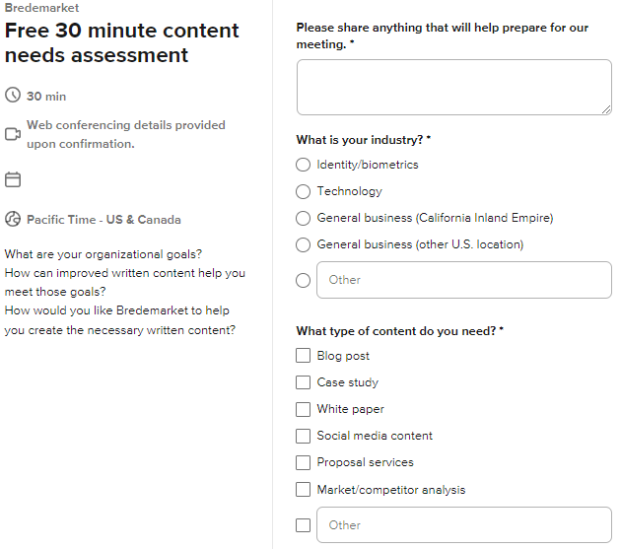
Create a landing page for the event with a form to collect the prospect’s name, email, and other essential information, and feed those names into the client’s customer relationship management (CRM) system.
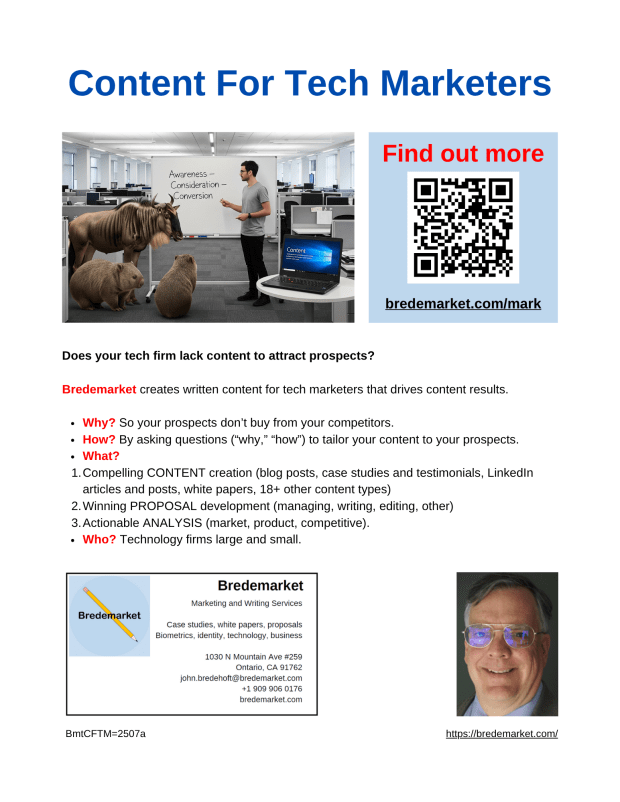
Create a printed sheet with a QR code leading to the landing page, have the prospect point their camera to the QR code, and then the prospect can enter their information directly from their phone.
There are many other ways to collect information, including specialized software and (really old school) business cards, but this way will work.
I wanted to demonstrate how to do this, but Bredemarket doesn’t have any in-person events on its calendar, and I don’t ask my prospects to sign up for my CRM.























 Bredemarket