I’m moving in a different direction on social media. Well, personal social media anyway.
There are multiple schools of thought about whether small companies with well-known leaders should share content on their company platforms or their personal social media platforms.
On one extreme, companies only share content on company channels, to better establish the brand of WidgetCorp or whatever.
On the other extreme, company heads only share content on their personal channels because their personal connections are so important to the company’s success. In fact, these company heads may not even bother to create separate company pages.
Obviously, most companies and company heads adopt a “do both” tactic. Maybe the company head reshares company posts. Or maybe the company reshares company head posts.
Or they do something that John Bredehoft and Bredemarket have done in the past: share the same content on both the company and the personal channels.
I might not do that any more.
The experiment
The rationale behind sharing company posts on your personal channels is that your personal friends like you and will engage with your company posts.
But this rationale ignores one very pertinent fact: most of my friends have NO interest in identity, biometrics, cybersecurity, or related technologies.
Why would they engage with such content if it doesn’t interest them?
I’d share Bredemarket Facebook content to my personal Facebook feed…and with very few exceptions I’d end up with crickets.
Or I’d share some Bredemarket LinkedIn content to my personal LinkedIn account. Often…crickets.
But most painful of all was when I would share Bredemarket Instagram posts to my Instagram stories. Higher impressions then the same stories on the Bredemarket account…but absolutely no engagement. Crickets again.
So on Monday afternoon I intentionally conducted an experiment on my personal Facebook, Instagram, and LinkedIn accounts, where together I have a combined 3,396 connections. My Monday afternoon identity/biometric and product marketing-related content received a total of 9 engagements…and that’s counting the Instagram user who requested “Can u share it @canadian.icon”).
Even acccounting for the three algorithms involved…that’s low.
And it…um, prompted me to ask myself a “why” question.
Why share corporate content on personal feeds?
Good question.
So for now I’m “moving in a different direction” (a few of you know where THAT phrase originated) and not bothering to share Bredemarket content on my personal feeds. At least for now.
Those who are dying to see Bredemarket content will subscribe to the appropriate Bredemarket Facebook, Instagram, or LinkedIn feeds.
But frankly, my friends have no need or desire to see Bredemarket content, so they won’t.
In my case, my high school friends, church friends, and even some of my former coworkers (who left the identity/biometric industry years ago) are NOT Bredemarket’s hungry people. So I’ll spare them the parade of wildebeests, wombats, and iguanas.
Product and service marketing is deceptively easy…because there’s no need to market to everyone.
I just calculated the numbers. Of the world’s population (not counting non-person entities) a generous (!) maximum of 8,000 people are hungry and interested in buying the services Bredemarket provides.
The true number is probably more like 800, but let me fantasize for a moment.
Unreal fantasy.
Or to put it another way, 99.9999% of people have absolutely no interest in Bredemarket.
But I didn’t privately contact people and gloat about my byline.
Well, with two exceptions. Because I wrote briefly (one sentence) about third-party risk management, I privately alerted two TPRM professionals who wouldn’t have seen it otherwise.
“Employ third-party risk management (TPRM) to minimize the risk when biometric data is stored with cloud providers, application partners, and companies in the supply chain.”
Pearls and ice
Other than that, I engaged in no private messaging, even to long-standing biometric professionals.
Some of the biometric professionals saw my blog or social mentions of the guest post and were duly impressed.
Others likely saw my blog or social mentions and didn’t care one bit.
The rest never saw my blog or social mentions, which meant that they didn’t actively follow Bredemarket, which again meant that they didn’t care at all.
The whole pearls before swine story plays here.
Or selling ice makers to Eskimos.
A lost cause.
Whatever example you prefer, there’s no need to market your product to those who don’t give a REDACTED about it.
“Steak and Kidney Pie – It is a classic British pie filled with chunks of beef steak and kidneys cooked in a rich gravy.
“Chicken and Mushroom Pie – This pie is made with tender pieces of chicken combined with mushrooms in a creamy sauce, which is then encased in pastry.
“Cornish Pasty – Although Cornish Pasty is not a pie, many refer to it as a handheld pie. It is a pastry filled with diced meat, potatoes, and vegetables.
“Shepherd’s Pie – A minced lamb or beef pie is topped with mashed potatoes in this preparation.”
And on and on through other meats, but no apple pie on the list. (And forget about pumpkin pie.)
Cars
Which brings us to the British equivalent of the Chevrolet. In the 1970s, I’m not certain that Chevrolet was “America’s favorite car”—sister GM brand Oldsmobile may have held that title numerically. But “Chevy” vied with Ford as the sentimental favorite in the 1970s.
Today America’s favorite car is the Toyota.
But what of the United Kingdom? Obviously not everyone could afford a Rolls Royce. They were buying Fords in 1975, primarily the Cortina and the Escort. I owned an Escort here in the U.S. many years later, but never owned a Cortina, a primarily UK auto related to the Taurus.
Bredemarket promotes itself in all sorts of places. My LinkedIn newsletter is an example, but there are other places where Bredemarket speaks, including the Bredemarket blog and a number of social channels.
The channels that Bredemarket uses have varied over time. While wise minds such as Jay Clouse have recommended to not spread yourself thin, I ignored his advice and found myself expanding from LinkedIn to TikTok. (TikTok is a Chinese-owned social media platform. You may have heard of it.)
Then in May 2024 I contracted my online presence, announcing that I was retreating from some social channels “that have no subscribers, exhibit no interest, or yield no responses.” After I had shed some channels, I ended up on a basic list of Facebook, Instagram, LinkedIn, and Threads.
Now I may contract again, and I may expand again, but for now I want to touch upon the reasons why a business should post or not post on multiple social channels, and how the business can generate content for all those channels.
Why should you only post on a single social channel?
There is no right or wrong answer for every business, and there are some businesses that should only post on a single social channel.
If all your prospects are using a single social channel and are on NO OTHER channel, then you only need to post on that channel.
If you are NOT in danger of losing your account on that social channel because of some automated detection of a violation (“You violated one of the terms in our TOS. We won’t tell you which one. YOU figure it out.”), then you can continue to post on that channel and no other.
If the social channel is NOT in danger of business liquidation or forced government closure, then you can continue to post on that channel and no other.
Why should you post on multiple social channels?
Not all businesses satisfy all the criteria above. For one, your “hungry people” (target audience) may be dispersed among several social channels. From my personal experience, I know that some people only read Bredemarket content in my blog, some only read my content on LinkedIn, some only read my content on Facebook (yes, it’s true; one of Bredemarket’s long-term champions primarily engages with me on Facebook), some only on Instagram, and so forth.
What would happen if I decided to can most of my social channels and only post TikTok videos? I’d lose a lot of engagement and business.
Even if I concentrated on LinkedIn only, which seems like a logical tactic for a B2B service provider, I would lose out. Do you know how many people on Threads NEVER read LinkedIn? I don’t want to lose those people.
So that’s where I ended up. And if you know my system, the question after the “why” question is the “how” question…
How can you post on multiple social channels?
Repurposing…intelligently.
You don’t have to create completely unique content for every platform. You can adapt content for each platform, when it makes sense.
So now I’m going to eat my own wildebeest food and see where I can repurpose this text, which was originally a LinkedIn article. Yes, even on TikTok. I may not come up with a whopping 31 pieces of content like I did in a 2023 test, but I can certainly get this message out to people who hate LinkedIn. Perhaps maybe even to my mailing list, for people who have subscribed to the Bredemarket mailing list.
I haven’t figured out what I’ll do in this particular instance, but here are some general guidelines on content repurposing:
You can just copy and paste the entire piece of content on another platform. For example, I took all this text and copied it from the original LinkedIn article. But I hope I remembered to edit all the phrases that assume this content is posted on LinkedIn. And I’d have to consider something else…
You can just copy and paste the entire piece of content on another platform and remove the links. To be honest, no social media platform likes outbound links, but some platforms such as Instagram REALLY don’t like outbound links. So before you do this, ask if the content still makes sense if the links aren’t present.
You can provide a summary of the content and link back to the original content for more detail. Isolate the important points in the content, just publish those isolated points, and then link back to the original content if the reader wants more detail. Bear in mind that they probably won’t, because clicking on a link is one extra step that most people won’t want to do.
You can provide a really short summary of the content and link back to the original content for more detail. Bluesky and other Twitter wannabe platforms have character limitations, so often you have to really abridge the content to fit it in the platform. I’ve often written a “really short” version of my content for resharing, then discovered that even that version is too long for Bluesky.
You can address the content topic in an entirely different medium. Because of my preferences, I usually start with text and then develop an image and/or a video and/or audio that addresses the topic. But trust me—if I convert this blog post (yes, I rewrote the preceding three words when I copied this from the original LinkedIn article) into video or audio format, it will NOT include all the words you are reading here. Unless I’m feeling particularly cranky.
Oh, and if you’re using pictures with your content, don’t forget to adjust the pictures as needed. A 1920×1080 LinkedIn article image will NOT work on Instagram.
So there you have it. Posting on multiple social channels helps you reach people you may not otherwise reach, as long as you don’t spread yourself too thin or get discouraged. And you can repurpose content to fit within the expectations of each of these social channels, allowing you to re-use your content multiple times.
If you’ll excuse me, I have a lot of work to do. (Plus the usual Bredemarket services: I onboarded a new client yesterday and hope to onboard another one this week.)
If your humor has evolved to a point where the very idea of an IPVM account on TikTok amuses you—and if my use of the word “evolved” amuses you further—then perhaps Bredemarket offers the background and experience to help you convey your
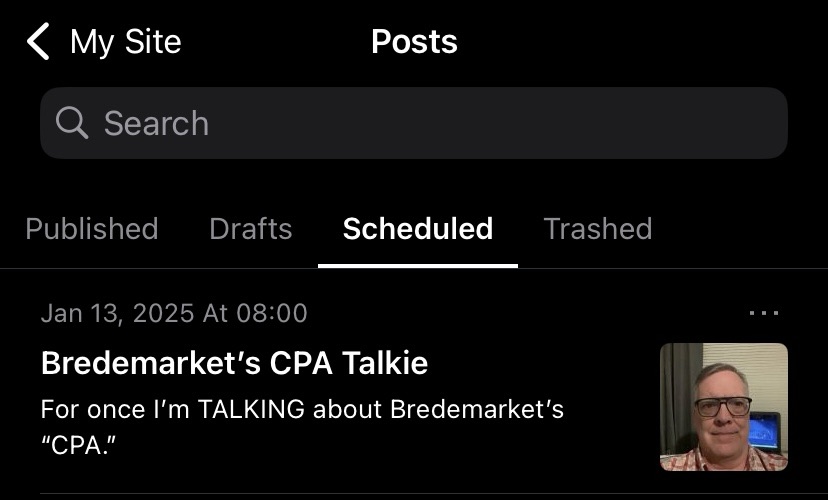
First, the video is 3 minutes and 40 seconds long, which for me is long. And why you won’t see it on Bluesky or Instagram. But you will see it here; it’s already scheduled.
Oh, and I talk. The video alternates between shots of me at Bredemarket world headquarters and shots of textual/image descriptions incorporating Canva’s finest AI-generated music. If you’ve seen my other videos you know the…um…score.
I start by introducing the subject of “marketing and writing services” and identifying MY hungry people (target audience).
Then I explain, in detail, what Bredemarket’s “CPA” services are NOT…and what they ARE.
Then I do something that some sales professionals would NEVER do—reveal my pricing up front.
Finally, my call to action is for interested prospects to book a meeting with me on my CPA page. If you don’t already have the link to that page, you’ll get it on Monday.
Well, that’s that. Come back Monday at 8:00 am Pacific Standard Time / 1600 GMT.
My current two categories for go-to-market collateral, “external” and “internal,” are not sufficient. I want to fix that, but I’m still thinking through things, such as what to call the third category. As of this moment, my best option is “intrinsic,” based upon my conversations with my good buddy Gemini.
My current two categories for go-to-market collateral
Based upon go-to-market efforts that stretch back a decade (even before I formally became a Product Marketing Manager), I have traditionally divided go-to-market output into two categories.
22 types of content Bredemarket can create.
External content for your hungry people (target audience), such as articles, blog posts, social media, case studies, white papers, and proposals. This content goes to CEOs, marketers, engineers, IT staff, and many others at the companies that buy from you.
Internal content for the people in the company who talk to your hungry people, such as battlecards, sales playbooks, and scripts for trade show demonstrations. This content goes to salespeople, marketers, product managers, customer success folks, and many other employees and contractors.
Some content can either be external or internal, depending upon the audience.
Simple and straightforward, right?
My emerging third category
But during a current go-to-market effort for a client, I realized that these two categories are insufficient, since both the client and I are creating content that will never been seen by either the external clients or the internal clients.
I’ll give you two heavily redacted and anonymized examples for a #fakefakefake machine.
AI-generated by Google Gemini.
Bob wrote a Word document that listed the pain points that MegaCorp’s client encounter when trying to put green round widgets on their end customers’ beanie caps.
Judy created a picture with stick figures that showed how clients can use the MegaCorp WidgetPlacer 2000 for their beanie cap production needs.
Bob and Judy (names from this song) are NEVER going to show that document or that picture to the customers, or even to the company’s own account managers.
So why create it?
Because they will be the initial guides as the go-to-market team creates all the other external and internal collateral for the effort.
These foundation documents are a critical part of the go-to-market effort. Without them, the subsequent go-to-market collateral will be a contradictory mishmash of stuff, and you’ll need to undertake a lot of effort to align all the content after the fact.
And the third category is…
…well, I don’t know what to call this third category yet.
“Internal internal content” seems a bit silly.
“Foundational content” seems a bit grandiose.
“Bob and Judy” content seems like an independent TV show.
If we call the first category “external” marketing content for customers, and we call the second category “internal” marketing content for employees, then what do we call the third category which is only for the people who create marketing content for customers and employees?
Gemini’s first batch of answers:
Internal Marketing Content for Marketing Teams
Marketing Team Communication
Marketing Team Resources
Internal Marketing Tools
Brevity is NOT a strength of generative AI. Even when I specifically instructed Gemini to provide single word responses, I got hyphenated words:
Intra-marketing (combining “intra” for within and “marketing”)
Meta-marketing (implying a higher-level perspective on marketing)
Team-marketing (emphasizing its focus on the marketing team)
The fatal flaw is that not all the people on a go-to-market team are marketers. (This is my fault because of the prompt I wrote.)
And if I lop off the last part of each compound phrase, two of my options are “team” (too generic) and “meta” (NO).
And “intra” is too close to “internal internal.” But perhaps it’s a start. So I asked Gemini for words similar to “intra-” and got this response:
The prefix “intra-” means “within,” “inside,” or “inner.” Here are 12 words that convey a similar meaning:
Inward: Turning or moving toward the inside.
Internal: Existing or occurring within something.
Inner: Situated or located within.
Intrinsic: Belonging to or inherent in the nature of something.
Interior: The inside part of something.
Intramural: Occurring within a school or institution.
Intranet: A private computer network within an organization.
Intravenous: Administered into a vein.
Intracranial: Situated or occurring within the skull.
Intracellular: Existing or occurring within a cell.
Intralingual: Relating to or occurring within a language.
Intrajugular: Situated or occurring within the jugular vein.
I kind of like “intrinsic,” but I’ll sleep on it.
In the meantime, what would YOU call the third category?
If you don’t remember, “Why ask why? Try Bud Dry” was a short-lived advertising tagline from a short-lived Budweiser product from some short-lived part of the early 90s…
But “why ask why” is not just an old advertising slogan. It’s also an excellent question in its own right.
If you’ve read my writing for any length of time, you know I spend a lot of time on the questions why, how, and what.
Heck, I even wrote a book about those (and three other) questions. Then I rewrote the book when I came up with a seventh question.
But during the last few years I failed to realize one true power of these interrogative questions—and other interrogative questions such as who (an important question for identity folks).


















 Bredemarket