Updates, updates, updates, updates…

If I hired myself to update the Bredemarket website, I’d be employed full time.

Early June website updates

My “opportunity” that allowed me to service identity clients again necessitated several changes to the website, which I documented in a June 1 post entitled “Updates, updates, updates…

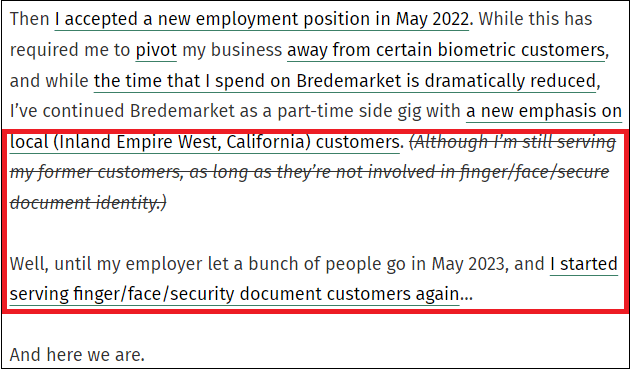
Then I had to return to this website to make some hurried updates, since my April 2022 prohibition on taking certain types of work is no longer in effect as of June 2023. Hence, my home page, my “What I Do” page, and (obviously) my identity page are all corrected.

From https://bredemarket.com/2023/06/01/updates-updates-updates/

Basically, I had gone through great trouble to document that Bredemarket would NOT take identity work, so I had to reverse a lot of pages to say that Bredemarket WOULD take identity work.

I may have found a few additional pages after June 1, but eventually I reached the point where everything on the Bredemarket website was completely and totally updated, and I wouldn’t have to perform any other changes.

You can predict where this is going.

Who I…was

Today it occurred to me that some of the readers of the LinkedIn Bredemarket page may not know the person behind Bredemarket, so I took the opportunity to share Bredemarket’s “Who I Am” web page on the LinkedIn page.

Only then did I read what the page actually said.

So THAT page was also updated (updates in red).

From https://bredemarket.com/who-i-am/ as of August 8, 1:35 pm PDT. Subject to change.

So yes, this biometric content marketing expert/identity content marketing expert IS available for your content marketing needs. If you’re interested in receiving my help with your identity written content, contact me.

To be continued, probably…

There Are Just Five Factors of Authentication. (I want the job.)

As some of you know, I’m seeking full-time employment after my former employer let me go in late May. As part of my job search, I was recently invited to a second interview for a company in my industry. Before that interview, I made an important decision about how I was going to present myself.

If you’ve read any of Bredemarket’s content, there are times when it takes a light tone, in which wildebeests roam the earth while engaging in marketing activities such as elaborating the benefits of crossing the stream.

By Danijel Mihajlovic – https://thenextcrossing.com/wildebeest-migration-kenya, CC BY-SA 4.0, https://commons.wikimedia.org/w/index.php?curid=96024366

Some of that DOES NOT fly in the corporate world. (For most companies, anyway.) If you analyze a wide selection of corporate blogs, you won’t see the word “nothingburger.” But you do here.

So as I prepared for this important job interview, I made sure that I was ready to discuss the five factors of authentication, and my deep experience as an identity content marketing expert with many of those factors.

The five factors of authentication, of course, are:

  • Something you know.
  • Something you have.
  • Something you are.
  • Something you do.
  • Somewhere you are.

“But wait a minute,” some of you are saying. “Didn’t you just say that there is a sixth factor of authentication, ‘Somewhat you why?'”

For the purposes of this job interview, there isn’t! I confined myself to the five factors only during the discussion, using examples such as passwords, driver’s licenses, faces, actions, and smartphone geolocation information.

But in the end, my caution was of no avail. I DIDN’T make it to the next stage of interviews.

Maybe I SHOULD have mentioned “Somewhat you why” after all.

Bredemarket’s Name for the Sixth Factor of Authentication

Depending upon whom you ask, there are either three or five factors of authentication.

Unless you ask me.

I say that there are six.

Let me explain.

First I’ll discuss what factors of authentication are, then I’ll talk about the three factor and five factor school, then I’ll briefly review my thoughts on the sixth factor—now that I know what I’ll call it.

What are factors of authentication?

Before proceeding to factors of authentication, let’s review TechTarget’s definition of authentication.

Authentication is the process of determining whether someone or something is, in fact, who or what it says it is.

From https://www.techtarget.com/searchsecurity/definition/authentication

For purposes of this post I’m going to stay away from the “something” part and concentrate on the “someone” part.

For example, if Warren Buffett has a bank account, and I claim that I am Warren Buffett and am entitled to take money from that bank account, I must complete an authentication process to determine whether I am entitled to Warren Buffett’s money. (Spoiler alert: I’m not.)

So how do I authenticate? There are many different ways to authenticate, which can be grouped into several authentication factors. Here’s how Sumo Logic defines “authentication factor.”

An authentication factor is a special category of security credential that is used to verify the identity and authorization of a user attempting to gain access, send communications, or request data from a secured network, system or application….Each authentication factor represents a category of security controls of the same type. 

From https://www.sumologic.com/glossary/authentication-factor/

When considering authentication factors, the whole group/category/type definition is important. For example, while a certain system may require both a 12-character password and a 4-digit personal identification number (PIN), these are pretty much the same type of authentication. It’s just that the password is longer than the PIN. From a security perspective, you don’t gain a lot by requiring both a password and a PIN. You would gain more by choosing a type of authentication that is substantially different from passwords and PIN.

How many factors of authentication are there?

So how do we define the factors of authentication? Different people have different definitions.

Three factors of authentication

For the most part, I believe that everyone agrees on at least three factors of authentication. As I noted in a prior post on factors of authentication, NIST defines the following three factors:

Factors include: (i) something you know (e.g. password/personal identification number (PIN)); (ii) something you have (e.g., cryptographic identification device, token); or (iii) something you are (e.g., biometric).

From https://csrc.nist.gov/glossary/term/Multi_Factor_Authentication, cited in https://bredemarket.com/2022/03/19/remember-the-newer-factors-of-authentication/

Note that NIST’s three factors are very different from one another. Knowing something (such as a password or a PIN) differs from having something (such as a driver’s license) or being something (a fingerprint or a face).

But some people believe that there are more than three factors of authentication.

Five factors of authentication

Let’s add two factors to the definition trumpeted by NIST. People such as The Cybersecurity Man have included all five in their definition.

  • Something you know.
  • Something you have.
  • Something you are.
  • Something you do.
  • Somewhere you are.

For more information, see my March 2021 post on the five factors of authentication.

But are there only five?

Six factors of authentication

In April 2022, I began wondering if there is a sixth authentication factor. While I struggled to put it into the “some xxx you xxx” format, I was able to encapsulate what this sixth factor was.

What about the authentication factor “why”?

This proposed factor, separate from the other factors, applies a test of intent or reasonableness to any identification request.

From https://bredemarket.com/2022/04/12/the-sixth-factor-of-multi-factor-authentication-you-heard-it-here-first/
Why is this man smoking a cigarette outdoors? By Marek Slusarczyk, CC BY 3.0, https://commons.wikimedia.org/w/index.php?curid=108924712

Over the months, I struggled through some examples of the “why” factor.

  • Why is a person using a credit card at a McDonald’s in Atlantic City? (Link) Or, was the credit card stolen, or was it being used legitimately?
  • Why is a person boarding a bus? (Link) Or, was the bus pass stolen, or was it being used legitimately?
  • Why is a person standing outside a corporate office with a laptop and monitor? (Link) Or, is there a legitimate reason for an ex-employee to gain access to the corporate office?

As I refined my thinking, I came to the conclusion that “why” is a reasonable factor of authentication, and that this was separate from the other authentication factors (such as “something you do”).

And the sixth factor of authentication is called…

You’ll recall that I wanted to cast this sixth authentication factor into the “some xxx you xxx” format.

So, as of today, here is the official Bredemarket list of the six factors of authentication:

  • Something you know.
  • Something you have.
  • Something you are.
  • Something you do.
  • Somewhere you are.

(Drumroll…)

  • Somewhat you why.

Yes, the name of this factor stands out from the others like a sore thumb (probably a loop).

However, the performance of this factor stands out from the others. If we can develop algorithms that accurately measure the “why” reasonableness of something as a way to authenticate identity, then our authentication capabilities will become much more powerful.

How Can Your Identity Business Create the RIGHT Written Content?

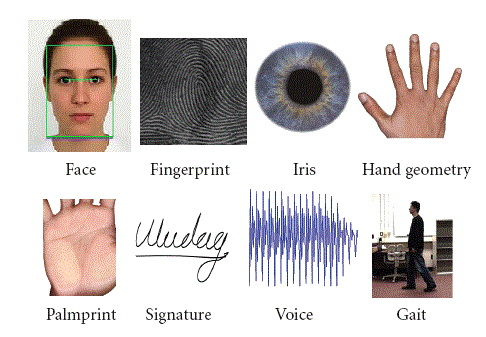
Does your identity business provide biometric or non-biometric products and services that use finger, face, iris, DNA, voice, government documents, geolocation, or other factors or modalities?

Does your identity business need written content, such as blog posts (from the identity/biometric blog expert), case studies, data sheets, proposal text, social media posts, or white papers?

How can your identity business (with the help of an identity content marketing expert) create the right written content?

For the answer, click here.

Updates, updates, updates…

When keeping your websites updated, I advise you to do as I say, not as I do. Two of my websites were significantly out of date and needed hurried corrections.

Designed by Freepik.

I realized this morning that the “My Experience” page on my jebredcal website was roughly a year out of date, so I hurriedly added content to it. Now the page will turn up in searches for the acronym “ABM” (OK, maybe not on the first page of the search results).

Then I had to return to this website to make some hurried updates, since my April 2022 prohibition on taking certain types of work is no longer in effect as of June 2023. Hence, my home page, my “What I Do” page, and (obviously) my identity page are all corrected.

Oh yeah, I updated my Calendly availability hours also. Which is good, because I already have two meetings booked this week.

Which reminds me…if you need Bredemarket’s services:

The ITIF, digital identity, and federalism

I just read an editorial by Daniel Castro, the vice president of the Information Technology and Innovation Foundation (ITIF) and director of the Center for Data Innovation. The opinion piece, published in Government Technology, is entitled “Absent Federal IDs, Digital Driver’s Licenses a Good Start.”

You knew I was going to comment on this one.

Why Daniel Castro supports a national digital ID

Let me allow Castro to state his case.

After Castro identifies the various ways in which people prove identity online, and the drawbacks of these methods, here’s what Castro says about the problem that needs to be addressed:

…poor identity verification is one of the reasons that identity theft is such a growing problem as more services move online. The Federal Trade Commission received 1.4 million reports of identity theft last year, double the number in 2019, with one security research firm estimating $56 billion in losses.

Castro then goes on to state his ideal solution:

The best solution to this problem would be for the federal government to develop an interoperable framework for securely issuing and validating electronic IDs and then direct a federal agency to start issuing these electronic IDs upon request. 

Castro then notes that the federal government has NOT done this:

But in the absence of federal action, a number of states have already begun this work on their own by creating digital driver’s licenses that provide a secure digital alternative to a physical identity document.

Feel free to read the rest of the story.

“Page two.” By Shealah Craighead – The original was formerly from here and is now archived at georgewbush-whitehouse.archives.gov., Public Domain, https://commons.wikimedia.org/w/index.php?curid=943922

But for me I’m going to stop right there.

Why Americans oppose mandatory national physical and digital IDs

Castro’s proposal, while ideal from a technological standpoint, doesn’t fully account for the realities of American politics.

Many Americans (regardless of political leanings) are strongly opposed to ANY mandatory national ID system. For example, many Americans don’t want our Social Security Numbers to become mandatory national IDs (even though they are de facto national IDs today). And while the federal government does issue passports, it isn’t mandatory that people GET them.

And many Americans don’t want state driver’s licenses to become mandatory national IDs. I went into this whole issue in great detail in my prior post “How 6 CFR 37 (REAL IDs) exhibits…federalism,” which made the following points:

  1. States are NOT mandated to issue REAL IDs. (And, no citizen is mandated to GET a REAL ID.)
  2. The federal government CAN mandate which IDs are accepted for federal purposes.
  3. Because the federal government can mandate the IDs to use when entering a federal facility or flying at a commercial airport, ALL of the states were eventually “persuaded” to issue REAL IDs. (Of course, it has take nearly two decades, so far, for that persuasion to work, and it won’t work until 2023, or later.)

So, considering all of the background regarding the difficulties in mandating a national PHYSICAL ID, imagine how things would erupt if the federal government mandated a national DIGITAL ID.

It wouldn’t…um…fly.

Transportation Security Administration Checkpoint at John Glenn Columbus International Airport. By Michael Ball – Own work, CC0, https://commons.wikimedia.org/w/index.php?curid=77279000

And this is why some states are moving ahead on their own with mobile driver’s licenses.

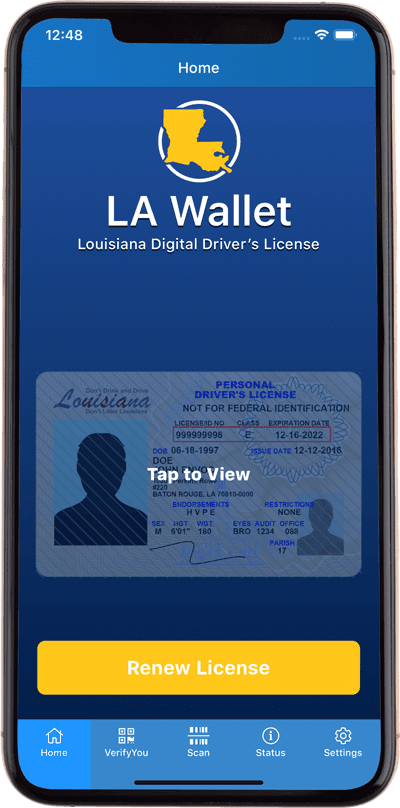
LA Wallet Louisiana Digital Driver’s License. lawallet.com.

However, there’s a teeny tiny catch: while the states can choose to mandate that their mDLs be accepted at the STATE level, states cannot mandate that their digital identities be used for FEDERAL purposes.

Here we go again.

Of course, federal government agencies are starting to look at the issues with a mobile version of a “REAL ID,” including the standard(s) to which any mobile ID used for federal purposes must adhere.

Improving Digital Identity Act of 2020, or 2021, or 2025…

While the government agencies are doing this work, another government agency (the U.S. Congress) is also working on this. Castro mentions Rep. Bill Foster’s H.R. 8215, introduced in the last Congress. I’m not sure why he bothered to introduce it in September 2020, when Congress wasn’t going to do anything with it. As you may have heard, we had an election at that time.

Of course, he just reintroduced it last month, so now there’s more of a chance that it will be considered. Or maybe not.

Regardless, the “Improving Digital Identity Act” proposes the creation of a task force at the federal level with federal, state participants, and local participants. It also mandates that NIST create a digital identity “framework,” with an interim version available 240 days after the Act is passed. Among other things, the ACT also mandates that NIST Special Publication 800-63 become “binding operational directives” for federal agencies.

(Does that mean that it will be illegal to mandate password changes every 90 days? Woo hoo!)

Should this Act actually pass at some point, its directives will need to be harmonized with what the Department of Homeland Security is already doing, and of course with what the states are already doing.

Oh, and remember my reference to the DHS’ work in this area? Among those who have submitted verbal and/or written comments, several (primarily from privacy organizations) have stated that the government should NOT be promoting ANY digital ID at all. The sentiments in this written comment, submitted anonymously, are all too common.

There are a lot of security and privacy concerns with accepting digital ID’s. First and foremost, drivers licenses contain a lot of sensitive information. If digital ID’s are accepted, then it could potentially leak that info to hackers if it is not secured properly. Plus, there is the added concern that using digital ID’s will lead to extra surveillance where unnecesary. Finally, digital ID will not allow individuals who are poorer to be abele to submit an ID because they might not have access to the same facilities. I am strongly against this rule and I do NOT think that digital ID should be an option.

I expect other privacy organizations to submit comments that may be better-written, but they echo the same sentiment.

The infancy of mobile driver’s licenses

More and more states are adopting mobile driver’s licenses that can be stored on a smartphone. Mobile driver’s licenses (mDLs) are available from Colorado, Delaware, Louisiana, and Oklahoma, and may be available from additional states by the time you read this.

LA Wallet Louisiana Digital Driver’s License. lawallet.com.

For me, the two key benefits of mDLs are the following:

  • If you have your smartphone, you have your mDL. Since smartphones are becoming more of a necessary must-have item – and wallets are not – the presence of a driver’s license on a smartphone is beneficial. (Unless, of course, you’re the type of person who misplaces your smartphone.)
  • mDLs can be designed to show only the information that is necessary. If I want to enter a bar or other facility for people over 21, I don’t have to show the bouncer my weight, my address, or even my birthdate. I just have to show the bouncer that I’m over 21.

While mDLs are becoming available in more states, they are not fully mature yet.

  • They are only valid in the state where they were issued. You can’t show your Oklahoma mDL in California. (Well, I guess you CAN show it, but a Californian isn’t obligated to do anything.)
  • Even within the state of issue, they’re still not always valid. At least some states require you to carry your physical driver’s license while driving, even if you have an mDL. And you can’t present an mDL to airport security in Denver or any other city. (See the LA Wallet image above, which clearly states “NOT FOR FEDERAL IDENTIFICATION.” So even if Louisiana’s physical driver’s license is REAL ID compliant, its mDL isn’t.)

Part of the issue regarding acceptance of mDLs is that the standards are still evolving. One key standard, ISO/IEC FDIS 18013-5 (Personal identification — ISO-compliant driving licence — Part 5: Mobile driving licence (mDL) application), is still under development.

But these four states, and others, didn’t want to wait until the standards were fully approved, and their solutions were fully certified, before issuing mDLs. Louisiana’s LA Wallet solution was introduced back in July 2018. While none of the solutions by definition can claim compliance with ISO/IEC FDIS 18013-5, they are already providing benefits to the license holders in these four states.

How long will it be until all states, provinces, and territories support mDLs?

The five authentication factors

(Part of the biometric product marketing expert series)
I thought I had blogged about the five factors of authentication, either here or at jebredcal, but I guess I haven’t explicitly written a post just on this topic. (You’d expect an identity content marketing expert to do that.)

And I’m not going to do that today either (at least in any detail), because The Cybersecurity Man already did a good job at that (as have many others).

However, for those like me who get a little befuddled after authentication factor 3, I’m going to list all five authentication factors.

  • Something You Know. Think “password.” And no, passwords aren’t dead. But the use of your mother’s maiden name as an authentication factor is hopefully decreasing.
  • Something You Have. I’ve spent much of the last ten years working with this factor, primarily in the form of driver’s licenses. (Yes, MorphoTrak proposed driver’s license systems. No, they eventually stopped doing so. But obviously IDEMIA North America, the former MorphoTrust, has implemented a number of driver’s license systems.) But there are other examples, such as hardware or software tokens.
  • Something You Are. I’ve spent…a long time with this factor, since this is the factor that includes biometrics modalities (finger, face, iris, DNA, voice, vein, etc.). It also includes behavioral biometrics, provided that they are truly behavioral and relatively static.
  • Something You Do. The Cybersecurity Man chose to explain this in a non-behavioral fashion, such as using swiping patterns to unlock a device. This is different from something such as gait recognition, which supposedly remains constant and is thus classified as behavioral biometrics.
  • Somewhere You Are. This is an emerging factor, as smartphones become more and more prevalent and locations are therefore easier to capture. Even then, however, precision isn’t always as good as we want it to be. For example, when you and a few hundred of your closest friends have illegally entered the U.S. Capitol, you can’t use geolocation alone to determine who exactly is in Speaker Pelosi’s office.

Now when these factors are combined via multi-factor authentication, there is a higher probability that the person is who they claim to be. If I enter the password “12345” AND I provide a picture of my driver’s license AND I provide a picture of my face AND I demonstrate the secret finger move AND I am within 25 feet of my documented address, then there is a pretty good likelihood that I am me, despite the fact that I used an extremely poor password.

I don’t know if anyone has come up with a sixth authentication factor yet. But I’m sure someone will if it hasn’t already been done. And then I’ll update to update this post in the same way I’ve been updating my Bredemarket 2021 goals.

Why I created a LinkedIn Showcase Page for Bredemarket

It was Sunday, and I was thinking about something that I wanted to communicate to a potential client in the coming week. The potential client performs work in multiple areas, and had inquired about my assisting in one of those areas.

As I thought about solutions for that one section of the potential client’s website, I began wondering how that material could be repurposed in other channels, including LinkedIn. One solution, I realized, was for the client to set up a special “showcase page” on LinkedIn that was dedicated to this one area. Content from the website could then be repurposed for the showcase page.

If you are unfamiliar with LinkedIn Showcase Pages, they “are extensions of your LinkedIn Page, designed to spotlight individual brands, business units and initiatives.”

A notable example of the use of showcase pages is Adobe. Adobe has a company page, but since Adobe provides a plethora of products and services, it would be a firehose to cover EVERYTHING on the main Adobe page. So Adobe established showcase pages, such as its page for Adobe Experience Cloud, that allowed the company to go into greater detail for that particular topic.

But this doesn’t explain why I just created a showcase page for a Bredemarket customer segment. Actually, there are two reasons.

  • While Bredemarket provides its services to identity firms, technology firms, general business, and nonprofits, it’s no secret that Bredemarket’s most extensive experience is in the identity industry. Because of my experience in biometrics and secure documents, I know the messages that identity firms need to communicate to their customers and to the public at large. Because of this, I thought I’d create a showcase page dedicated solely to the services that Bredemarket can provide to identity firms.
  • There’s another reason why I created the showcase page – the “eating your own dog food” reason. If I’m going to talk about the use of LinkedIn Showcase Pages, wouldn’t it make sense for me to create my own?

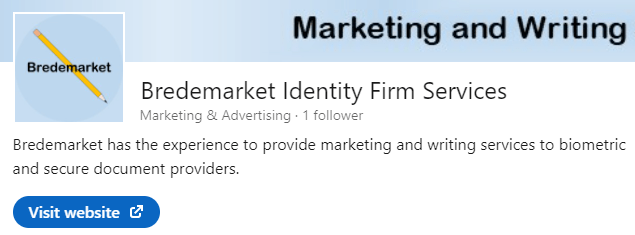
So on Sunday I created the Bredemarket Identity Firm Services page on LinkedIn; you can find it at the https://www.linkedin.com/showcase/bredemarket-identity-firm-services/ URL.

And if your interest is specifically in identity, be sure to click the Follow button.