How Bredemarket Helps in Early Proposal Engagement

Man, I’ve been negative lately.

I figure that it is time to become more positive.

I’m going to describe one example of how Bredemarket has helped its customers, based upon one of my client projects from several years ago.

Stupid Word Tricks. Tell your brother, your sister and your mama too. See below.

I’ve told this story before, but I wanted to take a fresh look at the problem the firm had, and the solution Bredemarket provided. I’m not identifying the firm, but perhaps YOUR firm has a similar problem that I can solve for you. And your firm is the one that matters.

The problem

This happened several years ago, but was one of Bredemarket’s first successes.
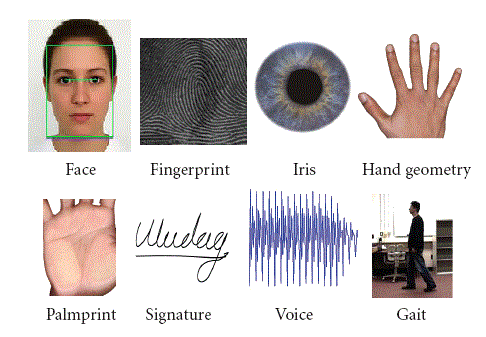
From Sandeep Kumar, A. Sony, Rahul Hooda, Yashpal Singh, in Journal of Advances and Scholarly Researches in Allied Education | Multidisciplinary Academic Research, “Multimodal Biometric Authentication System for Automatic Certificate Generation.”

I should preface this by noting that there are a lot of different biometric modalities, including some that aren’t even listed in the image above.

The firm that asked for my help is one that focuses on one particular biometric modality, and provides a high-end solution for biometric identification.

In addition, the firm’s solution has multiple applications, crime solving and disaster victim identification being two of them.

The firm needed a way to perform initial prospect outreach via budgetary quotations, targeted to the application that mattered to the prospect. A simple proposal problem to be solved…or so it seemed.

Why the obvious proposal solution didn’t work

I had encountered similar problems while employed at Printrak and MorphoTrak and while consulting here at Bredemarket, so the solution was painfully obvious.
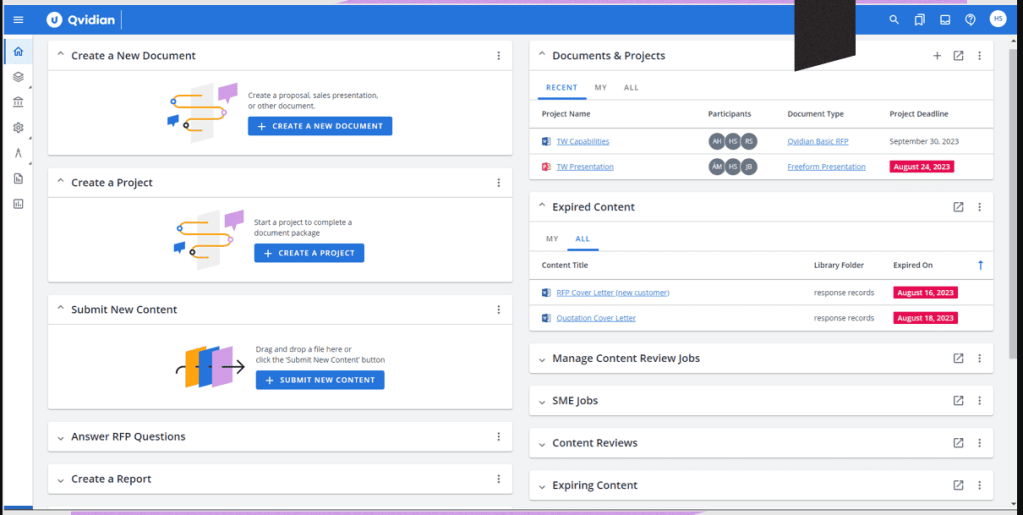
Qvidian, one proposal automation software package that I have used. But there are a LOT of proposal automation software packages out there, including some new ones that incorporate artificial intelligence. From https://uplandsoftware.com/qvidian/.

Have your proposal writers create relevant material in their proposal automation software that could target each of the audiences.

So when your salesperson wants to approach a medical examiner involved in disaster victim identification, the proposal writer could just run the proposal automation software, create the targeted budgetary quotation, populate it with the prospect’s contact information, and give the completed quotation to the salesperson.

Unfortuntely for the firm, the painfully obvious solution was truly painful, for two reasons:

  • This firm had no proposal automation software. Well, maybe some other division of the firm had such software, but this division didn’t have access to it. So the whole idea of adding proposal text to an existing software solution, and programming the solution to generate the appropriate budgetary quotation, wasn’t going to fly.
  • In addition, this firm had no proposal writers. The salespeople were doing this on their own. The only proposal writer they had was the contractor from Bredemarket. And they weren’t going to want to pay for me to generate every budgetary quotation they needed.

In this case, the firm needed a way for the salespeople to generate the necessary budgetary quotations as easily as possible, WITHOUT relying on proposal automation software or proposal writers.

Bredemarket’s solution

To solve the firm’s problem, I resorted to Stupid Word Tricks.

(Microsoft Word, not Cameo.)

I created two similar budgetary quotation templates: one for crime solving, and one for disaster victim identification. (Actually I created more than two.) That way the salesperson could simply choose the budgetary quotation they wanted.

The letters were similar in format, but had little tweaks depending upon the audience.
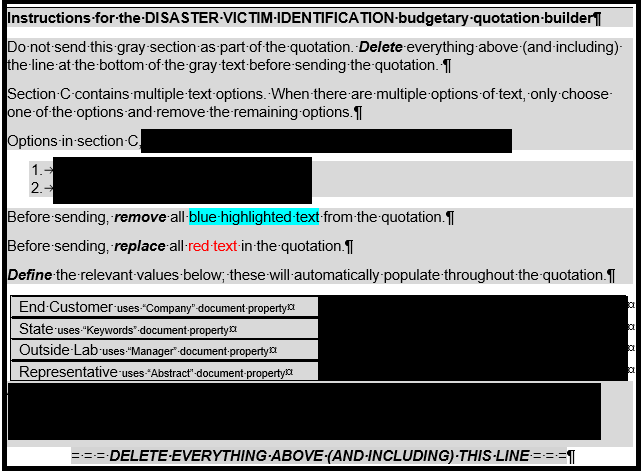
Using document properties to create easy-to-use budgetary quotations.

The Stupid Word Tricks came into play when I used Word document property features to allow the salesperson to enter the specific information for each prospect, which then rippled throughout the document, providing a customized budgetary quotation to the prospect.

The result

The firms’ salespeople used Bredemarket’s templates to generate initial outreach budgetary quotations to their clients.

And the salespeople were happy.

I’ve used this testimonial quote before, but it doesn’t hurt to use it again.

“I just wanted to truly say thank you for putting these templates together. I worked on this…last week and it was extremely simple to use and I thought really provided a professional advantage and tool to give the customer….TRULY THANK YOU!”

Comment from one of the client’s employees who used the standard proposal text

While I actively consulted for the firm I maintained the templates, updating as needed as the firm achieved additional certifications.

Why am I telling this story again?

I just want to remind people that Bredemarket doesn’t just write posts, articles, and other collateral. I can also create collateral such as these proposal templates that you can re-use.

So if you have a need that can’t be met by the painfully obvious solutions, talk to me. Perhaps we can develop our own solution.
How Can Your Identity Business Create the RIGHT Written Content?

Does your identity business provide biometric or non-biometric products and services that use finger, face, iris, DNA, voice, government documents, geolocation, or other factors or modalities?

Does your identity business need written content, such as blog posts (from the identity/biometric blog expert), case studies, data sheets, proposal text, social media posts, or white papers?

How can your identity business (with the help of an identity content marketing expert) create the right written content?

For the answer, click here.

Four Mini-Case Studies for One Inland Empire Business—My Own

I guess I can be persuasive. I just persuaded myself to do something.

On Saturday, I wrote the post “Six Benefits for Inland Empire Businesses from Case Studies.

Then I asked myself, why not write a case study for my own Inland Empire business, Bredemarket?

If I could demonstrate that Bredemarket benefited a firm via a case study, that could help Bredemarket get business from other firms. I said so myself:

A well-crafted case study can be the first step in convincing a potential customer to become a paying customer.

From https://bredemarket.com/2023/04/15/six-benefits-for-inland-empire-businesses-from-case-studies/

Achieving 400% of My Goal

But once I started writing the document, I decided that one case study wasn’t enough.

So I wrote four mini-case studies in the same document, briefly describing how I helped four Bredemarket clients create different types of content so that they could win more business.

  • I helped one client to quickly generate consistent proposals. One of the client’s salespeople even provided me with a testimonial. (You may have seen it before.)
  • I helped another client share persuasive case studies. The client kept on coming back to me for more case studies—a dozen in all—and other work.
  • I helped a third client position via blogs and a white paper.
  • Finally, I helped position a sole proprietor.

After the four mini-case studies, I briefly described how Bredemarket works with clients. (Sleep is involved.)

By Ilya Repin – Tretyakov Gallery, Moscow, Public Domain, https://commons.wikimedia.org/w/index.php?curid=60387757

I didn’t get into my six questions, since I already wrote an e-book on that topic, but I did provide an overview of the initial meeting, the content iteration process, and my work for hire policy (which explains why I didn’t name the four clients listed above).

So would you like to read my four mini-case studies?

Here is my latest e-book, “How Bredemarket Can Help You Win Business.”

And if I can help you win business, let me know. I have Saturday morning office hours.

Retabulating the work that Bredemarket has done for clients (as of February 16, 2022)

My biometric/identity collateral wasn’t the only thing that I updated yesterday.

As part of my preparation for yesterday evening’s Ontario IDEA Exchange meeting, I took the time to update my “local” brochure. (Because local is important: see the first of my three goals for 2022.) This brochure includes a section that discusses the types and numbers of pieces that I have prepared for clients, including the number of case studies, the number of RFx responses, and so forth.

Those numbers hadn’t been updated since last September.

Before going to the meeting, I wanted to make sure my “local” brochure had the latest numbers.

I’ll go ahead and share them with you. This covers the projects that Bredemarket has completed for clients over the last 18 months, as of February 16, 2022:

  • Fourteen (14) case studies
  • Eight (8) articles (blog posts)
  • Three (3) service offering descriptions
  • Three (3) white papers
  • Nine (9) RFx responses
  • Four (4) sole source responses
  • Six (6) proposal templates
  • One (1) technical leave behind
  • Two (2) biometric analyses
Inland Empire B2B Content Services from Bredemarket.

As it turns out, I didn’t hand out my local brochure to anyone at last night’s IDEA Exchange. (It was a small crowd, most of whom I already knew.)

But at least I’ve tabulated the numbers.

Now I just have to update all of my NON local collateral…

When wildebeests propose

(No, this is NOT a post about wildebeest mating rituals. If that is your interest, go here. This is a post about how businesses develop sales proposals that they send to other businesses. This process has its own rituals, but they are not studied by biologists.)

Bredemarket isn’t my first time working as a contractor.

I still remember a night in October 1994. I had been contracting for several firms, and had just started a new contracting assignment in Anaheim, in an oddly shaped triangular building. I was contracting with a company’s Proposals Department, despite the fact that I had never written a proposal before. I had once helped to write a Request for Proposal, but that RFP was pretty much just a checklist.

As a contractor, I was paid by the hour, so I didn’t mind the fact that I was asked to work extra hours that October evening. While the actual employees were feverishly working on a response to a state-issued RFP, I was tasked with writing sole source proposal letters for things I had never heard of before that day. So there I was, writing letters that explained the “Input Station 2000” and the “Latent Station 2000” and things like that.

I continued contracting after that night, and eventually became an employee of the company as a proposal writer. I spent over five years writing about Input Stations and Latent Stations and Search Processors and amazingly small Fingerprint Processor boards, and after a while I even knew what I was writing about. I still remember my joy when I mentally had an understanding of RAID.

After my five years in Proposals, I stayed with the company in another role (product manager) through two corporate acquisitions, and after the second corporate acquisition I rejoined the Proposals organization, spending another five years there. And even after I left Proposals for the second time, I continued to contribute to proposals afterwards. My flying pig did a lot of flying.

I have continued to do proposals work for Bredemarket, helping a firm develop standard proposal templates that its salespeople can use.

But Bredemarket also writes its OWN proposals, which is how Bredemarket gets some of its business.

You’ve heard the saying about eating your own dog food. That statement bored me, so I started talking about eating your own iguana food. Eventually I tired of iguanas and pivoted to wildebeests.

Black wildebeest. By derekkeats – Flickr: IMG_4955_facebook, CC BY-SA 2.0, https://commons.wikimedia.org/w/index.php?curid=14620744

Whether dog, iguana, or wildebeest, you get a slightly different perspective on proposals when you’re writing them for yourself.

But only a SLIGHTLY different perspective. After all, you’re still promoting a product or service, and still communicating benefits to a potential customer. That remains true whether the proposal was written on behalf of Printrak, MorphoTrak, Bredemarket, or one of Bredemarket’s clients.

But things are still a little different when you’re proposing for yourself and your service.

For one, the approval cycle is streamlined. As part of a multinational corporation, the MorphoTrak proposal approval cycle was relatively complex, even after my boss took extreme steps to simplify it. If MorphoTrak was going to release a $20 million dollar proposal, there was a good chance that someone at MorphoTrak’s corporate parent in France was going to have a seat at the approval table.

Now I’ll admit that Bredemarket has never issued a $20 million dollar proposal. Because of this, all of the proposals that Bredemarket has issued have only required a single approver.

Even then, however, you may have to wait a day to get that proposal approved. After all, the proposal approver is a strong practitioner of the “let’s sleep on it” school, and usually comes back with revised proposal ideas a day later after sleeping on it.

For example, let’s take a recent proposal that Bredemarket submitted to a potential client. The proposal was pretty much done, but the “sleep on it” interval had to take place before it was re-examined the next morning. I incorporated my new ideas (my dreams?) into the text, and then I printed a copy of the proposal for one last review.

A few minutes later, the printed copy was filled with changes.

So I made the changes, printed the new final version, and reviewed it one more time.

And added more markups, resulting in changes.

In the end, the proposal exceeded the three review cycles common in some of my offerings. And I probably could have reviewed it one or two more times, but I wanted to get the proposal out the door.

And even as I emailed the proposal to the potential client, I realized that proposals are often iterative, and that my potential client may have some requests for changes, resulting in a proposal modification.

Or maybe more than one proposal modification.

Back when I was at MorphoTrak, I regarded a proposal modification as a sign of failure. It meant that we didn’t get it right the first time, and therefore MorphoTrak would have to spend money to issue a revised proposal, and perhaps a re-revised proposal, and perhaps more. At the time MorphoTrak appended a letter to its revised proposals – “a” for the first revision, “b” for the second revision, etc. To my knowledge MorphoTrak never issued a “z” proposal revision, but we did go fairly deep in the alphabet.

By Serg!o – Own work, Public Domain, https://commons.wikimedia.org/w/index.php?curid=83494916

From my present perspective, I’m a little more welcoming of proposal revisions. It’s an admission that I don’t know everything about the client, although I can hazard a guess as to what the client needs.

Remember Bredemarket’s client who needed standard proposal templates? Well, my own proposal to that client went through a few revisions, even after the original contract was finally approved. There weren’t any huge overhauls in the original proposal content, but there were a few things here and there that needed to be tweaked so that both parties were satisfied.

While I’ve had some successful proposals, some of Bredemarket’s proposals to potential clients did not result in business. (Yet.) These potential clients, for various reasons, decided not to pursue business with me.

Of course, this is true of any proposals organization. No proposal team that I know of has sustained 100% success over an extended period, although I know of one team that won the majority of its competitive bids over a 2 to 3 year period.

But the wildebeest continues to hone his own proposal skills, while using what he learns to benefit future clients.

(Past illustrations) Standard text

(This past illustration describes something that I performed in my career, either for a Bredemarket client, for an employer, or as a volunteer. The entity for which I performed the work, or proposed to perform the work, is not listed for confidentiality reasons.)

PROBLEM

Companies need to respond to questions from their potential customers. Often the company crafts a specific response to each potential customer, even when multiple potential customers are asking the exact same questions.

SOLUTION

As many people already know, the solution is to create a database of standard text.

By John Willis Clark – http://www.ib.hu-berlin.de/~wumsta/Milkau/109-2.jpg: Fritz-Milkau-Dia-Sammlung, erstellt in der Photographischen Werkstatt der Preußischen Staatsbibliothek von 1926-1933originally from The Care of Books by John Willis Clark (Fig 94, p132), Public Domain, https://commons.wikimedia.org/w/index.php?curid=135286

In some cases, companies can create standard text by adapting previous text submitted to potential customers in the past. In other cases, new text must be written. Once developed, the standard text can be stored in a dedicated database designed for this purpose, or it can simply be stored in a Microsoft Word document of officially approved responses.

RESULTS

I have created (or tried to create) a lot of standard text over the years.

For two companies, I was one of the people responsible for gathering standard text from subject matter experts (SMEs), or for writing new standard text myself. This standard text had to be reviewed with SMEs at regular intervals, and any necessary updates had to be incorporated.

For a third company, I was the SME responsible for reviewing and updating the standard text.

For a fourth company, I suggested that the company create standard text, but the company chose not to act on my suggestion.

For a fifth company, I was asked to create a simple database of standard text, addressing multiple markets for a particular product line.

And, of course, I’ve created standard text for my own company, suitable for repurposing in multiple formats.