Reducing Biometric Marketing Internal Bias By Using Bredemarket

Identity/biometric marketing leaders continuously talk about how their companies have reduced bias in their products. But have they reduced bias in their own marketing to ensure it resonates with prospects?

I recently talked about the problem of internal bias:

“Marketers are driven to accentuate the positive about their companies. Perhaps the company has a charismatic founder who repeatedly emphasizes how ‘insanely great’ his company is and who talked about ‘bozos.’ (Yeah, there was a guy who did both of those.) 

“And since marketers are often mandated to create both external and internal sales enablement content, their view of their own company and their own product is colored.”

Let’s look at two examples of biometric marketing internal bias…and how to overcome it.

Google Gemini.

Internal bias at Company A

  • Company A does not participate in the U.S. National Institute of Standards and Technology (NIST) Face Recognition Technology Evaluation (FRTE) for technical reasons. 
  • As a result, the company’s marketing machine constantly discredits NIST FRTE, and the company culture is permeated with a “NIST is stupid” mentality. 
  • All well and good…until it runs into that one prospect who asks, “Why are you scared to measure yourself against the competition? Does your algorithm suck that bad?”

Internal bias at Company B

  • Company B, on the other hand, participates in FRTE, FATE, FRIF (previously FpVTE), and every other NIST test imaginable. 
  • This company’s marketing machine declares its superiority as a top tier biometric vendor, supported by outside independent evidence. 
  • All well and good…until it runs into that one prospect who declares, “That’s just federal government test data. How will you perform in our benchmark using our real data and real computers?”

Internal bias at Bredemarket 

Well, I have my admittedly biased solution to prevent companies from tumbling into groupthink, drinking of Kool-Aid, and market irrelevance.

Contract with an outside biometric product marketing expert. (I just happen to know one…me.)
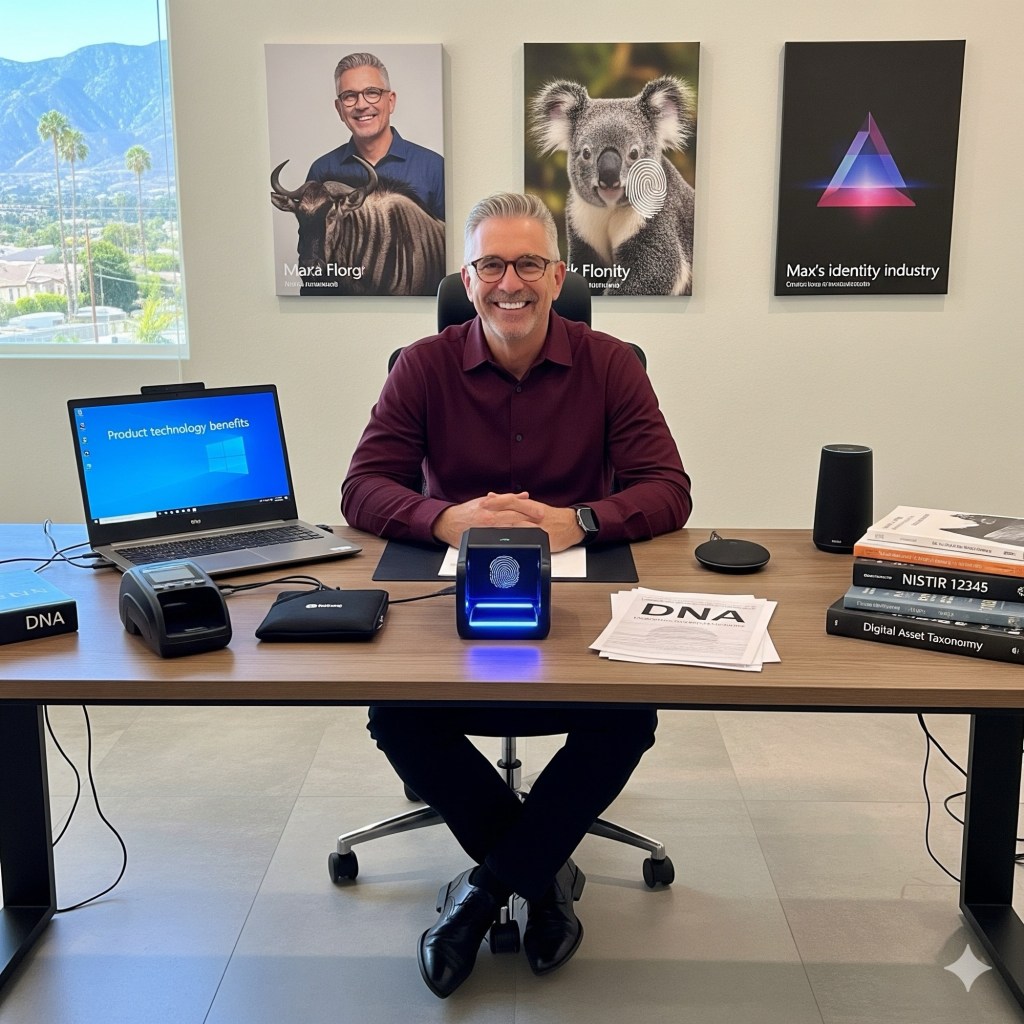
Google Gemini.

I haven’t spent 30 years immersed in your insular culture. I’ve heard all the marketing-speak from different companies, and I’ve written the marketing-speak for nearly two dozen of them. I can ensure that your content resonates with your external customers and prospects, not only with your employees.

All well and good…until…

Reducing internal bias at Bredemarket 

“But John, what about your own biases? IDEMIA, Motorola, Incode, and other employers paid you for 25 years! You probably have an established process that you use to prepare andouillette at home, based upon a recipe from 2019!”

Google Gemini.

I don’t…but point taken. So how do I minimize my own biases?

My breadth of experience lessens the biases from my past. Look at my market-speak from 1994 to 2023, in order:

  • We are Printrak, a nimble private company that will dominate AFIS with our client-server solution.
  • We are Printrak (stock symbol AFIS) a well-funded public company that will dominate AFIS, mugshot, computer aided dispatch, and microfiche.
  • We are Motorolans, and our multi-tier Digital Justice Solution has a superior architecture to that of Sagem Morpho and others.
  • We are MorphoTrak, bringing together the best technologies from MetaMorpho and Printrak BIS, plus superior French technology for secure credentials and road safety…unencumbered by the baggage that weighs down MorphoTrust.
  • We are IDEMIA North America, bringing together the best technologies from MorphoTrust and MorphoTrak for ABIS, driver’s licenses, and enrollment, coupled with the resources from the rest of IDEMIA, a combined unbreakable force.
  • We are Incode, not weighed down with the baggage of the old dinosaurs, and certainly not a participant in the surveillance market.

Add all the different messaging of Bredemarket’s clients, plus my continuous improvement (hello MOTO) of my capabilities, and I will ensure that my content, proposals, and analysis does not trap you in a dead end.

Reducing internal bias at your company 

Are you ready to elevate your company with the outside perspective of a biometric product marketing expert?

Let’s talk (a free meeting). You explain, I ask questions, we agree on a plan, and then I act.

Schedule a meeting at https://bredemarket.com/mark/

How L-1 Identity Solutions Came To Be

(Imagen 4. Not an exaggeration.)

The history of L-1 Identity Solutions has always fascinated me. I dealt with then-bitter enemies Digital Biometrics and Identix while I was at Printrak, with Viisage while I was at Motorola, and de facto competed with MorphoTrust while I was at MorphoTrak…until MorphoTrust in effect acquired MorphoTrak when IDEMIA NSS was set up and I reported to a supervisor in Massachusetts.

I used to have a PowerPoint presentation that traced the family tree of all of L-1’s acquisitions. Wish I still had it. But here’s a little taste of where things stood before Joseph Atick and Robert LaPenta started combining things:

  • Identix, while making some efforts in the AFIS market, concentrated on creating live scan fingerprinting machines, where it competed (sometimes in court) against companies such as Digital Biometrics and Bioscrypt.
  • The fingerprint companies started to compete against facial recognition companies, including Viisage and Visionics
  • Oh, and there were also iris companies such as Iridian
  • And there were other ways to identify people. Even before 9/11 mandated REAL ID (which we may get any year now), Polaroid was making great efforts to improve driver’s licenses to serve as a reliable form of identification.

(Some former links are dead and were removed from the bullets above. But the Digital Biometrics-Identix court case is described here, and Polaroid’s history with driver’s licenses in Utah is described here.)

Back in 2023 I assembled a list of “Five Topics a Biometric Content Marketing Expert Needs to Understand.” My fifth topic was “How L-1 Identity Solutions came to be.” I claimed I was half joking, but in reality I was completely serious. Despite similar efforts by HID and others (including IDEMIA), the sheer number of companies that combined to form L-1 remains unmatched.

All five.

Printrak and Morpho Acquired Companies. You Won’t Believe What Happened Next! (And what of…?)

Why do I have a sudden interest in things that happened at Morpho nearly 10 years ago, and at Printrak over 20 years ago? I’ll explain at the end of this post.

Printrak acquires…

Let’s start by looking at my former employer Printrak. In the summer of 1996 Printrak became a publicly traded company, and had secured the four-letter ticker “AFIS” back when an automated fingerprint identification system was THE biometric solution. (Face schmace. Iris schmiris. Voice schmoice.)

But then Printrak began to get bigger.

  • In April 1997 Printrak acquired a Greenville, South Carolina company, TFP Inc., that manufactured mugshot systems.
  • Later that same year Printrak acquired SunRise Imaging of Fremont, California, a provider of microfiche scanning services.
  • Printrak finished the year by acquiring the computer aided dispatch (CAD) and records management systems (RMS) unit of SCC Communications Corp., thus launching activities in Boulder, Colorado.

These acquisitions, costing millions of dollars each, increased the capabilities of Printrak. Several years later, I would be part of creating a “digital justice solution” that married AFIS, CAD, RMS, mugshot, and other services.

But not yet. Before that could happen, Printrak changed dramatically.

Printrak is acquired!

There used to be an online document that listed the entire negotiation history of what happened after these acquisitions, but I can no longer access that document. Instead, I found a document that lists the final results:

“ITEM 5. OTHER EVENTS On August 28, 2000, Printrak International Inc. (the “Registrant”) issued a press release regarding an agreement (the “Merger Agreement”) among Motorola, Inc. (“Motorola”), the Registrant, Panther Acquisition Corp., a wholly-owned subsidiary of Motorola (“Acquisition Sub”) and the Giles Living Trust UDT dated December 17, 1993, The Giles Family Foundation, and The Smith Family Revocable Trust dated October 2, 1992 (collectively referred to herein as the “Registrant’s Majority Stockholders”) pursuant to which Acquisition Sub will be merged (the “Merger”) with and into Registrant, with Registrant surviving the Merger as a wholly-owned subsidiary of Motorola. On August 28, 2000 the Registrant’s Majority Stockholders executed a written consent of stockholders approving the terms and authorizing the execution of the Merger Agreement by the Registrant. Under the Merger Agreement, Motorola has agreed to pay $12.1406 per share for all the outstanding common stock and common stock equivalents of Registrant for an aggregate merger consideration of approximately $160 million.”

In the language above, the two “Giles” entities were controlled by Richard Giles, who had joined De La Rue Printrak and then purchased the Printrak part from De La Rue. The Smith Family Revocable Trust was controlled by Charles Smith, another Printrak employee. While Printrak was a publicly traded entity, Richard Giles held over half the shares, and therefore had the power to sell, provided that the deal received the proper approvals from the United States, Argentina, Brazil, Germany, Romania, and other countries.

Why did Motorola want to acquire Printrak? Because Motorola needed a CAD product to pair with its significant business in police radios. And among Printrak’s acquisitions was a division with a CAD product, making that acquisition by far the most significant of the three acquisitions from 1997. Microfiche went nowhere, and the fact that the present company DataWorks Plus was founded in 2000 in Greenville, South Carolina is no accident.

But returning to Printrak, its growth through acquisitions made Printrak itself an acquisition target.

SCC, Sunrise Imaging, Printrak…and Motorola.

Morpho acquires…

Fast forward a few years, and a lot had happened at the Motorola company that Printrak joined. I won’t go into the history of Motorola during that decade, but by 2008 the company was shedding businesses that weren’t critically important. The CAD and RMS business was critically important, but the fingerprint business—the original pre-1997 Printrak—was not.

Which naturally attracted the attention of a large French aerospace/defense company, Safran. This company, itself the merger of two firms, had its own fingerprint identification technology, but I’ll let Ken Moses and his co-authors (including Scott Swann) tell this part of the story:

“In the late 1970s, a computer engineering subsidiary of France’s largest financial institution responded to a request by the French Ministry of Interior to work on automated fingerprint processing for the French National Police. Later, this company joined with the Morphologic Mathematics Laboratory at the Paris School of Mines to form a subsidiary called Morpho Systems that went on to develop a functioning [AFIS].”

Morpho Systems and its North American subsidiary were acquired by several companies in succession, the last being Safran.

And Safran thought that Motorola’s “Biometric Business Unit” would complement its existing biometric activities. So Safran purchased the unit (including me) from the willing seller Motorola, which became part of MorphoTrak.

But Safran wasn’t done acquiring. As I previously noted:

“By 2011, Safran decided that it needed additional identity capabilities, so it acquired L-1 Identity Solutions and renamed the acquisition as MorphoTrust.”

Along the way Safran also acquired a controlling stake in GE Homeland Protection, which it renamed Morpho Detection.

These various acquisitions strengthened Safran’s identity and biometric capabilities, which was good because Safran’s competitors were also busy. Eventually the entire identity and security business was renamed “Morpho” after the little old French company from the 20th century. This was a major division within Safran’s empire…

Morpho is acquired!

…but Safran remained an aerospace/defense company, and Morpho was a distraction.

A distraction that attracted the attention of Advent International. Advent had acquired a company called Oberthur Technologies in 2011, with the intent of improving it and selling it for a profit. Advent decided that an Initial Public Offering (IPO) would be a way to realize this profit, but Oberthur withdrew its IPO in 2015.

Would Oberthur be a more attractive IPO if it was combined with another entity, such as the non-aerospace/defense part of Safran?

The upshot was that Advent and Safran started talking, resulting in a sale that created the combined (mostly) Advent-controlled entity OT-Morpho. But a name change happened a few months later.

I watched this from a conference room in Anaheim, California.

I won’t get into the subsequent history of IDEMIA, in which Advent has spun off one part of IDEMIA, and may be spinning off another.

The point I want to make? Morpho’s growth through acquisitions made Morpho itself an acquisition target.

Motorola’s Biometric Business Unit, L-1 Identity Solutions, Morpho…and Advent International.

Incode acquires…

Now before someone slams me, I’m not making any predictions, just some observations.

Now let’s look at my former employer Incode. Unlike Printrak, Incode is not a publicly-traded firm. Like IDEMIA, Incode is held by private investors, although in Incode’s case there are multiple investors, not just one. Incode’s investors include General Atlantic, Softbank, J. P. Morgan, and others.

Lately Incode has been on an acquisition spree of its own.

Now remember that Incode’s investors didn’t invest just because they want to see cool technologies. They invested because they want to make money. And these moves potentially strenghthen Incode so that its investors may make a profit through an Incode IPO…

…or an acquisition of Incode by another entity, which would continue the consolidation of the identity/biometric industry.

???

In Case You Missed My Incessant “Biometric Product Marketing Expert” Promotion

Biometric product marketing expert.

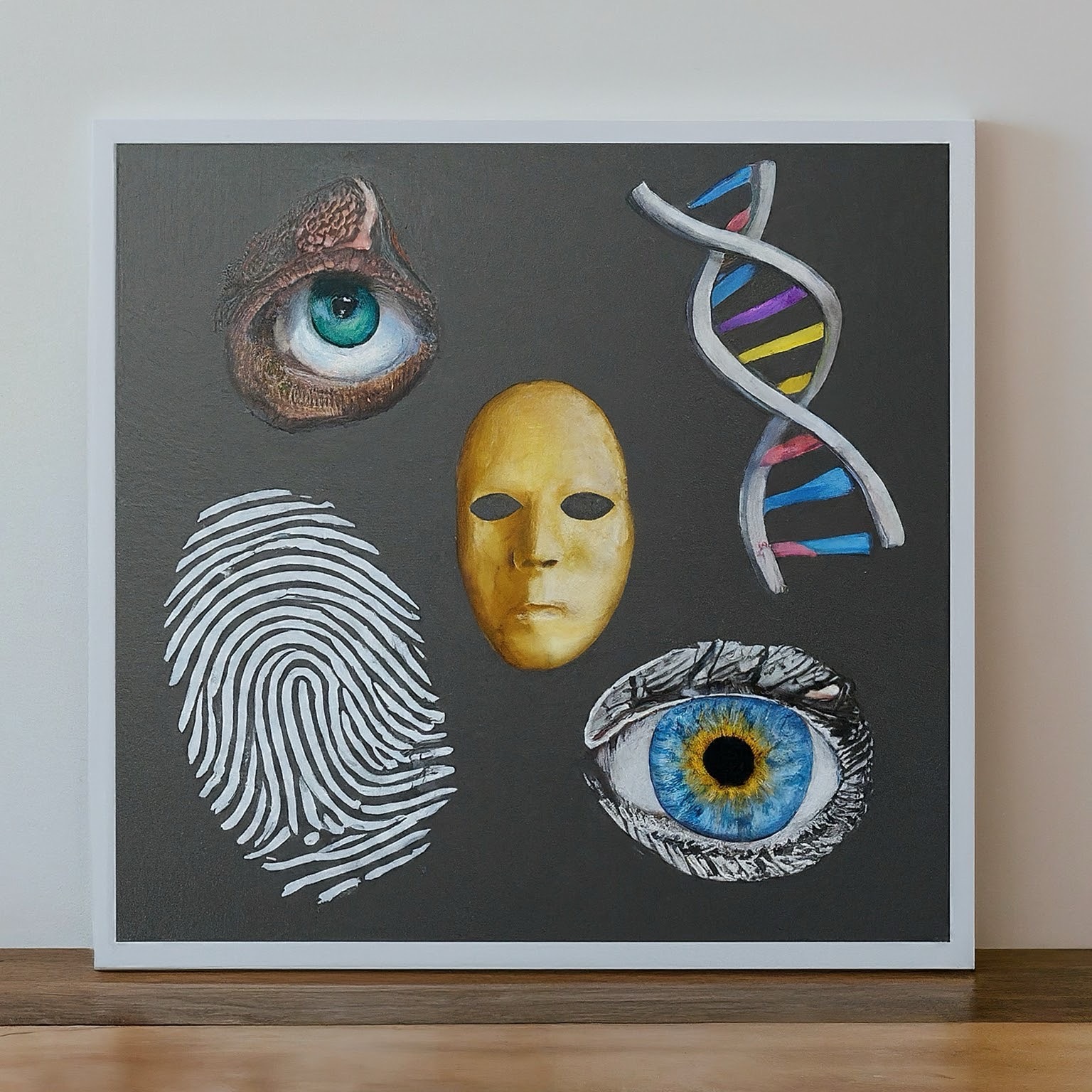
Modalities: Finger, face, iris, voice, DNA.

Plus other factors: IDs, data.

John E. Bredehoft has worked for Incode, IDEMIA, MorphoTrak, Motorola, Printrak, and a host of Bredemarket clients.

(Some images AI-generated by Google Gemini.)

Biometric product marketing expert.

Let’s Explain the MINEX Acronyms

(Part of the biometric product marketing expert series)

Any endeavor, scientific or non-scientific, tends to generate a host of acronyms that the practitioners love to use.

For people interested in fingerprint identification, I’ve written this post to delve into some of the acronyms associated with NIST MINEX testing, including ANSI, INCITS, FIPS, and PIV.

And, of course, NIST and MINEX.

After defining what the acronyms stand for, I’ll talk about the MINEX III test. Because fingerprints are still relevant.

Common MINEX acronyms

NIST

We have to start with NIST, of course. NIST is the National Institute of Standards and Technology, part of the U.S. Department of Commerce.

NIST was involved with fingerprints before NIST even existed. Back when NIST was still the NBS (National Bureau of Standards), it issued its first fingerprint interchange standard back in 1986. I’ve previously talked about the 1993 version of the standard in this post, “When 250ppi Binary Fingerprint Images Were Acceptable.”

But let’s move on to another type of interchange.

MINEX

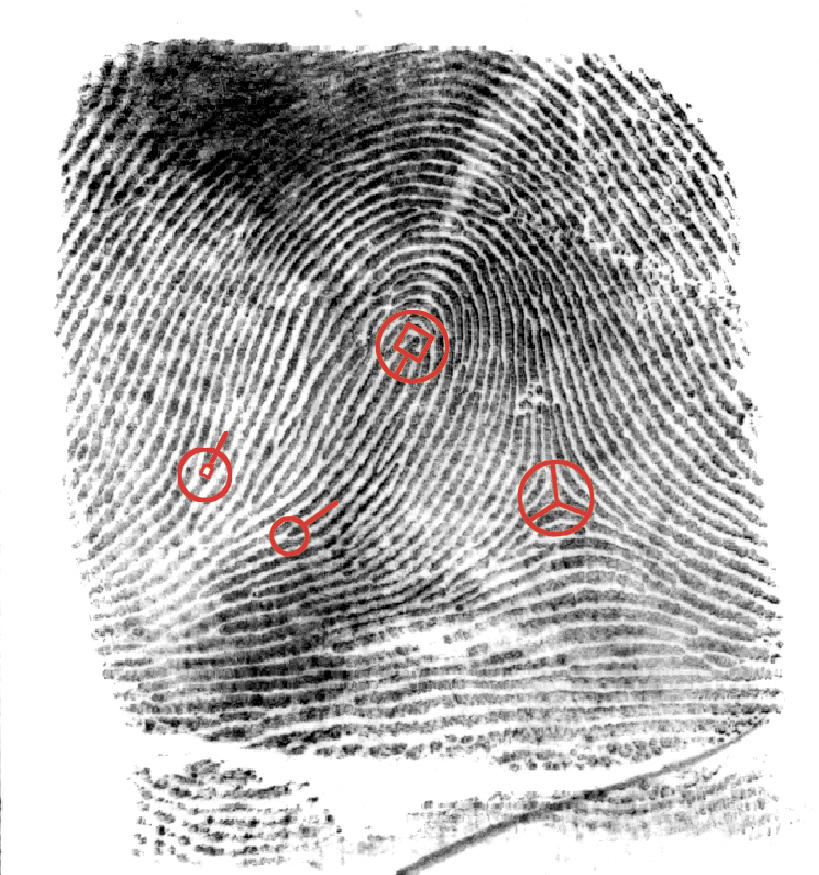
It’s even more important that we define MINEX, which stands for Minutiae (M) Interoperability (IN) Exchange (EX).

From NIST, 2006.

You’ll recall that the 1993 (and previous, and subsequent) versions of the ANSI/NIST standard included a “Type 9” to record the minutiae generated by the vendor for each fingerprint. However, each vendor generated minutiae according to its own standard. Back in 1993 Cogent had its standard, NEC its standard, Morpho its standard, and Printrak its standard.

So how do you submit Cogent minutiae to a Printrak system? There are two methods:

First, you don’t submit them at all. Just ignore the Cogent minutiae, look at the Printrak image, and use an algorithm regenerate the minutiae to the Printrak standard. While this works with high quality tenprints, it won’t work with low quality latent (crime scene) prints that require human expertise.

The second method is to either convert the Cogent minutiae to the Printrak minutiae standard, or convert both standards into a common format.

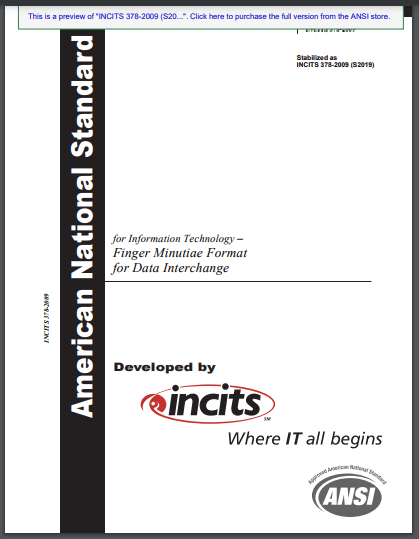
Something like ANSI INCITS 378-2009 (S2019).

So I guess we need to define two more acronyms.

ANSI

Actually, I should have defined ANSI earlier, since I’ve already referred to it when talking about the ANSI/NIST data interchange formats.

ANSI is the American National Standards Institute. Unlike NIST, which is an agency of the U.S. government, ANSI is a private entity. Here’s how it describes itself:

The American National Standards Institute (ANSI) is a private, non-profit organization that administers and coordinates the U.S. voluntary standards and conformity assessment system. Founded in 1918, the Institute works in close collaboration with stakeholders from industry and government to identify and develop standards- and conformance-based solutions to national and global priorities….

ANSI is not itself a standards developing organization. Rather, the Institute provides a framework for fair standards development and quality conformity assessment systems and continually works to safeguard their integrity.

So ANSI, rather than creating its own standards, works with outside organizations such as NIST…and INCITS.

INCITS

Now that’s an eye-catching acronym, but INCITS isn’t trying to cause trouble. Really, they’re not. Believe me.

INCITS, or the InterNational Committee for Information Technology Standards, is another private organization. It’s been around since 1961, and like NIST has been known under different names in the past.

Back in 2004, INCITS worked with ANSI (and NIST, who created samples) to develop three standards: one for finger images (ANSI INCITS 381-2004), one for face recognition (ANSI INCITS 385-2004), and one for finger minutiae (ANSI INCITS 378-2004, superseded by ANSI INCITS 378-2009 (S2019)).

When entities used this vendor-agnostic minutiae format, then minutiae from any vendor could in theory be interchanged with those from any other vendor.

This came in handy when the FIPS was developed for PIV. Ah, two more acronyms.

FIPS and PIV

One year after the three ANSI INCITS standards were released, this happened (the acronyms are defined in the text):

Federal Information Processing Standard (FIPS) 201 entitled Personal Identity Verification of Federal Employees and Contractors establishes a standard for a Personal Identity Verification (PIV) system (Standard) that meets the control and security objectives of Homeland Security Presidential Directive-12 (HSPD-12). It is based on secure and reliable forms of identity credentials issued by the Federal Government to its employees and contractors. These credentials are used by mechanisms that authenticate individuals who require access to federally controlled facilities, information systems, and applications. This Standard addresses requirements for initial identity proofing, infrastructure to support interoperability of identity credentials, and accreditation of organizations issuing PIV credentials.

So the PIV, defined by a FIPS, based upon an ANSI INCITS standard, defined a way for multiple entities to create and support fingerprint minutiae that were interoperable.

But how do we KNOW that they are interoperable?

Let’s go back to NIST and MINEX.

Testing interoperability

So NIST ended up in charge of figuring out whether these interoperable minutiae were truly interoperable, and whether minutiae generated by a Cogent system could be used by a Printrak system. Of course, by the time MINEX testing began Printrak no longer existed, and a few years later Cogent wouldn’t exist either.

You can read the whole history of MINEX testing here, but for now I’m going to skip ahead to MINEX III (which occurred many years after MINEX04, but who’s counting?).

  • Like some other NIST tests we’ve seen before, vendors and other entities submit their algorithms, and NIST does the testing itself.
  • In this case, all submitters include a template generation algorithm, and optionally can include a template matching algorithm.
  • Then NIST tests each algorithm against every other algorithm. So the “innovatrics+0020” template generator is tested against itself, and is also tested against the “morpho+0115” algorithm, and all the other algorithms.
From NIST. Retrieved July 29, 2024.

NIST then performs its calculations and comes up with summary values of interoperability, which can be sliced and diced a few different ways for both template generators and template matchers.

From NIST. Top 10 template generators (Ascending “Pooled 2 Fingers FNMR @ FMR≤10-2) as of July 29, 2024.

And this test, like some others, is an ongoing test, so perhaps in a few months someone will beat Innovatrics for the top pooled 2 fingers spot.

Are fingerprints still relevant?

And entities WILL continue to submit to the MINEX III test. While a number of identity/biometric professionals (frankly, including myself) seem to focus on faces rather than fingerprints, fingers still play a vital role in biometric identification, verification, and authentication.

Fingerprints are clearly a 21st century tool.

Even if one vendor continues its obsession with 1970s crime fighters.

And no, I’m NOT going to explain what the acronym FAP means. This post has too many acronyms already (TMAA).

When 250ppi Binary Fingerprint Images Were Acceptable

(Part of the biometric product marketing expert series)

I remember the first computer I ever owned: a Macintosh Plus with a hard disk with a whopping 20 megabytes of storage space. And that hard disk held ALL my files, with room to spare.

For sake of comparison, the video at the end of this blog post would fill up three-quarters of that old hard drive. Not that the Mac would have any way to play that video.

That Mac is now literally a museum piece.

By Tmarki – Own work, Public Domain, https://commons.wikimedia.org/w/index.php?curid=8058630.

And its 20 megabyte hard disk illustrates the limitations of those days. File storage was a precious commodity in the 1980s and 1990s, and we therefore accepted images that we wouldn’t even think about accepting today.

This affected the ways in which entities exchanged biometric information.

The 1993 ANSI/NIST standard

The ANSI/NIST standard for biometric data interchange has gone through several iterations over the years, beginning in 1986 when NIST didn’t even exist (it was called the National Bureau of Standards in those days).

Fingerprints only

When I began working for Printrak in 1994, the image interchange standard in effect was ANSI/NIST-CSL 1-1993, the “Data Format for the Interchange of Fingerprint Information.”

Yes, FINGERPRINT information. No faces. No scars/marks/tattoos. signatures, voice recordings, dental/oral data, irises, DNA, or even palm prints. Oh, and no XML-formatted interchange either. Just fingerprints.

No logical record type 99, or even type 10

Back in 1993, there were only 9 logical record types.

For purposes of this post I’m going to focus on logical record types 3 through 6 and explain what they mean.

  • Type 3, Fingerprint image data (low-resolution grayscale).
  • Type 4, Fingerprint image data (high-resolution grayscale).
  • Type 5, Fingerprint image data (low-resolution binary).
  • Type 6, Fingerprint image data (high-resolution binary).

Image resolution in the 1993 standard

In the 1993 version of the ANSI/NIST standard:

  • “Low-resolution” was defined in standard section 5.2 as “9.84 p/mm +/- 0.10 p/mm (250 p/in +/- 2.5 p/in),” or 250 pixels per inch (250ppi).
  • The “high-resolution” definition in sections 5.1 and 5.2 was twice that, or “19.69 p/mm +/- 20 p/mm (500 p/in +/- 5 p/in.”
  • While you could transmit at these resolutions, the standard still mandated that you actually scan the fingerprints at the “high-resolution” 500 pixels per inch (500ppi) value.

Incidentally, this brings up an important point. The series of ANSI/NIST standards are not focused on STORAGE of data. They are focused on INTERCHANGE of data. They only provided a method for Printrak system users to exchange data with automated fingerprint identification systems (AFIS) from NEC, Morpho, Cogent, and other fingerprint system providers. Just interchange. Nothing more.

Binary and grayscale data in the 1993 standard

Now let’s get back to Types 3 through 6 and note that you were able to exchange binary fingerprint images.

Yup, straight black and white images.

The original uploader was CountingPine at English Wikipedia. – Transferred from en.wikipedia to Commons., CC BY-SA 3.0, https://commons.wikimedia.org/w/index.php?curid=90286557.

Why the heck would fingerprint experts tolerate a system that transmitted binary images that latent fingerprint examiners considered practically useless?

Because they had to.

Storage and transmission constraints in 1993

Two technological constraints adversely affected the interchange of fingerprint data in 1993:

  • Storage space. As mentioned above, storage space was limited and expensive in the 1980s and the 1990s. Not everyone could afford to store detailed grayscale images with (standard section 4.2) “eight bits (256 gray levels)” of data. Can you imagine storing TEN ENTIRE FINGERS with that detail, at an astronomical 500 pixels per inch?
  • Transmission speed. There was another limitation enforced by the modems of the data. Did I mention that the ANSI/NIST standard was an INTERCHANGE standard? Well, you couldn’t always interchange your data via the huge 1.44 megabyte floppy disks of the day. Sometimes you had to pull your your trusty 14.4k or 28.8k modem and send the images over the telephone. Did you want to spend the time sending those huge grayscale images over the phone line?
Sound effects not included. By Wilton Ramon de Carvalho Machado – Own work, CC BY-SA 3.0, https://commons.wikimedia.org/w/index.php?curid=3572726.

So as a workaround, the ANSI/NIST standard allowed users to interchange binary (black and white) images to save disk space and modem transmission time.

And we were all delighted with the capabilities of the 1993 ANSI/NIST standard.

Until we weren’t.

The 2015 ANSI/NIST standard

The current standard, ANSI/NIST-ITL 1-2011 Update 2015, supports a myriad of biometric types. For fingerprints (and palm prints), the focus is on grayscale images: binary image Type 5 and Type 6 are deprecated in the current standard, and low-resolution Type 3 grayscale images are also deprecated. Even Type 4 is shunned by most people in favor of new friction ridge image types in which the former “high resolution” is now the lowest resolution that anyone supports:

  • Type 13, Variable-resolution latent friction ridge image.
  • Type 14, Variable-resolution fingerprint image.
  • Type 15, Variable-resolution palm print image.

We’ve come a long way.

Now that you’ve read this whole thing, I’ll share my video which covers everything in 25 seconds.

Fade to gray.

By the time I upload this video to Instagram, I’ll probably use Instagram’s music facilities to add this song as background music.

  • And note that the band name is spelled Visage with one I, not Viisage with two I’s. (Now part of IDEMIA, along with Printrak.)
  • But the spelling inaccuracy is not surpring. The band can’t spell “gray” either.
From https://www.youtube.com/watch?v=eZHk4RwIp_g.

Fill Your Company Gap With A Biometric Content Marketing Expert

Companies often have a lot of things they want to do, but don’t have the people to do them. It takes a long time to hire someone, and it even takes time to find a consultant that knows your industry and can do the work.

This affects identity/biometric companies just like it affects other companies. When an identity/biometric company needs a specific type of expertise and needs it NOW, it’s often hard to find the person they need.

If your company needs a biometric content marketing expert (or an identity content marketing expert) NOW, you’ve come to the right place—Bredemarket. Bredemarket has no identity learning curve, no content learning curve, and offers proven results.

Identity/biometric consulting in the 1990s

I remember when I first started working as an identity/biometric consultant, long before Bredemarket was a thing.

OK, not quite THAT long ago. I started working in biometrics in the 1990s—NOT the 1940s.

In 1994, the proposals department at Printrak International needed additional writers due to the manager’s maternity leave, and she was so valuable that Printrak needed to bring in TWO consultants to take her place.

At least initially, the other consultant and I couldn’t fill the manager’s shoes.

Designed by Freepik.
  • Both of us could write.
  • Both of us could spell “AFIS.”
  • Both of us could spell “RAID.” Not the bug spray, but the storage mechanism that stored all those “huge” fingerprint images.
  • But on that first night that I was cranking out proposal letters for something called a “Latent Station 2000,” I didn’t really know WHAT I was writing about.

As time went on, the other consultant and I learned much more—so much that the company brought both of us on as full-time employees.

After we were hired full-time, we spent a combined 45+ years at Printrak and its corporate successors in proposals, marketing, and product management positions, contributing to industry knowledge.

Which shows that learning how to spell “AFIS” can have long-term benefits.

Printrak’s problem

When Printrak needed biometric proposal writing experts quickly, it found two people who filled the bill. Sort of.

But neither of us knew biometrics before we started consuting at Printrak.

And I had never written a proposal before I started consulting at Printrak. (I had written an RFP. Sort of.)

But frankly, there weren’t a lot of identity/biometric consultants out in the field in the 1990s. There were the 20th century equivalents of Applied Forensic Services LLC, but at the time I don’t think there were any 20th century equivalents of Tandem Technical Writing LLC.

The 21st century solution

Unlike the 1990s, identity/biometric firms that need consulting help have many options. In addition to Applied Forensic Services and Tandem Technical Writing you have…me.

Mike and Laurel can tell you what they can do, and I heartily endorse both of them.

Let me share with you why I call myself a biometric content marketing expert who can help your identity/biometric company get marketing content out now:

  • No identity learning curve
  • No content learning curve
  • Proven results

No identity learning curve

I have worked with finger, face, iris, DNA, and other biometrics, as well as government-issued identity documents and geolocation. If you are interested, you can read my Bredemarket blog posts that mention the following topics:

No content learning curve

Because I’ve produced both external and internal content on identity/biometric topics, I offer the experience to produce your content in a number of formats.

  • External content: account-based marketing content, articles, blog posts (I am the identity/biometric blog expert), case studies, data sheets, partner comarketing content, presentations, proposals, sales literature sheets, scientific book chapters, smartphone application content (events), social media posts, web page content, and white papers.
  • Internal content: battlecards, competitive analyses, demonstration scripts (events), email internal newsletters, FAQs, multi-year plans, playbooks, project plans, proposal templates, quality improvement documents, requirements documents, strategic analyses, and website/social media analyses.

Proven results

Read about them here.

So how can you take advantage of my identity/biometric expertise?

If you need day-one help for an identity/biometric content marketing or proposal writing project, consider Bredemarket.

(Bredemarket Premium) The mechanics of acquisitions

During my years in biometrics, my employer was acquired by another firm three times:

  • Printrak was acquired by Motorola in 2000.
  • Part of Motorola was acquired by Safran in 2009.
  • Part of Safran was acquired by Oberthur in 2017. (The combined entity was named IDEMIA.)

Acquisitions always cause a lot of changes, but one of these three acquisitions caused more changes than any of the others.

Subscribe to get access

Subscribe to Bredemarket Premium to access this premium content.

  • Subscriptions just $5 per month.
  • Access Bredemarket’s expertise without spending hundreds or thousands of dollars.