About THAT Reuters article

I intentionally chose an obscure title for this post.

I could have entitled the post “Ricardo Montalban.” Just because.

In a more relevant way, I could have entitled the post “Former IDEMIA employee weighs in on Advent’s possible sale of the company.” That would have got some clicks, to be sure.

But it would have misled the reader, because the reader would have gotten the idea that I have some expertise in corporate acquisitions, and an abillity to predict them.

And as past history has shown, I do not have any such expertise.

  • In 2000, I was completely and totally surprised when I learned that Printrak wanted to sell itself to Motorola. I didn’t have a clue that any such thing was going to happen.
  • In 2008, I was reading online late one evening and was completely and totally surprised when I learned that Motorola wanted to sell off half of Printrak to the French company Safran, the Sagem Morpho folks. Yes, Motorola was in trouble, but I didn’t have any idea that we would be sold off.
  • Years later, I was kinda sorta surprised when Safran decided that it wanted to get rid of its entire identity and security business, and was completely and totally surprised when the buyer was an American investment firm that owned Oberthur Technologies.

So my record on really understanding these acquisitions is pretty low.

With that caveat, I’ll go ahead and use a really eye-catching SUBtitle. Better late than never.

Former IDEMIA employee weighs in on Advent’s possible sale of the company

Impressive, isn’t it?

But before proceeding, I should let you know about THAT Reuters article that I referenced in the real post title.

On Friday, Reuters published an exclusive article entitled “Advent gears up for $4.6 bln sale of French biometrics firm IDEMIA – sources.”

So who is Advent?

Advent (actually, Advent International) is the American investment firm that I mentioned earlier. As an investment firm, its purpose in life is to buy businesses, improve them, and sell them for a profit.

Back in 2011, Advent bought Oberthur Technologies with this intent. To that end, Advent announced in 2015 that Oberthur Technologies planned an Initial Public Offering. Within a month, those plans were shelved. Advent determined that an Oberthur IPO wouldn’t do so well.

So Advent began thinking about ways to make Oberthur more attractive.

At the same time, Safran was trying to decide what to do with its identity and security business. The purchase of Printrak was just a blip in Safran’s plans, as it acquired L-1 Identity Solutions (renamed MorphoTrust) and other businesses. But Safran is not an identity and security company. It’s a “de plane” company.

By ABC Television – eBay itemphoto frontphoto back, Public Domain, https://commons.wikimedia.org/w/index.php?curid=20143137

And Safran is also a defense company to protect France and other countries from evil forces.

The identity part of the business was clearly the odd one out. Heck, rich Corinthian leather would have fit better into the Safran product line.

By dave_7 – originally posted to Flickr as Chrysler Cordoba, CC BY 2.0, https://commons.wikimedia.org/w/index.php?curid=6890171

OK, I’ll stop now.

Anyway, in the end Advent announced in 2016 that it had entered into an agreement to negotiate the purchase of Safran’s identity and security business. The purchase was completed on May 31, 2017, and Advent combined Oberthur (OT) and the portion of Safran (Morpho) into OT-Morpho, which was quickly renamed IDEMIA.

I was an employee of IDEMIA at the time, and I don’t think I’m spilling any company secrets if I reveal that Advent wanted IDEMIA to do really really well, so that it could make a profit on the two acquisitions. I wasn’t at the highest executive level that was setting the high-level strategy, but I was often working on initiatives to help realize Advent’s profitability goal.

The possibility of an IDEMIA IPO or sale receded somewhat in early 2020. Among other things, COVID adversely affected two of IDEMIA’s core businesses in the United States, TSA PreCheck (nobody was flying) and driver’s licenses (the DMV offices were all closed).

Back to THAT Reuters article

Fast forward to 2022 and Reuters’ exclusive revelations.

Advent International is looking to sell its French biometrics and fingerprint identification firm IDEMIA in a deal worth up to $4.6 billion as it seeks to capitalise on growing demand for cybersecurity assets in Europe, two sources told Reuters.

The U.S. buyout fund is reviewing a series of options to sell IDEMIA, including a possible break-up of the company which was formed in 2016 by combining Safran’s identity and security business with Oberthur Technologies, the sources said.

From https://www.reuters.com/business/exclusive-advent-gears-up-46-bln-sale-french-biometrics-firm-idemia-sources-2022-02-04/

As you, the wise reader, know, Reuters goofed here.

IDEMIA was NOT formed in 2016. The formation of IDEMIA was ANNOUNCED in 2016, but the deal wasn’t actually COMPLETED until 2017. Hey, at least Biometric Update got it right.

Anyway, if you read either Reuters or Biometric Update, you’ll learn that nothing is going to happen immediately (France is holding an election in April, and the composition of the new government could impact any sale), and that the possible split-up may separate the part of the business that sells to governments from the part that sells to commercial firms.

Of course, the big question about any sale of IDEMIA would be the identity of the buyer. Would Advent try (again) to issue an IPO, or would Advent look for one or more existing companies to purchase IDEMIA?

Both Reuters and Biometric Updare speculate that Thales could be a potential buyer. While Safran was slimming down to concentrate on its aircraft business, Thales has been beefing to to diversify its business, most notably in its purchase of Gemalto. (As people in my industry know, that purchase provided Thales with the technology of the old Cogent Systems.)

However, there are two possible issues with a Thales purchase of all or part of IDEMIA.

  • Antitrust issues. Automated fingerprint identification systems isn’t the only product that Thales and IDEMIA have in common. For example, both companies provide driver’s licenses in the United States. As any Thales purchase of IDEMIA is considered by the United States, France, and dozens of other countries, the deal could be opposed on antitrust grounds. This can be mitigated by limiting what Thales can buy, but it could complicate matters.
  • Thales is French. Some of the driver’s license and biometric technology that IDEMIA sells was developed in the United States, and is used by many government agencies, including the Federal Bureau of Investigation and the Department of Homeland Security. At present, while IDEMIA is headquartered in France, it is primarily owned by Americans, so there’s a teeny bit of comfort in that. But what if a French firm were to own IDEMIA? The horror! (Many years ago, when Cogent Systems first sold itself, it intentionally chose a U.S. buyer, 3M, for this very reason.) Never mind that the U.S. government has been using French (and Japanese) technology for years, and that some very specific arrangements have been set up to mitigate the risks of foreign ownership. Some Senator or another is guaranteed to raise a big stink if U.S. government institutions are dependent upon a French company.

So perhaps Thales could buy all or part of IDEMIA, or perhaps it may pass. But if Thales passes, are there any U.S.-owned companies that may have an interest in IDEMIA’s technology?

Because of my biometric bias, the first thing that I would consider would be American companies that are active in the biometric market. However, many of the U.S. companies are small, and don’t have a few billion dollars lying around to buy IDEMIA. So don’t look for Aware, Clearview AI, Paravision, Rank One Computing, or the like to be a buyer.

There are of course much bigger U.S. firms in high tech that have dipped their fingers into the biometrics market. Amazon, Apple, Facebook, Google, and Microsoft all come to mind. However, those same customers that are of prime concern to U.S. Senators are also or prime concern to the employees of some of those firms, who don’t want their employers to do business with the “evil” Department of Homeland Security or even the “evil” local police departments that should all be defunded. (Amazon quit selling Rekognition to police agencies, for example.) Even Apple, which is developing its own digital driver’s license technology, is probably reluctant to own IDEMIA.

But there’s one tech company that intrigues me as possibly having an interest in IDEMIA.

Oracle.

It’s big enough to make the purchase, certainly likes to make acquisitions, and has no hesitation about working with government agencies.

ANY government agency.

After all, the name “Oracle” came from a database project that Ellison worked on before founding the company with the same name.

His client was the Central Intelligence Agency.

If you’ve paid attention to this article, then you already know that since I have speculated that Oracle could purchase IDEMIA, that puts the chances of Oracle actually purchasing IDEMIA at zero.

And for all we know, Reuters’ two sources might be unreliable, or something else might happen (another COVID variant?) that could cause Advent to hold on to IDEMIA for a few more years.

So we’ll have to see what happens.

The difference between biometrics and biometrics

(Part of the biometric product marketing expert series)

We’ll get to Bob a little later. But let me start off by telling you something.

AAABWTCI.

That stands for “acronyms are a bad way to convey information.”

But you didn’t know that.

Many of us like to use acronyms to quickly convey information, but we need to remember that different people use acronyms in different ways.

For example, in my circles, people generally understand “FBI” to refer to the United States Federal Bureau of Investigation.

But try telling that to the Faith Bible Institute, or to an employee of Frontier Booking International. (I’ll admit that the founder of the latter company, Ian Copeland, chose the company name deliberately. After all, his brother Miles founded I.R.S. Records, and their father worked for the Central Intelligence Agency.)

It’s best not to use acronyms at all and instead use full words. Because if you use full words, then (as Ed McMahon would say) you will ensure that EVERYONE knows exactly what you mean.

By photo by Alan Light, CC BY 2.0, https://commons.wikimedia.org/w/index.php?curid=3048124

Allow me to play the Johnny Carson role and say that Ed was WRONG.

By Johnny_Carson_with_fan.jpg: Peter Martorano from Cleveland, Ohio, USAderivative work: TheCuriousGnome (talk) – Johnny_Carson_with_fan.jpg, CC BY 2.0, https://commons.wikimedia.org/w/index.php?curid=12750959

After all, the great English philosopher Robert Plant (I told you we’d get to Bob eventually) noted,

“You know sometimes words have two meanings.”

“Stairway to Heaven.” https://genius.com/Led-zeppelin-stairway-to-heaven-lyrics

Take the word “biometrics.” In my circles, people generally understand “biometrics” to refer to one of several ways to identify an individual.

By Dawid Weber – Praca własna, CC BY 3.0, https://commons.wikimedia.org/w/index.php?curid=102148689

But for the folks at Merriam-Webster, this is only a secondary definition of the word “biometrics.” From their perspective, biometrics is primarily biometry, which can refer to “the statistical analysis of biological observations and phenomena” or to “measurement (as by ultrasound or MRI) of living tissue or bodily structures.” In other words, someone’s health, not someone’s identity.

Fun fact: if you go to the International Biometric Society and ask it for its opinion on the most recent FRVT 1:N tests, it won’t have an answer for you.

The terms “Biometrics” and “Biometry” have been used since early in the 20th century to refer to the field of development of statistical and mathematical methods applicable to data analysis problems in the biological sciences.

Recently, the term “Biometrics” has also been used to refer to the emerging field of technology devoted to the identification of individuals using biological traits, such as those based on retinal or iris scanning, fingerprints, or face recognition. Neither the journal “Biometrics” nor the International Biometric Society is engaged in research, marketing, or reporting related to this technology. Likewise, the editors and staff of the journal are not knowledgeable in this area.  

From https://www.biometricsociety.org/about/what-is-biometry

This can confuse people when I refer to myself as a biometric proposal writing expert or a biometric content marketing expert. I’ve been approached by people who wanted my expertise, but who walked away disappointed that I had never written about a clinical trial.

Despite this, there are some parallels between biometrics and biometrics. After all, both biometrics and biometrics take body measurements (albeit for different reasons), and therefore some devices that can be used for biometry can sometimes also be used for identification, and vice versa.

But only sometimes. Your run-of-the-mill optical fingerprint reader won’t contribute to any medical diagnosis, and I’m still on the fence regarding whether brain waves can be used to identify individuals. I need a sample size larger than 50 people before I’ll claim brain waves as a reliable biometric.

Of course, a biometric device such as an Apple Watch can not only measure your biometrics, but also your geolocation, which is another authentication factor.

Pangiam is flying high on its acquisitions

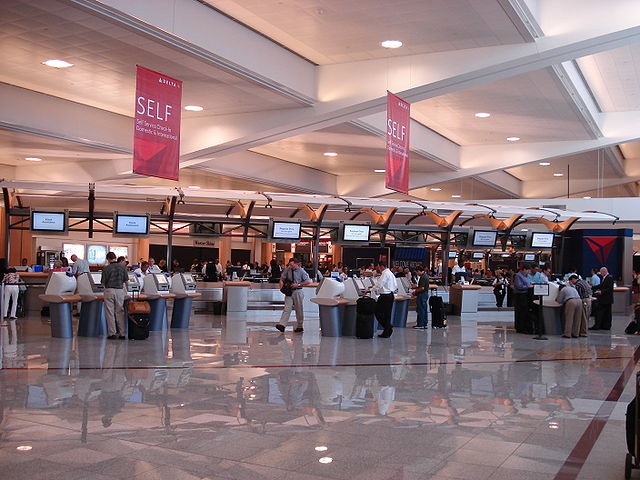
Pangiam, the company that acquired both the Metropolitan Washington Airports Authority product veriScan and the Trueface company and product, is continuing to establish itself in the airport market (while pursuing other markets).

By Atlantacitizen – w:Image:Album 13 006.jpg, Public Domain, https://commons.wikimedia.org/w/index.php?curid=2608406

Forbes recently published this article:

Delta Airlines, the Transportation Security Administration (TSA), and a travel tech company called Pangiam have partnered up to bring facial recognition technology to the Hartsfield–Jackson Atlanta International Airport (ATL). 

As of next month, Delta SkyMiles members who use the Fly Delta app and have a TSA PreCheck membership will be able to simply look at a camera to present their “digital ID” and navigate the airport with greater ease. In this program, a customer’s identity is made up of a SkyMiles member number, passport number and Known Traveler Number.

Of course, TSA PreCheck enrollment is provided by three other companies…but I digress. (I’ll digress again in a minute.)

Forbes goes on to say that this navigation will be available at pre-airport check in (on the Fly Delta app), bag drop (via TSA PreCheck), security (again via TSA PreCheck), and the gate.

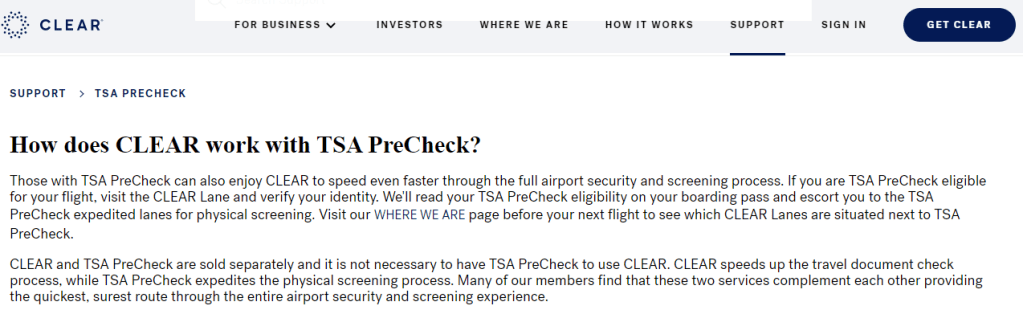
Incidentally, this illustrates how security systems from different providers build upon each other. Since I was an IDEMIA employee at the time that IDEMIA was the only company that performed TSA PreCheck enrollment, I was well aware (in my super-secret competitive intelligence role) how CLEAR touted the complementary features of TSA PreCheck in its own marketing.

Now I have no visibility into Pangiam’s internal discussions, but the company obviously has a long-term growth plan that it is executing.

So what will its next step be?

(Bredemarket Premium) The big biometric firms and the even bigger tech firms

When I was part of an industry in which the three major players were my employer IDEMIA and its competitors NEC and Thales, I was always aware of a potential threat to these three multi-billion dollar biometric companies. Specifically, there were much, much bigger technology companies (both inside and outside of Silicon Valley) with huge resources and extensive artificial intelligence experience. These firms could put the three biometric firms out of business at any time.

By Syassine – Own work, CC BY-SA 3.0, https://commons.wikimedia.org/w/index.php?curid=31368987

But is this threat a real threat? Or is it overstated?

Subscribe to get access

Subscribe to Bredemarket Premium to access this premium content.

  • Subscriptions just $5 per month.
  • Access Bredemarket’s expertise without spending hundreds or thousands of dollars.

Build your own automated fingerprint identification system…for FREE!

At Bredemarket, I work with a number of companies that provide biometric systems. And I’ve seen a lot of other systems over the years, including fingerprint, face, DNA, and other systems.

The components of a biometric system

While biometric systems may seem complex, the concept is simple. Years ago, I knew a guy who asserted that a biometric system only needs to contain two elements:

  • An algorithm that takes a biometric sample, such as a fingerprint image, and converts it into a biometric template.
  • An algorithm that can take these biometric templates and match them against each other.

If you have these two algorithms, my friend stated that you had everything you need for an biometric system.

Well, maybe not everything.

Today, I can think of a few other things that might be essential, or at least highly recommended. Here they are:

  • An algorithm that can measure the quality of a biometric sample. In some cases, the quality of the sample may be important in determining how reliable matching results may be.
  • For fingerprints, an algorithm that can classify the prints. Forensic examiners routinely classify prints as arches, whorls, loops, or variants of these three, and classifications can sometimes be helpful in the matching process.
  • For some biometric samples, utilities to manage the compression and decompression of the biometric images. Such images can be huge, and if they can be compressed by a reliable compression methodology, then processing and transmission speeds can be improved.
  • A utility to manage the way in which the biometric data is accessed. To ensure that biometric systems can talk to each other, there are a number of related interchange standards that govern how the biometric information can be read, written, edited, and manipulated.
  • For fingerprints, a utility to segment the fingerprints, in cases where multiple fingerprints can be found in the same image.

So based upon the two lists above, there are seven different algorithms/utilities that could be combined to form an automated fingerprint identification system, and I could probably come up with an eighth one if I really felt like it.

My friend knew about this stuff, because he had worked for several different firms that produced fingerprint identification systems. These firms spent a lot of money hiring many engineers and researchers to create all of these algorithms/utilities and sell them to customers.

How to get these biometric system components for free

But what if I told you that all of these firms were wasting their time?

And if I told you that since 2007, you could get source code for ALL of these algorithms and utilities for FREE?

Well, it’s true.

To further its testing work, the National Institute of Standards and Technology (NIST) created the NIST Biometric Image Software (NBIS), which currently has eight algorithms/utilities. (The eighth one, not mentioned above, is a spectral validation/verification metric for fingerprint images.) Some of these algorithms and utilities are available separately or in other utilities: anyone can (and is encouraged to) use the quality algorithm, called NFIQ, and the minutiae detector MINDTCT is used within the FBI’s Universal Latent Workstation (ULW).

If the FBI had just waited until 2007, it could have obtained the IAFIS software for free. FBI image taken from Chapter 6 of the Fingerprint Sourcebook, https://www.ojp.gov/pdffiles1/nij/225326.pdf.

As I write this, NBIS has not been updated in six years, when Release 5.0.0 came out.

Is anyone using this in a production system?

And no, I am unaware of any law enforcement agency or any other entity that has actually USED NBIS in a production system, outside of the testing realm, with the exception of limited use of selected utilities as noted above. Although Dev Technology Group has compiled NBIS on the Android platform as an exercise. (Would you like an AFIS on your Samsung phone?)

But it’s interesting to note that the capability is there, so the next time someone says, “Hey, let’s build our own AFIS!” you can direct them to https://www.nist.gov/itl/iad/image-group/products-and-services/image-group-open-source-server-nigos#Releases and let the person download the source code and build it.

Biometrics IS the financial sector

“Have to update my chart again.”

C. Maxine Most of Acuity Market Intelligence. From https://twitter.com/cmaxmost/status/1418306725510193152

Since I’m treading into financial territory here, I should disclose that Bredemarket has financial relationships with one or more of the companies mentioned in this post. This is not investment advice, do your own due diligence, bla bla bla.

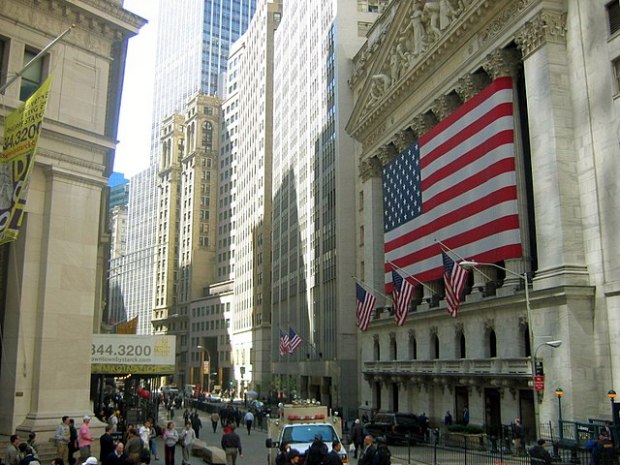
I don’t monitor the market enough to know if this is part of an overall trend, but there has been a lot of biometric and digital identity investment recently. Both Biometric Update and FindBiometrics (and other publications such as FinLedger) have written about some of these recent investments, and IPVM has published its acquisition analysis (for subscribers only). Here’s a partial list of the biometric and/or digital identity companies who have received new funding (via investors, IPO, or acquisitions) recently:

I am not a financial expert (trust me on this), but I suspect that these companies are benefiting from two contradictory factors.

  • The apparent WANING of the COVID threat suggests better market performance in the future.
  • Some biometric and digital identity investments are very attractive precisely BECAUSE of the COVID threat, and the resulting attractiveness of remote and touchless technologies.

Of course, markets run in cycles, and it’s hard to predict if this is just the beginning of money flowing to biometrics/digital identity companies, or if all of this will suddenly come to a grinding halt. Remember how hot so-called “fever scanners” were a year ago, until their deficiencies were identified? And remember how Microsoft was prompted to divest from Anyvision not too long ago?

It’s possible that a number of external factors, such as an increase in government bans of facial recognition use, consumer resistance to digital identity, or the entry (or re-entry) of much larger players into the biometrics and/or digital identity markets, could dampen the revenue hopes for these funded companies.

Of course, investors are used to analyzing risk, and in many cases the investments with higher risk can yield the greater rewards.

It’s all just a game.

Biometric (and other) authentication CAN be spoofed…but it isn’t easy

A few days ago, Liam Tung of ZDNet wrote an article entitled “Windows 10 security: Here’s how researchers managed to fool Windows Hello.”

Those who read the title of the article may conclude that biometrics is a terrible authentication method because it can be spoofed.

Just a picture of candy. Nothing special. By Jebulon – Own work, CC0, https://commons.wikimedia.org/w/index.php?curid=27753729

Well, until they come to the third paragraph of the article.

The attack is quite elaborate and would require planning, including being able to acquire an infrared (IR) image of the target’s face and building a custom USB device, such as a USB web camera, that will work with Windows Hello. The attack exploits how Windows 10 treats these USB devices and would require the attacker to have gained physical access to the target PC.

Of course, if the target is a really important target such as a world leader, it might be worth it to go to all of that effort to execute the attack.

However, the difficult attack would be much more difficult to execute if the authentication system required multiple biometrics, rather than just one.

And the attack would be even more difficult still if the authentication system employed multiple authentication factors, rather than the single “something you are” factor. If you have to spoof the fingerprint AND the face AND the driver’s license AND the five digit PIN AND the geolocation, and you don’t know in advance WHICH factors will be requested, it’s still possible to gain access, but it’s not easy.

Pangiam, CLEAR, and others make a “sporting” effort to deny (or allow) stadium access

Back when I initially entered the automated fingerprint identification systems industry in the last millennium, I primarily dealt with two markets: the law enforcement market that seeks to solve crimes and identify criminals, and the welfare benefits market that seeks to make sure that the right people receive benefits (and the wrong people don’t).

Other markets simply didn’t exist. If I pulled out my 1994-era mobile telephone and looked at it, nothing would happen. Today, I need to look at my 2020-era mobile telephone to obtain access to its features.

And there are other biometric markets also.

Pangiam and stadium bans

Back in 1994 I couldn’t envision a biometrics story in Sports Illustrated magazine. But SI just ran a story on how facial recognition can be used to keep fans out of stadiums who shouldn’t be there.

Some fans (“fanatics”) perform acts in stadiums that cause the sports teams and/or stadium authorities to officially ban them from the stadium, sometimes for life.

John Green is the man in the blue shirt and white baseball cap to Artest’s left. By Copyright 2004 National Basketball Association. – Television broadcast of the Pacers-Pistons brawl on ESPN., Fair use, https://en.wikipedia.org/w/index.php?curid=6824157

But in the past, these measures were ineffective.

For a long time, those “measures” were limited at best. Fans do not have to show ID upon entering arenas. Teams could run checks on all the credit cards to purchase tickets to see whether any belonged to banned fans, but those fans could easily have a friend buy the tickets. 

But there are other ways to enforce stadium bans, and Sports Illustrated quoted an expert on the matter.

“They’ve kicked the fan out; they’ve taken a picture—that fan they know,” says Shaun Moore, CEO of a facial-recognition company called Trueface. “The old way of doing things was, you give that picture to the security staff and say, ‘Don’t let this person back in.’ It’s not really realistic. So the new way of doing it is, if we do have entry-level cameras, we can run that person against everyone that’s coming in. And if there’s a hit, you know then; then there’s a notification to engage with that person.”

This, incidentally, is an example of a “deny list,” or the use of a security system to deny a person access. We’ll get to that later.

But did you notice the company that was mentioned in the last quote? I’ve mentioned that company before, because Trueface was the most recent acquisition by the company Pangiam, a company that has also acquired airport security technology.

But Pangiam/Trueface isn’t the only company serving stadium (and entertainment) venues.

CLEAR and stadium entry

Most of the time, sports stadiums aren’t concentrating on the practice of DENYING people entry to a stadium. They make a lot more money by ALLOWING people entry to a stadium…and allowing them to enter as quickly as possible so they can spend money on concessions.

One such company that supports this is CLEAR, which was recently in the news because of its Initial Public Offering. Coincidentally, CLEAR also provides airport security technology, but it has branched out from that core market and is also active in other areas.

For example, let’s say you’re a die-hard New York Mets fan, and you head to Citi Field to watch a game.

By Chris6d – Own work, CC BY-SA 4.0, https://commons.wikimedia.org/w/index.php?curid=101751795

The Mets don’t just let anyone into the stadium; you have to purchase a ticket. So you need to take your ticket out of your pocket and show it to the gate staff, or you need to take your smartphone out of your pocket and show your digital ticket to the gate staff.

What if you could get into the stadium without taking ANYTHING out of your pocket? Well, you can.

In the CLEAR Lane, your fingerprint is all you need to use tickets in your MLB Ballpark app – no need to pull out your phone or printed ticket as you enter the game.

Now that is really easy.

Pangiam and CLEAR aren’t the only companies in this space, as I well know. But there’s the possibility that biometrics will be used more often for access to sports games, concerts, and similar events.

(Bredemarket Premium) My (biometric) baby is American made

When I first entered the biometric world, the portion of the world that directly interested me (the automated fingerprint identification system, or AFIS industry) had three major players and one emerging player. Of those four, two were privately held American companies, and the other two were U.S. subsidiaries of foreign companies (one French, one Japanese).

Today it’s different.

Subscribe to get access

Subscribe to Bredemarket Premium to access this premium content.

  • Subscriptions just $5 per month.
  • Access Bredemarket’s expertise without spending hundreds or thousands of dollars.

Pangiam acquires something else (in this case TrueFace)

People have been coming here to find this news (thanks Google Search Console) so I figured I’d better share it here.

Remember Pangiam, the company that I talked about back in March when it acquired the veriScan product from the Metropolitan Washington Airports Authority? Well, last week Pangiam acquired another company.

TYSONS CORNER, Va., June 2, 2021 /PRNewswire/ — Pangiam, a technology-based security and travel services provider, announced today that it has acquired Trueface, a U.S.-based leader in computer vision focused on facial recognition, weapon detection and age verification technologies. Terms of the transaction were not disclosed….

Trueface, founded in 2013 by Shaun Moore and Nezare Chafni, provides industry leading computer vision solutions to customers in a wide range of industries. The company’s facial recognition technology recently achieved a top three ranking among western vendors in the National Institute of Standards and Technology (NIST) 1:N Face Recognition Vendor Test. 

(Just an aside here: companies can use NIST tests to extract all sorts of superlatives that can be applied to their products, once a bunch of qualifications are applied. Pay attention to the use of the phrase “among western vendors.” While there may be legitimate reasons to exclude non-western vendors from comparisons, make a mental note when such an exclusion is made.)

But what does this mean in terms of Pangiam’s existing product? The press release covers this also.

Trueface will add an additional capability to Pangiam’s existing technologies, creating a comprehensive and seamless solution to satisfy the needs of both federal and commercial enterprises.

And because Pangiam is not a publicly-traded company, it is not obliged to add a disclaimer to investors saying this integration might not happen bla bla bla. Publicly traded companies are obligated to do this so that investors are aware of the risks when a company speculates about its future plans. Pangiam is not publicly traded, and the owners are (presumably) well aware of the risks.

For example, a US government agency may prefer to do business with an eastern vendor. In fact, the US government does a lot of business with one eastern vendor (not Chinese or Russian).

But we’ll see what happens with any future veriTruefaceScan product.