Because my local Amazon Fresh post is taking off, it’s a good time to revisit the “one” thing Uplanders will encounter when they get there.
I’ve talked about Amazon One palm/vein biometrics several times in the past.
The August 2021 post about Amazon paying $10 for your biometrics, long before World (Worldcoin) did something similar. Hmm…wonder if the $10 deal is still on?
And it’s also available (or soon will be) on TP-Link door locks. But the How-To Geek writer is confused:
“TP-Link says that these palm vein patterns are so unique that they can even tell the difference between identical twins, making them safer than regular fingerprint or facial recognition methods.”
And the TP-Link page for the product has no sales restrictions. Even Illinois residents can buy it. Presumably there’s an ironclad consent agreement with every enrollment to prevent BIPA lawsuits.
Work Address: 235 E. Foothill Blvd, Upland, CA, 91786
Pay Rate: $17.80 per hour
Availability Requirements: Shift availability is dependent on operational needs.
Part-time: Shift availability required 3 days per week, including Saturday and Sunday
Flex-time: Must be available 2 weekdays between Monday-Friday and 1 weekend day/evening between Saturday-Sunday. May be scheduled up to 8 hours weekly, with additional shifts offered based on store availability.
Shifts are between 4 a.m. and 12 a.m. and may be up to 8 hours long
If you create your own test data, you’re more likely to pass the test. So what data was used for Amazon One palm/vein identity scanning accuracy testing?
But NIST has never conducted regular testing of palm identification in general, or palm/vein identity scanning in particular. Not for Amazon. Not for Fujitsu. Not for Imprivata. Not for Ingenico. Not for Pearson. Not for anybody.
“Amazon One is 100 times more accurate than scanning two irises. It raises the bar for biometric identification by combining palm and vein imagery, and after millions of interactions among hundreds of thousands of enrolled identities, we have not had a single false positive.”
“The company claims it is 99.999 percent accurate but does not offer information supporting that statistic.”
And so far I haven’t found any either.
Since the company trains its algorithm on synthetically generated palms, I would like to make sure the company performs its palm/vein identity scanning accuracy testing on REAL palms. If you actually CREATE the data for any test, including an accuracy test, there’s a higher likelihood that you will pass.
I think many people would like to see public substantiated Amazon One accuracy data. ZERO false positives is a…BOLD claim to make.
Perhaps one of the biggest changes over the last several decades is that we no longer possess physical things.
Old and new music
When some of us were younger, we would always go to “the record store” to buy a CD or cassette or vinyl (the “record”) or maybe an 8 track. We would put the physical media on a playback device. And unless the media were damaged or stolen, you always had it. RCA wouldn’t come to your house and take your Elvis record.
Let me be your teddy wildebeest.
Then services from Napster 1.0 to Apple to Spotify started to provide music in digital form. And now your music COULD be taken away. When Neil Young got mad at Spotify, I couldn’t listen to Neil any more. (They subsequently kissed and made up.)
This is true of many other things: TV shows, movies, even computer software.
Which brings us to books.
Old and new books
You could once buy books at your local bookstore, or from an online bookstore called Amazon. But then Amazon developed the Kindle e-reader. And as The Verge points out, something on the Kindle today may not be there tomorrow.
“Amazon has occasionally removed books from its online store and remotely deleted them from Kindles or edited titles and re-uploaded new copies to its e-readers. In 2009, the company removed copies of George Orwell’s Nineteen Eighty-Four and Animal Farm, explaining the books had been mistakenly published. More recently, many of Roald Dahl’s books, including Charlie and the Chocolate Factory, were replaced with updated copies featuring modified language on various ebook platforms. It’s a reminder that you don’t actually own much of the digital content you consume, and without the ability to back up copies of ebooks, you could lose them entirely if they’re banned and removed.”
New and improved edition.
But there is a workaround. If your Kindle has a copy of Mein Kampf or a book about gay hotspots near the Gulf of Mexico and you don’t want to lose it, you can save it outside of the Amazon ecosystem.
“(The feature is) still accessible through Amazon’s website by accessing your “Content Library” while logged into your account. For purchased books you select the “More actions” menu, choose “Download & transfer via USB,” select a Kindle device you have registered, and a copy of the book will be downloaded to your computer.”
A nice feature…especially if you want to make sure you don’t lose your purchased content. And it’s really nice if you want to put your Amazon content on a non-Amazon e-reader. Because the Kindle only has a minuscule 72% share of the e-reader market, this is a gargantuan threat to Amazon’s ability to sell hardware.
You can see where this is going.
Ch-ch-ch-ch-changes
Amazon has made a change, according to The Verge:
“Starting February 26, 2025, the ‘Download & Transfer via USB’ option will no longer be available. You can still send Kindle books to your Wi-Fi enabled devices by selecting the ‘Deliver or Remove from Device’ option.”
February 25.
To clarify, you can still access your books on the Kindle app.
Just not outside of it.
How does this affect your content?
This serves as a reminder about technological change, walled gardens, and obsolescence.
Which ties in with one of Bredemarket’s favorite topics, repurposing.
Now Bredemarket doesn’t create videos for clients, but if you need your identity/biometric or technology text repurposed in another format, I can help.
When you market to your prospects and customers, will they believe what you say? Or will you be exposed as a liar?
The Bredemarket blog has talked incessantly about customer focus from a marketing perspective, noting that an entity’s marketing materials need to speak to the needs of the customer or the prospect, not the selling entity.
But customer focus alone is not enough. When the customers sign up, they have to deal with someone.
Unless the customer is stuck in answer bot hell (another issue entirely), they will deal with an employee.
The expendables
And some employees are not happy, because they feel they are expendable.
“Every area should be looking to be 10% more efficient. If I was running a department with a hundred people, I guarantee you, if I wanted to, I couldn’t run it with 90 and be more efficient. I guarantee you, I could do it.”
So J.P. Morgan Chase is doing very well, Dimon is doing very well, but he’s implicitly saying that his people suck.
“This is going to be an intense year, and I want to make sure we have the best people on our teams. I’ve decided to raise the bar on performance management and move out low performers faster.”
You may have noticed my intentional use of the word “entity” at the beginning of this post. Because while businesses have attracted much attention in the current culture of “layoffs will continue until morale improves,” these businesses are themselves “low performers” in the shedding people category. Chief DOGE Elon Musk, fresh from reducing X’s headcount, is coordinating layoffs in the public sector.
“Federal agencies were ordered by Donald Trump to fire mostly probationary staff, with as many as 200,000 workers set to be affected and some made to rush off the premises.”
Zuckerberg could only dream of saying “you’re fired” to 200,000 people. That dream would certainly increase his masculine energy, but for now Musk has trumped Zuckerberg on that front.
Do J.P. Morgan Chase’s employees matter to Jamie Dimon?
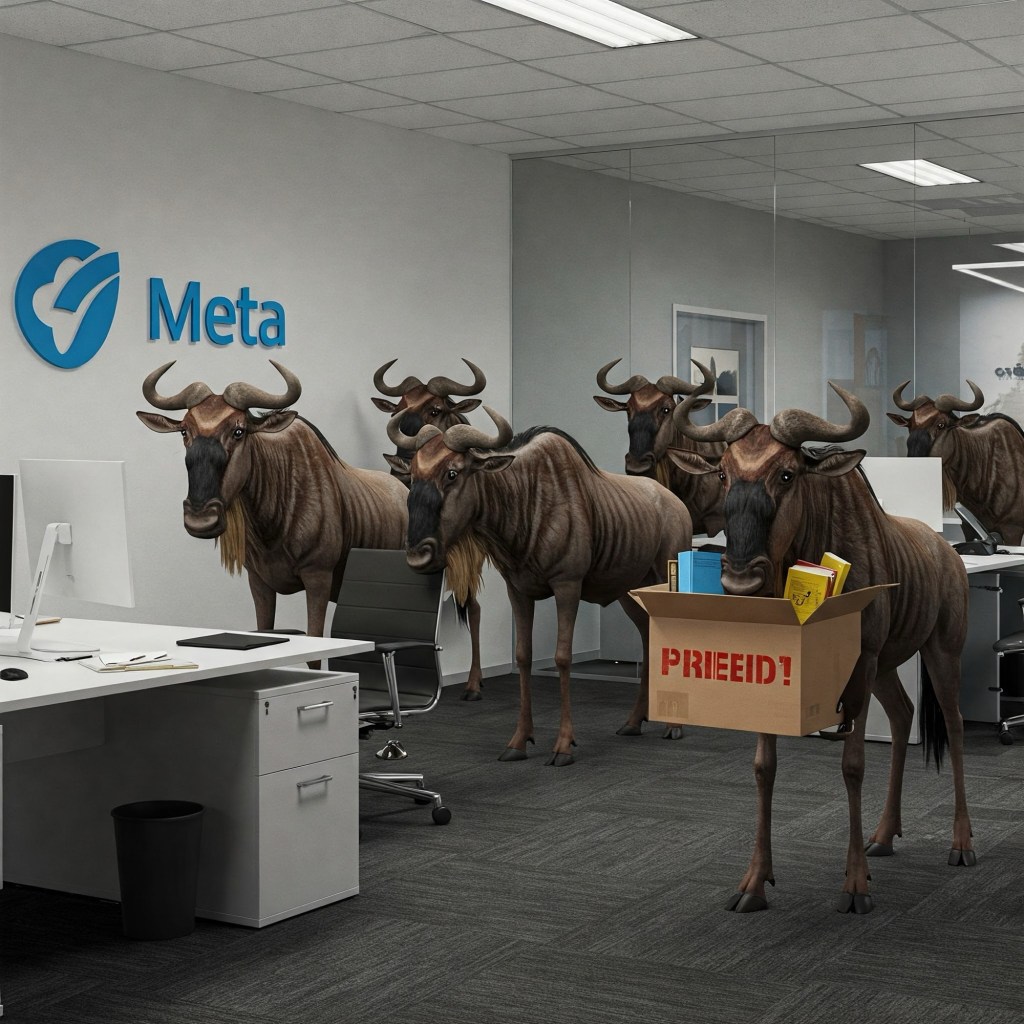
Do Meta’s employees matter to Mark Zuckerberg?
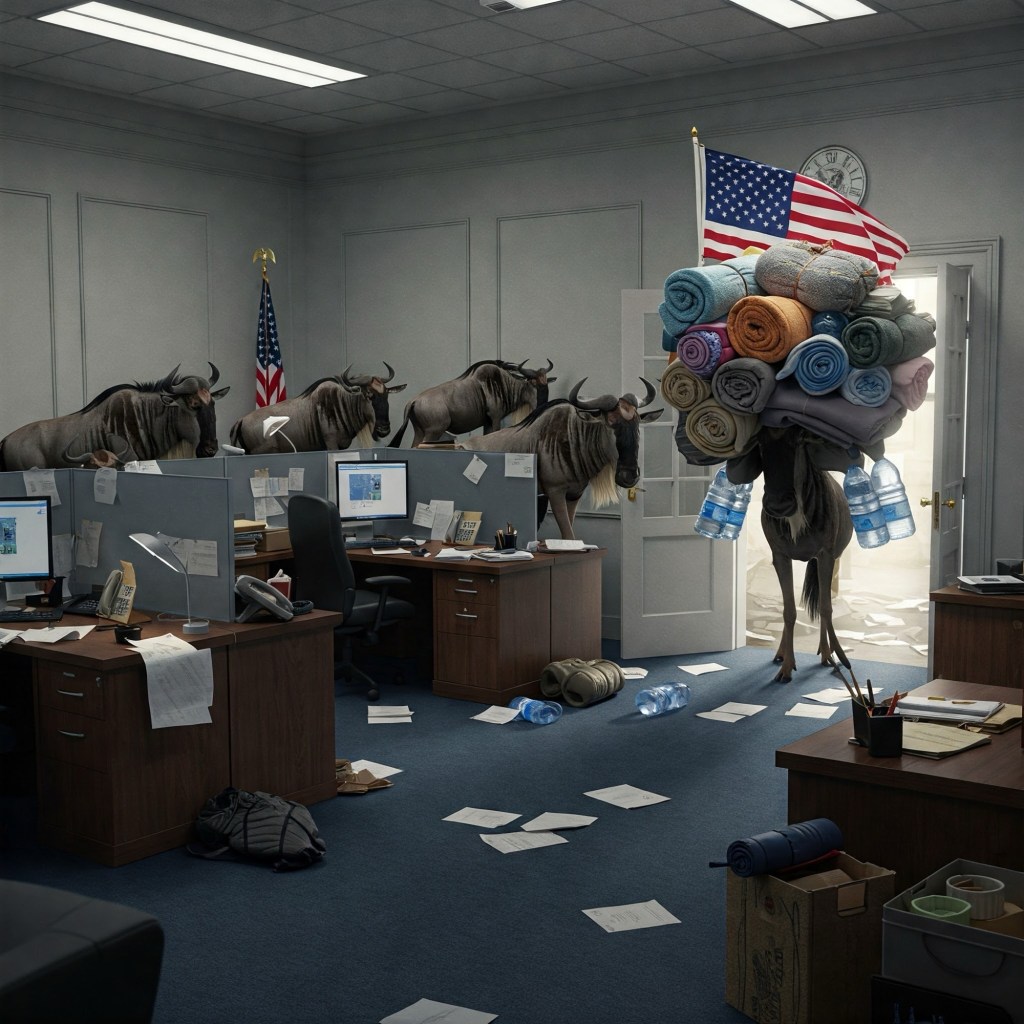
Do federal employees matter to Elon Musk and Donald Trump?
Regardless of the answer (and one could assert that they like the “good” employees and don’t want them to be harmed by the bad apples), their views are not universal.
The other extreme
Richard Branson (reportedly) does not put his needs first at the Virgin companies he runs.
Nor does he prioritize investors.
Oh, and if you’re one of Virgin’s customers…your happiness isn’t critically important either.
“So, my philosophy has always been, if you can put staff first, your customer second and shareholders third, effectively, in the end, the shareholders do well, the customers do better, and yourself are happy.”
You could argue that this is a means to an end, and that employee focus CAUSES customer focus. What if employee focus is missing?
“If the person who’s working for your company is not given the right tools, is not looked after, is not appreciated, they’re not gonna do things with a smile and therefore the customer will be treated in a way where often they won’t want to come back for more.”
Think about this the next time you have a problem with your Facebook account or at a Chase Bank or with your tax return.
Whether back office issues matter to customers
Of course I may be over reading into this, because I have said that the customer doesn’t care about your company. If you solve their problems, they don’t care if you’re hiring 200,000 people or firing 200,000 people.
If you solve their problems.
I can’t cite the source or the company, but I heard a horror story about an unhappy customer. The company had heavily bought into the “layoffs will continue until morale improves” philosophy, resulting in turnover in the employees who dealt with customers. When the customer raised an issue with the company, it made a point of saying that employee John Jones (not the employee’s real name) could have solved the customer’s problem long ago if the company hadn’t removed Jones from the account.
What about your company’s marketing?
So think about this in your marketing. Before you brag about your best places to work award, make sure that your prospect will see evidence of this in the employees they encounter.
“Our 8th annual LinkedIn Top Companies list highlights the 50 best large workplaces to grow your career in the U.S. right now. Fueled by unique LinkedIn data, the methodology analyzes various facets of career progression like promotion rates, skill development and more among employees at each company.”
Number 1 on LinkedIn’s April 2024 list? J.P. Morgan Chase.
HID Global has teamed up with Amazon Web Services to enhance biometric face imaging capabilities by utilizing the Amazon Rekognition computer vision cloud service on its U.ARE.U camera system.
And I also don’t know whether HID Global will be prevented from providing the U.ARE.U face product to law enforcement, given Amazon’s 2020-2021 ban on law enforcement use of Amazon Rekognition’s face capabilities.
Amazon Rekognition and the FBI
Especially since Fedscoop revealed in January that the FBI was in the “initiation” phase of using Amazon Rekognition. Neither Amazon nor the FBI would say whether facial recognition was part of the deal.
If Alphabet or Amazon reverse their current reluctance to market their biometric offerings to governments, the entire landscape could change again.
If they wished, Alphabet, Amazon, and the other tech powers could shut IDEMIA, NEC, and Thales completely out of the biometric business with a minimal (to them) investment. If you’re familiar with SWOT analyses, this definitely falls into the “threat” category.
But the Really Big Bunch still fear public reaction to any so-called “police state” involvement.
I won’t give away all the information about the Fischer Identity-AWS effort at Baylor—you have to opt in to access a gated case study to obtain that—but I will say that the case study claims a 12-week implementation of an IAM system that stores “several hundred thousand identities.”
I assume the alumni at Baylor are a generous segment of the university community.
She delivered a Thursday presentation entitled “Customizing generative AI applications for your business using your data.” The tool that Tanke uses for customization is Amazon Bedrock, which supports Retrieval-Augmented Generation, or RAG.
Retrieval-Augmented Generation (RAG) is the process of optimizing the output of a large language model, so it references an authoritative knowledge base outside of its training data sources before generating a response. Large Language Models (LLMs) are trained on vast volumes of data and use billions of parameters to generate original output for tasks like answering questions, translating languages, and completing sentences. RAG extends the already powerful capabilities of LLMs to specific domains or an organization’s internal knowledge base, all without the need to retrain the model. It is a cost-effective approach to improving LLM output so it remains relevant, accurate, and useful in various contexts.
Because Amazon has obviously referred to my seven questions—OK, maybe they didn’t—the RAG page devotes time to the “why” question and the “benefits” question.
So what happens when you use LLMs WITHOUT retrieval-augmented generation?
You can think of the Large Language Model as an over-enthusiastic new employee who refuses to stay informed with current events but will always answer every question with absolute confidence.
How does RAG solve these problems? It “redirects the LLM to retrieve relevant information from authoritative, pre-determined knowledge sources.” RAG allows you to introduce more current information to the LLM which reduces cost, increases accuracy (and attributes sources), and supports better testing and improvements.
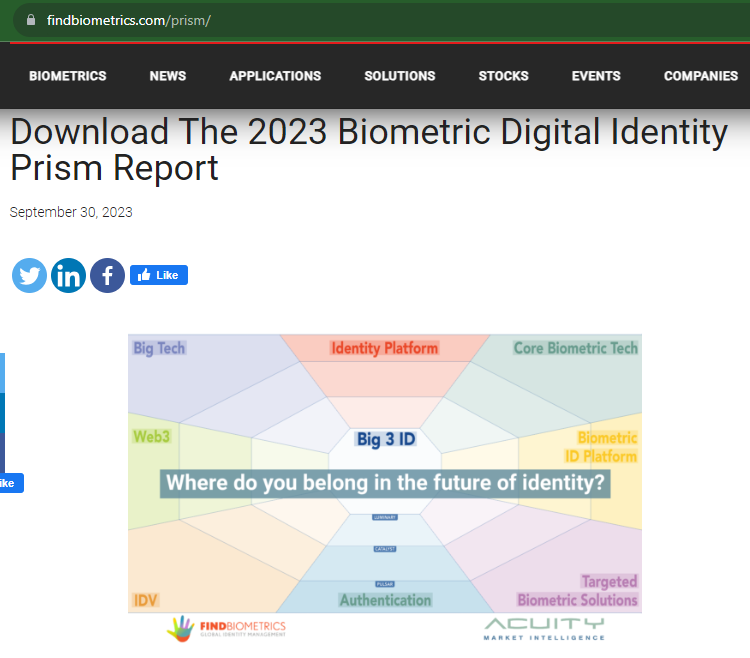
On September 30, FindBiometrics and Acuity Market Intelligence released the production version of the Biometric Digital Identity Prism Report. You can request to download it here.
But FindBiometrics and Acuity Market Intelligence didn’t invent the Big 3. The concept has been around for 40 years. And two of today’s Big 3 weren’t in the Big 3 when things started. Oh, and there weren’t always 3; sometimes there were 4, and some could argue that there were 5.
So how did we get from the Big 3 of 40 years ago to the Big 3 of today?
The Big 3 in the 1980s
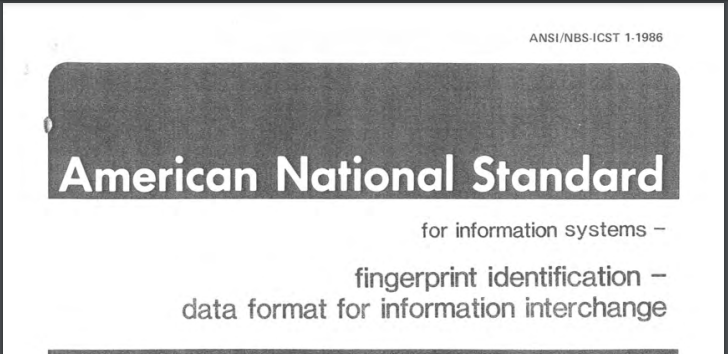
Back in 1986 (eight years before I learned how to spell AFIS) the American National Standards Institute, in conjunction with the National Bureau of Standards, issued ANSI/NBS-ICST 1-1986, a data format for information interchange of fingerprints. The PDF of this long-superseded standard is available here.
When creating this standard, ANSI and the NBS worked with a number of law enforcement agencies, as well as companies in the nascent fingerprint industry. There is a whole list of companies cited at the beginning of the standard, but I’d like to name four of them.
De La Rue Printrak, Inc.
Identix, Inc.
Morpho Systems
NEC Information Systems, Inc.
While all four of these companies produced computerized fingerprinting equipment, three of them had successfully produced automated fingerprint identification systems, or AFIS. As Chapter 6 of the Fingerprint Sourcebook subsequently noted:
Morpho Systems resulted from French AFIS efforts, separate from those of the FBI. These efforts launched Morpho’s long-standing relationship with the French National Police, as well as a similar relationship (now former relationship) with Pierce County, Washington.
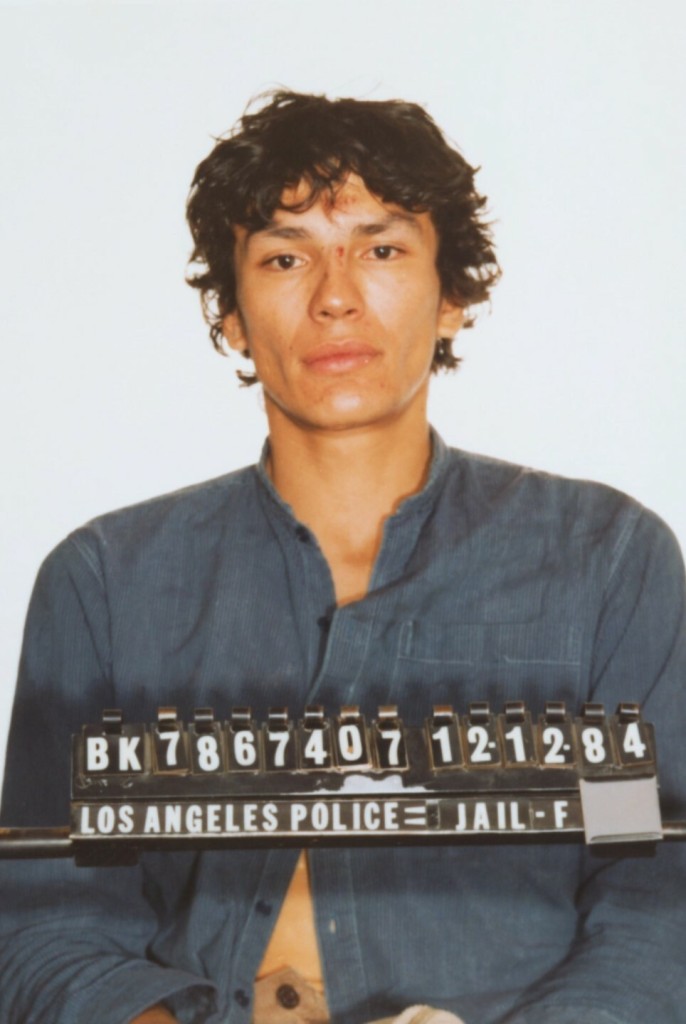
NEC had deployed AFIS equipment for the National Police Academy of Japan, and (after some prodding; read Chapter 6 for the story) the city of San Francisco. Eventually the state of California obtained an NEC system, which played a part in the identification of “Night Stalker” Richard Ramirez.
After the success of the San Francisco and California AFIS systems, many other jurisdictions began clamoring for AFIS of their own, and turned to these three vendors to supply them.
The Big 4 in the 1990s
But in 1990, these three firms were joined by a fourth upstart, Cogent Systems of South Pasadena, California.
While customers initially preferred the Big 3 to the upstart, Cogent Systems eventually installed a statewide system in Ohio and a border control system for the U.S. government, plus a vast number of local systems at the county and city level.
Between 1991 and 1994, the (Immigfation and Naturalization Service) conducted several studies of automated fingerprint systems, primarily in the San Diego, California, Border Patrol Sector. These studies demonstrated to the INS the feasibility of using a biometric fingerprint identification system to identify apprehended aliens on a large scale. In September 1994, Congress provided almost $30 million for the INS to deploy its fingerprint identification system. In October 1994, the INS began using the system, called IDENT, first in the San Diego Border Patrol Sector and then throughout the rest of the Southwest Border.
I was a proposal writer for Printrak (divested by De La Rue) in the 1990s, and competed against Cogent, Morpho, and NEC in AFIS procurements. By the time I moved from proposals to product management, the next redefinition of the “big” vendors occurred.
The Big 3 in 2003
There are a lot of name changes that affected AFIS participants, one of which was the 1988 name change of the National Bureau of Standards to the National Institute of Standards and Technology (NIST). As fingerprints and other biometric modalities were increasingly employed by government agencies, NIST began conducting tests of biometric systems. These tests continue to this day, as I have previously noted.
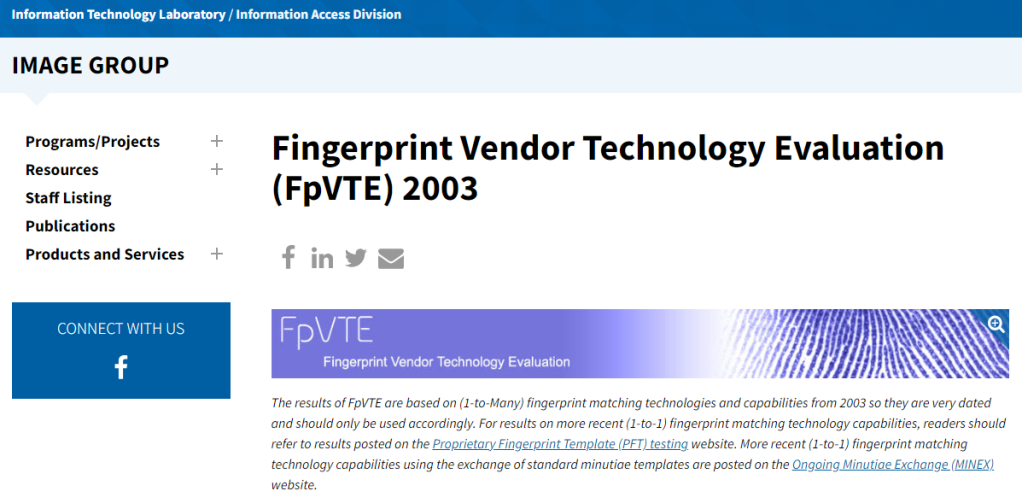
One of NIST’s first tests was the Fingerprint Vendor Technology Evaluation of 2003 (FpVTE 2003).
For those who are familiar with NIST testing, it’s no surprise that the test was thorough:
FpVTE 2003 consists of multiple tests performed with combinations of fingers (e.g., single fingers, two index fingers, four to ten fingers) and different types and qualities of operational fingerprints (e.g., flat livescan images from visa applicants, multi-finger slap livescan images from present-day booking or background check systems, or rolled and flat inked fingerprints from legacy criminal databases).
Eighteen vendors submitted their fingerprint algorithms to NIST for one or more of the various tests, including Bioscrypt, Cogent Systems, Identix, SAGEM MORPHO (SAGEM had acquired Morpho Systems), NEC, and Motorola (which had acquired Printrak). And at the conclusion of the testing, the FpVTE 2003 summary (PDF) made this statement:
Of the systems tested, NEC, SAGEM, and Cogent produced the most accurate results.
Which would have been great news if I were a product manager at NEC, SAGEM, and Cogent.
Unfortunately, I was a product manager at Motorola.
The effect of this report was…not good, and at least partially (but not fully) contributed to Motorola’s loss of its long-standing client, the Royal Canadian Mounted Police, to Cogent.
The Big 3, 4, or 5 after 2003
So what happened in the years after FpVTE was released? Opinions vary, but here are three possible explanations for what happened next.
Did the Big 3 become the Big 4 again?
Now I probably have a bit of bias in this area since I was a Motorola employee, but I maintain that Motorola overcame this temporary setback and vaulted back into the Big 4 within a couple of years. Among other things, Motorola deployed a national 1000 pixels-per-inch (PPI) system in Sweden several years before the FBI did.
Did the Big 3 remain the Big 3?
Motorola’s arch-enemies at Sagem Morpho had a different opinion, which was revealed when the state of West Virginia finally got around to deploying its own AFIS. A bit ironic, since the national FBI AFIS system IAFIS was located in West Virginia, or perhaps not.
Anyway, Motorola had a very effective sales staff, as was apparent when the state issued its Request for Proposal (RFP) and explicitly said that the state wanted a Motorola AFIS.
That didn’t stop Cogent, Identix, NEC, and Sagem Morpho from bidding on the project.
After the award, Dorothy Bullard and I requested copies of all of the proposals for evaluation. While Motorola (to no one’s surprise) won the competition, Dorothy and I believed that we shouldn’t have won. In particular, our arch-enemies at Sagem Morpho raised a compelling argument that it should be the chosen vendor.
Their argument? Here’s my summary: “Your RFP says that you want a Motorola AFIS. The states of Kansas (see page 6 of this PDF) and New Mexico (see this PDF) USED to have a Motorola AFIS…but replaced their systems with our MetaMorpho AFIS because it’s BETTER than the Motorola AFIS.”
But were Cogent, Motorola, NEC, and Sagem Morpho the only “big” players?
Did the Big 3 become the Big 5?
While the Big 3/Big 4 took a lot of the headlines, there were a number of other companies vying for attention. (I’ve talked about this before, but it’s worthwhile to review it again.)
Identix, while making some efforts in the AFIS market, concentrated on creating live scan fingerprinting machines, where it competed (sometimes in court) against companies such as Digital Biometrics and Bioscrypt.
The fingerprint companies started to compete against facial recognition companies, including Viisage and Visionics.
Oh, and there were also iris companies such as Iridian.
And there were other ways to identify people. Even before 9/11 mandated REAL ID (which we may get any year now), Polaroid was making great efforts to improve driver’s licenses to serve as a reliable form of identification.
In short, there were a bunch of small identity companies all over the place.
But in the course of a few short years, Dr. Joseph Atick (initially) and Robert LaPenta (subsequently) concentrated on acquiring and merging those companies into a single firm, L-1 Identity Solutions.
These multiple mergers resulted in former competitors Identix and Digital Biometrics, and former competitors Viisage and Visionics, becoming part of one big happy family. (A multinational big happy family when you count Bioscrypt.) Eventually this company offered fingerprint, face, iris, driver’s license, and passport solutions, something that none of the Big 3/Big 4 could claim (although Sagem Morpho had a facial recognition offering). And L-1 had federal contracts and state contracts that could match anything that the Big 3/Big 4 offered.
So while L-1 didn’t have a state AFIS contract like Cogent, Motorola, NEC, and Sagem Morpho did, you could argue that L-1 was important enough to be ranked with the big boys.
So for the sake of argument let’s assume that there was a Big 5, and L-1 Identity Solutions was part of it, along with the three big boys Motorola, NEC, and Safran (who had acquired Sagem and thus now owned Sagem Morpho), and the independent Cogent Systems. These five companies competed fiercly with each other (see West Virginia, above).
In a two-year period, everything would change.
The Big 3 after 2009
Hang on to your seats.
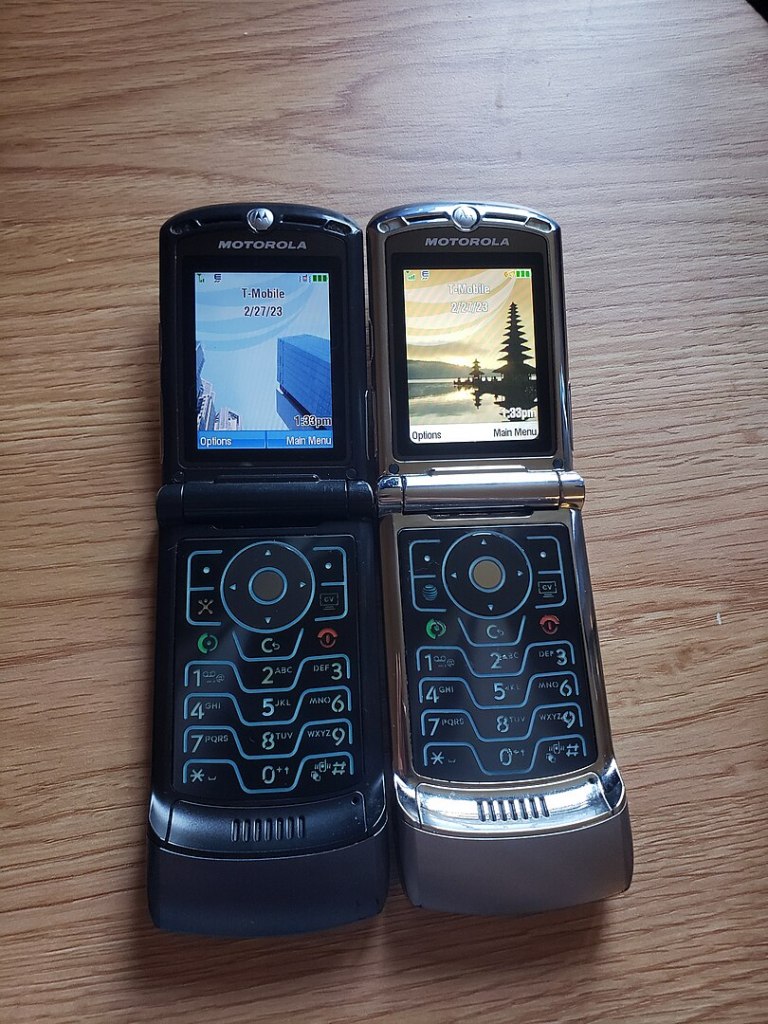
The Motorola RAZR was hugely popular…until it wasn’t. Eventually Motorola split into two companies and sold off others, including the “Printrak” Biometric Business Unit. By NextG50 – Own work, CC BY-SA 4.0, https://commons.wikimedia.org/w/index.php?curid=130206087
By 2009, Safran (resulting from the merger of Sagem and Snecma) was an international powerhouse in aerospace and defense and also had identity/biometric interests. Motorola, in the meantime, was no longer enjoying the success of its RAZR phone and was looking at trimming down (prior to its eventual, um, bifurcation). In response to these dynamics, Safran announced its intent to purchase Motorola’s Biometric Business Unit in October 2008, an effort that was finalized in April 2009. The Biometric Business Unit (adopting its former name Printrak) was acquired by Sagem Morpho and became MorphoTrak. On a personal level, Dorothy Bullard moved out of Proposals and I moved into Proposals, where I got to work with my new best friends that had previously slammed Motorola for losing the Kansas and New Mexico deals. (Seriously, Cindy and Ron are great folks.)
By 2011, Safran decided that it needed additional identity capabilities, so it acquired L-1 Identity Solutions and renamed the acquisition as MorphoTrust.
If you’re keeping notes, the Big 5 have now become the Big 3: 3M, Safran, and NEC (the one constant in all of this).
While there were subsequent changes (3M sold Cogent and other pieces to Gemalto, Safran sold all of Morpho to Advent International/Oberthur to form IDEMIA, and Gemalto was acquired by Thales), the Big 3 has remained constant over the last decade.
And that’s where we are today…pending future developments.
If Alphabet or Amazon reverse their current reluctance to market their biometric offerings to governments, the entire landscape could change again.
Or perhaps a new AI-fueled competitor could emerge.
The 1 Biometric Content Marketing Expert
This was written by John Bredehoft of Bredemarket.
If you work for the Big 3 or the Little 80+ and need marketing and writing services, the biometric content marketing expert can help you. There are several ways to get in touch:
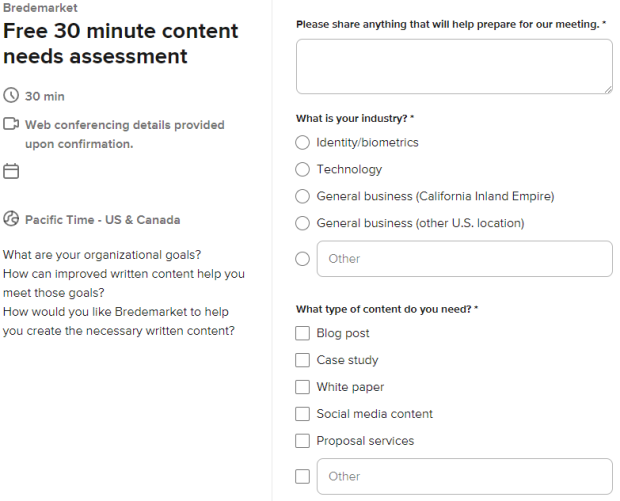
Book a meeting with me at calendly.com/bredemarket. Be sure to fill out the information form so I can best help you.









 Bredemarket
