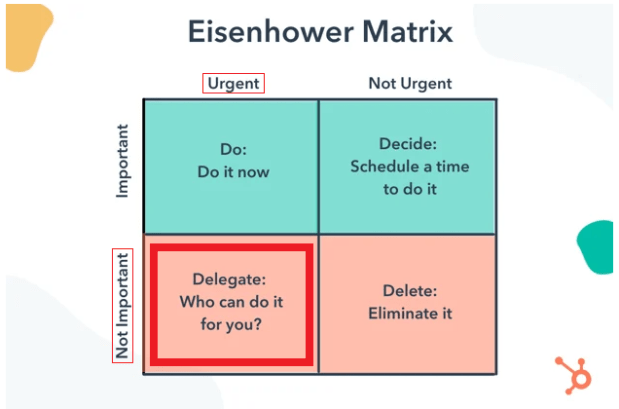
All things are NOT equally important. In fact, there are THREE levels of importance (TLOI):
IMPORTANT.
VERY IMPORTANT.
CRITICALLY IMPORTANT.
Maybe you use different words (perhaps “life-or-death important” or “DEFCON 1”), but the basic point remains. Some things are more important than others.
Make sure that everyone has a common understanding of how important a task is. If you think something is “important” but your partner thinks it is “very important,” your partner may think you are indifferent and have hurt emotions.
Enough theory; let’s apply this. Are you interested in an application of TLOI that answers the following questions?
How is the Eisenhower Matrix flawed by its use of only a SINGLE level of importance?
How does the correction of the Eisenhower Matrix with TLOI affect whether or not you will select Bredemarket as your content marketing expert?
The second question may not have ANY importance to you, but it’s critically important to me.
But in my previous discussions about the Eisenhower Matrix, I haven’t talked about the matrix gap. (Unrelated to the missile gap that Eisenhower’s successor claimed.)
Eisenhower’s half contribution to the Eisenhower Matrix
First, I guess most of you already know that Dwight D. Eisenhower never viewed an Eisenhower Matrix before his death in 1969, since the matrix didn’t appear until 1989. Eisenhower may have been (literally) a Supreme Commander, but he could not time travel. (His great-granddaughter? Maybe.)
While the Eisenhower Matrix originates in something Eisenhower said, his statement ignores half of the matrix.
In a 1954 speech, Eisenhower quoted an unnamed university president when he said, “I have two kinds of problems, the urgent and the important. The urgent are not important, and the important are never urgent.”
If you were to illustrate what Eisenhower actually said, there would only be two boxes—one for the urgent tasks, and one for the important tasks. There would be no need for a matrix per se, since Eisenhower claimed that the two categories never overlapped.
Stephen Covey thought differently.
Covey’s full contribution to the Eisenhower Matrix
In essence Covey asked, “What if Ike was wrong and there IS an overlap between the urgent and important?” Or, in his words:
In a knowledge-worker world where we are paid to think, create, and innovate, our primary tool for creating value is our brain. There are two basic parts of the brain: the Reactive Brain and the Thinking Brain….
We make choices based on two factors:
Importance (how valuable is the result of doing it)
Urgency (how soon does it need to be done)
The Reactive brain chooses urgency over importance because it wants to quiet the pressing, noisy issue. The Thinking brain chooses importance because it looks for high-payoff outcomes.
Covey then created the four-box matrix that indicates how items can have importance AND urgency, importance OR urgency, or neither. This created the Eisenhower Matrix we know and love, and which many of us find to be, um, “highly effective.”
The Eisenhower Matrix’s simplicity is its flaw
Part of the power of the Eisenhower Matrix is that it’s so simple to use. You just have to answer two questions to plug EVERY task into one of the four available boxes, and you’re then ready to do, decide, delegate, or delete as required.
But the simplicity of the matrix is misleading.
I’ll cite an example. How many times have you called a business and received an automated response saying, “Your call is important to us”?
I am in the midst of a job hunt, and when I hold the first interview (usually with a Talent Acquisition Specialist), I make a point of asking when they expect to extend an offer and place someone in the position. Most of them respond, “As soon as possible,” and mean it. But they can’t provide an actual date.
Yes, it’s important for the customer service department to answer that phone, and it’s important for the talent acquisition department to fill that position.
But “importance” doesn’t mean that if all the customer service lines are busy that the VP of Customer Success will order new phone lines to be installed RIGHT NOW, and that everyone in the company will be mandated to answer phones RIGHT NOW until the backlog is cleared.
Is there no budget for new phone lines? Rob a bank if you must. This is important.
Is your Chief Financial Officer preparing for a quarterly earnings call tomorrow? Get to the phones. This is important.
And “importance” doesn’t mean that if a position needs to be hired, the Talent Acquisition Specialist is empowered to order every person in the interviewing and selection process to drop everything that they’re doing RIGHT NOW and devote 100% of their time to selecting a candidate.
Are you on vacation or holiday? It doesn’t matter. Put down your drink! This is important.
Are you in New Delhi? It doesn’t matter. Wake up! This is important.
In the Eisenhower Matrix, all “important” things are of equal importance, with no attempt to prioritize them.
Fixing the flaw
How do we solve the “everything is equally important” problem?
(You can do the same with urgency and come up with gradations of urgency, but I’m not going to dive into that now. It’s…not important for what I want to say.)
Use of a more granular definition of importance provides benefits well beyond customer service and talent acquisition. Whenever you have to evaluate the importance of something, these more specific definitions will help.
Applying the correction to using Bredemarket
Let’s apply these gradations to my favorite topic—whether you should contract with Bredemarket to create your content marketing collateral. (OK, I doubt it’s your favorite topic, but trust me; there’s a “customer focus” issue here.)
For urgent content marketing needs, the existing Eisenhower Matrix provides only two choices:
If the need is not important, delegate by contracting with Bredemarket.
If the need is important, create the content yourself.
But when we apply the gradations, we have many more possible choices. In this case, we have four:
If the need is not important, delegate it, but it doesn’t really matter to whom or what you delegate it. ChatGPT or Bard is “good enough,” even if the result is awful.
If the need is important, delegate it to someone you trust to create very good content. Let them create the content, you approve it, and you’re done.
If the need is very important, then you may delegate some of the work, but you don’t want to delegate all of it. You need to be involved in the content creation process from the initial meeting, through the review of every draft, and of course for the final approval. The goal is stellar content. We’ll come back to this later.
If the need is critically important, then you probably don’t want to delegate the work and will want to do it yourself—unless you can find someone who is better than you in creating content.
So where does Bredemarket fit in to this list of expanded choices?
Depending upon your own talents, I fall in either the very important or the critically important category. I collaborate with you throughout the content creation process to ensure that you receive the best content possible.
If you agree that Bredemarket’s content creation services are very important (or critically important) to expanding your firm, let’s talk.
Book a meeting with me at calendly.com/bredemarket. Be sure to fill out the information form so I can best help you.
If you want a prospect to do something, stir up the necessary emotions: fear, fear of missing out (FOMO), anger, whatever. The call to action should emphasize that they act NOW. TV Tropes provides a few examples of these calls to action:
“If you call before midnight tonight, we’ll give you a special bonus!”
“Call in the next 5 minutes for a special bonus!”
“Call quickly because we’re only giving this offer to the first 100 callers.”
Of course, you don’t need to advertise on television to use these lines. It’s just as easy to use these messages online, as in the Walmart example above, or in this example.
A lot of marketers (and for that matter, a lot of scam artists) listen to the advice of marketing experts. As a result, we are bombarded with “act now” advertising.
In fact, we are bombarded with so much of this junk that we end up tuning it out.
For example, your firm’s website may be in urgent need of an upgrade. Perhaps the information on the website is out of date or completely incorrect. (Maybe you DON’T support Windows XP any more.)
But is that important?
If an issue is urgent and important, you would have updated your website already to avoid being fired.
If an issue is urgent but not important, then it’s something that you could delegate to a content marketing expert. (Ahem. We’ll revisit this later.)
Incidentally, I have some thoughts about the use of “importance” in the Eisenhower matrix, but I’ll save those for another post.
Is a task urgent?
Of course, this assumes that the issue is urgent. Perhaps it’s not urgent at all. As I said before, a lot of sellers like to create a false sense of urgency.
As a consultant, I often find prospects and clients who believe that a particular issue is NOT urgent. You can easily get that Walmart+ membership a few days later, at a minimally higher price. And you can easily wait on updating your online content.
If something is not urgent, then you have two choices depending upon the issue’s importance.
If an issue is not urgent and not important, then why bother taking care of it at all? Let it slide.
If an issue is not urgent but is important, then you had better do it…but there’s no rush. You don’t have to take care of it before midnight tonight. Next week will do…or the week after that.
It takes longer than three days for content marketing to yield results. One source estimates four to five months. Another source says six to twelve months. Joe Pulizzi (quoted by Neil Patel) estimates 15 to 17 months. And all the sources say that their estimates may not apply to your particular case.
So if a content marketing update isn’t going to yield immediate results, what’s the rush? Spending time making the updates, or even spending the time managing someone else to make the updates, takes away from tasks that yield financial results NOW.
…a competitor with up-to-date and accurate content swoops in and loots your prospects AND your existing customers away from you.
(Are you worried?)
Why would old content cause you to lose a customer? Because your outdated information demonstrates that you don’t care about your customers. After all, you’re not focused on your customers’ need for up-to-date information on your products and services.
(Are you angry?)
And if you lose enough prospects and customers to result in a revenue drop, then you may lose your job. Then you won’t have to worry about the company’s outdated content any more. Problem solved!
Of course, there’s the other alternative that I discussed earlier in this post, in which your content issues are urgent, but they’re not important enough to devote your own resources to them.
If you’re sold on using Bredemarket to create customer-focused messaging, there are three ways to move forward with your content project. Or you can just join the Bredemarket mailing list to stay informed.
Book a meeting with me at calendly.com/bredemarket. Be sure to fill out the information form so I can best help you.
You can express a single thought on multiple channels. And as far as I’m concerned, the more the merrier.
Me on “expert” advice on social media channel adoption
Incidentally, that’s why I object to the “expert” advice that I master one social media channel first before branching out into others.
If I adopt that strategy and ONLY market on LinkedIn and ignore Instagram and TikTok, I am automatically GUARANTEEING that the potential Instagram and TikTok audiences will never hear about my offer.
“How I Expanded 1 Idea into 31 Pieces of Content”
I’ve expressed my thoughts on this social media “expert” advice before:
The latter post, entitled “How I Expanded 1 Idea into 31 Pieces of Content,” described how…well, the title is pretty self-explanatory. I created 31 pieces of content based on a single idea.
The 31 pieces of content, published both through the Bredemarket channels (see above) and via my personal channels (including my jebredcal blog and my LinkedIn page), all increased the chance that SOMEONE would see the underlying message: “Your prospects don’t care about your technology.” Each piece of content was tuned for the particular channel and its target audience, ensuring that the message would resonate.
Speaking of repurposing, I’ve already adapted the words above and published them in four different ways (this is the fourth)…and counting. No TikTok video yet though.
Can Bredemarket help you repurpose or create content?
And if I can do this for me, I can do this for you.
Bredemarket can help you create content that converts prospects and drives content results. Why?
If you’re sold on using Bredemarket to create customer-focused messaging (remember: your prospects don’t care about your technology), or even if you’re not and just want to talk about your needs, there are three ways to move forward with your content project. Or you can just join the Bredemarket mailing list to stay informed.
Book a meeting with me at calendly.com/bredemarket. Be sure to fill out the information form so I can best help you.
If you’re familiar with Bredemarket’s “six questions your content creator should ask you”…I came up with a seventh question because I feared the six questions were not enough, and I wanted to provide you with better confidence that Bredemarket-authored content will achieve your goals.
To no one’s surprise, I’ll tell you WHY and HOW I added a seventh question.
If you want to skip to the meat, go to the WHAT section where you can download the new e-book.
Why?
Early Sunday morning I wrote something on LinkedIn and Facebook that dealt with three “e” words: entertainment, emotion, and engagement, and how the first and second words affect the third. The content was very long, and I don’t know if the content itself was engaging. But I figured that this wasn’t the end of the story:
I know THIS content won’t receive 250 engagements, and certainly won’t receive 25,000 impressions, but maybe I can repurpose the thoughts in some future content. (#Repurposing is good.)
Rather than delving into my content with over 25,000 impressions but less than 250 engagements, and rather than delving into the social media group I discussed, and rather than delving into the Four Tops and the Sons of the Pioneers (not as a single supergroup), I decided that I needed to delve into a single word: indifference, and how to prevent content indifference.
Because if your prospects are indifferent to your content, nothing else matters. And indifference saddens me.
The first questions in the Bredemarket Kickoff Guide, BmtKickoffGuide-20231022a. No, you can’t have the guide; it’s proprietary.
I decided that I needed to update my process, as well as that e-book, and add a seventh question, “Emotions?”
What?
For those who have raced ahead to this section, Bredemarket has a new downloadable e-book (revised from an earlier version) entitled “Seven Questions Your Content Creator Should Ask You.” It includes a new page, “Emotions,” as well as minor revisions to the other pages. You can download it below.
Money 20/20 is taking place in Las Vegas, Nevada, USA from Sunday, October 22 to Wednesday October 25.
While I am not in Las Vegas, Bredemarket will monitor the goings-on and share relevant news on Facebook (Bredemarket Identity Firm Services group), Instagram (Bredemarket), LinkedIn (Bredemarket Identity Firm Services page), bredemarket.com, and elsewhere.
For example, when biometric companies want to justify the use of their technology, they have found that it is very effective to position biometrics as a way to combat sex trafficking.
Similarly, moves to rein in social media are positioned as a way to preserve mental health.
Now that’s a not-so-pretty picture, but it effectively speaks to emotions.
“If poor vulnerable children are exposed to addictive, uncontrolled social media, YOUR child may end up in a straitjacket!”
In New York state, four government officials have declared that the ONLY way to preserve the mental health of underage social media users is via two bills, one of which is the “New York Child Data Protection Act.”
But there is a challenge to enforce ALL of the bill’s provisions…and only one way to solve it. An imperfect way—age estimation.
Because they want to protect the poor vulnerable children.
By Paolo Monti – Available in the BEIC digital library and uploaded in partnership with BEIC Foundation.The image comes from the Fondo Paolo Monti, owned by BEIC and located in the Civico Archivio Fotografico of Milan., CC BY-SA 4.0, https://commons.wikimedia.org/w/index.php?curid=48057924
And because the major U.S. social media companies are headquartered in California. But I digress.
So why do they say that children need protection?
Recent research has shown devastating mental health effects associated with children and young adults’ social media use, including increased rates of depression, anxiety, suicidal ideation, and self-harm. The advent of dangerous, viral ‘challenges’ being promoted through social media has further endangered children and young adults.
Of course one can also argue that social media is harmful to adults, but the New Yorkers aren’t going to go that far.
So they are just going to protect the poor vulnerable children.
CC BY-SA 4.0.
This post isn’t going to deeply analyze one of the two bills the quartet have championed, but I will briefly mention that bill now.
The “Stop Addictive Feeds Exploitation (SAFE) for Kids Act” (S7694/A8148) defines “addictive feeds” as those that are arranged by a social media platform’s algorithm to maximize the platform’s use.
Those of us who are flat-out elderly vaguely recall that this replaced the former “chronological feed” in which the most recent content appeared first, and you had to scroll down to see that really cool post from two days ago. New York wants the chronological feed to be the default for social media users under 18.
The bill also proposes to limit under 18 access to social media without parental consent, especially between midnight and 6:00 am.
And those who love Illinois BIPA will be pleased to know that the bill allows parents (and their lawyers) to sue for damages.
Previous efforts to control underage use of social media have faced legal scrutinity, but since Attorney General James has sworn to uphold the U.S. Constitution, presumably she has thought about all this.
Enough about SAFE for Kids. Let’s look at the other bill.
The New York Child Data Protection Act
The second bill, and the one that concerns me, is the “New York Child Data Protection Act” (S7695/A8149). Here is how the quartet describes how this bill will protect the poor vulnerable children.
CC BY-SA 4.0.
With few privacy protections in place for minors online, children are vulnerable to having their location and other personal data tracked and shared with third parties. To protect children’s privacy, the New York Child Data Protection Act will prohibit all online sites from collecting, using, sharing, or selling personal data of anyone under the age of 18 for the purposes of advertising, unless they receive informed consent or unless doing so is strictly necessary for the purpose of the website. For users under 13, this informed consent must come from a parent.
And again, this bill provides a BIPA-like mechanism for parents or guardians (and their lawyers) to sue for damages.
But let’s dig into the details. With apologies to the New York State Assembly, I’m going to dig into the Senate version of the bill (S7695). Bear in mind that this bill could be amended after I post this, and some of the portions that I cite could change.
This only applies to natural persons. So the bots are safe, regardless of age.
Speaking of age, the age of 18 isn’t the only age referenced in the bill. Here’s a part of the “privacy protection by default” section:
§ 899-FF. PRIVACY PROTECTION BY DEFAULT.
1. EXCEPT AS PROVIDED FOR IN SUBDIVISION SIX OF THIS SECTION AND SECTION EIGHT HUNDRED NINETY-NINE-JJ OF THIS ARTICLE, AN OPERATOR SHALL NOT PROCESS, OR ALLOW A THIRD PARTY TO PROCESS, THE PERSONAL DATA OF A COVERED USER COLLECTED THROUGH THE USE OF A WEBSITE, ONLINE SERVICE, ONLINE APPLICATION, MOBILE APPLICA- TION, OR CONNECTED DEVICE UNLESS AND TO THE EXTENT:
(A) THE COVERED USER IS TWELVE YEARS OF AGE OR YOUNGER AND PROCESSING IS PERMITTED UNDER 15 U.S.C. § 6502 AND ITS IMPLEMENTING REGULATIONS; OR
(B) THE COVERED USER IS THIRTEEN YEARS OF AGE OR OLDER AND PROCESSING IS STRICTLY NECESSARY FOR AN ACTIVITY SET FORTH IN SUBDIVISION TWO OF THIS SECTION, OR INFORMED CONSENT HAS BEEN OBTAINED AS SET FORTH IN SUBDIVISION THREE OF THIS SECTION.
So a lot of this bill depends upon whether a person is over or under the age of eighteen, or over or under the age of thirteen.
And that’s a problem.
How old are you?
The bill needs to know whether or not a person is 18 years old. And I don’t think the quartet will be satisfied with the way that alcohol websites determine whether someone is 21 years old.
Attorney General James and the others would presumably prefer that the social media companies verify ages with a government-issued ID such as a state driver’s license, a state identification card, or a national passport. This is how most entities verify ages when they have to satisfy legal requirements.
For some people, even some minors, this is not that much of a problem. Anyone who wants to drive in New York State must have a driver’s license, and you have to be at least 16 years old to get a driver’s license. Admittedly some people in the city never bother to get a driver’s license, but at some point these people will probably get a state ID card.
However, there are going to be some 17 year olds who don’t have a driver’s license, government ID or passport.
And some 16 year olds.
And once you look at younger people—15 year olds, 14 year olds, 13 year olds, 12 year olds—the chances of them having a government-issued identification document are much less.
What are these people supposed to do? Provide a birth certificate? And how will the social media companies know if the birth certificate is legitimate?
But there’s another way to determine ages—age estimation.
How old are you, part 2
As long-time readers of the Bredemarket blog know, I have struggled with the issue of age verification, especially for people who do not have driver’s licenses or other government identification. Age estimation in the absence of a government ID is still an inexact science, as even Yoti has stated.
Our technology is accurate for 6 to 12 year olds, with a mean absolute error (MAE) of 1.3 years, and of 1.4 years for 13 to 17 year olds. These are the two age ranges regulators focus upon to ensure that under 13s and 18s do not have access to age restricted goods and services.
So if a minor does not have a government ID, and the social media firm has to use age estimation to determine a minor’s age for purposes of the New York Child Data Protection Act, the following two scenarios are possible:
An 11 year old may be incorrectly allowed to give informed consent for purposes of the Act.
A 14 year old may be incorrectly denied the ability to give informed consent for purposes of the Act.
Is age estimation “good enough for government work”?