In this post, I knew I wanted to talk about preparing content for a product marketing effort. One in which the content had to be ready when someone pulled the trigger.
But I suspected that Google Gemini wouldn’t permit generation of an appropriate “trigger” picture because of Google’s guardrails.
Trigger and others from Republic Pictures. Public Domain.
So I moved in a different direction.
Pulling the trigger
But what’s the trigger?
The trigger to move forward—with a product launch, an event, an unsolicited proposal, hatever.
But if you’re a product marketer, and it’s your product, why can’t you pull the trigger?
Storytelling time.
The date is the date, but what is the date?
Imagen 4.
I was brought into a particular project, where everyone was readying go-to-market content for an executive meeting on a particular date.
Both internal and external content.
Training, FAQs, presentations, videos, blog posts, press releases, email campaigns, landing pages, call scripts, the whole bit.
As it turned out, I authored a bunch of the content myself, and helped on most of the rest.
All of us working toward that executive meeting date.
Finally, the date arrived, and all the content was presented to the executive team, mostly ready to go.
The response?
“Not yet.”
Because at the executive level, the fate of one particular product is relatively minor, compared to the overall scope of the business.
Now what?
Imagen 4.
So was the effort wasted?
If the product were eventually launched, then obviously not. The content is already queued. It’s much easier to go back in the queue and update old content than it is to wait until you get the go-ahead and THEN create brand new content. (In three days.)
And if the product were never launched…it still may not be a wasted effort. The company will launch new products (unless the company is Rite Aid), and the (sorry for the next two words) lessons learned from the old product can apply to the new one.
Provided you have a repeatable system for going to market (part of your strategy and process documents, or perhaps something less formal if your founder despises process) that you can dust off in the future.
Gating, or requiring a prospect to fill out a form before receiving valuable content, is touted as a way for the company to control the journey. Once the company knows who the prospect is, they can interact with the prospect more meaningfully. The company can’t do that if the content is downloaded by unknown prospects.
There’s only one problem with gating:
Gating introduces friction.
And even if you avoid long fill-in forms for your gating activity, it’s still a hurdle that your prospects have to cross. And they may not want to do it.
Let me give you an example: Assume you want to know all about Bredemarket.
So I provide a 20 page brochure entitled “All About Bredemarket.” But before you can download that brochure, you have to provide your name, email address, and anticipated purchase date.
Meanwhile, my fierce competitor offers a 20 page brochure entitled “The Truth About Bredemarket.” But my competitor is unfortunately intelligennt and offers the brochure to anyone who wants it, without requiring a scrap of information.
If you’re a prospect and don’t know what you want to do, which of these two brochures will you acquire first?
The one that’s easiest to get, which is my fierce competitor’s brochure.
In this case, this means that my competitor will shape the message about Bredemarket, not me. And I don’t think my competitor will praise me as the best product marketing consultant.
A biometric expert (I’m not the only one) was challenged to find a picture of a particular cartoon character in a particular setting, but was worried about copyright infringement.
I suggested that the expert substitute some other character in place of the copyrighted cartoon character.
I can’t share the particular example above, but the picture in this post illustrates the point. You subconsciously know which characters are being referenced, but the substitute characters (pre-copyright days) take care of the copyright issue.
As long as the rest of the image doesn’t infringe on copyright either. MLB may visit me, even if “the fruit company” doesn’t.
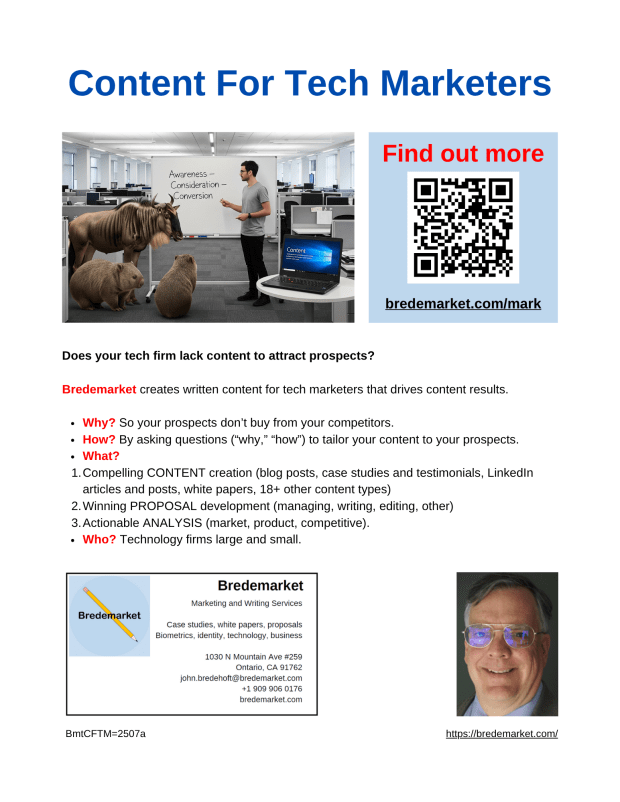
Admittedly a lot of content, especially for a non-working day. (One was scheduled.) But if your technology firm lacks marketing content, I know a guy – https://bredemarket.com/mark/
If you ignore what Yves-Alexandre de Montjoye et al said about the validity of 12 fingerprint minutiae points in their 2013 study (cited in phys.org), their conclusions about cell phone locations deserve consideration.
“By analyzing 15 months of cell phone mobility data from 1.5 million people, researchers have found that only four spatio-temporal points (an individual’s approximate whereabouts at the approximate time when they’re using their cell phone) are all that’s needed to uniquely identify 95% of the individuals.”
Why?
“[T]he researchers’ data shows that just four spatio-temporal points are needed to uniquely identify the mobility trace of an individual. In other words, it’s not likely that someone else will be in the same locations as you are at four different times of day.”
And once you perform multi-factor authentication by combining geolocation with another factor, such as an address or a social media post, privacy disappears.












 Bredemarket