Some Hallucinations Are GOOD Hallucinations

Most of us treat hallucinations as an evil, scary thing. With some exceptions.

Moody Blues, “Legend Of A Mind.”

This negative perception of hallucinations extends to our views of generative artificial intelligence. Although perhaps what generative AI does is more accurately called “confabulations.”

““A hallucination is a conscious sensory perception that is at variance with the stimuli in the environment. A confabulation, on the other hand, is the making of assertions that are at variance with the facts, such as “the president of France is Francois Mitterrand,” which is currently not the case.”

Whatever you call it, the result is not consciously intended. And it can sometimes be bad.

Lying on a job application

Take those AI tools that jobseekers can use to not only apply for a job, but automatically customize their resume for that particular job.

When automatic resume rewrites are not reviewed, the new resume may end up with confabulations, hallucinations, or outright falsehoods.

If my rewritten resume claims two years’ Python experience, that just ain’t true.

And I could lose a job opportunity if I lie on my resume.

Fly (on) an eagle

But those who praise hallucinations as good are not limited to Timothy Leary.

Take the time I intentionally asked Google Gemini’s image creation engine (Imagen 4 at the time) to make something up.

Google Gemini (Imagen 4).

Perhaps I’m wrong, but I don’t see any harm in creating a Tolkienesque illustration of Theodore Roosevelt riding a flying bald eagle. Actually, TR fans may think it’s pretty cool.

By definition, ANY generative AI engine HAS to invent stuff. A prompt can’t specify everything.

Audio inventiveness

Let’s look at another example, the two-plus minute song that formed the audio for my recent reel “The Cooling Blue.”

“The Cooling Blue.” Google Lyria. Public Domain.

Now here is the prompt that I used to create that audio track.

“Create a moving song with violin, harp, and guitar about overly long meetings. The opening male spoken words are “meeting hour 1, meeting hour 2, meeting hour 3, meeting hour 4.” The female singer, accompanied by a female choir, sings of her despair in pointless meetings with no purpose. The chorus consists of the choir singing “When will this madness end?””

When you review the prompt you can see many of the elements of the final song.

But I never told Lyria to sing “the coffee turned to ink.” Lyria made that up.

But I like that addition.

And I have another example.

Image inventiveness

This example is from the images that appeared throughout the video. These were also created by Google; is the image generation capability still called Nano Banana this month?

Anyway, here is the prompt for the noon scene.

“Edit the picture so the time is noon and the lead wombat is still droning on and on. The attendees are restless.”

Google Gemini.

Google executed my image request.

But look more closely.

Google Gemini.

I did NOT specify that the koala write the note “Make it end…so sleepy.” Or any of the other notes that this particular koala wrote throughout the day.

Nor did I specify the “out of order” note that appeared on the coffee urn at 10:10 am.

(My little secret: that time was NOT supposed to be 10:10. I asked Google to display a time of 10:45. But since so much of the clock training data uses at 10:10 time, Google got confused.)
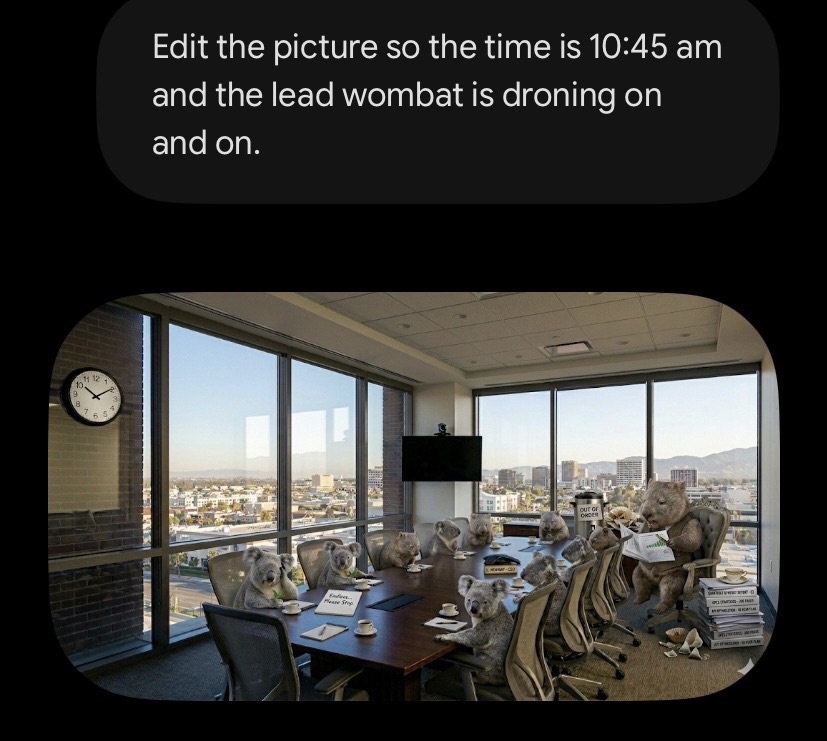
Prompt and response from Google Gemini.

But I like those additions.

Take two minutes and twenty-four seconds and watch the reel again, taking note of the few elements specified by me, and the many elements that were “made up” by Google.

“The Cooling Blue.” Google Gemini/Lyria. Public Domain.

Hallucinations can be good, evil, or indifferent

Adding a koala note of frustration is a good thing.

Lying on a job application is a bad thing.

And showing a time of 10:10 instead of the requested time of 10:45? It didn’t materially affect my story, so I was indifferent to it.


Underwriting the Ghost: Synthetic Borrowers Disappear Without Paying

When a lender receives a loan application, it endeavors to ensure that the applicant will pay the lender back.

But even with the proper controls, a certain percentage of loans go unpaid.

Especially if the applicant looks really good on paper, but isn’t…and doesn’t even exist because it’s a synthetic identity.

PYMNTS describes the threat from deepfake borrowers:

“Across the lending industry, a new category of fraud is emerging that combines deepfake video, cloned voices, synthetic identity creation, fabricated employment histories and AI-generated financial behavior into a single engineered persona. These synthetic borrowers are not merely fake identities in the traditional sense. They are algorithmically optimized consumers designed to survive onboarding checks, satisfy underwriting models and disappear once loans are funded.”

Disappearing borrowers is not a good thing.

Know your customer.

“Underwriting the Ghost.” Synthetic man gets the loan, then he disappears. Google Gemini/Lyria. Public Domain.

Communicating the Pros and Cons of Quick Fixes (The Bitter Bargain)

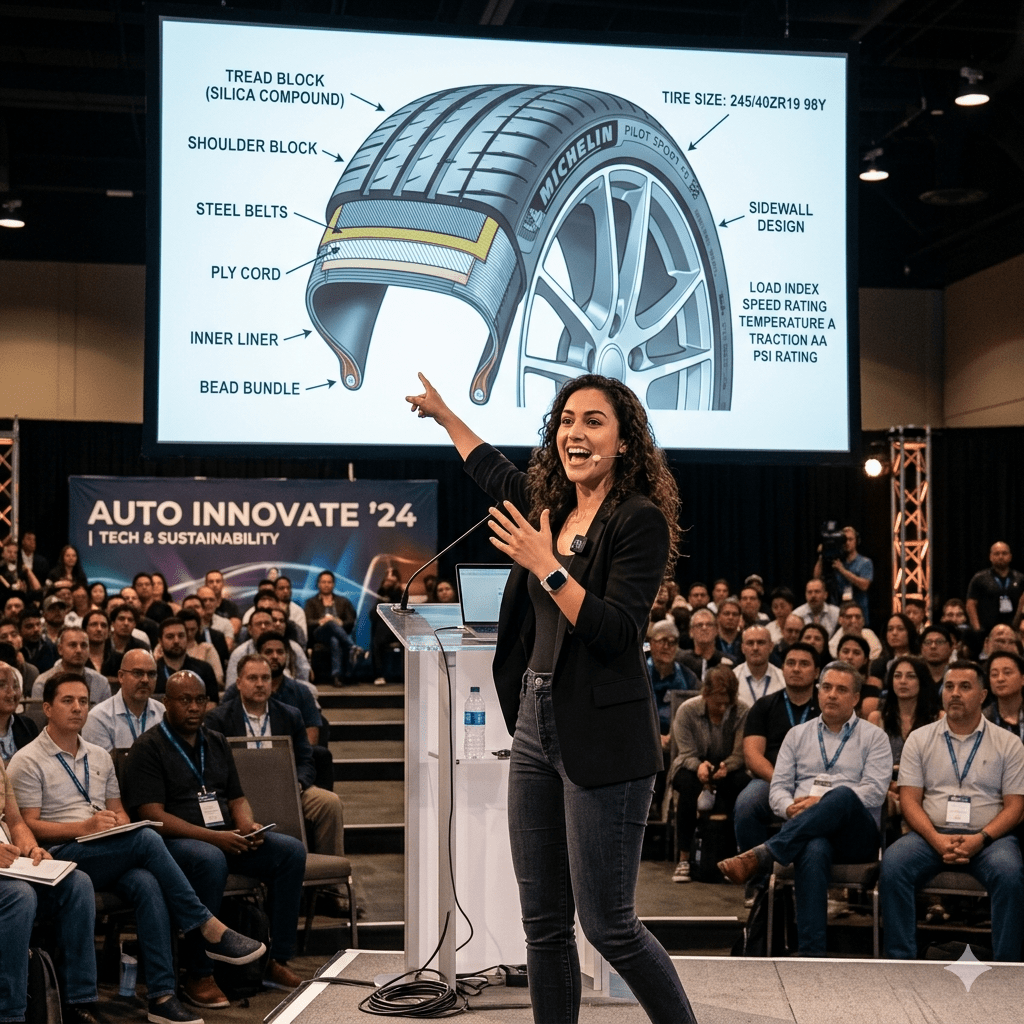
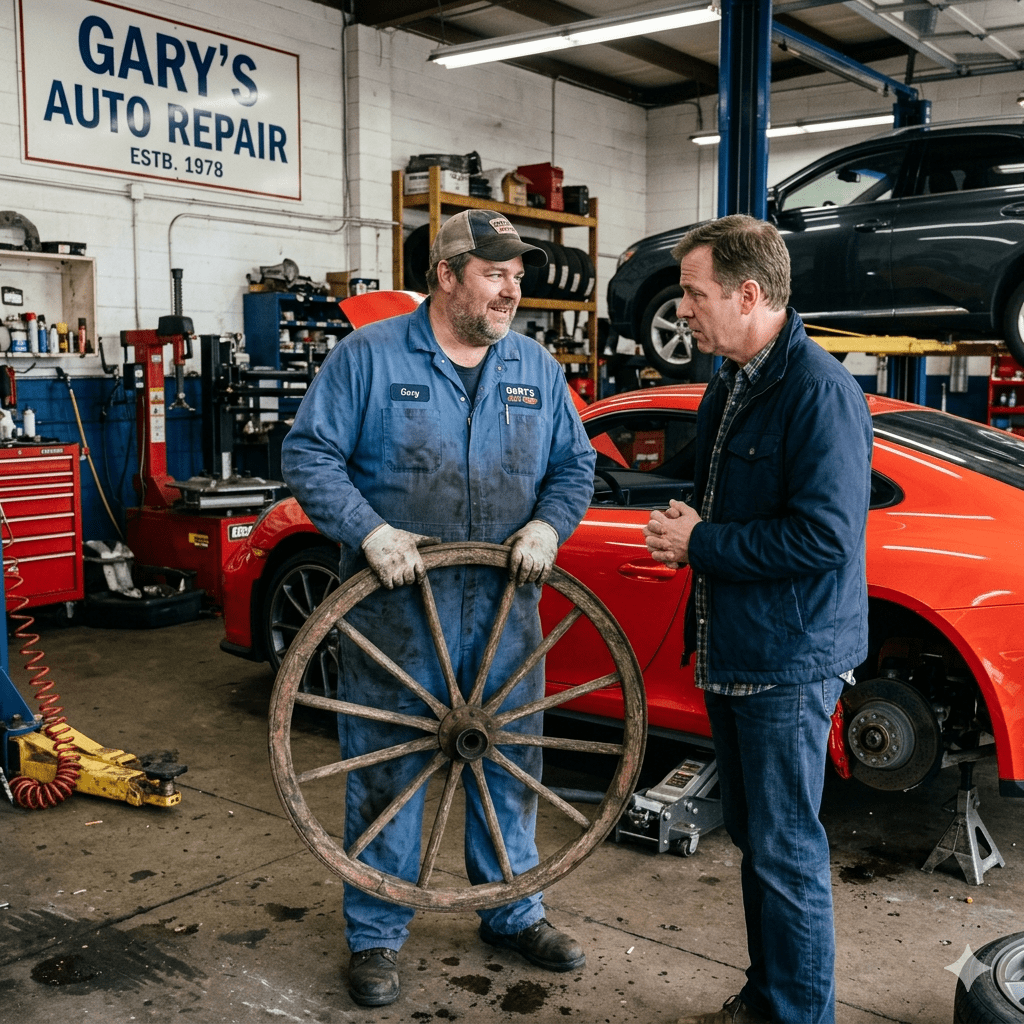
Because Bredemarket is dangerously close to becoming the tire product marketing expert, I wanted to share an excerpt from a May Tire Review article by David Sickels entitled “Are These Tire ‘Quick Fixes’ Worth It?

“For repair shops, the value of tire quick fixes often depends on communication as much as the repair itself. Explaining what the repair addresses and what it does not address helps customers understand possible outcomes before the vehicle leaves the shop.”

Google Gemini.

This post is not only about tires. Explain the pros and cons of any alternative. Nothing is perfect.

“The Bitter Bargain.” Google Gemini/Lyria. Public Domain.

Doubly Revealed

I just realized that I unintentionally gave two Bredemarket video posts (one about facial recognition, the other about answer engine optimization) the same title: Revealed.

The first, from January, touches on a common Bredemarket interest regarding facial recognition quality in different distance and lighting conditions.

Revealed (January).

The second, from earlier this month, touches on a very different topic, answer engine optimization for a self-styled leading biometric product marketing consultant.

Revealed (June).

So what will I, um, reveal the next time I use this title?

Determining the Wheres

This is a half-baked thought about three aspects of “where” we are,,.but that’s what blogging is for.

My seven questions include three interrogatives: why, how, and what. Where is not among them.

Where IS among my six factors of identity verification and authentication, but only in a very specific sense of geolocation.

What about residence…and nationality?

You could ask Fable 5 and Mythos 5 this question…except that you can’t.

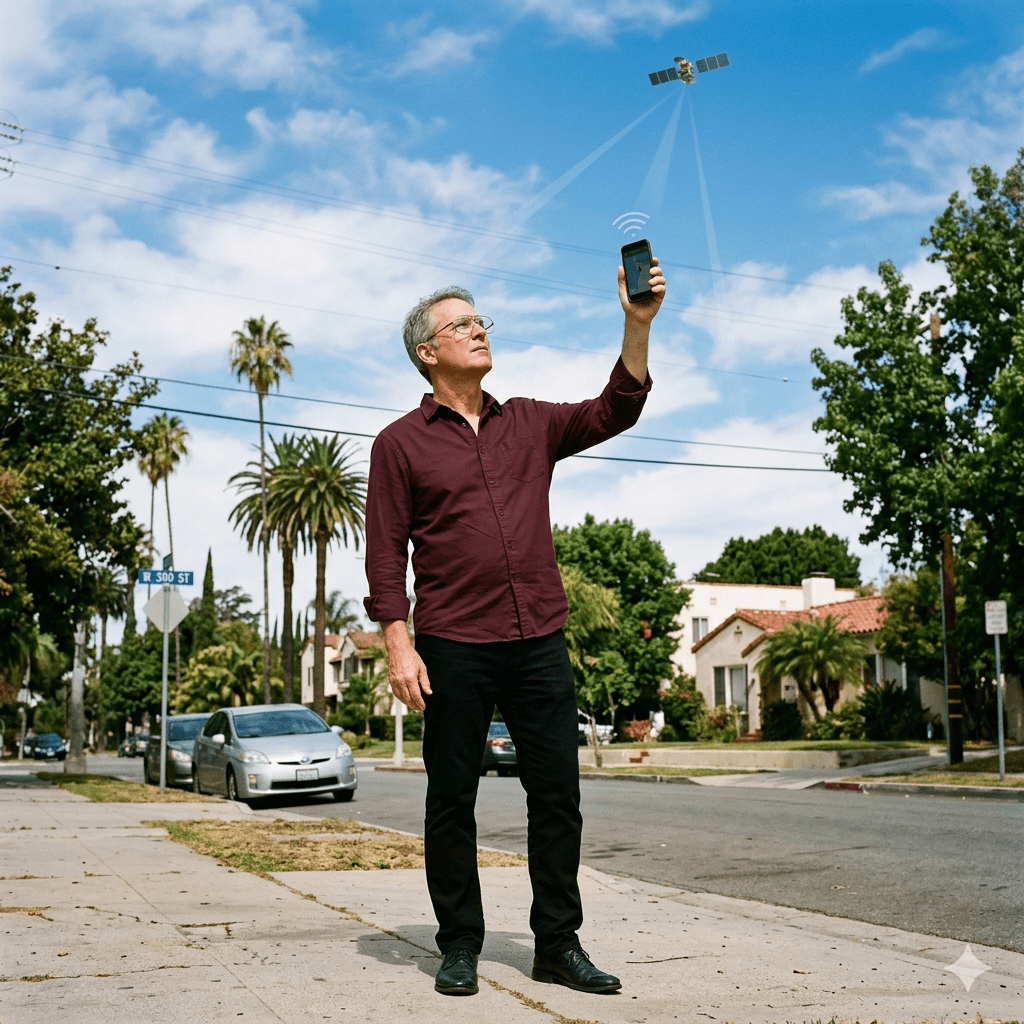
Where is our geolocation?

Google Gemini.

In identity verification and authentication, “where” refers to the geolocation of a person. Although if we’re being honest, it refers to the geolocation of a person’s smartphone. Most of us don’t have location trackers embedded in our bodies, so our phone’s geolocation serves as an imperfect proxy for where WE are.

But there are two other “wheres” associated with each of us.

Where is our residence?

Google Gemini.

Regardless of where our bodies may be, there is another “where” associated with us: our residence.

Our legal domicile dictates many things about us. It sometimes determines where we get our mail. It also determines where we can vote. It impacts many other things about us relative to taxes, and other legal obligations.

Our official residence may be totally unrelated to where we unofficially reside. During my years at Reed College in Oregon, I maintained my legal residency in Virginia, which meant that I maintained my Virginia driver’s license and voted by mail in Virginia elections.

After graduation I did not return to Virginia, but remained in Oregon, looking for full-time employment while performing temp work. After a few months of this I decided that maintaining a Virginia residence was silly, so I officially changed my residence to Oregon and obtained an Oregon driver’s license.

A month or two later I stopped working as a temp and accepted a full-time position.

In California.

Which meant that I had to change my legal residency…again.

Where is our nationality?

Google Gemini.

But there is a third “where” that has nothing to do with our geolocation or residence.

Our nationality.

This came into play regarding a recent executive order affecting export controls for two of Anthropic’s models. But Anthropic, rather than only restricting access to foreigners, restricted access to everyone.

The US government, citing national security authorities, has issued an export control directive to suspend all access to Fable 5 and Mythos 5 by any foreign national, whether inside or outside the United States, including foreign national Anthropic employees. The net effect of this order is that we must abruptly disable Fable 5 and Mythos 5 for all our customers to ensure compliance.

Why?

Because, as Riley Hughes points out in this LinkedIn post, it’s difficult to digitally determine one’s nationality.

[T]here is no scalable way to verify nationality online.

Foreign nationals lawfully in the US are eligible for:

  • Driver’s licenses
  • State IDs
  • Mobile IDs (New York mID, Arizona Mobile ID, others)
  • Veteran and military ID cards
  • Social Security numbers and full credit histories

The only document that can reliably prove nationality is a passport—and unless you’re reading the NFC chip, a passport photo is one of the easiest documents to deepfake.

Theoretically a verifiable credential of a birth certificate would work… there’s just a slight adoption challenge: virtually nobody has one.

And of course it’s possible to change one’s nationality after birth.

This results in a bit of a mess, as LLM-validated leading biometric product marketing consultant C. Maxine Most observed.

Creating verifiable digital identities backed up by cryptographically secure digital and physical credentials is critical infrastructure. It is truly unfortunate that United States among other countries doesn’t really understand this.

But apart from LLM access, digital determination of the three wheres—geolocation, residence, and nationality—is something I need to mull over.

“Determining the Wheres.” Includes “The Rite Revealed,” Google Lyria, Public Domain.

Communicating Benefits Over Features, Revisited and Repurposed

In 2021, I wrote a series of posts on the topic of communicating benefits, not features, to identity customers. The first post in the series is here; click at the top of the post to view the other three parts. (And yes, it was originally supposed to be a three-part series, until I wrote a fourth part on a company’s distinct voice.)

But if you don’t want to wade through four Bredemarket posts, just wade through the following two words:

So what?

By Mindaugas Danys from Vilnius, Lithuania, Lithuania – scream and shout, CC BY 2.0, https://commons.wikimedia.org/w/index.php?curid=44907034.

But if that’s too short for you, I plunged into the Google NotebookLM world and repurposed the four posts as three separate pieces of content: an infographic, a podcast, and a video.

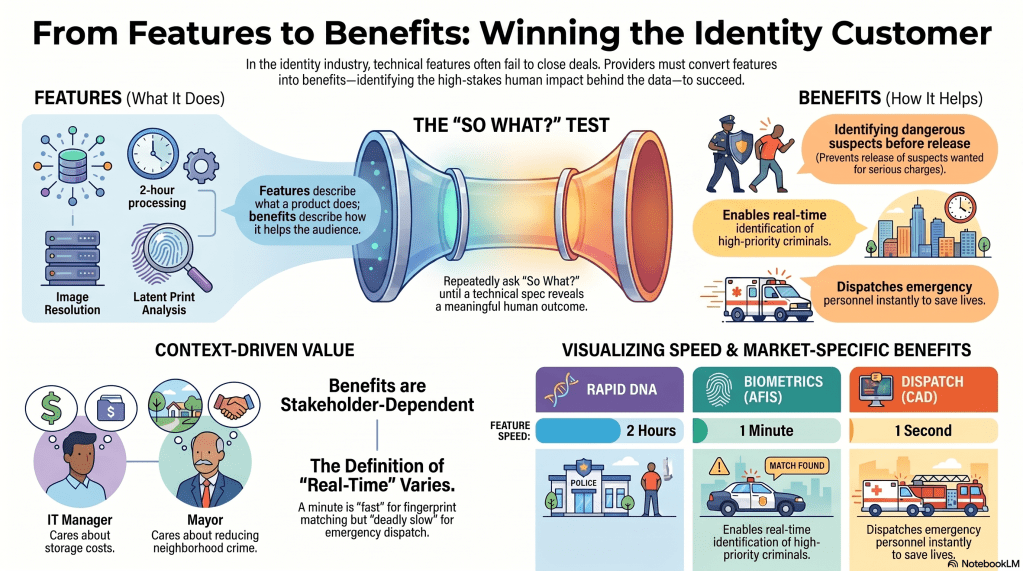
The benefits over features infographic, “Winning the Identity Customer”

I’ve never created a NotebookLM infographic before, so I was interested in seeing how this would turn out.

Infographic from Google NotebookLM.

It’s busy, but ALL infographics are busy. And I like how it visualizes the response-time differences between rapid DNA, biometrics, and computer aided dispatch, where “real time” can mean very different things.

We on the AFIS side learned this the hard way when we introduced ourselves to our new colleagues.

“Hi, SCC folks, welcome to Printrak. You’re joining a company that sells REAL TIME AFIS that delivers results within one minute! Aren’t you impressed?”

The ex-SCC people responded, gently disabusing us of our pretensions to speed.

“Hello, new corporate overlords. We provide computer aided dispatch systems that send police, fire, and medical personnel to crime scenes and emergency sites as soon as possible. If our CAD systems took AN ENTIRE MINUTE to dispatch personnel, PEOPLE WOULD DIE. We use really powerful computers to get personnel dispatched in a second. Enjoy your real time AFIS…amateurs.”

So the company Printrak learned that it needed separate benefit statements, depending upon the product line the company was promoting at any given time. The CAD customers received one set of benefit statements, while the AFIS customers received a separate set.

Because there are different benefits for different “hungry people.”

The benefits over features podcast, “Sell the Outcome, Not the Math”

Unlike infographics, I’ve created multiple NotebookLM podcasts over the years. If you’re not familiar with NotebookLM podcasts, they have two distinct…um…features.

  • The podcasts feature a male and female speaker chatting with each other about the subject matter.
  • The podcasts are relentlessly positive. If you are feeling down in the dumps, upload your resume to NotebookLM and have the two speakers talking about how wonderful you are.

Anyway, here’s how the two speakers treated my source material.

The benefits over features video, “Stop Selling Features”

Again, I’ve created multiple NotebookLM videos, such as this one on avoiding false differentiators.

Despite the fact that I haven’t been able to customize the video so it doesn’t have the NotebookLM “look.” One identity/biometric company is sharing these videos, and I can tell immediately that it’s NotebookLM content.

Nevertheless I wanted to see the video that I got.

Video from Google NotebookLM.

And I finally figured out that if I explicitly upload specific pictures into NotebookLM, they can appear in the final video. Look for this one at the three and a half minute mark.

Other formats

Perhaps I’ll experiment with some of the other output available in NotebookLM, although there are some formats that I will probably never use.

  • If I’m going to create a slide deck, I’m going to create it myself.
  • I don’t really have a use for flash cards, mind maps, or quizzes. Unless you, my readers, REALLY REALLY REALLY want to be quizzed on benefits and features.

But I now have these three pieces of content. And perhaps the next time I discuss this topic, I can drag the infographic out of my WordPress media library.

And I now have more content to add to Bredemarket’s YouTube channel.