What is B2B Writing?

Business-to-business (B2B) writing isn’t as complex as some people say it is. It may be hard, but it’s not complex.

Why do I care about what B2B writing is?

Neil Patel (or, more accurately, his Ubersuggest service) um, suggested that I say something about B2B writing.
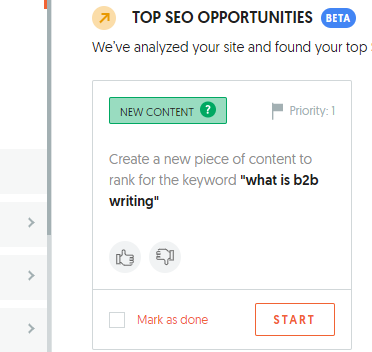
And then he (or it) suggested that I use generative artificial intelligence (AI) to write the piece.

I had a feeling the result was going to suck, but I clicked the “Write For Me” button anyway.
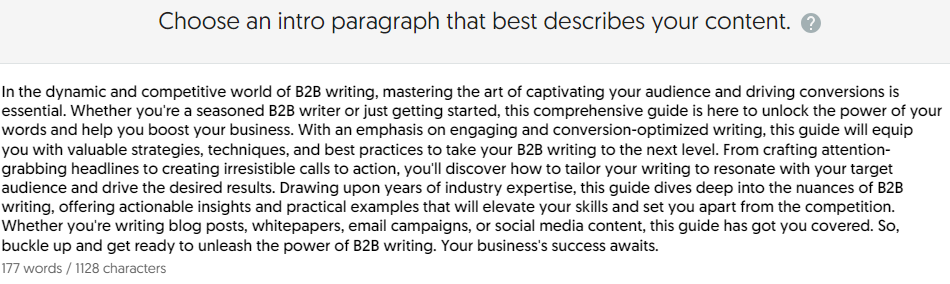
Um, thanks but no thanks. When the first sentence doesn’t even bother to define the acronym “B2B,” you know the content isn’t useful to explain the topic “what is B2B writing.”

And this, my friends, is why I never let generative AI write the first draft of a piece.

So, what IS B2B writing?

Before I explain what B2B writing is, maybe I’d better explain what “B2B” is. And two related acronyms.

  • B2B stands for business to business. Bredemarket, for example, is a business that sells to other businesses. In my case, marketing and writing services.
  • B2G stands for business to government. Kinda sorta like B2B, but government folks are a little different. For example, these folks mourned the death of Mike Causey. (I lived outside of Washington DC early in Causey’s career. He was a big deal.) A B2G company, for example, could sell driver’s license products and services to state motor vehicle agencies.
  • B2C stands for business to consumer. Many businesses create products and services that are intended for consumers and marketed directly to them, not to intermediate businesses. Promotion of a fast food sandwich is an example of a B2C marketing effort.

I included the “B2G” acronym because most of my years in identity and biometrics were devoted to local, state, federal, and international government sales. My B2G experience is much deeper than my B2B experience, and way deeper than my B2C expertise.

Let’s NOT make this complicated

I’m sure that Ubersuggest could spin out a whole bunch of long-winded paragraphs that explain the critical differences between the three marketing efforts above. But let’s keep it simple and limit ourselves to two truths and no lies.

TRUTH ONE: When you market B2B or B2G products or services, you have FEWER customers than when you market B2C products or services.

That’s pretty much it in terms of differences. I’ll give you an example.

  • If Bredemarket promoted its marketing and writing services to all of the identity verification companies, I would target less than 200 customers.
  • If IDEMIA or Thales or GET Group or CBN promoted their driver’s license products and services to all of the state, provincial, and territorial motor vehicle agencies in the United States and Canada, they would target less than 100 customers.
  • If McDonald’s resurrects and promotes its McRib sandwich, it would target hundreds of millions of customers in the United States alone.

The sheer scale of B2C marketing vs. B2B/B2G marketing is tremendous and affects how the company markets its products and services.

But one thing is similar among all three types of writing.

TRUTH TWO: B2B writing, B2G writing, and B2C writing are all addressed to PEOPLE.

Well, until we program the bots to read stuff for us.

This is something we often forget. We think that we are addressing a blog post or a proposal to an impersonal “company.” Um, who works in companies? People.

(Again, until we program the bots.)

Whether you’re marketing a business blog post writing service, a government software system, or a pseudo rib sandwich, you’re pitching it to a person. A person with problems and needs that you can potentially solve.

So solve their needs.

Don’t make it complex.

But what IS B2B writing?

Let’s return to the original question. Sorry, I got off on a bit of a tangent. (But at least I didn’t trail off into musings about “the dynamic and competitive world.”)

When I write something for a business:

  • I must focus on that business and not myself (customer focus). The business doesn’t want to hear my talk about myself. The business wants to hear what I can do for it.
  • I must acknowledge the business’ needs and explain the benefits of my solution to meet the business needs. A feature list without any benefits is just a list of cool things; you still have to explain how the cool things will benefit the business by solving its problem.
  • My writing must address one, or more, different types of people who are hungry for my solution to their problem. (This is what Ubersuggest and others call a “target audience,” because I guess Ubersuggest aims lasers at the assembled anonymous crowd.)

Again, this is hard, but not complex.

It’s possible to make this MUCH MORE complex and create a 96 step plan to author B2B content.

But why?

So now I’ve answered the question “What is B2B writing?”

Can Bredemarket write for your business? If so, contact me.

Today’s Acronym is RAG (Retrieval-Augmented Generation)

Today’s acronym comes from Maira Ladeira Tanke of Amazon Web Services, who focuses her work on generative AI.

She delivered a Thursday presentation entitled “Customizing generative AI applications for your business using your data.” The tool that Tanke uses for customization is Amazon Bedrock, which supports Retrieval-Augmented Generation, or RAG.

Retrieval-Augmented Generation (RAG) is the process of optimizing the output of a large language model, so it references an authoritative knowledge base outside of its training data sources before generating a response. Large Language Models (LLMs) are trained on vast volumes of data and use billions of parameters to generate original output for tasks like answering questions, translating languages, and completing sentences. RAG extends the already powerful capabilities of LLMs to specific domains or an organization’s internal knowledge base, all without the need to retrain the model. It is a cost-effective approach to improving LLM output so it remains relevant, accurate, and useful in various contexts.

From https://aws.amazon.com/what-is/retrieval-augmented-generation/.

Because Amazon has obviously referred to my seven questions—OK, maybe they didn’t—the RAG page devotes time to the “why” question and the “benefits” question.

Amazon identified two problems with large language models, or LLMs (not to be confused with LMMs):

  • LLM responses are unpredictable.
  • LLM data is static.

So what happens when you use LLMs WITHOUT retrieval-augmented generation?

You can think of the Large Language Model as an over-enthusiastic new employee who refuses to stay informed with current events but will always answer every question with absolute confidence.

From https://aws.amazon.com/what-is/retrieval-augmented-generation/.

Ouch.

How does RAG solve these problems? It “redirects the LLM to retrieve relevant information from authoritative, pre-determined knowledge sources.” RAG allows you to introduce more current information to the LLM which reduces cost, increases accuracy (and attributes sources), and supports better testing and improvements.

For more technical information, see “What is RAG?” and “Knowledge Bases for Amazon Bedrock.”

(Image sources: Amazon, SourcesOfInsight.com)

Ofcom and the Digital Trust & Safety Partnership

The Digital Trust & Safety Partnership (DTSP) consists of “leading technology companies,” including Apple, Google, Meta (parent of Facebook, Instagram, and WhatsApp), Microsoft (and its LinkedIn subsidiary), TikTok, and others.

The DTSP obviously has its views on Ofcom’s enforcement of the UK Online Safety Act.

Which, as Biometric Update notes, boils down to “the industry can regulate itself.”

Here’s how the DTSP stated this in its submission to Ofcom:

DTSP appreciates and shares Ofcom’s view that there is no one-size-fits-all approach to trust and safety and to protecting people online. We agree that size is not the only factor that should be considered, and our assessment methodology, the Safe Framework, uses a tailoring framework that combines objective measures of organizational size and scale for the product or service in scope of assessment, as well as risk factors.

From https://dtspartnership.org/press-releases/dtsp-submission-to-the-uk-ofcom-consultation-on-illegal-harms-online/.

We’ll get to the “Safe Framework” later. DTSP continues:

Overly prescriptive codes may have unintended effects: Although there is significant overlap between the content of the DTSP Best Practices Framework and the proposed Illegal Content Codes of Practice, the level of prescription in the codes, their status as a safe harbor, and the burden of documenting alternative approaches will discourage services from using other measures that might be more effective. Our framework allows companies to use whatever combination of practices most effectively fulfills their overarching commitments to product development, governance, enforcement, improvement, and transparency. This helps ensure that our practices can evolve in the face of new risks and new technologies.

From https://dtspartnership.org/press-releases/dtsp-submission-to-the-uk-ofcom-consultation-on-illegal-harms-online/.

But remember that the UK’s neighbors in the EU recently prescribed that USB-3 cables are the way to go. This not only forced DTSP member Apple to abandon the Lightning cable worldwide, but it affects Google and others because there will be no efforts to come up with better cables. Who wants to fight the bureaucratic battle with Brussels? Or alternatively we will have the advanced “world” versions of cables and the deprecated “EU” standards-compliant cables.

So forget Ofcom’s so-called overbearing approach and just adopt the Safe Framework. Big tech will take care of everything, including all those age assurance issues.

DTSP’s September 2023 paper on age assurance documents a “not overly prescriptive” approach, with a lot of “it depends” discussion.

Incorporating each characteristic comes with trade-offs, and there is no one-size-fits-all solution. Highly accurate age assurance methods may depend on collection of new personal data such as facial imagery or government-issued ID. Some methods that may be economical may have the consequence of creating inequities among the user base. And each service and even feature may present a different risk profile for younger users; for example, features that are designed to facilitate users meeting in real life pose a very different set of risks than services that provide access to different types of content….

Instead of a single approach, we acknowledge that appropriate age assurance will vary among services, based on an assessment of the risks and benefits of a given context. A single service may also use different
approaches for different aspects or features of the service, taking a multi-layered approach.

From https://dtspartnership.org/wp-content/uploads/2023/09/DTSP_Age-Assurance-Best-Practices.pdf.

So will Ofcom heed the DTSP’s advice and say “Never mind. You figure it out”?

Um, maybe not.

The Wildebeest Speaks! (Am I insane?)

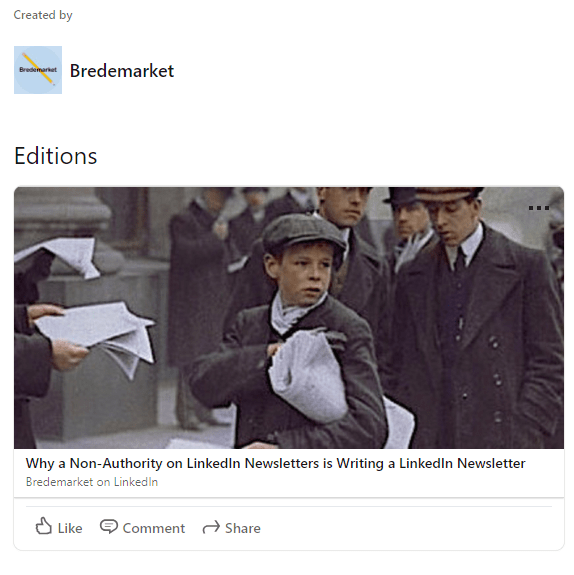
I really don’t need yet ANOTHER content distribution avenue.

From https://www.linkedin.com/pulse/why-non-authority-linkedin-newsletters-writing-newsletter-guj0c/.

But I created one anyway, just so I can understand how LinkedIn newsletters work.

Bredemarket’s new LinkedIn newsletter is called “The Wildebeest Speaks.” I plan to publish once a month, more or less.

LinkedIn users can subscribe to the newsletter at https://www.linkedin.com/newsletters/the-wildebeest-speaks-7172984705846243328/.

The 21st Century’s Four Revolutionary Biometric Events

I define a revolutionary biometric event as something that COMPLETELY TRANSFORMS the biometric industry.

For me, the four events that have revolutionized biometrics in this century (so far) include:

  • The September 2001 use of commercial planes in a terrorist attack.
  • The April 2013 Boston Marathon bombings.
  • The September 2013 introduction of Touch ID on the Apple iPhone.
  • The 2020 (and beyond) COVID-19 pandemic.

If you want to learn WHY I regard these four events as revolutionary, and why I DON’T regard the introduction of the Apple Vision Pro as revolutionary, see my June 2023 post.

Mass Casualties at Arrowhead Regional Medical Center…But Only a Drill

On Monday, March 4, Arrowhead Regional Medical Center (ARMC) in San Bernardino, California was one of two local medical centers to participate in a mass casualty drill.

The objective of the drill for ARMC was to test the hospital’s ability to respond effectively to a surge of patients resulting from a mass casualty incident. Throughout the exercise, ARMC staff demonstrated their proficiency in triage, patient care, communication and coordination of resources. The drill also provided an opportunity for staff to practice protocols for receiving patients, managing supplies and implementing surge capacity plans.

From https://main.sbcounty.gov/2024/03/07/arrowhead-regional-medical-center-participates-in-mass-casualty-incident-drill/.

It’s always good to conduct mass shooting drills in case they are needed in the future.

Or, in the case of Arrowhead Regional Medical Center, in the past.

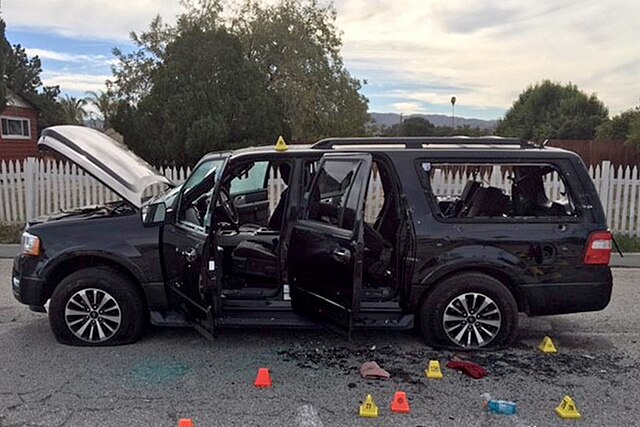
By San Bernardino County Sheriff’s Department – Public Domain, https://commons.wikimedia.org/w/index.php?curid=45514432

Remember December 2, 2015?

At least 14 people were dead and another 17 injured in a shooting Wednesday in San Bernardino, California, when gunmen who were heavily armed and “on a mission” opened fire during a function at a center for people with developmental disabilities, police said.

Police believe two alleged shooters — a county employee and a woman with whom he was in a relationship opened fire around 11 a.m. at the Inland Regional Center. They were armed with assault weapons and “prepared to do what they did as if they were on a mission,” San Bernardino Police Chief Jarrod Burguan said….

Five people were taken to the nearby Loma Linda University Medical Center, two of which were critical but stable, two of which were fair and the one who was still being assessed, according to a hospital spokeswoman. Six other people are being treated at Arrowhead Regional Medical Center, though their conditions are unknown.

From https://abcnews.go.com/US/police-respond-reports-active-shooter-san-bernardino/story?id=35535995.

Although it wasn’t mentioned in San Bernardino County’s 2024 description of the drill, I’m sure some participants remembered what happened nine years ago.

In fingerprint capture, 14 is better than 20

In many instances of fingerprint capture, whether obtaining prints through ink or through livescan, the tenprint person captures 14 images. Not 10, not 20, but 14.

Why?

Quality control.

Because the 14 images contain two impressions of every print, you can compare the top set of prints (the rolled prints) against the bottom set (the slap prints).

Locations of finger 2 (green) and finger 3 (blue) for rolled and slap prints.

In the example above, if the green rolled print is NOT the same as the green slap print, or if the blue rolled print is NOT the same as the blue slap print, then you captured the fingerprints in the wrong order.

I discussed this in more detail in an earlier post.

If you need Bredemarket’s marketing and writing services to explain the benefits of your technology to your prospects and customers, contact me.

Multispectral fingerprint readers, the succinct version

There are various types of dedicated fingerprint reader devices, including multispectral readers that can examine the subdermal layers of your fingers. Even if your surface fingerprints are worn away by bricklaying, time, or other factors, multispectral fingerprint readers can identify you anyway.

From HID Global, “A Guide to MSI Technology: How It Works,” https://blog.hidglobal.com/2022/10/guide-msi-technology-how-it-works

If you’re interested, I wrote more about multispectral readers, and how they relate to liveness detection, back in June 2023.

If you need Bredemarket’s marketing and writing services to explain the benefits of your technology to your prospects and customers, contact me.

Avoiding Antiquated Product Marketing

Identity/biometrics firms don’t just create social media channels for the firms themselves. Sometimes they create social media channels dedicated to specific products and services.

That’s the good news.

Here’s the bad news.

[REDACTED]

As I write this, it’s March 3. A firm hasn’t updated one of its product-oriented social media channels since February 20.

That’s February 20, 2020…back when most of us were still working in offices.

It’s not like the product no longer exists…but to the casual viewer it seems like it. As I noted in a previous post, a 2020 survey showed that 76% of B2B buyers make buying decisions primarily based on the winning vendor’s online content.

Now I’ll admit that I don’t always update all of Bredemarket’s social media platforms in a timely manner, but at least I update them more than once every four years. I even updated my podcast last month.

Sadly, I can’t help THIS product marketer, since Instagram posts are not one of my primary offerings.

If you’re an identity/biometric company that needs help with blogs, case studies, white papers, and similar text content, Bredemarket can work with you to deliver fresh content.

Avoiding Deleterious Forensic Nursing

Warning: this post discusses sexual assault and child abuse.

Hippocrates. By Unidentified engraver – 1881 Young Persons’ Cyclopedia of Persons and PlacesUpload by RedWolf 05:45, Jan 10, 2005 (UTC), Public Domain, https://commons.wikimedia.org/w/index.php?curid=164808

The Hippocratic Oath imposes duties on medical professionals, including this one:

I will follow that system of regimen which, according to my ability and judgment, I consider for the benefit of my patients, and abstain from whatever is deleterious and mischievous.

From https://www.health.harvard.edu/blog/first-do-no-harm-201510138421.

For people like me who do not use the word “deleterious” on a daily basis, it means “harmful often in a subtle or unexpected way.”

The dictates of the Hippocratic Oath lead us to forensic nursing (as defined by 1NURSE.COM), the invasive nature of some forensic techniques, and what companies such as Foster+Freeman are doing to minimize invasive evidence capture.

What is forensic nursing?

From the U.S. Federal Bureau of Investigation, https://www2.fbi.gov/publications/leb/2002/jan2002/jan02x29x1.jpg.

As 1NURSE.COM notes, forensic nursing is multidisciplinary, operating “at the critical juncture of medical science and the legal system.”

Forensic nursing is a specialized branch that integrates medical expertise with forensic science to provide comprehensive care for individuals impacted by violence, abuse, or criminal activities. These professionals serve as a crucial link between the realms of healthcare and the legal system, collaborating with law enforcement, attorneys, and other professionals to gather evidence, provide expert testimony, and ensure justice for victims.

From https://www.linkedin.com/pulse/forensic-nursing-exploration-intricate-profession-1nurse-com-iedyc/.

When I started my forensic career 29 years ago, I was solely involved in the capture and processing of fingerprints from criminals. If I may be honest, the well-being of the individual who provided the forensic evidence was NOT an overriding concern.

But within a year or two I started to get involved in the capture and processing of fingerprints from NON-criminals who were applying for and receiving government benefits.

  • For that market we HAD to concern ourselves with the well-being of our clients, to make fingerprint capture as easy as possible, and to treat our clients with the utmost respect.
  • In the end it didn’t matter, because in the popular mind fingerprinting was associated with criminals, and benefits recipients didn’t want to be treated like criminals no matter how nice we were. To my knowledge, all of the benefits recipient fingerprint programs in the United States have all ceased.

Forensic nursing needs to gather the necessary forensic evidence while preserving the compassionate care that nurses are required to provide.

Invasive forensic techniques

So if we have to take care when gathering information from benefits recipients, imagine the level of care we need to take when gathering information from crime victims. Returning to 1NURSE.COM’s article, here are two of the tasks that forensic nurses must perform:

Sexual Assault Forensics: Specializing in sexual assault examination, forensic nurses provide not only compassionate care but also play a pivotal role in collecting evidence essential for legal proceedings. Their expertise ensures a sensitive approach while preserving the integrity of forensic evidence. Example: A forensic nurse conducting a sexual assault examination may collect biological samples and document injuries to aid in prosecuting the assailant.

Child Abuse Investigation: Forensic nurses are instrumental in assessing and documenting cases of child abuse. They collaborate with child protective services and law enforcement to ensure the safety and well-being of the child. Example: A forensic nurse working on a child abuse case may conduct a thorough examination to document injuries and provide expert testimony in court.

From https://www.linkedin.com/pulse/forensic-nursing-exploration-intricate-profession-1nurse-com-iedyc/.

The “compassionate care” part is important, as Foster+Freeman notes in a separate article:

We have focussed a lot on how the investigation works when looking for crimes of a distressing nature but not actually how this investigation process can affect the victim of these crimes and put the victim first. This period can be incredibly distressing for the victim, and the investigation can make this worse as it is making the victim re-live this experience.

https://www.linkedin.com/pulse/victim-first-forensics-focusing-victims-crime-foster-freeman-gnw6e/

As part of their duties, the forensic nurse has to capture evidence from the very parts of the body that were assaulted during the abuse crime itself. No one wants to go through that again. How can evidence capture be less invasive?

Three ways to minimize invasive evidence capture

While it’s not possible to completely erase the pain that crime victims suffer during a forensic investigation, there are ways to minimize it. The Foster+Freeman article highlights three ways to do this:

  • Capture evidence via non-invasive techniques. As a supplier of alternate light source (ALS) technology, Foster+Freeman notes that its products can discover evidence, even at the subdermal layers, without touching the victim. “Using an ALS is a non-invasive and non-destructive way to examine potential evidence on the skin. This is especially important when dealing with fragile or sensitive skin, as it minimizes the risk of causing further harm during the examination process.”
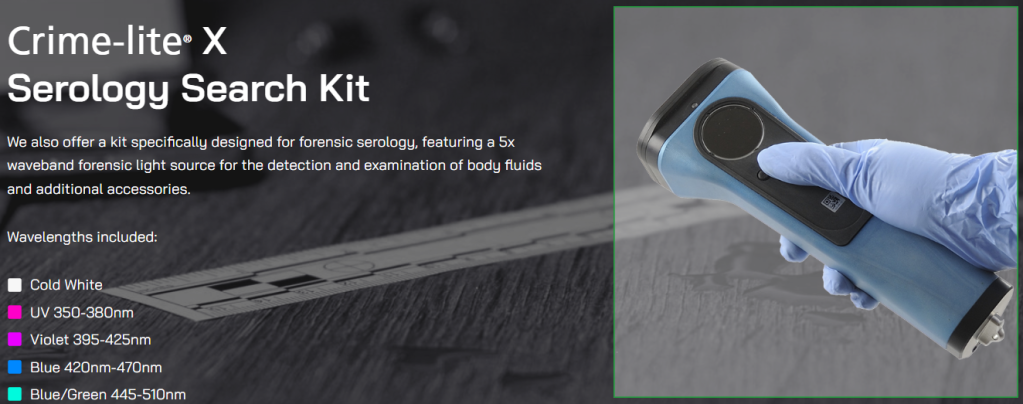
  • Capture evidence quickly. Forensic nurses do not want to prolong an examination. There are ways to gather evidence as quickly as possible. For example, rather than using multiple ALS devices, you can use a single one; Foster+Freeman’s Crime-lite® X Serology Search Kit is “a multispectral light source that has been made with five wavelengths of light integrated into one unit.”
  • Capture evidence thoroughly. What’s the point of putting a victim through the trauma of evidence capture if it doesn’t result in a conviction? Because of this, it’s important to capture as much evidence as possible. A variety of alternate light sources accomplishes this.

Foster+Freeman is just one of a multifarious array of companies that supply evidence collection solutions to forensic nurses and other forensic professionals.

And no, Foster+Freeman didn’t sponsor this post, although Bredemarket is available to provide writing services to Foster+Freeman or to other companies who need to drive content results.

And now that I’ve successfully used “multifarious,” I need to find a way to use “deleterious.” Keep your eyes open.