Three Technology News Sources

Are you hungry for (non-identity/biometric) technology news? Well, here are three places where you can find it.

Of course, nothing appears in any of these sources (or the more famous technology news sources) unless the companies create actual technology content.

Does your technology firm need help creating such content? Bredemarket can help.

Friday Deployment, Brittany Pietsch, and Marketing to “Thirsty People”

As you may know, I dislike the phrase “target audience” and am actively seeking an alternative.

By Christian Gidlöf – Photo taken by Christian Gidlöf, Public Domain, https://commons.wikimedia.org/w/index.php?curid=2065930

So far the best alternative to “target audience” that I’ve found is “hungry people,” which not only focuses on people rather than an abstraction, but also focuses on those who are ready to purchase your product or service.

But I just found an instance in which “thirsty people” may be better than “hungry people.” Specifically, for the Colorado spirits company Friday Deployment, which engages in product marketing in a very…um…targeted way. Including the use of a micro-influencer who is well-known to Friday Deployment’s thirsty people.

Heads up for regular Bredemarket blog readers: the “why” and “how” questions are coming.

Why are Friday Deployment’s “thirsty people” technologists?

Why does Friday Deployment aim its product marketing at technologists?

The website doesn’t elaborate on this, but according to LinkedIn, company owner Rishi Malik is also the VP of Engineering for Varo Bank (an active user of identity verification), and Malik’s history includes two decades of engineering experience. That’s enough to drive anyone to drink, on Fridays or any other day.

Presumably because of this background, Friday Deployment’s product marketing is filled with tech references. Here’s a sample from Friday Deployment’s web page (as of Friday, February 2, 2024).

It was inevitable. The tree is out of date, the history is a mess, and you just want to start your weekend. Maybe you just do a quick little git push --force? Maybe someone already did, and you now get to figure out the correct commit history?

From https://fridaydeployment.co/.

But that isn’t the only way that Friday Deployment markets to its “thirsty people.”

How does Friday Deployment’s marketing resonate with its thirsty people?

How else does Friday Deployment address a technologist audience?

Those of you who are familiar with LinkedIn’s tempests in a teapot realize that LinkedIn users don’t spend all of their time talking about green banners or vaping during remote interviews.

We also spend a lot of time talking about Brittany Pietsch.

TL;DR:

  • Pietsch was an account executive with Cloudflare.
  • Well, she was until one day when she and about 40 others were terminated.
  • Pietsch was terminated by two people that she didn’t know and who could not tell her why she was terminated.
  • This story would have disappeared under the rug…except that Pietsch knew that people were losing their jobs, so when she was invited to a meeting she videorecorded the first part of the termination, and shared it on the tubes.
  • The video went viral and launched a ton of discussion both for and against what Pietsch did. I lean toward the “for,” if you’re wondering.
  • And even Cloudflare admitted it screwed up in how the terminations were handled.

Since Friday Deployment’s “thirsty people” were probably familiar with the Brittany Pietsch story, the company worked with her to re-create her termination video…with a twist. (Not literally, since Pietsch drank the gin straight.)

@brittanypeachhh

Not every day is a good day at work. But every day is a good day for gin. Check out fridaydeployment.co.

♬ original sound – Brittany Pietsch
From https://www.tiktok.com/@brittanypeachhh/video/7330646930009410862.

Well, the product marketing ploy worked, since I clicked on the website of a spirits company that was new to me, and now I’m on their mailing list.

But let’s talk alcohol age verification

The Friday Deployment product marketing partnership with Brittany Pietsch worked…mostly. Except that I have one word of advice for company owner Rishi Malik.

With your Varo Bank engineering experience, you of all people should realize that Friday Deployment’s age verification system is hopelessly inadequate. A robust age verification system, or even an age estimation system, or even a question asking you to provide your date of birth would be better.

Bredemarket can’t create a viral video for your tech firm, but…

But enough about Friday Deployment. Let’s talk about YOUR technology firm.

How can your company market to your thirsty (or hungry) people? Bredemarket can’t create funny videos with micro-influencers, but Bredemarket can craft the words that speak to your audience.

To learn more about Bredemarket’s marketing and writing services for technology firms, click on the image below.

Sugar Pie Honey Bunch

Sorry, but all this discussion about Friday…well, I can’t help myself.

From https://www.youtube.com/watch?v=kfVsfOSbJY0.

And Rebecca Black, who actually has a very fine voice and sounds great when she’s singing non-inane lyrics, has engaged in a number of marketing opportunities herself. See if you can spot her in this ad.

If You’re Not Saying Things, Then You’re Not Selling

Some of you are arriving here after reading about the AI CEO Mika.

Some of you aren’t.

But all of you (well, unless you’re Mika, who might not get out all that much) are familiar with how an outdoor marketplace works.

A marketplace contains two types of people—sellers, and those who aren’t sellers.

Designed by Freepik.

There are many different ways to tell the sellers from the non-sellers, but one key way (at least as far as I’m concerned) is that sellers are saying things.

If you’re not saying things, then you’re not a seller.

And you’re not selling.

If you want to sell, maybe you should say stuff.

Whether you are an identity/biometric firm, a technology firm, or a firm located in California’s Inland Empire, Bredemarket can help you create the blog posts, case studies, white papers, and other content your firm needs.

Click on one of the images below to start to create content that converts prospects for your product/service and drives content results.

Clean Data is the New Oxygen, and Dirty Data is the New Carbon Monoxide

I have three questions for you, but don’t sweat; I’m giving you the answers.

  1. How long can you survive without pizza? Years (although your existence will be hellish).
  2. OK, how long can you survive without water? From 3 days to 7 days.
  3. OK, how long can you survive without oxygen? Only 10 minutes.

This post asks how long a 21st century firm can survive without data, and what can happen if the data is “dirty.”

How does Mika survive?

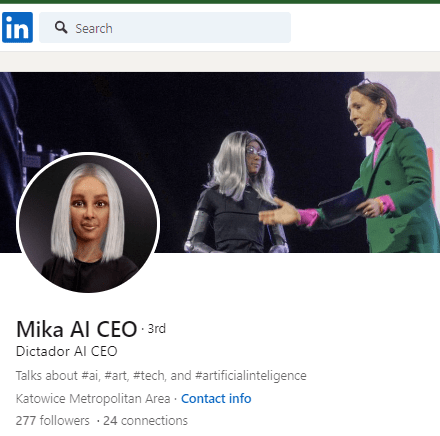
Have you heard of Mika? Here’s her LinkedIn profile.

From Mika’s LinkedIn profile at https://www.linkedin.com/in/mika-ai-ceo/

Yes, you already know that I don’t like LinkedIn profiles that don’t belong to real people. But this one is a bit different.

Mika is the Chief Executive Officer of Dictador, a Polish-Colombian spirits firm, and is responsible for “data insight, strategic provocation and DAO community liaison.” Regarding data insight, Mika described her approach in an interview with Inside Edition:

My decision making process relies on extensive data analysis and aligning with the company’s strategic objectives. It’s devoid of personal bias ensuring unbiased and strategic choices that prioritize the organization’s best interests.

From the transcript to https://www.youtube.com/watch?v=8BQEyQ2-awc
From https://www.youtube.com/watch?v=8BQEyQ2-awc

Mika was brought to my attention by accomplished product marketer/artist Danuta (Dana) Deborgoska. (She’s appeared in the Bredemarket blog before, though not by name.) Dana is also Polish (but not Colombian) and clearly takes pride in the artificial intelligence accomplishments of this Polish-headquartered company. You can read her LinkedIn post to see her thoughts, one of which was as follows:

Data is the new oxygen, and we all know that we need clean data to innovate and sustain business models.

From Dana Debogorska’s LinkedIn post.

Dana succinctly made two points:

  1. Data is the new oxygen.
  2. We need clean data.

Point one: data is the new oxygen

There’s a reference to oxygen again, but it’s certainly appropriate. Just as people cannot survive without oxygen, Generative AI cannot survive without data.

But the need for data predates AI models. From 2017:

Reliance Industries Chairman Mukesh Ambani said India is poised to grow…but to make that happen the country’s telecoms and IT industry would need to play a foundational role and create the necessary digital infrastructure.

Calling data the “oxygen” of the digital economy, Ambani said the telecom industry had the urgent task of empowering 1.3 billion Indians with the tools needed to flourish in the digital marketplace.

From India Times.

And we can go back centuries in history and find examples when a lack of data led to catastrophe. Like the time in 1776 when the Hessians didn’t know that George Washington and his troops had crossed the Delaware.

Point two: we need clean data

Of course, the presence or absence of data alone is not enough. As Debogorska notes, we don’t just need any data; we need CLEAN data, without error and without bias. Dirty data is like carbon monoxide, and as you know carbon monoxide is harmful…well, most of the time.

That’s been the challenge not only with artificial intelligence, but with ALL aspects of data gathering.

The all-male board of directors of a fertilizer company in 1960. Fair use. From the New York Times.

In all of these cases, someone (Amazon, Enron’s shareholders, or NIST) asked questions about the cleanliness of the data, and then set out to answer those questions.

  • In the case of Amazon’s recruitment tool and the company Enron, the answers caused Amazon to abandon the tool and Enron to abandon its existence.
  • Despite the entreaties of so-called privacy advocates (who prefer the privacy nightmare of physical driver’s licenses to the privacy-preserving features of mobile driver’s licenses), we have not abandoned facial recognition, but we’re definitely monitoring it in a statistical (not an anecdotal) sense.

The cleanliness of the data will continue to be the challenge as we apply artificial intelligence to new applications.

Clean room of a semiconductor manufacturing facility. Uploaded by Duk 08:45, 16 Feb 2005 (UTC) – http://www.grc.nasa.gov/WWW/ictd/content/labmicrofab.html (original) and https://images.nasa.gov/details/GRC-1998-C-01261 (high resolution), Public Domain, https://commons.wikimedia.org/w/index.php?curid=60825

Point three: if you’re not saying things, then you’re not selling

(Yes, this is the surprise point.)

Dictador is talking about Mika.

Are you talking about your product, or are you keeping mum about it?

I have more to…um…say about this. Follow this link.

When I Had To Describe This Technology, Words Failed Me

(TL;DR people can click here.)

What is this technology?

Last Saturday I hoped to gain inspiration so that I could shoot a video or capture an image to promote Bredemarket’s technology writing services—namely, writing blog posts, case studies, white papers, or other content to empower technology firms.

By mid-morning, with no inspiration, I captured a technology image of…something.

Chaffey High School, Ontario, California, November 11, 2023.

As I confessed in my “behind the scenes” video that day, I have no idea what this thing is, or whether this is used for water, gas, or something else entirely.

Chaffey High School, Ontario, California, November 11, 2023.

Why I did not know

And do you want to know WHY I couldn’t describe what I saw?

Because I failed to get a collaborator to work with me.

If an appropriate person from Chaffey High School presented themselves to me, they could have described:

  • Why this technology was necessary.
  • How the technology worked.
  • What the technology was.

You’ll notice that I asked the “why” question BEFORE I asked the “how” and “what” questions. Because “why” is most important. If a student or staff member sees this thing on the Chaffey campus, they naturally want to know why it’s there. They don’t really care if it pumps 100 liters of whatever per second.

How I can produce the right words for your technology firm

And that’s how I will work with YOUR technology firm when Bredemarket creates content. We work TOGETHER to create the content you need.

Do you need to create content that converts prospects for your technology product/service and drives content results?

Learn more by clicking on the image.

P.S. Don’t wait. There’s a cost to waiting.

Boots on the Ground, NOW

How many of you have used the phrase “boots on the ground“?

In the “war” against competitors, your company needs “boots on the ground”…especially for on-premise deployments.

I’ve known a couple of companies that didn’t realize that they lacked boots on the ground…and that they had no plan to get the boots on the ground that they definitely needed.

This doesn’t just affect a company’s products. It also affects a company’s content.

Company X brainstorms

Company X was a new software solutions provider that had an internal brainstorming channel, and one person made the following suggestion:

Why stop at providing software solutions to our customers? Why not provide complete solutions with both software and hardware?

Now you NEVER want to totally shoot down a brainstorming idea, but it’s appropriate to consider the positives and negatives of any brainstorm. I won’t delve into ALL the negatives of shifting from a software solution to a software/hardware solution (profit margins, delivery times, etc.), but I will focus on one:

If you deploy integrated software and hardware solutions, you are responsible for MAINTAINING them.

What does this mean?

  • This means that you have to hire employees with hardware maintenance expertise, or you have to hire managers who can oversee subcontractors with hardware maintenance expertise.
  • For certain products (such as those Company X sold), customers demand fast response times. Maybe a 2-hour response. Maybe a 5-minute response.
  • Customers won’t wait a week for a maintenance technician to show up at their site. Broken hardware grinds business to a halt, and customer’s won’t tolerate that.
  • And they DEFINITELY won’t send the hardware off to a distant facility for repair.

As a pure software firm, Company X had few if any people qualified to perform the necessary maintenance activities.

But at least Company X had SOME people to consider these issues. Company Y wasn’t so fortunate.

Company Y sells

Company Y was also a software solutions provider. Company Y wanted to break into a particular industry in a particular country. I won’t reveal the industry, but I will reveal the target country: the United States.

Company Y developed and delivered a sales pitch that talked about the importance of the industry in question, and how the company could deliver a solution for that industry in the U.S.

But it glossed over one thing: Company Y had very few people in the U.S. at the time. Oh, they were working on hiring some more people in the United States, but at the time they didn’t have many.

And it was painfully obvious that Company Y’s U.S. presence was lacking. While talking about the expectations of different generations of people in the industry, the company rep referred to “Generation Zed.” For anyone listening to the sales pitch, that sent up an immediate red flag.

Now I’ll be the first to admit that American English may not be considered the most advanced English in the world. After all, we spell many words with an abundance of z’s…whoops, I mean an abundance of zeds.

If you’re going to do business in the United States, you have to speak our language. And we Americans will be criticised (with an s) when we don’t speak another country’s language.

So when do you buy boots?

If you need boots on the ground to fight your competitors, you have to…well, you have to obtain boots on the ground. But when?

  1. One option is to wait until you need them, and THEN buy the boots. Wait until someone actually buys your software/hardware solution, or wait until you actually have a U.S. contract in your industry. No need to spend money on resources if you never use them, and if you do need the resources later, they’ll be able to ramp up quickly…right?
  2. The other option is to take the risk and put the boots in your closet NOW, so that when a customer calls upon you to deliver, you don’t embarrass yourself. This financially costs your company, but you’ll be primed and prepared to move forward when the business does come.

So let’s talk about your content

You don’t only need boots on the ground to deploy your products. You need boots on the ground to create the content that will entice prospects to BUY those same products.

You’ve been meaning to create that content for a while, but just haven’t gotten around to it. After all, there’s a financial cost in hiring an employee or a contractor (like Bredemarket) to create the content, and there’s an opportunity cost in taking one of your existing employees and tasking them with content creation.

So you haven’t created the content you need for your business.

And you’re probably not going to create it next week either.

Or next month.

Or next year.

Unless you move forward NOW and bring in some boots on the ground, namely Bredemarket, to work with you and create the content you desperately need.

Are you ready to move forward, or are you going to stay in place?

Or retreat?

You’re Doing It Wrong™: One Piece of Collateral Isn’t Enough

If you create a single piece of collateral for your product or service and say that you’ve completed your job, “you’re doing it wrong™.”

Product marketers and content marketers know that you’re just starting.

John Bonini on content vs. channel

John Bonini advises that you separate the content from the channel.

What most companies practice is not actually content marketing. It’s channel marketing.

They’re not marketing the content. They’re marketing the channel.

From LinkedIn.

You can express a single thought on multiple channels. And as far as I’m concerned, the more the merrier.

Me on “expert” advice on social media channel adoption

Incidentally, that’s why I object to the “expert” advice that I master one social media channel first before branching out into others.

If I adopt that strategy and ONLY market on LinkedIn and ignore Instagram and TikTok, I am automatically GUARANTEEING that the potential Instagram and TikTok audiences will never hear about my offer.

“How I Expanded 1 Idea into 31 Pieces of Content”

I’ve expressed my thoughts on this social media “expert” advice before:

The latter post, entitled “How I Expanded 1 Idea into 31 Pieces of Content,” described how…well, the title is pretty self-explanatory. I created 31 pieces of content based on a single idea.

The 31 pieces of content, published both through the Bredemarket channels (see above) and via my personal channels (including my jebredcal blog and my LinkedIn page), all increased the chance that SOMEONE would see the underlying message: “Your prospects don’t care about your technology.” Each piece of content was tuned for the particular channel and its target audience, ensuring that the message would resonate.

By Christian Gidlöf – Photo taken by Christian Gidlöf, Public Domain, https://commons.wikimedia.org/w/index.php?curid=2065930

As I often say, repurposing is good.

Speaking of repurposing, I’ve already adapted the words above and published them in four different ways (this is the fourth)…and counting. No TikTok video yet though.

Can Bredemarket help you repurpose or create content?

And if I can do this for me, I can do this for you.

Bredemarket can help you create content that converts prospects and drives content results. Why?

If you’re sold on using Bredemarket to create customer-focused messaging (remember: your prospects don’t care about your technology), or even if you’re not and just want to talk about your needs, there are three ways to move forward with your content project. Or you can just join the Bredemarket mailing list to stay informed.

  • Book a meeting with me at calendly.com/bredemarket. Be sure to fill out the information form so I can best help you.
Bredemarket logo

Technology Firms: Drive Content Results

Does your technology firm need written content—blog posts, articles, case studies, white papers?

Why do you need this content, and what is your goal?

How will you create the content? Do you need an extra, experienced hand to help out?

Learn how Bredemarket can create content that drives results for your technology firm.

Click the image below.

#contentmarketing #technology

Your Prospects Don’t Care About Your Technology

Technologists, you know how tough it is to create a technology product.

  • You have to assemble the technology, or perhaps create the technology yourself.
  • You have to work on the most minute details and make sure that everything is just right.
  • It takes a great deal of effort.

What if your product story is ignored?

But when you want to tell the story about your product, and all the effort you put into it, your prospects ignore everything you say. You might as well not be there.

Designed by Freepik. And yes, you need to woo your prospects.

Do you know why your prospects are ignoring you?

Because they don’t care about you. It’s all about them.

People want to satisfy their own needs

But the “it’s all about me” attitude is actually a GOOD thing, if you can harness it in your messaging. Let’s face it; we all have an “it’s all about me” attitude because we want to satisfy our needs.

  • You want to satisfy your own needs because you only care about selling your product.
  • I want to satisfy my own needs because I only care about selling Bredemarket’s services. (I’ll get to the selling part later.)
  • And your prospects want to satisfy their own needs because they only care about their problems. And because of your customers’ self-focus, they’re only going to care about your product if it solves their problems.

So when it’s time to tell the story about your product, don’t talk about your technology.

Adopt a customer focus

Instead of talking about you, talk about them.

From the Gary Fly / Brooks Group article “7 Tips for Implementing a Customer-Centric Strategy,” at https://brooksgroup.com/sales-training-blog/7-tips-implementing-customer-centric-strategy/

Adopt a customer focus and talk about things that your prospects care about, such as how your product will solve their problems.

  • Do your customers struggle for visibility, or awareness? Will your technology help their visibility?
  • Do your customers struggle when considered against the competition? Will your technology help them stand out?
  • Do your customers struggle to make money (conversion)? Will your technology help them make money?
  • Do your customers require better ease of use, speed, accuracy, or other benefits? Do the features of your technology provide those benefits?

In short, your customers need to understand how you can solve their problems.

How do you adopt a customer focus?

But how can you make sure that your story resonates with your prospects?

Perhaps you need a guide to work with you to craft your story. Yes, I can serve as a guide to solve YOUR problem.

If you’re interested in how Bredemarket, the technology content marketing expert, can help you create a customer-focused story for your prospects, find out how to create technology content that converts