They don’t know you.
Which is why good consultants ask questions.

Identity/biometrics/technology marketing and writing services

They don’t know you.
Which is why good consultants ask questions.

While I talk about wildebeests, iguanas, wombats, and friction ridge-equipped koalas, Justin Welsh talks about squirrels.
Purple squirrels.

Welsh explains what a purple squirrel is:
“A purple squirrel is a candidate so rare and perfectly matched to what you need that finding one feels impossible. Someone who checks every single box, including boxes you didn’t even know you cared about.”
Then Welsh provided an example of a purple squirrel, a man named Sagar Patel who worked for him at PatientPop.
At the time PatientPop had less than $40,000 in annual revenue, so it didn’t have a huge marketing department. It didn’t even have Bredemarket as a product marketing consultant because Bredemarket didn’t exist yet. And anyway, at the time I knew next to nothing about PatientPop’s healthcare-centered hungry people, physicians who needed to attract prospects and clients via then-current search engine optimization (SEO) techniques.

Patel could have launched into a complex, feature-laden SEO discussion, but his target physicians would have responded, “So what?” Doctors want to doctor, not obsess over choosing trailing keywords…and understand the benefits of a solution immediately.
So Patel, without the resources of a marketing department, took another approach.
“So Sagar grabbed some notebook paper and drew five sides of a pyramid. He labeled each one, describing his ‘5 sides of local SEO for healthcare providers,’ and then taped them all together.
“He made himself a little paper pyramid to use in his sales pitches.”
Was Patel’s paper pyramid an effective sales tool for PatientPop? Read Welsh’s article to find out.
Too many companies wait months for the perfect marketing solution instead of doing something NOW and refining it later.
Bredemarket’s different. I ask, then I act.
Once I’ve set my compass, I get my clients a draft within days. Last week alone I turned out drafts for two clients, moving them forward so the content is available to their prospects and clients.
With my suggested schedule for short content—three day drafts, three day reviews, three day redrafts—your new content can become your online “secret salesperson” within two weeks or less.
Don’t believe me? This post alone is chock-full of links to other Bredemarket posts and Bredemarket pages, all of which are functioning as “secret salespeople” for me every single day.
If you want secret salespeople to work for you, talk to me and we’ll devise a plan to improve your product marketing awareness RIGHT NOW.
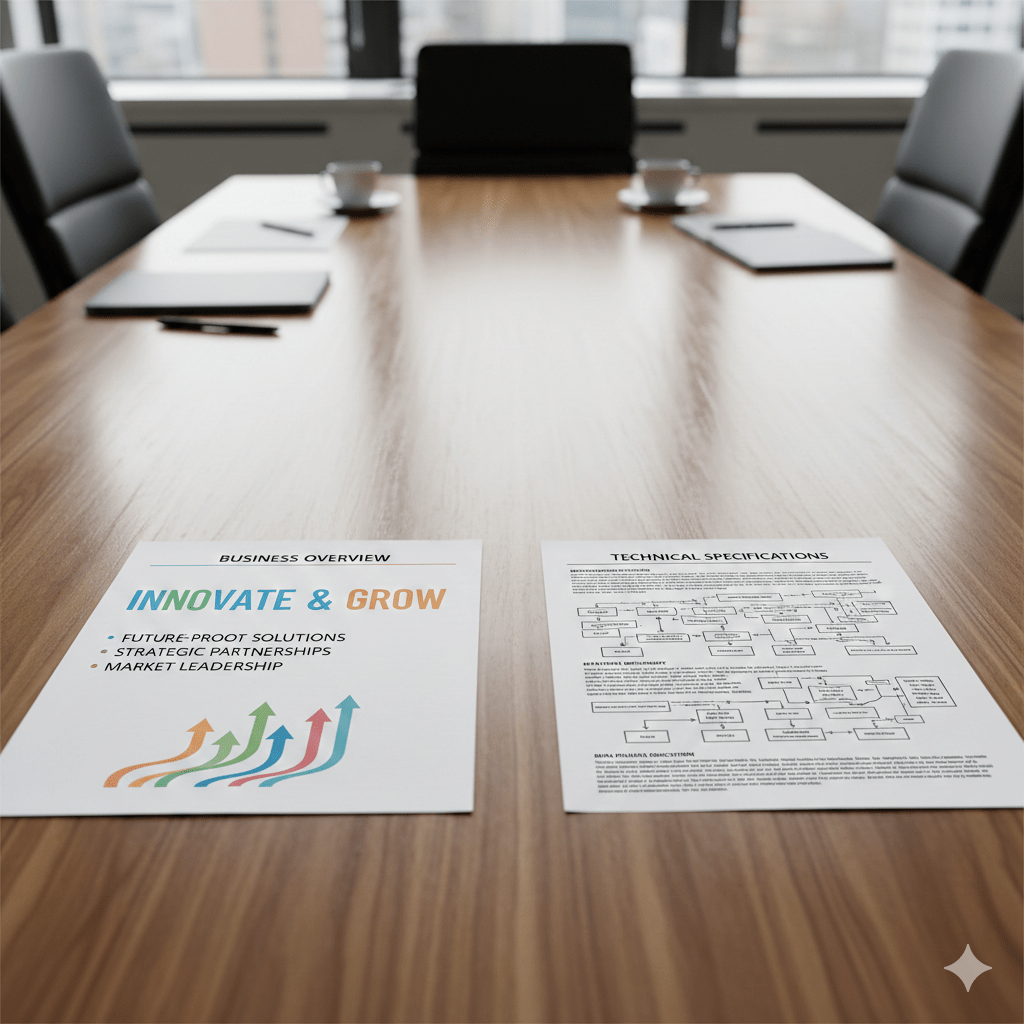
As I’ve said before, there may be many different stakeholders for a particular purchase opportunity.
For the purpose of this post I’m going to dramatically simplify the process by saying there are only two stakeholders for any RFP and any proposal responding to said RFP: “business” people, and “technical” people.

Returning to my oft-repeated example of an automated biometric identification system purchase by the city of Ontario, California, let’s look at what the business and technical people want:

So both parties are reading your proposal or other document, looking for these points.
So who is your “target audience” for your proposal?
Both of them.
Whether you’re writing a proposal or a data sheet, make sure that your document addresses the needs of both parties, and that both parties can easily find the information they’re seeking.
If I may take the liberty of stereotyping business and technical users, and if the document in question is a single sheet with printing on front and back, one suggestion is to put the business benefits on the front of the document with pretty pictures that resonate with the readers, and the technical benefits on the back of the document where engineers are accustomed to read the fine print specs.
Or something.
But if both business and technical subject matter experts are involved in the purchase decision, cater to both. You wouldn’t want to write a document solely for the techies when the true decision maker is a person who doesn’t know NFIQ from OFIQ.

Why?

Long-time Bredemarket fans may recall when Bredemarket established and publicized annual goals. I haven’t publicized my overall goals since 2022, but I am publicizing these two tactical goals for 2026 to (1) hold myself accountable, and to (2) enlist your help. Both are awareness goals, designed to bring Bredemarket to the attention of the identity, biometric, and technology marketing leaders who are my hungry people.
In calendar year 2026, achieve 100 WordPress views (as measured by “Most Viewed,” not “Most Downloaded”) for each of the three “essentials” videos:
For your convenience, you can find and view all three videos at a single Bredemarket blog post “Bredemarket Essentials November 2025.”
In calendar year 2026, achieve 1,000 YouTube views for each of the same three “essentials” videos.
Again for your convenience, you can find all three videos in this YouTube playlist: https://youtube.com/playlist?list=PLDHu4DNJv1KYQaR9Pvo0z4KzaZZweM02C
You can help me realize my goals by doing one or both of the following (I ask, then YOU act):
For me, 100 or 1,000 annual views of a video is a stretch goal. Even looking at lifetime statistics, my most popular WordPress video, my discovery of the Amazon Fresh Upland opening, has less than 100 views, and my most popular YouTube short, the metal strips that protect palm trees from squirrels, has less than 3,100 views. (I believe my most popular video ever was my Instagram reel of the San Antonio Avenue bridge: over 6,800 views.)
Maybe I should ditch the wildebeests, wombats, and iguanas (and koalas) and concentrate on squirrels. On a bridge. Eating Amazon Fresh groceries.

I’m old enough to remember when “maps” were large pieces of paper that you had to fold just right to store them. (Unless the maps were in a book.)
But whether your map is physical or electronic, if you don’t have it, and you’re in an area you don’t know, you’re going to get lost.
Which is why when I start a new project with a client, I try to get the answers to seven specific questions.
To learn about my seven questions, watch the video.
Or read the book.

Are you a technology marketing leader who lies awake at night worrying about the following?
“Keeping up with the speed and complexity of the digital landscape.”
Well, maybe not that exact phrase. That sounds like something generative AI would write.
And in fact, my buddy Bredebot wrote it when answering a question about Chief Marketing Officer pain points relative to content.

But I’m not going to let Bredebot write an entire post about it, because I’m going to write it myself.
The human way to reflect the sentiment above is to ask whether your content is up-to-date, or is as dated as a Pentium.
And that’s something that a marketing leader DOES worry about, because they (usually) want their firms to be perceived as innovative, not old fashioned.
Let me give you an example of outdated content that persists today.
For years we have been discussing search engine optimization, or SEO. The whole point of SEO is to ensure that your content appears at the top of results when you use Google or Bing or another search engine to launch a search. (Ignore “sponsored content” for a minute here.)
In case you haven’t noticed, fewer and fewer people are using search engines. Instead, they are searching for answers from their favorite generative AI tool, and now the new term the kids are using is answer engine optimization, or AEO. Or perhaps you can follow the lead of Go Fish and refer to generative engine optimization, or GEO.
Now some people are continuing to use SEO when they mean AEO and GEO, under the theory that it’s all just optimization, and it’s all just searching but just with a different tool. Personally, I believe that continuing to refer to SEO is confusing because the term has always been associated with search engines.
Plus, the concept of keywords is fading away, as Lisa Garrud noted in May.
“Unlike traditional SEO, which focuses on ranking for keywords, AEO concentrates on providing comprehensive, authoritative answers that AI systems can easily process and deliver to users….
“Think about how you use AI tools today. You don’t ask for ‘electrician Auckland residential services’, you ask, ‘What’s causing the flickering in my kitchen lights?’ or ‘How much should it cost to rewire a 1970s house?’ You want answers, not search results.”
But forget about XEO and let’s return to the content YOU create.
Let’s say that you’ve reached the point in your content calendar where you have to write a blog post about pop music.
And let’s also say that you’re old enough to remember the 20th century.
You may have a problem.
For example, when you see the words “pop music,” you may immediately spell the second word with a “z” and a “k” when you TALK ABOUT.
Or if someone mentions INTERPOL, you immediately respond with Deutsche Bank, FBI, and (und?) Scotland Yard.
And now that I’ve lost half my reading audience, you can see my point. While personas are approximations, you need to refer to them when crafting your content. If your hungry people (target audience) tend to be in their 20s and 30s, they’re probably not going to understand or respond to songs from M (Robin Scott) or Kraftwerk.
There are other things you can write that are obviously old, such as “fingerprint identification decisions are infallible.” That statement was questioned back in 2003…BEFORE the whole Brandon Mayfield thingie.
So how does a marketer ensure that their content is not dated? By remembering to ask, then act. Question your assumptions, do your research, write your content, then check your content.
Before you write your content, ensure your premise is correct. For example, I didn’t assume without questioning that “keeping up with the speed and complexity of the digital landscape” was a pressing issue. I KNEW that it was a pressing issue, because I encounter it daily.
Next, take a moment and check what you are about to say. Was your assumption about fingerprint examiner infallibility affected by the NAS report? Was your assumption affected by activities that occurred after the NAS report?
At some point you have to stop asking and start acting, writing your content. Write your draft 0.5 to get your thoughts down, then write your draft 1.0. And keep your personas in mind while you do it.
Once it’s drafted, check it again. Have your dated assumptions crept into your writing? Did you use the term “SEO” out of habit, by mistake? Fix it.
If you do all these things, you’ll ensure that your competitors don’t laugh at your content and tell you how out of touch you are.
Ideally, you want your competitors to show how out of date they are.
“Look at WidgetCorp, who doesn’t even know how to spell! Their writer’s left finger slipped while typing, and they typed the so-called word ‘AEO’ rather than ‘SEO’! Everybody know the term is SEO!”
Which gives you the opportunity to write a succinct reply to your bozo competitor.
I’ll give you the joy of writing it yourself.
Unless you want Bredemarket to write it, or other content. Book a free meeting to discuss your needs. https://bredemarket.com/mark/

(Imagen 4)
On Wednesday, in the process of explaining how B2B product marketers must address multiple “hungry people” (target audiences), I described the Bacchanal Buffet at Caesars Palace in Las Vegas, Nevada.
But buffets are not confined to Las Vegas.
I have not visited Spartanburg, South Carolina in decades. When my family was making regular drives from Virginia to Alabama, it was years before I learned how to spell “AFIS.” Yet I know that it has at least one good buffet serving multiple types of hungry people.
Not hungry for food.
Hungry for biometric software.
And no, I’m not talking about DataWorks Plus. They’re in Greenville.
But if you head east to Spartanburg, you’ll arrive at the headquarters of Integrated Biometrics, the company that just launched the IB360° software for partners and integrators.
But if you look at the IB360 web page, you’ll see that the various partners and integrators have different needs for software solutions. For example, here’s Integrated Biometrics’ messaging for hardware integrators:
“If you build with devices like fingerprint scanners or facial recognition cameras, IB360° helps you showcase your hardware’s full potential. Integrate quickly with modular licensing, create recurring revenue, and reduce reliance on external suppliers. Address multiple use cases with automated syncing and tight integration with Integrated Biometrics’ sensors.”
But software integerators and systems integrators have different needs than hardware integrators. You can view these on the web page.
Or you can download the appropriate brochure for your needs from the “Documents & Downloads” section at the bottom of the page.

As I’ve said before, you should write a proposal that resonates with the people who read it. In marketing terms, you write for the key personas in your target audience.
But what if your target audience never reads your proposal?
In Albania, it’s possible that no person will read it.
“A new minister in Albania charged to handle public procurement will be impervious to bribes, threats, or attempts to curry favour. That is because Diella, as she is called, is an AI-generated bot.
“Prime Minister Edi Rama, who is about to begin his fourth term, said on Thursday that Diella, which means “sun” in Albanian, will manage and award all public tenders in which the government contracts private companies for various projects.”
The intent is to stop corruption from “gangs seeking to launder their money from trafficking drugs and weapons.”
But how savvy is Diella?
Let me provide a proposal evaluation example that has nothing to do with corruption, but illustrates why AI must be robust.
A couple of years before I became a proposal writer, I was a Request for Proposals (RFP) writer…sort of. A Moss Adams consultant and I assembled an RFP that required respondents to answer Yes or No to a checklist of questions.
When the consultant and I received the proposals, we selected two finalists…neither of whom responded “Yes” to every question like some submissions.
We figured that the ones who said “Yes” were just trying to get the maximum points, whether they could do the work or not.

The two finalists gave some thought to the requirements and raised legitimate concerns.
Hopefully Diella is too smart to be fooled by such shenanigans. But how can she keep the gangs out of Albania’s government procurements?

Certainly on one level Diella can conduct a Know Your Business check to ensure a bidder isn’t owned by a gang leader. But as we’ve seen before in Hungary, the beneficial owner may not be the legal owner. Can Diella detect that?
Add to this the need to detect whether the entity can actually do what it says it will do. While I appreciate that the removal of humans prevents a shady procurement official from favoring an unqualified bidder, at the same time you end up relying on a bot to evaluate the bidders’ claims to competency.
Of course this could all be a gimmick, and Diella will do nothing more than give the government the aura of scientific selection, while in reality the same procurement officers will do the same things, with the same results.
Let’s see what happens with the next few bids.

Messaging. It’s what B2B product marketers do. And it’s also what proposal professional professionals do, as we shall see.
But even the simplest B2B product suffers with one-dimensional messaging.
Why? Because even simple products often require many types of people to get involved in the purchasing cycle.
Marketers often talk about target audiences. I personally believe that term doesn’t describe the concept properly, so I prefer to refer to hungry people.
Which brings us to the Las Vegas buffet.
Las Vegas is a destination visited by over 40 million people per year from all over the world. And the casino hotels know that they’re hungry for food, and they hope the hungry people will stay on property.
So do they serve Caesars Burgers?
Um, no. 40 million people don’t eat the same thing.
This becomes very clear if you visit the Bacchanal Buffet at Caesars Palace, with over 250 items prepared in 10 kitchens.
“From Roman-style pizza to Carne Asada Tacos inspired by the food trucks of L. A., there’s something for everyone. Find a world of flavor at our nine live-action cooking stations. Indulge in originals like slow-cooked prime rib, smoked beef brisket, crab, and wood-fired pizza. Or try something different, like whole Ahi Tuna Poke, roasted duck, or Singaporean Blue Crab and seasonal agua frescas.”
There is literally something for everyone. And the hungry person salivating for Ahi Tuna Poke doesn’t care about the beef brisket.
Which brings us to local police automated fingerprint identification system (AFIS) proposals.
If you had asked me in September 1994 (before I started at Printrak in October) the target audience for local police AFIS, I would have replied, “fingerprint people.”
That answer would be incorrect.
Because, even if you limit things to the criminal AFIS world, there are (at least) two types of fingerprint people: tenprint examiners, and latent examiners. I asked my buddy Bredebot to summarize the stereotypical differences between the two. Here is some of what he said:
“‘Assembly line‘ comparisons: Because tenprint comparisons use high-quality, known impressions taken under controlled conditions, their work can be automated and is often perceived as a high-volume, less complex task. This is in contrast to the specialized analysis required for latent prints.
“Artistic and subjective: Because latent prints are often smudged, distorted, and incomplete, examiners must make subjective judgments about their suitability for comparison. This has led to the criticism that the process is more of an art than a science.”
Bredebot has never attended an International Association for Identification conference, but I have. Many many years ago I attended a session on tenprint examiner certification. Latent examiners had this way cool certification and some people thought that more tenprint examiners should participate in their way cool certification program. As I recall, this meeting way heavily attended…by latent folks. Even today, the number of Certified Latent Print Examiners (CLPEs) is far greater than the number of Certified Tenprint Examiners (CTPEs).
But you can’t procure an AFIS by talking to tenprint and latent people alone.
As I noted years ago, other people get involved in a local police AFIS procurement, using Ontario, California as an example:

So even a relatively simple B2B product has multiple target audiences.
Should product marketers apply the same one-dimensional messaging to all of them?
Um, no.
If you did that, purchasing agents would fall asleep at mentions of “level 3 detail,” while latent examiners would abandon their usual attention to detail when confronted by privacy references to the California Information Practices Act of 1977. (The CCPA, CPRA, and CPPA apply to private entities.)
So, whether you like it or not, you need separate messaging for each of your categories of hungry people.

One time, as part of an account-based marketing effort, I had to construct a multi-variable messaging matrix…for a product that is arguably simpler than an AFIS.
And yes, I used Microsoft Excel.
And I can use my mad Excel skillz for you also, if your company needs content, proposal, or analysis assistance in your technology product marketing operations. Contact Bredemarket at https://bredemarket.com/mark/.
And proposal professional professionals, read this.


 Bredemarket