“THE DEPARTMENT OF Homeland Security is moving to consolidate its face recognition and other biometric technologies into a single system capable of comparing faces, fingerprints, iris scans, and other identifiers collected across its enforcement agencies, according to records reviewed by WIRED.”
But those very “records reviewed by WIRED” include this statement:
“This RFI is for planning purposes only and shall not be construed as an obligation on the part of the Government. This is NOT a Request for Quotations or Proposals. No solicitation document exists, and a formal solicitation may or may not be issued by the Government as a result of the responses received to this RFI.”
And even if this actually WAS a true procurement…HART was originally announced during the Obama administration in 2016. Ten years later, it still hasn’t happened.
An interesting Request for Information (Notice ID 70RDA126RFI000003) for a multi-biometric matching system was posted on SAM.gov on Friday, and it’s turning some heads. But is YOUR organization reading an RFI that is turning YOUR heads?
Bear in mind that this is a Request for INFORMATION, not a Request for PROPOSAL. And this is made clear in the document:
“This RFI is for planning purposes only and shall not be construed as an obligation on the part of the Government. This is NOT a Request for Quotations or Proposals. No solicitation document exists, and a formal solicitation may or may not be issued by the Government as a result of the responses received to this RFI.”
Forget the technical requirements…look at the BUSINESS requirements
Now I could get into the…um…minutiae of the request for information about a biometric matching system, the requirements for everything from presentation attack detection to on-premise/hybrid/cloud deployments, and a host of other things.
But in this case, the business requirements outweigh the technical requirements…by a LONG shot.
“The Department of Homeland Security (DHS) is seeking an enterprise-wide, scalable, and secure biometric matching software solution to support mission-critical identity verification, vetting, and investigative operations across all DHS Components, including CBP, ICE, TSA, USCIS, USSS, and Headquarters. The contractor will provide a DHS-wide enterprise license for multi-modal biometric matching software, along with all associated services, integration support, maintenance, and technical assistance necessary for full operational deployment.”
And in the next section:
“DHS is looking to acquire an enterprise-wide biometric matching software solution, including all licenses, services, and technical support necessary to enable seamless integration with all DHS biometric systems.”
Matching for ALL DHS components, and integration with ALL DHS biometric systems. This could just be a teeny system for limited operations…or it could be a super system. Since they’re asking about scalability, potential respondents should probably assume the latter.
So we’re talking loads of money.
Of course it could be scaled way down when or if a final RFP comes along. And maybe the vast expanse of the RFI is merely designed to get system integrators to drool.
Incidentally, Bredemarket offers proposal services to assist identity/biometric vendors in RFI and RFP responses such as this one. Over the years my proposals have won over $50 million in business. Presumably the respondents to this RFI have full proposal staffs (or maybe not), but if YOUR organization requires RFI and RFP assistance, schedule a meeting with Bredemarket.
Bredemarket services, process, and pricing.
(2/17/2026: See Anthony Kimery’s assessment of the RFI here.)
As I’ve said before, there may be many different stakeholders for a particular purchase opportunity.
For the purpose of this post I’m going to dramatically simplify the process by saying there are only two stakeholders for any RFP and any proposal responding to said RFP: “business” people, and “technical” people.
Google Gemini.
The business people are concerned about the why of the purchase. What pressing need is prompting the business (or government agency) to purchase the product or service? Do the alternatives meet the business need?
The technical people are concerned about the how of the purchase. Knowing the need, can the alternatives actually do what they say they can do?
Returning to my oft-repeated example of an automated biometric identification system purchase by the city of Ontario, California, let’s look at what the business and technical people want:
The business people want compliance with purchasing regulations, and superior performance that keeps citizens off the mayor’s back. (As of January 2026, still Paul Leon.)
The technical people want accurate processing of biometric evidence, proper interfaces to other ABIS systems, implementation of privacy protections, FBI certifications, iBeta or other conformance statements, and all sorts of other…um…minutiae.
So both parties are reading your proposal or other document, looking for these points.
So who is your “target audience” for your proposal?
Both of them.
Whether you’re writing a proposal or a data sheet, make sure that your document addresses the needs of both parties, and that both parties can easily find the information they’re seeking.
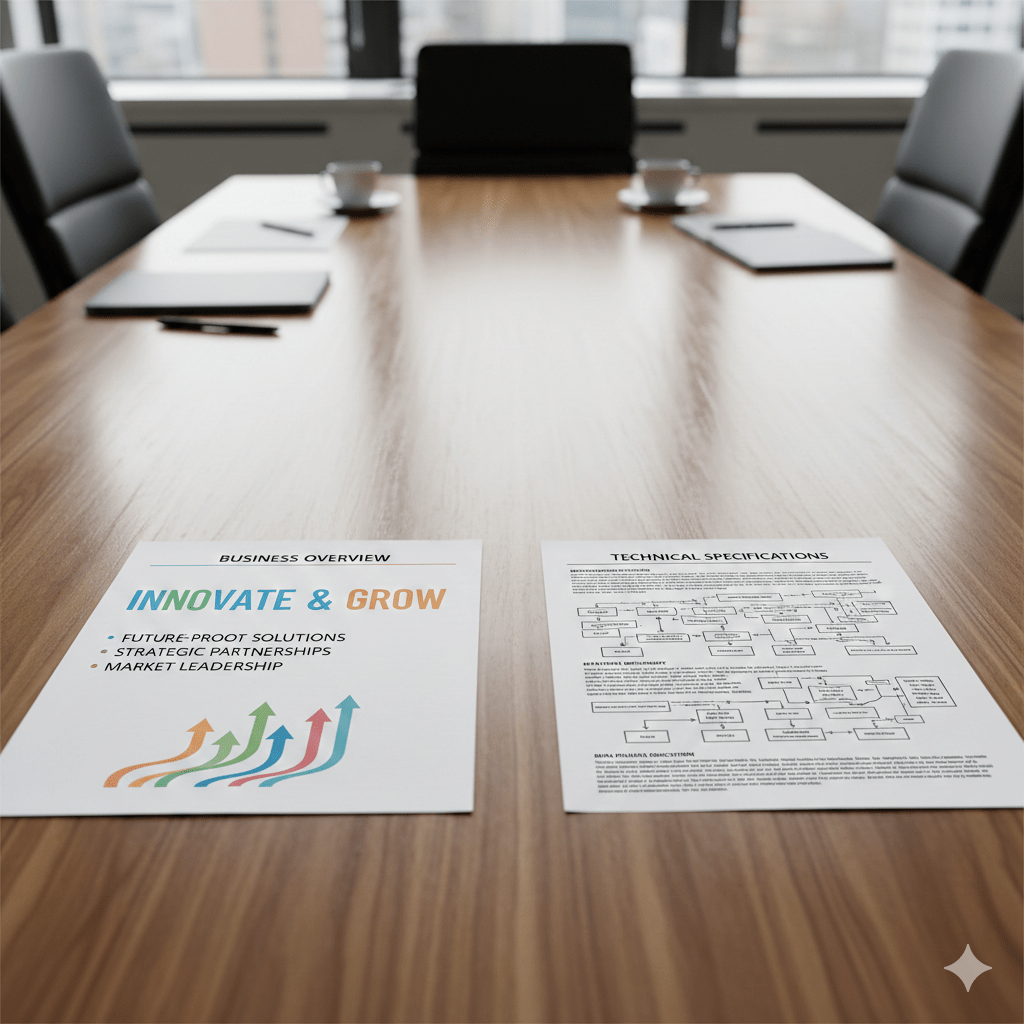
If I may take the liberty of stereotyping business and technical users, and if the document in question is a single sheet with printing on front and back, one suggestion is to put the business benefits on the front of the document with pretty pictures that resonate with the readers, and the technical benefits on the back of the document where engineers are accustomed to read the fine print specs.
Google Gemini. It took multiple tries to get generative AI to spell “innovate” correctly.
Or something.
But if both business and technical subject matter experts are involved in the purchase decision, cater to both. You wouldn’t want to write a document solely for the techies when the true decision maker is a person who doesn’t know NFIQ from OFIQ.
In theory, the decision on whether or not to submit a bid for a business opportunity is a well-established process: the bid/no bid process…that is, if you assume that no bidding something is desirable.
As you would expect, Shipley Associates (I may have mentioned Shipley before) offers a detailed description of a bid decision.
“Bid decisions are decisions gate reviews triggered by ongoing customer or opportunity intelligence. The opportunity manager (or capture manager) along with management determines whether to advance, defer, or end the pursuit. The decision hinges on whether you have the capability or can obtain the resources to pursue and subsequently capture an opportunity that meets your business objectives.”
But why make one decision when you can make three?
“Consider splitting the bid decision into at least three distinct milestones: pursuit, bid, and bid validation. A positive pursuit decision initiates preparation of the capture/opportunity plan. A positive bid decision initiates preparation of the proposal plan. A positive bid validation decision initiates the final proposal kickoff meeting and the full proposal preparation process.”
In all seriousness, I agree with this.
The first part of the Shipley Business Development Lifecycle.
Any stage gate process, such as the Shipley Business Development Lifecycle, includes decision criteria at each gate. If you determine early on that you would never win the opportunity, why waste resources on it?
And, in a true Shipley fashion the first two decisions, and possibly even the third, occur BEFORE the actual Request for Proposal is released.
But for some people, this is just plain wrong.
The “Bid Everything” method
For some people, the Shipley, SMA, Sant, and other practitioners are restrictive. Why work on an opportunity years before the RFP is released?
For these people, it makes more sense to concentrate your resources and evaluate the final RFP.
Not that much evaluation is needed, since every RFP falls into one of two categories.
We are the incumbent provider. If this is the case, then we HAVE to bid so that we don’t lose ground.
We are not the incumbent provider. If this is the case, then we HAVE to bid so that we gain ground.
It’s all pretty simple. And for those who claim that chasing lost causes lowers our probability of win, well, they’re just giving up too early.
Hey, our customer just released an RFP for a new system. I had no idea that they were going to release an RFP this year. Well, we’ve been the incumbent for years, and the people using our software seem to like us. I think. I don’t know the person who actually released the RFP, but my cousin’s brother-in-law knows him. As long as we come in with the lowest price, we’re certain to win this!
And it’s even better when your bid decision has full executive support…as in “I support the fact that you had better win this. And I will show up two hours before the submission time to help you by rewriting everything and changing the price.”
Luckily they’re not ALL like that…
Are you stretched?
But if you are stretched and need proposal help, book a free meeting with Bredemarket at https://bredemarket.com/mark/.
As I’ve said before, you should write a proposal that resonates with the people who read it. In marketing terms, you write for the key personas in your target audience.
But what if your target audience never reads your proposal?
“A new minister in Albania charged to handle public procurement will be impervious to bribes, threats, or attempts to curry favour. That is because Diella, as she is called, is an AI-generated bot.
“Prime Minister Edi Rama, who is about to begin his fourth term, said on Thursday that Diella, which means “sun” in Albanian, will manage and award all public tenders in which the government contracts private companies for various projects.”
Imagen 4.
The intent is to stop corruption from “gangs seeking to launder their money from trafficking drugs and weapons.”
When people evaluate proposals
But how savvy is Diella?
Let me provide a proposal evaluation example that has nothing to do with corruption, but illustrates why AI must be robust.
A couple of years before I became a proposal writer, I was a Request for Proposals (RFP) writer…sort of. A Moss Adams consultant and I assembled an RFP that required respondents to answer Yes or No to a checklist of questions.
When the consultant and I received the proposals, we selected two finalists…neither of whom responded “Yes” to every question like some submissions.
We figured that the ones who said “Yes” were just trying to get the maximum points, whether they could do the work or not.
Imagen 4.
The two finalists gave some thought to the requirements and raised legitimate concerns.
Can Diella detect corruption?
Hopefully Diella is too smart to be fooled by such shenanigans. But how can she keep the gangs out of Albania’s government procurements?
Imagen 4.
Certainly on one level Diella can conduct a Know Your Business check to ensure a bidder isn’t owned by a gang leader. But as we’ve seen before in Hungary, the beneficial owner may not be the legal owner. Can Diella detect that?
Add to this the need to detect whether the entity can actually do what it says it will do. While I appreciate that the removal of humans prevents a shady procurement official from favoring an unqualified bidder, at the same time you end up relying on a bot to evaluate the bidders’ claims to competency.
Of course this could all be a gimmick, and Diella will do nothing more than give the government the aura of scientific selection, while in reality the same procurement officers will do the same things, with the same results.
Biometric marketing leaders already know that I’ve talked about reader personas to death. But what about WRITER personas? And what happens when you try to address ALL the reader and writer personas?
Reader personas
While there are drawbacks to using personas, they are useful in both content marketing and proposal work when you want to tailor your words to resonate with particular types of readers (target audiences, or hungry people).
I still love my example from 2021 in which a mythical Request for Proposal (RFP) was issued by my hometown of Ontario, California for an Automated Biometric Identification System (ABIS). The proposal manager had to bear the following target audiences (hungry people) in mind for different parts of the proposal.
The field investigators who run across biometric evidence at the scene of a crime, such as a knife with a fingerprint on it or a video feed showing someone breaking into a liquor store.
The examiners who look at crime scene evidence and use it to identify individuals.
The people who capture biometrics from arrested individuals at livescan stations.
The information technologies (IT) people who are responsible for ensuring that Ontario, California’s biometric data is sent to San Bernardino County, the state of California, perhaps other systems such as the Western Identification Network, and the Federal Bureau of Investigation.
The purchasing agent who has to make sure that all of Ontario’s purchases comply with purchasing laws and regulations.
The privacy advocate who needs to ensure that the biometric data complies with state and national privacy laws.
The mayor (Paul Leon back in 2021, and still in 2025), who has to deal with angry citizens asking why their catalytic converters are being stolen from their vehicles, and demanding to know what the mayor is doing about it.
Probably a dozen other stakeholders that I haven’t talked about yet, but who are influenced by the city’s purchasing decision.
Writer personas
But who is actually writing the text to address these different types of readers?
Now in this case I’m not talking about archetypes (a topic in itself), but about the roles of the subject matter experts who write or help write the content.
I am currently working on some internal content for a Bredemarket biometric client. I can’t reveal what type of content, but it’s a variant of one of the 22 types of content I’ve previously addressed. A 23rd type, I guess.
But what would happen if someone in a role other than product marketing consultant wrote this content?
An engineer would emphasize different things. Maybe a focus on the APIs.
A finance manager would emphasize different things. Maybe an ROI focus.
A salesperson may focus on different things. Maybe qualification of a prospect. Or eventually conversion.
So the final content is not only shaped by the reader, but by the writer.
You can’t please everyone so you’ve got to please yourself
With all the different reader and writer personas, how should you respond?
Do all the things?
Perhaps you can address everyone in a 500 page proposal, but the internal content Bredemarket is creating is less than 10 pages long.
Which is possibly already too long for MY internal target audience.
So I will NOT create the internal content that addresses the needs of EVERY reader and writer persona.
Which is one truth about (reader) personas in general. If you need to address three personas, it’s more effective to create 3 separate pieces than a single one.
Which is what I’m doing in another project for this same Bredemarket biometric client, this one customer-facing.
And the content targeted to latent examiners won’t mention the needs of Paul Leon.
In which I address the marketing leader reader persona
So now I, the biometric product marketing expert writer persona, will re-address you, the biometric marketing leader reader persona.
You need content, or proposal content.
But maybe you’re not getting it because your existing staff is overwhelmed.
So you’re delaying content creation or proposal responses, or just plain not doing it. And letting opportunities slip through your fingers.
Normally these blog posts are addressed to Bredemarket’s PROSPECTS, the vendors who provide solutions that use biometrics or other technology. Such as identity proofing solutions.
But I’ve targeted this post for another audience, the organizations that BUY biometrics and technology solutions such as identity proofing solutions. Who knows? Perhaps they can use Bredemarket’s content-proposal-analysis services also. Later I will explain why you should use Bredemarket, and how you can use Bredemarket.
So if you are with an organization that SELLS identity proofing solutions, you can stop reading now. You don’t want to know what I am about to tell your prospects…or do you?
When you buy an identity proofing solution, you take on many responsibilities. While your vendor may be able to help, the ultimate responsibility remains with you.
Here are some questions you must answer:
What are your business goals for the project? Do you want to confirm 99.9% of all identities? Do you want to reduce fraudulent charges below $10 million? How will you measure this?
What are your technology goals for the project? What is your desired balance between false positives and false negatives? How will you measure this?
How will the project achieve legal compliance? What privacy requirements apply to your end users—even if they live outside your legal jurisdiction? Are you obtaining the required consents? Can you delete end user data upon request? Are you prepared if an Illinois lawyer sues you? Do you like prison food?
A new Government Accountability Office (GAO) audit found the Internal Revenue Service (IRS) has not exercised sufficient oversight of its digital identity-proofing program…
As many of you know, the IRS’ identity proofing vendor is ID.me. The GAO didn’t find any fault with ID.me. And frankly, it couldn’t…because according to the GAO, the IRS’ management of ID.me was found to be deficient.
“IRS was unable to show it had measurable goals and objectives for the program. IRS receives performance data from the vendor but did not show it independently identified outcomes it is seeking. IRS also has not shown documented procedures to routinely evaluate credential service providers’ performance. Without stronger performance reviews, IRS is hindered in its ability to take corrective actions as needed.
“ID.me acknowledges that its identity-proofing process involves the use of artificial intelligence (AI) technologies. However, IRS has not documented these uses in its AI inventory or taken steps to comply with its own AI oversight policies. Doing so would provide greater assurance that taxpayers’ rights are protected and that the technologies are accurate, reliable, effective, and transparent.”
You would think the IRS had a process for this…but apparently it doesn’t.
Dead on arrival (DOA).
But I’m not the IRS!
I’ll grant that you’re not the IRS. But is your identity proofing program management better…or worse?
Do you know what questions to ask?
Let Bredemarket ask you some questions. Perhaps these can help you create relevant external and internal content (I’ve created over 22 types of content), manage an RFP proposal process, or analyze your industry, company, or competitors.
“a word used in order to evade or retreat from a direct or forthright statement or position”
I don’t know how weasels became the subject of a negative phrase like this, but here we are.
I learned the phrase “weasel word” when I started working in proposals. I’ve been writing proposals for nearly 15 years, and I’ve run into many cases where I don’t comply with the written word of a mandatory requirement, and I end up having to…evade or retreat.
“This rule ensures that Federal agencies have appropriate flexibility to implement the card-based enforcement provisions of the REAL ID regulations after the May 7, 2025, enforcement deadline by explicitly permitting agencies to implement these provisions in phases….The rule also requires agencies to coordinate their plans with DHS, make the plans publicly available, and achieve full enforcement by May 5, 2027.”
As I have ranted repeatedly, the REAL ID enforcement DEADLINE is May 7, 2025, but FULL enforcement will be achieved by May 5, 2027. There are enough weasel words to distract from the fact that full enforcement is not taking place on May 7, 2025.
“Flexibility,” “implement in phases”…I’m taking notes. The next time I respond to a DHS RFI, I may use some of these.
Because Bredemarket does respond to Requests for Information, Requests for Proposal, and similar documents. One of Bredemarket’s clients recently received an award, with possible lucrative add-on work in the future.
Does your identity/biometric or technology conpany want the government to give you money? I can help. Talk to me: https://bredemarket.com/cpa/
From the early 1990s to 2019, the majority of my identity/biometric proposal work was with U.S. state and local agencies, with some work with foreign agencies (such as Canada’s RCMP), private entities, and a few proposals to U.S. federal agencies.
I had no idea what was going to happen in 2020, and one of the surprises is that the majority of my identity/biometric proposal work since 2020 has been with U.S. federal agencies. Many requests for information (RFIs) as well as other responses.
The L & N, not M, but close enough for government work.
I’ve worked on client proposals (and Bredemarket’s own responses) to the Departments of Defense, Homeland Security, Justice, and perhaps some others along the way.
And no, there’s no uniformity
Same department, different requirements.
Coincidentally, the two most recent identity/biometric proposals I managed for Bredemarket clients went to the same government department. But that’s where the similarities ended.
The first required an e-mail submission of a PDF (10 pages maximum) to two email addresses. A relative piece of cake.
Mmm…cake. Always reward your proposal people.
The last required an online submission. No, not a simple upload of a PDF to a government website. While my client did have to upload 2 PDFs, the majority of the submission required my client to complete a bunch of online screens.
And there were two separate sets of instructions regarding how to complete these online screens…which contradicted each other. So I had to ask a clarification question…and you know how THAT can go.
Oh, and as the consulting proposal expert, I could not complete the online screens on behalf of the client. The client’s company had a single login, which was assigned to a single person (a company executive) and could NOT be used by anybody else.
So on the day of proposal submission the executive and I videoconferenced, and I watched as the executive answered the responses, in part using a document in which I had drafted responses.
And of course things were not perfect. The executive pasted one of my responses into the space provided, and only THEN did we discover that the response had an unadvertised character limit. So I rewrote it…at the same time that I resized a required image with unadvertised dimension restrictions.
But there’s some uniformity
Perhaps if I had written more federal proposals at Printrak, Motorola, MorphoTrak, IDEMIA, and Incode, I would have known these things. Perhaps not; as late as 2014 I was still printing proposals on paper and submitting 10 or more volumes of binders (yes, binders) along with CDs that had to be virus-checked.
Some Requests for Proposal (RFPs) provide helpful checklists.
But regardless of whether you submit proposals online, via CD, or in paper volumes, some things remain constant.
Follow the instructions.
Answer the questions.
Emphasize the benefits.
And don’t misspell the name of the Contracting Officer.
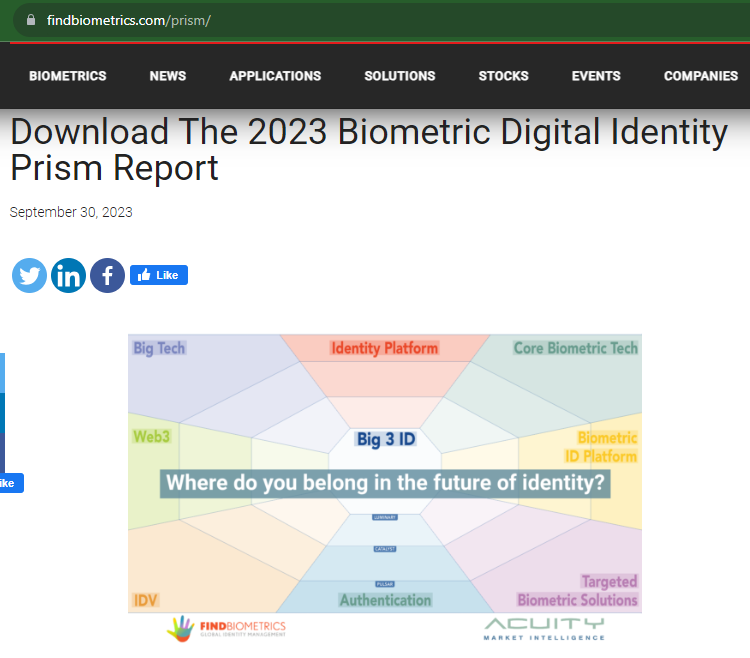
On September 30, FindBiometrics and Acuity Market Intelligence released the production version of the Biometric Digital Identity Prism Report. You can request to download it here.
But FindBiometrics and Acuity Market Intelligence didn’t invent the Big 3. The concept has been around for 40 years. And two of today’s Big 3 weren’t in the Big 3 when things started. Oh, and there weren’t always 3; sometimes there were 4, and some could argue that there were 5.
So how did we get from the Big 3 of 40 years ago to the Big 3 of today?
The Big 3 in the 1980s
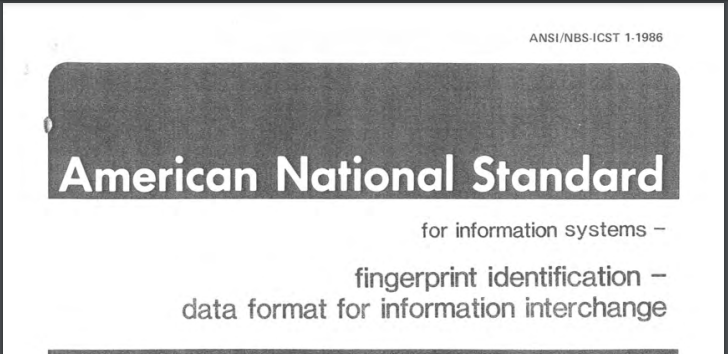
Back in 1986 (eight years before I learned how to spell AFIS) the American National Standards Institute, in conjunction with the National Bureau of Standards, issued ANSI/NBS-ICST 1-1986, a data format for information interchange of fingerprints. The PDF of this long-superseded standard is available here.
When creating this standard, ANSI and the NBS worked with a number of law enforcement agencies, as well as companies in the nascent fingerprint industry. There is a whole list of companies cited at the beginning of the standard, but I’d like to name four of them.
De La Rue Printrak, Inc.
Identix, Inc.
Morpho Systems
NEC Information Systems, Inc.
While all four of these companies produced computerized fingerprinting equipment, three of them had successfully produced automated fingerprint identification systems, or AFIS. As Chapter 6 of the Fingerprint Sourcebook subsequently noted:
Morpho Systems resulted from French AFIS efforts, separate from those of the FBI. These efforts launched Morpho’s long-standing relationship with the French National Police, as well as a similar relationship (now former relationship) with Pierce County, Washington.
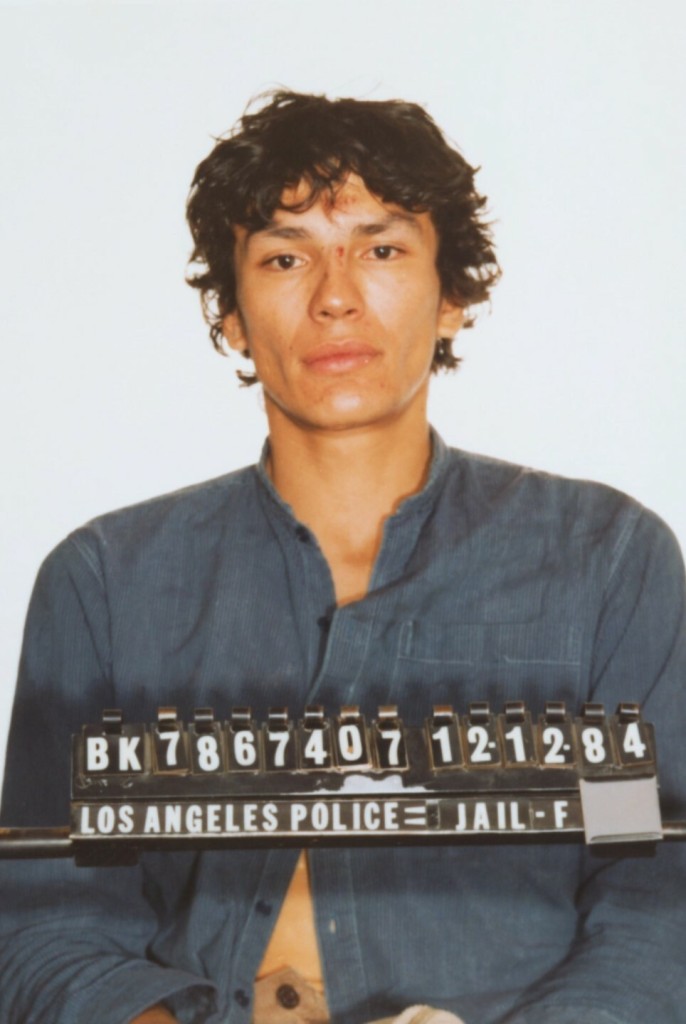
NEC had deployed AFIS equipment for the National Police Academy of Japan, and (after some prodding; read Chapter 6 for the story) the city of San Francisco. Eventually the state of California obtained an NEC system, which played a part in the identification of “Night Stalker” Richard Ramirez.
After the success of the San Francisco and California AFIS systems, many other jurisdictions began clamoring for AFIS of their own, and turned to these three vendors to supply them.
The Big 4 in the 1990s
But in 1990, these three firms were joined by a fourth upstart, Cogent Systems of South Pasadena, California.
While customers initially preferred the Big 3 to the upstart, Cogent Systems eventually installed a statewide system in Ohio and a border control system for the U.S. government, plus a vast number of local systems at the county and city level.
Between 1991 and 1994, the (Immigfation and Naturalization Service) conducted several studies of automated fingerprint systems, primarily in the San Diego, California, Border Patrol Sector. These studies demonstrated to the INS the feasibility of using a biometric fingerprint identification system to identify apprehended aliens on a large scale. In September 1994, Congress provided almost $30 million for the INS to deploy its fingerprint identification system. In October 1994, the INS began using the system, called IDENT, first in the San Diego Border Patrol Sector and then throughout the rest of the Southwest Border.
I was a proposal writer for Printrak (divested by De La Rue) in the 1990s, and competed against Cogent, Morpho, and NEC in AFIS procurements. By the time I moved from proposals to product management, the next redefinition of the “big” vendors occurred.
The Big 3 in 2003
There are a lot of name changes that affected AFIS participants, one of which was the 1988 name change of the National Bureau of Standards to the National Institute of Standards and Technology (NIST). As fingerprints and other biometric modalities were increasingly employed by government agencies, NIST began conducting tests of biometric systems. These tests continue to this day, as I have previously noted.
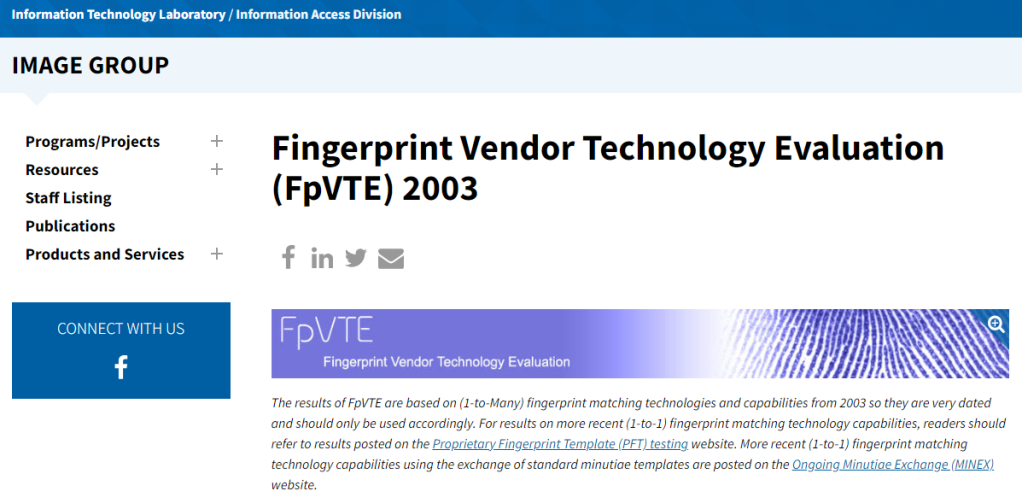
One of NIST’s first tests was the Fingerprint Vendor Technology Evaluation of 2003 (FpVTE 2003).
For those who are familiar with NIST testing, it’s no surprise that the test was thorough:
FpVTE 2003 consists of multiple tests performed with combinations of fingers (e.g., single fingers, two index fingers, four to ten fingers) and different types and qualities of operational fingerprints (e.g., flat livescan images from visa applicants, multi-finger slap livescan images from present-day booking or background check systems, or rolled and flat inked fingerprints from legacy criminal databases).
Eighteen vendors submitted their fingerprint algorithms to NIST for one or more of the various tests, including Bioscrypt, Cogent Systems, Identix, SAGEM MORPHO (SAGEM had acquired Morpho Systems), NEC, and Motorola (which had acquired Printrak). And at the conclusion of the testing, the FpVTE 2003 summary (PDF) made this statement:
Of the systems tested, NEC, SAGEM, and Cogent produced the most accurate results.
Which would have been great news if I were a product manager at NEC, SAGEM, and Cogent.
Unfortunately, I was a product manager at Motorola.
The effect of this report was…not good, and at least partially (but not fully) contributed to Motorola’s loss of its long-standing client, the Royal Canadian Mounted Police, to Cogent.
The Big 3, 4, or 5 after 2003
So what happened in the years after FpVTE was released? Opinions vary, but here are three possible explanations for what happened next.
Did the Big 3 become the Big 4 again?
Now I probably have a bit of bias in this area since I was a Motorola employee, but I maintain that Motorola overcame this temporary setback and vaulted back into the Big 4 within a couple of years. Among other things, Motorola deployed a national 1000 pixels-per-inch (PPI) system in Sweden several years before the FBI did.
Did the Big 3 remain the Big 3?
Motorola’s arch-enemies at Sagem Morpho had a different opinion, which was revealed when the state of West Virginia finally got around to deploying its own AFIS. A bit ironic, since the national FBI AFIS system IAFIS was located in West Virginia, or perhaps not.
Anyway, Motorola had a very effective sales staff, as was apparent when the state issued its Request for Proposal (RFP) and explicitly said that the state wanted a Motorola AFIS.
That didn’t stop Cogent, Identix, NEC, and Sagem Morpho from bidding on the project.
After the award, Dorothy Bullard and I requested copies of all of the proposals for evaluation. While Motorola (to no one’s surprise) won the competition, Dorothy and I believed that we shouldn’t have won. In particular, our arch-enemies at Sagem Morpho raised a compelling argument that it should be the chosen vendor.
Their argument? Here’s my summary: “Your RFP says that you want a Motorola AFIS. The states of Kansas (see page 6 of this PDF) and New Mexico (see this PDF) USED to have a Motorola AFIS…but replaced their systems with our MetaMorpho AFIS because it’s BETTER than the Motorola AFIS.”
But were Cogent, Motorola, NEC, and Sagem Morpho the only “big” players?
Did the Big 3 become the Big 5?
While the Big 3/Big 4 took a lot of the headlines, there were a number of other companies vying for attention. (I’ve talked about this before, but it’s worthwhile to review it again.)
Identix, while making some efforts in the AFIS market, concentrated on creating live scan fingerprinting machines, where it competed (sometimes in court) against companies such as Digital Biometrics and Bioscrypt.
The fingerprint companies started to compete against facial recognition companies, including Viisage and Visionics.
Oh, and there were also iris companies such as Iridian.
And there were other ways to identify people. Even before 9/11 mandated REAL ID (which we may get any year now), Polaroid was making great efforts to improve driver’s licenses to serve as a reliable form of identification.
In short, there were a bunch of small identity companies all over the place.
But in the course of a few short years, Dr. Joseph Atick (initially) and Robert LaPenta (subsequently) concentrated on acquiring and merging those companies into a single firm, L-1 Identity Solutions.
These multiple mergers resulted in former competitors Identix and Digital Biometrics, and former competitors Viisage and Visionics, becoming part of one big happy family. (A multinational big happy family when you count Bioscrypt.) Eventually this company offered fingerprint, face, iris, driver’s license, and passport solutions, something that none of the Big 3/Big 4 could claim (although Sagem Morpho had a facial recognition offering). And L-1 had federal contracts and state contracts that could match anything that the Big 3/Big 4 offered.
So while L-1 didn’t have a state AFIS contract like Cogent, Motorola, NEC, and Sagem Morpho did, you could argue that L-1 was important enough to be ranked with the big boys.
So for the sake of argument let’s assume that there was a Big 5, and L-1 Identity Solutions was part of it, along with the three big boys Motorola, NEC, and Safran (who had acquired Sagem and thus now owned Sagem Morpho), and the independent Cogent Systems. These five companies competed fiercly with each other (see West Virginia, above).
In a two-year period, everything would change.
The Big 3 after 2009
Hang on to your seats.
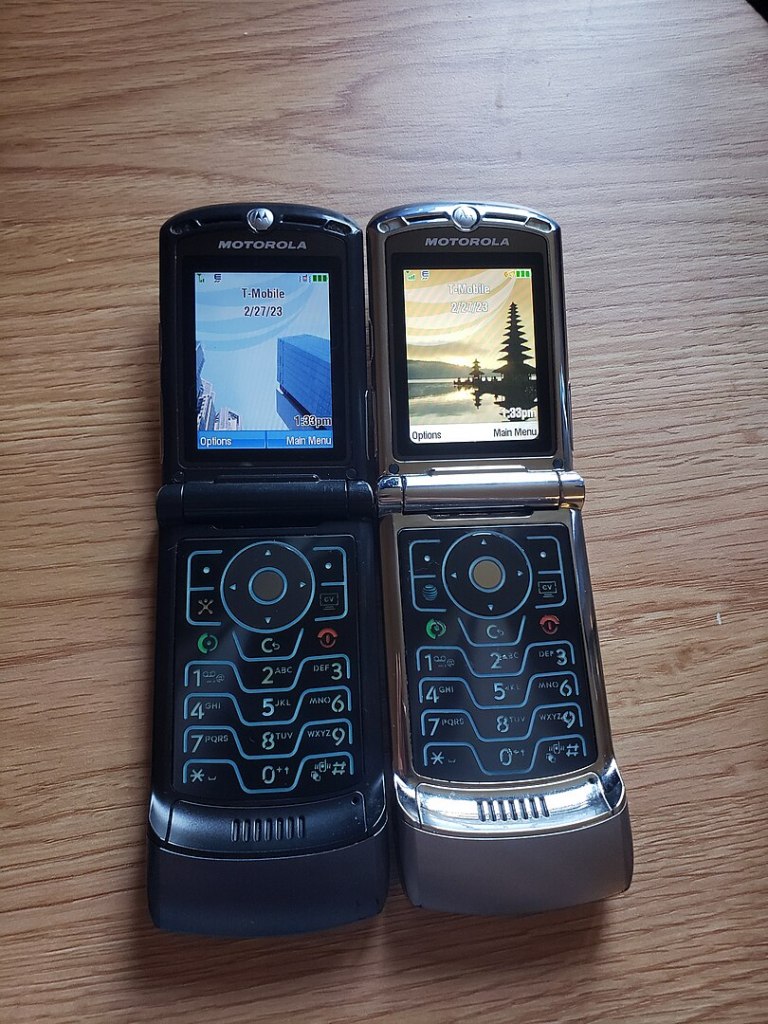
The Motorola RAZR was hugely popular…until it wasn’t. Eventually Motorola split into two companies and sold off others, including the “Printrak” Biometric Business Unit. By NextG50 – Own work, CC BY-SA 4.0, https://commons.wikimedia.org/w/index.php?curid=130206087
By 2009, Safran (resulting from the merger of Sagem and Snecma) was an international powerhouse in aerospace and defense and also had identity/biometric interests. Motorola, in the meantime, was no longer enjoying the success of its RAZR phone and was looking at trimming down (prior to its eventual, um, bifurcation). In response to these dynamics, Safran announced its intent to purchase Motorola’s Biometric Business Unit in October 2008, an effort that was finalized in April 2009. The Biometric Business Unit (adopting its former name Printrak) was acquired by Sagem Morpho and became MorphoTrak. On a personal level, Dorothy Bullard moved out of Proposals and I moved into Proposals, where I got to work with my new best friends that had previously slammed Motorola for losing the Kansas and New Mexico deals. (Seriously, Cindy and Ron are great folks.)
By 2011, Safran decided that it needed additional identity capabilities, so it acquired L-1 Identity Solutions and renamed the acquisition as MorphoTrust.
If you’re keeping notes, the Big 5 have now become the Big 3: 3M, Safran, and NEC (the one constant in all of this).
While there were subsequent changes (3M sold Cogent and other pieces to Gemalto, Safran sold all of Morpho to Advent International/Oberthur to form IDEMIA, and Gemalto was acquired by Thales), the Big 3 has remained constant over the last decade.
And that’s where we are today…pending future developments.
If Alphabet or Amazon reverse their current reluctance to market their biometric offerings to governments, the entire landscape could change again.
Or perhaps a new AI-fueled competitor could emerge.
The 1 Biometric Content Marketing Expert
This was written by John Bredehoft of Bredemarket.
If you work for the Big 3 or the Little 80+ and need marketing and writing services, the biometric content marketing expert can help you. There are several ways to get in touch:
Book a meeting with me at calendly.com/bredemarket. Be sure to fill out the information form so I can best help you.












 Bredemarket