“a word used in order to evade or retreat from a direct or forthright statement or position”
I don’t know how weasels became the subject of a negative phrase like this, but here we are.
I learned the phrase “weasel word” when I started working in proposals. I’ve been writing proposals for nearly 15 years, and I’ve run into many cases where I don’t comply with the written word of a mandatory requirement, and I end up having to…evade or retreat.
“This rule ensures that Federal agencies have appropriate flexibility to implement the card-based enforcement provisions of the REAL ID regulations after the May 7, 2025, enforcement deadline by explicitly permitting agencies to implement these provisions in phases….The rule also requires agencies to coordinate their plans with DHS, make the plans publicly available, and achieve full enforcement by May 5, 2027.”
As I have ranted repeatedly, the REAL ID enforcement DEADLINE is May 7, 2025, but FULL enforcement will be achieved by May 5, 2027. There are enough weasel words to distract from the fact that full enforcement is not taking place on May 7, 2025.
“Flexibility,” “implement in phases”…I’m taking notes. The next time I respond to a DHS RFI, I may use some of these.
Because Bredemarket does respond to Requests for Information, Requests for Proposal, and similar documents. One of Bredemarket’s clients recently received an award, with possible lucrative add-on work in the future.
Does your identity/biometric or technology conpany want the government to give you money? I can help. Talk to me: https://bredemarket.com/cpa/
To let you know how this braggart can help you with your identity, cybersecurity, and technology proposals.
First, the bragging
Let’s start the bragging by announcing that one of Bredemarket’s consulting clients was recently notified of an award by a federal agency.
I won’t name the client or the agency, other than to clarify that the agency is NOT the U.S. Department of Education, the Agency for International Development, the Voice of America, or similar agencies that have taken a beating over the last 2 1/2 months. So the award is fairly safe.
So what do I have to brag about?
To be honest, not much.
Second, the reality
Yes, I made sure that the proposal was compliant and persuasive, that it addressed all the required points, that it went to the correct person, that it stayed within the mandated page and word limits, and that it was delivered before the due date and time.
But if the client had proposed an inferior solution, questionable implementation plan, or unqualified personnel, there would NOT have been an award regardless of whether the text was in 12-point Times New Roman with the appropriate margins.
Like all Bredemarket projects, I collaborated with the client to submit the proposal, which in the end was a winning proposal.
Third, how did I get here?
I’ve told the story before, but I kind of fell into the proposals world in October 1994 when I began consulting for the Proposals Department at a company called Printrak International. After several acquisitions, the company became part of IDEMIA 23 years later.
During my time at Printrak, Motorola, MorphoTrak, and IDEMIA I spent two separate stints in Proposals, primarily focusing on state and local opportunities with various international opportunities thrown in.
Things changed in 2020 when Bredemarket started offering proposal services. With one exception (a State of California healthcare-related proposal), all my proposal work has been at the federal level.
I’ve worked at various proposal maturity levels, ranging from working via SMA in a mature proposal development process, to cases in which I was the sole proposal expert. But the keys always remain the same: work with the client, do great work, and turn the thing in on time.
Fourth, how will YOU get THERE?
If your organization has the need to submit a technology software proposal, perhaps I can help. I can plug into your existing proposals organization, or if necessary I can BE your proposals organization.
If you’d like to talk about it, schedule a free consultation via my “CPA” page (the “P” stands for Proposal) and check the “Proposal services” check box.
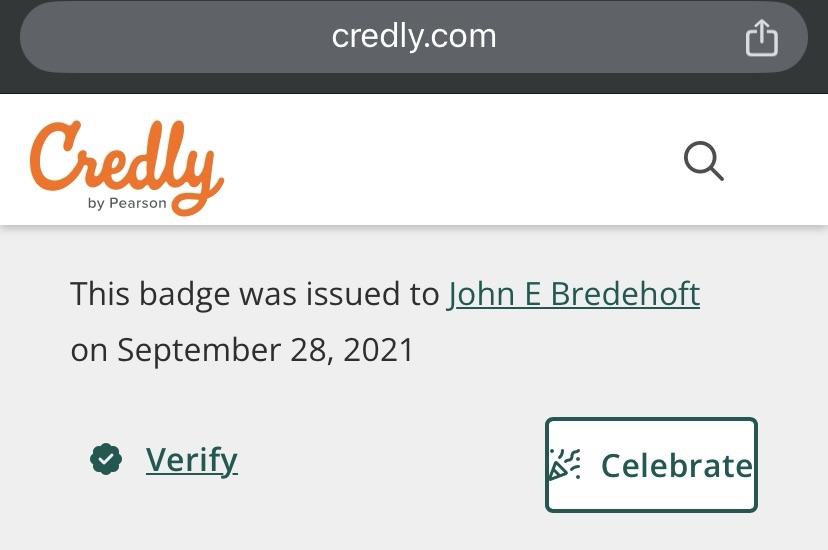
Now if you click on that link, you will see a “Verify” link at the top left.
From Credly.
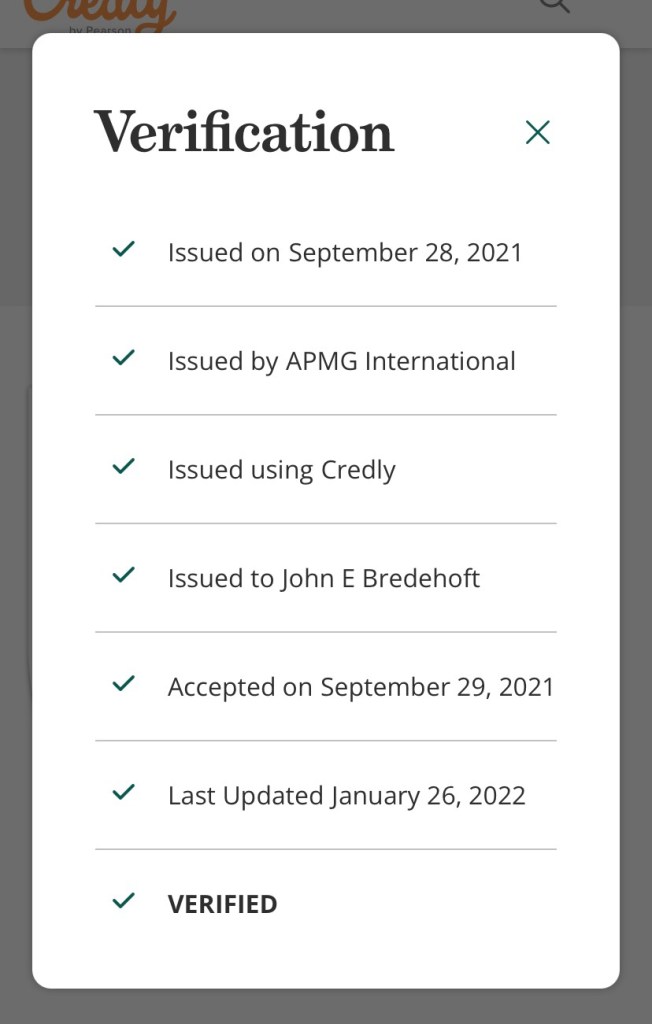
And if you click on that”Verify,” this is what you get.
The verification.
So I have verified that I am allowed to call myself John E. Bredehoft, CF APMP. It’s allowed:
In the same manner, those who have achieved one of the APMP certifications can append the appropriate certification. In the case of APMP Foundation certification, that means that I can style myself as “John E. Bredehoft, CF APMP.” (Or “John E. Bredehoft, MBA, CF APMP, RSBC” if I want to be thorough. But I probably won’t, since “RSBC” stands for “Radio Shack Battery Club.”)
But have I REALLY verified that I have achieved this accomplishment? (Not the battery club one, the proposal one. Although it would be good to know whether I really have that MBA educational accomplishment.)
The identity problem
You see, despite how impressive that Credly link is, it doesn’t prove nothing.
Sure, somebody who claimed to be John E. Bredehoft sat down in 2021 and took an online exam.
But was that person truly John E. Bredehoft?
And even if he was, am I the same John E. Bredehoft who received the certification?
Maybe there were fraudsters along the way. Maybe someone else took the test and pretended to be Bredehoft. Or maybe I’m not Bredehoft.
Sure, at one point I whipped out a credit card with Bredehoft’s name on it. But that doesn’t prove identity.
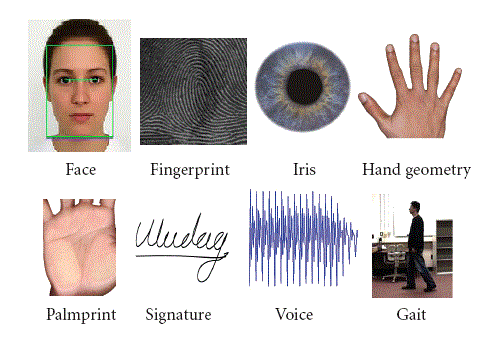
You probably know the things that prove identity. A biometric modality, including the liveness of that modality. A government-issued identity document that matches the biometric. A sensible location (was the test taker in Ontario, California as expected?).
Now perhaps this is overkill for authenticating a proposal writer, but it may not be if you need a certified plumber.
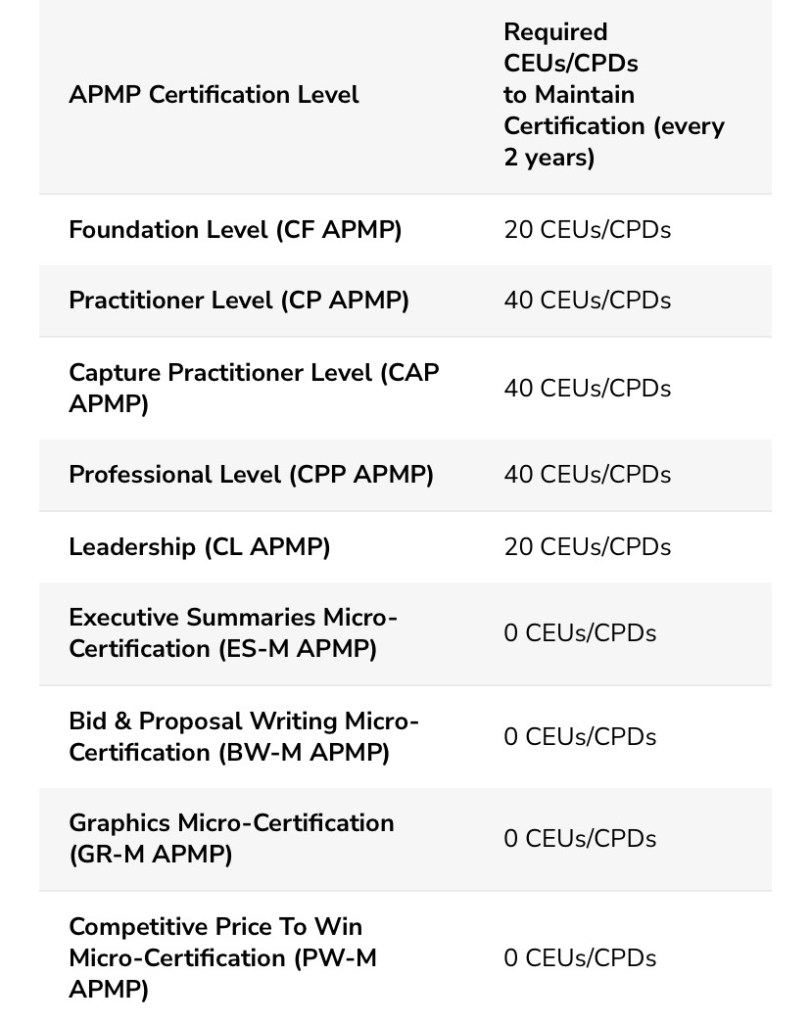
And because I truly am me, I know I didn’t meet the CEU/CPD requirement by September 2023. I don’t know how many I did achieve; the APMP was changing its CEU/CPD tracking system in early 2022, and then I joined Incode and theoretically wasn’t writing proposals any more. Theoretically.
So in truth, my shiny badge only represents a dated accomplishment. John E. Bredehoft can no longer use the CF APMP designation.
Unless I add “Emeritus” or something.
And as for those cases in which the certifications and identities truly matter…
Proposals are not the biggest part of my Bredemarket consulting work, but I still enjoy the satisfaction when my client submits a persuasive, compliant proposal. A day before the due date, even.
And yes, the Imagen 3 AI picture includes the number 96, in homage to Bredemarket’s very popular “96 Smiles” post about the Shipley Business Development Lifecycle.
But if you need proposal assistance, or content assistance, or analysis assistance, contact me.
Whether and how you delegate something depends upon its importance, especially if you recognize three levels of importance. Sometimes the very important and critically important items require a CPA, or Content-Proposal-Analysis marketing professional. (I know one.)
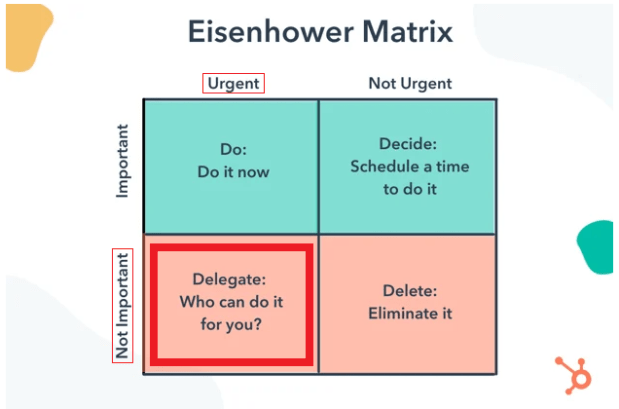
When you have a single level of importance, then decisions are pretty simple. For urgent things, do it yourself if it’s important, delegate it if it’s not.
When “importance” is more granular
But what if, instead of “Not Important” and “Important,” we had three levels of importance instead of just one? In other words, “Not Important,” “Important,” “Very Important,” and “Critically Important”?
A U.S. Navy plane flying over a Soviet ship in October 1962 is, um, classified as “Critically Important.” Oh, and it’s urgent. By USN – Dictionary of American Naval Aviation Squadrons Volume 2: The History of VP, VPB, VP(H) and VP(AM) Squadrons [4], Public Domain, https://commons.wikimedia.org/w/index.php?curid=7328539.
In that case, you not only consider whether to delegate something, but who should be delegated that thing. (Or, as you’ll see, WHAT should be delegated that thing.)
If the need is not important, delegate it, but it doesn’t really matter to whom or what you delegate it. ChatGPT or Bard is “good enough,” even if the result is awful.
If the need is important, delegate it to someone you trust to create very good content. Let them create the content, you approve it, and you’re done.
If the need is very important, then you may delegate some of the work, but you don’t want to delegate all of it. You need to be involved in the content creation process from the initial meeting, through the review of every draft, and of course for the final approval. The goal is stellar content.
If the need is critically important, then you probably don’t want to delegate the work and will want to do it yourself—unless you can find someone who is better than you in creating content.
As I noted in October, a more granular approach to importance increases the, um, importance of Bredemarket’s services.
In the simple Eisenhower Matrix model, Bredemarket handles the Not Important stuff while you handle the Important stuff.
In the “three levels of importance” model, Bredemarket handles the Very Important and Critically Important stuff. Because the merely Important stuff and the Not Important stuff doesn’t require my 30 years of technology, identity, and biometrics expertise.
Sometimes you need a CPA (but NOT a Certified Public Accountant)
But if your needs are critical, and you require the services of a CPA (Content-Proposal-Analysis marketing professional), then you need to learn what Bredemarket can do for you. Click on the image to learn more.
I should properly open this post by stating any necessary disclosures…but I don’t have any. I know NOTHING about the goings-on reported in this post other than what I read in the papers.
However, I do know the history of Thales and mobile driver’s licenses. Which makes the recent announcements from Florida and Thales even more surprising.
Gemalto’s pioneering mobile driver’s license pilots
Back when I worked for IDEMIA from 2017 to 2020, many states were performing some level of testing of mobile driver’s licenses. Rather than having to carry a physical driver’s license card, you would be able to carry a virtual one on your phone.
Some of these states were working with the company Gemalto to create pilots for mobile driver’s licenses. As early as 2016, Gemalto announced its participation in pilot mDL projects in Colorado, Idaho, Maryland, and Washington DC. As I recall, at the time Gemalto had more publicly-known pilots in process than any other vendor, and appeared to be leading the pack in the effort to transition driver’s licenses from the (physical) wallet to the smartphone.
Thales’ operational mobile driver’s license
By the time Gemalto was acquired by and absorbed into Thales, the company won the opportunity to provide an operational (as opposed to pilot) driver’s license. The Florida Smart ID app has been available to both iPhone and Android users since 2021.
One of the most important pieces of new information was a revised set of Frequently Asked Questions (or “Question,” or “Statement”) on the “Florida Smart ID” section of the Florida Highway Safety and Motor Vehicles website.
The Florida Smart ID applications will be updated and improved by a new vendor. At this time, the Florida Department of Highway Safety and Motor Vehicles is removing the current Florida Smart ID application from the app store. Please email FloridaSmartID@flhsmv.gov to receive notification of future availability.
Um…that was abrupt.
But a second piece of information, a Thales statement shared by PC Mag, explained the abruptness…in part.
In a statement provided to PCMag, a Thales spokesperson said the company’s contract with the FLHSMV expired on June 30, 2024.
“The project has now entered a new phase in which the FLHSMV requirements have evolved, necessitating a retender,” Thales says. “Thales chose not to compete in this tender. However, we are pleased to have been a part of this pioneering solution and wishes it continued success.”
The new vendor and/or the State of Florida chose not to begin providing services when the Thales contract expired on June 30.
Thales and/or the State of Florida chose not to temporarily renew the existing contract until the new vendor was providing services in 2025.
This third point is especially odd. I’ve known of situations where Company A lost a renewal bid to Company B, Company B was unable to deliver the new system on time, and Company A was all too happy to continue to provide service until Company B (or in some cases the government agency itself) got its act together.
Anyway, for whatever reason, those who had Florida mobile driver’s licenses have now lost them, and will presumably have to go through an entirely new process (with an as-yet unknown vendor) to get their mobile driver’s licenses again.
I’m not sure how much more we will learn publicly, and I don’t know how much is being whispered privately. Presumably the new vendor, whoever it is, has some insight, but they’re not talking.
I’m going to describe one example of how Bredemarket has helped its customers, based upon one of my client projects from several years ago.
Stupid Word Tricks. Tell your brother, your sister and your mama too. See below.
I’ve told this story before, but I wanted to take a fresh look at the problem the firm had, and the solution Bredemarket provided. I’m not identifying the firm, but perhaps YOUR firm has a similar problem that I can solve for you. And your firm is the one that matters.
The problem
This happened several years ago, but was one of Bredemarket’s first successes.
The firm that asked for my help is one that focuses on one particular biometric modality, and provides a high-end solution for biometric identification.
In addition, the firm’s solution has multiple applications, crime solving and disaster victim identification being two of them.
The firm needed a way to perform initial prospect outreach via budgetary quotations, targeted to the application that mattered to the prospect. A simple proposal problem to be solved…or so it seemed.
Why the obvious proposal solution didn’t work
I had encountered similar problems while employed at Printrak and MorphoTrak and while consulting here at Bredemarket, so the solution was painfully obvious.
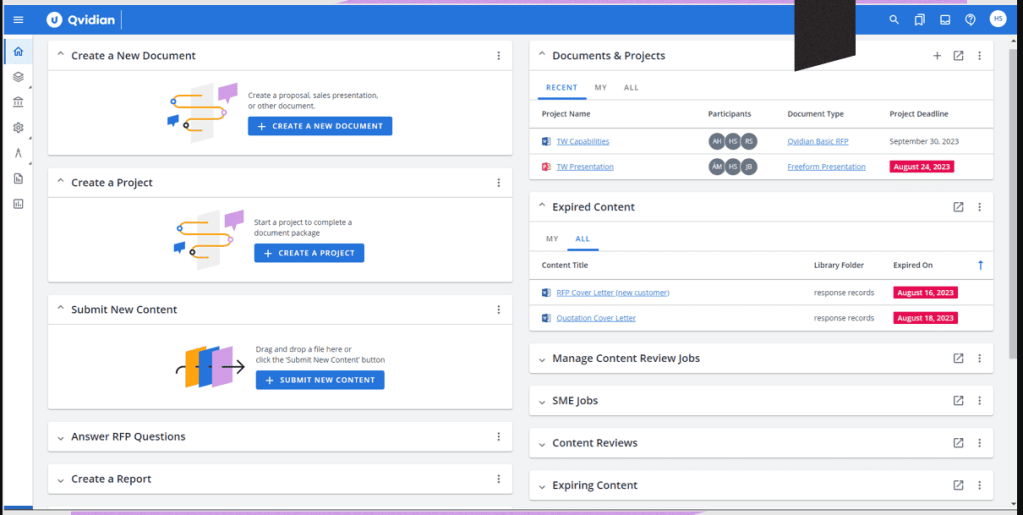
Qvidian, one proposal automation software package that I have used. But there are a LOT of proposal automation software packages out there, including some new ones that incorporate artificial intelligence. From https://uplandsoftware.com/qvidian/.
Have your proposal writers create relevant material in their proposal automation software that could target each of the audiences.
So when your salesperson wants to approach a medical examiner involved in disaster victim identification, the proposal writer could just run the proposal automation software, create the targeted budgetary quotation, populate it with the prospect’s contact information, and give the completed quotation to the salesperson.
Unfortuntely for the firm, the painfully obvious solution was truly painful, for two reasons:
This firm had no proposal automation software. Well, maybe some other division of the firm had such software, but this division didn’t have access to it. So the whole idea of adding proposal text to an existing software solution, and programming the solution to generate the appropriate budgetary quotation, wasn’t going to fly.
In addition, this firm had no proposal writers. The salespeople were doing this on their own. The only proposal writer they had was the contractor from Bredemarket. And they weren’t going to want to pay for me to generate every budgetary quotation they needed.
In this case, the firm needed a way for the salespeople to generate the necessary budgetary quotations as easily as possible, WITHOUT relying on proposal automation software or proposal writers.
Bredemarket’s solution
To solve the firm’s problem, I resorted to Stupid Word Tricks.
I created two similar budgetary quotation templates: one for crime solving, and one for disaster victim identification. (Actually I created more than two.) That way the salesperson could simply choose the budgetary quotation they wanted.
The letters were similar in format, but had little tweaks depending upon the audience.
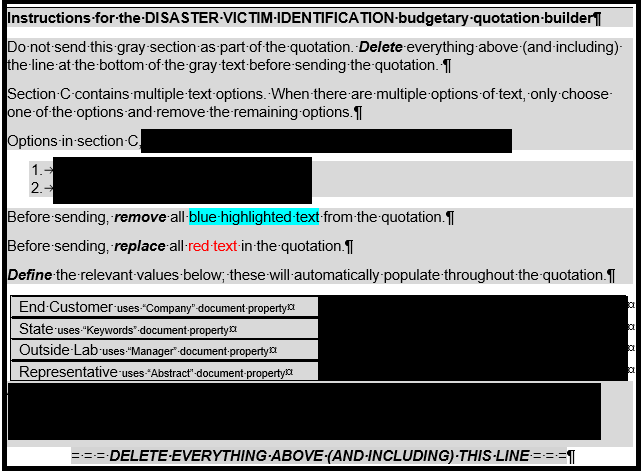
Using document properties to create easy-to-use budgetary quotations.
The Stupid Word Tricks came into play when I used Word document property features to allow the salesperson to enter the specific information for each prospect, which then rippled throughout the document, providing a customized budgetary quotation to the prospect.
The result
The firms’ salespeople used Bredemarket’s templates to generate initial outreach budgetary quotations to their clients.
And the salespeople were happy.
I’ve used this testimonial quote before, but it doesn’t hurt to use it again.
“I just wanted to truly say thank you for putting these templates together. I worked on this…last week and it was extremely simple to use and I thought really provided a professional advantage and tool to give the customer….TRULY THANK YOU!”
Comment from one of the client’s employees who used the standard proposal text
While I actively consulted for the firm I maintained the templates, updating as needed as the firm achieved additional certifications.
Why am I telling this story again?
I just want to remind people that Bredemarket doesn’t just write posts, articles, and other collateral. I can also create collateral such as these proposal templates that you can re-use.
If you’re familiar with Bredemarket’s “six questions your content creator should ask you”…I came up with a seventh question because I feared the six questions were not enough, and I wanted to provide you with better confidence that Bredemarket-authored content will achieve your goals.
To no one’s surprise, I’ll tell you WHY and HOW I added a seventh question.
If you want to skip to the meat, go to the WHAT section where you can download the new e-book.
Why?
Early Sunday morning I wrote something on LinkedIn and Facebook that dealt with three “e” words: entertainment, emotion, and engagement, and how the first and second words affect the third. The content was very long, and I don’t know if the content itself was engaging. But I figured that this wasn’t the end of the story:
I know THIS content won’t receive 250 engagements, and certainly won’t receive 25,000 impressions, but maybe I can repurpose the thoughts in some future content. (#Repurposing is good.)
Rather than delving into my content with over 25,000 impressions but less than 250 engagements, and rather than delving into the social media group I discussed, and rather than delving into the Four Tops and the Sons of the Pioneers (not as a single supergroup), I decided that I needed to delve into a single word: indifference, and how to prevent content indifference.
Because if your prospects are indifferent to your content, nothing else matters. And indifference saddens me.
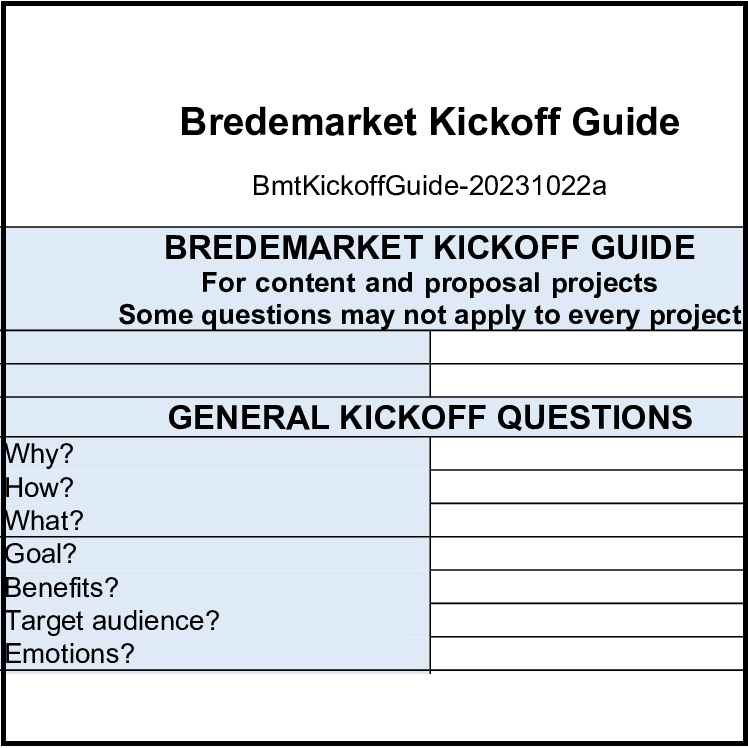
The first questions in the Bredemarket Kickoff Guide, BmtKickoffGuide-20231022a. No, you can’t have the guide; it’s proprietary.
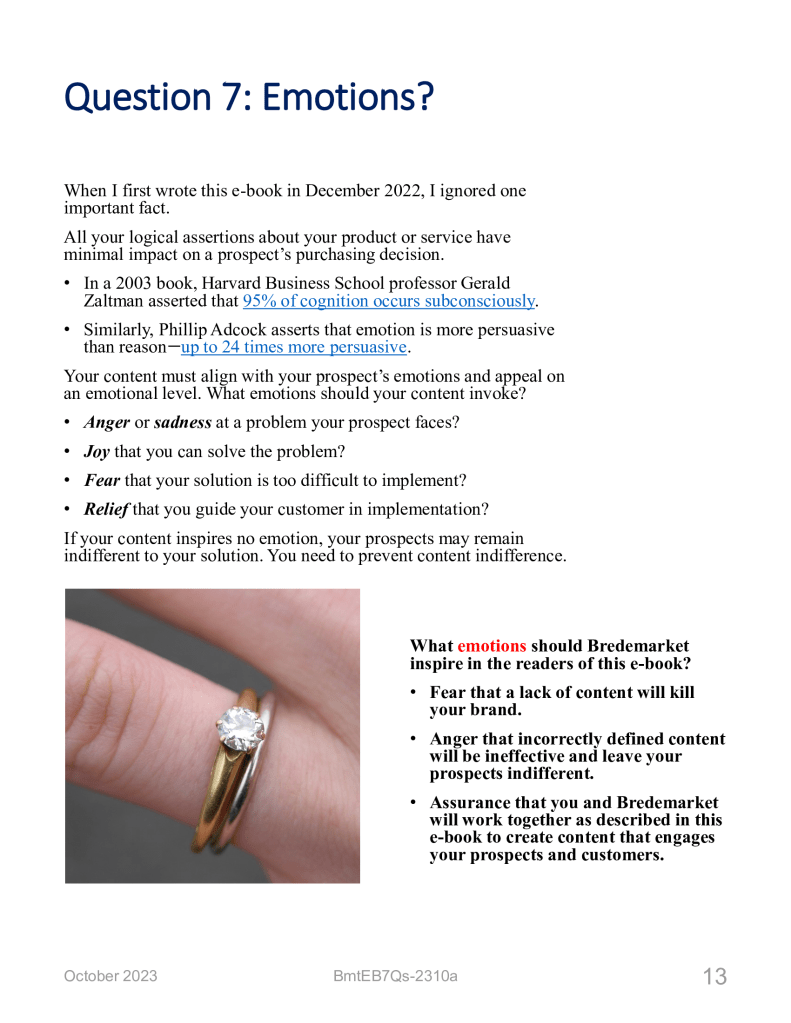
I decided that I needed to update my process, as well as that e-book, and add a seventh question, “Emotions?”
What?
For those who have raced ahead to this section, Bredemarket has a new downloadable e-book (revised from an earlier version) entitled “Seven Questions Your Content Creator Should Ask You.” It includes a new page, “Emotions,” as well as minor revisions to the other pages. You can download it below.
If you are reading this on your laptop (or your desktop), point your smartphone to the QR code on your laptop (or desktop) screen to read my first e-book, “Six Questions Your Content Creator Should Ask You.”
(UPDATE OCTOBER 22, 2023: “SIX QUESTIONS YOUR CONTENT CREATOR SHOULD ASK YOU IS SO 2022. DOWNLOAD THE NEWER “SEVEN QUESTIONS YOUR CONTENT CREATOR SHOULD ASK YOU” HERE.)
As I said before, QR codes are sometimes useful, and sometimes not.
If you want to know the “why” about the e-book-see what I did there?-visit my announcement of the e-book. You can view the e-book there also.
By the way, I just checked my WordPress stats. Since this e-book was published in December 2022, it’s been downloaded over 160 times. I hope it’s helping people.












 Bredemarket