On corporate identity (not personal identity)

I was checking on Bredemarket’s appearance in various searches (have I told you that I am a biometric proposal writing expert?), and I ran across something having to do with proposals and identity that was outside of my usual definition of “identity.”

This article talked about writing a proposal to help a company establish its corporate identity.

(Yes, I know a corporation is a person, but this is something different. I can’t capture IBM’s face, and Wendy’s face is not necessarily a unique biometric identifier.)

Establishing an outward-facing corporate identity

In the article, Ruben described how to help a company establish its corporate identity. After suggesting that you ensure that you understand the company, Ruben focused on the company’s needs.

Identify the Needs – having described the company, the next step is to explain why your idea for a logo or marketing campaign is suitable for their goals. There may be many “needs” you need to address. For example, it might be a good idea to describe why rebranding can make a company look more modern and approachable.

From there, you would naturally describe how you would meet the company’s needs, and why you are qualified to meet the company’s needs.

If all goes well, the company will contract with you, then you will come up with a plan to optimize the company’s corporate identity. The company will implement the plan, the company’s revenue will increase, and you will be a hero.

But corporate identity goes beyond the logo, the website, and the marketing materials.

Establishing a strategic corporate identity

There’s an important step that a company needs to take before making decisions on outward-facing marketing.

The company has to decide who it is.

There are a multitude of ways to do this, ranging from a detailed business plan to a brief mission statement or statement of purpose. Regardless of the avenue you take, you need to know what you want to do.

Take an example from the 1980s. Perhaps some of you may remember Mita, famous for the advertising slogan “all we make are great copiers.”

There was a reason that Mita used that slogan:

If you are sixth in unit sales in the office copier industry and you are one of the few manufacturers that does not have a diversified product line, then the thing to do in your advertising is disparage diversification.

From https://www.nytimes.com/1985/10/02/business/advertising-mita-copier-campaign-has-a-single-theme.html

In this case, the advertising slogan helped shape the entire strategy of the company, resulting in a corporate identity that was very successful.

From https://www.youtube.com/watch?v=RkNbEoFHCtc

Revising a strategic corporate identity

In fact, it was too successful. Because if you already make great copiers, what else do you need to do? Not much, I guess.

But early in the 1990s, it started making mistakes: relocating factories in expensive Hong Kong, letting management become bloated and backsliding on technology. At the same time, Fuji-Xerox, Ricoh and Konica stepped up their presence. Among other things, Mita failed to embrace digital technologies.

From https://www.latimes.com/archives/la-xpm-1998-aug-13-fi-12663-story.html

See Kodak.

Mita eventually went bankrupt and was acquired by Kyocera, who immediately decided to work on Mita’s corporate identity. The company was rebranded as Kyocera Mita Corporation in 2000, and was re-rebranded as Kyocera Document Solutions in 2012. Mita schmeeta.

In today’s business world, digitalization is proceeding at an unprecedented pace and the volume of documents is growing exponentially.
In this business environment, we believe that our mission is to support our customers to effectively manage their information, and turn that information into knowledge, in order to address their challenges with a sense of speed.

From https://www.kyoceradocumentsolutions.com/company/greeting.html

You can see how the corporate identity has evolved over the decades, and how a company that once concentrated on taking pieces of paper and making identical pieces of paper now aspires to transform document information into knowledge to address challenges.

What does this mean for your corporate identity?

As I’ve noted, establishment of a marketing corporate identity is only part of an overall strategic plan to guide the future direction of a company.

Taking Bredemarket as an example, the corporate identity established by my logo is only a part of the plan guiding Bredemarket.

Bredemarket logo

The pencil symbolizes writing, and long experience in writing, but it does not say WHAT Bredemarket writes. That has been established, revised, and expanded, partially through the annual goals that I set.

As long as I don’t blow it and get too restrictive (Bredemarket: all we write are fingerprint RFP responses), I should be fine.

The “market” is closed until Monday

The market is closed.

By FuriousGeorge1 from (optional) – Flickr, CC BY 2.0, https://commons.wikimedia.org/w/index.php?curid=2488362

Bredemarket just took care of some final items, and is now on vacation/holiday.

Well, until Monday. Proposal work is proposal work.

But until then, I hope those who celebrate Christmas have a happy one, and those who don’t have a happy weekend.

Louie, take a look at this! Free FTR FST Friday in Ontario

Another Friday, another all-day event.

FTR FST (“future fest”), sponsored by 4th Sector Innovations, SwoopIn, and several other organizations, will be held on Friday, November 12 in downtown Ontario, California. While I’m primarily going for the “professional development” part, FTR FST also features creative expression (including food trucks, which appropriately fall into the “creative expression” category), collaboration, and a tech showcase.

The professional development schedule includes the following sessions, among others:

  • A keynote presentation from Colin Mangham entitled “Days of Future Past.” According to FTR FST, the topic will be biomimicry.

Biomimicry is the practice of learning from and emulating life’s genius to create more efficient, elegant, and sustainable designs. It’s a problem-solving method, a sustainability ethos, an innovation approach, a change movement, and a new way of viewing and valuing nature. In practice it’s dedicated to reconnecting people with nature, and aligning human systems with biological systems.

As such, our aim is to connect a spectrum of innovation where human and biological system designs interact together seamlessly. Our team offers education and consulting to apply biological insights to systematic sustainability challenges. Our collaborative partnerships and services support interdisciplinary dialogue across industry sectors and regions, while reconnecting all of us to the local ecosystem that supports us.

OK, at this point some of you are saying to yourselves, “THAT kind of conference.”

By Maureen.gi at English Wikipedia, CC BY 3.0, https://commons.wikimedia.org/w/index.php?curid=32864557

But frankly, there’s just as much value in approaching problems from a futuristic sustainability view as there is in approaching problems from a more traditional program management process (or Shipley process, or whatever), or even from a more old school sustainability view as espoused by Broguiere’s and the late Huell Howser.

See, it all ties together. After all, the new school 4th Sector Innovations is less than a mile from the decidedly old school Graber Olive House (featured in one of Howser’s “Louie, take a look at this!” TV shows.)

I seem to have strayed from my original topic…

Anyway, let’s refocus and return to some of the other professional development sessions at this Friday’s FTR FST.

  • The workshop “Navigating Cashflow” by Gilbert Wenseslao, Chase Bank.
  • The workshop “Accessing Grants for Growth” by Pershetta SlackThe Funded Intensive. (NOW they hold this workshop. One of the previous presenters at the Ontario IDEA Exchange just finished submitting a grant application, and probably could have used this session.)
  • The workshop “Next Gen Cyber Security” by Erik Delgadillo, SecLex.
  • The workshop “The Evolution of Mobility” by Maritza Berger at Piaggio Fast Forward
  • A panel (participants unidentified) on equalizing opportunity.
  • Vendor spotlights.

After 3:00 pm, FTR FST transitions to less intensive sessions. Bring the kids! The complete schedule can be found here.

You can register for FTR FST here. Oh, and one new wrinkle: attendance at the professional development sessions is now FREE, thanks to the event sponsors.

FTR FST will be at 4th Sector Innovations, 404 N Euclid Avenue in Ontario.

From Mapquest. (Hey, why not?)

What’s in a rename? (Or, what is an oosto?)

The naming, or renaming, of a company is an important step in a company’s journey. While one should rightly concentrate on mission statements and processes and the like, the first impression many people will have of a company is its name.

So it’s important to get it right.

How my company was named

Sometimes the naming of a company is a relatively simple affair. For example, the company name “Bredemarket” is a combination of the beginning of my last name, Bredehoft, with the word market (derived from marketing).

Certainly the name is open to confusion (not that I was planning on doing business in East Sussex), but the name does communicate what the company is about.

I guess I could have called the company Bredewrite, but Bredemarket has grown on me.

Sometimes the naming of a company gets a little more involved.

How my former employer was renamed

When Oberthur was merged with the Morpho portion of Safran, the combined company needed a name (Oberthur was ruled out). So the company adopted the name “OT-Morpho,” indicating the heritage of the two parts of the company.

However, OT-Morpho was never intended to be the permanent name of the company. Everyone knew that the company would be renamed at some point in the future.

A few months later, as part of a razzle dazzle event, the new name of the company was revealed to an in-person audience in France and to people watching remotely all over the world (including myself).

If you don’t want to watch the entire video, the new name was…IDEMIA.

Some thought went into this name, as the accompanying press release noted.

In a world directly impacted by the exponential growth of connected objects, the increasing globalisation of exchanges, the digitalisation of the economy and the consumerisation of technology, IDEMIA stands as the new leader in trusted identities placing “Augmented Identity” at the heart of its actions. As an expression of this innovative strategy, the group has been renamed IDEMIA in reference to powerful terms: Identity, Idea and the Latin word idem, reflecting its mission to guarantee everyone a safer world thanks to its expertise in trusted identities.

However, some people didn’t like the new name at the time, and there was a big ruckus about how to pronounce the name. But at least some thought went into the name, and potential customers at least made the connection between IDEMIA and identity, if not to the other influences.

IDEM means – The same, me too. No, IDEMIA didn’t want to position itself as a “me too” company, but as a company that asserted the identity of an individual. From http://acronymsandslang.com/definition/7720102/IDEM-meaning.html.

Some of IDEMIA’s corporate predecessors also had some stories behind their names.

  • My former employer MorphoTrak was the result of a merger between Tacoma-based Sagem Morpho and the Anaheim-based Biometric Business Unit of Motorola that was previously known as Printrak. In the same way that OT-Morpho represented the union of Oberthur and Morpho, MorphoTrak represented the union of Sagem Morpho and Printrak.
  • The Morpho in Sagem Morpho was an element of the name of the original French company that was founded in the 1980s, Morpho Systèmes. I don’t know exactly why the company was named Morpho, but the term can mean form or structure, or it can refer to a particular group of butterflies with distinct wing patterns.
  • And Printrak, a product name before it was a company name, was derived from the word fingerprint. (And presumably from the system that tracked the fingerprints.)

So even if you don’t like these names, at least some thought went behind them.

And then there are other cases.

How another company was renamed

Anyvision was a company that had been around for a while, specializing in using artificial intelligence and vision to provide security solutions. But recently the company decided to expand its focus.

[T]he company’s evolution and vision for the future…is shaped, in part, by a new collaboration with Carnegie Mellon University’s (CMU) CyLab Biometric Research Center. The CMU partnership will focus on early-stage research in object, body, and behavior recognition….

“Historically, the company has focused on security-related use cases for our watchlist alerting and touchless access control solutions….[W]e’re looking beyond the lens of security to include ways our solutions can positively impact an organization’s safety, productivity and customer experience.”

So with this expanded focus, Anyvision decided that its corporate name was too limiting. So the company announced that is was renaming itself.

The new name is…Oosto.

Now some of you may have noticed that the name “Oosto” does not convey the idea of object, body, or behavior recognition in English, Latin, Hebrew (Anyvision started in Israel), or any other known language. As far as I know. (And yes, I saw what The Names Dictionary says.)

So why Oosto? According to Chris Burt at Biometric Update:

The new name was chosen because it is short, easy to pronounce, and free from pre-existing associations….

Well, at least you don’t have to worry about how to say Oosto, unlike Eye DEM ee uh or Eye DEEM e uh or Ih dem EE uh or whatever.

And it’s short.

And it’s obviously extremely free from pre-existing associations.

Which unfortunately means that people have no idea what an “oosto” is.

But it will probably grow on us over time, just as people now use the word “IDEMIA” without a second thought.

Hopefully there isn’t a market in East Sussex named Oosto.

What is a bridge?

A bridge helps you get from one place to another.

By Anneli Salo – Own work, CC BY-SA 3.0, https://commons.wikimedia.org/w/index.php?curid=15716878

Without a bridge, you’re stuck at one place and can’t get to the other place. Or you can try to get to the other place, but you may get very wet.

Businesses need bridges to connect with their customers. When the bridges are erected, the customers understand what the businesses can do for them. If the customers need those particular services, they can buy them.

In two hours, I plan to attend the Ontario (California, not Canada) IDEA Exchange at 4th Sector Innovations.

And if some of the attendees ask, I can explain how Bredemarket can be a bridge.

When Instagram’s interests are not your own

Now that I changed my mind and have augmented my personal Instagram account with a Bredemarket Instagram account, Instagram is sending Bredemarket helpful tips and messages. Here’s part of a message I recently received from Instagram.

Let EVERYONE know how to connect with you, including friends and family?

What’s wrong with letting EVERYONE know about your business social media account?

While there is some merit in Instagram’s advice, there’s one very important caveat if you are trying to build a business, rather than just trying to build follower count.

Only invite people to follow your business account who are genuinely interested in your business.

  • Obviously current customers are interested in your business, and inviting them to follow is a good idea.
  • The same goes for potential customers, a category that Instagram inadvertently left out of its pitch.
  • And some of your friends and family who are knowledgeable about the issues in your business may be good invitees, because even if they can’t provide business (and sometimes they can), they can serve as evangelists to others. Someone of my Facebook and LinkedIn friends have already helped me in this capacity.

But I haven’t gone out of my way to invite my friends who do not own or work for identity, biometrics, technology, or local (Inland Empire West) firms to follow the Bredemarket Instagram account. Why not? Because it provides no benefit to Bredemarket.

So why does Instagram want me to invite friends and family to follow the Bredemarket account? Because it does provide benefit to Instagram. The more people engaged on Instagram translates to more opportunities for Instagram to display ads, which benefits Instagram’s bottom line. But it won’t benefit your bottom line as a business.

So if my European daughters’ retired high school teacher is waiting for that Instagram invite from Bredemarket…keep waiting.

Shameless non-sponsored plug for Ray of Social

Incidentally, my thoughts on WHO to invite to follow your business social media accounts have been heavily influenced by Georgia of Ray of Social. Her Instagram account is here. Pay special attention to her “3 things that harm your growth,” especially thing 2 (although thing 1 and thing 3 are also important).

Shattering my assumptions by using LinkedIn for local marketing

At the same time that Bredemarket helps other firms to market themselves, Bredemarket has to market ITSELF, including social media marketing. And for the past year I’ve subscribed to the following formula:

  • Use LinkedIn for professional marketing to biometric/identity and technology clients.
  • Use Twitter as a supplement to this.
  • Use Facebook as a supplement to this, and also use Facebook as Bredemarket’s sole foray into “general business” marketing.

It sounded like a good formula at the time…but now I’m questioning the assumptions behind it. And I’m hoping that I can prove one of my assumptions wrong.

My initial assumptions about marketing to local businesses

As I write this, Bredemarket has no clients in my hometown of Ontario, California, or in any of the nearby cities. In fact, my closest clients are located in Orange County, where I worked for 25 years.

It’s no secret that I’ve been working to rectify that gap and drum up more local business.

So this was an opportune time for me to encounter Jay Clouse’s September 2021 New Client Challenge. (It’s similar to a challenge Clouse ran in August 2020. Repurposing is good.) Clouse’s first question to all participants asked which market we would be targeting, and in my case the local small business market seemed an obvious choice.

And this dialogue played in my mind…

So when I market to local businesses, I’ll want to do that via relevant Facebook Groups. Obviously I won’t market the local services via LinkedIn or Twitter, because those services are not tailored to local service marketing.

Questioning my assumptions

Then I realized that I was wrong, for two reasons.

  1. First, there are LinkedIn groups that concentrate on my local area, just as there are LinkedIn groups that concentrate on biometrics. I had already quit a number of the dormant Inland Empire LinkedIn groups, but I was still a member of two such groups and could (tastefully) market there.
  2. If LinkedIn doesn’t provide an opportunity for me to do something, why don’t I tailor my use of LinkedIn and provide myself the opportunity?

Specifically, some of you may recall that I only have two LinkedIn showcase pages, but I have three Facebook groups.

  • “Bredemarket Identity Firm Services” is present on both LinkedIn and Facebook.
  • “Bredemarket Technology Firm Services” is present on both LinkedIn and Facebook.
  • “Bredemarket General Business Services” is only present on Facebook.

I explained the rationale for the lack of a third LinkedIn showcase page in a nice neat summary:

Using myself as an example, I have segmented my customers into markets: the identity (biometrics / secure documents) specific market (my primary market), the general technology market, and the general business market. I don’t even target the general business market on LinkedIn (I do on Facebook), but I’ve created showcase pages for the other two.

If you consider that “local business services” is a subset of “general business services,” some of you can see where this is going.

Ch-ch-ch-ch-changes

But it took a while for the thought to pound its way into my brain:

Why DON’T you target the (local) general business market on LinkedIn?

I could just create a new showcase page, a process that would only take a few minutes. I wouldn’t even have to create any new artwork, since I could simply repurpose the Facebook general business artwork and use it for a LinkedIn local business showcase page. (Repurposing is good.)

(As an aside, my approach to artwork for Bredemarket’s marketing segments was dictated by LinkedIn Stories. Which is now disappearing. Oh well.)

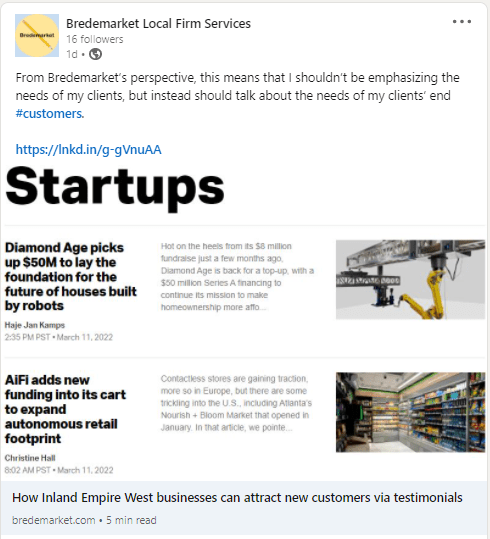
So anyway, LinkedIn is now the home of Bredemarket Local Firm Services.

Now I just have to populate the showcase page with content (and continue to do so), invite people to follow the new showcase page, and proceed on my plan for world domination, one loft at a time.

Call to action time

And if you’re a small business in the Ontario, California area, here’s some information on the services I can provide to you.

And if you want more detailed information, please visit https://bredemarket.com/local/. (Read to the end.)

And if you want even more detailed information, contact me.

So which assumption will I shatter next?

I’d like to prove THIS assumption wrong:

(Still waiting for that $10,000 per hour client.)

And now I’m unboxing tangible collateral

Yes, this is post five in a series.

We”ll start with the end result, and then detail how it got here.

(Yes, I know an unboxing post is supposed to save the final result of the unboxing until the end, but I got excited. I’ll repeat this picture at the end to keep the story straight.)

I created tangible collateral

As I detailed in the third post in the series, back on August 9 I was preparing to attend my first in-person event in a long time.

I’m going to an in-person event next week. For my younger readers (i.e. those who developed awareness after 2019), an “in-person event” is something where you are actually in the same room as the people that you are meeting, rather than looking at them in boxes on your computer screen

Who knew that this was the future of communication? By screenshot, Fair use, https://en.wikipedia.org/w/index.php?curid=34177604

After registering for the event, I realized that I had never printed business cards for Bredemarket. So I designed one on Canva and ordered it that same day, August 9.

I waited for tangible collateral

Canva filled the order and turned it over to a delivery service on August 10. I won’t name the delivery service, but it does business with the federal government and has an express business in addition to its ground business.

And the delivery service provides some good tracking of all the packages that it handles. I’d simply reproduce the tracking entries, but the most recent stops are first, which doesn’t lend itself to storytelling. So I’ll just reproduce selected stops on the way.

Tuesday, August 10, 2021
8:30 PMHENDERSON, NVLeft FedEx origin facility
6:32 PMHENDERSON, NVShipment exceptionBarcode label unreadable and replaced
6:05 PMHENDERSON, NVArrived at FedEx location
3:06 PMHENDERSON, NVPicked up
8:05 AMShipment information sent to FedEx

That’s actually pretty nice, I thought at the time. The order was fulfilled within a few hundred miles of Bredemarket’s world headquarters in Ontario, California, and would certainly arrive in time for my in-person meeting.

Wednesday, August 11, 2021
1:05 AMBLOOMINGTON, CAArrived at FedEx location

Very nice. Bloomington is within 20 miles of Ontario, so obviously I should expect my business cards to be delivered by the end of the week.

Friday, August 13, 2021
11:55 PMDEMING, NMIn transit
10:52 AMBLOOMINGTON, CADeparted FedEx location

Um, wait a minute. (Only now did I realize that this transit happened on Friday the 13th. Figures.)

I won’t reproduce the next few entries, but suffice it to say that as of 3:12 pm Central Time on Saturday, August 14, the package arrived at a location in Fort Worth, Texas.

By Tuesday, August 17, my package was still in Texas, and obviously wasn’t going to make it in time for my Wednesday night meeting. As I noted in the fourth post in the series, however, I had a workaround.

So that’s what I handed out on Wednesday, August 18. (Well, the first person only took a picture of the handout rather than taking the handout himself, because he prefers intangible things.)

At one point my expected delivery date was Thursday, August 19. That date came and went without business cards, but at least I got a podcast episode out of it.

Late that night, with my package still in Texas and no updated arrival date, I contacted Canva (even though it wasn’t Canva’s fault) because there wasn’t an efficient way to contact the delivery service. At the time I wondered if the package were truly lost and if I’d need Canva to replace it. I received an email from Canva that pretty much said to wait and see what happened.

Our records show that your print order…is currently in transit to your shipping address….

For a more detailed information about the delivery status, we highly suggest reaching out to the carrier since the order was already dispatched.

However, at the same time that I was filing things with Canva, I was also tweeting about it. And for those who don’t realize this, the social media people for many companies are proactive and really want to help.

Here to sort this out for you, John! Could you DM us your ticket ID (JTP-###…)? We’ll take a look! ^cv

The tweet actually contradicted the email (which said to contact the delivery service). But by the time Canva tweeted the request for my ticket ID, the delivery service had updated my status.

(And yes, I was checking Twitter before 5:00 am. Normally I don’t, but by this time I was really getting bugged about my wandering business cards.)

Later that day, my package finally left its Texas location. I had a momentary fear when it departed…a fear that people who live in Ontario, California will easily understand. Was my package headed back toward Ontario, California…or on its way to Ontario, Canada?

Thankfully, my package was in Deming, New Mexico on Friday evening, so at least it was headed in the right direction.

By Saturday, August 21, the package was back in Bloomington, California. But where would it go next?

Oh, and to top things off, in the middle of this I received a phishing attempt at one of my non-Bredemarket email addresses. Obviously this had nothing to do with my REAL shipment, but I still found it pretty funny.

Just in case anyone is unclear about this, the email DIDN’T really come from DHL. And if DHL were to ask US customers to pay a fee over the Internet, that fee wouldn’t be charged in Australian dollars.

Back to the question of where my package would go when it left Bloomington. Did my package have a lover in Deming, New Mexico that it wanted to visit for a third time?

Sunday, August 22, 2021
8:51 AMCHINO, CADelivery exceptionFuture delivery requested
7:46 AMCHINO, CAAt local FedEx facility
5:35 AMBLOOMINGTON, CADeparted FedEx location

Chino is even closer to Ontario than Bloomington. This was a positive move.

Let me explain the “future delivery requested” part. I was promised at one point that the package would be delivered on Sunday, August 22. Unfortunately, my business address (a UPS Store, competitor to the delivery service) is closed on Sunday.

Apparently the delivery service realized this too late, and told me that the package would be delivered Tuesday.

Then I was told that the package would be delivered Monday.

Monday, August 23, 2021
1:24 PMOntario, CADeliveredSignature on file
5:41 AMCHINO, CAOn FedEx vehicle for delivery
4:20 AMCHINO, CAAt local FedEx facility

I drove to my business address and proceeded with the unboxing.

Remember the August 10 entry that mentioned the replacement of the unreadable barcode label.
As is usual for shipments, the actual shipment box was placed in a larger box. This time I was thankful for this.
Completing the story, here’s the business card again.

So that’s done. And since I’ve never really used business cards all that frequently, this order should last me a while.

When is my next in-person event?

(Bredemarket Premium) Bredemarket tips for aspiring biometric freelancers (the 8/23/2021 11:45am edition)

So I just wrote a post that contained general tips for freelancers. But before launching into the meat of the post, I said the following:

I almost considered putting the Bredemarket Premium tag on this and making you pay to read it, but I’m not THAT much of a freelancing expert. (Yet.)

After I completed that post and shared it on Twitter, LinkedIn, and Facebook, I returned to my Bredemarket Premium idea. While my tips in the other post can help general freelancers, there are some things that I can share that are specific to BIOMETRIC freelancers.

This is NOT an example of biometric enrollment, but the entry device is secure from network attacks. By Rita Banerji – flickr, CC BY 2.0, https://commons.wikimedia.org/w/index.php?curid=18222218

So, here goes.

Subscribe to get access

Subscribe to Bredemarket Premium to access this premium content.

  • Subscriptions just $5 per month.
  • Access Bredemarket’s expertise without spending hundreds or thousands of dollars.

Bredemarket tips for aspiring freelancers (the 8/23/2021 10:15am edition)

I have marketed myself as the biometric content marketing expert and the biometric proposal writing expert.

Now I’m marketing myself as the freelancing expert.

“But John,” you may ask, “how can you do this? Yes, you are making money freelancing, but there are freelancers who are making a LOT more money than you are, who are working from exotic locales and are well known.”

Well, at least the locale is exotic, even if the hardware is very 20th century and the scribe only has anonymous Wikipedia/Flickr fame. By Rita Banerji – flickr, CC BY 2.0, https://commons.wikimedia.org/w/index.php?curid=18222218

Before I succumb to imposter syndrome, let me assert that I DO have some tips to offer based on my experience. Frankly, all of us do. Even if you’ve only been freelancing for a week, you’ve probably learned something that someone who has never freelanced would NOT know. So share it.

Before you read my tips, note an important point. I’ll caveat my tips by stating that MY experience may not necessarily apply to YOUR experience, and that sometimes it’s good to ignore the experts (or so-called experts). You need to do what is best for you.

How do I know that I have tips to offer?

Because someone whom I met via the Freelancers Union (see the link on the word “ignore” above) just asked me for advice, and by the time I was done answering her questions, I had written a LONG email.

So I figured that I’d share parts of the email (the portions that were NOT specific to her) with you.

I almost considered putting the Bredemarket Premium tag on this and making you pay to read it, but I’m not THAT much of a freelancing expert. (Yet.)

We’ll get to the whole topic of personal pictures later. This picture was taken in 1980 or 1981, but doesn’t necessarily reflect my business or show my expertise. (And yes, I’m terrible at darts.)

As I said, these are edited versions of my responses to the Freelancers Union contact, with some additions as I thought of other things. (I forgot to mention to my Freelancers Union contact that repurposing is important, and iteration is important.)

So, here goes.

If I offer multiple, potentially very different services, is it too overwhelming to list all of my services on a single page?

For purposes of this discussion, I’m going to assume that the “single page” is a LinkedIn company page or a Facebook business page. (In many cases, it’s best to separate your freelancing page from your personal page. Again, some disagree with me.)

If you think that all of your multi-services are too much to list on one page, then you have the option of creating “showcase” pages to highlight specific aspects of what you do. For example, if you wanted to differentiate two different sets of services, you could create two separate showcase pages.

Using myself as an example, I have segmented my customers into markets: the identity (biometrics / secure documents) specific market (my primary market), the general technology market, and the general business market. I don’t even target the general business market on LinkedIn (I do on Facebook), but I’ve created showcase pages for the other two.

The Bredemarket Identity Firm Services page on LinkedIn. Of course, your view of this page will vary; I doubt that 116 of the showcase page’s followers are in YOUR network.

I have a similar structure on Facebook.

In addition, my website also has targeted pages. I won’t show examples here (EDIT: I didn’t share links in my original email to the contact, but I did share links in this new post), but I have a page that’s just targeted for general identity, multiple pages targeted for the biometric aspect of identity, one targeted for the content marketing aspect of biometrics, one for the proposal writing aspect of biometrics, etc. Therefore, if I’m talking to someone about biometric proposals, I can just send the link to the biometric proposal writing expert page.

I actually market on Twitter (@jebredcal), but I don’t go into that level of segmentation there. In fact, my Twitter account isn’t even solely devoted to my consulting. In that case, I don’t feel it worthwhile to create segmented Twitter accounts for my various submarkets, but it may be different for others. 

However you slice and dice your market, dedicated pages for specific market segments allow for a more targeted experience. And the good thing is that it’s all free. (I actually pay for my website, but it could be free if I were fine with a mycompany.wordpress.com URL.)

How do I compensate for my liabilities?

TL;DR talk about your strengths.

In my case, I compensate for what I don’t do by emphasizing what I do.

I did not draw this myself. Originally created by Jleedev using Inkscape and GIMP. Redrawn as SVG by Ben Liblit using Inkscape. – Own work, Public Domain, https://commons.wikimedia.org/w/index.php?curid=1692938

For example, I do NOT create graphics (stick figures exhaust my capabilities), so my marketing materials emphasize my creation of text.

In addition, as I stated earlier, I emphasize the markets that I DO address – I talk a lot about biometrics/secure documents/identity, some about technology, and a little bit about general business.

And I don’t talk about graphics at all. (Whoops, I guess I just did.)

I’d like to use a photo of myself to personalize my service. What photo should I use?

If I were you, I’d take a minute to think about the picture you want to use. How will this picture show that you are the best provider for your specific service in the entire universe? What should be in the background?

  • For example, if you’re a master coder, should you have a computer screen behind you with something specific on the screen?
  • If you’re a writer, should you have a bookcase or perhaps an entire library behind you?
  • If you’re a certified forensic expert, should you show a murder scene behind you? (Maybe not.)

Look at it from the point of view of a potential customer – would I want to do business with this person? 

Of course, different marketing efforts call for different pictures. I actually had a reason to use the 1980-1981 t-shirt picture that I posted toward the beginning of this post: I was talking about the fact that I have been writing since my college days. And at other times, I use a Users Conference picture in which I am talking about a smartphone app that I populated. It just depends on the context.

What question from the Freelancers Union contact received a response that I am not posting here?

She asked one additional question about other reasonable ways to get her service out there. With one exception, I chose not to post my full response to that question here for two reasons:

  • First, my response contained some very specific details about the nature of my business that I have chosen not to share with the general public. If you really want to hear that part of the discussion, I’ll create a Bredemarket Premium post and make you pay to read the response.
  • Second, my response was a very good example of “your mileage may vary.” For example, I noted that I have not had success with a particular freelancing service, but noted that many other people HAVE had success with that same service.

So what’s the exception? In response to a specific comment that my contact made, I offered this response:

You never know when your existing network will yield opportunities.

I’m not going to print the rest of the paragraph from my email to my contact, but suffice it to say that the majority of Bredemarket’s business has been won as a result of people who knew me at IDEMIA, MorphoTrak, Motorola, or even Printrak.

  • Some worked with me and became “free agents” at the same time that I did.
  • Some worked with me but left long before I did.
  • Some used to work for competitors.
  • Some are now working for large companies, others small companies, and others are sole proprietors.
  • In some cases my contact directly asked me to consult, while in other cases the my contact talked to other people (sometimes in other companies) who asked me to consult.

In the end, you never know when those contacts you made months or years or decades ago may result in something new…not just in business, but in life.

P.S. One more thing: content calendars.