I couldn’t confirm the common ownership myself, so I’ll take Fielding Buck’s word for it. After all, he’s a professional with a quarter century of journalism experience (check his biography, which lists his 1995 award from his time at the Desert Sun), so I’m sure he got his facts straight. And you know that I like people with a quarter century of experience.
As Buck noted, the other two “Shack” restaurants are also in Redlands.
Breakfast Shack (couldn’t find a website, but I found an Instagram page) is at 615 West State Street.
The three “shacks” are all within three miles of each other, which means that you could start the day at Breakfast Shack, go to Taco Shack for lunch, and then walk the breakfast and tacos off before enjoying a Pizza Shack dinner.
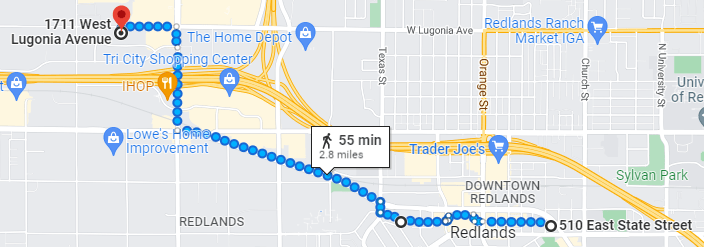
From west to east: Pizza Shack, Breakfast Shack, and Taco Shack. Via Google Maps.
I had nothing to do with Fielding Buck’s story, or with the three “shacks” in Redlands, but this story caught my eye.
Does your Inland Empire business have a story to tell?
Perhaps you don’t own a restaurant, but you may be in another type of business that has a story that you want to share.
Perhaps it’s a shorter story of around 400 to 600 words.
Something that you could share in a blog post, a social media Facebook or LinkedIn post, or in a downloadable form on your website.
Something that speaks to your potential customers’ needs, and clearly communicates the benefits that your business’ product or service provides to your potential customers.
Bredemarket’s content creation process ensures that the final written content (a) advances your GOAL, (b) communicates your BENEFITS, and (c) speaks to your TARGET AUDIENCE. It is both iterative and collaborative. For the full process, read this.
Bredemarket can help your Inland Empire business tell that story. Even if you’re west of Redlands and don’t serve food.
(Psst: local readers should scroll to the end of this page for a special “locals only” discount.)
If you would like Bredemarket to help your business tell your story…
Inland Empire West businesses (businesses in the Ontario, California area) have a need for business news. There are a variety of services that provide this news, but I wanted to let you know about MY service.
In September 2021, I started a page on LinkedIn called “Bredemarket Local Firm Services.” While the primary purpose is (admittedly) to promote the marketing and writing services that my company Bredemarket can provide to local businesses, the company page also provides information from others that may be of interest to you.
Recent posts to the Bredemarket Local Firm Services LinkedIn page.
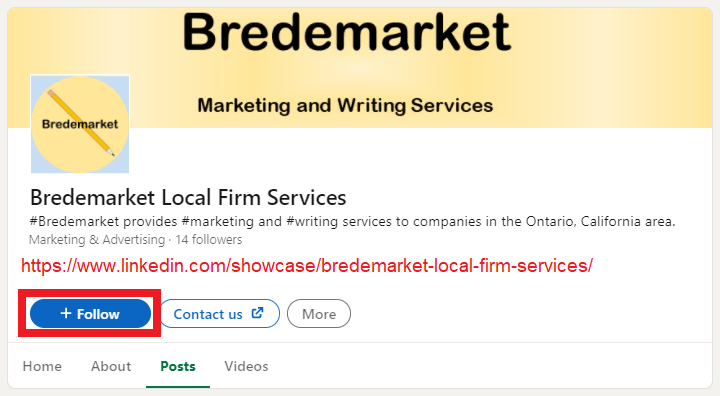
So, how do you follow the Bredemarket Local Firm Services page?
(Updated 4/18/2022 with additional customer focus information.)
I recently had the occasion to observe the digital marketing of a particular company, which I will refer to as “WidgetCo” in this post. (WidgetCo is NOT a current Bredemarket customer, and for various reasons will probably not become a future Bredemarket customer.)
Without going into detail, most of WidgetCo’s digital marketing (online information about the company on its website and its social media channels) emphasized its financial achievements, all related to startup funding.
If you’ve been around me for any length of time, you know how I reacted.
So what?
Let me give you an example of why bragging about your Series X funding is meaningless to your potential customers.
When you go to Amazon, Best Buy, or a similar online product-buying service, you can search for products based on various criteria.
For example, you can search for TVs based on screen size, or can search for computers based on the available storage, or search for CDs based on the artist.
Have you ever seen an online marketplace that lets you search for a product based upon the company’s Series C funding amount?
The reason that you can’t search for a product based upon its company’s Series C funding is because the customer doesn’t give a, um, hoot about the company’s Series C funding. You never hear a customer say, “You know, this product is good, but this other product comes from a company that just completed a $25 million Series C funding round. I’ll buy the other one instead.”
So why do people talk about this so much?
Customer-centric marketing
Marketing efforts need to begin with the customer, what the customer needs, and how you can fulfill the customer’s needs.
From Bredemarket’s perspective, this means that I shouldn’t be emphasizing the needs of my clients, but instead should talk about the needs of my clients’ end customers.
So, for example, my company Bredemarket shouldn’t EMPHASIZE my nearly 40 years in the Inland Empire West. It’s fine to mention it in passing, but that shouldn’t be the most important reason why you should use my marketing and writing services.
Instead, I SHOULD be emphasizing that you should use Bredemarket’s marketing and writing services because I can help you tell the stories that you need to tell to attract customers to your product or service.
There are various ways to tell these stories. Today I just want to talk about one of them.
Testimonials
You can say that your company provides an excellent product or service.
But it’s more important when one of your customers says that your company provides an excellent product or service. Outside praise is more important than self-praise (something I realized myself when I set Bredemarket’s second goal for 2022), and a testimonial that quotes one of your customers speaks the same language as your other customers.
As of February 16, 2022, I have created fourteen (14) case studies for clients. (“Case study” can be considered a fancy word for “testimonial”; both have the same goal.) For example, one of the case studies featured a law enforcement agency that used a product from a particular biometric firm. The law enforcement agency faced a particular need, the biometric firm provided a product that met this need, and the law enforcement agency apprehended a criminal with the product much more quickly than it could have without the product. (In fact, it’s possible that without the biometric firm’s product, the criminal may NEVER have been apprehended.)
So how does the biometric firm use this case study? It goes to OTHER law enforcement agencies and says, “Hey, YOU have this problem. Look at how another law enforcement agency solved this problem.” Because the case study was written from the perspective of a law enforcement agency, the message resonantes with other law enforcement agencies.
To be fair, the Inland Empire West businesspeople who are reading this are saying, “I don’t work with law enforcement agencies. How can your testimonial services help ME?”
I have not only worked with companies that sell to law enforcement agencies, but with other types of firms, ranging from sole proprietors to huge multinationals, that need to communicate with their end users.
In addition, YOU remain an essential part of the testimonial creation process. (Along with the customer that we will feature in the testimonial, of course.) When you engage with Bredemarket, we start by agreeing on the goal of the content, the benefits to communicate, and the target audience.
Bredemarket’s content creation process ensures that the final written content (a) advances your GOAL, (b) communicates your BENEFITS, and (c) speaks to your TARGET AUDIENCE. It is both iterative and collaborative….
(At the beginning) You and Bredemarket agree upon the topic, goal, benefits, and target audience (and, if necessary, outline, section sub-goals, relevant examples, and relevant key words/hashtags, and interim and final due dates).
You can read about how we will work together here, in my description of the Bredemarket 400 Short Writing Service. (If you want me to prepare a really LONG testimonial or case study, I can do that also.)
But will you enjoy the final product? I just happen to have a testimonial…
“I just wanted to truly say thank you for putting these templates together. I worked on this…last week and it was extremely simple to use and I thought really provided a professional advantage and tool to give the customer….TRULY THANK YOU!”
Comment from one of the client’s employees who used the standard proposal text
Oh, and one more thing. If you’re an Inland Empire West business, be sure to read this page and find the discount code at the bottom of the page.
Perhaps you recently read a Bredemarket blog post that included many of the same words that you saw in this post, and you’re now wondering if you’re going through deja vu all over again.
Yes, I wrote two similar (but not identical) posts.
This post is targeted to Inland Empire West companies who need Bredemarket services for testimonials (or case studies).
One post is targeted to biometric/identity customers who need Bredemarket services for case studies (or testimonials).
Why TWO posts, each of which is targeted to SEPARATE Bredemarket social media channels?
Because I need to address the needs of DIFFERENT types of customers, by using my skill set as applicable.
(4/18/2022: For additional information on customer focus, click here.)
And if I grow both sectors of my business, my Series B funding round will be HUGE.
Here’s the second of two videos that I filmed at the grand reopening of the Anthony Muñoz Community Center in Ontario, California. If you don’t like politician speeches, skip the first 15 minutes and go right to the facility tour.
FTR FST (“future fest”), sponsored by 4th Sector Innovations, SwoopIn, and several other organizations, will be held on Friday, November 12 in downtown Ontario, California. While I’m primarily going for the “professional development” part, FTR FST also features creative expression (including food trucks, which appropriately fall into the “creative expression” category), collaboration, and a tech showcase.
The professional development schedule includes the following sessions, among others:
A keynote presentation from Colin Mangham entitled “Days of Future Past.” According to FTR FST, the topic will be biomimicry.
Biomimicry is the practice of learning from and emulating life’s genius to create more efficient, elegant, and sustainable designs. It’s a problem-solving method, a sustainability ethos, an innovation approach, a change movement, and a new way of viewing and valuing nature. In practice it’s dedicated to reconnecting people with nature, and aligning human systems with biological systems.
As such, our aim is to connect a spectrum of innovation where human and biological system designs interact together seamlessly. Our team offers education and consulting to apply biological insights to systematic sustainability challenges. Our collaborative partnerships and services support interdisciplinary dialogue across industry sectors and regions, while reconnecting all of us to the local ecosystem that supports us.
OK, at this point some of you are saying to yourselves, “THAT kind of conference.”
But frankly, there’s just as much value in approaching problems from a futuristic sustainability view as there is in approaching problems from a more traditional program management process (or Shipley process, or whatever), or even from a more old school sustainability view as espoused by Broguiere’s and the late Huell Howser.
See, it all ties together. After all, the new school 4th Sector Innovations is less than a mile from the decidedly old school Graber Olive House (featured in one of Howser’s “Louie, take a look at this!” TV shows.)
The workshop “Next Gen Cyber Security” by Erik Delgadillo, SecLex.
The workshop “The Evolution of Mobility” by Maritza Berger at Piaggio Fast Forward.
A panel (participants unidentified) on equalizing opportunity.
Vendor spotlights.
After 3:00 pm, FTR FST transitions to less intensive sessions. Bring the kids! The complete schedule can be found here.
You can register for FTR FST here. Oh, and one new wrinkle: attendance at the professional development sessions is now FREE, thanks to the event sponsors.
FTR FST will be at 4th Sector Innovations, 404 N Euclid Avenue in Ontario.
My local area is undergoing a transformation, with a number of new businesses appearing in the area. Oddly enough, I keep on seeing two distinctly different types of businesses appearing here.
Over the last couple of years, a number of coffee shops have opened in downtown Ontario (California, not Canada). I’m unintentionally going to leave many of them off this list, but a few of the new coffee shops include Mestiza Cakehouse and Cafe, Special Needz Coffee (with a second location inside 4th Sector Innovations), and Starbucks.
At the same time, a number of new hair stylists and barber shops have opened in downtown Ontario. Trust me, there’s a bunch of them.
I don’t know if this is public knowledge (it’s been discussed at the Ontario IDEA Exchange and other B2B forums), but downtown Ontario is even on track to have an establishment that combines the two business types. (Of course, a few of you have already figured out who I’m talking about.)
I learned some fun facts during Eren Cello’s presentation to the Greater Ontario Business Council this morning, and filed those in my brain along with some other facts that I have collected over the years.
Cello is the Director of Marketing and Communications for Ontario International Airport in Ontario, California. Which, incidentally, is not in Canada.
Ontario International Airport in the 1980s and 1990s
I first became aware of Ontario International Airport in October 1983, when I flew in from Portland, Oregon for a job interview. Back in those days, you didn’t walk from the airplane straight into the terminal. Instead, you walked to a flight of stairs, went down the stairs, then walked across the runway to enter the terminal.
As Ontario and the surrounding area grew over the years, the then-owner of Ontario International Airport (Los Angeles World Airports) decided that an ambitious expansion of the airport was in order, including modern, multi-level terminals with check-in and baggage claim on the first floor, and the gates and shops on the second floor. Instead of renovating the existing terminal, LAWA decided to build two brand new terminals. These terminals were opened in 1998 and were designated “Terminal 2” and “Terminal 4.” As soon as traffic increased to the required level, LAWA would go ahead and build Terminal 3 between the two terminals.
And the old terminal, now “Terminal 1,” was closed.
Ontario International Airport Terminal 1 as of September 2021, 20 years after airport traffic changed forever.
It sounded like a sensible design and a sensible plan. What could go wrong?
Ontario International Airport in the 2000s and 2010s
Well, three years after Terminals 2 and 4 opened, 9/11 happened. This had two immediate effects.
First, the anticipated increase in passenger traffic needed to open Terminal 3 didn’t happen.
There were other alleged reasons for this which eventually led to the separation of Ontario International Airport from LAWA, but those are beyond the scope of this post. I wrote about them in a personal blog at the time; here’s an example.
Second, increased security meant that the second floors of Terminals 2 and 4 were accessible to passengers only.
The days of walking to the gate to send off departing passengers and greet arriving ones were gone forever.
And for all of those businesses that were located on the second floors of the two terminals, their customer base was cut dramatically, since non-ticketed individuals were confined to the first floors of the terminals. Until recently, those first floors only included the random vending machine to serve visitors. Only now is the situation starting to improve.
According to Cello, Ontario International Airport now serves 11 passenger airlines with nonstop flights to destinations in the United States, Mexico, Central America, and Asia.
The second most fascinating fun fact
But of all the fun facts I learned today, the second most fascinating fun fact was the reason why the international airlines are based in Terminal 2 rather than Terminal 4. No, it’s not because Southwest has so many flights in Terminal 4 that there is no room for anyone else. Actually, parts of Terminal 4 are closed; if you see a film with someone at Gate 412, you know the film is staged. See 15:08 of this video.
The reason why the international airlines are based in Terminal 2 is because that terminal is the only one designed for the large wide-body jets that go to international destinations.
Southwest Airlines, of course, has a different operating model that doesn’t need a lot of wide-body jets.
International services in the future and in the past
Incidentally, there are both short-term and long-term plans to improve the facilities for international passengers, who currently can depart from Terminal 2 but have to arrive at a completely separate “international arrivals terminal” (reviews) and go through security there.
And if you’re wondering why Ontario International Airport doesn’t have optimum service for international passengers, the “international” in the airport’s designation merely means that there is at least one existing flight to an international destination. For Ontario, trans-Pacific cargo flights existed back in the 1940s, and the first passenger flight from an international destination occurred (according to Wikipedia) on May 18, 1946, when a Pacific Overseas Airlines flight arrived from Shanghai. (This was the Pacific Overseas Airlines based in Ontario, California, not the Pacific Overseas Airlines in Siam. The Ontario company appears to have only been in existence for a year or so.)
Of course, back in 1946, international passengers didn’t have great expectations. Leaving the plane by going down a flight of stairs was the normal mode of operations; none of this walking from the airplane straight into the airport building.
The Beatles arrive at the former Idlewild Airport on February 7, 1964. Note the stairway in the background. By United Press International, photographer unknown – This image is available from the United States Library of Congress’s Prints and Photographs division under the digital ID cph.3c11094.This tag does not indicate the copyright status of the attached work. A normal copyright tag is still required. See Commons: Licensing for more information., Public Domain, https://commons.wikimedia.org/w/index.php?curid=4532407
The MOST fascinating fun fact
Oh, and in case you’re wondering why the wide-body jet service is only the second most fascinating fun fact, I learned something else today.
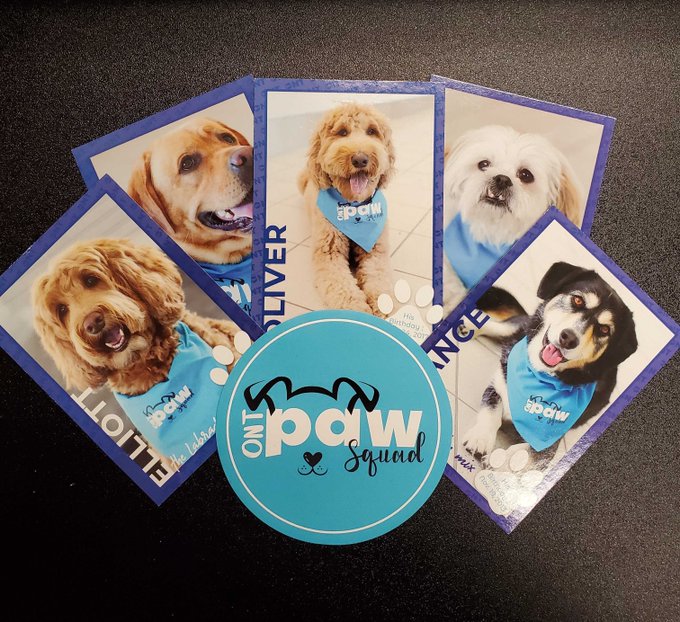
The “Paw Squad” at Ontario International Airport has their own trading cards!
At the same time that Bredemarket helps other firms to market themselves, Bredemarket has to market ITSELF, including social media marketing. And for the past year I’ve subscribed to the following formula:
Use LinkedIn for professional marketing to biometric/identity and technology clients.
Use Twitter as a supplement to this.
Use Facebook as a supplement to this, and also use Facebook as Bredemarket’s sole foray into “general business” marketing.
It sounded like a good formula at the time…but now I’m questioning the assumptions behind it. And I’m hoping that I can prove one of my assumptions wrong.
My initial assumptions about marketing to local businesses
As I write this, Bredemarket has no clients in my hometown of Ontario, California, or in any of the nearby cities. In fact, my closest clients are located in Orange County, where I worked for 25 years.
It’s no secret that I’ve been working to rectify that gap and drum up more local business.
I’ve thought about which of Bredemarket’s services would appeal to local small businesses.
Finally, I’ve started to create local targeted content, iterating to a (probably not) final version.
So this was an opportune time for me to encounter Jay Clouse’s September 2021 New Client Challenge. (It’s similar to a challenge Clouse ran in August 2020. Repurposing is good.) Clouse’s first question to all participants asked which market we would be targeting, and in my case the local small business market seemed an obvious choice.
And this dialogue played in my mind…
So when I market to local businesses, I’ll want to do that via relevant Facebook Groups. Obviously I won’t market the local services via LinkedIn or Twitter, because those services are not tailored to local service marketing.
Questioning my assumptions
Then I realized that I was wrong, for two reasons.
First, there are LinkedIn groups that concentrate on my local area, just as there are LinkedIn groups that concentrate on biometrics. I had already quit a number of the dormant Inland Empire LinkedIn groups, but I was still a member of two such groups and could (tastefully) market there.
If LinkedIn doesn’t provide an opportunity for me to do something, why don’t I tailor my use of LinkedIn and provide myself the opportunity?
Specifically, some of you may recall that I only have two LinkedIn showcase pages, but I have three Facebook groups.
“Bredemarket Identity Firm Services” is present on both LinkedIn and Facebook.
“Bredemarket Technology Firm Services” is present on both LinkedIn and Facebook.
“Bredemarket General Business Services” is only present on Facebook.
I explained the rationale for the lack of a third LinkedIn showcase page in a nice neat summary:
Using myself as an example, I have segmented my customers into markets: the identity (biometrics / secure documents) specific market (my primary market), the general technology market, and the general business market. I don’t even target the general business market on LinkedIn (I do on Facebook), but I’ve created showcase pages for the other two.
If you consider that “local business services” is a subset of “general business services,” some of you can see where this is going.
Ch-ch-ch-ch-changes
But it took a while for the thought to pound its way into my brain:
Why DON’T you target the (local) general business market on LinkedIn?
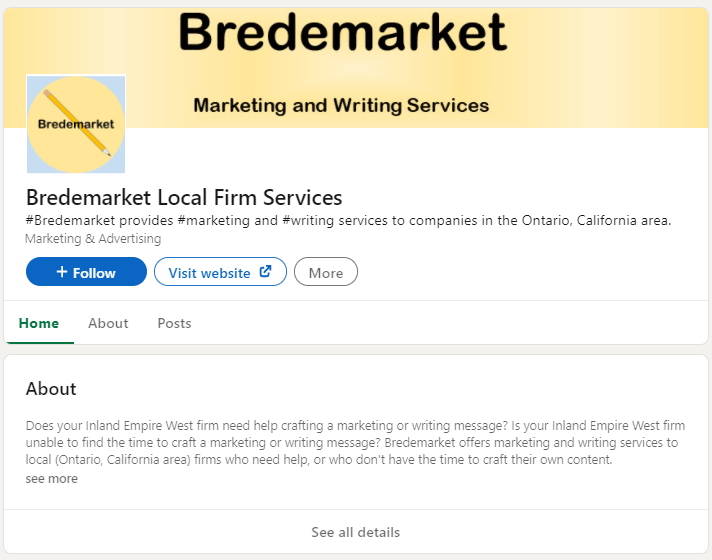
I could just create a new showcase page, a process that would only take a few minutes. I wouldn’t even have to create any new artwork, since I could simply repurpose the Facebook general business artwork and use it for a LinkedIn local business showcase page. (Repurposing is good.)
(As an aside, my approach to artwork for Bredemarket’s marketing segments was dictated by LinkedIn Stories. Which is now disappearing. Oh well.)
Now I just have to populate the showcase page with content (and continue to do so), invite people to follow the new showcase page, and proceed on my plan for world domination, one loft at a time.
Call to action time
And if you’re a small business in the Ontario, California area, here’s some information on the services I can provide to you.
There’s a sentence on the home page for Bredemarket that you may have glossed over, but it’s one that’s been on my mind for the past year.
Bredemarket presently offers its services to identity/biometrics, technology, and general business firms, as well as to nonprofits.
In this post, I’m going to zero in on a small subset of the third market, “general business firms,” and see how Bredemarket can help them.
Read on if you own a small, arty business in the Emporia Arts District of Ontario, or perhaps a larger, less arty business north of Holt in Ontario, or perhaps even a business in Upland or Montclair.
Identity/biometrics and technology are good to go
These markets are intentionally expressed in a particular order.
Technology is second on the list. As a matter of fact, Bredemarket’s first customer was a technology firm. And while I can’t necessarily speak to technology in the same depth that I can devote to identity and biometrics, I can clearly help technology clients with their content marketing and their proposals.
Getting more specific about “general business”
Which brings us to general business firms. (This post won’t even touch the fourth market, nonprofits.) This is obviously a broad category. Even if you don’t count sole proprietors (such as myself) or freelancers, there are somewhere around 7.7 million businesses in the United States. (This figure is from 2016; I’m not sure if it’s gone up or gone down in the last five years.) Now if you include sole proprietors in the total, then you’re talking about 32 million businesses. (This particular number may have actually increased over time.)
And the vast majority of those millions of businesses aren’t working in identity, biometrics, or even technology.
Obviously I can’t target them all. Well, I could try, but it would be a little ridiculous.
So what if I took a subset of those 32 million businesses and tried to see if Bredemarket could serve that subset?
The local small business persona
When you want to market to a particular group, you develop a persona that represents that group. You can then develop a profile of that persona: the persona’s needs, aspirations, and expectations; the persona’s underlying goals and values; and perhaps some other elements. The persona may be developed via extensive research, or perhaps via…a little less quantification.
So I began musing about a small business owner in my hometown of Ontario, California. Perhaps someone whose business is located here.
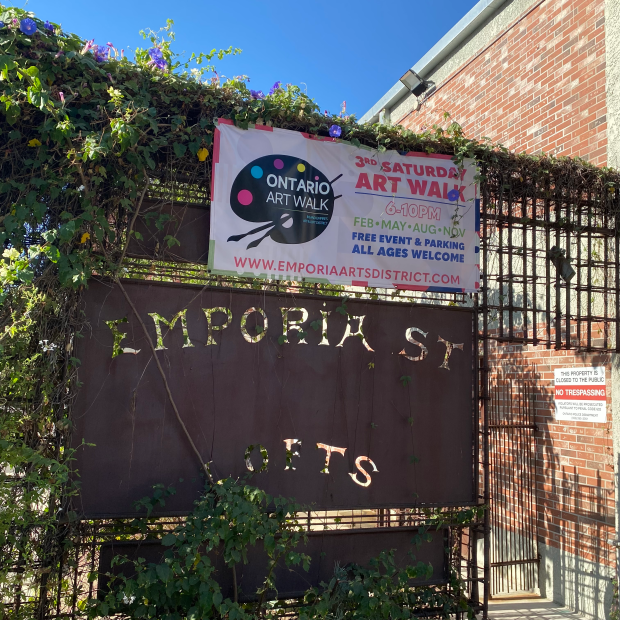
For those who aren’t from around here, the Emporia Arts District is in downtown Ontario, California, west of Euclid and south of Holt. While much of the activity is concentrated in the set of lofts/working spaces whose entrance is pictured here, there are also surrounding businesses that can be considered part of the district. And of course you can walk east of Euclid and north of Holt and find a wider variety of businesses.
But I concentrated on the businesses in the Emporia Arts District, noting that they’re…well, they’re arty. Let’s put it this way: my stick figures would not be attractive to them.
Looking at my two general offerings, proposal services and content marketing, it’s fairly unlikely that my proposal services would interest this crowd. If these business ARE submitting proposals, they are most likely applying for federal, state, or local grants, and that’s somewhat outside of my area of expertise.
(Tangential comment to those who click on links: having fun is good.)
But can my content marketing services provide value to the businesses in the Emporia Arts District (and elsewhere in Ontario and the surrounding cities)?
I realized that I DID have something to offer here.
What if your local business needs a short text piece?
After all, my writing services can be fairly flexible. While I originally envisioned that my Bredemarket 400 Short Writing Service could apply to content such as blog posts or LinkedIn posts, it could just as easily apply to a general brochure of 400 to 600 words with customer-provided pictures of artwork, classes, clothing, haircuts, or whatever.
Chances are it will be a little more exciting than this.
Or maybe not. (The story behind the piece of content above, developed when my business card order got delayed, is told here. Storytelling is good.)
The same overall process can apply to a small craft brochure just as it can apply to a discussion of the benefits of using an Adobe-trained marketing systems consultant. In either case, the engagement would start with a series of questions:
What is the topic of the content?
What is the goal that you want to achieve with the content?
What are the benefits (not features, but benefits) that your end customers can realize by using your product or service?
What is the target audience for the content? (I’m not the only one who’s establishing personas.)
There are other questions that I may ask, but you can see the whole process here.
Once these major items are established (starting off a project correctly is good), I can get writing, you can get reviewing, and I can provide you with the final product. You can then post an electronic version of the content on your website, or you can hand it out to people who stop by your business or loft or farmer’s market stall or whatever. (Intangible and tangible content are BOTH good.)
What if your local business needs a longer text piece?
Maybe 400 to 600 words isn’t enough. Maybe you want a longer piece, such as an entire product/service catalog, or a catalog listing a whole slew of businesses (maybe all the businesses at a farmer’s market).
I can help with that too. My Bredemarket 2800 Medium Writing Service, originally intended for longer white papers, can be repurposed for other types of content.
As you can guess, the target number of words for my service is 2800 words, or up to 3200 words.
The process can be a little more intricate also. Because there is more text to review, the review cycles can be longer. And I may ask a few more questions at the beginning. But in essence it’s similar to the process for the shorter writing service, with basic questions about the topic, goal, benefits, and target audience. You can see the entire process here.
What if you want more than 600 words, but less than 2800 words?
I’ll work with you. (Flexibility is good.)
If you can use one of my content marketing services, what are the next steps?
Share this online in places where you may see it. (Targeted content distribution is good.)
After that, repurpose (repurposing is good) this long, meandering blog post into some other type of content that I can distribute to businesses in the Emporia Arts District…or north of Holt…or in Upland or Montclair. Blog posts are transitory, and I’ll often express something in blog form and then pin it down in another format later.
Perhaps you can do the same, once I’ve created content for you.














 Bredemarket