Content, proposal, and analysis (“CPA”) marketing and writing services.
But what in the heck does Bredemarket DO?
During the first 21 days of March, my biometric, identity, and technology clients received blog posts, an ebook, emails, a landing page, slides, a press release, a Request for Information (RFI) response, a process, and other things.
Can I help your firm? Let me know on my “CPA” page.
I spent most of the afternoon drafting the content for an email nurture campaign, and I’m fascinated by the use of the word “nurture” by product marketers and content marketers.
“Lead nurturing is the process of building relationships with your prospects with the goal of earning their business when they’re ready. Lead nurturing is important to inbound marketing because it’s your opportunity to provide value to your leads and customers and help them grow with your business.”
I’ve said it before: You’re not a sausage grinder making sausages. You’re a flower attracting bees.
I don’t know, I don’t believe in the word “legacy.” I just think that’s another word for ego. Legacy doesn’t mean nothing. It’s just some word everybody grabbed onto.
It means absolutely nothing to me. I’m just passing through. I’m going to die and it’s going to be over. Who cares about legacy after that?
We’re nothing. We’re just dead. We’re dust. We’re absolutely nothing. Our legacy is nothing.
With the life that Tyson has lived, it’s understandable why he’s echoing Ecclesiastes in this interview.
But you don’t have to have had Tyson’s experiences to realize that legacy does not last.
Neither wanted nor needed
In business (and in life), there are companies (and people) who don’t need you or want you.
This may be temporary. The company that doesn’t need you today may urgently (and importantly) need you tomorrow.
Or it may NOT be temporary. There are companies that will NEVER need you or want you.
I recently ran across three such companies that will never need Bredemarket.
Six weeks (now less than six weeks)
Six weeks, the still image version.
Perhaps you noticed Bredemarket’s “six weeks” promotion over the weekend. It was addressed to companies that may have a final project that they want to complete before the year ends in six weeks. (Now 5 1/2 weeks.) I emphasized that Bredemarket can help companies complete those content, proposal, and analysis projects.
I also included email in this campaign, targeting prospects whom I haven’t worked with recently, or whom I’ve never worked with at all. I didn’t go overboard in my emails; although I have over 400 contacts in Bredemarket’s customer relationship management system, I sent the email to less than 40 of them.
As of this morning, none of the recipients has booked a meeting with me to discuss their end of year needs.
Some explicitly told me that they were fine now and did not need or want Bredemarket’s services for end of year projects.
Some didn’t respond, which probably indicates that they did not need or want Bredemarket’s services either.
And I discovered that three companies (four contacts) will NEVER need or want Bredemarket’s services.
Delivery incomplete
How did I discover that?
Via four “delivery status notification” messages.
Delivery incomplete.
So I visited the web pages in question, and they no longer existed.
This site can’t be reached.
I’ve been building up my CRM for over four years, so it’s not shocking that some companies have disappeared.
But one of the companies (“Company X”) DID exist a mere eight months ago.
I know this because I prepared a presentation on differentiation (see version 2 of the presentation here), and two representatives from Company X received the presentation in advance of a conference.
After the conference organizer distributed the presentation, I offered to meet with the companies individually (no charge) to discuss their content and differentiation needs, or anything else they wanted to discuss.
While some conference attendees took advantage of my April offer, the representatives from Company X did not.
And now in November, Company X no longer exists.
Tumbleweed image public domain.
Could Bredemarket have created the necessary content to keep Company X afloat? Who knows?
But EVERY company needs content to differentiate it from its competitors. Otherwise the competitors will attack you. And your competitors may not be as merciful with you as Jake Paul was with Mike Tyson.
If you need Bredemarket’s help with content, proposal, or analysis services, book a meeting with me.
This week has been a busy week in Bredemarket-land, including work on some of the following client projects:
Creating the first deliverable as part of a three-part series of deliverables.
Reworking that first deliverable for more precision.
Preparing to start work on the second deliverable.
Drafting a blog post for a client.
Gathering information for an email newsletter for a client.
Following up on a couple of consulting opportunities that take advantage of my identity/biometric expertise.
Creating a promotional reel based upon the grapes in my backyard. (Yet another reel. I plan to reveal it next week.)
Engaging in other promotional activities on Bredemarket’s key social media channels.
Plus I’ve been working on some non-Bredemarket deliverables and meetings with a significant time commitment.
But there’s one more Bredemarket deliverable that I haven’t mentioned—because I’m about to discuss it now.
The task
Without going into detail, a client required me to repurpose a piece of third-party government-authored (i.e. non-copyrighted) text, originally written for a particular market.
Shorten the text so it would be more attractive to the new market.
Simplify the presentation of the text to make it even more attractive to the new market.
The request was clear, and I’ve already completed the first draft of the text and am working on the second draft.
But I wanted to dive into the three steps above—not regarding this particular client writing project, but in a more general way.
Step 1: Rewrite
When you’ve worked in a lot of different industries, you learn that each industry has its own language, including things you say—and things you don’t say.
I’ll give you an example that doesn’t reflect the particular project I was working on, but does reflect why rewriting is often necessary.
When I started in biometrics, the first two industries that I wrote about were law enforcement and benefits administration.
Law enforcement’s primary purpose is to catch bad people, although sometimes it can exonerate good people. So when you’re talking about law enforcement applications, you frequently use a lot of terms that are negative in nature, such as “surveillance,” “suspect,” and “mugshot.”
Benefits administration’s primary purpose is to help good people, although sometimes it can catch bad people who steal benefits from good people. So when you’re talking about benefits administration applications, you tend toward more positive terms such as “beneficiary.” And if you take a picture of a beneficiary’s face, for heaven’s sake DON’T REFER TO THE FACIAL IMAGE AS A “MUGSHOT.”
These two examples illustrate why something originally written for “market 1” must often be rewritten for “market 2.”
But sometimes a simple rewrite isn’t enough.
Step 2: Shorten
Now I don’t play in the B2C market in which crisp text is extremely necessary. But it’s needed in the various B2G and B2B markets also—some more than others.
If you are writing for more scientific markets, your readers are more accustomed to reading long, academic, “Sage”-like blocks of text.
But if you are writing for other markets, such as hospitality, your readers not only don’t want to read long blocks of text, but actively despise it.
You need to “get to the point.”
Tim Conway (Sr.), as repeatedly played during Jim Healy’s old radio show. Sourced from the Jim Healy Tribute Site.
In my particular project, “market 1” was one of those markets that valued long-windedness, while “market 2” clearly didn’t. So I had to cut the text down significantly, using the same techniques that I use when rewriting my “draft 0.5” (which a client NEVER sees) to my “draft 1” (which I turn over to the client).
But sometimes a simple shorten isn’t enough.
Step 3: Simplify
If you know me, you know I’m not graphically inclined.
Someday I will reach this level of graphic creativity. Originally created by Jleedev using Inkscape and GIMP. Redrawn as SVG by Ben Liblit using Inkscape. – Own work, Public Domain, link.
But I still pay attention to the presentation of my words.
Remember those long blocks of text that I mentioned earlier? One way to break them up is to use bullets.
Bullets break up long blocks of text into manageable chunks.
Bullets are easier to read.
So your reader will be very happy.
But as I was editing this particular piece of content, sometimes I ran into long lists of bullets, which weren’t really conducive to the reading experience.
Question
Answer
What does this mean?
Why are long lists of bullets bad?
Because with enough repetition, they’re just as bad as long blocks of text.
Your readers will tune you out.
How can you format long lists of bullets into something easier to read?
One way is to convert the bullets into a table with separate entries.
Your readers will enjoy a more attractive presentation.
What do tables do for your reader?
They arrange the content in two dimensions rather than one.
The readers’ eyes move in two directions, rather than just one.
Hey, wait a minute…
Yeah, I just plugged my seven questions again by intentionally using the first three: why, how, and what.
You can go here to download the e-book “Seven Questions Your Content Creator Should Ask You.”
I don’t have the skill to make WordPress tables look as attractive as Microsoft Word tables. But even this table breaks up the monotony of paragraphs and lists, don’t you think?
So what happened?
After I had moved through the three steps of rewriting, shortening, and simplifying the original content, I had a repurposed piece of content that was much more attractive to the “hungry people” (target audience) who were going to read it.
These people wouldn’t fall asleep while reading the content, and they wouldn’t be offended by some word that didn’t apply to them (such as “mugshot”).
So don’t be afraid to repurpose—even for a completely different market.
I do it all the time.
Look at two of my recent reels. Note the differences. But note the similarities.
The identity/biometrics version of the reel.
The Inland Empire version of the same reel.
So which of Bredemarket’s markets do you think will receive the “grapes” reel?
When your company attends events, you’ll want to maximize your event return on investment (ROI) by creating marketing content that you publish before, during, and after the event.
The two things (first, second) you need to do NOW, well before your event.
And I’ll spill a couple of secrets along the way.
The first secret (about events)
I’m going to share two secrets in this post. OK, maybe they’re not that secret, but you’d think they ARE secrets because no one acknowledges them.
The first one has to do with event attendance. You personally might be awed and amazed when you’re in the middle of an event and surrounded by hundreds, or thousands, or tens of thousands of people. All of whom are admiring your exhibit booth or listening to your CEO speak.
Technically not a CEO (Larry Ellison’s official title is Chief Technology Officer, and the CEO is Safra Catz), but you get the idea. By Oracle PR Hartmann Studios – CC BY 2.0, https://commons.wikimedia.org/w/index.php?curid=47277811.
But guess what?
Many, many more people are NOT at the event.
They can’t see your exhibit booth, and can’t hear your speaker. They’re on the outside, TRYING to look in.
And all the money you spent on booth space and travel and light-up pens does NOTHING for the people who aren’t there…
Unless you bring the event to them. Your online content can bring the event to people who were never there.
But you need to plan, create, and approve your content before, during, and after the event. Here’s how you do that.
Three keys to creating event-related content
Yes, you can just show up at an event, take some pictures, and call it a day. But if you want to maximize your event return on investment, you’ll be a bit more deliberate in executive your event content. Ideally you should be:
Before the event begins, you need to plan your content. While you can certainly create some content on a whim as opportunity strikes, you need to have a basic idea of what content you plan to create.
Before the event. Why should your prospects and customers care about the event? How will you get prospects and customers to attend the event? What will attendees and non-attendees learn from the event?
During the event. What event activities require content generation? Who will cover them? How will you share the content?
Some dude creating Morphoway-related content for Biometric Update at the (then) ConnectID Expo in 2015.
After the event. What lessons were learned? How will your prospects and customers benefit from the topics covered at the event? Why should your prospects buy the product you showcased at the event?
Creating your event content
Once you have planned what you want to do, you need to do it. Before, during, and after the event, you may want to create the following types of content:
Blog posts. These can announce your attendance at the event before it happens, significant goings-on at the event (such as your CEO’s keynote speech or the evening party launching your new product), or lessons learned from the event (what your CEO’s speech or your new product means for your prospects and clients). Blog posts can be created relatively quickly (though not as quick as some social media posts), and definitely benefit your bottom line.
Social media. Social media such as Facebook, Instagram, and LinkedIn can also be used before, during, and after the event. Social media excels at capturing the atmosphere of the event, as well as significant activities. When done right, it lets people experience the event who were never there.
E-mails. Don’t forget about e-mails before, during, and after the event. I forgot about e-mails once and paid the price. I attended an event but neglected to tell my e-mail subscribers that I was going to be there. When I got to the event, I realized that hardly any of the attendees understood the product I was offering, and were not the people who were hungry for my product. If I had stocked the event with people from my e-mail list, the event would have been more productive for me.
Data sheets. Are you announcing a new product at an event? Have the data sheet ready.
Demonstration scripts. Are you demonstrating a new or existing product at the event? Script out your demonstration so that your demonstrators start with the same content and make the points YOU want them to make.
Case studies and white papers. While these usually come into play after the event, you may want to release an appropriate case study or white paper before or during the event, tied to the event topic. Are you introducing a new product at an industry conference? Time your product-related white paper for release during the conference. And promote the white paper with blog posts, social media, and e-mails.
Other types of content. There are many other types of content that you can release before, during, or after an event. Here’s a list of them.
Approving your event content
Make sure that your content approval process is geared for the fast-paced nature of events. I can’t share details, but:
If your content approval process requires 24 hours, then you can kiss on-site event coverage goodbye. What’s the point in covering your CEO’s Monday 10:00 keynote speech if the content doesn’t appear until 11:00…on Tuesday?
If your content approval process doesn’t have a timeline, then you can kiss ALL event coverage goodbye. There have been several times when I’ve written blog posts announcing my company’s attendance at an event…and the blog posts weren’t approved until AFTER the event was already over. I salvaged the blog posts via massive rewrites.
So how are you going to generate all this content? This brings us to my proposed solution…and the second secret.
The rest of this post talks about one of Bredemarket’s services, the Bredemarket 2800 Medium Writing Service. For those who haven’t heard about it, it’s a service where I provide between 2,800 and 3,200 words of written text.
“But John,” you’re asking. “How is a single block of 3,200 words of text going to help me with my event marketing?”
Time to reveal the second secret…
You can break up those 3,200 words any way you like.
For example, let’s say that you’re planning on attending an event. You could break the text up as follows:
One 500-word blog post annnouncing your attendance at the event.
Three 100-word social media posts before the event.
One 500-word blog post as the event begins.
One 300-word product data sheet prepared before the event and released on the second day of the event.
One 500-word blog post announcing the new product.
Three 100-word social media posts tied to the new product announcement.
One 500-word post-event blog post with lessons learned.
Three 100-word social media posts after the event.
For $2,000 (as of June 2024), you can benefit from written text for complete event coverage, arranged in any way you need.
So how can you and your company receive these benefits?
Read about the Bredemarket 2800 Medium Writing Service
First, read the data sheet for the Bredemarket 2800 Medium Writing Service so you understand the offer and process.
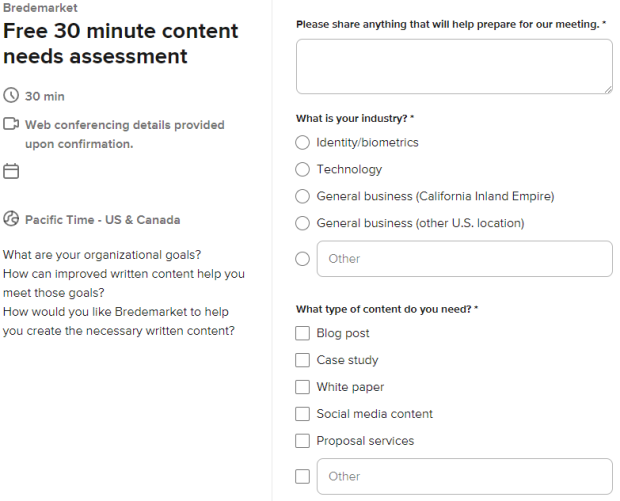
Second, contact Bredemarket to get the content process started well BEFORE your event. Book a meeting with me at calendly.com/bredemarket. Be sure to fill out the information form so I can best help you.
Normally it’s not economically feasible for me to write emails for Bredemarket, since I (for once) agree with the experts and keep my emails in the 100-word range. Because my normal minimum word length is 400 words, I usually don’t write emails for clients.
Except when the demand generation director on this client’s project envisions AN ENTIRE SEQUENCE of emails.
The demand generation director’s desired email sequence
You see, the demand generation director…um…demanded that I write an entire email sequence.
The first email in the sequence introduces the client.
The second one provides more information about why the client’s services benefits their customers.
Further emails build upon the previous information.
At the end of the sequence is the final email, with a clear call to action for the prospect to visit the client’s “landing page” and request a meeting with the client.
By the way, did you know that you can request a meeting with Bredemarket? Just go to https://calendly.com/bredemarket/ if you’d like to meet with me for a “content needs assessment.”
Actually, EVERY email in the sequence includes a link to go to the landing page and request a meeting. These are called “discovery meetings” in the trade, but you don’t have to call them that if you don’t want to. As noted above, I refer to my client meeting as a “content needs assessment.” Call the meetings wildebeests if you feel like it.
Back to my client’s demand generation director. The sequence of emails they requested tells a story. But rather than telling a short story in a single email, this sequence includes multiple emails, in which the content in each email builds upon the previous email, like chapters in a book.
Which leads me to Charles Dickens.
Charles Dickens gave birth to your marketing email sequence
Most of the novels, including Nicholas Nickleby, Dombey and Son, David Copperfield, Bleak House, Little Dorrit, and Our Mutual Friend, appeared in monthly parts following a very specific formula developed by Dickens and his publishers with the release of Dickens’s first full-length novel The Pickwick Papers (1836 – 37). The Pickwick Papers appeared in 20 parts over a period of 19 months. (The last part was a “double issue” that included parts 19 and 20). Each part contained 32 pages of letter press, 2 illustrations, various advertisements, and came wrapped in a flimsy green-paper front and back cover. The price for each part was one shilling (except for the last “double issue,” which was two). This price was very cheap compared to the standard price of a book, which at the time was 31 shillings 6 pence.
Other than cost savings, why did Dickens and his publishers share his content in serial form?
Dickens’s 20-part formula was successful for a number or reasons: each monthly number created a demand for the next since the public, often enamored of Dickens’s latest inventions, eagerly awaited the publication of a new part; the publishers, who earned profits from the sale of numbers each month, could partially recover their expenses for one issue before publishing the next; and the author himself, who received payment each time he produced 32 pages of text (and not necessarily a certain number of words), did not have to wait until the book was completed to receive payment.
So serialization helped Charles Dickens create demand, generate wealth, AND get the girl. Can’t argue with that. (Although they subsequently separated.)
What about your stories?
I am not Charles Dickens, but I’m trying to incorporate storytelling into Bredemarket’s work.
For example, the email sequence I created for the demand generation director shares details about how the problems the prospects may face, and how the client has helped their customers overcome these problems.
It all fits into the client story.
What’s the most important question to ask before telling a client story?
As I’ve said before, WHY is the most important question.
If you’d like to see all seven of the questions that your content creator should ask you, look below. And no, it’s not in seven serial mini-books, but in a single volume.
This post is an update to my January 2021 post about the four identity information services. Yes, I just created a fifth one. (But most of you can’t see it.)
The first three services
The first three were created for the benefit of employees at (then) Motorola, (then) MorphoTrak, and IDEMIA. Briefly, those three were:
A Motorola “COMPASS” intranet page entitled “Biometric Industry Information.”
A MorphoTrak SharePoint intranet page entitled “Identity Industry Information.” (Note the change in wording.)
An IDEMIA (and previously MorphoTrust and L-1) daily email newsletter.
The fourth service
Of course, since I wrote the January 2021 post in the Bredemarket blog, the main purpose of the post was to tout the fourth identity information source, the (then) newly-created “Bredemarket Identity Firm Services” LinkedIn showcase page.
I subsequently created a companion Bredemarket Identity Firm Services Facebook group, which like the LinkedIn showcase page (and unlike my previous efforts for Motorola, MorphoTrak, and IDEMIA) were publicly accessible.
Why did I do this?
I marvel at the thought that I kept on doing this over and over again for four different companies, including Bredemarket. Why did I have this pressing need to reinvent the wheel as I traveled from company to company?
Habitually I’ve been a reader, and have found myself reading a lot of information about the biometric industry or the wider identity industry. Of course it’s not enough just to read something, you have to do something with it. COMPASS, SharePoint, email, LinkedIn, and Facebook allowed me to do two things with all of the articles that I read:
Save them somewhere so that I could find them in the future.
Share them with other people who may be interested in them.
I didn’t collect information on my impact to others in versions 1.0 and 2.0, but by the time I started managing the IDEMIA email list, I not only received comments from people who appreciated the articles, but I was also able to grow the subscriptions to the email list. (People had to opt in to receive the emails; we didn’t cram them into the inboxes of every IDEMIA employee.)
Similarly, I’ve received comments from people on LinkedIn who follow the showcase page, stating that they appreciated what I was sharing there.
And while COMPASS and the MorphoTrak SharePoint are long gone, and IDEMIA’s Daily News may or may not still be in publication, I can assure you that the Bredemarket Identity Firms services LinkedIn page and Facebook group still continue to operate for your reading pleasure.
And that’s the end of the story.
No it’s not.
The fifth service
As some of you know, Bredemarket has become a side gig because of my new day job, which is with a company in the identity industry. During my first days on the new job, I set up subscriptions to my new company email account so that I could receive information from Crunchbase and Owler, as well as relevant Google Alerts on the identity industry.
And as I began receiving these subscriptions, as well as performing my usual scans of other news sources…
…well, you can guess what happened.
“I need to store these stories and share them with my coworkers,” I thought to myself.
Finally, I created a new identity information service using the well-worn title “Identity Industry Information.” (Hey, it’s easy for me to remember.)
Now I can’t actually SHARE this service with you, because it’s just for the employees at my new company.
And THIS iteration takes advantage of a technology that’s slightly newer than COMPASS.
It’s a Slack channel.
P.S. to employees at my current company – if you’d like to access this Slack channel, DM me on Slack and I’ll send you an invite.




















 Bredemarket