Revising Bredemarket’s content creation process

This post is a follow-up to a prior post. In that post, I looked at the different ways in which I described Bredemarket’s content creation process, compared that to other content creation processes, and decided what I would like to include in Bredemarket’s new content creation process.

Jean Miélot, a European author and scribe at work. By Jean Le Tavernier – [1], Public Domain, https://commons.wikimedia.org/w/index.php?curid=74516

But I didn’t actually publish my new content creation process in that post, because I wanted to think about it. Oh, and there was another reason. (Hint: 4.5X.)

Well, I’ve slept on it, thought about it, wrote it, and rewrote it.

So let’s see the (probably not) final result. It’s longer than I’d like, but at least it’s (hopefully) thorough. And yes, I left out “accelerate,” but I included just about everything else.

Now that I’ve posted it here, I’ll roll it out to the rest of the Bredemarket website.

Bredemarket’s content creation process as of August 4, 2021

Bredemarket’s content creation process ensures that the final written content (a) advances your GOAL, (b) communicates your BENEFITS, and (c) speaks to your TARGET AUDIENCE. It is both iterative and collaborative.

Here is the general content creation process (which may vary depending upon content complexity and your preferences):

  • You and Bredemarket agree upon the topic, goal, benefits, and target audience (and, if necessary, outline, section sub-goals, relevant examples, and relevant key words/hashtags, and interim and final due dates).
  • For complex content requiring input and approval of multiple subject matter experts, you and Bredemarket agree on a preliminary list of tasks, assigned persons, and due dates.
  • For content that must be incorporated into your content management system, you and Bredemarket agree on the necessary format and other parameters. Otherwise, the final copy will be provided in Microsoft Word docx format, including (as appropriate) callout indicators, hyperlinks, key words, and/or hashtags.
  • For projects requiring multiple related pieces of content, you and Bredemarket agree upon the desired frequency of content.
  • You provide relevant technical details (and, for selected longer content, access to the end customer for a 30 minute interview).
  • Bredemarket conducts any necessary research (or interviews).
  • Bredemarket iteratively provides the specified number of review copies of the draft content within the specified number of days per review. (The number of review cycles and review time must agree with any due dates.) The draft content advances your goal, communicates your benefits, and speaks to your target audience in your preferred tone of voice. Relevant examples and key words/hashtags are included.
  • You return comments on each review copy within the specified number of days. For longer content, you may provide the draft formatted copy for the final review.
  • After all reviews and comments, Bredemarket provides the final copy.

Accelerating robust content creation (re-examining Bredemarket’s content creation process)

As Bredemarket passes its one-year anniversary, I’m intentionally trying to re-evaluate what I do in order to improve my services to you.

When I say “you,” by the way, I’m speaking of clients or potential clients of Bredemarket. If you’re not interested in Bredemarket’s services, but are instead reading this hoping for a discussion of fingerprint third-level detail, this is NOT the post for you.

Back to my re-evaluation of my services. One thing that I’m doing is re-examining Bredemarket’s content creation process.

Jean Miélot, a European author and scribe at work. By Jean Le Tavernier – [1], Public Domain, https://commons.wikimedia.org/w/index.php?curid=74516

What is my current content creation process?

How do others create robust content?

What can I learn from them, and from you, to improve my own content creation process?

Bredemarket’s current content creation process

I’ve stated my content creation process in several separate areas of my website. One of my, um, goals is to make sure that my content creation process is consistently stated throughout the site.

First, let’s look at my elevator pitch, taken from my page “The benefits of benefits for identity firms.”

I work with you. Bredemarket uses an iterative, collaborative process with multiple reviews to make sure that your needs are expressed in what I write, and that the writing reflects your firm’s tone of voice. The final product needs to make me happy, it needs to make you happy, and it needs to make your potential client(s) happy.

That page was created just a few months ago, but it’s a rewrite of the specific processes that I created almost a year ago. While these vary from offering to offering (and from client to client), here’s how I stated my “iterative, collaborative process” in my description of the Bredemarket 2800 Medium Writing Service.

  • Agree upon topic (and, if necessary, outline) with client.
  • Client provides relevant technical details.
  • Bredemarket conducts any necessary research and provides the first review copy within seven (7) calendar days.
  • Client provides changes and any additional requested detail within seven (7) calendar days.
  • Bredemarket provides the second review copy within seven (7) calendar days.
  • Client provides changes and any requested detail within seven (7) calendar days.
  • Bredemarket provides the third review copy within seven (7) calendar days.
  • Client prepares the final formatted copy and provides any post-formatting comments within seven (7) calendar days.
  • Bredemarket provides the final version within seven (7) calendar days.

In addition to the words “iterative” and “collaborative,” I think that the two other words that are implicitly associated with my content creation process are “benefits” and “goals.”

Actually, I’m pretty explicit on benefits, as the previously-cited page and other writings indicate.

I haven’t been so explicit on goals (other than my own goals for Bredemarket), but that has become more important to me as Bredemarket has acquired experience.

  • While goals have been implicit with some of my clients—we all assume that the content that I have created will win more business in some generic way—my work with other clients has required me to be more explicit about the goals the content must achieve.
  • These goals not only affect the final call to action, but also affect the entire content creation and placement process.
  • For example, if the goal of a piece of content is to move an end customer to request a proposal from my client, where does that content have to be placed to elicit that request? In my line of work, it’s not Instagram.

So I concluded that I probably need to iterate my descriptions of my process to ensure that all aspects of the Bredemarket website, as well as all external communications, provide a concise and unified description of the benefits of how I work with you.

But before I did that rewrite, I wanted to see how others described a content creation process, to see what I could steal…I mean appropriate from those other descriptions.

The content creation processes of others

Obviously, I’m not the only entity that has communicated a process for content creation. Here are some others.

So if I add 4 plus 6 plus 6 plus 17, the resulting 33 step content creation process will be perfect, right?

Actually, I scanned these disparate processes to see what I’m missing in my iterative, collaborative, benefit-oriented, goal-oriented current process. These things came to mind.

Sub-goals. GatherContent makes a point of talking about multiple goals, one for “each piece of your content” or each topic addressed by your content. While this may be overkill for a tweet, it makes sense for longer content, such as a multi-section blog post.

Audience. This is an implicit thing that should be addressed explicitly, as ClearVoice and HubSpot suggest. There are a number of stakeholders who may potentially see your content, and you need to figure out which stakeholder(s) are the intended audiences for your content and plan accordingly. For example, this very post uses the word “you” to refer to an existing or potential client of Bredemarket, and I have had to shape this content to ensure that this is clear, and to warn other potential readers in advance that this post might not interest them.

When I say “you,” by the way, I’m speaking of clients or potential clients of Bredemarket. If you’re not interested in Bredemarket’s services, but are instead reading this hoping for a discussion of fingerprint third-level detail, this is not the post for you

Voice. HubSpot also suggests that the voice used in content creation is important. I happen to use a specific voice when I write these blog posts for Bredemarket, but you better believe I use a different voice when rewriting a chapter for a scientific book.

Frequency. If creating a series of content pieces, it’s wise to settle upon the frequency with which these pieces will appear. ClearVoice cites a HubSpot study in this regard.

HubSpot study of blogging data accumulated from 13,500+ of their customers found, “companies that published 16+ blog posts per month got about 4.5X more leads than companies that published between 0 – 4 monthly posts.”

Now this is only one study, and it may not apply to content other than blog posts; do your customers really want to get 16+ emails per month from you?

Frequency of course affects multiple aspects of the content creation process, including the review cycle. If you are only able to review my draft content once every two weeks, then perhaps a daily content release cycle isn’t good for you.

(One more thing. Bear in mind that I as a consultant have a financial interest in creating content as frequently as possible, since this increases the consulting rate. So if I propose something outrageous that exceeds your budget without providing tangible benefits, feel free to push back.)

Search Needs. Steps 5 and 6 in Orbit Media’s 17 step process, as well as HubSpot’s process, ask if people will search for the content in question. If so, it’s important to make sure that people will find it. The…um, goal is to “plan to make it the best page on the web for the topic.” (If people won’t search for it, then content distribution via the regular social media outlets is satisfactory.)

Tasks. GatherContent puts great emphasis on the tasks needed to produce the final content. This is NOT relevant for some of the content that I create with you, but it was EXTREMELY relevant when I managed the RFI response for a client a couple of months ago. Even though the response had a 20-page limit, a lot of information was packed into those 20 pages, and I had to work with a lot of subject matter experts to pull everything together and get it approved.

Examples. Orbit Media Studios discusses a number of items that are outside of the scope of textual content creation, and thus outside of my (current) scope (although I have suggested visual content that can be created by more talented people). One thing that does fall within my scope is to support the content with examples. Of course, a case study is just one big example, but in other cases some examples may be beneficial.

Promotional Considerations. No, I’m not talking about the game show language in which Montgomery Ward provides money and/or goods to a game show in exchange for a mention at the end of the show. Here, Orbit Media Studios is talking about how the content will be promoted once it is created. I address these questions all the time in my own self-promotion. If I’m re-sharing a link to content on social media, what excerpt should I include, and what hashtags should I use?

Due Dates. GatherContent also talks about due dates and how they affect the content creation process. Some of my clients don’t have due dates at all. Some have very vague due dates (“we’d like to go live with the content next month”). Other dates are very explicit; when you’re dealing with RFP and RFI responses, the end customer has a specific due date and time.

Content Inventory. GatherContent also talks about this. My content is often not stand-alone. It needs to integrate with other client content. The client’s content inventory needs not only affect the delivery of the final content, but may affect the format of the content itself. For example, if something is only going to be available in hardcopy, I can do away with the hyperlinks.

In addition to the information that I appropriated from these sources, perhaps it’s worthwhile to fit the whole thing into a needs / solution / results framework. Although in this case, the “results” would be “expected results.”

Oh, and there’s one more word that I’d like to work in there somewhere. Did you see that the title of this post started with the word “accelerating”? I, um, appropriate that from a source that I cannot discuss publicly, but it may make sense here also. If not for accelerating the content creation, at least for accelerating the expected results.

Bredemarket’s new and improved content creation process is…

Wow, that’s a lot of stuff.

Some of it is too detailed to include in a succinct statement of Bredemarket’s content creation process, and some of it should be included, even if I only include a single word.

So after that review, I can announce that Bredemarket’s new content creation process is…

TO BE DETERMINED.

I still need to think through this, write up a new succinct version, iterate it, and share the new version in a future post.

After all, a higher frequency of blog posts DOES lead to a greater number of leads. See “Frequency,” above.

Stay tuned.

Agile content

I purposely chose the title “Agile content” for this post, because for some of you “scrummy” individuals it will easily convey what I want to say: content can be tweaked as needed.

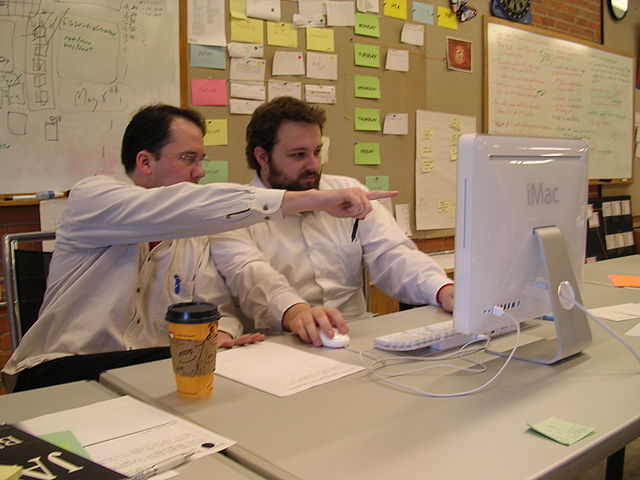
Pair programming, an agile development technique used by XP. By Lisamarie Babik – Ted & IanUploaded by Edward, CC BY 2.0, https://commons.wikimedia.org/w/index.php?curid=9546406

But I could have chosen a title that did not resonate as well with modern audiences: “Newer weblog content.”

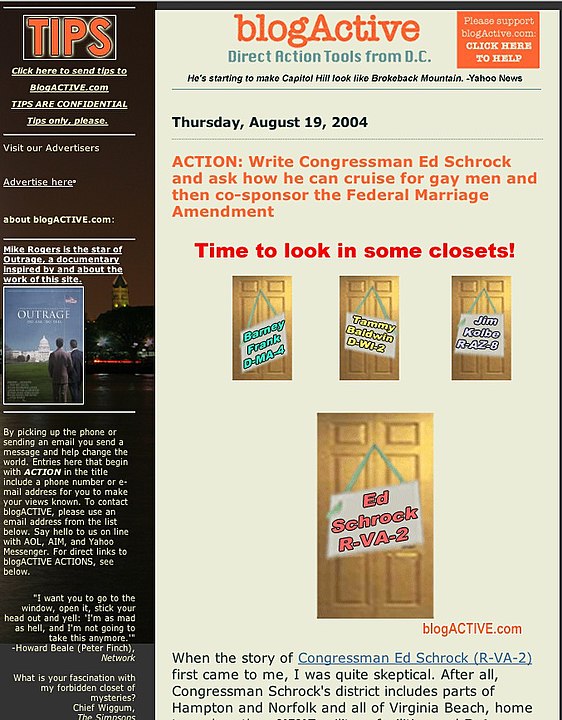
By Valleyhollandman – blogactive.com, CC BY-SA 3.0, https://commons.wikimedia.org/w/index.php?curid=24045040

After all, some of you remember what blog (weblog) posts were back in the day. They were not conceived as permanent, immovable statements, but were more transitory (akin to diaries) and could be adapted over time.

Changing my message

Even today, I’ve practiced adaptation with two versions (so far) of Bredemarket’s goals for 2021. (Perhaps it’s time for me to look at them and see if they need revision.) And others have done the same thing, recycling and updating content.

We can practice “Agile content,” regardless of whether or not we have a good idea of what we want to say.

  • Sometimes we know what we want to communicate. We set our goal, create content that meets our goal, and share it. Back in December, I had a pretty good idea of the goals that I wanted to set for 2021, so I shared them. The subsequent tweak that I made was relatively minor.
  • But sometimes we DON’T know what we want to communicate. Perhaps you’re entering a new market or pitching a new product, and you don’t know how the potential customers are going to react. Perhaps your initial idea is COMPLETELY wrong and will need to be COMPLETELY revised.

In the latter case, rather than waiting for all the focus groups and scientific studies and everything else (which can kill productivity), one option is to put something up NOW. And if the customers don’t like parts of it, adapt the content.

Or perhaps you keep on building new content that effectively supersedes the old.

  • For example, last year I created a page here that described the Bredemarket 400E Short Editing Service. Just between you and me, I have NEVER sold this particular service, and this is the first time in months that I have mentioned it. But I never pulled the “400E” page down, because for all I know I may be contacted tomorrow by someone who has content and needs me to edit it.
  • At the same time, all of the newer content that I have created on this website and elsewhere emphasizes my writing services rather than my editing services.

Changing YOUR message

The same thing that applies to my business can also apply to yours.

Maybe you want to test some content, either broadly (by linking to the content on the main page of your website and/or on your social media) or in a limited fashion (by only selectively sharing the link to the content). As you gather feedback about the content you have created, you can either leave it as it, tweak it, make wholesale changes to it, or delete it entirely.

Of course you need to remember that past content can still hang around somewhere, because the Internet never forgets. But in some cases it’s better to try some content out NOW, rather than waiting for all the facts.

As one of my clients likes to remind me, the perfect is the enemy of the good.

Which is why that same client had me create some content several months ago, and revise and expand on it as needed and as needs change. The client could have waited until now to release the content, which includes an important new product feature that couldn’t have been communicated several months ago. But then the client would have missed out on months of sales, as well as feedback on the original iteration of the content.

I’ll confess an ulterior motive: as a consultant, I get paid more to create and update content than I do to create content and do nothing with it afterwards. But the client benefits also because it starts using the content more quickly, leading to more sales.

My earlier calls to action didn’t communicate all of these options

Do you need Bredemarket’s help in content creation? Contact me.

How the APMP Body of Knowledge (BOK) benefits Bredemarket’s NON-proposal clients

(Updated 4/16/2022 with additional benefits information.)

Presumably you saw my earlier post, “I just re-rejoined the Association of Proposal Management Professionals. So what?” This post is a follow-up to the “So what?” part, specifically addressing clients of my consulting firm Bredemarket (marketing and writing services for biometric, technology, and general business firms) who DON’T use me for proposal services.

I said the following in that prior post:

But there are benefits for my Bredemarket clients who DON’T depend upon me for proposal support, but instead depend upon me for content marketing or other marketing and writing services. The same strategies and tactics that contribute to a more effective proposal can be extrapolated to apply to other areas, thus contributing to better white papers, better case studies, better blog posts, better social media posts, better marketing plans, etc., etc., etc. Again, this can help my clients win business.

(Yes, I intentionally used the words “win business.”)

Of course, now I’m in the initial process of making use of my new/old APMP membership by soaking in APMP things (while ALSO hopefully contributing things) that will benefit me and my clients.

I’ll talk about live webinars, the APMP Body of Knowledge, and the benefits for Bredemarket’s non-proposal clients.

Live webinars! Well, sometimes

My first opportunity to obtain value from my APMP membership came on Wednesday July 28, when the Western Chapter (a merger of the California Chapter and other chapters) scheduled a webinar entitled “Persuasion Through Page Architecture.” The presenter, Nancy Webb, offers over 30 years of design expertise. I recall the name, so I’ve probably attended a previous presentation of hers during my second (or perhaps even my first) stint in APMP.

Sadly, I was unable to learn from Nancy Webb on July 28. A major requirement for a webinar is the ability to access the web, and when we all logged into the webinar on Wednesday, we learned that Webb’s Internet connection was out and that the meeting would have to be rescheduled.

By Monoklon – Own work, CC BY-SA 4.0, https://commons.wikimedia.org/w/index.php?curid=75697420

Ah, technology.

The APMP Body of Knowledge

But MY Internet connection is working, so on Thursday afternoon I was able to visit the APMP website and poke around some more.

Which led me to the page describing the APMP Body of Knowledge (BOK).

Not a body OF KNOWLEDGE, but this illustration was created by Leonardo da Vinci, so the SMA folks will like it. By Leonardo da Vinci – https://www.metmuseum.org/special/Leonardo_Master_Draftsman/tour_gallery4.htm, Public Domain, https://commons.wikimedia.org/w/index.php?curid=1744423

And yes, I’m going to call the Body of Knowledge the BOK from now on. Bok bok bok.

By Andrei Niemimäki from Turku, Finland – Friends, CC BY-SA 2.0, https://commons.wikimedia.org/w/index.php?curid=3769100

It’s no surprise that the proposals world has a slew of acronyms (more on that later).

One important thing you need to know about the APMP BOK; it’s only for APMP members.

The APMP Body of Knowledge (BOK) is available to all APMP members in good standing.

Well, I haven’t done anything to lose my good standing yet, although if I were to log in to the BOK, copy all of the content, and post it here in the Bredemarket blog, I would obviously get in a heap of trouble. For one thing, Wordman would come after me.

Wordman. From https://wordmanspeaks.com/about-wordman/. Fair use. NOT created by Leonardo da Vinci; Wordman avatar created by Sean Jones (www.knitestudios.com)

As it turns out, Wordman could come after me in multiple ways. In addition to his superhero status, Wordman (Richard “Dick” Eassom) chairs the APMP Western Chapter, and is also an executive with SMA, Inc. (which I previously joined). I could get kicked out of the APMP AND SMA in one fell swoop!

(I could go off on a tangent and say why Moses was the most evil man in the Bible, but I really shouldn’t.)

(Moses broke all Ten Commandments at once.)

Um, John, let’s get back to the BOK

So I’m NOT going to go behind the firewall and redistribute the internal content of the APMP BOK.

But I CAN note what the APMP publicly says about the BOK.

TL;DR: as I’ve noted when talking about the brouhaha, the BOK and the APMP itself talk about topics that have applicability far beyond the creation of a proposal.

The topics are grouped into seven categories, which represent key practice areas for improving an organization’s business development focus:

Understand business development

Focus on the customer

Create deliverables

Lead a team

Manage processes

Train staff

Use tools and systems

Obviously, all seven of these categories apply to the creation of a proposal.

Benefits for my NON-proposal clients

And all seven of those categories just as easily apply to the creation of a blog post, case study, white paper, corporate strategy, or ANY deliverable for a customer-facing firm.

(4/16/2022: For additional information on benefits, click here.)

Again, I can’t speak about BOK specifics, but I spent part of Thursday afternoon reading about a topic which would have benefited me greatly in one of my NON-proposal positions with IDEMIA/MorphoTrak/Motorola/Printrak. Well, better late than never.

There are a number of helpful pieces of content in the APMP BOK, including…a list of common proposal acronyms. (CPAs??? No.)

For those who don’t know this, the major purpose of acronyms is to allow people of a small group to exchange secret communications in the presence of the non-initiated. “When you complete the response to the RFP for DoD, ensure that the collected KPIs align with the BD-CMM.” (In truth, many of these acronyms are used outside of the proposal profession, but the acronym list collects some of the important ones in one place.)

So I anticipate that I’ll be spending some significant time in the future reviewing the APMP BOK. And if all goes well, I’ll actually RETAIN something from these BOK content reviews that will result in better written content for ALL Bredemarket clients.

(And yes, Dick, I know that there’s also an SMA body of knowledge to which I have access…)

Another acronym is CTA

Incidentally, if you are a biometric (identity) or technology firm that needs a proposal (or content) consultant, feel free to contact Bredemarket.

How and why a company should use LinkedIn showcase pages

This post explains what LinkedIn showcase pages are, how Bredemarket uses LinkedIn showcase pages, and (a little more importantly) how YOUR company can use LinkedIn showcase pages.

What are LinkedIn showcase pages?

LinkedIn offers a variety of ways to share information. Two of those ways are as follows:

  • A personal LinkedIn page. This allows an individual to share their job history and other information. Here’s an example.
  • A company LinkedIn page, which contains information about a company, including “about” details, jobs, employees, and other facts. Here’s another example.

A third method is a LinkedIn showcase page. This is tied to a company page, but rather than telling EVERYTHING about the company, a showcase page allows the company to zero in on a PARTICULAR aspect of the company’s product/service offering.

How Bredemarket uses LinkedIn showcase pages

Most companies, even very small ones like Bredemarket, can segment their products and services in various ways. In Bredemarket’s case, the company offers some prepackaged services, such as a “short writing service” and a “medium writing service.”

However, it didn’t make sense for me to segment my services in this way. The people who are interested in 400 word written content are not dramatically different from the people who are interested in 2800 word written content. So instead of segmenting by service, I chose to segment by market.

I started by addressing one of my potential markets, the identity market (biometrics, secure documents, and other identity modalities). Back in November, I created a Bredemarket Identity Firm Services showcase page on LinkedIn, which eventually became a place for me to share information about the identity industry, both content generated by me and content generated by others.

Bredemarket Identity Firm Services on LinkedIn. https://www.linkedin.com/showcase/bredemarket-identity-firm-services/

Since then I’ve expanded my offerings. On LinkedIn, I presently have TWO showcase pages, one concentrated on the identity market, and one concentrated on the more general technology market.

Bredemarket Technology Firm Services on LinkedIn. https://www.linkedin.com/showcase/bredemarket-technology-firm-services/

These concentrations made the most sense to me, although I could segment even further if I chose to do so (separate showcase pages for fingers and palms, anyone?).

An aside for Facebook users

Incidentally, you can perform similar segmentation in Facebook. In Facebook terms, you can have a page associated with a particular company, and then (rather than showcase pages) you can have groups that link to the company page and delve into topics in more detail.

So Bredemarket (which is committed to disseminating information via multiple communication streams; see my goal number 3 here) has Facebook groups that are somewhat similar to the Bredemarket LinkedIn showcase pages. One difference is that I have three groups on Facebook. In addition to the identity and technology groups, I also have a general business group. At this point it didn’t make sense to create a LinkedIn showcase page for general business, but it did make sense for Bredemarket to have such a group on Facebook.

Enough about me. What about you?

Obviously Bredemarket is an unusual case, although for some of you it may make sense to segment based on markets.

Most companies, however, will choose to segment based upon products or product lines. This especially makes sense for multinational companies that offer a slew of products. However, even smaller companies with multiple product lines may benefit from showcase page segmentation. If a potential customer is only interested in your square blue widgets, but doesn’t care about your other widgets, a showcase page allows the customer to read about blue widgets without having to wade through everything else.

Some of you may have received a pitch from me suggesting how a showcase page can help you highlight one product or product line in this way.

Perhaps it’s best to show an example. I’ve previously highlighted Adobe as an example of a company with showcase pages, but for now I’d like to highlight another company with a similar issue.

Let’s look at Microsoft, which has an obvious interest in using LinkedIn to its fullest potential. Microsoft’s product and service lines have expanded over the years, and while some Microsoft entities (such as LinkedIn itself) have their own regular LinkedIn pages, Microsoft uses showcase pages for other entities, products, and services.

For example, Microsoft has a showcase page for Microsoft Dynamics 365.

But here’s a showcase page that has nothing to do with a product, service, or market: “Microsoft On the Issues.”

So there are a variety of ways that a company can slice and dice its communications, and LinkedIn showcase pages provide an ideal way to do that.

Does this interest you?

Of course, setting up a LinkedIn showcase page is only the beginning of the battle. If you set up a showcase page and don’t publish anything to it, your efforts are wasted. Potential customers look at your company’s online presence, after all.

If your company has established a showcase page, has set goals for how the showcase page will benefit the company, and now needs to generate content at a regular clip, Bredemarket can assist with the creation of the content, working with internal company subject matter experts as needed. If this service interests you, contact me. We will collaborate to ensure that your LinkedIn showcase page includes the best possible content.

Even Apple is moving to a service model. Biometric identity vendors are moving also.

Remember when you bought a big old hunk of hardware…and you owned it?

With cloud computing, significant portions of hardware were no longer owned by companies and people, but were instead provided as a service. And the companies moved from getting revenue from selling physical items to getting revenue from selling services.

From Apple Computer to Apple

Apple is one of those companies, as its formal name change from “Apple Computer” signifies.

Then “Apple Computer” circa 1978. From https://www.macrumors.com/2020/03/23/apple-computer-retail-sign/. Fair use.

Yet even as iTunes and “the” App Store become more prominent, Apple still made a mint out of selling new smartphone hardware to users as frequently as possible.

But Apple is making a change later in 2021, and Adrian Kingsley-Hughes noted the significance of that change.

The change?

So, it turns out that come the release of iOS 15 (and iPadOS 15) later this year, users will get a choice.

Quite an important choice.

iPhone users can choose to hit the update button and go down the iOS 15 route, or play it safe and stick with iOS 14.

Why is Apple supporting older hardware?

So Apple is no longer encouraging users to dump their old phones to keep up with new operating systems like the forthcoming iOS 15?

There’s a reason.

By sticking with iOS 14, iPhone users will continue to get security updates, which keeps their devices safe, and Apple gets to keep those users in the ecosystem.

They can continue to buy content and apps and pay for services such as iCloud.

Although Kingsley-Hughes doesn’t explicitly say it, there is a real danger when you force users to abandon your current product and choose another. (Trust me; I know this can happen.)

In Apple’s case, the danger is that the users could instead adopt a SAMSUNG product.

And these days, that not only means that you lose the sale of the hardware, but you also lose the sale of the services.

It’s important for Apple to support old hardware and retain the service revenue, because not only is its services business growing, but services are more profitable than hardware.

In the fiscal year 2019, Apple’s services business posted gross margins of 63.7%, approaching double the 32.2% gross margin of the company’s product sector. 

If current trends continue, Apple’s services (iCloud, Apple Music, AppleCare, Apple Card, Apple TV+, etc.) will continue to become relatively more important to the company.

The biometric identity industry is moving to a service model also

Incidentally, we’re seeing this in other industries, for example as the biometric identity industry also moves from an on-premise model to a software as a service (SaaS) model. One benefit of cloud-based hosting of biometric identity services is that both software and the underlying hardware can be easily upgraded without having to go to a site, deploying a brand new set of hardware, transferring the data from one set of hardware to the other, and hauling away the old hardware. Instead, all of those activities take place at Amazon, Microsoft, or other data centers with little or no on-premise fuss.

(And, as an added benefit, it’s easier for biometric vendors to keep their current customers because obsolescence becomes less of an issue.)

Is your biometric identity company ready to sell SaaS solutions?

But perhaps your company is just beginning to navigate from on-premise to SaaS. I’ve been through that myself, and can contract with you to provide advice and content. I can wear my biometric content marketing expert hat, or my biometric proposal writing expert hat as needed.

The “T” stands for technology. Or something. By Elred at English Wikipedia – Transferred from en.wikipedia to Commons by Moe_Epsilon., Public Domain, https://commons.wikimedia.org/w/index.php?curid=3812206

Obviously this involves more than just saying “we’re cloud-ready.” Customers don’t care if you’re cloud-ready. Customers only care about the benefits that being cloud-ready provides. And I can help communicate those benefits.

If I can help you communicate the benefits of a cloud-ready biometric identity system, contact me (email, phone message, online form, appointment for a content needs assessment, even snail mail).

Make sure your social media channels have current AND CONSISTENT content

A few months ago, I suggested that businesses should make sure that their social media channels have CURRENT content.

This does NOT count as current content.

But that’s only part of the battle.

It also helps if the social media channels of a business exhibit CONSISTENT content.

Because of my years of competitive analysis experience, I engage in some competitive analysis for one of my Bredemarket clients. This includes regular visits to competitor social media channels. I won’t mention the name of the competitor (after all, I don’t want to promote a company that competes with one of my clients), but one competitor is very good at social media channel consistency. The competitor uses four major social media outlets, and generally ensures that content on one outlet is also available on another outlet, in a format appropriate to that outlet.

Some companies…don’t do so well.

I’ve run across several companies with multiple social media outlets that fail to take advantage of them.

  • In one case, a company published a very good video on its YouTube channel, but failed to share a link to the YouTube video on any of its other outlets, missing a golden content sharing opportunity.
  • In another case, a company had created two Twitter accounts over the years, but never let the followers of the old Twitter account know about the new Twitter account. Sadly, the new Twitter account had FEWER followers than the old one, again missing a golden content sharing opportunity.
  • In a third case, a social media consultant created accounts on multiple social media outlets, but NEVER posted to one of the social media platforms. (And this is a social media consultant!) It would have been best to have NEVER created that dormant account at all, rather than creating an account with NO content.

I’m struggling with this myself at Bredemarket, since I have multiple accounts devoted to the Bredemarket business itself, and other accounts devoted to me in a professional or personal capacity. For example, I’m probably going to share this blog post after I publish it. Where should I share it? Why? How?

If only there were a service that could help me analyze my web/social media content…oh yeah, I offer one: Bredemarket 404 Web/Social Media Checkup.

If you’d like me to perform an unbiased third-party social media checkup, contact me. (I can analyze your competitors also.)

The business TikTok post that I couldn’t share with you

I had a really good post planned for today.

While I’m not a big creator of video content, I can certainly appreciate good content, and I planned to share some excellent video content with you.

There is a mobile car washing service in my hometown of Ontario, California. Now videos of mobile car washing are more exciting than videos of…well, videos of writers writing, but not by much. So if you want to grab someone’s attention, you have to put entertaining content into a mobile car washing video.

(No, not that.)

So this local mobile car washing service posted a video on TikTok that began with the service washing…a kid-size vehicle.

Completely cute and entertaining, so I decided to share it from the TikTok app to one of my Facebook groups, and then decided that I wanted to write a blog post about it.

So I went to share the video from the TikTok web page to this blog, and was told the video was not available. I investigated further, and found this on the account page.

Yes, you read that right – a COMPANY’S TikTok account is PRIVATE.

I went back to my TikTok app, navigated to the account, and confirmed that the video was still there (for those of us who were logged in and following the account) and that hundreds of people have seen it.

But I can’t share it with you, nor can I share any of the company’s other videos, which are restricted to “Followers only.”

But trust me, it was a really cute video.

Why you need current online content (or, one reason to prove to your customers that your firm is an ongoing, viable concern)

This is a follow up to my post from two days ago…with a critical data point.

In that prior post, I listed some ways that a company’s website and social media channels could look attractive or unattractive to customers. I focused on the second of my three issues, which was whether the website/channels have current content.

But that prior post consisted of my opinions regarding why your company should hire Bredemarket to work with you on written content creation. Obviously self-serving.

But to be honest, is current content all that important? “Does website and social media content really matter?” you may ask. “Don’t B2B customers gather data by word of mouth anyway?”

The Demand Gen Report June 2020 B2B Buyer Behavior Study

Um…word of mouth is not that prevalent, according to Demand Gen Report, which released a B2B study last June entitled “2020 B2B Buyer Behavior Study.” You can download that study yourself for free here.

Much of the study concentrated specifically on COVID-19 related effects, but one item on pages 7 and 8 of the study caught my eye.

This portion of the study concentrated on the sources that B2B purchasers referenced when making buying decisions. Specifically, the survey participants were asked, “What were the first three resources that informed you about the solution in question?” Responses were as follows:

  • Web search: 53%
  • Vendor web sites: 41%
  • Review sites: 30%
  • Prior experience with the vendor: 28%
  • Peers/colleagues: 27%

Yes, almost twice as many B2B buyers depend upon the web for initial research rather than asking peers and colleagues.

Demand Gen Report offered the following comments on these and related responses (emphasis mine):

Making a positive first impression is important in any buying situation, but the survey showed that it is becoming an even more critical part of the buyer journey. Not surprisingly, most buying journeys start online, with a general web search, specific vendor websites and review sites as the first resources buyers used to inform them about a specific topic area related to their purchase….

The survey underscored that content remains a critical influence on B2B buying decisions, with 76% of respondents saying the winning vendor’s content had a significant impact on their buying decision.

Demand Gen Report, 2020 B2B Buyer Behavior Study, page 7. Available via download (5,664KB).

Now I don’t want to quote the entire study: again, you can download the study yourself. And I’ll admit that I’m only concentrating on a portion of the entire study.

But there’s no denying that a company’s online content is critical in B2B buying decisions.

Does your content cater to potential buyer behavior?

So, is your website and social media content the content that you want your customers to see?

  • Have you posted product-specific content on your website blog and/or your website “news” page in the last 3 months?
  • How about your website case studies, product data sheets, testimonials, white papers, and/or presentations? Are these recent, or is your company relying on past successes and failing to communicate present successes?
  • Have you posted relevant content on your company LinkedIn page in the last 3 months?
  • How about your other company social media outlets? Facebook? Instagram? Twitter? YouTube?

Although I refrain from linking to them, I know of countless bad examples of outdated content. Web “news” pages or social media accounts with no posts in years. LinkedIn company pages with no posts at all. Companies that haven’t posted presentations in a decade. Data sheets that prominently mention a product’s compatibility with Windows 7. Companies that post wonderful YouTube videos, but then fail to share the video link on their other social media channels or on their own website.

Call to (your) action

This is the part of the post where I share my “contact with me!” pitch, but before I do that, perhaps you should take the following steps yourself.

  1. Take a look at your website and your social media channels from the view of one of your potential customers. When putting the “customer” hat on, do you like what you see?
  2. If you don’t like what you see, what are you going to do about it?

Now perhaps Bredemarket is NOT the answer to question 2. Perhaps you have an employee who has the time to update your content, and do so on a regular basis.

But if you find that you need outside help in creating content (short blog posts, longer white papers, whatever), feel free to contact Bredemarket.

As a reminder, my process to work with a client to create content is a collaborative process. For example, here’s the process that Bredemarket uses when working with a client to produce written text of approximately 2800 to 3200 words, such as the content for a white paper.

  • Agree upon topic (and, if necessary, outline) with client.
  • Client provides relevant technical details.
  • Bredemarket conducts any necessary research and provides the first review copy within seven (7) calendar days.
  • Client provides changes and any additional requested detail within seven (7) calendar days.
  • Bredemarket provides the second review copy within seven (7) calendar days.
  • Client provides changes and any requested detail within seven (7) calendar days.
  • Bredemarket provides the third review copy within seven (7) calendar days.
  • Client prepares the final formatted copy and provides any post-formatting comments within seven (7) calendar days.
  • Bredemarket provides the final version within seven (7) calendar days.

(By the way, these times are maximum times. For the white papers that I have written, both the client and I have provided our deliverables in less than seven days, and we didn’t need all of the review cycles. Better preparation up-front minimizes the need to fix things at the end.)

A similar (but simpler) process is used for shorter Bredemarket writing projects of approximately 400 to 600 words, such as blog posts or LinkedIn posts.

Regardless of the specifics of the process, the goal is to work together to create text that states your company’s message and attracts your company’s desired clients.

And letting your potential customers know that you exist.

Three ways to prove to your customers that your firm is an ongoing, viable concern

[Update, January 27, 2021: a July 2020 study from Demand Gen Report explains WHY up-to-date content is important. I addressed that study in this post.]

When a customer is looking for a business to provide products and/or services, the customer would probably prefer to deal with a business that is not bankrupt.

Now I haven’t conducted specific surveys on this topic. This is just a wild hunch that I have. (As the meme says, prove me wrong.)

The search for viable businesses also applies in B2B relationships also, or businesses that provide services to businesses. Bredemarket, of course, provides marketing and writing services to businesses, and I’d be wasting my time if I pursued businesses that no longer existed.

What if your business IS still an active business, but just LOOKS like it no longer exists?

I’m going to list a few things that I check out, either when Bredemarket is looking at selling something to potential clients, or when I as a potential customer want to buy something. If you’re a business owner, here is a three question checklist to ask yourself when you look at your website and your social media channels.

  1. Make sure your business website still exists.
  2. Make sure the business website and social media channels have current content.
  3. Get the copyright date right.

After looking at these three items in the checklist, I’ll then have a few more comments on the SECOND of these three items, current (NOT outdated) content, because this is the one for which Bredemarket (or another consultant, or perhaps one of your own employees) can have the most impact.

Checklist Item 1: Make sure your business website still exists

This sounds like a no-brainer, but I’ll say it anyway. If a business website no longer exists, either the business is bankrupt, or the business has changed its marketing and forgot to take care of a loose end or two.

Just today I was surveying local businesses in a particular industry, and I ran across the Google listing for a particular business. The business was highly rated in Google reviews, so I checked out the business a little more. In the process of checking out the business, I found its Yelp page, which had one negative review (and an explanatory reply from the business owner). I also found a social media page for the business, which included a post about the company’s brand new location and how wonderful it was.

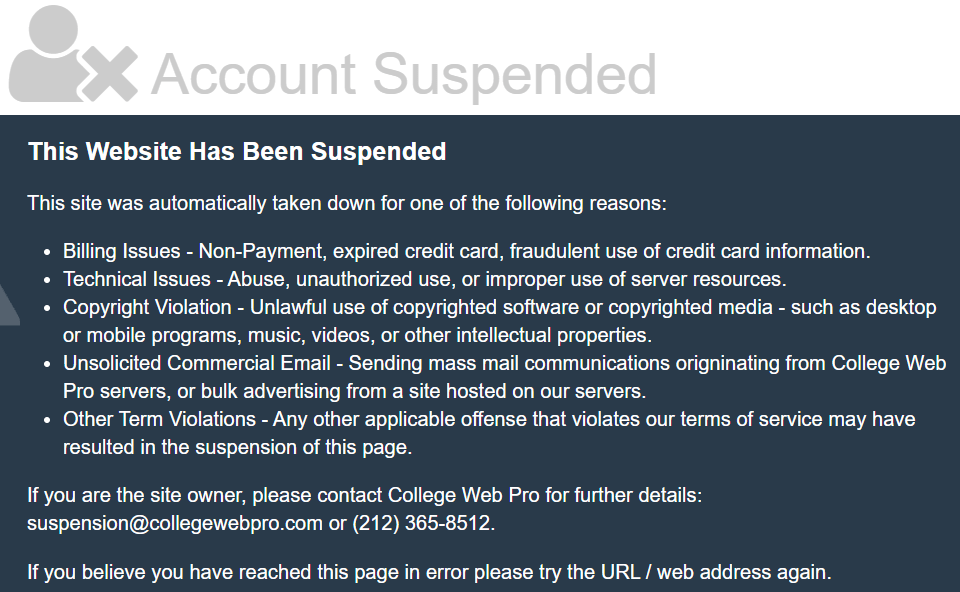
But in between checking out the Google listing and the Yelp page, I happened to check the business’ own website. This website was prominently mentioned on Google, Yelp, and the social media channel. And when I followed the link to that website, I saw this.

Now I’m going to give the business the benefit of the doubt and assume that the business DIDN’T send unsolicited commercial email, violate copyright, or used fraudulent credit cards. (If it did, the business owner is in REAL trouble right now.)

I’m just going to assume that the company didn’t pay its web hosting bill.

Why am I assuming this? Because after I visited the web page, I looked at the Google listing again, and took a more careful look at the other content that I found on Yelp and the social media channel. When doing so, I noticed that no reviews or other content had been posted about the business in more than a year. (See the second item on the checklist, below.) So my guess is that the business is no more.

Now, of course it’s possible that the business is still operating in a minimal way, without a website. (If I felt like it, I could drive by the new location advertised on its social media channel and see what’s there.) Or perhaps the business created a new website with a different URL and never closed the old one.

But do people really want to do business with a company that doesn’t pay its bills?

Checklist Item 2: Make sure the business website and social media channels have current content

Lack of current content is something that troubles bankrupt companies and ongoing companies alike. Ever since I started Bredemarket, I’ve dealt with several companies that are facing a “dated content” problem. Now I know that these companies aren’t bankrupt, and are in fact bringing in revenue; it’s just that their content is outdated.

What usually happens, in small and large companies alike, is that an effort is made at some point to “spruce up” the content of a website and/or its social media channels. Perhaps an employee is assigned to this task, or perhaps a consultant does it. (I’ve done both.) A heroic effort is undertaken, and a bunch of new content is produced, impressing the company heads and the company’s clients.

But then…things happen, and next thing you know your online channels have content that is three years old…or ten years old.

Or if the exact year of the content isn’t explicitly identified, there are clues within the content itself as to its age, such as “Our product is now supported on Windows 7.”

What are the ramifications of dated content? Visitors begin to wonder why there isn’t any new content.

  • Perhaps the company went bankrupt; see my first checklist item, above.
  • Perhaps the company is still a going concern, but hasn’t done anything in the last few years. Maybe that great customer reference from three years ago was the last new customer that the company got, or maybe that great presentation from several years ago was the last time the company presented anything.
  • Perhaps the company has continued to do business, but its more recent business isn’t as impressive as its previous business.
  • The most positive explanation is that the company HAS done amazing things in the last few years, but hasn’t taken the time to tell the story of its most recent accomplishments. (TL;DR: I can help.)

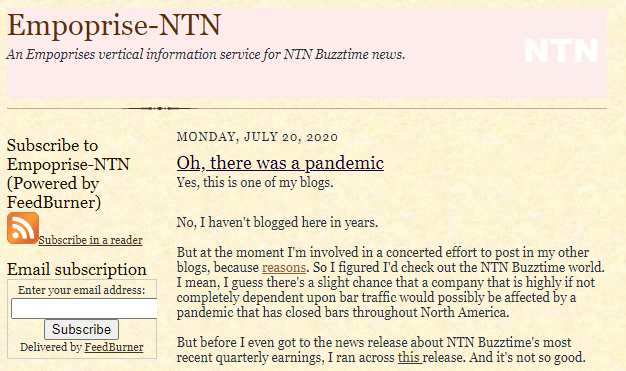
Now I don’t always eat my own wildebeest food myself in this regard. I’ve previously noted that my Empoprise-NTN blog isn’t updated regularly; in fact, it has only had one update in the last five years. (And no, I can’t really use COVID as an excuse.)

If you’re a business owner, ask yourself: do you want your business social media channels to look as outdated as the Empoprise-NTN blog? I don’t think you do.

Checklist Item 3: Get the copyright date right

This is a simple little thing, but it can stick out when it’s not fixed.

Now I’m writing this in January of a new year, so I’ll cut a little bit of slack here for companies with a “Copyright © 2020” notice on their web pages that hasn’t been updated to 2021 yet.

But if your website still says “Copyright © 2019,” fix it. Now.

Incidentally, I found a site that says “Copyright © 1996-2019” at the top of the page, and “Copyright © 2021” at the bottom of the page. Confusing.

But let’s get back to Checklist Item 2

Outdated copyright notices are more of a nuisance than anything else, and if your company has already gone bankrupt there isn’t much that can be done.

Outdated content is something that a company CAN remedy. And it’s something that the company SHOULD remedy.

Neil Patel provides one practical reason for removing outdated content:

The more low-quality content you have on your site, the less authoritative you’ll look to Google, and the harder it will be to rank.

But that’s just Google. Google and Bing are important, but perhaps not as important as real people.

Hugh Duffy wonders how those real people react to outdated content.

An outdated site makes your firm seem behind the times. These days, that can be cause for potential clients to steer clear. They think if you’re not updating your site, there may be other aspects of your business left unattended.

You don’t want your dated website to cause Google to question it, and you certainly don’t want your dated website to cause living breathing people to question it.

So fix the content in the website and the social media channels!

To fix an outdated content issue, you just have to ask yourself a few questions.

  • What do you want your online channels to say (the message)?
  • What recent examples can you cite in your online channels that support your desired message?
  • Who knows about these recent examples? (The account manager? The program manager? The customer?)
  • Who can talk to these subject matter experts (SMEs) and convert the examples into the proper messaging?

Now of course the step of eliciting the correct information from the SMEs and finalizing a written message has its own sub-process. For example, here’s the process that Bredemarket uses when working with a client to produce written text of approximately 2800 to 3200 words, such as the content for a white paper.

  • Agree upon topic (and, if necessary, outline) with client.
  • Client provides relevant technical details.
  • Bredemarket conducts any necessary research and provides the first review copy within seven (7) calendar days.
  • Client provides changes and any additional requested detail within seven (7) calendar days.
  • Bredemarket provides the second review copy within seven (7) calendar days.
  • Client provides changes and any requested detail within seven (7) calendar days.
  • Bredemarket provides the third review copy within seven (7) calendar days.
  • Client prepares the final formatted copy and provides any post-formatting comments within seven (7) calendar days.
  • Bredemarket provides the final version within seven (7) calendar days.

(By the way, these times are maximum times. For the white papers that I have written, both the client and I have provided our deliverables in less than seven days, and we didn’t need all of the review cycles. Better preparation up-front minimizes the need to fix things at the end.)

A similar (but simpler) process is used for shorter Bredemarket writing projects of approximately 400 to 600 words, such as blog posts or LinkedIn posts.

Regardless of the process(es) that I use, or that another consultant uses, or perhaps one of your employees uses, the goal is to create written text that meets your company’s needs.

And if you have an outdated content problem and need a consultant to help you fix it, contact me.