External content creators, part two: branding

If you missed the first post in this series, I’m looking at four concerns that companies may have about contracting with external content creators. These four concerns were identified by Andrew Wheeler, CEO of Skyword, who addressed each one in turn.

In this post series, I will augment Wheeler’s responses with some thoughts of my own.

The concern

The second concern Andrew Wheeler raised in his article was the following:

They’ll never “get” our brand like we do

This differs from expertise. It’s one thing to have the expertise that a company needs. It’s another thing to know how companies do things.

I’ll choose an example well outside of my areas of expertise to make the point. Specifically, I’ll talk about insurance companies.

Would someone explain to me why multiple insurance companies choose to air ads in which the spokespeople are intentionally annoying? There’s one company that makes a big point about how annoying its white-clothed female spokesperson is. Another insurance company has a spokesperson referred to as “mayhem.” And then there’s the company that used to feature the performing voice of Gilbert Gottfried; if you are not familiar with his voice, it’s not smooth and calming.

Other insurance companies have adopted an older, more traditional branding approach that hearkens back to Allstate’s old “you’re in good hands” or State Farm’s “like a good neighbor.” New York Life still maintains this more soothing approach.

From https://www.youtube.com/watch?v=BMaQetarGsY

What if an external content creator approached a company with the wrong branding tone? “Your lifestyle commercial is BORING. Here’s my pitch for an ad with an emu and a gecko who are seriously injured in a major automobile accident!”

That pitch meeting wouldn’t end well.

What Andrew Wheeler said

Here’s an excerpt from the post:

Making sure a partner is well-versed in your brand is both a process and a two-way street. 

From https://www.skyword.com/contentstandard/the-truth-about-trusting-external-content-partners/

It’s a two-way street because the company has to communicate to the freelancer its branding standards, while the freelancer has to research the company to get a feel for how the company communicates.

What I say

So how do you make sure this required communication happens?

By allocating time for it at the beginning of the project.

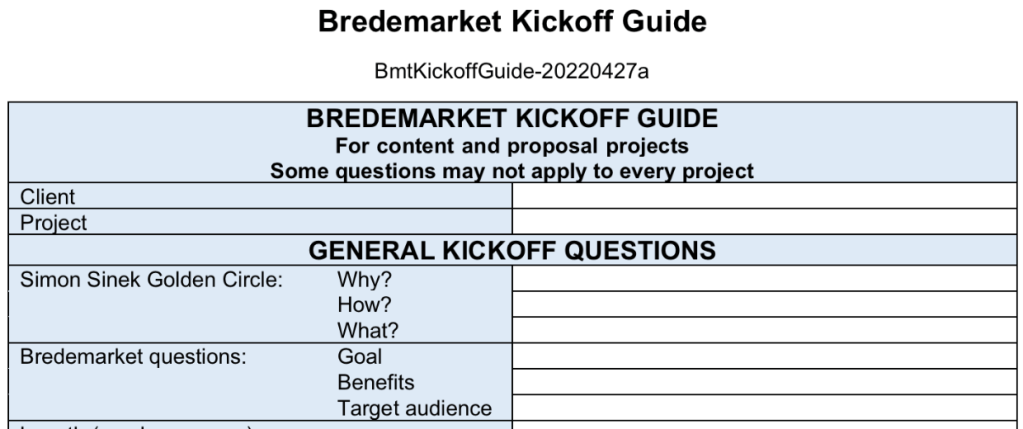
On occasion I’ve described the process that Bredemarket uses when kicking off a project with its clients. I start by providing a high-level overview.

Bredemarket’s content creation process ensures that the final written content (a) advances your GOAL, (b) communicates your BENEFITS, and (c) speaks to your TARGET AUDIENCE. It is both iterative and collaborative.

From https://bredemarket.com/2021/08/04/revising-bredemarkets-content-creation-process/

When I drill down into the content creation process itself, here is how I describe the kickoff meeting with the client.

You and Bredemarket agree upon the topic, goal, benefits, and target audience (and, if necessary, outline, section sub-goals, relevant examples, and relevant key words/hashtags, and interim and final due dates).

From https://bredemarket.com/2021/08/04/revising-bredemarkets-content-creation-process/

Agreement upon the branding strategy can fall into this initial discussion, perhaps when talking about the goal of the content. If the goal is to gently reassure potential clients that the service will ease their burdens, then the content will take one approach. If the goal is to shock and amuse potential clients with a stronger call to action, then you’ll use the mayhem guy.

Regardless of your process, it’s important to communicate and reach agreement on the critical things at the beginning of the project. This saves expensive rework later in the project.

Time to move on to the third concern, “we’ll lose accountability and quality control.

External content creators, part one: expertise

After reading a SideHusl recommendation for suggested work for nomads (even though I’m not a nomad), I signed up with yet another external referral service, Skyword. My Skyword profile is here, by the way.

From https://johnbredehoft.skyword.com/

After getting everything set up, I explored the company more deeply, and ran across this article by Skyword CEO Andrew Wheeler entitled “The Truth About Trusting External Content Partners.” The article addresses the reluctance of companies to trust outsiders to create their content. Wheeler cataloged four concerns and addressed them one by one.

As I read Wheeler’s article, three thoughts came to mind.

  1. I have things to say myself about each of these four concerns.
  2. Hmm…four-post series. Because the four-post series last week wasn’t enough.
  3. And then I can add the series to my Skyword portfolio.

So, let’s dig in. I’ll summarize the concern that a company may have with using an external content creator, look at how Andrew Wheeler addressed the concern, and then add a few thoughts of my own.

The concern

The first concern Andrew Wheeler raised in his article was the following:

The content won’t be in-depth or expert enough for our audience

From the perspective of the company, they’ve spent years or decades acquiring the expertise in question. What happens if they bring someone off the street who can spell “AFIS,” but has no idea what it is?

What Andrew Wheeler said

Wheeler addressed this concern by noting that there are a lot of people out there who have the expertise that a company needs. This is but a small part of what Wheeler said; read the rest here.

The reason we believe in tapping into freelance creators for content, rather than agencies or insourcing, is that the talent pool is so large it’s guaranteed that people with the skills you’re looking for are out there. 

From https://www.skyword.com/contentstandard/the-truth-about-trusting-external-content-partners/

As part of the process of signing up with Skywords as a freelancer, you are asked to go into detail about your specific expertise: identifying the types of expertise that you possess, and where you acquired that expertise.

What I say

From the freelancing perspective, it is incumbent on the freelancer to identify the specific expertise they can provide.

I won’t link to the specific conversations, but I’ve seen social media posts from aspiring freelance writers saying, “Hey, I can write stuff.” When pressed for details, they often respond, “Oh, I can write anything.” No wonder companies get jittery about using freelancers.

If you’ve read any of my stuff, you know that I have identified some specific areas of expertise that I provide. You know, the biometric content marketing expert and biometric proposal writing expert stuff. Although I’m certainly willing to expand beyond these core markets (see my first goal for 2022), I realize that my best chances at writing are with companies in the biometric/identity space.

In fact, my issue is the inverse of the company issue. While companies are looking for freelancers with relevant expertise, I am looking for companies that can use my relevant expertise. There are obviously a number of biometric/identity companies out there, some of which have used Bredemarket, others of which have not used Bredemarket.

Why isn’t EVERY biometric/identity company using Bredemarket?

Well, the concern about expertise is only the first concern. There are three others that must be addressed:

On corporate identity (not personal identity)

I was checking on Bredemarket’s appearance in various searches (have I told you that I am a biometric proposal writing expert?), and I ran across something having to do with proposals and identity that was outside of my usual definition of “identity.”

This article talked about writing a proposal to help a company establish its corporate identity.

(Yes, I know a corporation is a person, but this is something different. I can’t capture IBM’s face, and Wendy’s face is not necessarily a unique biometric identifier.)

Establishing an outward-facing corporate identity

In the article, Ruben described how to help a company establish its corporate identity. After suggesting that you ensure that you understand the company, Ruben focused on the company’s needs.

Identify the Needs – having described the company, the next step is to explain why your idea for a logo or marketing campaign is suitable for their goals. There may be many “needs” you need to address. For example, it might be a good idea to describe why rebranding can make a company look more modern and approachable.

From there, you would naturally describe how you would meet the company’s needs, and why you are qualified to meet the company’s needs.

If all goes well, the company will contract with you, then you will come up with a plan to optimize the company’s corporate identity. The company will implement the plan, the company’s revenue will increase, and you will be a hero.

But corporate identity goes beyond the logo, the website, and the marketing materials.

Establishing a strategic corporate identity

There’s an important step that a company needs to take before making decisions on outward-facing marketing.

The company has to decide who it is.

There are a multitude of ways to do this, ranging from a detailed business plan to a brief mission statement or statement of purpose. Regardless of the avenue you take, you need to know what you want to do.

Take an example from the 1980s. Perhaps some of you may remember Mita, famous for the advertising slogan “all we make are great copiers.”

There was a reason that Mita used that slogan:

If you are sixth in unit sales in the office copier industry and you are one of the few manufacturers that does not have a diversified product line, then the thing to do in your advertising is disparage diversification.

From https://www.nytimes.com/1985/10/02/business/advertising-mita-copier-campaign-has-a-single-theme.html

In this case, the advertising slogan helped shape the entire strategy of the company, resulting in a corporate identity that was very successful.

From https://www.youtube.com/watch?v=RkNbEoFHCtc

Revising a strategic corporate identity

In fact, it was too successful. Because if you already make great copiers, what else do you need to do? Not much, I guess.

But early in the 1990s, it started making mistakes: relocating factories in expensive Hong Kong, letting management become bloated and backsliding on technology. At the same time, Fuji-Xerox, Ricoh and Konica stepped up their presence. Among other things, Mita failed to embrace digital technologies.

From https://www.latimes.com/archives/la-xpm-1998-aug-13-fi-12663-story.html

See Kodak.

Mita eventually went bankrupt and was acquired by Kyocera, who immediately decided to work on Mita’s corporate identity. The company was rebranded as Kyocera Mita Corporation in 2000, and was re-rebranded as Kyocera Document Solutions in 2012. Mita schmeeta.

In today’s business world, digitalization is proceeding at an unprecedented pace and the volume of documents is growing exponentially.
In this business environment, we believe that our mission is to support our customers to effectively manage their information, and turn that information into knowledge, in order to address their challenges with a sense of speed.

From https://www.kyoceradocumentsolutions.com/company/greeting.html

You can see how the corporate identity has evolved over the decades, and how a company that once concentrated on taking pieces of paper and making identical pieces of paper now aspires to transform document information into knowledge to address challenges.

What does this mean for your corporate identity?

As I’ve noted, establishment of a marketing corporate identity is only part of an overall strategic plan to guide the future direction of a company.

Taking Bredemarket as an example, the corporate identity established by my logo is only a part of the plan guiding Bredemarket.

Bredemarket logo

The pencil symbolizes writing, and long experience in writing, but it does not say WHAT Bredemarket writes. That has been established, revised, and expanded, partially through the annual goals that I set.

As long as I don’t blow it and get too restrictive (Bredemarket: all we write are fingerprint RFP responses), I should be fine.

Bredemarket and proposals, part four: other services

So I’ve been going through my list of red bullets from this graphic.

Excerpt from https://bredemarket.com/wp-content/uploads/2022/02/bmtprop-20220221a.pdf

I decided to write posts on some of the red bullets to explain the types of services that Bredemarket offers.

  • The first post described Bredemarket’s RFx response services.
  • The second described Bredemarket’s sole source response services.
  • The third described Bredemarket’s proposal template services.

Which brought me to the fourth bullet, which was a fairly interesting project.

The technical leave behind project

This particular project was an unusual one, for two reasons.

First, there were four companies involved:

  1. Bredemarket.
  2. The company that contracted Bredemarket.
  3. The company that contracted the company that contracted Bredemarket.
  4. The final customer.

Despite all of the layers on this particular project, the people from all four companies worked well together and got the job done.

The second unusual thing about this particular project was that although it was not a proposal project per se, it required proposal expertise.

While I can’t go into details, I can briefly say that the goal of the project was to provide “technical leave behinds” for the final customer. The customer was a consulting firm with significant technical expertise in a particular vendor’s product family. When the customer visited one of its clients, it wanted to leave its client with one or more of these technical leave behinds, each of which was devoted to one of the many products in the product family.

So while these technical leave behinds were not proposals themselves, and on first glance appear to be more along the lines of Bredemarket’s content marketing work, they fulfilled a proposal-like purpose by providing information that the client could subsequently use to request information or a proposal from the consulting firm.

Because of this, the technical leave behinds had to be customer centric and respond to specific needs that customers may have. Maybe not to the specific level of detail that would satisfy 100% of any one customer’s specific needs, but the leave behinds at least had to address some major needs in template form.

So what?

Those of you who have read my writing on benefits knew that this question was coming.

“So Bredemarket can author technical leave behinds. So what?”

The benefit to you is that Bredemarket can work with you to create text to meet any of your needs, even if it doesn’t fit into some nice neat category such as a sole source proposal or an RFP response or a case study or a white paper or a blog post. For example, over the years I’ve not only created technical leave behinds, but I’ve also created and/or maintained trade show demonstration scripts, brief company analyses, customer and competitor installation lists, internal information services, external information services (including dedicated LinkedIn and Facebook pages devoted to particular topics), website and social media analyses, and a myriad of other pieces of written content.

If you need any type of written content that can help your company connect with other companies, let me know and I’ll work with you to create that content.

OK, now I’m done with expanding on the red bullets. There’s no point in expanding on the fifth bullet, “Additional proposal work for Bredemarket itself,” because that service is of no benefit to you. It only benefits me. Similarly, my MorphoTrak and Printrak proposal work won’t benefit you, unless you work for IDEMIA and are making money off of my prior work.

Again, if you missed any posts in the series, be sure to visit parts one, two, and three. And let me know if I can help you.

Why am I using the word “casetimonial”?

We often get bent out of shape trying to come up with precise definitions of things. While sometimes this precision is warranted, there are times when it is overkill.

Take the answer to this question:

What is the difference between a case study and a testimonial?

Not that type of case. By Thomas Quine – Lead type case, CC BY 2.0, https://commons.wikimedia.org/w/index.php?curid=51684202

Some people have taken some time answering the question about the difference between a case study and a testimonial. For example, here’s what Juliet Platt says:

The difference between Case Studies and Testimonials is really length and depth.

From https://casestudywriter.co.uk/whats-the-difference-between-a-case-study-and-a-testimonial/

Platt then gives examples of the longer, in-depth nature of case studies vs. the shorter nature of testimonials.

Another person who has addressed the question is Donna St. Jean Conti:

“Show me ROI, or it’s not a case study.” An editor told me this some 15 years ago, and he was so right.

From https://www.agilitypr.com/pr-news/public-relations/whats-the-difference-between-a-case-study-and-a-testimonial/

This gets into the difference between quantitative information and qualitative information. By this definition, a case study always has to address return on investment, or it’s not a case study.

I have a different view

While I respect the views of these two people (and others), I have a different view. My answer to the question “What is the difference between a case study and a testimonial” is as follows:

Who cares?

From https://bredemarket.com/bredemarket-and-case-studies/

Let me explain.

Regardless of what you call the document, a case study or a testimonial allows a firm to attract new customers by showcasing the successes of existing customers.

From https://bredemarket.com/bredemarket-and-case-studies/

And as far as I’m concerned, the length of the piece and the choice to use quantitative or qualitative data (or both) is secondary to the primary purpose, which is to present an example that resonates with a potential customer.

Not that I don’t have ANY rules. Whether you’re writing a case study or testimonial, I like to structure it with the following format:

  1. The problem.
  2. The solution.
  3. The results (from using the solution to solve the problem).

This format allows a customer-centric presentation with which the reader can identify. “Hey, Joe’s Garage used this widget to solve their problem. Maybe I can use this widget to solve a similar problem.”

Now perhaps others use a different outline for their case studies or testimonials. And that’s…OK.

For those of you old enough to remember Stuart Smalley. By http://www.tvacres.com/words_stuart.htm, Fair use, https://en.wikipedia.org/w/index.php?curid=31855280

My own term

So for ease of communication, I’ve decided to adopt a different term. It’s not original with me, but it doesn’t look like anyone else is currently using the term on a regular basis.

Instead of using awkward references to “case studies and/or testimonials,” I’m just going to refer to casetimonials.

I used the casetimonial term a lot on this page (recently revised) on the Bredemarket website, which not only includes a shorter form of the discussion above about the difference between a case study and a testimonial, but also discusses how a casetimonial can be used, how it can be repurposed, the types of firms that can benefit from casetimonials, and how Bredemarket can help you create your own casetimonials.

If you can use Bredemarket’s assistance with communicating past customer successes to future clients:

Retabulating the work that Bredemarket has done for clients (as of February 16, 2022)

My biometric/identity collateral wasn’t the only thing that I updated yesterday.

As part of my preparation for yesterday evening’s Ontario IDEA Exchange meeting, I took the time to update my “local” brochure. (Because local is important: see the first of my three goals for 2022.) This brochure includes a section that discusses the types and numbers of pieces that I have prepared for clients, including the number of case studies, the number of RFx responses, and so forth.

Those numbers hadn’t been updated since last September.

Before going to the meeting, I wanted to make sure my “local” brochure had the latest numbers.

I’ll go ahead and share them with you. This covers the projects that Bredemarket has completed for clients over the last 18 months, as of February 16, 2022:

  • Fourteen (14) case studies
  • Eight (8) articles (blog posts)
  • Three (3) service offering descriptions
  • Three (3) white papers
  • Nine (9) RFx responses
  • Four (4) sole source responses
  • Six (6) proposal templates
  • One (1) technical leave behind
  • Two (2) biometric analyses
Inland Empire B2B Content Services from Bredemarket.

As it turns out, I didn’t hand out my local brochure to anyone at last night’s IDEA Exchange. (It was a small crowd, most of whom I already knew.)

But at least I’ve tabulated the numbers.

Now I just have to update all of my NON local collateral…

Who said something about marketing channels that lack content?

Good evening, loyal readers. Although I’ve tested your loyalty lately.

This is my first post on the Bredemarket blog since December 24.

As in nearly a month ago.

Now who was it that said “If your marketing channels lack content, your potential customers may not know that you exist”?

Oh, yeah. That was me.

So what happened? Why haven’t I been posting anything here in nearly a month?

Well, business picked up considerably, and I haven’t had the spare time to conceive and write new blog posts.

(Incidentally, it turns out that the “(non-identity) proposal consulting contract” that I referenced in my December 10 post will extend beyond Tuesday, January 25. The end customer granted an extension to the proposal due date, and we’re taking advantage of the extension.)

And I already have two new projects lined up, as well as some continuing work.

Now I just have to figure out a way to continue my own marketing efforts.

Because as someone once said, “If your channels lack content, your potential customers may forget about you. And that’s NOT good for business.”

Perhaps I should hire myself to create content for myself. That would result in some interesting entries in my accounting system. And would I issue a 1099 to myself?

Another reason to repurpose old content

Earlier this week I was asked about one of the posts that I wrote in the Bredemarket blog. I had to confess that I hadn’t thought about the topic much recently.

After this conversation, I realized that the referenced post was written back in July.

Because I’ve written over 200 posts in the Bredemarket blog over the past year-plus, some of them kind of get merged together in my mind.

And in this particular case, my thoughts on the original topic have evolved since the summer.

So if you see a future post that revises and updates something I wrote about four months ago, now you know why.

I hope that the new post won’t be dramatically different from the old one.

So who is Cubox?

Some people like to look at baseball statistics or movie reviews for fun.

Here at Bredemarket, we scan the latest one-to-many (identification) results from NIST’S Ongoing Face Recognition Vendor Test (FRVT).

Hey, SOMEBODY has to do it.

Dicing and slicing the FRVT tests

For those who have never looked at FRVT before, it does not merely report the accuracy results of searches against one database, but reports accuracy results for searches against eight different databases of different types and of different sizes (N).

  • Mugshot, Mugshot, N = 12000000
  • Mugshot, Mugshot, N = 1600000
  • Mugshot, Webcam, N = 1600000
  • Mugshot, Profile, N = 1600000
  • Visa, Border, N = 1600000
  • Visa, Kiosk, N = 1600000
  • Border, Border 10+YRS, N = 1600000
  • Mugshot, Mugshot 12+YRS, N = 3000000

This is actually good for the vendors who submit their biometric algorithms, because even if the algorithm performs poorly on one of the databases, it may perform wonderfully on one of the other seven. That’s how so many vendors can trumpet that their algorithm is the best. When you throw in other qualifiers such as “top five,” “best non-Chinese vendor,” and even “vastly improved,” you can see how dozens of vendors can issue “NIST says we’re the best” press releases.

Not that I knock the practice; after all, I myself have done this for years. But you need to know how to interpret these press releases, and what they’re really saying. Remember this when you read the vendor announcement toward the end of this post.

Anyway, I went to check the current results, which when you originally visit the page are sorted in the order of the fifth database, the Visa Border database. And this is what I saw this morning (October 27):

For the most part, the top five for the Visa Border test contain the usual players. North Americans will be most familiar with IDEMIA and NEC, and Cloudwalk and Sensetime have been around for a while.

A new algorithm from a not-so-new provider

But I had never noticed Cubox in the NIST testing before. And the number attached to the Cubox algorithm, “000,” indicates that this is Cubox’s first submission.

And Cubox did exceptionally well, especially for a first submission.

As you can see by the superscripts attached to each numeric value, Cubox had the second most accurate algorithm for the Visa Border test, the most accurate algorithm for the Visa Kiosk test, and placed no lower than 12th in the six (of eight) tests in which it participated. Considering that 302 algorithms have been submitted over the years, that’s pretty remarkable for a first-time submission.

Well, as an ex-IDEMIA employee, my curious nature kicked in.

Who is Cubox?

I’ll start by telling you who Cubox is not. Specifically, Cubox is not CuBox the low-power computer.

The Cubox that submitted an algorithm to NIST is a South Korean firm with the website cubox.aero, self-described as “The Leading Provider in Biometrics” (aren’t they all?) with fingerprint and face solutions. Cubox competes in the access control and border control markets.

Cubox’s ten-year history and “overseas” page details its growth in its markets, and its solutions that it has provided in South Korea, Mongolia, and Vietnam.

And although Cubox hasn’t trumpeted its performance on its own website (at least in the English version; I don’t know about the Korean version), Cubox has publicized its accomplishment on a LinkedIn post.

Why NIST tests aren’t important

But before you get excited about the NIST results from Cubox, Sensetime, or any of the algorithm providers, remember that the NIST test is just a test. NIST cautions people about this, I have cautioned people about this (see the fourth point in this post), and Mike French has also discussed this.

However, it is also important to remember that NIST does not test operational systems, but rather technology submitted as software development kits or SDKs. Sometimes these submissions are labeled as research (or just not labeled), but in reality it cannot be known if these algorithms are included in the product that an agency will ultimately receive when they purchase a biometric system. And even if they are “the same”, the operational architecture could produce different results with the same core algorithms optimized for use in a NIST study.

The very fact that test results vary between the NIST databases explicitly tells you that a number one ranking on one database does not mean that you’ll get a number one ranking on every database. And as French reminds us, when you take an operational algorithm in an operational system with a customer database, the results may be quite different.

Which is why French recommends that any government agency purchasing a biometric system should conduct its own test, with vendor operational systems (rather than test systems) loaded with the agency’s own data.

Incidentally, if your agency needs a forensic expert to help with a biometric procurement or implementation, check out the consulting services offered by French’s company, Applied Forensic Services.

And if you need help communicating the benefits of your biometric solution, check out the consulting services offered by my own company, Bredemarket. After all, I am a biometric content marketing expert.

What if your business has no website or web page?

In January of this year, I wrote a couple of posts about websites with outdated content.

The posts were obviously self-serving (since Bredemarket happens to sell services to update website text), but the second post backed my points up with data.

Specifically, a study noted that when people want to research a solution, 53% of them perform a web search for the solution, and 41% of them go to vendor web sites.

I used this data to make the point that your website had better be up to date, if you want your potential customers to have a good impression of your business.

An outdated website looks bad.

But I just ran across something even worse.

Worse than an outdated website

I’m not going to provide specifics, but I just saw a Facebook post in a local business group that promoted a service. This happens to be a service that is popular with individuals and businesses. The Facebook post stated that the service provider was the best provider in the local area, and was better than the competition. The post then gave the company name of the service provider, and…

…a local phone number.

You can guess what I did next. Like 53% of you, I searched for information on this particular company. I started on Facebook itself; since the individual made the post on Facebook, I figured that the company had a Facebook page.

It didn’t. The company had no Facebook presence.

So I got out of Facebook and went off into the World Wide Web and (like 41% of you) searched for the company’s web page.

I found no company web page with that name in California, but I did find a company with that name in another part of the country that coincidentally provided the same service. But I could tell that this was a separate company.

So I went back to the original Facebook post and asked a question.

Does [COMPANY NAME] have a website, or just a phone number?

I received a response from the original poster.

Bredemarket, no, just a number.

I made no further comment, but it got me thinking.

What’s worse than a website with outdated content?

No website or web page at all.

And I’m not talking about a fancy-dancy website. If you’ve seen Bredemarket’s website, it’s not fancy-dancy.

I’m just talking about a simple page. It doesn’t have to be on your own domain; it could be on wordpress.com (like my jebredcal site) or wix.com even facebook.com (Bredemarket has one of those too). Just something that ideally tells you the company name, the person who runs the company, the address of the company (yes, UPS Store addresses are acceptable; I know), a phone number, and an email address.

When all of these elements are available, and they’re present on a website, you have at least some assurance that the company is a viable concern. (I’ll grant that this can be faked, like Abdul Enterprises was faked, but at least a name, address, email, and phone number suggest that the company is real.)

A company name and a phone number with no website, no email address, and no company ownership information is…well, it’s sketchy.

So how does a company without an online presence establish one?

There are a variety of ways to establish a company online presence. You could pay for a website, you could set up a free website via a variety of service providers, or you could simply set up a social media page such as a Facebook page.

Now Bredemarket doesn’t create websites, and Bredemarket doesn’t create Facebook business pages. Facebook offers step-by-step instructions on how to create a Facebook business page, and there are guides on how to create complete websites such as a Wix site (and you can do it for free if you don’t need a custom domain and use accountname.wixsite.com/siteaddress).

Creating the site, however, is only part of the story.

Bredemarket can help you establish the initial content for a website or a Facebook page. (And if you desire, I can help you refresh the content also.)

Let’s look at the simplest example, where you just want to establish a presence with a few hundred words (say 400 to 600 words).

I’ll start by asking you a bunch of questions.

  • Topic. Well, the topic is your business, of course, but how would you summarize your business in one sentence?
  • Goal. What is the goal of your site or page? Do you want people to immediately buy something online? Do you want people to rush to your business location and buy something? Or do you just want people to talk to you about your product or service?
  • Benefits. I’ve talked about this ad nauseum, but it’s important to explain why people should want your product or service. If your explanation results in a “so what?” from the potential customer, then you need to refine your benefit statement.
  • Target audience. The message on your site or page is obviously affected by your target audience. A page intended for forensic scientists will have different messaging than a page intended for high school students who want an after school snack.
  • Other questions. These are going to vary from engagement to engagement, but it’s important to ask these questions up front to minimize any misunderstandings later.

After you and I have talked through these questions, I’ll start creating the text to place on your website. By the time we’ve gone through the process and we’re done, you’ll have an initial website presence for your business. People will be able to find your business, find out what it’s about, contact you, and give you lots of money.

But that won’t happen until the people can find out what you offer.

And it won’t happen if they only have a business name and a phone number.

If you want Bredemarket to help you establish an online presence with the correct words to woo customers:

Inland Empire West businesses should visit https://bredemarket.com/local/ for a special “locals only” discount.