But I thought I’d better check the “Who I Am” page before resharing it to Facebook. And it’s good I did, because I realized that it required one important update.
Well, perhaps the page didn’t require the update, but I personally thought the update was necessary. I’ll let you judge for yourself.
Regardless of whether this edit was needed, static web pages certainly can change.
The “Who I Am” page before the change
If you haven’t seen my “Who I Am” page, it starts with a description of me and my writing background, then transitions into the story of how Bredemarket came to be. After describing the events that prompted me to establish Bredemarket, I concluded the section as follows:
So I formally registered Bredemarket with the City of Ontario and San Bernardino County, and with other private businesses that allowed me to offer my services.
It’s a nice little story about the establishment of Bredemarket in the fall of 2020, but as originally written the “Who I Am” page doesn’t describe the changes to the company that took place in the spring of 2022.
So I just inserted some material between the two paragraphs reproduced above.
For nearly two years, Bredemarket was my primary source of income.
As mentioned above, I have limited time to spend on Bredemarket, and revamping the entire website is not the best use of my time.
Of course I could pay someone to do it, but Bredemarket’s revenue is also limited.
There are also SEO considerations. Some time ago I knew of a company that performed a complete (and necessary) website revamp, despite the hit that it would deal to the company’s search results. And yes, search results did take a hit.
So I’m not going to chuck the existing Bredemarket website and start over.
However, I am going to try to slowly refresh the existing static web pages (currently 39) as I encounter them, so that the existing search results will be improved.
And how do you decide who the target segments are within that target audience?
The professional marketer’s way to define a target segment
A few months ago, some marketers were writing eight pieces of content. At one point, they stepped back and defined personas that corresponded to these eight pieces of content.
A persona is a fictional, yet realistic, description of a typical or target user of the product. A persona is an archetype instead of an actual living human, but personas should be described as if they were real people.
Harley shared an example of a persona (go to her article to see it) that incorporated a lot of detail:
A name (in this case, “Rosa Cho”)
Biographical details (job title, age, city of residence)
Behavioral details (what motivates her, her frustrations, her goals)
Why all the detail? Because this detail allows us to think of this abstract persona as a living person. As marketers design their product, they can reference this persona and ask themselves if Rosa Cho would like this content.
The first of these 9 steps is to perform research to obtain reliable data (rather than mere hypotheses) about your persona. This research may be based on your own knowledge, on interviews with customers and customer-facing salespeople, or on data sources (including web analytics).
The remaining 8 steps use this research to segment the audience into individual archetypes, decide on the layout (what the persona will contain), and fill in the details. I’m not going to reproduce all of McCay’s content; you can see all 9 of his steps here.
If you’re someone who thinks that 9 steps is too many steps, perhaps you’ll prefer Louis Grenier’s 4 step process. Although frankly it’s pretty much the same.
Choose questions for your survey
Set up a survey on a popular page
Analyze your data
Build your persona
OK, the emphasis is slightly different, but in both cases you assemble data (McCay uses multiple sources, Grenier uses a survey), analyze it, and then create the personas.
And I’m sure there are a variety of other methods to create personas. If you want to go down the persona creation route, choose the one that works for you.
Why personas?
But why create personas?
Because marketing research emphasizes that persona creation is better than the alternative.
As every professional marketer knows, the data-driven method of persona creation is necessary to create accurate personas. As McCay states:
It is important to keep in mind that a persona is a collective image of a segment of your target audience (TA). It cannot be the face of the entire TA. Nor can it be just one person. You need somewhat of a golden middle.
Note that you should never base your target segment on the attributes of a single person. That’s going to skew your data and perhaps overemphasize some quirk of the individual person.
For example, if your company were marketing to part-time consultants, and chose to market to me rather than a persona created from data, then your company would erroneously conclude that all part-time consultants have prior experience with FriendFeed and an interest in orienteering.
This is not accurate for other part-time consultants, 99.99999% of whom have never heard of FriendFeed and think that orienteering is some form of Japanese study. (It isn’t.)
If you aspire to be a professional marketer, don’t read this
As professional marketers will tell you, using a real person rather than a constructed persona to define your target audience (or target segment) is an absolutely terrible thing to do.
But be terrible.
For some of you, I recommend that you consider using a real person as a starting point.
Large multi-million dollar businesses can devote the resources to the surveys, interviews, analytics, and other steps necessary for thorough persona creation.
But what if you’re a small business and don’t have the time or resources to do all that?
Don’t tell anyone, but you can cheat.
Don’t read this either: two steps to define a target segment
So you’ve read the warnings above, but you’re ready to ignore them and forgo you chance at a Super Duper Marketing Research award (application fee $899, not counting the cost of the awards dinner).
Without further ado, here are Bredemarket’s two steps to define a target segment.
Start with a real person.
Adjust.
If you read above, you realize that this method has severe problems, especially if you skip the second step altogether. By starting your focus with a real person, you could inadvertently create marketing text that emphasizes individual eccentricities that are relatively unimportant.
Is your content true north, or magnetic north?
But if you use your smarts to adjust and generalize the original person, you have a quick and dirty way to create your persona.
Rather than collecting extensive survey results and deriving an artificial persona from those results, you start with a real person.
An example
For example, let’s say that my company Bredemarket is targeting local businesses that need content or proposal creation.
I could start with a real local person who could use Bredemarket’s services, and then adjust that real biography and behavioral attributes as necessary to remove the oddities.
Or I could start with a non-local person and adjust as necessary to make the person a local person, filling in biographical and behavioral details as needed.
Either way, the end product is a quick and dirty persona that Bredemarket can use to target local businesses.
But what do professional marketers do in reality?
But are quick and dirty personas too dirty to use? Shouldn’t we stick to professional marketing techniques and create fictitious personas?
For example, when you create your Rosa Cho persona, how do you depict the persona? Do you use an illustration, or do you use an image of a real person?
A real photo is obviously a terrible thing to use, because it is based on a real individual and ignores all of the research that you performed to create the rest of the persona.
And illustrations can be fallible, since chances are that they don’t incorporate all of your research either. (Does the median 34 year old freelancer from Seattle really look like the illustration? Or does the illustration more accurately depict a 35 year old from Tacoma?)
Let’s face it: persona creation is not merely a science, but also an art. And sometimes you may take artistic license. This content marketing expert gives you permission to do so.
TL;DR Do what you want
There are valid arguments for a 4 step, 9 step, or 96 step (heh) persona creation process.
And there are valid arguments for just winging it.
The important thing is to target somebody when creating content, or having someone create content for you.
Which is why Bredemarket asks customers who their target audience is in the first place. It’s all in Bredemarket’s most recent e-book; read this post to find out how to download the e-book.
I’ve been going through some of my other blogs and finding things that I forgot I wrote. For example, I wrote something on my Empoprise-BI blog entitled “When retailers INTRODUCE friction.”
It’s not surprising that I was writing about frictionless experiences in 2019. After all, my then-employer IDEMIA was promoting the touchless fingerprint reader MorphoWave and its use in places like dining halls.
But I was surprised that my Empoprise-BI 2019 post started with a discussion on online shopping cart abandonment.
And there’s a dramatic financial incentive to make shopping frictionless – roughly 70% of online shopping carts are abandoned without the customer purchasing anything, a potential loss of revenue for the company. The same thing can happen at old-fashioned physical stores, except that in this case the abandoned shopping carts are real shopping carts – and if there’s frozen food sitting in an abandoned shopping cart, you have to deal with both lost revenue and lost inventory.
In identity proofing, friction results when it takes significant effort for a person to prove who they are. If it takes a user too long to prove their identity, the user may become frustrated and give up. This hurts businesses that depend upon digital onboarding for their customers.
Whether you conduct business online or in-person, it’s wise to take an audit of your business practices to make sure you’re not throwing up roadblocks that keep your customers away. And not just the identity stuff; are there other things that make it hard for customers to buy from you?
As I pivot Bredemarket’s writing services (due to my exit from some biometric writing) and return to a more regular blog posting schedule, I’ve discovered that Bredemarket isn’t the only Inland Empire West business that could use some additional text content.
There are local business websites with blogs that are nearly dormant. And that’s not good.
Sure, some of them have active image-based accounts on popular social services (Instagram, TikTok, etc.).
Content that answers a lot of questions about your business – six questions in particular. Actually more than that, but there are six questions that will get you started with your personal content creator. I know; I wrote the book on it.
The answers to those questions launch an iterativeprocess to create your blog content. Perhaps a one-time post, or better yet a blog post every month, attracting customers on a regular basis. Your own secret salesperson, as it were.
I offer the Bredemarket 400 Short Writing Service, a package that starts with a kickoff session and ends with between 400 and 600 words of blog or social content.
This gave me an opportunity to revisit the topic and add critical information on wildebeests, George (H.W.) Bush, and Yogi Berra.
But more importantly, it allows me to share my thoughts with a wider audience.
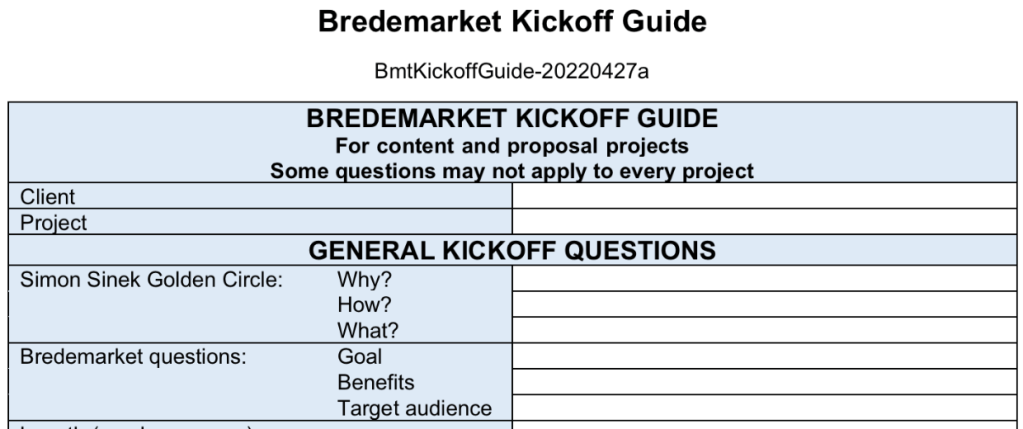
If you missed the October blog post, I state that there are six critical questions that your content creator must ask before creating content. These questions apply whether your content creator is a consultant, an employee at your company, or you.
The e-book discusses each of these six questions:
Why?
How?
What?
Goal?
Benefits?
Target Audience?
And as I note in the e-book, that’s just the beginning of the content creation process.
Whether you intend to use Bredemarket as your content creator, use someone else as your content creator, or create your own content, the points in this e-book are helpful. They can be applied to content creation (case studies, white papers, blog posts) or proposal work, and apply whether you are writing for Inland Empire West businesses or businesses anywhere.
And if you read the e-book, you’ll discover why I’m NOT sharing it on the Bredemarket Identity Firm Services LinkedIn page and Facebook group.
You can download the e-book here. And you can be a content marketing expert also.
(UPDATE OCTOBER 22, 2023: “SIX QUESTIONS YOUR CONTENT CREATOR SHOULD ASK YOU IS SO 2022. DOWNLOAD THE NEWER “SEVEN QUESTIONS YOUR CONTENT CREATOR SHOULD ASK YOU” HERE.)
For those who are not familiar with the term, a “call to action,” abbreviated as CTA, is just what it sounds like: a summons to do something. So if you want to call it a STDS, feel free. (Although I wouldn’t.)
Of course, calls to action have been used long before the digital world appeared. For several decades, automobile dealer Cal Worthington (and his dog Spot) wanted people to come to his car dealerships, so in between the entertaining animals, the call to action “Go see Cal” was repeated in commercials like this one.
And things haven’t changed in the 21st century, except that most of us have retired the dog Spot. For example, some of my blog posts include the following call to action:
These three bullets, when used, are preceded by a statement such as “If I can work with you to create your written content, please contact me.” Or whatever makes sense for the particular blog post.
But not all of my posts include the three CTA bullets.
Posts for awareness don’t need CTAs
(UPDATE 7/24/2023: Upon further reflection, I should have said “Posts for awareness don’t ALWAYS need CTAs.” See my updated blog post, “Awareness Calls to Action.”)
Candy Street Market, 110 W Holt, Ontario, California
This post simply talked about a new candy store in Ontario, California, but never talked about Bredemarket’s content creation or proposal writing services.
So why did I write a post that doesn’t directly lead to business?
In short, the post let people know all of the business that I wouldn’t accept in the future.
Why post a call to action after announcing that?
And how would I word it? “If you are a biometric identity company that needs content marketing or proposal writing services, don’t call me”?
It comes down to goals
But you don’t need to detailed list of do’s and don’ts to determine which blog posts need CTAs.
It all boils down to one simple question:
What is the goal of the blog post?
As I stated in October, one of the six questions that you (or your content creator) should ask before starting work is about the goal for the piece of content.
Do you want people to keep you in mind if they need your product or service in the future? (“That guy knows Ontario, and he writes content; maybe he can help me.”)
Do you want people get more information on something (such as a service description)?
Do you want people to contact you personally if they want more information?
Do you want people to pull out their credit card immediately and buy something?
The answers to those questions will shape the final content, whether a CTA is needed, and the type of CTA.
This post DOES have a CTA
So let’s say you’re an Inland Empire business that needs a content marketing expert to write a blog post for you.
And let’s say that you have specific goals for this blog post.
And you’re targeting a particular audience for this blog post. (Maybe candy lovers.)
And you realize that buyers aren’t persuaded by a list of features you offer, but by a list of benefits for them. (Yes, benefits are important.)
Before Bredemarket writes a blog post for you, I’ll ask you about these items and others (see the list here), to make sure that my work is aligned with what you need.
So do you want to talk to me about that blog post that your business needs?
The store has announced a soft opening, but it’s apparently very soft; I went by at 11:15am today (Saturday) and the door was locked with no hours posted.
But stay tuned to its Instagram account candystreetmarket for updates.
Candy Street Market is at 110 W Holt in Ontario, next to the Honduran restaurant.
Candy Street Market, 110 W Holt, Ontario, California
If you want a content marketing expert to write for your business, do you just say “Write this, and make it viral”?
Not THAT viral. (Too soon?) By Alexey Solodovnikov (Idea, Producer, CG, Editor), Valeria Arkhipova (Scientific Сonsultant) – Own work. Scientific consultants:Nikitin N.A., Doctor of Biological Sciences, Department of Virology, Faculty of Biology, Lomonosov Moscow State University.Borisevich S.S. Candidate of Chemical Sciences, Specialist in Molecular Modeling of Viral Surface Proteins, Senior Researcher, Laboratory of Chemical Physics, Ufa Institute of Chemistry RASArkhipova V.I., specialization in Fundamental and Applied chemistry, senior engineer, RNA Chemistry Laboratory, Institute of chemical biology and fundamental medicine SB RAS, CC BY-SA 4.0, https://commons.wikimedia.org/w/index.php?curid=104914011
Six words of instruction will not result in great content.
Even if you just say “Write this” and leave off the viral part, this will not work either.
You and your content creator have to have a shared understanding of what the content will be.
For example, as I indicated in a previous post, you and your content creator have to agree on the tone of voice to use in the content. The content creator could write something in a tone of voice that may not match your voice at all, which would mean that the content would sound horribly wrong to your audience.
Imagine a piece for financial executives written in the style of Crazy Eddie. Ouch.
And that’s just one thing that could go wrong when you and your content creator are not on the same…um, page.
Bredemarket’s content creation process includes six questions
When Bredemarket works with you to create content, I use a content creation process. I’ve revised my original content creation process severaltimes, and I’m sure I’ll revise it more as I work with more of you.
But as of today, Bredemarket’s kickoff meetings with clients begin with six high-level questions that set the scene for everything that follows.
Question One: Why?
As I noted in my Simon Sinek post, the “why?” question needs to be answered before any other question is asked.
Before you ask a content creator to write a case study about how your Magnificent Gizmo cures bad breath, you need to understand why you’re in the good breath business in the first place. Did you have an unpleasant childhood experience? Were you abandoned at the altar? WHY did you care enough to create the Magnificent Gizmo in the first place?
(As I write this post, I’m going to look at how each of these six questions can be answered for the post itself. After all, it’s fair to ask: Why does Bredemarket do what it does? Short answer: because I write. You can pry my keyboard out of my cold dead hands. For the longer answer, read the “Who I Am” page on the Bredemarket website.)
Question Two: How?
You also need to make sure your content creator can explain how you do what you do. Have you created your own set of algorithms that make breath good? Do you conduct extensive testing with billions of people, with their consent? How is your way of doing things superior to that of your competitors?
Once these are clear in your mind, you’re ready to talk about the “what.” As Sinek notes, many people start with the “what” and then proceed to the “how,” and may or may not even answer the “why.” But when you ask the “why” first and the “how” second, your “what” description is much better.
(Again, you may be asking what Bredemarket does. I craft the words to communicate with technical and non-technical audiences. For additional clarification, read “What I Do,” which also notes what I don’t do. Sorry, finger/face/ID document vendors.)
Question Four: Goal?
Once the Golden Circle is defined, we’re ready to dig a little deeper into the specific piece of content you want. We’re not ready to talk about page count and fonts, yet, though. There’s a few other things we need to settle.
What is the goal of the content? Simple awareness of the product or service you provide? Or are you ready for consideration? Or is it time for conversion? The goal affects the content dramatically.
(In the case of this post, the goal is primarily awareness, but if you’re ready for conversion to become a paying customer, I won’t turn you away.)
Question Five: Benefits?
I’ve written ad nauseum on the difference between benefits and features, so for this question five about benefits I’ll just briefly say that written content works best when it communicates how the solution will help (benefit) the customer. A list of features will not make a difference to a customer who has specific needs. Do you meet those needs? Maintain a customer focus.
(Bredemarket’s primary benefit is focused content that meets your needs. There are others, depending upon your industry and the content you require.)
Question Six: Target Audience?
This one is simple to understand.
If you’re a lollipop maker and you’re writing for kids who buy lollipops in convenience stores, you’ll write one way.
If you’re a lollipop maker and you’re writing to the convenience stores who could carry your lollipops, you’ll write another way.
Now sometimes content creators get fancy and create personas and all that (Jane Smith is a 54 year old single white owner of a convenience store in a rural area with an MBA and a love for Limp Bizkit), but the essential thing is that you understand who you want to read your content.
(This particular piece is targeted for business owners, executives, directors, and managers, especially in California’s Inland Empire, who have a need to create focused content that speaks to their customers. The target audience not only affects how I am writing this post, but also how I will distribute it.)
What if you use a different content creator?
I am forced to admit that not everyone chooses Bredemarket to create their content.
Maybe you create your content yourself.
Maybe you already have access to content creators.
Or maybe you have a limited budget and can only pay a penny a word to your content creator. Let’s face it, a five dollar blog post does sound attractive.
But that doesn’t mean that you can’t use these six questions. I did publish them, after all, and they’re based on questions that others have asked.
If you create your own content, ask yourself these six questions before you begin. They will focus your mind and make your final content better.
If you have someone else create your content, make sure that you provide the answers for your content creator. For example, if you seek a content creator on Upwork or Fiverr, put the answers to these questions in your request for quotes. Experienced writers will appreciate that you’re explaining the why, how, what, goal, benefits, and target audience at the very beginning, and you’ll get better quotes that way. If someone knows your target audience is crime scene examiners, then you’ll (hopefully) see some quotes that describe the writer’s experience in writing for crime scene examiners.
And if you provide the answers to those six questions and your content creator says, “That doesn’t matter. I write the same for everyone,” run away.
I have done a little bit of acting in my life, and have learned that acting often involves removing aspects of yourself and replacing them with aspects of your character. Just like donning a mask to cover parts of your head.
Perhaps the character you are playing as an actor may be dramatically different from your own self. To my knowledge, Carroll O’Connor did not insult non-white people like his character Archie Bunker did.
Yet at the same time, the character necessarily acquired some traits from the actor, and the actor identified with the character.
When we spoke to (O’Connor) prior to his death, he explained to us that he constantly had to battle writers who thought they understood the character better than he did.
But this post is not about “All in the Family.” It’s about “All in the Business.”
When a business’ archetype is not your own
I’ve previously written about archetypes before, in the August 2021 post “Why is Kaye Putnam happy that I’m IGNORING her marketing advice?” That post describes how I took an online test to see which of twelve brand archetypes matched the personality of Bredemarket, and also myself. The results clearly showed that I was primarily aligned with the Sage archetype.
(Ignore the political ramifications. Stay with me here.)
So how do you doff a “Sage” mask and don a “Maverick” mask, or perform some other archetype switch?
You need to understand the brand archetype you are targeting, and consciously adapt your communication to fit that archetype rather than your own.
So perhaps I might write a sentence like this in my normal Sage mode:
Finding the perforations in the wrapper, I carefully unwrapped the ice cream sandwich.
But how would a Maverick open an ice cream sandwich?
Removing the barriers that separated me from the final product, I boldly unwrapped the ice cream sandwich.
In the past, I guess I’ve subconsciously absorbed the tone of voice for a client or employer for whom I was writing, but in most cases I never thought of this in archetype terms.
What is your archetype? And should you care?
So when Bredemarket or another content marketing expert starts to write something for you, should you fret and fuss over what your archetype is?
If you feel like it. But it’s not essential.
What is essential is that you have some concept of the tone of voice that you want to use in your communication.
And how do you know what tone you want to use? You have to answer some questions.

















 Bredemarket