If you can use my services in any of these areas, book a free 30 minute content needs assessment and talk to Bredemarket. https://bredemarket.com/mark/
Once I answered that question (I think you can guess my answer), I talked about how you can effectively combine word-of-mouth and corporate efforts via “casetimonials“—either case studies or testimonials that allow the happy customer to have their say, while your company helps to shape the message.
Focusing on case studies, I said the following:
Case studies require more collaboration, as I found out when I wrote a dozen case studies for a firm.
We had to collaborate between myself, a few people from the firm, and representatives of the firm’s customers who could provide the facts.
My Bredemarket 400 Short Writing Service (these were short 2-page case studies) includes “access to the end customer for a 30 minute interview,” and I definitely accessed these customers.
Because many of the subscribers and followers of my Substack page aren’t fingerprint experts (although a few are), my posts on Substack tend to be more introductory. So I wrote this for Substack, but also decided to share it on the Bredemarket blog at some point.
If you look sort of closely at your fingertip, you see one commonality between (most) fingers and Ruffles: both have ridges. For purposes of this exercise, take a close look at where the ridges go.
In some cases, the ridges just stop and go no further.
In other cases, a single ridge splits into two or more ridges. Or if you want to follow a different perspective, two or more ridges combine into a single ridge. But that perspective screws up the discussion later.
Ridges do other things which I will ignore for now.
The important things is that you can identify the specific point at which a ridge ending occurs. And you can identify the specific point of a bifurcation, where a ridge splits into two ridges. (If a ridge splits into three, that’s a trifurcation.)
Those ridge ending and bifurcation points? Those are the minutiae.
Human fingerprint examiners can identify these minutiae points.
So can the algorithms on an automated fingerprint identification system (AFIS) or an automated biometric identification system (ABIS).
And if two fingers have minutiae in the same locations, and don’t have minutiae in one finger that are not present on the other finger…then they’re the same finger. (I’m simplifying here, since the quality of the prints and the way the skin bends affect the ability to find minutiae.)
Which means that if the police find a fingerprint on a stolen car that doesn’t belong to the owner…
…and the minutiae on your finger match the minutiae on the print from the car…
…you’d better have a good lawyer.
Oh, and one more thing: you also have ridges, ridge endings, and bifurcations on your palms and toes. So don’t try to steal a car while barefoot.
Harry Chambers of OneTrust gave a far-reaching overview of the worldwide state of privacy legislation this morning. Chambers covered a ton of topics, but I’m going to focus on proposed changes to the California Invasion of Privacy Act, or CIPA.
“CIPA was originally enacted in 1967 to combat traditional wiretapping and eavesdropping, primarily in the context of telephone communications. It was never designed to address the complexities of the digital age or regulate how businesses track user interactions on the internet.”
But that didn’t stop the lawyers. As Chambers noted, a ton of lawsuits tried to apply 1967 law to modern use cases, including (Fisher Phillips) “routine website technologies such as cookies, pixels, search bar/form, chatbots, and session replay tools.”
Heck, back in 1967 cookies made you high. Whoops, that’s brownies.
Imagen 4.
You can imagine how California technology businesses felt about this. Chatbots as illegal wiretapping? Ouch.
Imagen 4.
Enter California SB 690 to stop what Fisher Phillips called a “shakedown” (settle or you’ll go to court). It proposed to align CIPA with the “commercial business purposes” definition under CCPA as amended.
Imagen 4. For the story behind this picture, see “AI Still Has Bias.”
On June 3, the California Senate unanimously approved SB 690.
But submission to the California Assembly is delayed:
“On July 2, the author of SB 690, State Senator Anna Caballero (D-14), announced she was pausing SB 690, holding it in the Assembly until at least 2026. Caballero cited ‘outstanding concerns around consumer privacy,’ and acknowledged continued opposition from consumer privacy advocates and attorneys’ groups.”
So the lawsuits can continue until morale improves.
In this post, I knew I wanted to talk about preparing content for a product marketing effort. One in which the content had to be ready when someone pulled the trigger.
But I suspected that Google Gemini wouldn’t permit generation of an appropriate “trigger” picture because of Google’s guardrails.
Trigger and others from Republic Pictures. Public Domain.
So I moved in a different direction.
Pulling the trigger
But what’s the trigger?
The trigger to move forward—with a product launch, an event, an unsolicited proposal, hatever.
But if you’re a product marketer, and it’s your product, why can’t you pull the trigger?
Storytelling time.
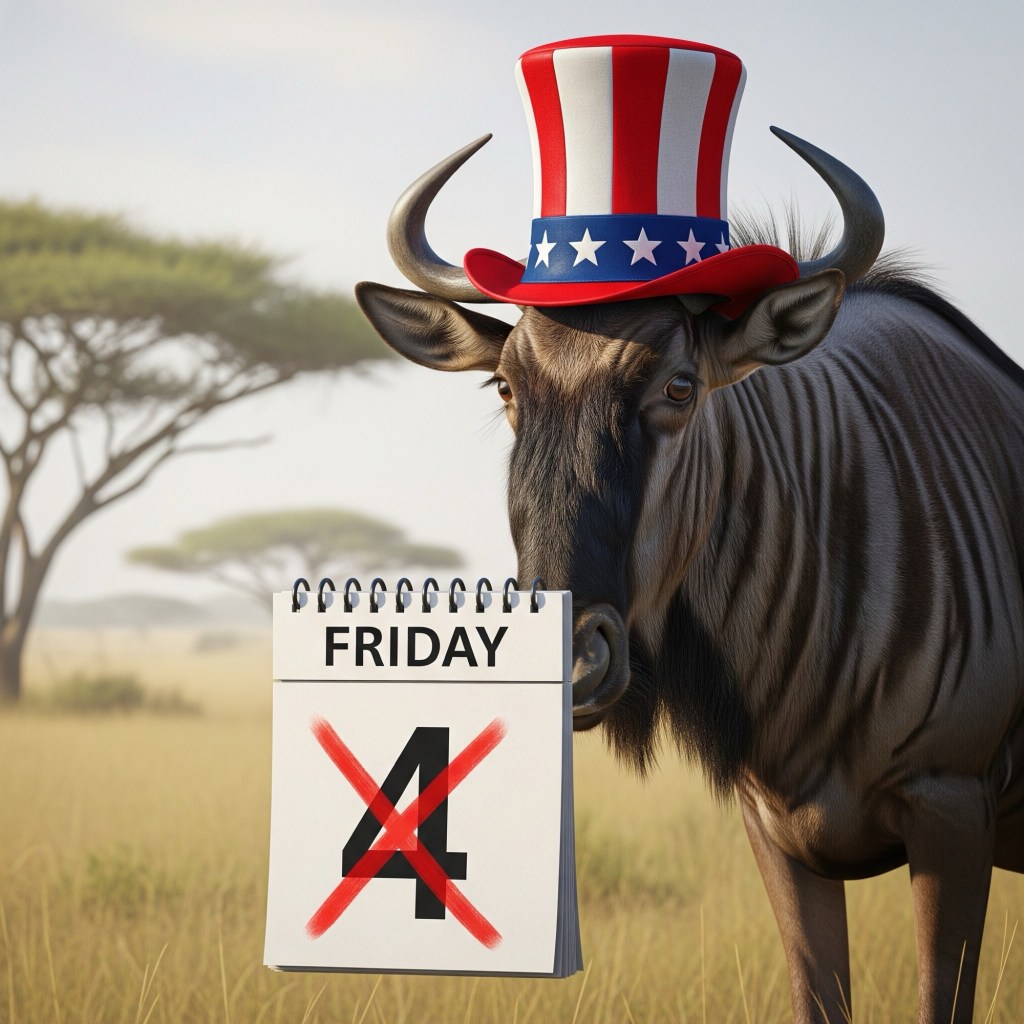
The date is the date, but what is the date?
Imagen 4.
I was brought into a particular project, where everyone was readying go-to-market content for an executive meeting on a particular date.
Both internal and external content.
Training, FAQs, presentations, videos, blog posts, press releases, email campaigns, landing pages, call scripts, the whole bit.
As it turned out, I authored a bunch of the content myself, and helped on most of the rest.
All of us working toward that executive meeting date.
Finally, the date arrived, and all the content was presented to the executive team, mostly ready to go.
The response?
“Not yet.”
Because at the executive level, the fate of one particular product is relatively minor, compared to the overall scope of the business.
Now what?
Imagen 4.
So was the effort wasted?
If the product were eventually launched, then obviously not. The content is already queued. It’s much easier to go back in the queue and update old content than it is to wait until you get the go-ahead and THEN create brand new content. (In three days.)
And if the product were never launched…it still may not be a wasted effort. The company will launch new products (unless the company is Rite Aid), and the (sorry for the next two words) lessons learned from the old product can apply to the new one.
Provided you have a repeatable system for going to market (part of your strategy and process documents, or perhaps something less formal if your founder despises process) that you can dust off in the future.
Gating, or requiring a prospect to fill out a form before receiving valuable content, is touted as a way for the company to control the journey. Once the company knows who the prospect is, they can interact with the prospect more meaningfully. The company can’t do that if the content is downloaded by unknown prospects.
There’s only one problem with gating:
Gating introduces friction.
And even if you avoid long fill-in forms for your gating activity, it’s still a hurdle that your prospects have to cross. And they may not want to do it.
Let me give you an example: Assume you want to know all about Bredemarket.
So I provide a 20 page brochure entitled “All About Bredemarket.” But before you can download that brochure, you have to provide your name, email address, and anticipated purchase date.
Meanwhile, my fierce competitor offers a 20 page brochure entitled “The Truth About Bredemarket.” But my competitor is unfortunately intelligennt and offers the brochure to anyone who wants it, without requiring a scrap of information.
If you’re a prospect and don’t know what you want to do, which of these two brochures will you acquire first?
The one that’s easiest to get, which is my fierce competitor’s brochure.
In this case, this means that my competitor will shape the message about Bredemarket, not me. And I don’t think my competitor will praise me as the best product marketing consultant.















 Bredemarket