I grew up in a time when phones were attached to the wall and not to us.
When something called a “card catalog” was an essential research tool.
And when the best way to learn the lyrics to your favorite song was to go to the drug store and buy the monthly magazine that listed all the song lyrics.
Imagen 4.
Not that this was necessary for ALL songs. You could pretty much figure out the lyrics to “53 Miles West of Venus.”
Imagen 4.
But for some songs you definitely needed the lyric magazines. Because the lyrics may not be on the record, and probably wouldn’t be on the cassette. And in those innocent days in which we didn’t yet do ourselves a favor by unplugging the jukebox—and we certainly didn’t hang the deejay—the guy behind the turntables didn’t know them either.
Imagen 4.
Of course it’s a lot different today. The phone, no longer attached to the wall, displays lyrics from websites such as Genius, music streaming services such as Spotify, and lyric videos posted on sites such as YouTube.
I embedded a reel in that post with the following text:
If their focus is elsewhere
My focus won’t impede
Since I had created the reel anyway, I repurposed it by sharing it on Bredemarket’s social media channels.
Including YouTube. You can see the YouTube short here:
Now when I shared it on YouTube, I did so with no context whatsoever. The caption simply read “In the Distance.” Without the words I wrote in the original blog post (I’ll get to two particular words later).
Yet by Monday morning the short had over 1,000 views. For Bredemarket’s YouTube channel, that’s a lot. Only three shorts have attained higher views: two about Tropical Storm Hilary, and one about squirrels.
But why?
Why?
The relative popularity of this short on YouTube is a mystery. Other than its brevity, it includes none of the elements of a successful video:
It does not use trending audio.
It does not use trending key words or hashtags.
Its message is obscure, if not downright cryptic.
Its visuals do not appeal to a mass audience.
Perhaps…
I have a theory that probably isn’t correct, but I’m going to entertain it anyway.
If this didn’t immediately occur to you, the reel subconsciously incorporates emotion. Emotion at the loss of my “former friends” as mentioned in the blog (but not on YouTube). Yes, some of the same former friends who forgot my birthday long ago.
So my wild theory is that the sense of loss, resignation, and renewed determination (I won’t impede on them) permeated the reel and subconsciously increased interest.
Or maybe I’m wrong. Perhaps there are just more wombat fans than I realized.
In the Distance.
Regardless of the unexpected popularity of this YouTube short, it illustrates why emotions are now the seventh of the seven questions that a content creator should ask you.
I (always) need to improve my INTENTIONAL injection of emotions into my content.
The listed artist for this song is Royalty Free Music Background.
The song title is “Future Electronic (Upbeat Music).”
I had been using an AI music generator in Canva, but since that is now restricted to non-commercial use I switched to another music app within Canva for Bredemarket’s videos.
Taking great care to select videos that are royalty free.
Since I liked this particular song, I used it in two videos, the first of which was only 8 seconds long, the second 64 seconds long.
And then I merrily uploaded both videos to the Bredemarket blog, LinkedIn, various Meta properties, and Bluesky with no problem.
Until I got to YouTube.
The 8 second video uploaded fine, but the 64 second version was blocked worldwide because of a copyright violation.
My interests are admittedly niche (I created a YouTube video about it that most people won’t watch), but I’m still devoted to feeding the few who are also interested in this niche.
So if you’re interested in identity and technology content, ensure you’re following the Bredemarket blog and current social channels. They’ve changed since my original list and the May 2024 contraction, but…
in addition to the Bredemarket website, you can currently search for Bredemarket on Bluesky, Facebook, Instagram, LinkedIn, Threads, the aforementioned YouTube, a well-known site that may or may not disappear in the next three weeks, and other places.
I’m seeking a Senior Product Marketing Manager role in software (biometrics, government IDs, geolocation, identity and access management, cybersecurity, health) as an individual contributor on a collaborative team.
Key Accomplishments
Product launches (Confidential software product, Know Your Business offering, Morpho Video Investigator, MorphoBIS Cloud, Printrak BIS, Omnitrak).
Multiple enablement, competitive analysis, and strategy efforts.
Exploration of growth markets.
Multiple technologies.
Multiple industries.
Over 22 types of content.
Currently available for full-time employment or consulting work (Bredemarket).
I don’t know, I don’t believe in the word “legacy.” I just think that’s another word for ego. Legacy doesn’t mean nothing. It’s just some word everybody grabbed onto.
It means absolutely nothing to me. I’m just passing through. I’m going to die and it’s going to be over. Who cares about legacy after that?
We’re nothing. We’re just dead. We’re dust. We’re absolutely nothing. Our legacy is nothing.
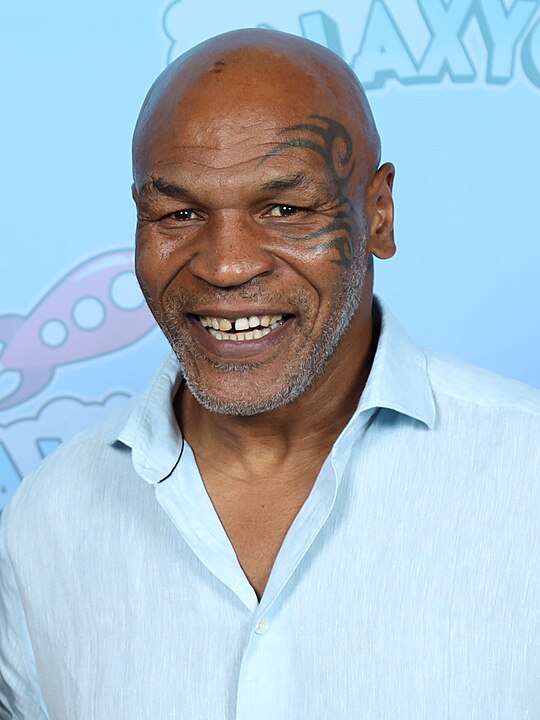
With the life that Tyson has lived, it’s understandable why he’s echoing Ecclesiastes in this interview.
But you don’t have to have had Tyson’s experiences to realize that legacy does not last.
Neither wanted nor needed
In business (and in life), there are companies (and people) who don’t need you or want you.
This may be temporary. The company that doesn’t need you today may urgently (and importantly) need you tomorrow.
Or it may NOT be temporary. There are companies that will NEVER need you or want you.
I recently ran across three such companies that will never need Bredemarket.
Six weeks (now less than six weeks)
Six weeks, the still image version.
Perhaps you noticed Bredemarket’s “six weeks” promotion over the weekend. It was addressed to companies that may have a final project that they want to complete before the year ends in six weeks. (Now 5 1/2 weeks.) I emphasized that Bredemarket can help companies complete those content, proposal, and analysis projects.
I also included email in this campaign, targeting prospects whom I haven’t worked with recently, or whom I’ve never worked with at all. I didn’t go overboard in my emails; although I have over 400 contacts in Bredemarket’s customer relationship management system, I sent the email to less than 40 of them.
As of this morning, none of the recipients has booked a meeting with me to discuss their end of year needs.
Some explicitly told me that they were fine now and did not need or want Bredemarket’s services for end of year projects.
Some didn’t respond, which probably indicates that they did not need or want Bredemarket’s services either.
And I discovered that three companies (four contacts) will NEVER need or want Bredemarket’s services.
Delivery incomplete
How did I discover that?
Via four “delivery status notification” messages.
Delivery incomplete.
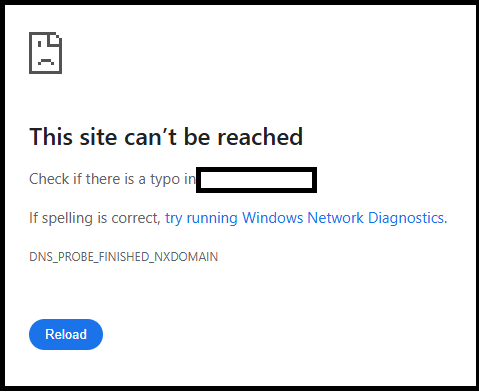
So I visited the web pages in question, and they no longer existed.
This site can’t be reached.
I’ve been building up my CRM for over four years, so it’s not shocking that some companies have disappeared.
But one of the companies (“Company X”) DID exist a mere eight months ago.
I know this because I prepared a presentation on differentiation (see version 2 of the presentation here), and two representatives from Company X received the presentation in advance of a conference.
After the conference organizer distributed the presentation, I offered to meet with the companies individually (no charge) to discuss their content and differentiation needs, or anything else they wanted to discuss.
While some conference attendees took advantage of my April offer, the representatives from Company X did not.
And now in November, Company X no longer exists.
Tumbleweed image public domain.
Could Bredemarket have created the necessary content to keep Company X afloat? Who knows?
But EVERY company needs content to differentiate it from its competitors. Otherwise the competitors will attack you. And your competitors may not be as merciful with you as Jake Paul was with Mike Tyson.
If you need Bredemarket’s help with content, proposal, or analysis services, book a meeting with me.
Of all the technologies I don’t know about, jobseeker technology is the most important. Between July 2000 and today, I’ve spent over 30 months searching for full-time employment. So it helps to know how employers search for potential employees.
And a lot of those 30-plus months have been filled with self-styled experts advising people “how to beat the applicant tracking system (ATS)” (as if there were only one) and “how to access the hidden job market” (because of course employers don’t want anyone to know that they’re searching for talent).
So when Melanie Woods of CGL Recruiting offered 20 jobseekers the chance to see how their LinkedIn Profile appears to users of LinkedIn Recruiter, I really wanted to win one of those 20 slots.
If I could boil all 7 tips down to 1, I’d emphasize that recruiters have limited time, and something a recruiter can understand in 0 seconds is much better than something that would take a recruiter 5 seconds to understand.
Instead of spending money on advertising, my team is going to be taking a different approach and it involves YOU #jobseekers!
Sounds like a plan, since a word-of-mouth testimonial converts more effectively than copy written by a marketing hack. (But what if the testimonial is FROM a marketing hack?)
The offer
She then described the offer.
We are going to be offering 20 free 20 minute sessions to job seekers who are currently out of work. During your session I will pull you up live in LinkedIn Recruiter and test your profile to show you where you are coming up in searches and where you are falling out. I will help you adjust your profile so you can appear in more searches for the jobs you are targeting.
What is LinkedIn Recruiter?
As you can probably guess, LinkedIn Recruiter is the premium-priced service that recruiters use to search LinkedIn for job candidates. The top-tier package (“contact Sales” for the price) includes:
Unlimited LinkedIn network access: Find and engage anyone on LinkedIn
150 InMail messages/month per license and bulk messaging
40+ advanced search filters, including “Open to work” and “More likely to respond”
Multi-user collaboration tools
Prepaid slots to rotate job postings in and out as needed
If your company is recruiting more than 4 positions a year, the high-end version of LinkedIn Recruiter could be the tool for you.
But when recruiters use LinkedIn Recruiter, they don’t look at a candidate’s LinkedIn profile—they look at the LinkedIn Recruiter view of the candidate’s profile, optimized for their purposes.
Hence Melanie was offering job applicants the opportunity to see how their profile appears to a recruiter. Valuable information to have.
What CGL Recruiting wanted in return
But remember that the lucky winners had to provide “advertising” to CGL Recruiting in return.
Here is where the advertising piece comes in….if you feel that the 20 minutes was helpful to you and your job search, we would appreciate you doing a review of our services on LinkedIn and one other social media platform (your choice), sharing how the time spent was useful to you and your job search.
Melanie and I met via Zoom early Monday afternoon Pacific Time (late afternoon Central Time), and I received a firehose of information during the 20-minute session. I’m not going to cover ALL the information she provided; instead, I’ll confine myself to the top 7 tips.
The first job on the LinkedIn profile is the most important.
Use all 5 “job title” slots.
Some employers AREN’T 1st and 2nd degree connections.
You can have 6 on-site job locations, not just 5.
Consider listing at least one college-related date.
Ampersands are bad.
Temperamental writers shouldn’t fall in love with pet phrases.
Tip 1: The first job on the LinkedIn profile is the most important
For my job search for a Senior Product Marketing Manager role, my Incode position is (maybe) more important than my current Bredemarket position. On my resume, I take care of this by listing Incode BEFORE Bredemarket. But because LinkedIn profiles are chronological, and Bredemarket is my current “employer,” I can’t reorder like that.
The LinkedIn Recruiter view of the profile doesn’t show all the positions, but only the top 3. And the first position takes great prominence.
LinkedIn Recruiter view of my LinkedIn profile, Monday, May 13, 2024, 1:30 pm PDT.
In the default view, the recruiter can’t see my fourth position (Strategic/Product Marketing Manager from 2015 to 2017), but only the first three. And only one of those three positions is product marketing-related.
Melanie zeroed in on my “Sole Proprietor” position, which tells a recruiter nothing about what I actually DO at Bredemarket. Sure the recruiter could click through and read about the marketing and writing services that Bredemarket provides…but recruiters have limited time.
I thought about her advice after the call, and for LinkedIn (and resume) purposes I’m changing my Bredemarket job title to “Product Marketing Consultant.” My work for my clients is all product/service-related, so the job title makes sense.
Now recruiters will see that two of my three most recent positions were product marketing-related, which makes me more attractive to the one position that I’m targeting.
One position? Wait a minute…
Tip 2: Use all 5 “job title” slots
That’s right. In my “job preferences,” my only listed job title was “Senior Product Marketing Manager.”
I can list up to 5.
Why not use all 5?
So now my job titles include the following:
Senior Product Marketing Manager
Product Marketing Manager
Marketing Content Manager
Global Product Marketing Manager
Product Marketing Consultant
So I have the position title from Incode, the consulting title from Bredemarket, two product marketing title variants, and a content marketing title for good measure (Bredemarket readers know why).
Now some people question why I’d list all these similar titles, since anyone who takes a few seconds can figure out that I’d be interested in a global product marketing manager position or whatever.
That’s the problem. Recruiters DON’T HAVE a few seconds. When hundreds or thousands of people apply for positions, recruiters need to get through the profiles as quickly as possible.
So Melanie wanted me to make her job easier.
Tip 3: Some employers AREN’T 1st and 2nd degree connections
You can control the visibility of your email address and your phone number on LinkedIn. While I don’t list a phone number on my LinkedIn profile, I do make my jobseeking email address (which is separate from my Bredemarket email address) visible. In fact, I configured my email address visibility for viewing by my 1st degree and 2nd degree connections.
But there was a fallacy in that tactic.
It became obvious in the session because Melanie (not a connection since her LinkedIn connections are maxed out) could NOT see my email address. Therefore, if recruiter Melanie wanted to contact me, she could ONLY contact me via InMail.
If you want ANY potential recruiter to see your email, increase its visibility to all connections. Obviously there are risks to this, so you need to judge what visibility is right for you. (Especially for phone numbers.)
Tip 4: You can have 6 on-site job locations, not just 5
While all of Bredemarket’s work is remote, and my previous work at Incode was remote, I’m not averse to on-site work. As long as it’s within driving distance.
To help local companies, I listed a selected five cities (the maximum) where I am available for on-site work:
Ontario, California, United States
San Bernardino, California, United States
Covina, California, United States
Pasadena, California, United States
Anaheim, California, United States
But Melanie pointed out that I didn’t need to list Ontario, since my profile already states that I live in Ontario. That freed up one slot to add another city. I chose to list Riverside, although I could have listed Brea or Fullerton or Industry or Pomona or Corona or many other cities. (LinkedIn, your on-site locations feature needs work.)
Tip 5: Consider listing at least one college-related date
Now let’s get into age discrimination talk.
If a company desires to discriminate against job applicants due to age, one effective way to do so is to look at the dates the applicants attended college. It’s pretty easy to quietly filter out the geezer applicants with no one the wiser.
For this reason I didn’t bother to add my college attendance dates to my LinkedIn profile. Why give the discriminating (in a negative way, not a positive way) firm the ammo they need to get the young, cheap workers they really want? (Of course those workers are inexperienced, but that’s another topic entirely.)
But Melanie pointed out one truth about companies that want to discriminate: if they don’t discriminate against you when they read your LinkedIn profile or resume, they can easily discriminate against you when they SEE you.
Oh, and there’s one more thing: if recruiters search for candidates based upon their graduation dates, profiles without graduation dates will never been seen by recruiters.
So I mulled over her advice.
I decided not to list the date that I started attending Cal State Fullerton’s MBA program.
And I decided not to list the date I graduated from Reed College.
I certainly didn’t list the date I started attending Reed College. (But I will confess that this song blasted from the Old Dorm Block. And I’ll also confess that I could lose the last 4 1/2 minutes.)
But I did pencil in my 1991 graduation date from Cal State Fullerton’s MBA program. Since my LinkedIn profile includes ALL my biometric positions going back to 1994, this isn’t a shocking revelation.
Tip 6: Ampersands are bad
LinkedIn profiles can include skills. I’ve listed near the limit of 50 skills, some of which are tied to particular positions, LinkedIn Learning courses, and other education and certifications.
Among many others, two of my listed skills are “identity & access management” and “sales & marketing management.”
Technology experts immediately see where this is going. So why didn’t I?
Melanie immediately noted that the ampersand character in those two skill descriptions can wreak havoc with some computerized systems.
I swapped out those skills for some new ones: identity and access management, and sales and marketing management, removing the problem.
Tip 7: Temperamental writers shouldn’t fall in love with pet phrases
Melanie’s biggest concern about my LinkedIn profile involved the very first sentence.
The one that appears below my profile, name, and preferred pronouns, but above my city of residence.
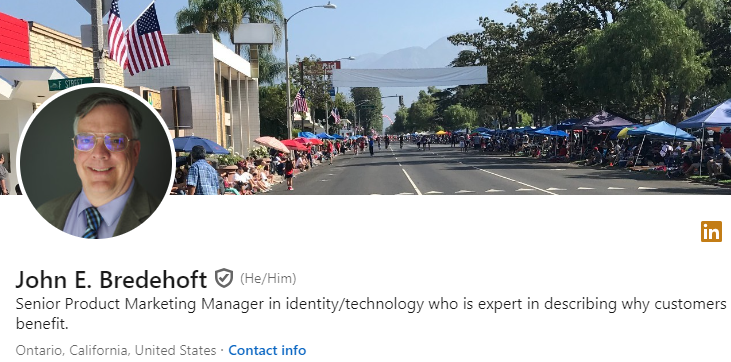
John Bredehoft LinkedIn profile, public view, Monday, May 13, 2024, 1:30 pm PDT.
Senior Product Marketing Manager in identity/technology who is expert in describing why customers benefit.
She read that sentence word for word.
“Senior Product Marketing Manager”? She liked that.
“In identity/technology”? I guess she liked that; at least she didn’t comment on it.
The rest of the sentence? Not so much.
Regular Bredemarket readers are familiar with the last three words of that sentence, and realize that every one of those three words is critically important. Why rather than what, customers rather than producers, and benefits rather than features. I’ve devoted a post (plus another post) to those three words. If I only had a few seconds to explain the importance of those three words…
Um, yet again, recruiters aren’t interested in taking a few minutes to read everything I have written about Simon Sinek’s Golden Circle, customer focus, or benefits. They don’t even want to watch a short reel on the topic.
So I have to rewrite the last part of that first sentence. As I write this post, I’m still mulling over alternatives.
CGL Recruiting’s expertise was highly beneficial
The 7 items above were just some of the tips that Melanie Woods imparted to me, all in the space of 20 minutes.
Again, the common theme is that recruiters have limited time, LinkedIn Recruiter lets them maximize that limited time, and jobseeker data also has to let recruiters maximize that limited time. If you can do something in 0 seconds, don’t take 5 seconds to do it.
I haven’t even explored some of the other features that CGL Recruiting offers, including Melanie Woods’ YouTube channel.
But the 20 minutes I spent with her were certainly valuable.
Now I just have to figure out another way to say “why customers benefit.”
I see social posts in which the authors thank their followers for getting them to a certain follower count, and I receive Instagram messages promising me that for just a little money I can get tens of thousands of followers.
I definitely ignore the latter messages, and personally I ignore the former messages also.
Because follower counts don’t matter.
Just because Bredemarket has X followers doesn’t necessarily mean that Bredemarket will make lots of money. I could use viral tactics to attract countless followers that would never, ever purchase Bredemarket’s marketing and writing services.
In fact, I could live just fine with 25 followers…provided that they’re the RIGHT followers.
But while this is normally true, I’ve run into a couple of instances in which follower counts DO matter. Because you need a certain heft to get the large companies to pay attention to you.
So I started my own to fill the void, then waited for similarly interested WhatsApp users to find my channel via search.
But there was a catch.
Although it isn’t explicitly documented anywhere, it appears that using the WhatsApp channel search only returns channels that already have thousands of subscribers. When I searched for a WhatsApp channel for “identity,” WhatsApp returned nothing.
WhatsApp channel search for “identity.”
As a result, I found myself promoting my WhatsApp channel everywhere EXCEPT WhatsApp.
I also have a YouTube channel, and you CAN find that. But it also suffers from a lack of subscribers.
On Monday I received an onimous-sounding email from YouTube with the title “Your channel has lost access to advanced features.”
The opening paragraph read as follows:
To help keep our community safe, we limit some of our more powerful features to channels who have built and maintained a positive channel history or who have provided verification.
Ah, verification. I vaguely remember having to provide Alphabet with my ID a few months ago.
The message continued:
As of now, your channel doesn’t have sufficient channel history. It has lost access to advanced features. This may have happened because your channel did not follow our Community Guidelines.
While I initially panicked when I read that last sentence, I then un-panicked when I realized that this may NOT have happened because of a Community Guidelines violation. The more likely culprit was an insufficient channel history.
Your channel history data is used to determine whether your content and activity has consistently followed YouTube’s Community Guidelines.
Your channel history is a record of your:
Channel activity (like video uploads, live streams, and audience engagement.)
Personal data related to your Google Account.
When and how the account was created.
How often it’s used.
Your method of connecting to Google services.
Most active channels already have sufficient channel history to unlock advanced features without any further action required.
Frankly, my YouTube channel doesn’t have a ton of audience engagement. Now I could just start uploading a whole bunch of videos…but then I risk violating the Community Guidelines by getting a “spamming” accusation.
As it turns out, there’s only one “advanced feature” that I really miss: the ability to “Add external links to your video descriptions.” And I’m trying to tone down my use of external links because Alphabet (on YouTube) and Meta (on Instagram) discourage their use anyway.
But for now the previously-added external links to videos such as this one are now disabled.
Perhaps if I post long-form videos more frequently and get thousands of subscribers, I will get enough “audience engagement” to restore the advanced features.
But the question remains: how do I get thousands of people to subscribe to my WhatsApp channel and my YouTube channel?
Perhaps I can adapt a really cool TikTok challenge to WhatsApp and YouTube.
You can create the exciting Savage Challenge on TikTok and ask your audience to participate in it. In this challenge, people will have to learn and follow the choreography of Megan Thee Stallions’ highly loved song, “Savage.”
And if I go to the local car wash with a baseball bat and start knocking out car windows, I may end up in jail. And that usually does NOT increase the follower count. Because as Johnny Somali persumably found out in Japan, you can’t film videos when you’re in jail.
Whenever I see these pieces that proclaim that the author can help you brainstorm x ideas for content, I ignore them. For better or worse, I have no problem coming up with content ideas.
And when I come up with the content ideas, I don’t just use them in one piece of content. I’ll use the idea in several pieces of content. Yes, I love repurposing.
I think I’ve set a new record for myself over the last few days by creating 31 pieces of content from a single idea.
The post doesn’t aim to tell you how you should create and reshare your content, but perhaps while you’re reading the post you may get some fresh ideas that fit your own working practices.
Three years of preparation
Before you can share content in numerous places, you need numerous places to share your content. It’s obvious, but it’s true. After all, it would be repetitive to post the exact same content multiple times in the Bredemarket blog.
So since I started Bredemarket in 2020, I not only developed the Bredemarket blog, but I have also developed (or made use of) other social platforms.
If you’re starting out in business, you’ve probably heard the advice that as your business branches out into social platforms, you shouldn’t try to do everything at once. Instead you should make sure that your business offering is really solid on one platform before branching out into others.
Yes, I’ve been naughty again and didn’t listen to the expert advice.
Four pages on LinkedIn, not counting my personal profile (we’ll get to my personal profile later).
Four pages/groups on Facebook.
Other image/text platforms such as Instagram and Threads.
Two video-only platforms: TikTok and YouTube.
Numerous audio outlets for my podcast.
My personal X account.
To the content marketing experts that say that I should just concentrate on LinkedIn and ignore everything else, note that I then have a 0% chance of reaching non-LinkedIn users. Who knows? Perhaps that TikTok video may result in a conversion that I couldn’t have made otherwise.
One idea
The idea that struck me last weekend was not original to me, and it’s been bouncing around in my head (and on these pages) for some time now. But I thought I’d reword it in a different way. After a few tweaks, I came up with the following statement:
Your Customers Don’t Care About Your Product’s Technology
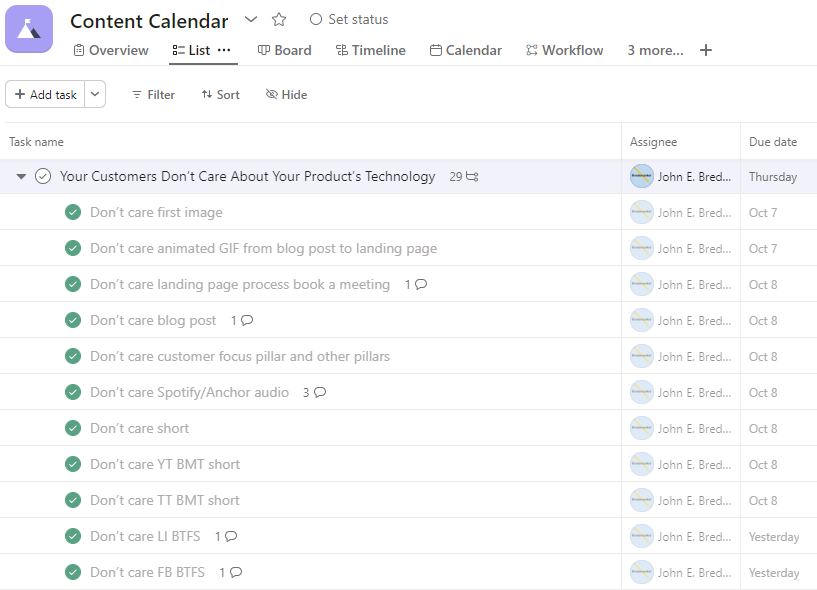
As you will see, I continued to tweak the statement, but that’s the one that I put in my Asana “Content Calendar” project.
The Asana task that would eventually result in this blog post. Only the first subtasks are shown; as you will see, there are many more.
As I would subsequently reflect, I thought that companies knew that you need to focus on the customer rather than focusing on yourself, but I see too many companies that are self-focused in their marketing. They emphasize the amazing technology features of their product.
I want to put a stop to that, and if necessary I will help companies create customer-focused marketing materials. For a fee, of course.
But enough about me. Let’s illustrate how that one idea can expand into multiple content pieces.
31 pieces of content
So now I had to write about how customers don’t care about your product’s technology.
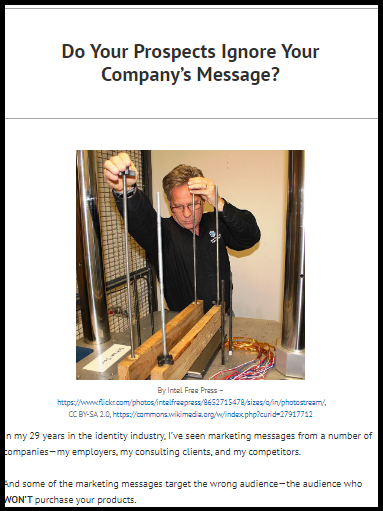
An image, sourced from Wikipedia, of a technologist doing technology things.
An image, designed by Freepik, of a customer ignoring someone prattling on about their technology.
The “customer focus” illustration that I have used frequently in the past.
An animated GIF that beckoned readers to the landing page, described below. The GIF includes the first two images listed above, plus a third from the landing page itself.
Most importantly, the post included all the text that made my original point (“Do you know why your prospects are ignoring you? Because they don’t care about you. It’s all about them.”), along with my argument for customer focus, and my concluding call to action to find out how to “Create Technology Content That Converts.”
Content 2: Landing page
And “Create Technology Content That Converts” was the title of my landing page. Often I put the call to action on the same page as the original point, but sometimes (as in this case) I separate the call to action for a more focused presentation. Plus I have the option of having multiple blog posts point to the same landing page. This post points to the landing page, for example (click the GIF above or one of the other links).
The landing page dug more deeply into why and how Bredemarket can help you create a customer-focused message, talking about the questions I ask, the types of content I can create, and the process.
Once all this was done, everything was set. People who read the blog post could (if so inclined) go to the landing page, and people who read the landing page could (if so inclined) contact me.
But only if they saw the blog post in the first place.
If they don’t find the post on Google or Bing, and if they’re not already subscribing to the blog, then how will they get to the blog post?
Content 3, 4, 5, 6, 7, and 8: Information pages
There are numerous themes that continuously pop up in the Bredemarket blog, and I have created “information pages” (pillars) that link to all of the content that I have written on these themes.
Now perhaps you won’t do all of this, but if there’s a place on your website where you should mention your new blog post, be sure and do it.
For example, if you wrote a blog post about Topic X in 2021, and you’re readdressing Topic X in a 2023 post, then go back and update the 2021 post to say that you have new thoughts on Topic X. Then the people who find your 2021 post can go to the new post and get the latest information.
Content 9: Audio podcast
My podcast is more accurately described as a mini-podcast, because each episode is usually only 1-2 minutes long. Perhaps someday I’ll create hour-long episodes, but not today.
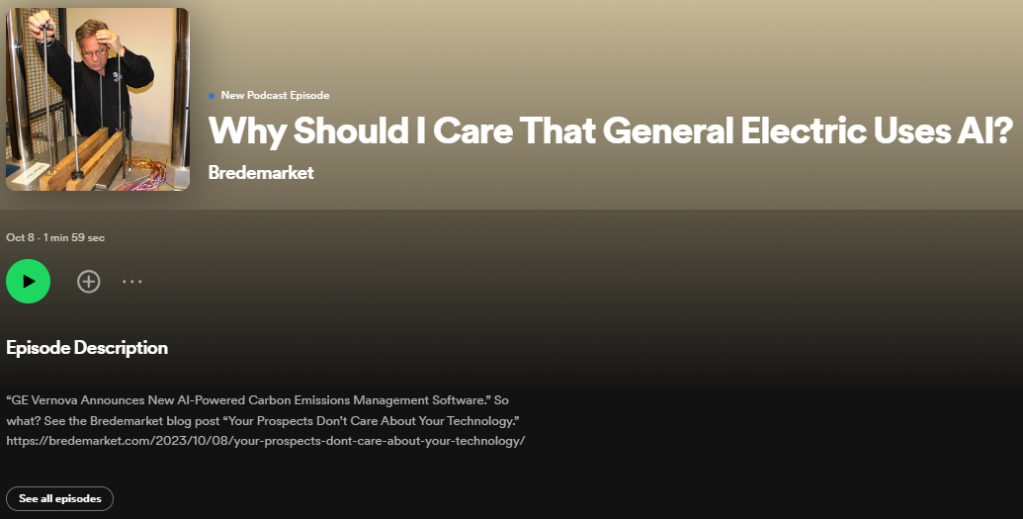
And on Sunday I created a 2-minute episode with a new take. After noting (as I said above) that sometimes we know things that people don’t know, I declared:
I then described a really bad General Electric press release that focused on GE technology and not on customer needs.
Then I plugged the blog post, which was linked in the episode description. And I resued the “technologist doing technology thinks” image from the blog post.
Now I only list this as one piece of content, but really it’s multiple pieces of content. Not only can you access the episode on Spotify for Podcasters (formerly Anchor), but you can also access it on Spotify itself, Apple Podcasts, and numerous other podcast hosting services.
After this, I returned to the blog post itself and looked for other ways to share it.
Content 10, 11, 12, 13, 14, 15, 16, and 17: Bredemarket LinkedIn and Facebook pages, showcase pages, and groups
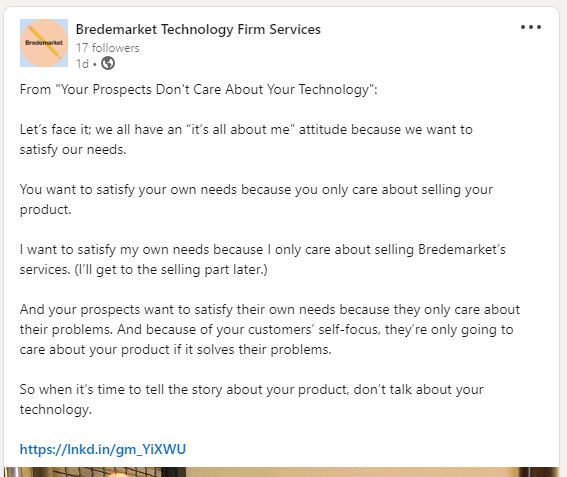
Because the blog post explicitly mentioned “technology” in the title, the best fit for a reshare of the blog post was on the Bredemarket Technology Firm Services LinkedIn showcase page (reshare here) and Facebook group (reshare here).
Why do I have a myriad of LinkedIn and Facebook outlets?
Because often people who are interested in technology don’t care about identity, and people who are interested in the Inland Empire don’t care about technology, and people who care about Bredemarket in general don’t care about every identity company reshare that I post.
And of course, some people who love LinkedIn hate Facebook, and some people who love Facebook hate LinkedIn.
So I could have just shared this to the technology outlets, but this particular post had a broader application. Inland Empire businesses, identity companies, and general marketers all have the problem of referring to self rather than the customer.
So I reshared the original technology shares to the other relevant groups.
You know how the Instagram experts say that you should post reels? Or you should post carousels? Or whatever?
I say that you should post a healthy balance of all sorts of things.
I wanted to reshare the blog post on Instagram, so I posted an Instagram carousel post using the two images from the blog post and the “money” image from the landing page.
Even though Instagram is a terrible platform to reshare content on other platforms, because the links aren’t clickable.
Unless you reshare the post as a story and use the “link” feature to embed a link.
Content 19 and 20: Bredemarket Threads and JEBredCal X
Oh, and there are two other places where I reshared the link to the blog post:
As a xeet or whatever tweets are called these days. (This is not an official Bredemarket X account, but my “professional” X account where I share Bredemarket stuff and other stuff.)
So that encompassed the first set of content reshares. But before I go on…
Content 21: LinkedIn reshare of podcast
All of the stuff listed above was stuff that I meticulously planned by listing subtasks to the original Asana task “Your Customers Don’t Care About Your Product’s Technology.”
But I forgot that I deviated from Asana and also shared a link to the podcast in the Bredemarket Technology Firm Services LinkedIn showcase page.
Some people are horrified that I deviated from Asana and didn’t record this important share. (And they’ll really be horrified later in this post when I create another piece of content and don’t log it in Asana.)
Others are horrified that I put all the other stuff in Asana in the first place.
As for me, well, I got the content out. Cool.
But the blog post wasn’t enough. I needed to convey the same message in a different way, for those who think words and stuff aren’t cool.
Content 22, 23, 24, and 25: The short
In the same way that I created an audio podcast that made the same points as the blog post (while linking to the blog post), I wanted to create a video vertical short that did the same thing.
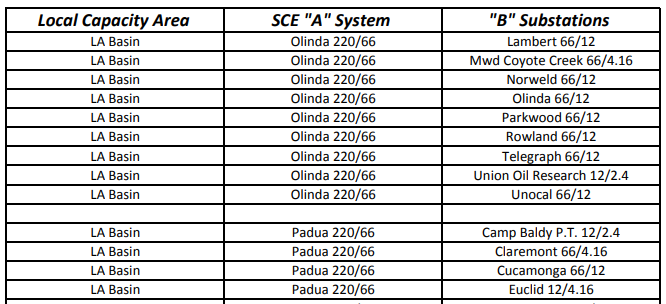
So I headed out to the Southern California Edison Euclid Substation.
I then stood in front of some very technological stuff, and filmed 27 seconds of me talking about the prospect’s problems…and your problem…and how Bredemarket can solve your problem.
By the time I was finished, the video short was available on:
So now both WordPress and Instagram had two pieces of content that kinda sorta said the same thing. But this is good. Maybe some people like the video version, while others like the text version. I’ll catch them one way or ther other.
But before I actually shot the video at the SCE Euclid Substation…
Content 26: Instagram Live/Reel
…I was scouting out locations. (If you know the Talking Heads song “Found a Job” you’ll recognize the phrase.)
When I arrived at the SCE Euclid Substation, I walked around the south and west sides of the substation, looking for the best place to shoot my video.
And I was broadcasting on Instagram Live as I was doing this, offering my adoring fans a rare “behind the scenes” look at Bredmarket activities. And, incidentally, proving that Bredemarket behind the scenes is pretty boring.
But the Instagram Live session was recorded, and was posted as a reel a couple of days before my video short was posted.
I don’t know if it made a huge difference in the subsequent reception of the short, but one of my relatives liked the “behind the scenes” look so that’s good.
So those 26 pieces of content addressed Bredemarket’s views on customer focus and benefits.
But my life is not confined to Bredemarket. Time for one huge repurpose.
Content 27: jebredcal blog post
At the same time that I’m asking Bredemarket prospects to contract with me, I’m asking technology companies (including identity companies) to hire me as a Senior Product Marketing Manager.
And the same message can, with some adaptation, be delivered to hiring companies.
If you compare the jebredcal blog post with the original Bredemarket blog post, you can see some clear similarities…with some noticeable differences. For example, I don’t ask employers to use Bredemarket’s calendly, email, or web messaging channels. I use my personal email and my LinkedIn profile messaging capability instead.
Now that the blog post was written, I was ready to share it on LinkedIn where the employers are. (No Facebook. No TikTok.)
Correction: I was ALMOST ready to share a link to the post on LinkedIn. I had to complete one thing first.
Content 28: Personal short
I decided that on the day before I shared the post on LinkedIn, I’d create a personal video short that introduced the content.
But this one, rather than taking place in front of a cool electrical facility, would be a behind-the-scenes view of Bredemarket’s world headquarters. Since the city of Ontario restricts you from viewing this yourself (restriction 3), this is the only way that you will ever see Bredemarket’s world headquarters.
Exciting?
No, completely boring.
But I did it anyway, and posted the video on LinkedIn yesterday. (And if you look to the left, you can see Bredemarket’s business license as required by restriction 1.)
Content 29: The LinkedIn share of the jebredcal post
Once I realized that I was going to write one blog post for Bredmarket prospects and one post for potential employers, I decided to write a third post that talked out how you create different content for different target audiences. As I noted above, the two pieces of content have significant similarities, but also significant differences.
But as I thought about it, I thought it would be more important to illustrate how you could take a single idea and repurpose it as 30 different pieces of content.
Well, 30 so far. I still have to figure out how and where to reshare THIS blog post…
Content 31: LinkedIn post about a job rejection
Stop the presses!
And here’s another EXCITING behind-the-scenes look at how Bredemarket works!
By Tuesday afternoon (October 10, 2023), I had substantially completed writing this blog post on “How I Expanded 1 Idea Into 30 Pieces of Content.” But since there was no huge rush to publish the post—after all, I had just published 29 other pieces of content over the past few days—I figured I’d take advantage of the opportunity to “sleep on it” and look at the post one more time before publication.
Then something happened early Wednesday morning.
Every day, potential employers tell thousands of job candidates that they are “moving in a different direction.” By Original: Jack Ver at Dutch Wikipedia Vector: Ponor – Own work based on: Plaatsvector.png by Jack Ver at Dutch Wikipedia, CC BY-SA 4.0, https://commons.wikimedia.org/w/index.php?curid=95477901
I received a “you have not been selected for this position” email from a potential employer. I had only applied for the position two days earlier, on Monday, right in the midst of all of this content creation.
If you are one of the lucky talent acquisition professionals who is still employed, there is ONE CRITICAL THING that you MUST impress upon your employers.
Please tell your employers NOT to list positions as “remote/hybrid.”
That’s kind of like listing a food as “vegan/beef.” Is it vegan, or is it beef? It’s a mystery until you take a bite, and there’s a 50% chance you will be disappointed or horrified with what you find.
You may ask what a LinkedIn post about “remote/hybrid” job listings has to do with incorrectly-focused product marketing messaging.
It’s all in the call to action. Those who read to the end of the post encountered these words.
Anyway, if you’ve read this far and are seeking an experienced identity/biometrics/technology Senior Product Marketing Manager for a #remote position (or a position within 25 miles of Ontario, California), please message me. The linked post below includes my contact information, as well as my philosophy on product marketing messaging.

















 Bredemarket