I’ve talked about the words “why,” “how,” and “what” and their relation to writing, but I haven’t talked about the word “which.”
Not in relation to sandwiches, but in relation to words.
If you are a marketing executive, you know that the words you use in your marketing content can make or break your success. When your company asks employees or consultants to write marketing content for you, which words should they use?
Here are four suggestions for you and your writers to follow.
Your writers should use the right words for your brand.
Your writers should use the right words for your industry.
Your writers should use words that get results.
Your writers should be succinct.
Your writers should use the right words for your brand
Your company has a tone of voice, and your writers should know what it is. If you can’t tell them what it is, they will figure it out themselves.
Your company has a particular writing style—hopefully one that engages your prospects and customers. Regardless of your writer’s personal style, they must create copy that aligns with your own style. In effect, they put on a “mask” that aligns the words they create with the words that your company needs.
Your writers should use the right words for your industry
Similarly, your company provides products and services in one or more industries, and your copy must align with the terms those industries use, and the way industry participants express themselves.
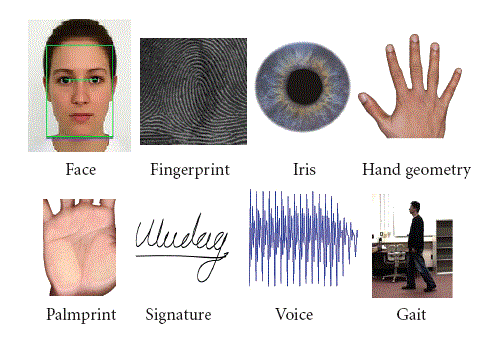
For example, a writer who is writing content for the biometric industry will use different terms than a writer who is writing content for art collectors because of the differences in the two target audiences.
Biometric readers (the people, not the devices) care about matching accuracy measurements, such as those compiled by the U.S. National Institute of Standards and Technology (NIST) in its Face Recognition Vendor Test, or as measured in agency-managed benchmarks. (Mike French’s example.) They often respond to quantitative things, although more high-level concepts like “keeping citizens safe from repeat offenders” (a public safety-related benefit) also resonate.
Art collectors care about more qualitative things, such as not being scared of handing over their dream to a commissioned artist whose work will inspire affection. (Well, unless the collector is an art investor and not an art lover; investors use different terminology than lovers.)
So make sure your writers get the words right. Otherwise, it’s as if someone is speaking Italian to a bunch of French speakers. (Kaye Putnam’s example.) Your prospects will tune you out if you use words they don’t understand.
Your writers should use words that get results
There is one important exception to my suggestions above. If your company’s current words don’t result in action, quit using your current words and use better ones that support your awareness, consideration, conversion, or other goals.
If you start talking about your solution without addressing your prospect’s pain points or problems, they won’t know why they should care about your solution.
For example, let’s say that the message you want to give to your prospects is that your company makes wireless headphones.
The prospect doesn’t care about wireless headphones per se. The prospect cares about the troubles they face with tangled cords, and how your company offers a solution to their problem of tangled cords.
Features are important to you. Benefits are important to your prospects. Since the prospects are the ones with the money, listen to them and talk about benefits that change their lives, not how great your features are.
Your writers should be succinct
I have struggled with succinctness for decades. I could give you countless examples of my long-windedness, but…that wouldn’t be appropriate.
So how do I battle this personally? By creating a draft 0.5 before I create my draft 1. I figure out what I’m going to say, say it, and then sleep on the text—sometimes literally. When I take a fresh look at the text, I usually ruthlessly chop a bunch of it out and focus on the beef.
Now there are times in which detail is appropriate, but there are also times in which a succinct message gets better results.
Selecting your content marketer
If your company needs employees or consultants to write marketing content for you, make sure they create the right content.
If your company’s views on content creation parallel my own, maybe I can help you.
If you need a full-time employee on your staff to drive revenue as your personal Senior Product Marketing Manager or Senior Content Marketing Manager, take a look at my 29 years of technology (identity/biometric) and marketing experience on my LinkedIn profile. If you like what you see, contact me via LinkedIn or at jebredcal@gmail.com.
If you need a marketing consultant for a single project, then you can reach me via my Bredemarket consultancy.
So unless someone such as an employer or a consulting client requires that I do things differently, here are three ways that I use generative AI tools to assist me in my writing.
If you read the post, you’ll recall that some of the items were suggestions. However, one was not:
Bredemarket Rule: Don’t share confidential information with the tool
If you are using a general-purpose public AI tool, and not a private one, you don’t want to share secrets.
By Unnamed photographer for Office of War Information. – U.S. Office of War Information photo, via Library of Congress website [1], converted from TIFF to .jpg and border cropped before upload to Wikimedia Commons., Public Domain, https://commons.wikimedia.org/w/index.php?curid=8989847
I then constructed a hypothetical situation in which Bredemarket was developing a new writing service, but didn’t want to share confidential details about it. One of my ideas was as follows:
First, don’t use a Bredemarket account to submit the prompt. Even if I follow all the obfuscation steps that I am about to list below, the mere fact that the prompt was associated with a Bredemarket account links Bredemarket to the data.

Now I happen to have a ton of email accounts, so if I really wanted to divorce a generative AI prompt from its Bredemarket origins, I’d just use an account other than my Bredemarket account. It’s not a perfect solution (a sleuth could determine that the “gamer” account is associated with the same person as the Bredemarket account), but it seems to work.
But not well enough for one company.
Adobe’s restrictions on employee use of generative AI
PetaPixel accessed a gated Business Insider article that purported to include information from an email from an Adobe executive.
Adobe employees have been instructed to not use their “personal email accounts or corporate credit cards when signing up for AI tools, like ChatGPT.” This, the publication reports, comes from an internal email from Chief Information Officer Cindy Stoddard that Insider obtained.
Specifically, the email apparently included a list of “Don’ts”:
Don’t use personal emails for tools used on work-related tasks. This is the one that contradicts what I previously suggested. So if you work for Adobe, don’t listen to me.
Don’t include any personal or non-public Adobe information in prompts. This is reasonable when you’re using public tools such as ChatGPT.
Don’t use outputs verbatim. This is also reasonable, since (a) the outputs may be incorrect, and (b) there are potential copyright issues.
But don’t think that Adobe is completely restricting generative AI. It’s just putting guardrails around its use.
“We encourage the responsible and ethical exploration of generative Al technology internally, which we believe will enable employees to learn about its capabilities as we explore how it will change the way we all work,” Business Insider reported Stoddard wrote in the email.
“As employees, it’s your responsibility to protect Adobe and our customers’ data and not use generative Al in a way that harms or risks Adobe’s business, customers, or employees.”
So my suggestion to use a non-corporate login to obfuscate already-scrubbed confidential information doesn’t fly with Adobe. All fine and good.
The true takeaways from this are two:
If you’re working for or with someone who has their own policies on generative AI use, follow their policies.
If they don’t have their own policies on submitting confidential information to a generative AI tool, and if you don’t have your own policy on submitting confidential information to a generative AI tool, then stop what you’re doing and create a policy now.
Suggestion 1: A human should always write the first draft.
Suggestion 2: Only feed bits to the generative AI tool.
An ironclad rule: Don’t share confidential information with the tool.
This post will focus on the first suggestion, although the ironclad rule will come up in the discussion also.
There are several reasons why I believe that a human should write the first draft, and the generative AI tool should only be used to improve the draft. Two of these reasons (I won’t get into the ego part) are as follows:
Iterate on my work to make it better. For me, the process of writing itself lets me tweak the text throughout the written content. In my view this makes the first draft much better, which makes the final version even better still.
Control the tone of my writing. One current drawback of generative AI is that, unless properly prompted, it often delivers bland, boring text. Creating and iterating the text myself lets me dictate the tone of voice and eliminates the need to rewrite the whole thing later to change the tone.
However, there is one drawback to my method. It takes a lot longer.
If you submit a prompt to a generative AI tool and receive results in a minute, and if you tweak the prompt four times to make it better, you’ll have a complete first draft in five minutes.
Using my method, I don’t create a first draft in five minutes. It usually takes me between 60 and 120 minutes (not counting “sleep on it” time) to crank out a first draft the old fashioned way.
Let’s look at a different way to use generative AI in writing.
Guess what this means? All of my personal concerns about sharing confidential data with a generative AI tool are eliminated. Read Writer’s Terms of Service:
7.1. Ownership. All data, information, files, or other materials and content that Customer makes available to Company for the purpose of utilizing the Service (including, without limitation, training data, prompt inputs, and drafts) (“Customer Content”) shall remain the sole property of Customer. Customer shall retain all intellectual property rights in the Customer Content. Company does not screen Customer Content, is not responsible for storing or maintaining backups of any Customer Content, and is not responsible for the content of or any use by Customer of the Customer Content.
[W]hat we did at Writer was simple: customers already had their style guides built into Writer — their writing style, terminology, and must-have language. We used that plus samples of customers’ best blog posts, help articles, headlines, email subject lines, ads, and more. Writer can create first drafts that are significantly better than other tools because the content is modeled off your best content and trained on your voice.
“Create a unique, consistent, and relatable voice that shines through every communication touch point — at scale. Your marketing team doesn’t have time for the copyediting (or scolding).”
“Keep your editorial guidelines up-to-date and easy to access. From punctuation to capitalization rules to grade level and specific terminology, put all your guidance in one place.”
“Make your core messaging easy to repeat. Keep company voice, terms, and boilerplate consistent, no matter who’s writing.”
But is Writer’s output as bland as the reputed “style” from other generative AI tools? If it is, then you won’t save any time by using Writer, since you’ll have to rewrite everything to fit your tone of voice anyway.
Now I haven’t tested Writer, but Trello has. And it sounds like Trello’s tone of voice has been preserved even when the bots write the content.
Trello avoids the “professional voice” trap traditional software companies fall into (aka stodgy, robotic tone) by treating the person who reads their content like a coworker….With phrases like “go from Trello zero to Trello hero,” you can see that the writers at Trello had permission and encouragement to have fun while writing help content, and that fun translates to a delightful experience for users….
Leah Ryder told us, “With the 10-year anniversary of Trello around the corner, combined with major developments in-product with the new Views feature, it seemed like the right time to update and align our brand and product towards our shared goal of empowering productivity for teams everywhere.”…
Trello’s brand refresh was 1.5 years in the making, and it took a tremendous amount of strategic leadership, partnered with cross-team collaboration to make it happen. It couldn’t have happened without ten years of defining and committing to rule-breaking brand principles. Over the next decade, there’s no doubt the product will change as it adapts to user needs, but with strong brand principles in place, Trellists can always expect a sense of joy built into everything Trello creates.
So if Writer and Trello are correct in their assertions, it IS possible for a well-designed generative AI tool to create a first draft that does NOT require extensive rewrites. Or, if you control your data warehouse, fact-checking. This preserves the ability to save time, since you don’t have to rewrite bland text or correct inaccurate text.
My compulsion to share stuff about identity and biometrics, which you can see if you visit my Bredemarket Identity Firm Services LinkedIn page and Facebook group.
Unfortunately for us, 90% of the song deals with the negative aspects of a person obsessing over another person. If you pick through the lyrics of the Animotion song “Obsession” and forget about what (or who) the singer is obsessing about, you can find isolated phrases that describe how an obsession can motivate you.
“I cannot sleep”
“Be still”
“I will not accept defeat”
But thankfully, there are more positive ways to embrace an obsession.
Justin Welsh on embracing an obsession
While Justin Welsh’s July 2022 post “TSS #028: Don’t Pick a Niche. Embrace an Obsession” is targeted for solopreneurs, it could just as easily apply to those who work for others. Regardless of your compensation structure, why do you choose to work where you do?
For Welsh, the practice of picking a niche risks commoditization.
They end up looking like, sounding like, and acting like all of their competition. The internet is full of copycats and duplicates.
(For example, I’d bet that all of the people who are picking a niche know better than to cite the Animotion song “Obsession” in a blog post promoting their business.)
Perhaps it’s semantics, but in Welsh’s way of thinking, embracing an obsession differs from picking a niche. To describe the power of embracing an obsession, Welsh references a tweet from Daniel Vassalo:
Find something you want to do really badly, and you won’t need any goals, habits, systems, discipline, rewards, or any other mental hacks. When the motivation is intrinsic, those things happen on their own.
I trust you can see the difference between picking something you HAVE to do, versus obsessing over something you WANT to do.
What’s in it for you?
Welsh was addressing this post to me and people like me, and his message resonates with me.
But frankly, YOU don’t care about me and about whether I’m motivated. All that you care about is that YOU get YOUR content that you need from me.
So why should you care what Justin Welsh and Daniel Vassllo told me?
The obvious answer is that if you contract with Bredemarket for your marketing and writing services, you’ll get a “pry my keyboard out of my cold dead hands” person who WANTS to write your stuff, and doesn’t want to turn the writing process over to some two-year-old bot (except for very small little bits).
I’m still working on my TikTok generative AI dance. (Don’t hold your breath.)
“Pry my keyboard,” indeed.
Do you need someone to obsess over YOUR content?
Of course, if you need someone to write YOUR stuff, then I won’t have time to work on a TikTok dance. This is a good thing for me, you, and the world.
As I’ve stated elsewhere, before I write a thing for a Bredemarket client, I make sure that I understand WHY you do what you do, and understand everything else that is relevant to the content that we create.
As I work on the content, you have opportunities to review it and provide your feedback. This ensures that both of us are happy with the final copy.
And that your end users become obsessed with YOU.
So if you need me to create content for you, please contact me.
Military pilots have a huge reputation for supersized egos. Not that I necessarily have a problem with egos, but this must be recognized. And the phrase above bears it out.
Scott is the pilot, in charge of things.
God is the co-pilot, subservient to Scott’s every command. Heck, since Scott runs the show, God might as well be a mere passenger.
But this is not only a religious issue.
Who controls artificial intelligence?
If you’re going to employ generative artificial intelligence (generative AI) to create your written work, you need to decide who will be the pilot, and who will be the co-pilot.
You could send the prompt off to your favorite generative AI tool and let it shape the words you will communicate to your customers. In this case, the tool is the pilot, and you’re just the co-pilot.
Or you could take the approach that I have taken. (See my post “The Temperamental Writer’s Two Suggestions and One Rule for Using Generative AI” if you’re not familiar with my views.) In this case you are clearly the pilot, and the generative AI tool is merely the co-pilot to assist you will small tasks here and there.
(The perceptive ones among you have already noted that I treat text and images differently. In the image above, I clearly took the co-pilot’s seat and let Freepik pilot the process. My raving egotism does not extend to my graphic capabilities.)
This concept of AI as a co-pilot rather than a pilot is not just my egotistical opinion.
When GitHub implemented its generative AI coding solution, it named the solution “GitHub Copilot.” The clear implication is that the human coder is still running the show, while GitHub Copilot is helping out its boss.
But enough about generative AI. Heaven knows I’ve been spouting off about that a lot lately. Let’s turn to another topic I spout off about a lot—how you should work with your content creator to generate your content marketing text.
Who should pilot a content marketing project?
Assume for the moment that your company has decided NOT to entrust its content marketing text to a generative AI tool, and instead has contracted with a human content marketing expert to create the text.
Again, there are two ways to approach the task.
The first approach is to yield all control to the expert. You sit back, relax, and tell your content marketing consultant to do whatever they want. They provide the text, and you pay the consultant with no questions asked. The content marketing consultant is the pilot here.
The second approach is to retain all control yourself. You tell the content marketing consultant exactly what you want, and exactly what words to say to describe your best-of-breed, game-changing, paradigm-shifting, outcome-optimizing solution. (That last sentence was painful to write, but I did it for you.) The content marketing consultant follows your exact commands and produces the copy with the exact words you want. You are the pilot here.
So which of these two methods is the best way to create content?
Bredemarket’s preferred content creation process is a collaborative one, in which you and I both control the process. While in the end you are the de facto pilot since you control the purse-strings, Bredemarket emphasizes and follows this collaborative approach.
It continues as we move through the process, and I create copies of the text for your review (two review cycles if you use my Bredemarket 400 package, three if you use my Bredemarket 2800 package).
Throughout this collaborative and iterative package we both pilot the process, and we both contribute our unique strengths to produce the final written product.
Are you ready to collaborate?
If you have content marketing needs that Bredemarket can help you achieve, let me know and we’ll talk about how to pilot a content marketing project together.
Repurposing is fun, not only because I get to customize the message to a new audience (in this case, specifically to the identity/biometrics crowd rather than the general AI/writing crowd), but also because it gives me a chance to revisit and modify some of the arguments I used or didn’t use in the original post. (For example, I dove into the Samsung AI issue a little more deeply this time around.)
I recently published “The Temperamental Writer’s Two Suggestions and One Rule for Using Generative AI.” If you didn’t read it, the three ways I use generative AI are as follows:
(Suggestion) A human should always write the first draft.
(Suggestion) Only feed bits to the generative AI tool.
(Rule) Don’t share confidential information with the tool.
If content consumers expect created content within 5 minutes, will i have to change my suggestions/rule a year from now?
(Suggestion) A human should always write the first draft.
(Suggestion) Only feed bits to the generative AI tool.
(Rule) Don’t share confidential information with the tool.
Here is how I used generative AI to improve a short passage, or a bit within a blog post. I wrote the text manually, then ran it through a tool, then tweaked the results.
However, I noted in passing that these suggestions and rules may not always apply to my writing. Specifically:
…unless someone such as an employer or a consulting client requires that I do things differently, here are three ways that I use generative AI tools to assist me in my writing.
Now that I’ve said my piece on how to use generative AI in writing, I’m researching how others approach the issue. Here is how WIRED approaches generative AI writing, and differences between WIRED’s approach and Bredemarket’s approach.
Why does WIRED need these generative AI rules?
Before looking at what WIRED does and doesn’t do with generative AI, it’s important to understand WHY it approaches generative AI in this fashion.
This is an issue that WIRED faces when evaluating all technology, and has plauged humankind for centuries before WIRED launched as a publication. Sure, we can perform some amazing technolocial task, but what are the ethical implications? What are the pros and cons of nuclear science, facial recognition…and generative artificial intelligence?
“We do not publish stories with text generated by AI, except when the fact that it’s AI-generated is the whole point of the story.”
“We do not publish text edited by AI either.”
“We may try using AI to suggest headlines or text for short social media posts.“
“We may try using AI to generate story ideas.“
“We may experiment with using AI as a research or analytical tool.“
I don’t want to copy and paste all of WIRED’s rationale for these five rules into this post. Go to WIRED’s article to see this rationale.
But I want to highlight one thing that WIRED said about its first rule, which not only applies to entire articles, but also to “snippets” (or “bits”) and editorial text.
[A]n AI tool may inadvertently plagiarize someone else’s words. If a writer uses it to create text for publication without a disclosure, we’ll treat that as tantamount to plagiarism.
The plagiarism issue is one we need to treat seriously. “I’ll polish them until they shine” is probably not enough to land me in court, but it provides yet another reason to follow my second suggestion to only feed little bits (snippets) of text to the tool. (WIRED won’t even do that.)
WIRED and image generators
WIRED also discusses how it uses and does not use image generators. I’m not going to delve into that topic in this post, but I encourage you to read WIRED’s article if you’re interested. I need to think through the ethics of this myself.
So who’s right?
Now that you’re familiar with my policy and WIRED’s policy, you’ll probably want to keep an eye on other policies. (Sadly, most entities don’t have a policy on generative AI use.)
And when you compare all the different policies…which one is the correct one?
Yeah, I’m an opinionated, crotchety, and temperamental writer.
So how do you think that I feel about ChatGPT, Bard, and other generative AI text writing tools?
Actually, I love them. (Even when they generate “code snippets” instead of text.)
But the secret is in knowing how to use these tools.
Bredemarket’s 2 suggestions and one rule for using generative AI
So unless someone such as an employer or a consulting client requires that I do things differently, here are three ways that I use generative AI tools to assist me in my writing. You may want to consider these yourself.
Bredemarket Suggestion 1: A human should always write the first draft
Yes, it’s quicker to feed a prompt to a bot and get a draft. And maybe with a few iterative prompts you can get a draft in five minutes.
And people will soon expect five-minute responses. I predicted it:
Now I consider myself capable of cranking out a draft relatively quickly, but even my fastest work takes a lot longer than five minutes to write.
“Who cares, John? No one is demanding a five minute turnaround.”
Not yet.
Because it was never possible before (unless you had proposal automation software, but even that couldn’t create NEW text).
What happens to us writers when a five-minute turnaround becomes the norm?
If I create the first draft the old-fashioned way, it obviously takes a lot longer than five minutes…even if I don’t “sleep on it.”
But the entire draft-writing process is also a lot more iterative. As I wrote this post I went back and forth throughout the text, tweaking things. For example, in the first draft alone the the three rules became three suggestions, then two suggestions and one rule. And there were many other tweaks along the way, including the insertion of part of my two-week old LinkedIn post.
It took a lot longer, but I ended up with a much better first draft. And a much better final product.
Bredemarket Suggestion 2: Only feed bits to the generative AI tool
The second rule that I follow is that after I write the first draft, I don’t dump the whole thing into a generative AI tool and request a rewrite of the entire block of text.
Instead I dump little bits and pieces into the tool, perhaps something as short as a sentence or two. I want my key sentences to pop. I’ll use generative AI to polish them until they shine.
The “code snippet” (?) rewrite that created the sentence above, after I made a manual edit to the result.
But always check the results. HubSpot flagged one AI-generated email title as “spammy.”
Bredemarket Rule: Don’t share confidential information with the tool
This one isn’t a suggestion. It’s a rule.
Remember the “Hey, I had ChatGPT write this for you” example that I cited above? That actually happened to me. And I don’t know what the person fed as a prompt to ChatGPT, since I only saw the end result, a block of text that included information that was, at the time, confidential.
OK, not THAT confidential. By July_12,_2007_Baghdad_airstrike_unedited_part1.ogv: US Apache helicopterderivative work: Wnt (talk) – July_12,_2007_Baghdad_airstrike_unedited_part1.ogv, Public Domain, https://commons.wikimedia.org/w/index.php?curid=9970435
Let’s say that Bredemarket is developing a new writing service, the “Bredemarket 288 Tweet Writing Service.” (I’m not. It’s not economically feasible. But bear with me.)
Now this is obviously an extremely valuable trade secret.
If someone scouring generative AI data found out about this offering and beat me to the punch, I would lose $45 billion. Or maybe less.
So how should I have a generative AI tool edit text about my new service?
First, don’t use a Bredemarket account to submit the prompt. Even if I follow all the obfuscation steps that I am about to list below, the mere fact that the prompt was associated with a Bredemarket account links Bredemarket to the data.
Second, if the word “Bredemarket” appears in the prompt, change it to something else. Like my standby WidgetCo, or maybe Wildebeest Inc.
Third, obfuscate other parts of the prompt. Perhaps change 288 (a number closely associated with modern-day Twitter) to something else, and maybe change other things also.
To show how this is done, here’s something I just submitted to a well-known generative AI tool.
Convert the following to eye-catching text with 250 or fewer characters: “Wildebeest Inc. is pleased to announce that we are providing a brand new service for you, the Wildebeest 176 YouTube Video Creation Service. This service, priced at $50, allows me to collaborate with you in creating a YouTube video. Before I start work, I ask you a number of questions about your desired video, including where the video will be shown, the features you want to highlight, and the target audience. I prepare seventeen drafts during the process, and you can review each of them. The result is a YouTube video that meets your needs and brings your company a lack of profits.”
So my collaborative service provided…a code snippet!
Code snippet
**Wildebeest 176 YouTube Video Creation Service**
**Get a custom YouTube video for $50**
* Collaborate with a video creator
* 17 drafts for review
* Meet your needs and bring profits
**Sign up today!**
Use code with caution.
Now I can edit the text and insert the real words, adjusting them as needed, without revealing my super-secret project.
Would a temperamental writer really do all of this?
Yes, a temperamental writer would really do all of this.
Despite my (overly?) high opinion of my own written work vs. something a bot would write, in certain circumstances the bot can improve my writing.
And as long as I disclose to a potential Bredemarket client (or an employer) my three suggestions (whoops, two suggestions and one rule) for using generative AI, there should be no ethical or legal problem in using a tool. In a sense it’s like using online grammar correction tools, or a book like a dictionary or thesaurus.
So embrace our bot overlords, but keep your eyes wide open.
Behind that smiling face beats the heart of an opinionated, crotchety, temperamental writer.
When you’ve been writing, writing, and writing for…um…many years, you tend to like to write things yourself, especially when you’re being paid to write.
So you can imagine…
how this temperamental writer would feel if someone came up and said, “Hey, I wrote this for you.”
how this temperamental writer would feel if someone came up and said, “Hey, I had ChatGPT write this for you.”
So how do you think that I feel about ChatGPT, Bard, and other generative AI text writing tools?
Actually, I love them.
But the secret is in knowing how to use these tools.
Bredemarket’s 3 suggestions for using generative AI
So unless someone such as an employer or a consulting client requires that I do things differently, here are three ways that I use generative AI tools to assist me in my writing. You may want to consider these yourself.
Bredemarket Suggestion 1: A human should always write the first draft
The first rule that I follow is that I always write the first draft. I don’t send a prompt off and let a bot write the first draft for me.
Obviously pride of authorship comes into play. But there’s something else at work also.
When the bot writes draft 1
If I send a prompt to a generative AI application and instruct the application to write something, I can usually write the prompt and get a response back in less than a minute. Even with additional iterations, I can compose the final prompt in five minutes…and the draft is done!
And people will expect five-minute responses. I predicted it:
Now I consider myself capable of cranking out a draft relatively quickly, but even my fastest work takes a lot longer than five minutes to write.
“Who cares, John? No one is demanding a five minute turnaround.”
Not yet.
Because it was never possible before (unless you had proposal automation software, but even that couldn’t create NEW text).
What happens to us writers when a five-minute turnaround becomes the norm?
Now what happens when, instead of sending a few iterative prompts to a tool, I create the first draft the old-fashioned way? Well obviously it takes a lot longer than five minutes…even if I don’t “sleep on it.”
But the entire draft-writing process is also a lot more iterative and (sort of) collaborative. For example, take the “Bredemarket Suggestion 1” portion of the post that you’re reading right now.
It originally wasn’t “Bredemarket Suggestion 1.” It was “Bredemarket Rule 1,” but then I decided not to be so dictatorial with you, the reader. “Here’s what I do, and you MAY want to do it also.”
And I haven’t written this section, or the rest of the post, in a linear fashion. I started writing Suggestion 3 before I started the other 2 suggestions.
I’ve been jumping back and forth throughout the entire post, tweaking things here and there.
Just a few minutes ago (as I type this) I remember that I had never fully addressed my two-week old LinkedIn post regarding future expectations of five-minute turnarounds. I still haven’t fully addressed it, but I was able to repurpose the content here.
Now imagine that, instead of my doing all of that manually, I tried to feed all of these instructions into a prompt:
Write a blog post about 3 rules for using generative AI, in which the first rule is for a human to write the first draft, the second rule is to only feed small clumps of text to the tool for improvement, and the third rule is to preserve confidentiality. Except don’t call them rules, but instead use a nicer term. And don’t forget to work in the story about the person who wrote something in ChatGPT for me. Oh, and mention how ornery I am, but use three negative adjectives in place of ornery. Oh, and link to the Writing, Writing, Writing subsection of the Who I Am page on the Bredemarket website. And also cite the LinkedIn post I wrote about five minute responses; not sure when I wrote it, but find it!
What would happen if I fed that prompt to a generative AI tool?
You’ll find out at the end of this post.
Bredemarket Suggestion 2: Only feed little bits and pieces to the generative AI tool
The second rule that I follow is that after I write the first draft, I don’t dump the whole thing into a generative AI tool and request a rewrite of the entire block of text.
Instead I dump little bits and pieces into the tool.
Such as a paragraph. There are times when I may feed an entire paragraph to a tool, just to look at some alternative ways to say what I want to say.
Or a sentence. I want my key sentences to pop. I’ll use generative AI to polish them until they shine.
The “code snippet” (?) rewrite that created the sentence above, after I made a manual edit to the result.
Or the title. You can send blog post titles or email titles to generative AI for polishing. (Not my word.) But check them; HubSpot flagged one generated email title as “spammy.”
Or a single word. Yes, I know that there are online thesauruses that can take care of this. But you can ask the tool to come up with 10 or 100 suggestions.
Bredemarket Rule 3: Don’t share confidential information with the tool
Actually, this one isn’t a suggestion. It’s a rule.
Remember the “Hey, I had ChatGPT write this for you” example that I cited above? That actually happened to me. And I don’t know what the person fed as a prompt to ChatGPT, since I only saw the end result, a block of text that included information that was, at the time, confidential.
OK, not THAT confidential. By July_12,_2007_Baghdad_airstrike_unedited_part1.ogv: US Apache helicopterderivative work: Wnt (talk) – July_12,_2007_Baghdad_airstrike_unedited_part1.ogv, Public Domain, https://commons.wikimedia.org/w/index.php?curid=9970435
Did my “helper” feed that confidential information to ChatGPT, allowing it to capture that information and store it in its systems?
Let’s say that Bredemarket is developing a new writing service, the “Bredemarket 288 Tweet Writing Service.” (I’m not. It’s not economically feasible. But bear with me.)
Now this is obviously an extremely valuable trade secret.
If someone scouring generative AI data found out about this offering and beat me to the punch, I would lose $45 billion. Or maybe less.
So how should I have a generative AI tool edit text about my new service?
First, don’t use a Bredemarket account to submit the prompt. Even if I follow all the obfuscation steps that I am about to list below, the mere fact that the prompt was associated with a Bredemarket account links Bredemarket to the data.
Second, if the word “Bredemarket” appears in the prompt, change it to something else. Like my standby WidgetCo, or maybe Wildebeest Inc.
Third, obfuscate other parts of the prompt. Perhaps change 288 (a number closely associated with modern-day Twitter) to something else, and maybe change other things also.
To show how this is done, here’s something I just submitted to a well-known generative AI tool.
Convert the following to eye-catching text with 250 or fewer characters: “Wildebeest Inc. is pleased to announce that we are providing a brand new service for you, the Wildebeest 176 YouTube Video Creation Service. This service, priced at $50, allows me to collaborate with you in creating a YouTube video. Before I start work, I ask you a number of questions about your desired video, including where the video will be shown, the features you want to highlight, and the target audience. I prepare seventeen drafts during the process, and you can review each of them. The result is a YouTube video that meets your needs and brings your company a lack of profits.”
So my collaborative service provided…a code snippet!
Code snippet
**Wildebeest 176 YouTube Video Creation Service**
**Get a custom YouTube video for $50**
* Collaborate with a video creator
* 17 drafts for review
* Meet your needs and bring profits
**Sign up today!**
Use code with caution.
Now I can edit the text and insert the real words, adjusting them as needed, without revealing my super-secret project.
Would a temperamental writer really do all of this?
Yes, a temperamental writer would really do all of this.
Despite my (overly?) high opinion of my own written work vs. something a bot would write, in certain circumstances the bot can improve my writing.
And as long as I disclose to a potential Bredemarket client (or an employer) my three suggestions (whoops, two suggestions and one rule) for using generative AI, there should be no ethical or legal problem in using a tool. In a sense it’s like using online grammar correction tools, or a book like a dictionary or thesaurus.
Roberto Mata sued Avianca airlines for injuries he says he sustained from a serving cart while on the airline in 2019, claiming negligence by an employee. Steven Schwartz, an attorney with Levidow, Levidow & Oberman and licensed in New York for over three decades, handled Mata’s representation.
But at least six of the submitted cases by Schwartz as research for a brief “appear to be bogus judicial decisions with bogus quotes and bogus internal citations,” said Judge Kevin Castel of the Southern District of New York in an order….
In late April, Avianca’s lawyers from Condon & Forsyth penned a letter to Castel questioning the authenticity of the cases….
Among the purported cases: Varghese v. China South Airlines, Martinez v. Delta Airlines, Shaboon v. EgyptAir, Petersen v. Iran Air, Miller v. United Airlines, and Estate of Durden v. KLM Royal Dutch Airlines, all of which did not appear to exist to either the judge or defense, the filing said.
Schwartz, in an affidavit, said that he had never used ChatGPT as a legal research source prior to this case and, therefore, “was unaware of the possibility that its content could be false.” He accepted responsibility for not confirming the chatbot’s sources.
Schwartz is now facing a sanctions hearing on June 8.
Earlier in this post, I imagined the prompt that I would have to deliver to a generative AI tool to create the first draft that I created manually.
Write a blog post about 3 rules for using generative AI, in which the first rule is for a human to write the first draft, the second rule is to only feed small clumps of text to the tool for improvement, and the third rule is to preserve confidentiality. Except don’t call them rules, but instead use a nicer term. And don’t forget to work in the story about the person who wrote something in ChatGPT for me. Oh, and mention how ornery I am, but use three negative adjectives in place of ornery. Oh, and link to the Writing, Writing, Writing subsection of the Who I Am page on the Bredemarket website. And also cite the LinkedIn post I wrote about five minute responses; not sure when I wrote it, but find it!
Are you wondering what I’m wondering?
So I fed the prompt above into Google Bard. The result begins with the next paragraph. I think my version is more entertaining, but the bot version is admittedly more succinct, if less accurate (especially the “ornery” paragraph). And after a lot of thought, I canned this version of the post entirely and came up with a more succinct, mostly manually-created version instead. You can read it here.
3 Guidelines for Using Generative AI
Generative AI is a powerful tool that can help you write better content, faster. However, it’s important to use it responsibly. Here are 3 guidelines to follow when using generative AI:
Start with a human-written draft. Generative AI is best used to improve existing content, not to create it from scratch. Start by writing a draft of your content, then use generative AI to polish it.
Feed small clumps of text to the tool. Generative AI can be inaccurate if you feed it too much text at once. Instead, feed it small clumps of text, and then review and edit the results.
Prioritize confidentiality. Generative AI can be used to create confidential content. If you are using generative AI to create confidential content, be sure to take steps to protect it.
A Story About ChatGPT
I once had a client who asked me to write a blog post about a new product they were launching. I was really busy at the time, so I decided to use ChatGPT to help me write the post. I gave ChatGPT a brief overview of the product, and it generated a draft of the post in about 10 minutes. The post was well-written and informative, and it saved me a lot of time.
Ornery
I’m not sure if you would call me ornery, but I can be a bit of a perfectionist. I like to make sure that my work is the best it can be, and I’m not afraid to ask for help when I need it.
Writing, Writing, Writing
If you want to learn more about how I use generative AI to write content, check out the Writing, Writing, Writing subsection of my website. I also wrote a LinkedIn post about five minute responses. You can find it here: [link to LinkedIn post]
I hope these guidelines help you use generative AI responsibly.