The ultimate cable you’ve been searching for is finally here. Solve all your power needs with a faster, more sustainable, more durable cable. Designed for superior convenience and versatility, this unique 2-in-1 connector houses both USB-C and Lightning connectors in a single head and is strong enough to withstand the most active all-day, all-device use.
Upload PDFs, websites, YouTube videos, audio files, Google Docs, or Google Slides, and NotebookLM will summarize them and make interesting connections between topics, all powered by Gemini 1.5’s multimodal understanding capabilities.
With all of your sources in place, NotebookLM gets to work and becomes a personalized AI expert in the information that matters most to you….
Our new Audio Overview feature can turn your sources into engaging “Deep Dive” discussions with one click.
I uploaded the most recent version of my resume to NotebookLM.
Technically, this is not my resume; this is a PDF version of a portion of my LinkedIn profile. But my resume has similar information.
NotebookLM used the resume as source material to create a 20+ minute podcast called “Career Detective.” In the podcast, a male and a female pair of bots took turns discussing the insights they gleaned from the resume of John E. “Breedehoft.” (I use a short e, not a long e, but people can call me anything if I get business from it.)
Surprisingly, they didn’t really hallucinate. Or at least I don’t think they did. When the bots said I was deeply qualified, as far as I’m concerned they were speaking the truth.
They even filled in some gaps. For example, I used the acronyms for KYC, KYB, and AML on my resume to save space, so one of the bots explained to the other what those acronyms meant, and why they were important.
Probably the most amusing part of the podcast was when they noted that I had worked at two very large companies. (Just so you know, my resume only goes back to 2015, so Motorola isn’t even discussed.) While Incode and IDEMIA are both multinationals, I wouldn’t characterize Incode as massive.
Anyway, judge for yourself
So here’s the audio episode of “Career Detective” that focuses on…me.
By the way, I learned about NotebookLM via the Never Search Alone Slack workspace, but still need to explore NotebookLM’s other features.
To install iOS 18 on my older 64GB IPhone I had to offload or outright remove many apps, including most of my game apps.
One of those game apps was Niantic’s most recent location-based app, Peridot. Like many other Niantic games, Peridot encourages outdoor activity—and heavy smartphone use while playing the game.
Today was the first day that I took my usual Saturday morning walk WITHOUT Peridot on my phone. Ordinarily, my phone desperately needs a charge at the end of my walk. Today, despite filming a number of video clips for a personal October video, I returned home with over 75% battery remaining.
But with a paucity of virtual sandwiches, flowers, and tomatoes.
Technology marketers, do you need written content?
If you don’t use written content to communicate with your prospects and clients, save yourself some time and stop reading this.
But if you realize that written content is essential for prospect awareness, consideration, and especially conversion…
And if you need someone adept at creating a variety of written content, from blog posts and articles to case studies and white papers to smartphone application content and scientific book chapters…
Bredemarket can help.
Technology marketers, do you need written content?
I have created all of these types of content, plus internal content such as market/competitor analyses and proposal templates. And I can create this content for your company.
Keeping the internet open is crucial, and part of being open means Reddit content needs to be accessible to those fostering human learning and researching ways to build community, belonging, and empowerment online. Reddit is a uniquely large and vibrant community that has long been an important space for conversation on the internet. Additionally, using LLMs, ML, and AI allow Reddit to improve the user experience for everyone.
In line with this, Reddit and OpenAI today announced a partnership to benefit both the Reddit and OpenAI user communities…
Perhaps some members of the Reddit user community may not feel the benefits when OpenAI is training on their data.
While people who joined Reddit presumably understood that anyone could view their data, they never imagined that a third party would then process its data for its own purposes.
Oh, but wait a minute. Reddit clarifies things:
This partnership…does not change Reddit’s Data API Terms or Developer Terms, which state content accessed through Reddit’s Data API cannot be used for commercial purposes without Reddit’s approval. API access remains free for non-commercial usage under our published threshold.
Of all the technologies I don’t know about, jobseeker technology is the most important. Between July 2000 and today, I’ve spent over 30 months searching for full-time employment. So it helps to know how employers search for potential employees.
And a lot of those 30-plus months have been filled with self-styled experts advising people “how to beat the applicant tracking system (ATS)” (as if there were only one) and “how to access the hidden job market” (because of course employers don’t want anyone to know that they’re searching for talent).
So when Melanie Woods of CGL Recruiting offered 20 jobseekers the chance to see how their LinkedIn Profile appears to users of LinkedIn Recruiter, I really wanted to win one of those 20 slots.
If I could boil all 7 tips down to 1, I’d emphasize that recruiters have limited time, and something a recruiter can understand in 0 seconds is much better than something that would take a recruiter 5 seconds to understand.
Instead of spending money on advertising, my team is going to be taking a different approach and it involves YOU #jobseekers!
Sounds like a plan, since a word-of-mouth testimonial converts more effectively than copy written by a marketing hack. (But what if the testimonial is FROM a marketing hack?)
The offer
She then described the offer.
We are going to be offering 20 free 20 minute sessions to job seekers who are currently out of work. During your session I will pull you up live in LinkedIn Recruiter and test your profile to show you where you are coming up in searches and where you are falling out. I will help you adjust your profile so you can appear in more searches for the jobs you are targeting.
What is LinkedIn Recruiter?
As you can probably guess, LinkedIn Recruiter is the premium-priced service that recruiters use to search LinkedIn for job candidates. The top-tier package (“contact Sales” for the price) includes:
Unlimited LinkedIn network access: Find and engage anyone on LinkedIn
150 InMail messages/month per license and bulk messaging
40+ advanced search filters, including “Open to work” and “More likely to respond”
Multi-user collaboration tools
Prepaid slots to rotate job postings in and out as needed
If your company is recruiting more than 4 positions a year, the high-end version of LinkedIn Recruiter could be the tool for you.
But when recruiters use LinkedIn Recruiter, they don’t look at a candidate’s LinkedIn profile—they look at the LinkedIn Recruiter view of the candidate’s profile, optimized for their purposes.
Hence Melanie was offering job applicants the opportunity to see how their profile appears to a recruiter. Valuable information to have.
What CGL Recruiting wanted in return
But remember that the lucky winners had to provide “advertising” to CGL Recruiting in return.
Here is where the advertising piece comes in….if you feel that the 20 minutes was helpful to you and your job search, we would appreciate you doing a review of our services on LinkedIn and one other social media platform (your choice), sharing how the time spent was useful to you and your job search.
Melanie and I met via Zoom early Monday afternoon Pacific Time (late afternoon Central Time), and I received a firehose of information during the 20-minute session. I’m not going to cover ALL the information she provided; instead, I’ll confine myself to the top 7 tips.
The first job on the LinkedIn profile is the most important.
Use all 5 “job title” slots.
Some employers AREN’T 1st and 2nd degree connections.
You can have 6 on-site job locations, not just 5.
Consider listing at least one college-related date.
Ampersands are bad.
Temperamental writers shouldn’t fall in love with pet phrases.
Tip 1: The first job on the LinkedIn profile is the most important
For my job search for a Senior Product Marketing Manager role, my Incode position is (maybe) more important than my current Bredemarket position. On my resume, I take care of this by listing Incode BEFORE Bredemarket. But because LinkedIn profiles are chronological, and Bredemarket is my current “employer,” I can’t reorder like that.
The LinkedIn Recruiter view of the profile doesn’t show all the positions, but only the top 3. And the first position takes great prominence.
LinkedIn Recruiter view of my LinkedIn profile, Monday, May 13, 2024, 1:30 pm PDT.
In the default view, the recruiter can’t see my fourth position (Strategic/Product Marketing Manager from 2015 to 2017), but only the first three. And only one of those three positions is product marketing-related.
Melanie zeroed in on my “Sole Proprietor” position, which tells a recruiter nothing about what I actually DO at Bredemarket. Sure the recruiter could click through and read about the marketing and writing services that Bredemarket provides…but recruiters have limited time.
I thought about her advice after the call, and for LinkedIn (and resume) purposes I’m changing my Bredemarket job title to “Product Marketing Consultant.” My work for my clients is all product/service-related, so the job title makes sense.
Now recruiters will see that two of my three most recent positions were product marketing-related, which makes me more attractive to the one position that I’m targeting.
One position? Wait a minute…
Tip 2: Use all 5 “job title” slots
That’s right. In my “job preferences,” my only listed job title was “Senior Product Marketing Manager.”
I can list up to 5.
Why not use all 5?
So now my job titles include the following:
Senior Product Marketing Manager
Product Marketing Manager
Marketing Content Manager
Global Product Marketing Manager
Product Marketing Consultant
So I have the position title from Incode, the consulting title from Bredemarket, two product marketing title variants, and a content marketing title for good measure (Bredemarket readers know why).
Now some people question why I’d list all these similar titles, since anyone who takes a few seconds can figure out that I’d be interested in a global product marketing manager position or whatever.
That’s the problem. Recruiters DON’T HAVE a few seconds. When hundreds or thousands of people apply for positions, recruiters need to get through the profiles as quickly as possible.
So Melanie wanted me to make her job easier.
Tip 3: Some employers AREN’T 1st and 2nd degree connections
You can control the visibility of your email address and your phone number on LinkedIn. While I don’t list a phone number on my LinkedIn profile, I do make my jobseeking email address (which is separate from my Bredemarket email address) visible. In fact, I configured my email address visibility for viewing by my 1st degree and 2nd degree connections.
But there was a fallacy in that tactic.
It became obvious in the session because Melanie (not a connection since her LinkedIn connections are maxed out) could NOT see my email address. Therefore, if recruiter Melanie wanted to contact me, she could ONLY contact me via InMail.
If you want ANY potential recruiter to see your email, increase its visibility to all connections. Obviously there are risks to this, so you need to judge what visibility is right for you. (Especially for phone numbers.)
Tip 4: You can have 6 on-site job locations, not just 5
While all of Bredemarket’s work is remote, and my previous work at Incode was remote, I’m not averse to on-site work. As long as it’s within driving distance.
To help local companies, I listed a selected five cities (the maximum) where I am available for on-site work:
Ontario, California, United States
San Bernardino, California, United States
Covina, California, United States
Pasadena, California, United States
Anaheim, California, United States
But Melanie pointed out that I didn’t need to list Ontario, since my profile already states that I live in Ontario. That freed up one slot to add another city. I chose to list Riverside, although I could have listed Brea or Fullerton or Industry or Pomona or Corona or many other cities. (LinkedIn, your on-site locations feature needs work.)
Tip 5: Consider listing at least one college-related date
Now let’s get into age discrimination talk.
If a company desires to discriminate against job applicants due to age, one effective way to do so is to look at the dates the applicants attended college. It’s pretty easy to quietly filter out the geezer applicants with no one the wiser.
For this reason I didn’t bother to add my college attendance dates to my LinkedIn profile. Why give the discriminating (in a negative way, not a positive way) firm the ammo they need to get the young, cheap workers they really want? (Of course those workers are inexperienced, but that’s another topic entirely.)
But Melanie pointed out one truth about companies that want to discriminate: if they don’t discriminate against you when they read your LinkedIn profile or resume, they can easily discriminate against you when they SEE you.
Oh, and there’s one more thing: if recruiters search for candidates based upon their graduation dates, profiles without graduation dates will never been seen by recruiters.
So I mulled over her advice.
I decided not to list the date that I started attending Cal State Fullerton’s MBA program.
And I decided not to list the date I graduated from Reed College.
I certainly didn’t list the date I started attending Reed College. (But I will confess that this song blasted from the Old Dorm Block. And I’ll also confess that I could lose the last 4 1/2 minutes.)
But I did pencil in my 1991 graduation date from Cal State Fullerton’s MBA program. Since my LinkedIn profile includes ALL my biometric positions going back to 1994, this isn’t a shocking revelation.
Tip 6: Ampersands are bad
LinkedIn profiles can include skills. I’ve listed near the limit of 50 skills, some of which are tied to particular positions, LinkedIn Learning courses, and other education and certifications.
Among many others, two of my listed skills are “identity & access management” and “sales & marketing management.”
Technology experts immediately see where this is going. So why didn’t I?
Melanie immediately noted that the ampersand character in those two skill descriptions can wreak havoc with some computerized systems.
I swapped out those skills for some new ones: identity and access management, and sales and marketing management, removing the problem.
Tip 7: Temperamental writers shouldn’t fall in love with pet phrases
Melanie’s biggest concern about my LinkedIn profile involved the very first sentence.
The one that appears below my profile, name, and preferred pronouns, but above my city of residence.
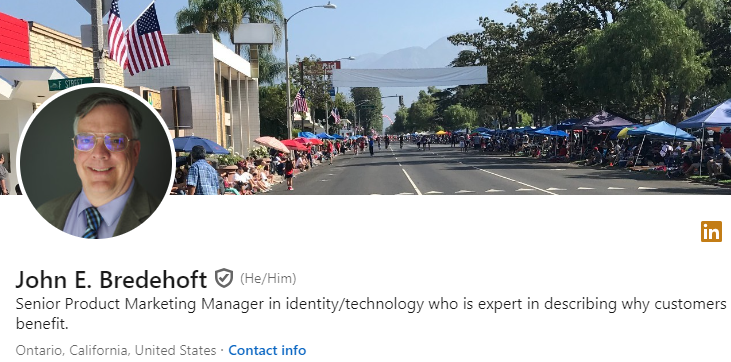
John Bredehoft LinkedIn profile, public view, Monday, May 13, 2024, 1:30 pm PDT.
Senior Product Marketing Manager in identity/technology who is expert in describing why customers benefit.
She read that sentence word for word.
“Senior Product Marketing Manager”? She liked that.
“In identity/technology”? I guess she liked that; at least she didn’t comment on it.
The rest of the sentence? Not so much.
Regular Bredemarket readers are familiar with the last three words of that sentence, and realize that every one of those three words is critically important. Why rather than what, customers rather than producers, and benefits rather than features. I’ve devoted a post (plus another post) to those three words. If I only had a few seconds to explain the importance of those three words…
Um, yet again, recruiters aren’t interested in taking a few minutes to read everything I have written about Simon Sinek’s Golden Circle, customer focus, or benefits. They don’t even want to watch a short reel on the topic.
So I have to rewrite the last part of that first sentence. As I write this post, I’m still mulling over alternatives.
CGL Recruiting’s expertise was highly beneficial
The 7 items above were just some of the tips that Melanie Woods imparted to me, all in the space of 20 minutes.
Again, the common theme is that recruiters have limited time, LinkedIn Recruiter lets them maximize that limited time, and jobseeker data also has to let recruiters maximize that limited time. If you can do something in 0 seconds, don’t take 5 seconds to do it.
I haven’t even explored some of the other features that CGL Recruiting offers, including Melanie Woods’ YouTube channel.
But the 20 minutes I spent with her were certainly valuable.
Now I just have to figure out another way to say “why customers benefit.”
I recall one product in particular (not a Segway, but a biometric product housed in a tower) that was an impressive fusion of algorithmic and mechanical excellence. The complex design that went into developing the tower product resulted in a device that performed its function superbly.
The complex engineering also caused the product to have such a high price that no one would ever buy it…but I digress.
But there was another issue with the product. I was writing proposals at the time, and we certainly could have written up a product description that emphasized the product’s lengthy set of features.
But the people receiving our proposals wouldn’t have cared one bit.
Prospects don’t care about lengthy feature lists
You see, prospects don’t care about lengthy feature lists.
If your product stops terrorists from boarding airplanes, then and only then will they care about your company or your product.
If your product can’t stop terrorists from boarding airplanes, or if there is another product that is better at stopping terrorists from boarding airplanes, then your prospects won’t care about your product.
So how do you get prospects to care?
You don’t get prospects to care by talking about your extensive feature lists.
Let me give you a tip. If you find an employee at the prospect’s company who wants to spend a lot of time talking about your extensive feature lists, that employee probably DOESN’T have the authority to approve the purchase.
The people who DO have the authority to approve the purchase don’t have time to talk about extensive feature lists.
The approvers want to know, in 30 seconds or less, how your solution BENEFITS them.
Do you need help explaining your benefits?
Talking about benefits rather than features is just one tactic to successfully appeal to your prospects.
If you need help ensuring that your written materials (blog posts, white papers, web pages) resonate with your prospects, you can ask Bredemarket to help you.
So far the best alternative to “target audience” that I’ve found is “hungry people,” which not only focuses on people rather than an abstraction, but also focuses on those who are ready to purchase your product or service.
But I just found an instance in which “thirsty people” may be better than “hungry people.” Specifically, for the Colorado spirits company Friday Deployment, which engages in product marketing in a very…um…targeted way. Including the use of a micro-influencer who is well-known to Friday Deployment’s thirsty people.
Heads up for regular Bredemarket blog readers: the “why” and “how” questions are coming.
Why are Friday Deployment’s “thirsty people” technologists?
Why does Friday Deployment aim its product marketing at technologists?
Presumably because of this background, Friday Deployment’s product marketing is filled with tech references. Here’s a sample from Friday Deployment’s web page (as of Friday, February 2, 2024).
It was inevitable. The tree is out of date, the history is a mess, and you just want to start your weekend. Maybe you just do a quick little git push --force? Maybe someone already did, and you now get to figure out the correct commit history?
But that isn’t the only way that Friday Deployment markets to its “thirsty people.”
How does Friday Deployment’s marketing resonate with its thirsty people?
How else does Friday Deployment address a technologist audience?
Those of you who are familiar with LinkedIn’s tempests in a teapot realize that LinkedIn users don’t spend all of their time talking about green banners or vaping during remote interviews.
Well, she was until one day when she and about 40 others were terminated.
Pietsch was terminated by two people that she didn’t know and who could not tell her why she was terminated.
This story would have disappeared under the rug…except that Pietsch knew that people were losing their jobs, so when she was invited to a meeting she videorecorded the first part of the termination, and shared it on the tubes.
The video went viral and launched a ton of discussion both for and against what Pietsch did. I lean toward the “for,” if you’re wondering.
Since Friday Deployment’s “thirsty people” were probably familiar with the Brittany Pietsch story, the company worked with her to re-create her termination video…with a twist. (Not literally, since Pietsch drank the gin straight.)
Well, the product marketing ploy worked, since I clicked on the website of a spirits company that was new to me, and now I’m on their mailing list.
But let’s talk alcohol age verification
The Friday Deployment product marketing partnership with Brittany Pietsch worked…mostly. Except that I have one word of advice for company owner Rishi Malik.
With your Varo Bank engineering experience, you of all people should realize that Friday Deployment’s age verification system is hopelessly inadequate. A robust age verification system, or even an age estimation system, or even a question asking you to provide your date of birth would be better.
Bredemarket can’t create a viral video for your tech firm, but…
But enough about Friday Deployment. Let’s talk about YOUR technology firm.
How can your company market to your thirsty (or hungry) people? Bredemarket can’t create funny videos with micro-influencers, but Bredemarket can craft the words that speak to your audience.
To learn more about Bredemarket’s marketing and writing services for technology firms, click on the image below.
Time for me to make a cryptic LinkedIn post. Although now that I’m sharing the secret here, I’ll have to lower the score to 89.
Bredemarket’s first rule
But before I share my revised Phineas-Hirshfield score, I need to share the first Bredemarket Rule, the Bredemarket Rule of Corporate Tool Adoption. (Copyright 2023 Bredemarket.)
In any organization, the number of adopted tools that perform the exact same function is always in excess of one.
In other words, if there’s someone in your organization who is using an iPhone, there is someone else in your organization who is using an Android phone.
Or someone has a Mac, and another person has a Windows computer.
Or someone has one brand of software, while someone else has the competitior brand.
Even if an organization dictates that everyone will use a single tool, there will be someone somewhere who will rebel against the organization and use a different tool.
Presumably the first panelist was exposed to Asana at one point and liked it, while the second panelist was exposed to Monday and liked it.
Or, since the panelists were from two different companies, maybe each company standardized on one or the other. Or maybe the departments within their companies standardized on a particular tool, but if you poll the entire company, you’ll find some Monday departments and some Asana departments.
Multiple tools in a single department
Even in the same department you may find multiple tools. Let me cite an example.
Several of the people who were in the Marketing department of Incode Technologies have since left the company, and I’m working with one of them on a project this week.
I had to send a PDF to him, and was also going to also send him the source Microsoft Word document…until I remembered from our days at Incode that he was (and I guess still is) a Google Docs guy.
Of course, there are times in which an entire organization agrees on a single tool, but those times never last.
My mid-1990s employer, Printrak International, was preparing to go public. The head of Printrak determined that the company needed some help in this, and brought several staffers on board who were expert in Initial Public Offerings (IPOs).
One of these people took the role of Chief Financial Officer, preparing Printrak for its IPO and for two post-IPO acquisitions, one of which profoundly and positively impacted the future of the firm.
Along the way, he established the rule that Printrak would become a Lotus Notes shop.
For those who don’t remember Lotus Notes, it was one of those Lotus-like products that could do multiple things out of the box. And because the CFO was the CFO, he could enforce Lotus Notes usage.
Until the CFO left a couple of years later to assist another company, and the impetus to use Lotus Notes dropped off significantly.
And that, my friends, is why my former colleagues in IDEMIA aren’t using HCL Notes (the successor to Lotus Notes and IBM Notes) today.
So how do you settle the Tool Wars?
Do you know how you settle the Tool Wars?
You don’t. It’s an eternal battle.
In the case of Bredemarket, I can dictate which tools I use…unless my clients tell me otherwise. Then the client’s word is law…unless there’s a compelling reason why my tool should be used instead of the client’s tool. In Bredemarket’s 3+ years of existence, I haven’t encountered such a compelling reason…yet.
Just be flexible enough to use whatever tool you need to use, and you’ll be fine.





















 Bredemarket