Accelerating robust content creation (re-examining Bredemarket’s content creation process)

As Bredemarket passes its one-year anniversary, I’m intentionally trying to re-evaluate what I do in order to improve my services to you.

When I say “you,” by the way, I’m speaking of clients or potential clients of Bredemarket. If you’re not interested in Bredemarket’s services, but are instead reading this hoping for a discussion of fingerprint third-level detail, this is NOT the post for you.

Back to my re-evaluation of my services. One thing that I’m doing is re-examining Bredemarket’s content creation process.

Jean Miélot, a European author and scribe at work. By Jean Le Tavernier – [1], Public Domain, https://commons.wikimedia.org/w/index.php?curid=74516

What is my current content creation process?

How do others create robust content?

What can I learn from them, and from you, to improve my own content creation process?

Bredemarket’s current content creation process

I’ve stated my content creation process in several separate areas of my website. One of my, um, goals is to make sure that my content creation process is consistently stated throughout the site.

First, let’s look at my elevator pitch, taken from my page “The benefits of benefits for identity firms.”

I work with you. Bredemarket uses an iterative, collaborative process with multiple reviews to make sure that your needs are expressed in what I write, and that the writing reflects your firm’s tone of voice. The final product needs to make me happy, it needs to make you happy, and it needs to make your potential client(s) happy.

That page was created just a few months ago, but it’s a rewrite of the specific processes that I created almost a year ago. While these vary from offering to offering (and from client to client), here’s how I stated my “iterative, collaborative process” in my description of the Bredemarket 2800 Medium Writing Service.

  • Agree upon topic (and, if necessary, outline) with client.
  • Client provides relevant technical details.
  • Bredemarket conducts any necessary research and provides the first review copy within seven (7) calendar days.
  • Client provides changes and any additional requested detail within seven (7) calendar days.
  • Bredemarket provides the second review copy within seven (7) calendar days.
  • Client provides changes and any requested detail within seven (7) calendar days.
  • Bredemarket provides the third review copy within seven (7) calendar days.
  • Client prepares the final formatted copy and provides any post-formatting comments within seven (7) calendar days.
  • Bredemarket provides the final version within seven (7) calendar days.

In addition to the words “iterative” and “collaborative,” I think that the two other words that are implicitly associated with my content creation process are “benefits” and “goals.”

Actually, I’m pretty explicit on benefits, as the previously-cited page and other writings indicate.

I haven’t been so explicit on goals (other than my own goals for Bredemarket), but that has become more important to me as Bredemarket has acquired experience.

  • While goals have been implicit with some of my clients—we all assume that the content that I have created will win more business in some generic way—my work with other clients has required me to be more explicit about the goals the content must achieve.
  • These goals not only affect the final call to action, but also affect the entire content creation and placement process.
  • For example, if the goal of a piece of content is to move an end customer to request a proposal from my client, where does that content have to be placed to elicit that request? In my line of work, it’s not Instagram.

So I concluded that I probably need to iterate my descriptions of my process to ensure that all aspects of the Bredemarket website, as well as all external communications, provide a concise and unified description of the benefits of how I work with you.

But before I did that rewrite, I wanted to see how others described a content creation process, to see what I could steal…I mean appropriate from those other descriptions.

The content creation processes of others

Obviously, I’m not the only entity that has communicated a process for content creation. Here are some others.

So if I add 4 plus 6 plus 6 plus 17, the resulting 33 step content creation process will be perfect, right?

Actually, I scanned these disparate processes to see what I’m missing in my iterative, collaborative, benefit-oriented, goal-oriented current process. These things came to mind.

Sub-goals. GatherContent makes a point of talking about multiple goals, one for “each piece of your content” or each topic addressed by your content. While this may be overkill for a tweet, it makes sense for longer content, such as a multi-section blog post.

Audience. This is an implicit thing that should be addressed explicitly, as ClearVoice and HubSpot suggest. There are a number of stakeholders who may potentially see your content, and you need to figure out which stakeholder(s) are the intended audiences for your content and plan accordingly. For example, this very post uses the word “you” to refer to an existing or potential client of Bredemarket, and I have had to shape this content to ensure that this is clear, and to warn other potential readers in advance that this post might not interest them.

When I say “you,” by the way, I’m speaking of clients or potential clients of Bredemarket. If you’re not interested in Bredemarket’s services, but are instead reading this hoping for a discussion of fingerprint third-level detail, this is not the post for you

Voice. HubSpot also suggests that the voice used in content creation is important. I happen to use a specific voice when I write these blog posts for Bredemarket, but you better believe I use a different voice when rewriting a chapter for a scientific book.

Frequency. If creating a series of content pieces, it’s wise to settle upon the frequency with which these pieces will appear. ClearVoice cites a HubSpot study in this regard.

HubSpot study of blogging data accumulated from 13,500+ of their customers found, “companies that published 16+ blog posts per month got about 4.5X more leads than companies that published between 0 – 4 monthly posts.”

Now this is only one study, and it may not apply to content other than blog posts; do your customers really want to get 16+ emails per month from you?

Frequency of course affects multiple aspects of the content creation process, including the review cycle. If you are only able to review my draft content once every two weeks, then perhaps a daily content release cycle isn’t good for you.

(One more thing. Bear in mind that I as a consultant have a financial interest in creating content as frequently as possible, since this increases the consulting rate. So if I propose something outrageous that exceeds your budget without providing tangible benefits, feel free to push back.)

Search Needs. Steps 5 and 6 in Orbit Media’s 17 step process, as well as HubSpot’s process, ask if people will search for the content in question. If so, it’s important to make sure that people will find it. The…um, goal is to “plan to make it the best page on the web for the topic.” (If people won’t search for it, then content distribution via the regular social media outlets is satisfactory.)

Tasks. GatherContent puts great emphasis on the tasks needed to produce the final content. This is NOT relevant for some of the content that I create with you, but it was EXTREMELY relevant when I managed the RFI response for a client a couple of months ago. Even though the response had a 20-page limit, a lot of information was packed into those 20 pages, and I had to work with a lot of subject matter experts to pull everything together and get it approved.

Examples. Orbit Media Studios discusses a number of items that are outside of the scope of textual content creation, and thus outside of my (current) scope (although I have suggested visual content that can be created by more talented people). One thing that does fall within my scope is to support the content with examples. Of course, a case study is just one big example, but in other cases some examples may be beneficial.

Promotional Considerations. No, I’m not talking about the game show language in which Montgomery Ward provides money and/or goods to a game show in exchange for a mention at the end of the show. Here, Orbit Media Studios is talking about how the content will be promoted once it is created. I address these questions all the time in my own self-promotion. If I’m re-sharing a link to content on social media, what excerpt should I include, and what hashtags should I use?

Due Dates. GatherContent also talks about due dates and how they affect the content creation process. Some of my clients don’t have due dates at all. Some have very vague due dates (“we’d like to go live with the content next month”). Other dates are very explicit; when you’re dealing with RFP and RFI responses, the end customer has a specific due date and time.

Content Inventory. GatherContent also talks about this. My content is often not stand-alone. It needs to integrate with other client content. The client’s content inventory needs not only affect the delivery of the final content, but may affect the format of the content itself. For example, if something is only going to be available in hardcopy, I can do away with the hyperlinks.

In addition to the information that I appropriated from these sources, perhaps it’s worthwhile to fit the whole thing into a needs / solution / results framework. Although in this case, the “results” would be “expected results.”

Oh, and there’s one more word that I’d like to work in there somewhere. Did you see that the title of this post started with the word “accelerating”? I, um, appropriate that from a source that I cannot discuss publicly, but it may make sense here also. If not for accelerating the content creation, at least for accelerating the expected results.

Bredemarket’s new and improved content creation process is…

Wow, that’s a lot of stuff.

Some of it is too detailed to include in a succinct statement of Bredemarket’s content creation process, and some of it should be included, even if I only include a single word.

So after that review, I can announce that Bredemarket’s new content creation process is…

TO BE DETERMINED.

I still need to think through this, write up a new succinct version, iterate it, and share the new version in a future post.

After all, a higher frequency of blog posts DOES lead to a greater number of leads. See “Frequency,” above.

Stay tuned.

(Bredemarket Premium) Watch a new security market evolve

Markets come and go.

When I first joined the biometrics industry in the 1990s, biometric benefits (welfare) applications were hot in the United States as states and localities deployed biometric verification solutions for benefits recipients.

However, the landscape changed over the years, and most of those biometric systems have since been shut down.

Of course, new markets also appear.

Nokia 3310 3G (20180116). By Santeri Viinamäki, CC BY-SA 4.0, https://commons.wikimedia.org/w/index.php?curid=65577308

If someone had told me in 1994 that we would use biometrics to “unlock” our phones, I would have had no idea what the person was talking about. Why would we need to unlock our phone, anyway? Sure, if a thief grabbed my cell phone, the thief could make a long distance call to another state. But it’s not like the thief could access my bank account via an unlocked cell phone, right?

And there are other markets.

Subscribe to get access

Subscribe to Bredemarket Premium to access this premium content.

  • Subscriptions just $5 per month.
  • Access Bredemarket’s expertise without spending hundreds or thousands of dollars.

Winding down the 28th parallel experiment

Wrapping up a few loose ends about the whole 28th parallel thingie (where I posted/shared multiple content items in a short period to see what would happen).

I just completed a podcast episode about it. (TL;DR: no huge effect.)

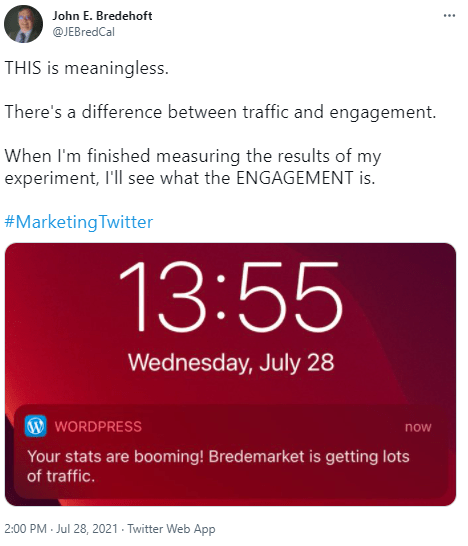
Yesterday, I made an observation about traffic vs. engagement on my business Twitter account.

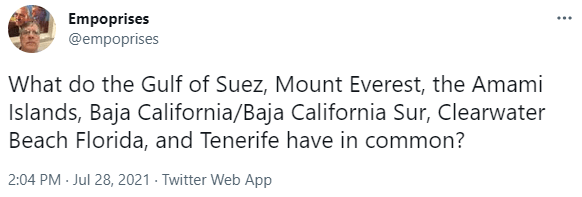
Also yesterday, I posted an obscure trivia question on my personal Twitter account. (It didn’t really get traffic OR engagement.)

Conclusion? In the short term it didn’t help, but it didn’t harm either. And I may exercise the flexibility to increase my content sharing when warranted.

Tenerife. By NASA Earth Observatory image by Jesse Allen, using Landsat data from the U.S. Geological Survey. Caption by Kathryn Hansen. – https://earthobservatory.nasa.gov/images/88659/tenerife-canary-islands, Public Domain, https://commons.wikimedia.org/w/index.php?curid=101333395

That was fun.

Well, my experiment is now complete.

If you missed the explanation of what I just did, I had a backlog of identity-related draft blog posts, and I decided to post all of them at once.

Specifically, I just posted:

And all four of those posts were also shared to my Twitter account, the Bredemarket Identity Firm Services showcase page on LinkedIn, and the Bredemarket Identity Firm Services group on Facebook.

Will my 140+ blog subscribers, 250+ Twitter followers, 120+ showcase page followers, and 9 group followers (yeah, Facebook lags the other platforms) be overwhelmed by this blast of content? Or will they like it? Or will they even notice?

Because of the way social media feeds work, it is questionable that many of the followers will even notice. Social media feeds are presented to readers in order of importance, and Bredemarket isn’t the most important thing to ANY of these followers. (Except for me. Maybe.)

The 28th parallel

Black wildebeest. By derekkeats – Flickr: IMG_4955_facebook, CC BY-SA 2.0, https://commons.wikimedia.org/w/index.php?curid=14620744

My Bredemarket activities allow me to eat my own wildebeest food, trying out activities that I can potentially duplicate for my clients.

One of these activities is a content calendar, in which I strive to balance my own content between the various foci of Bredemarket. This ensures that I don’t neglect talking about certain things that I do.

One problem that I DON’T have is generating enough content about identity topics. In fact, over the last few days I’ve built up several posts that discuss identity. Under normal circumstances, it would take a couple of weeks to post all of them.

I’m not going to do that.

I’m going to post several of them this afternoon. Especially since a couple of them are interrelated, and it’s easier to interrelate things when you post them at about the same time.

Be prepared for the identity posts that will appear on the Bredemarket blog, and in the relevant (i.e. identity-related) social media channels.

Will this abundance of content result in MORE engagement, or LESS? (Not that I’m planning to create 100 posts over the next couple of hours, but perhaps some may be overwhelmed.)

In case you’re interested in the entire slew of content, I’m going to tag all of this afternoon’s posts with the tag 28thparallel.

And if you have to ask whether I’m referring to the 28th parallel north or the 28th parallel south, the answer is…north.

Stay tuned.

I just re-rejoined the Association of Proposal Management Professionals. So what?

Remember my Tuesday post about the controversy regarding the possible name change of the Association of Proposal Management Professionals to the Association of Winning Business Professionals? And how the upcoming Denver conference of the organization (whatever its name is by October) might be…interesting?

By Billy Hathorn – Own work, CC BY-SA 3.0, https://commons.wikimedia.org/w/index.php?curid=11357434

Anyway, it turns out that I will have an inside view of all the brouhaha.

Why?

Because I have rejoined (actually RE-rejoined) the Association of Proposal Management Professionals. (Or at least that’s what the organization is called right now. The name may change, of course.)

Why does my renewed membership in the Association of Proposal Management Professionals matter to Bredemarket clients? And how can it benefit those who DON’T use Bredemarket for proposal services?

I’ll tell you why/how in this post.

So I re-rejoined the APMP

As I previously noted, this will be my third term as a member of the APMP (or, membership Version 3.0).

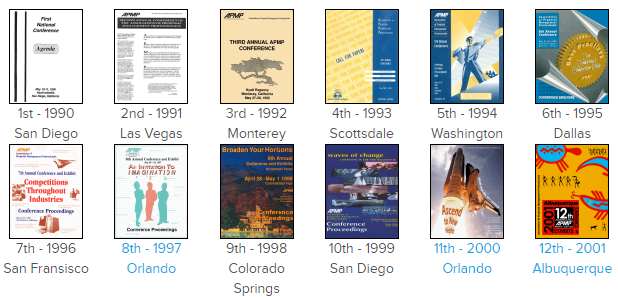
Covers from early APMP conference booklets, including the cover for the conference that I attended in San Diego in 1999. From https://www.apmp.org/page/ConferenceArchive
  • I initially joined the APMP while I was a proposal writer at Printrak, but I let my membership lapse when I became a product manager. I couldn’t justify having my employer pay for a proposal organization membership when I was a product manager who only occasionally contributed to proposals. (Although some of those proposals, such as West Virginia’s first state AFIS, were critical to the company.)
  • I subsequently rejoined the APMP when the initial MorphoTrak corporate reorganization resulted in my move from product management to proposal management. After joining in 2012, I (again) let my membership lapse in 2015 after I became a strategic marketing manager, because (again) I couldn’t justify having my employer pay for a proposal organization membership when I was a marketing manager who only occasionally contributed to proposals. (Although some of those proposals, such as Michigan’s first cloud AFIS, were critical to the company.)

Obviously, back in those days corporate reimbursement for professional memberships depended upon the policies of the corporation in question. Well, now I’m not an employee of a large corporation, so I don’t have to justify my memberships to a corporate supervisor or accountant. Instead, as a sole proprietor I have to justify my memberships to myself (and the Internal Revenue Service, and the California Franchise Tax Board).

And since much of Bredemarket’s consulting revolves around proposal services, it makes sense for me to re-rejoin the APMP.

But it turned out that I couldn’t just send money to the APMP and be done with it. As an ex-member, there was an additional step involved.

If you are a former member but cannot access your account, PLEASE: Do not register as a new member….If you cannot access your past email address, contact our Member Services team (or call +1 866/466-2767, then dial 0). Within one business day (or sooner), you will receive a link with which you can pay for a new membership using your existing account.

So I contacted APMP’s Member Services team, who associated my lapsed membership with my NEW email address.

And I paid my dues, time after time, I’ve done my sentence but committed no crime…whoops, I seem to have digressed from the discussion of my new APMP membership. But in my defense, I’m not the first to associate the old Queen song with the APMP.

Anyway, I’m now an APMP member…again.

Just call me 3143. (Want to fire up a copy of Microsoft Word 97 while you do that?)

The one big difference between APMP Membership Version 3.0 and Versions 1.0 and 2.0 is that these days I am not EXCLUSIVELY dedicated to proposals. After all, I am not only the (self-styled) biometric proposal writing expert, but also the biometric content marketing expert. (With similar expertise in marketing and writing for technology firms and general business firms.)

In fact, I guess you could say that I am a general expert in…winning business.

So what?

Since I spend so much of my time talking about benefits, I’m sure that some Bredemarket clients are asking about the benefits to THEM of my APMP/AWBP/whatever membership. Yes, this internal dialogue is taking place with some of you right now.

ME: “I am a member of the Association of Proposal Management Professionals again!”

YOU: “So what?”

Yours truly in a small group (I’m on the right) at the 2014 APMP Bid & Proposal Con in Chicago. Photo source: the gallery at https://www.apmp.org/events/event_photos.asp?eid=379324&id=130518 Fair use.

To answer this, I’ll state that my APMP membership will benefit my clients because I can provide them with superior services—superior proposal services, AND superior non-proposal services—that will help my clients to, um, win business. (As you’ve probably already noticed, I’ve found myself using those words a lot over the last few weeks.) My renewed affiliation with APMP will reintroduce me to beneficial outside education, general knowledge, and contacts.

  • For my Bredemarket clients who depend upon me for proposal support, the benefits are obvious. The things that I learn (and relearn) from APMP will help me provide better contributions to my clients’ proposals, hopefully helping the clients secure more proposal awards and business.
  • But there are benefits for my Bredemarket clients who DON’T depend upon me for proposal support, but instead depend upon me for content marketing or other marketing and writing services. The same strategies and tactics that contribute to a more effective proposal can be extrapolated to apply to other areas, thus contributing to better white papers, better case studies, better blog posts, better social media posts, better marketing plans, etc., etc., etc. Again, this can help my clients win business.

We’ll have to see exactly HOW my APMP membership directly benefits my Bredemarket clients.

Stay tuned.

How can small and smaller businesses market themselves?

While Bredemarket sends its solicitations to a (targeted) group of businesses, Bredemarket itself receives solicitations from other businesses. However, sometimes it seems that the solicitations that I receive aren’t targeted that well.

(Of course, perhaps some of the recipients of my solicitations would claim that my targeting attempts are also deficient, so I should watch out about casting stones.)

If you ignore the completely off-the-wall solicitations that I receive, some of the more serious solicitations just do not match Bredemarket’s needs.

For example, I’ve received at least one pitch from a company that offers to provide all of the human resources services that Bredemarket needs for a low monthly fee.

By Alan Cleaver from Whitehaven, United Kingdom – Interview, CC BY 2.0, https://commons.wikimedia.org/w/index.php?curid=57309901

A fine service to be sure…but since Bredemarket is a sole proprietorship that doesn’t engage other people as either employees or subcontractors, a human resources service would be overkill.

The United States Small Business Administration (SBA) defines a “small business” as a company with fewer than 1,500 employees and an average of $38.5 million in average annual receipts. My one-person company certainly has fewer than 1,500 employees, and I’m probably not revealing any confidential information when I say that Bredemarket’s average annual receipts are less than $38.5 million.

So I guess Bredemarket is a “very” small business.

But there are even smaller businesses.

Nano-small businesses of the past

Just to put things into perspective, Bredemarket has a city business license, has filed a fictitious business name statement with San Bernardino County, has a published address at which it receives mail, has received an Employer Identification Number from the Internal Revenue Service (IRS), and files quarterly estimated taxes with both the IRS and California’s Franchise Tax Board.

Years ago, I operated a much smaller business that didn’t have any of those things.

Specifically, I was a paperboy.

Several decades before my time, but you get the drift. By Ruddy, Marjorie Georgina (1908-1980) – Whitby Public Library, Reference No. ruddymg_050_002, Public Domain, https://commons.wikimedia.org/w/index.php?curid=4548723

Way back in the Dark Ages (before the Kardashian/Jenner women became famous independent of O.J. Simpson), newspapers were delivered by people under the age of 18. These days, the few physical newspaper deliveries that I see are performed by adults driving cars and throwing papers out the window. Former papergirl Molly Snyder explains the shift:

The shift in carriers’ age was due partly to the disappearance of evening newspapers that provided student-friendly delivery times. The accessibility of internet news, growing concerns for the safety of un-escorted kids, and new distribution procedures also affected the change.

“To remain profitable, we phased out the ‘neighborhood shacks’ and home drop offs and migrated to larger distribution centers dealing solely with adult distributors,” said Ronald Zinda, distribution supervisor for the Milwaukee Journal Sentinel of 45 years.

Nano-small businesses of the present

Even with the disappearance of paperpeople, there are a number of jobs today that fly under the radar of the Internal Revenue Service, city business license departments, and other government regulatory bodies. Here are a few examples; while some of these types of business may actually comply with government reporting requirements, many of them don’t.

By Nalbarian – Own work, CC BY-SA 4.0, https://commons.wikimedia.org/w/index.php?curid=95136303
  • The person on the street corner selling fruit treats.
  • The person on the street corner selling flowers.
  • The teenager who comes up to your door selling candy for a school club, a sports team, or as part of a supposed program to keep kids out of trouble by having them walk around neighborhoods and sell stuff after dark.
  • The person who sells homemade crafts.

Bredemarket can’t really serve these nano-small businesses. When your products (fruit treats, flowers, or whatever) only cost a few dollars, you’re not going to pay Bredemarket hundreds of dollars to create content for your website or social media outlet. In fact, you probably don’t even HAVE a website or a social media outlet.

Which businesses NEED Bredemarket’s services?

Let’s move up a step and look at small businesses that have an established online identity, do their best to comply with business requirements, and meet the IRS definition of a (non-hobby) ongoing concern.

Now any of those businesses COULD use Bredemarket’s services…but many of them don’t NEED Bredemarket. A number of small businesses are doing just fine in meeting their business goals, and are perfectly capable of taking care of the written communications necessary to keep the business profitable.

But what about the businesses that have particular goals that they can’t meet? Specifically, what about businesses that need targeted, regular online content to make customers aware of the business, but the business owners don’t have the time (or the inclination) to create the necessary online content?

By Unknown author – postcard, Public Domain, https://commons.wikimedia.org/w/index.php?curid=7691878

If you own a business and need a consultant to help you create online content for your website, your Facebook or LinkedIn page, or for another communication method (even paper), Bredemarket can help. My “What I Do” page lists the types of written content that I can create for your business, including both short length (400-600 word) and medium length (2800-3200 word) content. (No, I don’t author individual tweets, but I guess I could author a thread if you like.)

If you’re interested in using my marketing and writing services, talk to me. I can collaborate with you to ensure that your business goals are met and your business messages are disseminated.

How and why a company should use LinkedIn showcase pages

This post explains what LinkedIn showcase pages are, how Bredemarket uses LinkedIn showcase pages, and (a little more importantly) how YOUR company can use LinkedIn showcase pages.

What are LinkedIn showcase pages?

LinkedIn offers a variety of ways to share information. Two of those ways are as follows:

  • A personal LinkedIn page. This allows an individual to share their job history and other information. Here’s an example.
  • A company LinkedIn page, which contains information about a company, including “about” details, jobs, employees, and other facts. Here’s another example.

A third method is a LinkedIn showcase page. This is tied to a company page, but rather than telling EVERYTHING about the company, a showcase page allows the company to zero in on a PARTICULAR aspect of the company’s product/service offering.

How Bredemarket uses LinkedIn showcase pages

Most companies, even very small ones like Bredemarket, can segment their products and services in various ways. In Bredemarket’s case, the company offers some prepackaged services, such as a “short writing service” and a “medium writing service.”

However, it didn’t make sense for me to segment my services in this way. The people who are interested in 400 word written content are not dramatically different from the people who are interested in 2800 word written content. So instead of segmenting by service, I chose to segment by market.

I started by addressing one of my potential markets, the identity market (biometrics, secure documents, and other identity modalities). Back in November, I created a Bredemarket Identity Firm Services showcase page on LinkedIn, which eventually became a place for me to share information about the identity industry, both content generated by me and content generated by others.

Bredemarket Identity Firm Services on LinkedIn. https://www.linkedin.com/showcase/bredemarket-identity-firm-services/

Since then I’ve expanded my offerings. On LinkedIn, I presently have TWO showcase pages, one concentrated on the identity market, and one concentrated on the more general technology market.

Bredemarket Technology Firm Services on LinkedIn. https://www.linkedin.com/showcase/bredemarket-technology-firm-services/

These concentrations made the most sense to me, although I could segment even further if I chose to do so (separate showcase pages for fingers and palms, anyone?).

An aside for Facebook users

Incidentally, you can perform similar segmentation in Facebook. In Facebook terms, you can have a page associated with a particular company, and then (rather than showcase pages) you can have groups that link to the company page and delve into topics in more detail.

So Bredemarket (which is committed to disseminating information via multiple communication streams; see my goal number 3 here) has Facebook groups that are somewhat similar to the Bredemarket LinkedIn showcase pages. One difference is that I have three groups on Facebook. In addition to the identity and technology groups, I also have a general business group. At this point it didn’t make sense to create a LinkedIn showcase page for general business, but it did make sense for Bredemarket to have such a group on Facebook.

Enough about me. What about you?

Obviously Bredemarket is an unusual case, although for some of you it may make sense to segment based on markets.

Most companies, however, will choose to segment based upon products or product lines. This especially makes sense for multinational companies that offer a slew of products. However, even smaller companies with multiple product lines may benefit from showcase page segmentation. If a potential customer is only interested in your square blue widgets, but doesn’t care about your other widgets, a showcase page allows the customer to read about blue widgets without having to wade through everything else.

Some of you may have received a pitch from me suggesting how a showcase page can help you highlight one product or product line in this way.

Perhaps it’s best to show an example. I’ve previously highlighted Adobe as an example of a company with showcase pages, but for now I’d like to highlight another company with a similar issue.

Let’s look at Microsoft, which has an obvious interest in using LinkedIn to its fullest potential. Microsoft’s product and service lines have expanded over the years, and while some Microsoft entities (such as LinkedIn itself) have their own regular LinkedIn pages, Microsoft uses showcase pages for other entities, products, and services.

For example, Microsoft has a showcase page for Microsoft Dynamics 365.

But here’s a showcase page that has nothing to do with a product, service, or market: “Microsoft On the Issues.”

So there are a variety of ways that a company can slice and dice its communications, and LinkedIn showcase pages provide an ideal way to do that.

Does this interest you?

Of course, setting up a LinkedIn showcase page is only the beginning of the battle. If you set up a showcase page and don’t publish anything to it, your efforts are wasted. Potential customers look at your company’s online presence, after all.

If your company has established a showcase page, has set goals for how the showcase page will benefit the company, and now needs to generate content at a regular clip, Bredemarket can assist with the creation of the content, working with internal company subject matter experts as needed. If this service interests you, contact me. We will collaborate to ensure that your LinkedIn showcase page includes the best possible content.

(Bredemarket Premium) My (biometric) baby is American made

When I first entered the biometric world, the portion of the world that directly interested me (the automated fingerprint identification system, or AFIS industry) had three major players and one emerging player. Of those four, two were privately held American companies, and the other two were U.S. subsidiaries of foreign companies (one French, one Japanese).

Today it’s different.

Subscribe to get access

Subscribe to Bredemarket Premium to access this premium content.

  • Subscriptions just $5 per month.
  • Access Bredemarket’s expertise without spending hundreds or thousands of dollars.

My prediction of the death of tangible collateral was premature

I love it when I am SPECTACULARLY wrong.

Just a few days ago I wrote a post dedicated to marketing intangible products, in which I said things like this:

…when I started attending trade shows in the mid 1980s, I would go by booths and pick up company case studies and white papers and stuff them into a bag. (Booths and sponsors that provided such bags were VERY important.) Today, some vendors don’t even have printed case studies and white papers in their booths any more; the attendees simply request electronic copies.

and:

In the old days of product marketing collateral, you could get into big discussions about the quality, weight, and finish of the paper that you used to print your collateral. Today, those discussions are for the most part irrelevant, since the recipients print the collateral on their own printers, if they print the collateral at all.

My prior post definitively stated that all of that printed collateral stuff was a relic of the past.

Then I went to an event on Friday.

The event was here in the city of Ontario, although it was way on the other side of the city and it took me 25 minutes to drive there. It was called “Tech on Tap,” and was held at the New Haven Marketplace, a shopping center next to a new residential development in the former agricultural reserve.

The event started with a half hour of speeches, followed by the ribbon cutting for a new microbrewery. Rather than listening to all the speeches, I spent my time visiting all the “Tech on Tap” booths.

When I went home, I realized that I had accumulated a BIT of tangible collateral.

OK, a LOT of tangible collateral.

So much for Mr. “Everything is Intangible.”

So WHY was I spectacularly wrong? I think there were two reasons:

  • I am normally used to attending events in the B2G/B2B space. The city’s event was clearly a B2C event, and individual consumers have different expectations than business/government attendees. (Even for B2G/B2B events, how many attendees end up snatching booth swag for their kids?)
  • While a number of the booths at “Tech on Tap” were staffed by tech companies (robots, ISPs, and the like), about half of the booths were staff by departments of the city of Ontario. Sometimes cities do not rush into tech as quickly as businesses do, and sometimes the citizens of a government do not EXPECT cities to rush into tech.

If you look closely at my loot, you will see that most of it is from city agencies. And there were a lot of agencies represented, including city utilities, police, fire, and recreation.

Oh, and if you look closely at my loot, you will see that I ended up with TWO bags, BOTH from the same agency, the Ontario Municipal Utilities Company. This agency had two separate booths on opposite ends up the area, one staffed by the recycling/trash folks, the other by the water folks. After I had already obtained the green bag from the recycling/trash booth, the person at the water booth insisted on giving me the blue bag (which folds up; nice). And when I started to put the blue bag inside my already-filled green bag, he convinced me that I should do the opposite.

I’m still amused that I, the proclaimer that there will be no “death of passwords,” was myself equally insistent about the “death of tangible collateral.” Neither is going to happen.