On marketing intangible products

These days, more and more of us are marketing products that are intangible. But most of the essentials of marketing intangible products don’t differ much from marketing tangible ones.

Many, many years ago, the phrase “intangible product” seemed like a lot of nonsense. How could something be a product if you couldn’t touch it? Could you grab a product out of thin air?

By Hoodedwarbler12 (talk) – I (Hoodedwarbler12 (talk)) created this work entirely by myself., Public Domain, https://en.wikipedia.org/w/index.php?curid=26933846

Obviously that is no longer the case.

I’m not even going to, um, touch the NFT world, but clearly things that we used to think of as tangible products are now moving to the intangible realm. I’ll give you two examples from my experience:

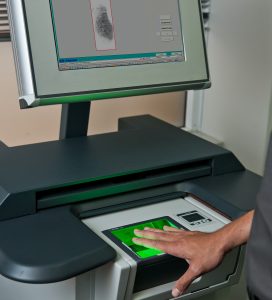
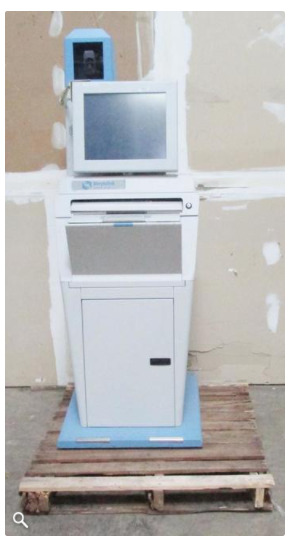
  • When I started selling automated fingerprint identification systems (AFIS) in the 1990s, a law enforcement agency’s AFIS consisted of a set of computer servers in the agency’s computer room, coupled with a set of some fairly expensive workstations in the agency’s work areas. But even then, there were several states that had minimal computer servers at the state agencies, with most of the servers located in the state of California. The Western Identification Network model was duplicated in later years by other agencies who would host their biometric server “products” at faraway Amazon or Microsoft locations.
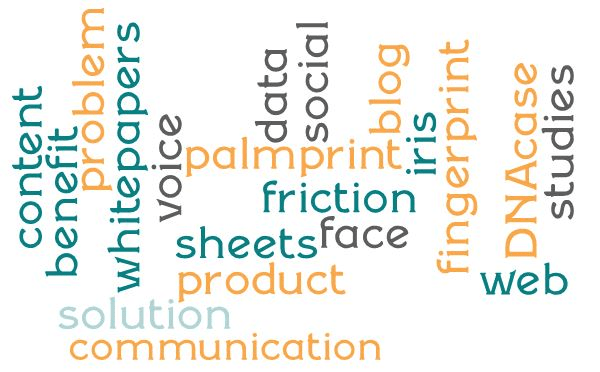
  • Similarly, when I started attending trade shows in the mid 1980s, I would go by booths and pick up company case studies and white papers and stuff them into a bag. (Booths and sponsors that provided such bags were VERY important.) Today, some vendors don’t even have printed case studies and white papers in their booths any more; the attendees simply request electronic copies.
By Silverije – Own work, CC BY-SA 4.0, https://commons.wikimedia.org/w/index.php?curid=63431852

Yet for the most part the marketing of these intangible products isn’t much different from the way that the old tangible versions were marketed. The differences are minor:

  • When Printrak sold AFIS servers, care was taken to place a Printrak logo prominently on the server, where it would compete with the Digital Equipment Corporation logo from the server manufacturer. The logo even appeared as a component on an extended Bill of Materials. Now, purchasers of cloud solutions from the biometric companies don’t need to worry about placing logos on physical servers.
  • In the old days of product marketing collateral, you could get into big discussions about the quality, weight, and finish of the paper that you used to print your collateral. Today, those discussions are for the most part irrelevant, since the recipients print the collateral on their own printers, if they print the collateral at all.

The important thing in each case is the content. Fewer and fewer law enforcement agencies care WHERE their biometric data is stored, as long as it meets certain security, accuracy, and response time requirements. Similarly, people who collect marketing collateral are much more concerned with WHAT the collateral says than the weight of the paper used to print it.

By Rick Dikeman at the English Wikipedia, CC BY-SA 3.0, https://commons.wikimedia.org/w/index.php?curid=164188

I have been accused of preferring substance over style, and I plead guilty. While style is clearly important, the substance of the product must excel or the style is wasted.

Sometimes this requires the product creator to take a step back from the nitty gritty of collateral creation, and decide what the collateral is supposed to do, and why the customer should care. Rather than saying “give me a case study that tells how the widget is exactly 70 mm high,” my clients are now asking to “give me a case study that tells our customers why our product will let them sleep securely at night.”

If you would like to explore these topics for your next piece of collateral, whether it be a case study, white paper, proposal, or some other marketing written work, Bredemarket can help you explore. Bredemarket uses a collaborative process with its clients to ensure that the final written product communicates the client’s desired message. Often the client provides specific feedback at certain stages of the process to ensure that the messaging is on track. I combine the client’s desires with my communications expertise to create a final written product that pleases both of us.

Contact me and we can discuss how to work together to realize your goals.

How livescan fingerprinting enrollment service providers win business

One of the tasks that I used to perform as an employee of IDEMIA was to track the state-by-state status of livescan fingerprinting enrollment services. And I soon discovered that enrollment services differed substantially from IDEMIA’s other major product lines.

This post describes the nuances in livescan fingerprinting enrollment services, the many players that are involved, the livescan technology, and (most importantly) how enrollment service providers win business.

Why enrollment services differ from driver’s license and AFIS services

At IDEMIA, I tracked the company’s presence in three major product lines (and a slew of others). And IDEMIA’s presence in each market differed depending upon the nuances of the markets.

  • For IDEMIA’s driver’s license services, there was only one provider for each state. Let’s face it, you can’t have two agencies issuing state driver’s licenses. (Although I guess this would satisfy someone’s libertarian fantasy.)
  • For IDEMIA’s automated fingerprint identification systems (AFIS), there was only one provider of law enforcement AFIS in each state. However, there were other statewide fingerprinting systems back in the days when fingerprints were used for welfare benefits, and a number of county and city law enforcement agencies had their own AFIS systems.
  • But for IDEMIA’s enrollment services, there could potentially be dozens or hundreds of small businesses that provided the service. All of this depended upon how the state authorized enrollment. In some states, only one private entity could provide enrollment services, while in some other states multiple private entities could do so.

Why we have enrollment services

So what are “enrollment services”? I’ll defer to my former employer IDEMIA and use the description from its IdentoGO website.

IdentoGO by IDEMIA provides a wide range of identity-related services with our primary service being the secure capture and transmission of electronic fingerprints for employment, certification, licensing and other verification purposes – in professional and convenient locations.

Of course IdentoGO isn’t the only “channeler” in town. A number of these small businesses that provide enrollment services are allied with Certifix Livescan, others with Thales (Gemalto), others with Fieldprint, others with Biometrics4All, and others with many other FBI-approved channelers.

And in some cases, you can go to your local police agency and have the police capture your fingerprints for enrollment purposes.

The Ripon (California) Police Department provides LiveScan fingerprinting service to the public. https://riponpd.org/?page_id=1226

The channelers, and the hundreds upon hundreds of local businesses that are supported by them, handle some or all of a variety of fingerprint verification tasks, including (depending upon the individual state or Federal regulations) banking, education, firearm permits, health care, insurance, legal services, real estate, social services, state employment, transportation, and many others.

  • The basic theory is that if you are, for example, applying for a banking position, your fingerprints are searched against the FBI’s fingerprint database to make sure you don’t have a prior fraud conviction.
  • Or if you’re applying for an education position, you weren’t previously convicted of committing a crime at a school or with children.
  • Or if you’re applying for a transportation position, those multiple drunk driving convictions may cause a problem.

You get the idea.

Who are the end enrollment service providers?

So who are these small business owners who offer these livescan fingerprinting enrollment services?

In most cases, enrollment services are an add-on to a small firm’s existing business.

  • Maybe the business is a travel agency, and it offers fingerprinting along with other travel-related services (such as passport photos).
  • Maybe the business is a tax preparation service.
  • Maybe it’s an insurance agency.

So the business buys or leases a desktop livescan station, aligns with one of the major channelers, gets the necessary state approvals (in California, from the Office of the Attorney General), and waits for the applicants to…well, apply.

Livescan fingerprint capture isn’t idiot-proof, but if I can do it, you probably can also

“But wait,” you may say. “Isn’t the capture of fingerprints a specialized process requiring substantial forensic knowledge?”

She’s not a CSI, but she played one on TV. By Source, Fair use, https://en.wikipedia.org/w/index.php?curid=17752707

While you do need to take care to capture fingerprints correctly, livescan systems have dramatically improved in quality, allowing a travel agent or insurance agent to capture high-quality prints.

(I’ll let you in on a little secret: even the law enforcement officers who capture livescan prints from criminals don’t necessarily have years of experience in fingerprint capture.)

As someone who has worked with livescan systems since the mid 1990s, I can attest to the dramatic improvements in livescan technology. I wasn’t around in the early 1990s when Printrak and Digital Biometrics partnered to provide an AFIS-compatible livescan, but I was certainly around when Printrak introduced its own livescan, the LiveScan Station 2000 (LSS 2000), that competed with Digital Biometrics, Identix, and other livescan providers. (Today, former competitors Digital Biometrics, Identix, and Printrak are all part of a single company, IDEMIA.) The LSS 2000 used a Printrak-manufactured capture device attached to a computer running Digital UNIX.

By the time I became a product manager (not for livescans, but for AFIS servers), Motorola introduced two new livescan devices, the LiveScan Station 3000U and the LiveScan Station 3000N. (The “U” stood for Unix, the “N” for the Windows NT family.) The capture device for these two workstations was manufactured by Heimann Biometric Systems, which through a series of subsequent mergers is now part of HID Global.

When you’re an employee of a fingerprinting company, you’re often asked to participate in fingerprint scanner tests. (At least you were in the days before GDPR and CCPA.) So the livescan engineers decided to compare the capture quality of the LSS 2000, the LSS 3000U, and the LSS 3000N. I joined several others in participating in the scanner tests.

But I ran into a problem.

At the time that I participated in this scanner test, I had been working with paper for about two decades, and as a result of this and other things I have very light fingerprints. This isn’t an issue if you’re using a subdermal fingerprint capture system (Lumidigm, one manufacturer of such systems, was also acquired by HID Global), but it’s definitely an issue with the average optical system.

Oh, and did I mention that we were capturing our OWN fingerprints as part of this test? Rather than getting a trainer or someone with law enforcement experience to take our prints, this motley assemblage of marketers and engineers was following the DIY route.

With the result that the fingerprints that I captured on the LSS 2000 were pretty much unusuable.

But the later generation LSS 3000 prints looked a lot better. (I believe that the LSS 3000N prints were the best, which heralded the last hurrah for UNIX workstations in the AFIS world, as Windows computers proved their ability to perform AFIS work.)

And of course time has not stood still since those experiments in the early 2000s. (Although you can still buy a LiveScan 3000N today, for the price of $1.00.)

Today you can buy livescan stations that capture prints at 1000 pixels per inch (ppi), 4 times the resolution of the 500 ppi stations that were prevalent in the 1990s and early 2000s. And frankly, that are still prevalent today; most law enforcement agencies see no need to buy the more expensive 1000 ppi stations, so 500 ppi stations still prevail.

So how does a customer select a livescan fingerprinting enrollment service provider?

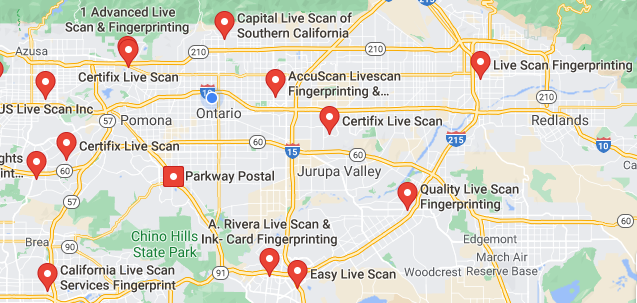
So let’s say a customer is applying for a position at a bank or at a school or somewhere else that asks for a fingerprint check. In the state of California, there’s not just one place that you can go to get this service. For example, there are probably a dozen or more enrollment service providers within a few miles of Bredemarket’s corporate headquarters in Ontario.

So how does a customer select a livescan fingerprinting enrollment service provider?

Well, customers do so just like they do with any other business.

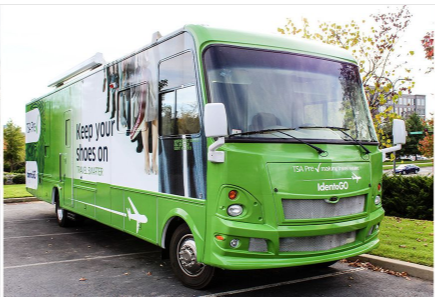
IdentoGO Mobile Enrollment RV. https://www.identogo.com/mobile-enrollment-rv
  • Maybe they saw a picture of the IdentoGO RV and that caused “IdentoGO” to stick in their mind when searching for an enrollment service provider.
  • Or maybe they’re driving down a street in the neighborhood and they see a sign that mentions “livescan fingerprinting.”
  • Or maybe they’re on Facebook and see a page that promotes a specific livescan fingerprint enrollment service provider.

The key for the enrollment service provider, of course, is to make sure that your message stays top of customer’s mind when the time comes for the customer to need your service.

  • Your message needs to appear where the customer will see it.
  • Your message has to speak to the customer’s needs.
  • And your message must explain how to obtain the service. Does the customer have to make an appointment? If so, how does the customer make the appointment?

If the customer never sees your message, it’s going to be a lot harder for the customer to use your business. While the California Office of the Attorney General does include a list of all of the authorized livescan fingerprinting providers in California, and all of the various channelers maintain their own lists, neither the Attorney General nor your friendly channeler is going to necessarily direct someone to YOUR business.

You need to let your customers know of your existence, and WHY your service BENEFITS them as opposed to the service down the street.

Bredemarket can help.

If you provide livescan fingerprinting enrollment services and need experienced and knowledgeable help in getting your message out to your customers, contact me:

Marketing messages at multiple levels

Today is podcast day on my content calendar, and I decided upon a title for my next podcast before I even started recording it.

The title? “All clear for an IPO.”

When I selected that title, I knew that 100% of the listeners would discern that the podcast had to do with some company’s initial public offering.

And I knew that 5% of the listeners would understand the significance of the word “clear” in the title.

And I additionally knew that 1% of the listeners would understand the significant of the word “all” in the title.

If you listen to the podcast episode, you’ll understand the significance of these two words, if you didn’t already know their significance.

This is an example of a marketing message that works at multiple levels. Some people will take the title at face value, while others will discern deeper information.

Personally, a lot of my writing is like this, with dense links to illustrative material and occasional phrases that have multiple meanings.

But what happens when a marketing message has multiple meanings and the marketer doesn’t know it?

I am a lover of comedy, and one of my favorite comedy groups from the 1980s is the Pet Shop Boys. Now you might think of the Pet Shop Boys as a music group, but you’re wrong. The duo is actually an accomplished comedy group, with their comedy present in their musical, visual, and lyrical output.

Musically, seek out the Pet Shop Boys’ recording of “Always on My Mind” and compare it to, for example, Willie’s version. Tongue is firmly in cheek here.

Visually, I can sum things up in two words: Chris Lowe. While Neil sings away in videos or in concert, Chris has perfected the fine art of standing there.

“We had a video director once who said I stood still very well,” Chris informs me proudly. “It’s not easy, you know. A lot of people can’t do it. It’s an art form.”

And how about those lyrics? On the surface, songs like “Opportunities” sound like the lyrics came from a Thatcherite manifesto, but anyone who was aware of the currents in United Kingdom politics in the 1980s would obviously know that the Pet Shop Boys didn’t really mean that. Right?

Well

I wonder how many Allstate insurance customers are singing along with a song dripping with sarcasm.

However, I suspect that Neil and Chris enjoyed making a quick pound off of an American insurance company. After all, they got lots of money in return.

…the duo’s U.S. Top 10 “Opportunities (Let’s Make Lots of Money)” has entered (Billboard) magazine’s Dance/Electronic Digital Song Sales chart at No. 5, after appearing in an ad for Allstate Insurance that aired during Super Bowl LV…

The tone of voice to use when talking about forensic mistakes

Remember my post that discussed the tone of voice that a company chooses to use when talking about the benefits of the company and its offerings?

Or perhaps you saw the repurposed version of the post, a page section entitled “Don’t use that tone of voice with me!”

The tone of voice that a firm uses does not only extend to benefit statements, but to all communications from a company. Sometimes the tone of voice attracts potential clients. Sometimes it repels them.

For example, a book was published a couple of months ago. Check the tone of voice in these excerpts from the book advertisement.

“That’s not my fingerprint, your honor,” said the defendant, after FBI experts reported a “100-percent identification.” They were wrong. It is shocking how often they are. Autopsy of a Crime Lab is the first book to catalog the sources of error and the faulty science behind a range of well-known forensic evidence, from fingerprints and firearms to forensic algorithms. In this devastating forensic takedown, noted legal expert Brandon L. Garrett poses the questions that should be asked in courtrooms every day: Where are the studies that validate the basic premises of widely accepted techniques such as fingerprinting? How can experts testify with 100 percent certainty about a fingerprint, when there is no such thing as a 100 percent match? Where is the quality control in the laboratories and at the crime scenes? Should we so readily adopt powerful new technologies like facial recognition software and rapid DNA machines? And why have judges been so reluctant to consider the weaknesses of so many long-accepted methods?

Note that author Brandon Garrett is NOT making this stuff up. People in the identity industry are well aware of the Brandon Mayfield case and others that started a series of reforms beginning in 2009, including changes in courtroom testimony and increased testing of forensic techniques by the National Institute of Standards and Technology and others.

It’s obvious that I, with my biases resulting from over 25 years in the identity industry, am not going to enjoy phrases such as “devastating forensic takedown,” especially when I know that some sectors of the forensics profession have been working on correcting these mistakes for 12 years now, and have cooperated with the Innocence Project to rectify some of these mistakes.

So from my perspective, here are my two concerns about language that could be considered inflammatory:

  • Inflammatory language focusing on anecdotal incidents leads to improper conclusions. Yes, there are anecdotal instances in which fingerprint examiners made incorrect decisions. Yes, there are anecdotal instances in which police agencies did not use facial recognition computer results solely as investigative leads, resulting in false arrests. But anecdotal incidents are not in my view substantive enough to ban fingerprint recognition or facial recognition entirely, as some (not all) who read Garrett’s book are going to want to do (and have done, in certain jurisdictions).
  • Inflammatory language prompts inflammatory language from “the other side.” Some forensic practitioners and criminal justice stakeholders may not be pleased to learn that they’ve been targeted by a “devastating forensic takedown.” And sometimes the responses can get nasty: “enemies” of forensic techniques “love criminals.”

Of course, it may be near to impossible to have a reasoned discussion of forensic and police techniques these days. And I’ll confess that it’s hard to sell books by taking a nuanced tone in the book blurb. But if would be nice if we could all just get along.

P.S. Garrett was interviewed on TV in connection to the Derek Chauvin trial, and did not (IMHO) come off as a wild-eyed “defund the police” hack. His major point was that Chauvin’s actions were not made in a split second, but in a course of several minutes.

The business TikTok post that I couldn’t share with you

I had a really good post planned for today.

While I’m not a big creator of video content, I can certainly appreciate good content, and I planned to share some excellent video content with you.

There is a mobile car washing service in my hometown of Ontario, California. Now videos of mobile car washing are more exciting than videos of…well, videos of writers writing, but not by much. So if you want to grab someone’s attention, you have to put entertaining content into a mobile car washing video.

(No, not that.)

So this local mobile car washing service posted a video on TikTok that began with the service washing…a kid-size vehicle.

Completely cute and entertaining, so I decided to share it from the TikTok app to one of my Facebook groups, and then decided that I wanted to write a blog post about it.

So I went to share the video from the TikTok web page to this blog, and was told the video was not available. I investigated further, and found this on the account page.

Yes, you read that right – a COMPANY’S TikTok account is PRIVATE.

I went back to my TikTok app, navigated to the account, and confirmed that the video was still there (for those of us who were logged in and following the account) and that hundreds of people have seen it.

But I can’t share it with you, nor can I share any of the company’s other videos, which are restricted to “Followers only.”

But trust me, it was a really cute video.

Learning from the losses

From my years in proposals, and from my time working to secure contracts for Bredemarket, I’ve had a lot of experience with win/loss situations. Often we compete for things, and we usually either win the things, or lose them.

But sometimes things are a little more complex. Take the example of my first three Bredemarket opportunities. At the time I wasn’t trying to win independent consulting contracts; I was trying to secure full-time employment. I’ve told the story before, but here’s a brief version of the story as a set of win/loss experiences.

CompanyDid I get the job?Did I get a consulting contract?
Company #1No, I wasn’t trying to get a job with this company. The head of the company approached me for consulting work.Yes, I got a consulting contract. (Actually multiple contracts.)
Company #2No, I didn’t get the job. Yes, I got a consulting contract.
Company #3No, I didn’t get the job.No, I didn’t get a consulting contract. (Yet.)
Three companies, no jobs, two consulting contracts. Did I win, or did I lose?

In terms of job offers, I got exactly zero job offers from these three companies. But I did get consulting contracts from two of the companies. So as a true marketing professional, I will officially declare a 67% win rate, unless I want to round it up even further and declare a 70% win rate.

But throughout my experiences, I’ve found that I’ve learned a lot from the losses. I’ve told a number of stories in this regard, but today I’m going to share a story that I haven’t shared publicly until now. So gather round while I tell my story. (No pranking.)

Photograph of sculpture “The Storyteller”, featuring Ken Kesey, in Eugene, Oregon. By Original work: Pete HelzerDepiction: Jonesey95 – own work, CC BY-SA 4.0, https://en.wikipedia.org/w/index.php?curid=48410264

Once I was competing for an opportunity to market two products for a firm. The two products competed in markets that were outside my identity (biometrics / secure documents) comfort zone, so I had to do some cramming to learn about the products and their markets. As I crammed, I discovered three “opportunities to excel,” or what some people refer to as “challenges.” Or “land mines.”

  1. Who? First, the two products had come to the firm by way of acquisitions, so the market was confused about not only the names of the products, but the name of the company that was now offering the products. Market confusion is never good.
  2. Um…who? Second, if you looked at the markets for these two products, this firm’s offerings weren’t widely known to some people. In my competitive research, I was checking a lot of sites that listed leading players in the two markets, and this firm’s offerings weren’t always listed. Market apathy is never good.
  3. What? Third, the markets themselves were somewhat complex and ill-defined. The markets had a number of sub-markets, and some competitor products would concentrate on some sub-markets, while others would concentrate on others. It was cumbersome to compare these two products and evaluate the competitors and sort-of competitors. Market complexity is never good.

Anyway, despite my cramming sessions on these two products and their respective markets, I did not win the opportunity to market these two products for the firm. Someone else got that opportunity. (I never even got to show off my cramming knowledge, which is probably just as well.)

So now I can sit back and watch how the winner will take advantage of these opportunities to excel. Since the firm now has someone who can market these two products, I expect that we will all hear more about them soon.

But what did I personally learn from this experience?

  1. First, I learned that it’s possible to extrapolate from your own experience to analyze new opportunities. (Actually, I already knew that, but it was good to have a reminder.)
  2. Second, I learned a lot about these two markets, these two products, and their competitors. I won’t share this here, but maybe I’ll have an opportunity to share it some day. (If I can remember the results of my cramming exercises.)
  3. Third, I was reminded (yet again) that a loss can sometimes be a win. After all, I got a blog post out of the experience.

POSTSCRIPT

Fourth…as I was trying to find a good illustration for “cramming” for this post (as you can see, I didn’t), I discovered an alternate term for cramming: swotting.

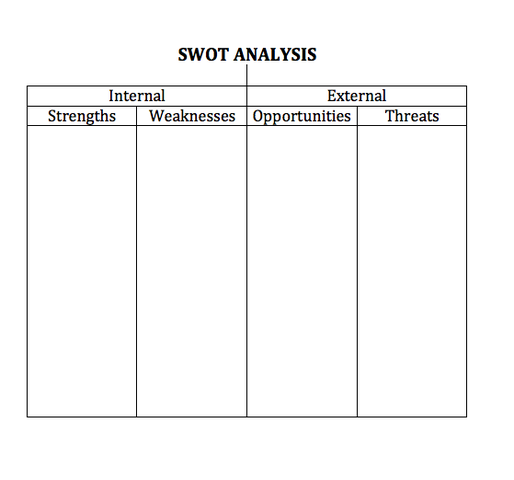
Marketers know that the acronym SWOT can also refer to Strengths, Weaknesses, Opportunities, Threats.

By Syassine – Own work, CC BY-SA 3.0, https://commons.wikimedia.org/w/index.php?curid=31368987

SWOT analysis is a technique to size up a product, a market, or a company.

Ironically, I didn’t perform any SWOTting while I was swotting.

Should engineers rule the world?

TL;DR – No, but.

But for the rest of you who want to consider the question for a couple of minutes…

Life is messy. It’s easy to look around and find examples of ways in which people do things incorrectly. “If only people did things rationally,” you might think to yourself, “these problems would be avoided.” So some desire rational solutions, such as those that could be provided if engineers ruled the world.

Engineers conferring on prototype design, 1954. By Bundesarchiv, Bild 183-23805-1665 / CC-BY-SA 3.0, CC BY-SA 3.0 de, https://commons.wikimedia.org/w/index.php?curid=5349654

In 2016, Global Construction Review asked the question “Should engineers rule the world?” But before I look at the possible answers to that question, let me share a couple of anecdotal stories.

Years and years ago, I worked for company that prided itself on being run by engineers, and having an engineering mindset. For this company, that meant that it exerted great effort to design technically superior solutions. Since I am not an engineer, I was therefore able to observe from the sidelines as the company designed and (after some time) released a product that was a technical marvel. There was only one problem: the product was so expensive that no one would buy it.

That same company had designed another technically superior product, but this one was priced reasonably enough that people throughout the world would buy it…except in the United States. There were established competitors in the United States, and it would take a great effort to displace them. From my vantage point in the US, I asked the product people an apparently simple question: why should US customers choose our company’s product rather than the competitors’ products? Apparently my question “did not compute” with the product people, because I never got an answer to my question. I guess they expected the US customers to be dazzled by our product’s obvious superiority or something.

Now that I’ve gotten those two anecdotal stories out of the way, let’s return to Global Construction Review’s question: “Should engineers rule the world?” The article begins by citing an example in which application of engineering principles at the outset could have prevented a catastrophe later on.

Take the Syrian civil war, for instance. In a paper published last year in the Proceedings of the National Academy of Sciences, Colin P. Kelley and co-authors proposed that a record-breaking drought in northeastern Syria between 2007 and 2010 caused the sudden migration of 1.5 million poor farmers into cities, setting the scene for the widespread unrest that erupted into outright revolt in early 2011.

The thinking, of course, is that if the drought had been minimized or averted through the timely application of scientific principles, the migration would not have happened, and the resulting unrest would not have happened.

So the question about engineers ruling the world was posed to several thinkers, beginning with Tim Chapman, described as the leader of an infrastructure group. Chapman began by observing that politicians concentrate too much on the short term, while some others concentrate too much on the long term.

Engineers are able to bridge this gap. A world run by engineers would be more planned, more strategic, more organised.

But Chapman wasn’t willing to hand the engineers the keys to everything. While he wanted them at the table, he noticed one drawback that engineers need to overcome.

But engineers also need to change, too, if they are to sell their answers to a sceptical world. They need to be better story-tellers who bring society along with them, rather than trying to impose solutions.

Some of the other people interviewed in the article echoed the thought that engineers should be at the table, but no one was willing to let them be the sole arbiters of what is best.

Oddly enough, or perhaps not so oddly, there was one word that I was unable to find in the article.

That word was “listen.”

It’s fine for engineers to be able to tell the story of why a solution should be adopted, but it’s also necessary for engineers to be able to listen to the people who may or may not benefit from the solution. Perhaps the proposed solution is too expensive (see my first anecdotal example), or perhaps existing solutions are perfectly fine (see my second anecdotal example). Or perhaps the solution goes against a group’s most important cultural values; while foreigners are often baffled by Americans’ resistance to government dictates, the fact remains that American history has influenced us to resist such dictates.

So while engineers should be heard, they shouldn’t rule the world.

Marketers should rule the world.

Am I right?

I really want to know (if this song is truly related to crime scene investigation)

I was performing some website maintenance this afternoon, and decided to add a page dedicated to Bredemarket’s services for identity firms. I was trying to think of an introductory illustration to go with the page, since the town crier can only go so far. So, claiming fair use, I decided that this image made perfect sense.

“Who Are You” by The Who. Fair use, https://en.wikipedia.org/w/index.php?curid=11316153

Now while use of the “Who Are You” album cover on a Bredemarket identity page makes perfect sense to me, it may not make sense to 6.9 billion other people. So I guess I should explain my line of thinking.

The link between human identification and the song “Who Are You” was established nearly two decades ago, when the television show “C.S.I. Crime Scene Investigation” started airing on CBS. TV shows have theme songs, and this TV show adopted a (G-rated) excerpt from the Who song “Who Are You” as its theme song. After all, the fictional Las Vegas cops were often tasked with identifying dead bodies or investigating crime scene evidence, so they would be expected to ask the question “who are you” a lot.

Which reminds me of two stories:

  • I actually knew a real Las Vegas crime scene investigator (Rick Workman), but by the time I knew him he was working for the neighboring city of Henderson.
  • CSI spawned a number of spinoffs, including “CSI:Miami.” When I was a Motorola product manager, CSI:Miami contacted us to help with a storyline involving a crime scene palm print. While Motorola software was featured in the episode, the GUI was jazzed up a bit so that it would look good on TV.

So this song (and other Who songs for the CSI spinoffs) is indelibly associated with police crime scene work.

But should it be?

After all, people think that “When a Man Loves a Woman” is a love song based upon its title. But the lyrics show that it’s not a love song at all.

When a man loves a woman
Down deep in his soul
She can bring him such misery
If she is playin’ him for a fool

So are we at fault when we associate Pete Townshend’s 1970s song “Who Are You” with crime scene investigation?

Yes, and no.

While the “who are you” question has nothing to do with figuring out who committed a crime, it DOES involve a policeman.

This song is based on a day in the life of Pete Townshend….

Pete left that bar and passed out in a random doorway in Soho (a part of New York). A policeman recognized him (“A policeman knew my name”) and being kind, woke him and and told him, “You can go sleep at home tonight (instead of a jail cell), if you can get up and walk away.” Pete’s response: “Who the f–k are you?”

Because it was the 1970s, the policeman did not try to identify the drunk Townshend with a mobile fingerprint device linked to a fingerprint identification system, or a camera linked to a facial recognition system.

Instead, the drunk Townshend questioned the authority of the policeman. Which is what you would expect from the guy who wrote the line “I hope I die before I get old.”

Speaking of which, did anybody notice that on the album cover for “Who Are You,” Keith Moon is sitting on a chair that says “Not to Be Taken Away”? Actually, they did…especially since the album was released on August 18, 1978 and Moon died on September 7.

While Moon’s death was investigated, no crime scene investigators were involved.

What is the difference between the showroom and the workroom?

When Arizonan Carl Hayden first joined the U.S. House of Representatives, a fellow Congressperson advised Hayden, “If you want to get ahead here, you have to be a work horse and not a show horse.” When Hayden became a U.S. Senator, he dispensed the same advice to incoming colleagues.

But it doesn’t just apply to U.S. Senators.

I thought of this “workhorse/showhorse” distinction last night. It was Valentine’s Day, and I was driving in the dark to pick up some pizza that we had ordered to mark the day. No, that wasn’t’ my Valentine’s Day present; my wife had already received chocolate-covered strawberries.

No, not THOSE chocolate covered strawberries. She got some REAL ones earlier in the day.

So anyway, I was driving back home in the dark after picking up the pizza and noticed something odd. Somewhere out there in the darkness, there were all these glittering tiny lights. I thought to myself, I will turn aside to see this great sight, why the tiny lights glitter.

It turns out that there was a guy, standing next to his van, holding glow-in-the-dark hearts that he was selling.

I didn’t stop, and I didn’t buy. (And I didn’t take a picture, because I knew it wouldn’t turn out well.) But as I was driving home I thought about the guy. And two things came to mind.

First, I doubt that the guy was out selling his products by his van earlier in the day. Why not? Because they wouldn’t look that good early in the day. They would look much better in the dark, in a parking space away from any store or street light. Buyers would then be attracted to his product, like moths to a flame. (Actually, moths probably aren’t attracted to flame. But I digress.)

Second, I realized what would have happened if I had succumbed to the urge to buy one of these glow-in-the-dark hearts from the guy, and if I had taken it home and brought it in the house.

  • Where it wouldn’t look so good, because we have lights all over the house that would diminish the effect of the present.
  • And if I tried to get my wife to go outside to see how the lights looked in the darkness, she would have refused to go out and would have returned to eating pizza.

The challenge that faces any provider is to provide a service that not only looks good when you buy it in the showroom, but also looks good when you put it to work in the workroom. Now there are certainly some providers who are more than happy to take the money and run, but most providers seek to provide long-term customer satisfaction, which is key to getting repeat business and references.

After all, if you go to a car showroom in California and buy a used car, you have the option to buy a contract that allows you to return the car within two days. So if that used car looks great in the showroom but is unsatisfactory when you drive it off the lot, the used car dealer loses that sale, and perhaps loses any future business from you and your friends. Many businesses, such as Amazon, offer similar policies that allow returns under certain circumstances.

Perhaps I’m making assumptions, but I’m guessing that the guy in the van in the dark didn’t have a return policy. It’s not economically feasible in his business.

And now I’m hungry for chocolate covered strawberries. But I’ll probably just get M&Ms and Welch’s fruit snacks.