I’m jumping ahead in the year-end post ridiculousness to cite Bredemarket’s two most notable accomplishments this year. Not to detract from my other accomplishments this year, but these two were biggies.
The second was my go-to-market effort for a Bredemarket client in September, which I discussed (without mentioning my participation) here. And there’s a video for that effort also.
Recent go-to-market.
I’ve accomplished many other things this year: client analyses, blog posts (both individually and in series), consultations, presentations, press releases, proposals, requirements documents, sales playbooks, and many more.
And I still have three more weeks to accomplish things.
On Wednesday, in the process of explaining how B2B product marketers must address multiple “hungry people” (target audiences), I described the Bacchanal Buffet at Caesars Palace in Las Vegas, Nevada.
But buffets are not confined to Las Vegas.
I have not visited Spartanburg, South Carolina in decades. When my family was making regular drives from Virginia to Alabama, it was years before I learned how to spell “AFIS.” Yet I know that it has at least one good buffet serving multiple types of hungry people.
Not hungry for food.
Hungry for biometric software.
And no, I’m not talking about DataWorks Plus. They’re in Greenville.
But if you head east to Spartanburg, you’ll arrive at the headquarters of Integrated Biometrics, the company that just launched the IB360° software for partners and integrators.
But if you look at the IB360 web page, you’ll see that the various partners and integrators have different needs for software solutions. For example, here’s Integrated Biometrics’ messaging for hardware integrators:
“If you build with devices like fingerprint scanners or facial recognition cameras, IB360° helps you showcase your hardware’s full potential. Integrate quickly with modular licensing, create recurring revenue, and reduce reliance on external suppliers. Address multiple use cases with automated syncing and tight integration with Integrated Biometrics’ sensors.”
But software integerators and systems integrators have different needs than hardware integrators. You can view these on the web page.
Or you can download the appropriate brochure for your needs from the “Documents & Downloads” section at the bottom of the page.
I’m going to limit my thoughts to two of the four changes that Integrated Biometrics mentioned.
Decentralized systems
When I started in the biometrics industry in 1994, an automated fingerprint identification system (AFIS) was usually a centralized system. Tenprint and latent examiners at the state capital (there was no federal IAFIS back then) would work in buildings at or near a huge minicomputer that held the state’s fingerprint records. Perhaps there may have been a few remote tenprint and latent workstations connected by modem, and perhaps there were some livescan stations scattered around, but for the most part these client/server systems had a single server in a state computer room. (Well, except for the Western Identification Network, but WIN was ahead of its time.)
Fast forward 30 years, and while this model may work in the United States, it may not work elsewhere.
What if you don’t have internet or cellular communications? (Yes, cellular. Modern edge devices are a topic addressed in the Integrated Biometrics article that I won’t go into here.)
Or what if the communications are so incredibly slow that it would take forever to submit a search to the capital city, and return results to the originator?
This is where decentralized systems come into play. Rather than requiring everyone to ping the same central hub, the biometric database is distributed and synchronized among multiple servers in multiple locations.
Or maybe you’re getting ahead of me here and realizing that “servers” is too limiting. What if you could put all or part of a biometric database on your smartphone, so you can search a captured biometric against a database immediately without waiting for network communication time?
Such decentralized systems were impossible in 1994, but they are certainly possible today. And IB360 lets partners build their own biometric systems with decentralization and synchronization.
Speaking of building…
Demand for speed
As I mentioned, I’ve been in the biometric industry since 1994, and although my early years were spent in a pre-contract proposals role, I’ve seen enough post-contract deployments to know that they take a long time. Whether you were dealing with Printrak, NEC, Sagem Morpho, or the upstart Cogent, it would take many months if not years to deploy a fingerprint system.
For the most part, this is still true today with “pre-made” systems from NEC, IDEMIA, Thales, and the others.
And it’s also true if you decide to deploy your own “custom-built” fingerprint or biometric system from scratch.
Either way, there is a lot of engineering, integration, and orchestration that must take place before a system is deployed. You can’t take an AFIS for Bullhead City, Arizona and deploy it in Anaheim, California…or the state of Tennessee…or the nation of Switzerland. You need to perform months of tailoring/configuration first.
Integrated Biometrics asserts that waiting years for a biometric system is far too long.
Other changes
I’ll let you read the Integrated Biometrics article to learn about the other two evolutionary changes: more powerful hardware (I’ve alluded to this), and a myriad of use cases.
All of these changes have impacted the biometric market, and prompted Integrated Biometrics to introduce IB360. To read about this modular software suite and its benefits, visit the IB360 product page.
Skipping the “leading provider” stuff, we get to this:
“Integrated Biometrics (IB)…formally announced today the launch of IB360, transforming the speed and cost to deploy identity systems. The IB360 platform is a low-code toolset of SDK-based software modules that allows our partners and integrators to more efficiently create biometric identity-based solutions with minimal development cycles.”
In its article “The Science of Infant Biometrics: Are We Really There Yet?” Integrated Biometrics identifies three key components for success: capture, storage, and matching. Since the Bredemarket blog has previously discussed capture, I’ll quote a bit of what Integrated Biometrics has to say about it.
[I]nfant fingerprints have smaller ridge spacing (roughly) 4-5 pixels compared to 9-10 in adults). Movement, skin peeling, and soft, malleable skin can also distort the fingerprint, making it difficult to capture accurate data.
Because of that size, the company cites studies that suggest a capture resolution of 3500 ppi and beyond may be necessary.
But that’s not the biggest of the three key components. The biggest one is matching, because even if you capture the best infant image, it’s of no use if it doesn’t correctly match (or not match) against adult images.
Luckily, we’re now at the point where we’re starting to get data for the same person at infant and (near) adult ages, so we can study the issue. Integrated Biometrics’ post contains more detail in the section “Can Today’s Algorithms Track Biometric Evolution from Infancy to Adulthood?” I’ll direct you there to read about it.
The COVID-19 pandemic may be a fading memory, but contactless biometrics remains popular.
Back in the 1980s, you had to touch something to get the then-new “livescan” machines to capture your fingerprints. While you no longer had messy ink-stained fingers, you still had to put your fingers on a surface that a bunch of other people had touched. What if they had the flu? Or AIDS (the health scare of that decade)?
As we began to see facial recognition in the 1990s and early 2000s, one advantage of that biometric modality was that it was CONTACTLESS. Unlike fingerprints, you didn’t have to press your face against a surface.
“Actually this effort launched before that, as there were efforts in 2004 and following years to capture a complete set of fingerprints within 15 seconds…”
This WAS an unusual question, considering that it took a minute or more to capture inked prints or livescan prints. And the government expected this to happen in 15 seconds?
A decade later several companies were pursuing this in conjunction with NIST. There were two solutions: dedicated kiosks such as MorphoWave from my then-employer MorphoTrak, and solutions that used a standard smartphone camera such as SlapShot from Sciometrics and Integrated Biometrics.
The, um, upshot is that now contactless fingerprint and face capture are both a thing. Contactless capture provides speed, and even the impossible 15 second capture target was blown away.
Fingers and faces can be captured “on the move” in airports, border crossings, stadiums, and university lunchrooms and other educational facilities.
Perhaps Iris and voice can be considered contactless and fast.
Any endeavor, scientific or non-scientific, tends to generate a host of acronyms that the practitioners love to use.
For people interested in fingerprint identification, I’ve written this post to delve into some of the acronyms associated with NIST MINEX testing, including ANSI, INCITS, FIPS, and PIV.
NIST was involved with fingerprints before NIST even existed. Back when NIST was still the NBS (National Bureau of Standards), it issued its first fingerprint interchange standard back in 1986. I’ve previously talked about the 1993 version of the standard in this post, “When 250ppi Binary Fingerprint Images Were Acceptable.”
But let’s move on to another type of interchange.
MINEX
It’s even more important that we define MINEX, which stands for Minutiae (M) Interoperability (IN) Exchange (EX).
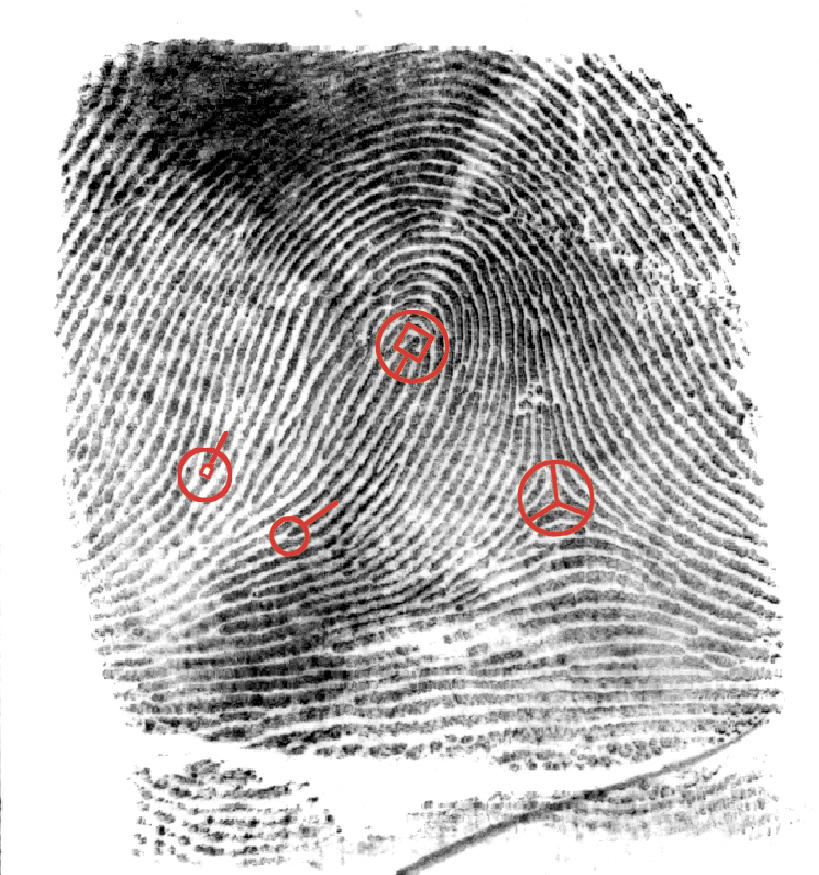
You’ll recall that the 1993 (and previous, and subsequent) versions of the ANSI/NIST standard included a “Type 9” to record the minutiae generated by the vendor for each fingerprint. However, each vendor generated minutiae according to its own standard. Back in 1993 Cogent had its standard, NEC its standard, Morpho its standard, and Printrak its standard.
So how do you submit Cogent minutiae to a Printrak system? There are two methods:
First, you don’t submit them at all. Just ignore the Cogent minutiae, look at the Printrak image, and use an algorithm regenerate the minutiae to the Printrak standard. While this works with high quality tenprints, it won’t work with low quality latent (crime scene) prints that require human expertise.
The second method is to either convert the Cogent minutiae to the Printrak minutiae standard, or convert both standards into a common format.
The American National Standards Institute (ANSI) is a private, non-profit organization that administers and coordinates the U.S. voluntary standards and conformity assessment system. Founded in 1918, the Institute works in close collaboration with stakeholders from industry and government to identify and develop standards- and conformance-based solutions to national and global priorities….
ANSI is not itself a standards developing organization. Rather, the Institute provides a framework for fair standards development and quality conformity assessment systems and continually works to safeguard their integrity.
So ANSI, rather than creating its own standards, works with outside organizations such as NIST…and INCITS.
INCITS
Now that’s an eye-catching acronym, but INCITS isn’t trying to cause trouble. Really, they’re not. Believe me.
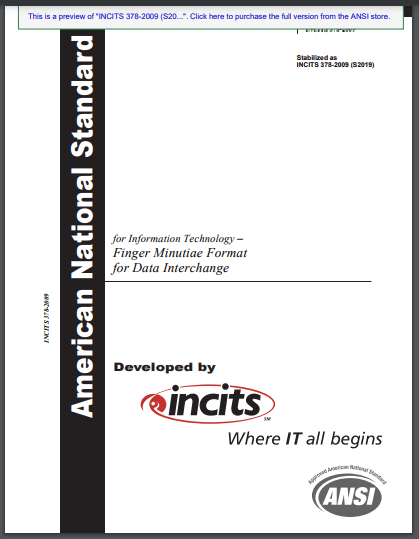
Back in 2004, INCITS worked with ANSI (and NIST, who created samples) to develop three standards: one for finger images (ANSI INCITS 381-2004), one for face recognition (ANSI INCITS 385-2004), and one for finger minutiae (ANSI INCITS 378-2004, superseded by ANSI INCITS 378-2009 (S2019)).
When entities used this vendor-agnostic minutiae format, then minutiae from any vendor could in theory be interchanged with those from any other vendor.
This came in handy when the FIPS was developed for PIV. Ah, two more acronyms.
FIPS and PIV
One year after the three ANSI INCITS standards were released, this happened (the acronyms are defined in the text):
Federal Information Processing Standard (FIPS) 201 entitled Personal Identity Verification of Federal Employees and Contractors establishes a standard for a Personal Identity Verification (PIV) system (Standard) that meets the control and security objectives of Homeland Security Presidential Directive-12 (HSPD-12). It is based on secure and reliable forms of identity credentials issued by the Federal Government to its employees and contractors. These credentials are used by mechanisms that authenticate individuals who require access to federally controlled facilities, information systems, and applications. This Standard addresses requirements for initial identity proofing, infrastructure to support interoperability of identity credentials, and accreditation of organizations issuing PIV credentials.
So the PIV, defined by a FIPS, based upon an ANSI INCITS standard, defined a way for multiple entities to create and support fingerprint minutiae that were interoperable.
But how do we KNOW that they are interoperable?
Let’s go back to NIST and MINEX.
Testing interoperability
So NIST ended up in charge of figuring out whether these interoperable minutiae were truly interoperable, and whether minutiae generated by a Cogent system could be used by a Printrak system. Of course, by the time MINEX testing began Printrak no longer existed, and a few years later Cogent wouldn’t exist either.
You can read the whole history of MINEX testing here, but for now I’m going to skip ahead to MINEX III (which occurred many years after MINEX04, but who’s counting?).
Like some other NIST tests we’ve seen before, vendors and other entities submit their algorithms, and NIST does the testing itself.
In this case, all submitters include a template generation algorithm, and optionally can include a template matching algorithm.
Then NIST tests each algorithm against every other algorithm. So the “innovatrics+0020” template generator is tested against itself, and is also tested against the “morpho+0115” algorithm, and all the other algorithms.
NIST then performs its calculations and comes up with summary values of interoperability, which can be sliced and diced a few different ways for both template generators and template matchers.
From NIST. Top 10 template generators (Ascending “Pooled 2 Fingers FNMR @ FMR≤10-2“) as of July 29, 2024.
And this test, like some others, is an ongoing test, so perhaps in a few months someone will beat Innovatrics for the top pooled 2 fingers spot.
Are fingerprints still relevant?
And entities WILL continue to submit to the MINEX III test. While a number of identity/biometric professionals (frankly, including myself) seem to focus on faces rather than fingerprints, fingers still play a vital role in biometric identification, verification, and authentication.
Identity and biometrics firms can achieve quantifiable benefits with prospects by blogging. Over 40 identity and biometrics firms are already blogging. Is yours?
These firms (and probably many more) already recognize the value of identity blog post writing, and some of them are blogging frequently to get valuable content to their prospects and customers.
Is your firm on the list? If so, how frequently do you update your blog?
In most cases, I can provide your blog post via my standard package, the Bredemarket 400 Short Writing Service. I offer other packages and options if you have special needs.
Get in touch with Bredemarket
Authorize Bredemarket, Ontario California’s content marketing expert, to help your firm produce words that return results.
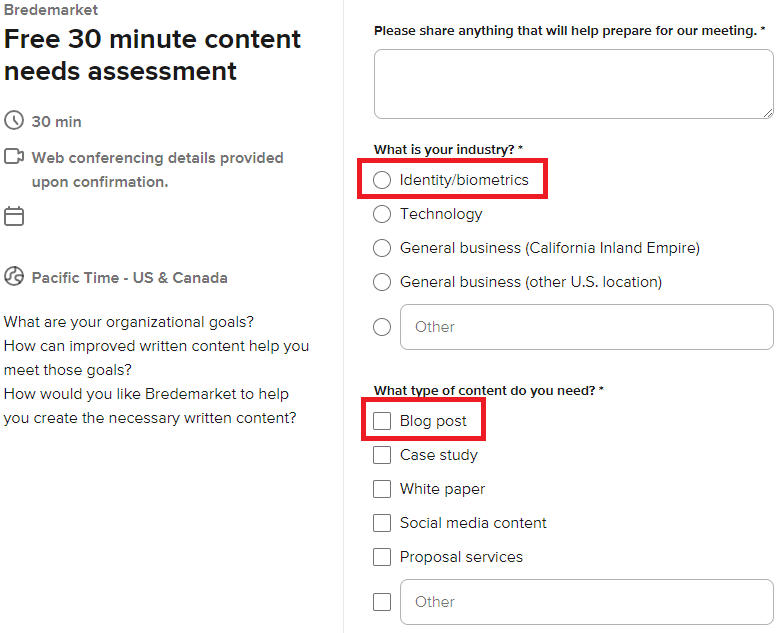
To discuss your identity/biometrics blog post needs further,book a meeting with me at calendly.com/bredemarket. On the questionnaire, select the Identity/biometrics industry and Blog post content.
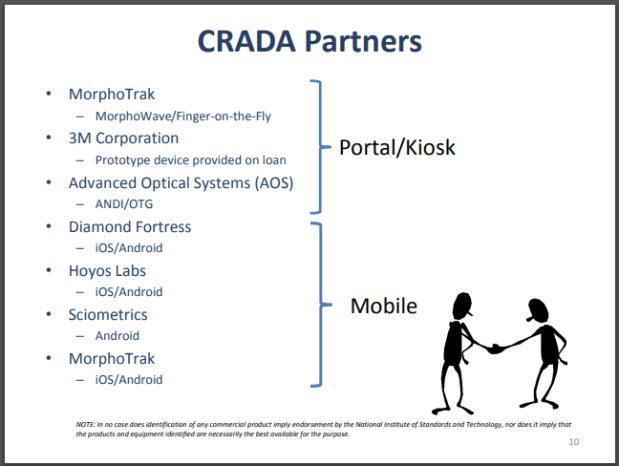
I’ve worked in the general area of contactless fingerprint capture for years, initially while working for a NIST CRADA partner. While most of the NIST CRADA partners are still pursuing contactless fingerprint technology, there are also new entrants.
In the pre-COVID days, the primary advantage of contactless fingerprint capture was speed. As I noted in an October 2021 post:
Actually this effort launched before that, as there were efforts in 2004 and following years to capture a complete set of fingerprints within 15 seconds; those efforts led, among other things, to the smartphone software we are seeing today.
By 2016, several companies had entered into cooperative research and development agreements with NIST to develop contactless fingerprint capture software, either for dedicated devices or for smartphones. Most of those early CRADA participants are still around today, albeit under different names.
I’ve previously written posts about two of these CRADA partners, Telos ID (previously Diamond Fortress) and Sciometrics (the supplier for Integrated Biometrics).
But these aren’t the only players in the contactless fingerprint market. There are always new entrants in a market where there is opportunity.
A month before I wrote my post about Integrated Biometrics/Sciometrics’ SlapShot, a company called Tech5 released its own product.
T5-AirSnap Finger uses a smartphone’s built-in camera to perform finger detection, enhancement, image processing and scaling, generating images that can be transmitted for identity verification or registration within seconds, according to the announcement. The resulting images are suitable for use with standard AFIS solutions, and comparison against legacy datasets…
Parthe has noted the importance of smartphone-based contactless fingerprint capture:
“We all carry these awesome computers in our hands,” Parthe explains. “It’s a perfectly packaged hardware device that is ideal for any capture technology. Smartphones are powerful compute devices on the edge, with a nice integrated camera with auto-focus and flash. And now phones also come with multiple cameras which can help with better focus and depth estimation. This allows the users to take photos of their fingers and the software takes care of the rest. I’d just like to point out here that we’re talking about using the phone’s camera to capture biometrics and using a smartphone to take the place of a dedicated reader. We’re not talking about the in-built fingerprint acquisition we’re all familiar with on many devices which is the means of accessing the device itself.”
I’ve made a similar point before. While dedicated devices may not completely disappear, multi-purpose devices that we already have are the preferable way to go.
For more information about T5-AirSnap Finger, visit this page.
Tech5’s results for NIST’s Proprietary Fingerprint Template (PFT) Evaluation III, possibly using an algorithm similar to that in T5-AirSnap Finger, are detailed here.









 Bredemarket