Boots on the Ground, NOW

How many of you have used the phrase “boots on the ground“?

In the “war” against competitors, your company needs “boots on the ground”…especially for on-premise deployments.

I’ve known a couple of companies that didn’t realize that they lacked boots on the ground…and that they had no plan to get the boots on the ground that they definitely needed.

This doesn’t just affect a company’s products. It also affects a company’s content.

Company X brainstorms

Company X was a new software solutions provider that had an internal brainstorming channel, and one person made the following suggestion:

Why stop at providing software solutions to our customers? Why not provide complete solutions with both software and hardware?

Now you NEVER want to totally shoot down a brainstorming idea, but it’s appropriate to consider the positives and negatives of any brainstorm. I won’t delve into ALL the negatives of shifting from a software solution to a software/hardware solution (profit margins, delivery times, etc.), but I will focus on one:

If you deploy integrated software and hardware solutions, you are responsible for MAINTAINING them.

What does this mean?

  • This means that you have to hire employees with hardware maintenance expertise, or you have to hire managers who can oversee subcontractors with hardware maintenance expertise.
  • For certain products (such as those Company X sold), customers demand fast response times. Maybe a 2-hour response. Maybe a 5-minute response.
  • Customers won’t wait a week for a maintenance technician to show up at their site. Broken hardware grinds business to a halt, and customer’s won’t tolerate that.
  • And they DEFINITELY won’t send the hardware off to a distant facility for repair.

As a pure software firm, Company X had few if any people qualified to perform the necessary maintenance activities.

But at least Company X had SOME people to consider these issues. Company Y wasn’t so fortunate.

Company Y sells

Company Y was also a software solutions provider. Company Y wanted to break into a particular industry in a particular country. I won’t reveal the industry, but I will reveal the target country: the United States.

Company Y developed and delivered a sales pitch that talked about the importance of the industry in question, and how the company could deliver a solution for that industry in the U.S.

But it glossed over one thing: Company Y had very few people in the U.S. at the time. Oh, they were working on hiring some more people in the United States, but at the time they didn’t have many.

And it was painfully obvious that Company Y’s U.S. presence was lacking. While talking about the expectations of different generations of people in the industry, the company rep referred to “Generation Zed.” For anyone listening to the sales pitch, that sent up an immediate red flag.

Now I’ll be the first to admit that American English may not be considered the most advanced English in the world. After all, we spell many words with an abundance of z’s…whoops, I mean an abundance of zeds.

If you’re going to do business in the United States, you have to speak our language. And we Americans will be criticised (with an s) when we don’t speak another country’s language.

So when do you buy boots?

If you need boots on the ground to fight your competitors, you have to…well, you have to obtain boots on the ground. But when?

  1. One option is to wait until you need them, and THEN buy the boots. Wait until someone actually buys your software/hardware solution, or wait until you actually have a U.S. contract in your industry. No need to spend money on resources if you never use them, and if you do need the resources later, they’ll be able to ramp up quickly…right?
  2. The other option is to take the risk and put the boots in your closet NOW, so that when a customer calls upon you to deliver, you don’t embarrass yourself. This financially costs your company, but you’ll be primed and prepared to move forward when the business does come.

So let’s talk about your content

You don’t only need boots on the ground to deploy your products. You need boots on the ground to create the content that will entice prospects to BUY those same products.

You’ve been meaning to create that content for a while, but just haven’t gotten around to it. After all, there’s a financial cost in hiring an employee or a contractor (like Bredemarket) to create the content, and there’s an opportunity cost in taking one of your existing employees and tasking them with content creation.

So you haven’t created the content you need for your business.

And you’re probably not going to create it next week either.

Or next month.

Or next year.

Unless you move forward NOW and bring in some boots on the ground, namely Bredemarket, to work with you and create the content you desperately need.

Are you ready to move forward, or are you going to stay in place?

Or retreat?

Buzzworthy Inbound Marketing For IE Firms

Plant sex. It’s difficult, because the stationary nature of flowers complicates sexual reproduction. But as you will see, the solution to the plant sex problem can also solve the marketing problem of your Inland Empire firm.

Stigma with pollen. By Thomas Bresson – Own work, CC BY 3.0, https://commons.wikimedia.org/w/index.php?curid=26008626

According to Let’s Talk Science:

Flowering plants reproduce sexually through a process called pollination. Flowers contain male sex organs called stamens and female sex organs called pistils. The anther is the part of the stamen that contains pollen. Pollen contains the male gametes. Pollen must be moved to a part of the pistil called the stigma for reproduction to take place. 

From Let’s Talk Science.

Because flowers cannot cross-pollinate by themselves, they need to attract bees (or other insects) to help. So the flowers just bat their little flower eyes, and the excited bees take the pollen from one flower’s anther to another flower’s stigma/pistil.

By The original uploader was Y6y6y6 at English Wikipedia. – Original image located at PDPhoto.org. Transferred from en.wikipedia to Commons by Drilnoth using CommonsHelper., Public Domain, https://commons.wikimedia.org/w/index.php?curid=7365698

Surprisingly, plant sex has EVERYTHING to do with your Inland Empire firm. Your firm is “a flower attracting bees.” So I’ll show you how your firm can attract the bees to spread your pollen and spawn results.

What is inbound marketing?

Now you don’t need to be like a flower and have an anther with pollen to attract prospects. The business equivalent of plant sex is inbound marketing. HubSpot defines inbound marketing as follows:

Creating tailored marketing experiences through valuable content is the core of an inbound marketing strategy that helps you drive customer engagement and growth.

From HubSpot.

Unlike outbound marketing in which your firm goes out and grabs the prospects (hopefully not literally) through trade shows or cold calling, in inbound marketing the prospects come to you. And because the prospects are in your invisible trust funnel, you don’t have to log them in your customer relationship management system or track them (and their precious metrics) in your traditional sales funnel.

Your traditional funnel where you know everything about your prospects. From Venn Marketing, “Awareness, Consideration, Conversion: A 4 Minute Intro To Marketing 101.” (Link)

Or your non-traditional sales funnel with a “messy middle.”

The “problem” for those who thrive on marketing analytics is that you don’t know who is in your trust funnel. I know from experience.

  • Most of Bredemarket’s work and most of my full-time employment positions came from people coming to me, rather than me soliciting people. They just popped up.
  • As I previously mentioned in my trust funnel post, Kasey Jones has acquired customers who have never engaged with her in the past, but who suddently expressed a desire to work with her. Again, they just popped up.

But if your business can get that trust funnel working, the revenue will come. Not immediately, and not when you expect it, but it will come.

How can your Inland Empire firm create your own trust funnel?

Inbound marketing can attract “trust funnel” prospects to your firm by creating content that speaks to their needs.

  • First, you need to create the content, or have someone create it for you. If you fail to create new content, your website and social channels will look stale, and prospects will wonder if your firm is still ongoing and viable.
  • Second, ensure your content meets your prospects’ needs by asking key questions about your planned content before you create it.
Here are seven questions you can ask before creating content. Read Bredemarket’s e-book “Seven Questions Your Content Creator Should Ask You” for more details.

And Bredemarket is ready to help your Inland Empire firm create that content and ask the necessary questions to drive results. Click the picture to learn more.

What is Your Tone of Voice?

We relate to firms as entities with personalities…and particular tones of voice. Could you imagine Procter & Gamble speaking in Apple’s tone of voice, or vice versa?

And one more thing…Charmin. Now in black.

(Thunderous applause and royal adoration with no indifference whatsoever.)

Designed by Freepik.

When you contract with a writer

Firms take care to speak in a particular tone of voice. Which means that the people writing their copy have to speak in that same tone of voice.

I have spent time thinking about Bredemarket’s own tone of voice, most recently when I delved into the “royalty” aspects of the Bredemarket family of archetypes. In that family “Sage” is most dominant, but there are also other elements.

Bredemarket’s top archetypes: sage, explorer, royalty, and entertainer.

In Bredemarket’s case, my sage/explorer/royalty/entertainer tone of voice is visible in Bredemarket’s writing. At least in Bredemarket’s SELF-promotional writing.

But MY tone of voice makes no difference to my clients, all of whom are focused on their OWN tones of voice. And Bredemarket has to adjust to EACH CLIENT’S tone of voice.

  • If I’m writing for a toilet paper manufacturer, I will NOT delve into details of how the product is used. Then again, maybe I will. Times have changed since Mr. Whipple.
  • If I’m writing for a cool consumer electronics firm, I definitely WILL delve into product use…if it’s cool.
  • If I’m writing for a technologist, I’m not going to throw a lot of music references into the technologist’s writing. I will emphasize the technologist’s expertise.
  • If I’m writing for a firm dedicated to advancement, I’m not going to throw ancient references into the firm’s writing. I will emphasize the newness of the firm’s approach, using the firm’s own key words.

My hope is that if you see two pieces of ghostwritten (work-for-hire) Bredemarket work for two different clients, you WON’T be able to tell that they were both written by me.

When your writer dons your mask

I’ve addressed the topic of adaptation before, where people don masks to portray characters that they are not.

By JamesHarrison – Own work, Public Domain, https://commons.wikimedia.org/w/index.php?curid=4873863

At the time I said the following:

So when Bredemarket or another content marketing expert starts to write something for you, should you fret and fuss over what your archetype is?

If you feel like it. But it’s not essential.

What is essential is that you have some concept of the tone of voice that you want to use in your communication.

From https://bredemarket.com/2022/10/30/donning-archetypes/

I then led into…well, something that is long outdated. But the gist of what I said at the time is that you need to determine what your firm’s tone of voice is, so that your writers can consistently write in that tone of voice.

Creating content with your tone of voice

So if Bredemarket works with you to create your content, how will I know your desired tone of voice? By one of two ways.

  1. You tell me.
  2. I ask you.
Bredemarket’s first seven questions, the October 30, 2023 version.

As we work through the seven questions that will shape your content, I ensure that I understand the tone of voice that you want to adopt in your content.

And with the review cycles interspersed through the content creation process, you can confirm that the tone is correct, and I can make adjustments as needed.

Unless you absolutely insist that I use a hackneyed phrase like “best of breed.” That requires a significant extra charge.

Do you want to drive content results in your own tone of voice with Bredemarket’s help?

Here’s how.

Measuring Goals: What Cathy Camera Says

I am repurposing my recent e-book “Seven Questions Your Content Creator Should Ask You” as a post series on the Bredemarket Instagram account. I am doing this because series are cool and stuff. Whether or not my readers are anticipating each new post in the series is up for debate. Maybe all of them have read the e-book already. (Or maybe not.)

Monday’s Instagram post on the goal of your content

Anyway, on Monday I got to the fifth post in the Instagram series. Here’s what the post image looks like. (The Yogi Berra-themed image is timely with baseball’s World Series going on right now, even though the Yankees are nowhere near it.)

And here’s the text that accompanied the Instagram post:

The fourth of the seven questions your content creator should ask you is Goal?
It’s important that you set a goal.
Maybe awareness. Maybe consideration. Maybe conversion. Maybe something else.
As Yogi Berra reportedly said, “if you don’t know where you are going, you might end up someplace else.” And that “someplace else” might not be where you want to be.
#bredemarket7questions #contentmarketing #contentmarketingexpert #goal #goals

From https://www.instagram.com/p/CzB2biBr27o/

Cathy Camera’s LinkedIn comment

Well, as long as I had created the post series for Instagram, I figured I’d share the same series on two other Bredemarket social channels, one of which was the Bredemarket LinkedIn page.

When I posted the image and accompanying text there, Cathy Camera commented.

Who is Cathy Camera, you may ask? Well, Camera is “The Construction Copywriter.”

You need to get ahead of your competitors. So you need your clients to understand you’re delivering reliable, high-quality services.

Having someone like me, with knowledge of and experience working with your industry, will help you achieve your goals more quickly without stress.

From https://cathycamera.com.au/

If you guessed that Camera has thoughts about goals, you’re right. Here’s the comment she added to my LinkedIn post:

Yes, there should always be a goal and if people can be more specific about objectives, they’ll at least be able to measure their results.

From https://www.linkedin.com/posts/bredemarket_bredemarket7questions-contentmarketing-contentmarketingexpert-activity-7124787047231283200-G5Xn/

Cathy Camera highlighted something that I didn’t.

  • The goal you set isn’t only important when you have to create the content.
  • The goal you set is also important after you publish the content and you need to determine if the content did its job.

Being SMART in your goals

Note Camera’s comment about being “more specific about objectives.”

Ideally your goal for your content (or for anything) should be a SMART goal, where SMART stands for Specific, Measurable, Attainable, Relevant, and Time-Bound.

  • For example, a goal to enable Bredemarket to make US$10,000,000 (or A$10,000,000) from a single blog post is not an attainable goal.
  • But a goal to have blog post readers engage a certain number of times is certainly a relevant goal.

So it looks like my “set a goal” advice for your content could be a lot more…um…specific.

I’m not going to revise the e-book (again), but I did revise my form.

You’re Doing It Wrong™: One Piece of Collateral Isn’t Enough

If you create a single piece of collateral for your product or service and say that you’ve completed your job, “you’re doing it wrong™.”

Product marketers and content marketers know that you’re just starting.

John Bonini on content vs. channel

John Bonini advises that you separate the content from the channel.

What most companies practice is not actually content marketing. It’s channel marketing.

They’re not marketing the content. They’re marketing the channel.

From LinkedIn.

You can express a single thought on multiple channels. And as far as I’m concerned, the more the merrier.

Me on “expert” advice on social media channel adoption

Incidentally, that’s why I object to the “expert” advice that I master one social media channel first before branching out into others.

If I adopt that strategy and ONLY market on LinkedIn and ignore Instagram and TikTok, I am automatically GUARANTEEING that the potential Instagram and TikTok audiences will never hear about my offer.

“How I Expanded 1 Idea into 31 Pieces of Content”

I’ve expressed my thoughts on this social media “expert” advice before:

The latter post, entitled “How I Expanded 1 Idea into 31 Pieces of Content,” described how…well, the title is pretty self-explanatory. I created 31 pieces of content based on a single idea.

The 31 pieces of content, published both through the Bredemarket channels (see above) and via my personal channels (including my jebredcal blog and my LinkedIn page), all increased the chance that SOMEONE would see the underlying message: “Your prospects don’t care about your technology.” Each piece of content was tuned for the particular channel and its target audience, ensuring that the message would resonate.

By Christian Gidlöf – Photo taken by Christian Gidlöf, Public Domain, https://commons.wikimedia.org/w/index.php?curid=2065930

As I often say, repurposing is good.

Speaking of repurposing, I’ve already adapted the words above and published them in four different ways (this is the fourth)…and counting. No TikTok video yet though.

Can Bredemarket help you repurpose or create content?

And if I can do this for me, I can do this for you.

Bredemarket can help you create content that converts prospects and drives content results. Why?

If you’re sold on using Bredemarket to create customer-focused messaging (remember: your prospects don’t care about your technology), or even if you’re not and just want to talk about your needs, there are three ways to move forward with your content project. Or you can just join the Bredemarket mailing list to stay informed.

  • Book a meeting with me at calendly.com/bredemarket. Be sure to fill out the information form so I can best help you.
Bredemarket logo

Seven Questions Your Content Creator Should Ask You: the e-book version

No, this is not déjà vu all over again.

If you’re familiar with Bredemarket’s “six questions your content creator should ask you”…I came up with a seventh question because I feared the six questions were not enough, and I wanted to provide you with better confidence that Bredemarket-authored content will achieve your goals.

To no one’s surprise, I’ll tell you WHY and HOW I added a seventh question.

If you want to skip to the meat, go to the WHAT section where you can download the new e-book.

Why?

Early Sunday morning I wrote something on LinkedIn and Facebook that dealt with three “e” words: entertainment, emotion, and engagement, and how the first and second words affect the third. The content was very long, and I don’t know if the content itself was engaging. But I figured that this wasn’t the end of the story:

I know THIS content won’t receive 250 engagements, and certainly won’t receive 25,000 impressions, but maybe I can repurpose the thoughts in some future content. (#Repurposing is good.)

From LinkedIn.

But what to repurpose?

Rather than delving into my content with over 25,000 impressions but less than 250 engagements, and rather than delving into the social media group I discussed, and rather than delving into the Four Tops and the Sons of the Pioneers (not as a single supergroup), I decided that I needed to delve into a single word: indifference, and how to prevent content indifference.

Because if your prospects are indifferent to your content, nothing else matters. And indifference saddens me.

By Mark Marathon – Own work, CC BY-SA 4.0, https://commons.wikimedia.org/w/index.php?curid=72257785

How?

Eventually I decided that I needed to revise an old piece of content from 2022.

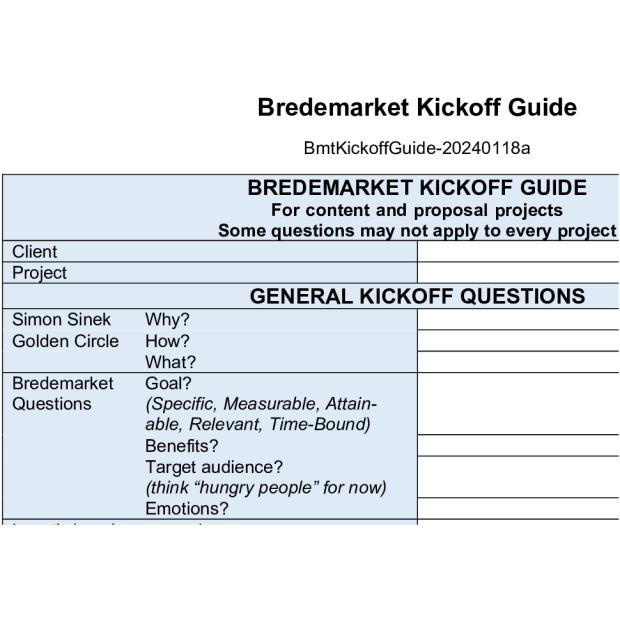
The first questions in the Bredemarket Kickoff Guide, BmtKickoffGuide-20231022a. No, you can’t have the guide; it’s proprietary.

I decided that I needed to update my process, as well as that e-book, and add a seventh question, “Emotions?”

What?

For those who have raced ahead to this section, Bredemarket has a new downloadable e-book (revised from an earlier version) entitled “Seven Questions Your Content Creator Should Ask You.” It includes a new page, “Emotions,” as well as minor revisions to the other pages. You can download it below.

Goal, Benefits, Target Audience, and Emotions

You’ll have to download the e-book to find the answers to the remaining four questions.

Prepare Yourself

Created by Imgflip.

Money 20/20 is taking place in Las Vegas, Nevada, USA from Sunday, October 22 to Wednesday October 25.

While I am not in Las Vegas, Bredemarket will monitor the goings-on and share relevant news on Facebook (Bredemarket Identity Firm Services group), Instagram (Bredemarket), LinkedIn (Bredemarket Identity Firm Services page), bredemarket.com, and elsewhere.

#biometric

#biometrics

#contentmarketing

#finance

#financialidentity

#fintech

#identity

#money2020

Technology Firms: Drive Content Results

Does your technology firm need written content—blog posts, articles, case studies, white papers?

Why do you need this content, and what is your goal?

How will you create the content? Do you need an extra, experienced hand to help out?

Learn how Bredemarket can create content that drives results for your technology firm.

Click the image below.

#contentmarketing #technology

Inland Empire Firms: Drive Content Results

Does your Inland Empire firm need written content—blog posts, articles, case studies, white papers?

Why do you need this content, and what is your goal?

How will you create the content? Do you need an extra, experienced hand to help out?

Learn how Bredemarket can create content that drives results for your Inland Empire firm.

Click the image below.

#contentmarketing #inlandempire

When Your Firm’s Differentiation REPELS Your Customers

I constantly preach that firms should not adopt “me too” messaging. Ideally, a firm’s messaging should not copy its competitors, but should instead state why the firm is better than all others, and why all the other firms are worthless in comparison.

But when a firm differentiates itself, there is always a danger that the firm will forget one important thing: how will the customers react to the firm’s differentiated messaging? Will the differentiation turn the customers off?

Trust me, it can happen.

A multinational’s great idea that backfired

Some time ago, I was working for a multinational firm that clearly differentiated itself from all of its competitors. This multinational had been around for some time and was known for its particular tone.

I’m not going to reveal the name of the particular multinational firm, or the tone it radiated.

The IBM illustrative example

But the tone used by that multinational was just as powerful as the tone IBM exuded in the mid-20th century.

In the 1950s and 1960s, “Big Blue” meant a particular style.

The man and his machine: Thomas Watson Jr. strikes a pose to sell the System/360. From https://www.itnews.com.au/gallery/ibm-gets-hammered-inside-big-blues-huge-clearance-auction-531538

IBM acquired an image of an army of men (this was the mid-20th century, after all), all wearing blue suits and white shirts.

Even as late as the 1980s (and beyond), the men of IBM had the look:

The men of IBM didn’t wear facial hair and wore only white shirts….IBM wanted to make sure they did not offend a prospect or a customer. Research had shown them that some people don’t like facial hair…so no facial hair. Research had also shown that people assume a degree of professionalism with a white shirt that may not be assumed if a person wore a blue or yellow shirt. So white shirts it is!

From https://bulanetwork.com/4004-dont-be-offensive-ibms-white-shirt-strategy/
The look persists today. Won Sung-shik, general manager of IBM Korea (IBM Korea). From https://www.koreaherald.com/view.php?ud=20210708000919

Back to my multinational

Let’s leave the theoretical example and return to the situation at my distinctive multinational.

Now the multinational that employed me long ago didn’t have a “blue suit-white shirt” dress code, but in other ways the multinational had a distinctive tone that radiated from the executive level down to the ranks of the worker bees like myself.

  • We all embodied this tone.
  • We spoke in this tone.
  • And our marketing messages also spoke in this tone, regardless of the market segment to which our marketers were speaking.
  • Even if the market segment had a very different tone than the one the multinational was projecting. (Imagine the Military Police selling the Vietnam War in Haight-Ashbury.)
By By S.Sgt. Albert R. Simpson. Department of Defense. Department of the Army. Office of the Deputy Chief of Staff for Operations. U.S. Army Audiovisual Center. – This tag does not indicate the copyright status of the attached work. A normal copyright tag is still required. See Commons:Licensing., Public Domain, https://commons.wikimedia.org/w/index.php?curid=1111279

When my multinational sent its marketing collateral out to prospects who used a very different tone than that used by the multinational, the prospects hated it. The marketing department received multiple complaints from salespeople whose clients were repelled by the material.

By Mindaugas Danys from Vilnius, Lithuania, Lithuania – scream and shout, CC BY 2.0, https://commons.wikimedia.org/w/index.php?curid=44907034

One of my coworkers surveyed the negative campaign reaction with dismay. The coworker had joined the company after the marketing tone was adopted. My coworker asked a simple question: “What type of customer focus group testing was conducted before we used this tone on a marketing campaign?”

“We didn’t conduct any focus group testing,” my coworker was told. “We didn’t need any.”

In retrospect, I guess we did need to test the messaging before we delivered it.

Four ways to balance customer focus and a firm’s distinctive messaging

If you’ve been reading recent Bredemarket blog posts, you’re probably not surprised that this is turning into yet another blog post about customer focus. But how do you balance a firm’s distinctive differentiators with a focus on its customers?

  1. First, you need to ensure that you are truly focusing on the customer, and not what you think the customer is. If a military police officer were to try to put himself in the shoes of a hippie to imagine what the hippie’s life was like, the MP would fail utterly.
  2. Second, you need to ensure that your messaging to the customer is something the customer cares about. It’s fine to adopt your “big blue” tone, but make sure that your messaging resonates with the customer.
  3. Third, your messaging should also explain why you do what you do. Why did IBM create System/360 computers, after all?
  4. Fourth, your messaging needs some smarts. Just because your prospect bought a refrigerator on Monday doesn’t mean that they’ll want a second refrigerator on Tuesday.

If you follow these and similar steps, then it (almost) doesn’t matter if your firm’s generic messaging is antithetical to the values of your prospects. Because your prospects won’t get generic messaging, but messaging that is focused for them.

EBM (Etowah Brunch Market), not IBM. But close enough. From https://www.instagram.com/p/Cs_m-vNOAN3/