Four Restrictions on Bredemarket’s City of Ontario Business License, and Why You Should Care

Remember when I said that I spent Labor Day renewing my City of Ontario business license?

Well, the approved license arrived in the mail today.

City of Ontario business license for Bredemarket, October 01, 2023 through September 30, 2024.

The electronic mail, not the snail mail.

By Geierunited – Own work, CC BY-SA 3.0, https://commons.wikimedia.org/w/index.php?curid=95926

This coming year will be the fourth year of Bredemarket’s existence. I started in August 2020, but it took a few weeks for the city business license and other paperwork to complete.

Now while the City of Ontario (California, not Canada) business license renewal entitles me to conduct business in the city as Bredemarket (when coupled with the Fictitious Business Name statement I filed with San Bernardino County), it is not an official endorsement of my activity by the city, and is definitely NOT an endorsement of the call to action at the end of this post.

More importantly, the City of Ontario has imposed four significant restrictions on the way that Bredemarket conducts business. Do they affect how I do business with you? We’ll see.

First: I must post the business license in a conspicuous place

Done.

City of Ontario business license, posted in a conspicuous place in an undisclosed location. And no, I don’t wear my glasses all the time.

Although as we will see when we get to the third restriction, the whole meaning of “conspicuous place” is irrelevant to Bredemarket’s business.

Second: I can’t conduct just ANY business

The business license is issued “for consulting services, including marketing and writing services.” The license does NOT allow me to bake pies, perform auto maintenance, launch rockets into space, or perform heart surgery.

You won’t see the Bredemarket 33410 Aortic Valve Surgery Service any time soon. The city won’t let me offer it. (33410, by the way, is the medical code for Under Surgical Procedures on the Aortic Valve.)

Dang guvmint.

Third: No visitation from clients

Remember how the city requires that I post my license in a conspicuous place? Well, the city also prohibits me from having clients visit me at my work location. This makes sense, since residential neighborhoods aren’t really built to have a bunch of cars park outside a house where business is conducted.

No, Bredemarket clients cannot park their cars in front of my house. And no, this is not my house. (And they’re not your cars either.) Fair use. The Verge, “Multimillion-dollar Ferraris, Jaguars, Astons, and a fine cup of tea.” The cast of cars and characters from the first Goodwood press day in 1993. Lord Charles March is by the front door of the house with his light blue AC 16/80 designed by his grandfather.

This means that when I do have a person-to-person meeting (rather than a videoconference) to conduct business, the meeting has to be offsite. For example, a couple of years ago I met with an advisor at Brandon’s Diner in Upland. (And the lunch was tax deductible!)

Fourth: No signage permitted

Again, because my work location is in a residential neighborhood, I can’t put a huge neon sign in my front yard with the Bredemarket logo.

Bredemarket logo
Imagine this in my front yard.

And no, I can’t put a small neon sign in my front yard.

Or any neon sign.

I wonder if the city will let me put signage on my mailbox? Actually, the UPS Store probably won’t allow that either.

Bredemarket’s mailing address is 1030 N Mountain Ave #259, Ontario CA 91762-2114. If you read my previous post, you know that “MBE” stands for Mailboxes Etc.

So what?

The reason that these city restrictions don’t matter to you is because (since we still have the Internet) Bredemarket is perfectly capable of conducting its business online.

You don’t have to look for my business sign, or a parking place in front of the place where I conduct business. Why not? Because I can meet with you via Google Meet or another videoconferencing service, or we can talk on the phone, or even exchange emails with each other.

I’ve worked from home since March 2020—first for IDEMIA, then for Bredemarket, then for Incode Technologies, then for Bredemarket again. During that time I’ve been able to meet all of the needs of Bredemarket clients remotely, despite no public parking and no signage.

Well, almost all the needs. I haven’t been able to perform aortic valve surgery for my clients.

Dang guvmint.

The city does not endorse this call to action

Do you want to use the marketing and writing services of a government-licensed consulting firm?

More importantly, do you want to use the marketing and writing services of a consulting firm that ensures the right questions are asked at the beginning of the project, and that you have complete input during the writing and review cycles?

Authorize Bredemarket, Ontario California’s content marketing expert, to help your firm produce words that return results.

Could Bredemarket survive without the Internet?

I wasn’t going to labor on this Labor Day, but I ended up renewing my City of Ontario business license. (This coming year will be the fourth that Bredemarket has conducted business in Ontario.)

Business license renewal (now complete).

To receive that mailing from the City, Bredemarket of course has to have a mailing address, courtesy of a local UPS Store (formerly known as Mailboxes Etc.).

Now most people don’t interact with Bredemarket via my physical mailing address. The few that do include the City of Ontario, and three of my clients who have chosen to pay me via paper checks. (I’m flexible.)

This got me curious.

What if?

What if the Internet were to disappear tomorrow? What if the only way my clients could interact with Bredemarket was through my Bredemarket physical mailing address? Could Bredemarket still conduct business?

Possibly.

Some of my business would disappear overnight. Blog posts, for example, are meaningless in a non-Internet world, unless companies choose to post long text-based communications on utility poles. Or in laundromats.

This used to be my laundromat. 454 N Mountain Ave, Ontario, CA 91762.

Even if the Internet were to disappear, I could still write text for case studies (maintaining my Inland Empire case study writing business) and white papers. I could send my client a Microsoft Word file (perhaps an old version of Word), and the firm could send the file to their printer. But how would I send the file? Put a CD in the mail?

Back to reality

Luckily, we DO have the Internet.

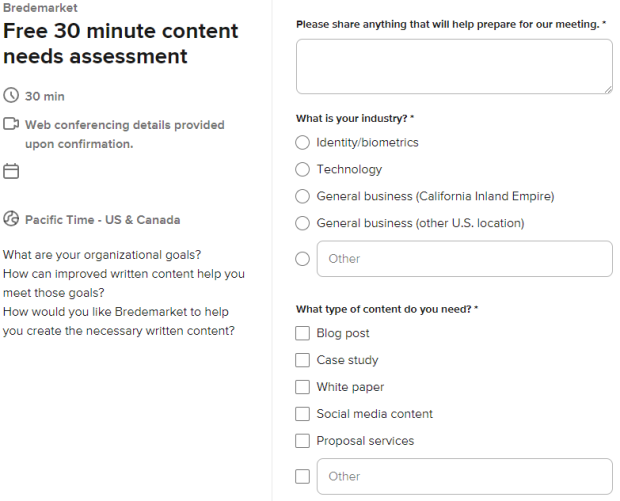
If you need to communicate with Bredemarket regarding your marketing and writing needs, you can go to my contact page at https://bredemarket.com/contact/. As of today, my contact methods include email, phone, and web page form. You can even book a calendar meeting with me.

And yes, you can “snail mail” me also at 1030 N Mountain Ave #259, Ontario, CA 91762-2114.

By Geierunited – Own work, CC BY-SA 3.0, https://commons.wikimedia.org/w/index.php?curid=95926

ICYMI: Facial Recognition Inaccuracy

In case you missed it…

Let’s address two items before we continue. Trust me; it’s important.

  1. The Gender Shades study evaluated only three algorithms: one from IBM, one from Microsoft, and one from Face++. It did not evaluate the hundreds of other facial recognition algorithms that existed in 2018 when the study was released.
  2. The study focused on gender classification and race classification. Back in those primitive innocent days of 2018, the world assumed that you could look at a person and tell whether the person was male or female, or tell the race of a person. (The phrase “self-identity” had not yet become popular, despite the Rachel Dolezal episode which happened before the Gender Shades study). Most importantly, the study did not address identification of individuals at all.

For the rest of the story, see “We Survived Gummy Fingers. We’re Surviving Facial Recognition Inaccuracy. We’ll Survive Voice Spoofing.”

(Bredemarket email, meeting, contact, subscribe)

AdvoLogix on “9 Ways to Use AI in the Workplace”

Bredemarket occasionally gets pitches from people who want to write for the blog, or to link to something they’ve already written.

Most of these pitches are crap.

But I just received an excellent and relevant pitch from a PR coordinator. I won’t reproduce his pitch, though, because I don’t want to get sued.

Which in this case is a very distinct possibility.

Who is AdvoLogix?

The PR coordinator represents a company called AdvoLogix, and wanted me to reshare something his company had written.

My first question (of course) is why AdvoLogix exists.

We build and deliver technologies that help legal teams collaborate and grow.

From https://www.advologix.com/about-advologix/

The company provides legal software, resident on Salesforce, that addresses several areas:

Now I am not a lawyer, but I’m sure these terms mean something to lawyers. If you’re looking for these types of solutions, check the links above.

Why did AdvoLogix pitch me?

The PR coordinator had observed Bredemarket’s previous posts on artificial intelligence (excluding the one that I wrote after his pitch), and thought that AdvoLogix’s recent blog post on the same topic would be of interest to Bredemarket’s readers.

What does AdvoLogix say about using AI in the workplace?

AdvoLogix’s post is clear in its intent. It is entitled “9 Ways to Use AI in the Workplace.” The introduction to the post explains AdvoLogix’s position on the use of artificial intelligence.

Rather than replacing human professionals, AI applications take a complementary role in the workplace and improve overall efficiency. Here are nine actionable ways to use artificial intelligence, no matter your industry.

From https://www.advologix.com/ai-applications-business/

I won’t list ALL nine of the ways—I want you to go read the post, after all. But let me highlight one of them—not the first one, but the eighth one.

Individual entrepreneurs can also benefit from AI-driven technologies. Entrepreneurship requires great financial and personal risk, especially when starting a new business. Entrepreneurs must often invest in essential resources and engage with potential customers to build a brand from scratch. With AI tools, entrepreneurs can greatly limit risk by improving their organization and efficiency. 

From https://www.advologix.com/ai-applications-business/

The AdvoLogix post then goes on to recommend specific ways that entrepreneurs can use artificial intelligence, including:

  • AI shopping
  • Use AI Chatbots for Customer Engagement

Regardless of how you feel about the use of AI in these areas, you should at least consider them as possible options.

Why did AdvoLogix write the post?

Obviously the company had a reason for writing the post, and for sharing the post with people like me (and like you).

AdvoLogix provides law firms, legal offices, and public agencies with advanced, cloud-based legal software solutions that address their actual needs. 

Thanks to AI tools like Caster, AdvoLogix can provide your office with effective automation of data entry, invoicing, and other essential but time-consuming processes. Contact AdvoLogix to request a free demo of the industry’s best AI tools for law offices like yours. 

From https://www.advologix.com/ai-applications-business/

So I’m not even going to provide a Bredemarket call to action, since AdvoLogix already provided its own. Good for AdvoLogix.

But what about Steven Schwartz?

The AdvoLogix post did not specifically reference Steven Schwartz, although the company stated that you should control the process yourself and not cede control to your artificial intelligence tool.

Something that Schwartz did not do.

Roberto Mata sued Avianca airlines for injuries he says he sustained from a serving cart while on the airline in 2019, claiming negligence by an employee. Steven Schwartz, an attorney with Levidow, Levidow & Oberman and licensed in New York for over three decades, handled Mata’s representation.

But at least six of the submitted cases by Schwartz as research for a brief “appear to be bogus judicial decisions with bogus quotes and bogus internal citations,” said Judge Kevin Castel of the Southern District of New York in an order….

In late April, Avianca’s lawyers from Condon & Forsyth penned a letter to Castel questioning the authenticity of the cases….

Among the purported cases: Varghese v. China South Airlines, Martinez v. Delta Airlines, Shaboon v. EgyptAir, Petersen v. Iran Air, Miller v. United Airlines, and Estate of Durden v. KLM Royal Dutch Airlines, all of which did not appear to exist to either the judge or defense, the filing said.

Schwartz, in an affidavit, said that he had never used ChatGPT as a legal research source prior to this case and, therefore, “was unaware of the possibility that its content could be false.” He accepted responsibility for not confirming the chatbot’s sources.

Schwartz is now facing a sanctions hearing on June 8.

From https://www.cnn.com/2023/05/27/business/chat-gpt-avianca-mata-lawyers/index.html

On that sanctions hearing date, Schwartz was mercilessly grilled by the judge. Later that month, the judge sanctioned and fined Schwartz and another lawyer.

In the end, you are responsible, not the tool you use.

By the way, Roberto Mata lost the case. Not because of his lawyers’ misuse of AI, but because the case was filed too late.

Should Inland Empire Companies Generate Content with ChatGPT (or other generative AI tools)?

An image of a neural network. By DancingPhilosopher – Own work, CC BY-SA 4.0, https://commons.wikimedia.org/w/index.php?curid=135594693

Inland Empire companies are asking the same question that other companies are asking: “Should my business use ChatGPT (or another generative AI tool) to quickly generate content?”

Bear in mind that I have a vested interest in the answer to this question, because Bredemarket’s business is content generation for other businesses. So I don’t have a natural inclination to tell you not to buy my services and use ChatGPT or Bard or whatever instead.

Nevertheless, I’ll outline the advantages and drawbacks of using automation (in this case generative AI tools) to create written content. Then I’ll look at the three options for your business’ content generation needs. (Surprise! One of those options is to contract with Bredemarket. You’ve been warned that a call to action is coming.)

An “exchange” of questions

As I mentioned in my post about creating and populating Facebook business pages, yesterday afternoon was the first time in years that I had attended a monthly Ontario IDEA Exchange meeting. For those who aren’t familiar with these meetings, they allow small business owners from the Ontario, California area to meet and…um…exchange ideas.

By Mack Male – originally posted to Flickr as Ontario Convention Center, CC BY-SA 2.0, https://commons.wikimedia.org/w/index.php?curid=9512928

One of the attendees asked me what I thought of ChatGPT.

If you’ve read the Bredemarket blog or the Bredemarket LinkedIn page, you know that I have some thoughts on this. (If you haven’t seen my thoughts, I’ll share them later in this post.)

It turns out that the attendee had a reason for asking the question that went well beyond generative artificial intelligence (generative AI), and touched on automation in general.

  • Should we use ChatGPT, Bard, or another generative AI tool to generate text content, or should we contact a content marketing expert?
  • Similarly, should we use a generative AI tool to generate image content, or should we contact a graphic design expert?
  • Going beyond generative AI, should we use tax preparation software, or should we contact a tax preparation expert?

You can ask this same question about a variety of business services. Should you opt for the (sometimes) cheaper automated solution, or should you get a real person to perform the service?

This can be a loaded question. After all, I can’t tell you that you should always use a person for these tasks when I personally use Freepik and a well-known tax preparation software package.

Designed by Freepik.

So, returning to content, let’s take a (probably non-objective) look at the pros and cons of using generative AI tools for content creation. After all, some of my best friends use generative AI…and they’re still my friends (and obviously not my customers).

Generative AI content advantages

While generative AI isn’t as trendy a topic as it was a few months ago, people are still talking about using generative AI to create text content. And there are clearly some advantages to it.

  • It’s very fast. No, you won’t create your text in a minute. But with properly written prompts (commands to the generative AI tool) and by using a few iterations, you can probably get generative AI text content in five minutes. You won’t get text content of any length from Bredemarket in five minutes.
  • It’s (usually) free. In most cases, you can obtain your text at no cost to you. Again, Bredemarket doesn’t work for free.
  • It’s easy. You don’t need to know how to write. Sure, you need to know how to write the prompt, but you don’t need to worry about the mechanics of writing the text itself, and when to use “its” or “it’s”. You don’t want to sound like a looser, after all. (That was wrong.)
  • It’s “good enough.” Under most circumstances, the text created by a generative AI tool gets the job done, and is obviously better than no text at all.

Generative AI content drawbacks

Perhaps I’m biased, but I think that we can all agree on the drawbacks that I’ve listed below.

  • Potential accuracy issues. Generative AI content is sourced from the Internet, and you know how accurate the Internet can be at times. For example, when I was working for my former employer, I asked one popular generative AI tool to tell me the weaknesses of my employer’s product. The tool returned two responses, one of which was plain wrong.
  • More potential accuracy issues. The way generative AI tools work, most of them provide their answers as if they were most certainly true, with no attempt to provide the probability that the response is correct or incorrect. In essence, Mr. Gen AI is an automated know-it-all with complete certainty in its answers, even when they are obviously wrong.
  • Potential relevancy issues. Depending upon your generative AI tool, you may not have access to the latest data and may instead rely on older data that was available when the generative AI tool was trained. At one point, several of the popular generative AI tools were trained on data from 2021 or earlier, which meant that they knew nothing about events that happened last week.
  • Potential privacy issues. When you feed prompts to a generative AI tool, the prompts are stored by the tool. What if you’re using a public tool, and you’re feeding confidential data from your company to the tool? What’s going to happen to your company’s private data? (This is especially critical when the data crosses international borders, something that gave Samsung serious concern.)
  • Potential tone of voice issues. If your company feeds a prompt to a generative AI tool, and your competitor feeds the same prompt to the same tool, you will get similar or identical responses. If both companies use these responses, then the companies will sound like bland “me-too” providers, with no differentiation.

I’ve touched on a number of these issues in more detail in pieces that I’ve written on the Bredemarket blog (and in one case on LinkedIn). These explain when I use generative AI, and when I do not.

So what should YOUR business do?

Depending upon your business needs, your budget, and your marketing direction, you have three choices.

(UPDATE OCTOBER 23, 2023: “SIX QUESTIONS YOUR CONTENT CREATOR SHOULD ASK YOU IS SO 2022. DOWNLOAD THE NEWER “SEVEN QUESTIONS YOUR CONTENT CREATOR SHOULD ASK YOU” HERE.)

  • Use a generative AI tool to write your content. It’s fast, it’s free, it’s easy. It may be good enough.
  • Use a low-cost writer to write your content. If you want to spend a little money, you can find writers who will work for pennies per word. That’s more than a generative AI tool, but you have a better chance of getting the content you want.
  • Use Bredemarket. I cost more than pennies per word (the cost for my standard 400-600 word writing package is in the brochure on my Bredemarket 400 Short Writing Service page), but Bredemarket’s collaborative kickoff process, including the opening six questions that I ask you, helps to ensure that your firm will get the content that you need.

Authorize Bredemarket, Ontario California’s content marketing expert, to help your firm produce words that return results.

Bredemarket logo

Bonus: here’s what Google Bard says on the topic (written by Google, not by me)

Sure, here are three advantages and three drawbacks of using generative AI to create written content:

Advantages:

  • Speed: Generative AI can create content much faster than humans. This can be a major advantage for businesses that need to produce a lot of content quickly, such as content marketing agencies or news organizations.
  • Cost-effectiveness: Generative AI can be a more cost-effective way to create content than hiring human writers. This is especially true for tasks that are repetitive or time-consuming, such as writing product descriptions or blog posts.
  • Accuracy: Generative AI can be very accurate in generating content that is factually correct. This is because it is trained on large datasets of text and code.

Drawbacks:

  • Creativity: Generative AI is not as creative as humans. It can only generate content that is based on the data it has been trained on. This means that it may not be able to come up with new ideas or insights.
  • Bias: Generative AI can be biased, depending on the data it is trained on. This is a concern because it could lead to the creation of content that is inaccurate or harmful.
  • Plagiarism: Generative AI can sometimes plagiarize content from other sources. This is because it is trained on a variety of text data, including some that may not be properly cited.

Overall, generative AI can be a valuable tool for creating written content. However, it is important to be aware of its limitations and to use it responsibly.

Here are some additional things to keep in mind when using generative AI to create written content:

  • Always fact-check the content before publishing it. Generative AI can sometimes make mistakes, so it is important to double-check the information.
  • Be clear about the purpose of the content. Are you trying to inform, persuade, or entertain? The purpose of the content will help you determine the tone and style of the writing.
  • Be aware of the audience. Who are you writing for? What are their interests and needs? Tailor the content to your audience.
  • Use generative AI as a tool, not a replacement for human creativity. Generative AI can be a great way to get started with a writing project, but it is important to put your own unique spin on the content.

Creating a Business Page on Facebook for Your Inland Empire Company

There are Inland Empire companies that have an online presence, and companies that don’t.

Yes, the Ontario Convention Center has an online presence, on the web and elsewhere. Picture by Mack Male – originally posted to Flickr as Ontario Convention Center, CC BY-SA 2.0, https://commons.wikimedia.org/w/index.php?curid=9512928

If your Inland Empire company doesn’t have an online presence, one quick way to create one is to create a business page on Facebook.

This post outlines the benefits of establishing an online presence via a Facebook business page. It also provides four examples of Facebook business pages. Finally, the post addresses the thorny question of creating content for your Facebook business page.

Why Faceboook may be the best online presence for your business

For the first time in years, I attended an Ontario IDEA Exchange meeting at AmPac Business Capital on Tuesday afternoon. There was a mixture of attendees: some who had established several businesses, some like me who had run one business for some time, and a few who were just starting out in business.

The ones who were starting out were still trying to figure out all the things you need to do to start a business: figuring out why the business exists in the first place, getting the appropriate business licenses (and in some cases professional licenses), printing business cards (or creating the online equivalent), setting up SOME kind of way to track prospects and customers…and establishing an online presence.

Now some businesses choose to establish their online presence by creating a website.

I believe that this is the best way to establish an online presence since you have more control over the content. Plus, there are several alternative ways to create a business website (I use WordPress, but you can use SquareSpace, Wix, or any of several other website builders).

But even the simplest website can involve a lot of complexity—bredemarket.com currently has 57 pages, not counting tag pages and individual blog post pages.

For many small businesses, it may be much easier to create a Facebook business page then to create an entire website.

  • Facebook business pages are free. (Well, unless you run ads.)
  • Facebook business pages are easy to create.
  • Facebook business pages potentially reach billions of people, including your prospects and customers.

Creating a Facebook business page

So how do you create a Facebook business page?

There’s no need for me to document all of that in detail, since many have already done so.

Starting with Facebook itself.

As long as you have a personal Facebook profile, and as long as you can provide basic information about your business (category, address, areas serviced, email, phone number, website, hours, etc.), you can create a Facebook page from your laptop or desktop computer by following these steps:

  1. From the Pages section, click Create new Page.
  2. Add your Page name and category.
  3. Add your Page’s bio and click Create.
  4. (Optional) Add information, such as Contact, Location and Hours, and click Next.
  5. (Optional) Add profile and cover photos, and edit the action button, and click Next.
  6. (Optional) Invite friends to connect with your Page, and click Next.
  7. Click Done.
From https://www.facebook.com/business/help/473994396650734?id=939256796236247

Don’t worry if you don’t have all the optional items, such as a page cover picture. You can add them later. This will get you going.

Other guides to creating Facebook business pages are available from Buffer (with pictures), Hootsuite (with pictures). Sprout Social (with pictures), and a number of other sources.

But before you create YOUR Facebook business page, let me show you four varied examples of EXISTING Facebook business pages.

Four examples of Facebook business pages

Let’s take a look at some pages that already exist. Perhaps one or more of these will give you ideas for your own page.

The artist page (Paso Artis)

Paso Artis is a European business whose proprietor is a painter who sells her paintings.

The menu options at the bottom of the picture above (some of which cannot be seen) illustrate some of the elements you can include in a Facebook page. Here are just a few of the page elements that Paso Artis uses:

  • Posts. This is the equivalent of a blog on a website, and allows you to post text, images, videos, and other types of content.
  • About. This is where you provide contact and other basic information about your business.
  • Shop. Facebook allows you to include a shop, which Paso Artis uses to sell her paintings.
  • Photos. As you can imagine for an artist’s page, photos of the artwork are essential.

The shirtmaker page (Shirts by Kaytie)

(UPDATE 10/20/2023: Because Shirts by Kaytie is sadly no longer in business, I have removed the, um, live links to her Facebook page.)

Let’s leave Europe and go to Illinois where we find another artist, but her work is not displayed on paintings, but on shirts. Here is the Shirts by Kaytie Facebook page.

You’ll notice that Shirts by Kaytie has a different menu item order (and different menu items) than Paso Artis. For example, Shirts by Kaytie doesn’t have a Facebook “shop” element; you need to contact her directly to purchase items.

But Shirts by Kaytie certainly has photos.

The marketer/writer page (Bredemarket)

Enough of such exotic locations as Europe and Illinois. Let’s head to California’s Inland Empire and look at my favorite marketing/writing services Facebook page, the Bredemarket Facebook page.

I’d like to point out two things here.

  • First, Bredemarket (unlike Paso Artis and Shirts by Kaytie) provides services rather than tangible products. Therefore, I chose to include a “Services” element as part of my Facebook page.

Second, Bredemarket has chosen to implement Facebook’s “groups” feature. In Bredemarket’s case, there are three separate groups that focus on various aspects of Bredemarket’s business. Inland Empire businesses can read the content in the Bredemarket Inland Empire B2B Services group and not get bogged down in out-of-area identity discussions about the change from FRVT to FRTE. (They’re missing out.)

The local technology champion page (Startempire Wire)

I saved the Startempire Wire Facebook page for last because it makes terrific use of Facebook’s capabilities.

By the way, if you are an Inland Empire business—especially an Inland Empire startup technology business—and you have never heard of Startempire Wire, STOP READING MY POST and go follow Startempire Wire’s Facebook page NOW. Startempire Wire is THE news source for Inland Empire startup tech information, and is a strong champion of the IE tech community.

So what does Startempire Wire’s Facebook page offer? Posts, photos, weekly videos, and the “Inland Empire Startup Scene” group. All of the content is jam-packed with information.

Facebook pages are essential to these firms’ strategies

Now in some cases the Facebook pages are only part of the online presence for these firms. Both Bredemarket and Startempire Wire have their own web pages, and both firms are also active on other online properties such as LinkedIn. (Bredemarket is almost everywhere, but not on Snapchat.) But Facebook is an essential part of the outreach for all four of these firms, allowing them to reach prospects and clients who are only on Facebook and nowhere else.

Perhaps a Facebook page is a perfect solution for YOUR firm’s online presence.

Let’s talk about content

But creating a Facebook page is not enough.

You need to populate it with content, such as images, videos…and posts.

And if your Facebook page doesn’t have any content, it’s useless to your prospects. As I’ve preached for years, an empty page makes your prospects and customers question whether you exist.

Now I’m not saying that you HAVE to update your Facebook page daily, but it’s a good idea to add new content at least once a month.

But what if you aren’t a writer, or don’t have time to write? Do you have to resort to ChatGPT?

Heavens no. (I’ll say more about that later.)

Well, online content creation is where Bredemarket comes in. I help firms create blog posts, Facebook posts, LinkedIn articles, case studies, white papers, and other content (22 different types of content at last count).

Does your product (or company) need these 22 content types?

Let me help you populate your Facebook page (or other online content).

Authorize Bredemarket, Ontario California’s content marketing expert, to help your firm produce words that return results.

Bredemarket logo

The 22 (or more) Types of Content That Product Marketers Create

(Part of the biometric product marketing expert series)

(Updated blog post count 10/23/2023)

I mentioned something in passing in Bredemarket’s recent go-to-market post that I think needs a little more highlighting. So here is a deeper dive into the 22 types of content that product marketers create. (Well, at least 22. I’m probably missing some.)

And by the way, I have created all 22 of these types of content, from blog posts and battlecards to smartphone application content and scientific book chapters. And I can create it for you.

Taylor Swift "22" single cover.
By “22” (Single by Taylor Swift) on 7digital, Fair use, https://en.wikipedia.org/w/index.php?curid=39857014

“But John,” you’re saying, “Don’t you know anything? Content is created by content marketers!”

Read on.

The NON difference between product marketing and content marketing

If you consult with the experts, they will tell you that there is a distinct division between product marketing and content marketing, and that they are two entirely separate disciplines.

Janus, two-headed.
By Loudon dodd – Own work, CC BY-SA 3.0, https://commons.wikimedia.org/w/index.php?curid=7404342

Why is it that so many business-to-business (B2B) marketers confuse product marketing with content marketing?

Because it requires a lot of discipline. That’s why.

B2B marketers who get it right understand the difference between these two fundamentally different types of marketing, what their purposes are and how to use them correctly.

From https://www.forbes.com/sites/forbescommunicationscouncil/2019/08/27/is-your-business-confusing-product-marketing-and-content-marketing/?sh=2edf86f51d88

There certainly is a difference—if you work in a firm that enforces strict definitions and separation between the two.

U.S. - Mexico border.
No dark sarcasm in the blog post. By US Border Patrol – Department of Homeland Security, United States Border Patrol http://www.dhs.gov/xlibrary/photos/sand-dune-fence.jpg, Public Domain, https://commons.wikimedia.org/w/index.php?curid=11951642

Some firms (especially startups) don’t have the luxury to enforce such definitions. They don’t have separate teams to create awareness content, consideration content, and conversion content. They have one team (or perhaps one person) to create all that content PLUS other stuff that I’ll discuss later.

One-man band.
sin, a one-man band in New York City. By slgckgc – https://www.flickr.com/photos/slgc/8037345945/, CC BY 2.0, https://commons.wikimedia.org/w/index.php?curid=47370848

For example, during my most recent stint as a product marketing employee at a startup, the firm had no official content marketers, so the product marketers had to create a lot of non-product related content. So we product marketers were the de facto content marketers for the company too. (Sadly, we didn’t get two salaries for filling two roles.)

Why did the product marketers end up as content marketers? It turns out that it makes sense—after all, people who write about your product in the lower funnel stages can also write about your product in the upper funnel stages, and also can certainly write about OTHER things, such as company descriptions, speaker submissions, and speaker biographies.

Creating external content and internal content

Man holding a huge pencil.
Designed by Freepik.

And when you find a “you can pry my keyboard out of my cold dead hands” person, you’ll naturally want to get them to write other things.

As a result, I’ve written a ton of stuff over my last 29 years in identity/biometrics. It didn’t take a great leap for me to self-identify as the identity content marketing expert and the biometric content marketing expert (and other expert definitions; I’m an expert in creating expert titles).

I’ve compiled a summary of the types of content that I’ve created over the years, not only for Bredemarket’s clients, but also for my employers at Incode Technologies, IDEMIA, MorphoTrak, Motorola, and Printrak.

Not all of these were created when I was in a formal product marketing role, but depending upon your product or service, you may need any of these content types to support the marketing of your product/service.

It’s helpful to divide the list into two parts: the external (customer-facing) content, and the internal (company-only) content.

10 types of external content I have created

External content is what most people think of when they talk about product marketing or content marketing. After all, this is the visible stuff that the prospects see, and which can move them toward a purchase (conversion). The numbers after some content types indicate the quantities of pieces of collateral that I have created.

  • Articles
  • Blog Posts (500+, including this one)
  • Briefs/Data/Literature Sheets
  • Case Studies (12+)
  • Proposals (100+)
  • Scientific Book Chapters
  • Smartphone Application Content
  • Social Media (Facebook, Instagram, LinkedIn, Threads, TikTok, Twitter)
  • Web Page Content
  • White Papers and E-Books

Here’s an video showing some of the external content that I have created for Bredemarket.

Bredemarket Work Samples, August 2023. Previously posted at https://bredemarket.com/2023/08/14/bredemarket-work-samples-the-video-edition/

9 types of internal content I have created

While external content is sexy, internal content is extremely important, since it’s what equips the people inside a firm to promote your product or service. The numbers after some content types indicate the quantities of pieces of collateral that I have created.

  • Battlecards (80+)
  • Competitive Analyses
  • Event/Conference/Trade Show Demonstration Scripts
  • Plans
  • Playbooks
  • Proposal Templates
  • Quality Improvement Documents
  • Requirements
  • Strategic Analyses

And here are 3 more types

Some content can either be external or internal. Again, numbers indicate the quantities of pieces of collateral I have created.

  • Email Newsletters (200+)
  • FAQs
  • Presentations

Content I can create for you

Does your firm need help creating one of these types of content?

Maybe two?

Maybe 22?

I can create content full-time for you

If your firm needs to create a lot of content types for your products, then consider hiring me as your full-time Senior Product Marketing Manager. My LinkedIn profile is here, documenting my 29 years of experience in identity/biometric technology as a product marketer, a strategist, and in other roles.

Or I can consult for you

But if your firm needs a more limited amount of content and can’t employ me on a full-time basis, then you can contract with me through my consulting firm Bredemarket. For example, I could write a single 400-600 word blog post or short article for you.

Or 2 blog posts/articles.

Or 22 blog posts/articles. (The more the merrier.)

Do you need these services?

Authorize Bredemarket, Ontario California’s content marketing expert, to help your firm produce words that return results.

Bredemarket logo

And yes, I know this post had two separate calls to action. What do you expect from a guy who thinks product marketers are content marketers?

And here’s one for the Swifties. No, it’s not “Taylor’s version.” But we all know that she is the only person who can reconcile differences between so-called standards bodies, since any standard Swift champions will become the de facto standard.

From https://www.youtube.com/watch?v=AgFeZr5ptV8

Does Self-Focus (Rather than Customer Focus) Lead to Blandness?

45 million years ago, in 2018, Amanda Retzki pointed out a danger that can occur when firms talk about their accomplishments rather than focusing on their customers’ needs: bland, “me too” text.

One of the biggest reasons so much marketing today sounds the same (“exceptional customer service,” “commitment to quality,” “expertise that adds value,” etc.) is that companies fall back on what’s easy and what they believe they’re supposed to do: talk about themselves.

Seems like it should make sense, but it doesn’t.

Turns out, this “learn more about us!” approach will put you in the fast lane to bland, overused, cookie-cutter marketing (and results)…. 

If everyone follows the same marketing approach, everyone ends up with the same results: mediocrity.

From https://www.weidert.com/blog/tips-to-differentiate-company-marketing
By Slastic – Own work, Public Domain, https://commons.wikimedia.org/w/index.php?curid=7260831

(UPDATE OCTOBER 23, 2023: “SIX QUESTIONS YOUR CONTENT CREATOR SHOULD ASK YOU IS SO 2022. DOWNLOAD THE NEWER “SEVEN QUESTIONS YOUR CONTENT CREATOR SHOULD ASK YOU” HERE.)

If I may talk about myself for a moment (but hopefully in a differentiating way), this is one of the main benefits of my inclusion of the “why” question as part of the six questions that I like to ask potential Bredemarket clients. When I ask one of my prospects why their company exists, I get some valuable answers that help differentiate the prospect from everyone else.

As I said in a previous post on product positioning:

If your product suddenly disappeared from the world, would your target audience (or, in marketing-speak, personas) care?

Would your target audience be just as happy with the competitive offerings, or would the target audience lose out if your product’s distinctive benefits were suddenly no longer available?

From https://bredemarket.com/2023/08/28/quick-thoughts-on-product-positioning/

Hopefully, the world WILL feel a loss if your product disappeared.

But too often a company’s products appear to be just like the products from all the other companies, which makes the consideration phase (where prospects try to differentiate between products) difficult.

For example, I am familiar with a particular industry that has over 80 competitors. And most of those competitors use the word “trust” as a key part of their marketing strategy. (Not just a tactic; a strategy.) Spend some time reading the websites of all of the companies in this particular industry, and you’ll see the word “trust” so many times that it will become mind-numbing.

Here are a few examples:

power a world of digital trust

The Ultimate Guide to Trust & Safety

Businesses have just 10 minutes to establish trust

Optimize Identity Verification for Growth, Innovation, Trust

how to prioritize trust and safety

Various sources.

How can you tell the companies apart?

Only one company dares to buck the trend: Black Ink Tech, who champions (and has trademarked) the slogan “Truth Over Trust.”

Then again, Bredemarket can’t talk. I shudder to think of the count of times that I’ve used some form of the word “collaborate.”

We all need to avoid blandness and stand out by exhibiting customer focus.

Bottles of Huy Fong Sriracha Hot Chili Sauce.
The pride of Irwindale. Fair use. From https://www.huyfong.com/

Do you need to differentiate your offering from others?

Authorize Bredemarket, Ontario California’s content marketing expert, to help your firm produce words that return results.

Quick Thoughts on Product Positioning

I’ve already talked about product launches in my recent On “Go-to-Market” post, but having worked in product marketing for some time, I know that there are a lot of tasks that your firm has to perform even when you’re not launching a new product.

One of those tasks is product positioning. And it’s important.

Product positioning isn’t quite as complex as global positioning (a factor of authentication, by the way). By Paulsava – Own work, CC BY-SA 4.0, https://commons.wikimedia.org/w/index.php?curid=47209685

Six questions for product positioning

There are some complex ways to define product positioning, probably even at the level of Shipley 96-step complexity. But when I can, I gravitate for the simple.

Here’s how I define product positioning:

(UPDATE OCTOBER 23, 2023: “SIX QUESTIONS YOUR CONTENT CREATOR SHOULD ASK YOU IS SO 2022. DOWNLOAD THE NEWER “SEVEN QUESTIONS YOUR CONTENT CREATOR SHOULD ASK YOU” HERE.)

  • Why your product (or service) exists.
  • How your product benefits your customers.
  • What your product is (but note that I asked the first two questions before this one).
  • Other facets of your product (goal, benefits, target audience—if this is new to you, catch up by reading my e-book on the six questions your content creator should ask you).

Why the questions matter

If your product suddenly disappeared from the world, would your target audience (or, in marketing-speak, personas) care?

Would your target audience be just as happy with the competitive offerings, or would the target audience lose out if your product’s distinctive benefits were suddenly no longer available?

Choose one (food) to go forever. Reproduced at https://josephmallozzi.com/2020/10/01/october-1-2020-lets-chat/

There are a number of popular memes that ask you to remove one popular food from a list of foods. What would happen if, instead of asking about pizza and tacos, you asked your target audience about your product and eight others? Would your product survive the cut, or would your prospects happily dump it?

Position your product so that it always remains top of mind for your prospects.

  • Answer the questions above.
  • Create content that is focused on the customer (not focused on your firm).
  • Create content that explains benefits (not features) to your prospects.

The Temperamental Writer’s Temperament

Since I have self-branded myself as the “temperamental writer,” it makes sense to explore what other people say about the writer’s temperament.

Curiosity

Rob Bignell:

If there is an overarching temperament that is important to all fiction writers, curiosity about life and others arguably is paramount.

From https://inventingrealityeditingservice.typepad.com/inventing_reality_editing/2013/10/what-is-a-writers-natural-temperament.html

This also applies to non-fiction, Rob. Trust me.

Inquisitiveness (or not)

Zadie Smith:

Some writers won’t read a word of any novel while they’re writing their own. Not one word….Try to recommend a good novel to a writer of this type while he’s writing and he’ll give you a look like you just stabbed him in the heart with a kitchen knife. It’s a matter of temperament. Some writers are the kind of solo violinists who need complete silence to tune their instruments. Others want to hear every member of the orchestra — they’ll take a cue from a clarinet, from an oboe, even.

From https://advicetowriters.com/advice/a-matter-of-temperament-1

Perhaps I’m wrong, but in the world of non-fiction, writers MUST hear at least some members of the orchestra. To comment on the world around us, we need to know what is happening in the world around us. We can’t make up our own Narnia and write to it, because our audience lives in the real world.

Choleric, Melancholic, Sanguine, or Phlegmatic

 K.M. Weiland:

The first step in learning how to maximize your personality’s pros and minimize its cons is to figure out your basic personality type. One simple approach is that of the “four temperaments” approach (popularized by Tim LaHaye, among others), in which human personalities are narrowed down into four basic categories: choleric, melancholic, sanguine, and phlegmatic. 

From https://www.helpingwritersbecomeauthors.com/whats-your-writing-personality/

Heck, I’ve already spent time figuring out my Jungian archetype. I didn’t exactly relish re-examining myself on the Tim LaHaye model.

But I reviewed Weiland’s summary of the four temperaments anyway, and decided that I exhibit some of the traits of the melancholic writer:

  • Natural bent toward writing
  • Detail-oriented
  • Precise
By Publisher: R. Prudent. Paris. – Own collection., Public Domain, https://commons.wikimedia.org/w/index.php?curid=52055282

The other temperaments vary greatly.

But what does this mean for firms needing content?

You can get any content marketer to write your words, but you’d be better off getting a curious, inquisitive, precise one who isn’t going to sit back and let a bot do all the work. (The whole “bot” thing is what riled up my temperamental nature in the first place.)

And by the most amazing coincidence, I know a content marketing firm that exhibits all of these “temperamental” capabilities.

My own firm, Bredemarket, that serves identity/biometric, technology, and local (California’s Inland Empire) firms that need blog posts, white papers, and other types of written content.

Authorize Bredemarket, Ontario California’s content marketing expert, to help your firm produce words that return results.

Bredemarket logo