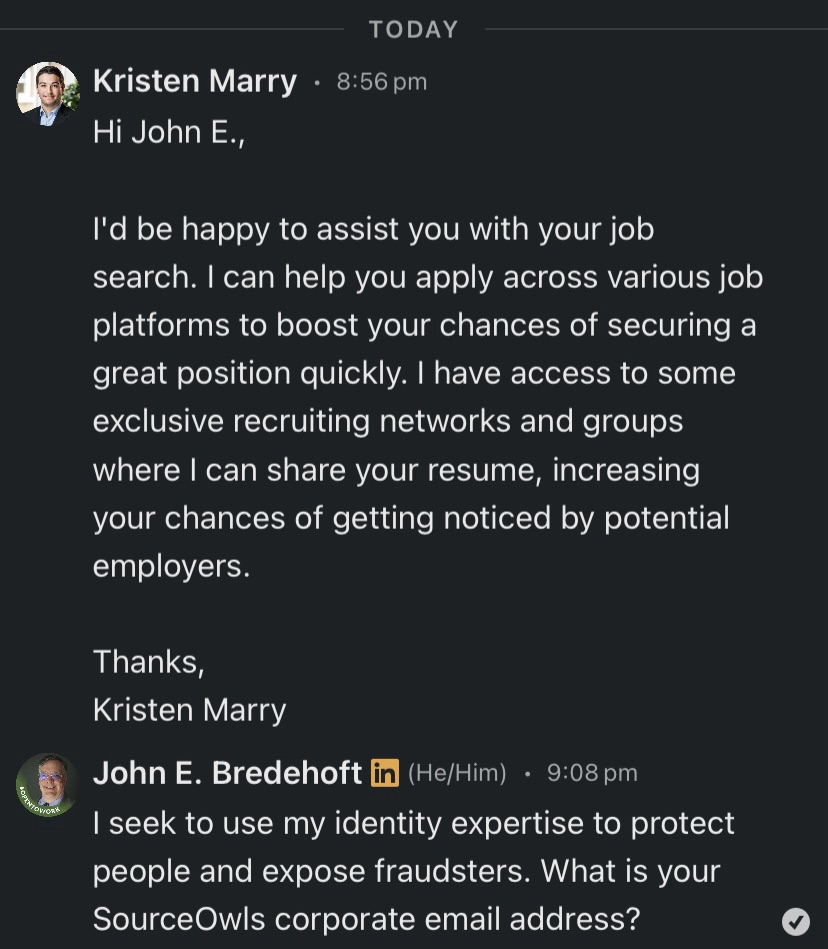
I will have more to say about this later, but for now here is the synthetic identity video (the long version) that I created this morning.
Identity/biometrics/technology marketing and writing services

I will have more to say about this later, but for now here is the synthetic identity video (the long version) that I created this morning.

As an identity/biometric blog expert knows, superior identity blog post writing requires specification of benefits and maintenance of customer focus.
As content creators accelerate information generation and distribution, content consumers demand information NOW. Perhaps my prediction of five-minute content creation hasn’t occurred—yet—but firms need to distribute their messages as fast as possible.

This Bredemarket blog post discusses a rapid way for identity/biometric firms to communicate the benefits of their solutions and capture their prospects’ attention immediately.
While my consultancy Bredemarket creates identity content in a variety of customer-facing formats, including white papers, case studies, and e-books, one of my favorite ways to write about identity is via blog posts.
Why?
However, if your identity/biometric blog post merely consists of a list of features of your product or service, then you’re wasting your time.

If your post simply states that your new latent fingerprint station captures print evidence at 2000 pixels per inch, most of your prospects are going to say, “So what?”
On the other hand, if your post talks about how your latent fingerprint station’s high capture resolution benefits your prospects by helping experts to solve crimes more quickly and getting bad people off the street, then your prospects are going to care about your product/service—and will convert from prospects to paying customers.
That little tip about benefits vs. features is just one of numerous tips that I’ve picked up over my many years as an identity/biometric blog expert. And you can benefit from my ability to start writing immediately because I require no learning curve. My 29 years of identity/biometric expertise comes in handy when your firm requires identity blog post writing.
OK, perhaps it’s an exaggeration to say that I can start writing immediately. Before I type a single word, we need to ensure a common understanding of why we’re writing this blog post. If you want to know how we achieve this common understanding, read the e-book I mentioned earlier.
If you are ready to purchase my Bredemarket 400 Short Writing Service to create a blog post (or other short content) describing the benefits of your identity/biometric product or service, then we should start talking sooner rather than later.

I self-describe as a “you can pry my keyboard out of my cold dead hands” person who likes to use physical or virtual keyboards to communicate. But what about using a telephone handset (when used for voice rather than data purposes)? That’s a different matter entirely.

If you have a personality that gravitates away from verbal communication, you sometimes find that you need to get out of your comfort z…I mean, you need to stray from your normal routine and use your non-preferred communication method.
I just did that earlier this week, and refrained from sending an email or other written message, instead choosing to use good old-fashioned voice communications to contact someone. And it worked, showing that voice and written communication do not have to compete with each other, and can complement each other.
This post takes a look at how writers function, both in textual and verbal environments, and what can happen when writers stray from their normal routine (or comfort zone).
I’ve talked before about my compulsion to write. Whether on a piece of paper, a typewriter (yes, I’m that old), a computer, or a smartphone, I am very accustomed to putting words to a text-based medium.

Maybe I’m TOO accustomed to typing words into devices.
It may not surprise you to learn that my VERBAL communications are less frequent. While I’m not mute in front of crowds, I gravitate toward written rather than verbal communications when I have the choice.
This preference is not uncommon, and Highly Sensitive Refuge speculates that there is a reason for this.
If you have noticed that it’s easier and more enjoyable for you to write rather than speak out your emotions, thoughts, and experiences, you might be a highly sensitive person (HSP). Highly sensitive people are the roughly 30% of the population who are wired at a brain level to process all information more deeply. This makes them more sensitive to the world around them, both emotionally and physically.
In other words: if you’re a highly sensitive person, you’re experiencing the world very differently than others do. You think more deeply, feel more strongly, and have a lot going on in your head. That can make it hard to get your words out — unless you have the time to sort them out in writing.
From https://highlysensitiverefuge.com/do-you-prefer-writing-to-speaking/

I’m not sure if I am a 100% match to the descriptions above; for example, I believe I have a LESSER awareness to environmental subtleties. However, I certainly tend to be sensitive about some things. (Are my WhatsApp friends tired of my incessant messages?) And you already know that I enjoy the process of working in my brain through drafts 0.5 and 1.0 of a piece of content.
But there are drawbacks to staying within your comfort zone.
Excuse me. Sorry, but there’s something going on in my head that I have to address.
I’ve decided that I’m tired of the phrase “comfort zone,” in the same way that I’m tired of “game changer,” “thinking out of the box,” and (shudder) “best of breed.”
There’s nothing inherently wrong with the phrase “comfort zone.” Unlike the other phrases above, the literal meaning does not radically differ from the common usage. But “comfort zone” has reached an oversaturation point.

Now I’ll grant that some of these 65,200,000 search results are non-psychological and refer to air conditioning and other things, but the phrase “comfort zone” is used an awful lot.
I wasn’t sure what would be better. So I asked my buddy Google Bard.
In my view, a couple of these (“safe space,” “your comfort bubble”) are just as bad as “comfort zone,” but “normal routine” and “what you’re used to” are much better and less jargon-y than “comfort zone.”
So I’ll use that instead.
OK now, where we were?
Sorry about that.
But there are drawbacks to straying from your normal routine. Sometimes written communication just doesn’t cut it. (“Doesn’t cut it” is another piece of jargon I should eliminate. But one per post is enough.)
I don’t know how many times I’ve had this exchange with coworkers, friends, and family.
PERSON: Did you resolve the issue with Jane?
ME: I emailed her a couple of days ago but haven’t heard back.
PERSON: Why don’t you pick up the phone and call her?
ME: I’ll email her again. Or maybe I’ll text her.
PERSON: CALL HER!
ME, IRRITATED: OK, I’ll call her!
From a meaningful apocryphal conversation. Not put to music…yet.
I thought about this during a recent interchange with one of my Bredemarket clients.
I had emailed a question to the client, and the very busy client said they would get back to me with the answer. After a while, I emailed the client again. And again.
At this point I started to get worried. (Maybe I am sensitive. A bit.)
But before I jumped to the wrong conclusion, I decided that I had better pick up the phone and call the client.
Not that day, but the next day. I mean, you can’t be rash about things like that.
So the next day I did pick up the phone and called the client…but the client wasn’t available.
A few minutes later, I received an email with an explanation for the delay (the busy client had been even busier than usual due to unanticipated circumstances), AND the client provided the answer to my question. Everything was very good.
All solved by a simple phone call.
Maybe I should do this more often.

“Not a phone call from John again…”

(Updated question count 10/23/2023)
I’m stealing an idea from Matthew Mace and adapting it to explain how Bredemarket works.
Matthew Mace is a freelance content writer who recently posted the following on LinkedIn:
Do you need a freelance content writer but don’t know what to expect?
I created a “work with me” pdf that explains what I do and how I can help you.
From https://www.linkedin.com/posts/matthewmace-contentmarketing_cycling-running-wellness-activity-7094675414727450624-8U_Y/
His post then explains what is included in his “work with me” PDF. If you’d like his PDF, send him a message via his LinkedIn profile.
Glad you asked.
After reading Mace’s LinkedIn post, I realized that I have a bunch of different online sources that explain how to work with Bredemarket, but they’re scattered all over the place. This post groups them all the “how to work with Bredemarket” content together, following an outline similar (yet slightly different) to Mace’s.
And no, it’s not a stand-alone PDF, but as you read the content below you’ll discover two stand-alone PDFs that address critical portions of the process.
As you’ll see below, “why” is a very important question, even more important than “how.” Here are some reasons to work with Bredemarket.

This question is just as important as the prior one. If you need the following, you WON’T want to work with Bredemarket.

Here are the three most common packages that Bredemarket offers.

Note that these are the standard packages. If your needs are different, I can adapt them, or charge you an hourly rate if the need is not well defined. (But as you will see below, I try to work with you at the outset to define the project.)
If you follow the link above for your desired package and download the first brochure on each page, you’ll get a description of the appropriate service. The pricing is at the bottom of each brochure.
Each brochure also explains how I kick off a project, but the procedure is fairly common for each package.
When I work with a client, I hold a kickoff to make sure that we have a common understanding at the beginning of the project.
The first seven questions that we address are critical. In fact, I wrote an e-book that addresses these seven questions alone.

But that’s not all that we address in the kickoff. There are some other lower-level questions that I ask you (such as the long and short form of your company name).
Once we have defined the project, I iteratively provide draft copy and you iteratively review it. The number and length of review cycles varies depending upon the content length and your needs. For example, I use up to two review cycles of up to three days each for short content.
Eventually I provide the final copy, you publish it and pay me, and both of us are happy.
Because I usually function as a ghostwriter, I cannot publicly provide samples or identity my clients. But I’ve written yet another e-book that anonymously describes some sample projects that I’ve performed for clients, including a testimonial from one of them.

If you believe that I can help you create the content your firm needs, let’s talk.
Or if Matthew Mace’s content services better fit your needs, use him.
Are you considering contracting with a marketing and writing service?
Would you like to know more about Bredemarket’s marketing and writing services to provide the right words for identity/biometrics, technology, and local B2B firms?
Would you like multiple options to learn about Bredemarket?


This post is ONLY intended for people who want to stay up-to-date with information from Bredemarket. If you have no such interest, you can skip reading this post and I’ll “give a couple of minutes back to you.”
There are a number of ways to get the latest Bredemarket information, but these three are probably the most important.
To subscribe to the Bredemarket blog and get the latest information directly from Bredemarket:
The Bredemarket blog contains over 400 posts on marketing, writing, identity and biometrics, technology, and California’s Inland Empire. It also lets you know how you can use Bredemarket’s marketing and writing services for your company.
To subscribe to the LinkedIn page and see the latest content from Bredemarket, and special content from Bredemarket’s market-oriented LinkedIn pages:
I’ve found LinkedIn to be a valuable source of information, and much of the third-party information I find on LinkedIn is reshared on the Bredemarket LinkedIn page and its market-oriented “showcase” pages on identity, technology, and local business. (You can follow those three pages also.)
To subscribe to the mailing list and receive special private content in advance of everyone else:
I’m revitalizing the mailing list to let those with a keen interest in Bredemarket know about my future plans.
In some cases, a customer’s purchase of a particular product or service indicates possible future interest in that same product or service.
But this indicator only goes so far.
If you just purchased an expensive item such as a refrigerator or a car or a house, chances are you’re not in the market for a second refrigerator or car or house.

But some companies don’t understand that high priced items are not usually purchased in bulk. According to a parcelLabs emotional shipping experience study:
People have lost patience with brands who send incorrect or inaccurate marketing materials. In fact, brands that do this are driving their customers away.
Of the 49% that say they were incorrectly targeted to in the last six months, 42% said they immediately unsubscribed from the brand’s marketing content. Another 24% chose to block the brand on social media!
43% said that they received marketing for a product they’d already bought.
You have to be more intelligent in your customer focus. Once a customer has purchased an item, they may—or may not—need a second one. In a different context, I have referred to this as “somewhat you why,” or the need to understand the intent of what someone is doing.
If I’m standing outside my former employer’s office with some computer equipment, perhaps I’m returning equipment to my former employer.
If I’m purchasing a refrigerator, in most cases I’m not contemplating purchase of a second one immediately.
Although if I’m opening a chain of restaurants…

If I hired myself to update the Bredemarket website, I’d be employed full time.
My “opportunity” that allowed me to service identity clients again necessitated several changes to the website, which I documented in a June 1 post entitled “Updates, updates, updates…“
Then I had to return to this website to make some hurried updates, since my April 2022 prohibition on taking certain types of work is no longer in effect as of June 2023. Hence, my home page, my “What I Do” page, and (obviously) my identity page are all corrected.
From https://bredemarket.com/2023/06/01/updates-updates-updates/
Basically, I had gone through great trouble to document that Bredemarket would NOT take identity work, so I had to reverse a lot of pages to say that Bredemarket WOULD take identity work.
I may have found a few additional pages after June 1, but eventually I reached the point where everything on the Bredemarket website was completely and totally updated, and I wouldn’t have to perform any other changes.
You can predict where this is going.
Today it occurred to me that some of the readers of the LinkedIn Bredemarket page may not know the person behind Bredemarket, so I took the opportunity to share Bredemarket’s “Who I Am” web page on the LinkedIn page.
Only then did I read what the page actually said.
So THAT page was also updated (updates in red).

So yes, this biometric content marketing expert/identity content marketing expert IS available for your content marketing needs. If you’re interested in receiving my help with your identity written content, contact me.
To be continued, probably…
There are a variety of ways that you can catch fraudsters who try to steal someone’s financial identity, but sometimes the simple ones work best.
The U.S. Department of Justice recently reported on a traffic stop that occurred three years ago.
Monroe County Sheriff’s deputies found eight debit cards and three driver’s licenses belonging to other people in (Jamal Denzel) Austin’s possession during a traffic stop for reckless driving and failing to maintain lane on Jan. 19, 2020. A subsequent investigation revealed that Austin, who worked at an Atlanta club, had used two stolen identities to register two separate fictious (sic) businesses with the Georgia Secretary of State’s Office to obtain two Capital One business credit cards with credit limits of $30,000 and $20,000.
From https://www.justice.gov/usao-mdga/pr/macon-man-sentenced-prison-resulting-identity-theft-investigation
Three driver’s licenses? Yikes.
The investigation, which also included participation by the United States Secret Service and other local, state, and federal agencies, also uncovered a stolen $49,000 check.
Well, Austin lost the stolen money and his freedom. He was sentenced to 48 months in federal prison.
Now I’ll grant the early stages of this investigation aren’t as sexy as other fraud detection methods, but it worked.
Fraudsters, stay in your lane.
(Part of the biometric product marketing expert series)
I know that I’m the guy who likes to say that it’s all semantics. After all, I’m the person who has referred to five-page long documents as “battlecards.”
But sometimes the semantics are critically important. Take the terms “factors” and “modalities.” On the surface they sound similar, but in practice there is an extremely important difference between factors of authentication and modalities of authentication. Let’s discuss.
To answer the question “what is a factor,” let me steal from something I wrote back in 2021 called “The five authentication factors.”
Something You Know. Think “password.” And no, passwords aren’t dead. But the use of your mother’s maiden name as an authentication factor is hopefully decreasing.
Something You Have. I’ve spent much of the last ten years working with this factor, primarily in the form of driver’s licenses. (Yes, MorphoTrak proposed driver’s license systems. No, they eventually stopped doing so. But obviously IDEMIA North America, the former MorphoTrust, has implemented a number of driver’s license systems.) But there are other examples, such as hardware or software tokens.
Something You Are. I’ve spent…a long time with this factor, since this is the factor that includes biometrics modalities (finger, face, iris, DNA, voice, vein, etc.). It also includes behavioral biometrics, provided that they are truly behavioral and relatively static.
Something You Do. The Cybersecurity Man chose to explain this in a non-behavioral fashion, such as using swiping patterns to unlock a device. This is different from something such as gait recognition, which supposedly remains constant and is thus classified as behavioral biometrics.
Somewhere You Are. This is an emerging factor, as smartphones become more and more prevalent and locations are therefore easier to capture. Even then, however, precision isn’t always as good as we want it to be. For example, when you and a few hundred of your closest friends have illegally entered the U.S. Capitol, you can’t use geolocation alone to determine who exactly is in Speaker Pelosi’s office.
From https://bredemarket.com/2021/03/02/the-five-authentication-factors/
(By the way, if you search the series of tubes for reading material on authentication factors, you’ll find a lot of references to only three authentication factors, including references from some very respectable sources. Those sources are only 60% right, since they leave off the final two factors I listed above. It’s five factors of authentication, folks. Maybe.)
The one striking thing about the five factors is that while they can all be used to authenticate (and verify) identities, they are inherently different from one another. The ridges of my fingerprint bear no relation to my 16 character password, nor do they bear any relation to my driver’s license. These differences are critical, as we shall see.
In identity usage, a modality refers to different variations of the same factor. This is most commonly used with the “something you are” (biometric) factor, but it doesn’t have to be.
The identity company Aware, which offers multiple biometric solutions, spent some time discussing several different biometric modalities.
[M]any businesses and individuals (are adopting) biometric authentication as it been established as the most secure authentication method surpassing passwords and pins. There are many modalities of biometric authentication to pick from, but which method is the best?
From https://www.aware.com/blog-which-biometric-authentication-method-is-the-best/
After looking at fingerprints, faces, voices, and irises, Aware basically answered its “best” question by concluding “it depends.” Different modalities have their own strengths and weaknesses, depending upon the use case. (If you wear thick gloves as part of your daily work, forget about fingerprints.)
ID R&D goes a step further and argues that it’s best to use multimodal biometrics, in which the two biometrics are face and voice. (By an amazing coincidence, ID R&D offers face and voice solutions.)
And there are many other biometric modalities.

But the word “modalities” is not reserved for biometrics alone. The scientific paper “Multimodal User Authentication in Smart Environments: Survey of User Attitudes,” just released in May, includes this image that lists various modalities. As you can see, two of the modalities are not like the others.

In fact, each authentication factor has multiple modalities.
Modalities within a single authentication factor are more closely related than modalities within multiple authentication factors. As I mentioned above when talking about factors, there is no relationship between my fingerprint, my password, and my driver’s license. However, there is SOME relationship between my driver’s license and my passport, since the two share some common information such as my legal name and my date of birth.
What does this mean?
Therefore, while multimodal authentication is better tha unimodal authentication, multifactor authentication is usually better still (unless, as Incode Technologies notes, one of the factors is really, really weak).
As you can see, you need to be very careful when writing about modalities and factors.
You need a biometric content marketing expert who has worked with many of these modalities.
Actually, you need an identity content marketing expert who has worked with many of these factors.
So if you are with an identity company and need to write a blog post, LinkedIn article, white paper, or other piece of content that touches on multifactor and multimodal issues, why not engage with Bredemarket to help you out?
If you’re interested in receiving my help with your identity written content, contact me.