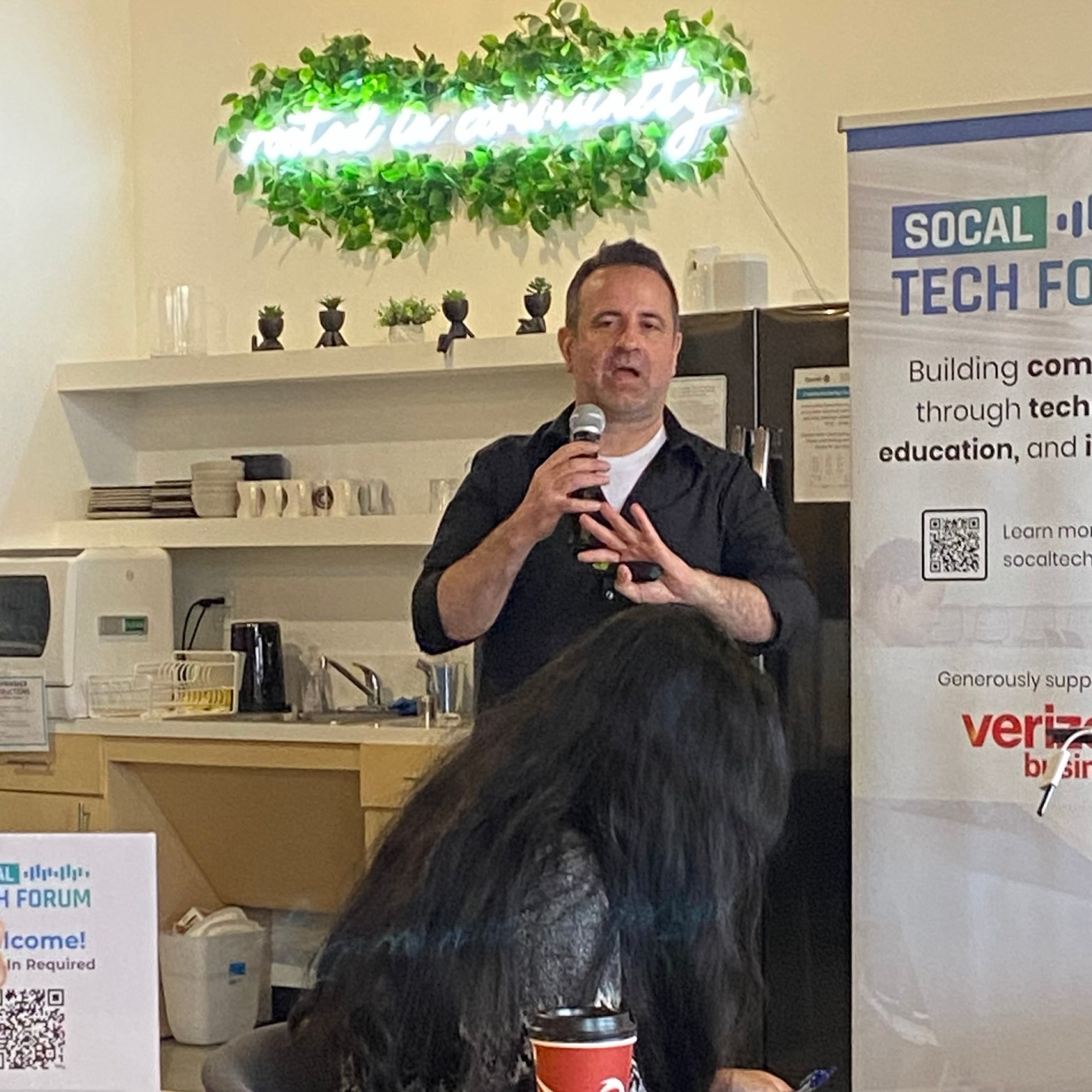
Francesco Fabbrocino’s Five Rules of Fraud Prevention…and Bredemarket’s Caveat to Rule 2

Francesco Fabbrocino of Dunmor presented at today’s SoCal Tech Forum at FoundrSpace in Rancho Cucamonga, California. His topic? Technology in FinTech/Fraud Detection. I covered his entire presentation in a running LinkedIn post, but I’d like to focus on one portion here—and my caveat to one of his five rules of fraud detection. (Four-letter word warning.)

The five rules

In the style of Fight Club, Fabbrocino listed his five rules of fraud detection:

1. Nearly all fraud is based on impersonation.

2. Never expose your fraud prevention techniques.

3. Preventing fraud usually increases friction.

4. Fraud prevention is a business strategy.

5. Whatever you do, fraudsters will adapt to it.

All good points. But I want to dig into rule 2, which is valid…to a point.

Rule 2

If the fraudster presents three different identity verification or authentication factors, and one of them fails, there’s no need to tell the fraudster which one failed. Bad password? Don’t volunteer that information.

In fact, under certain circumstances you may not have to reveal the failure at all. If you are certain this is a fraud attempt, let the fraudster believe that the transaction (such as a wire transfer) was successful. The fraudster will learn the truth soon enough: if not in this fraud attempt, perhaps in the next one.

But “never” is a strong word, and there are some times when you MUST expose your fraud prevention techniques. Let me provide an example.

Biometric time cards

One common type of fraud is time card fraud, in which an employee claims to start work at 8:00, even though he didn’t show up for work until 8:15. How do you fool the time clock? By buddy punching, where your friend inserts your time card into the time clock precisely at 8, even though you’re not present.

Enter biometric time clocks, in which a worker must use their finger, palm, face, iris, or voice to punch in and out. It’s very hard for your buddy to have your biometric, so this decreases time clock fraud significantly.

The four-letter word

Unless you’re an employer in Illinois, or a biometric time clock vendor to employers in Illinois.

Illinois state flag. Public domain.

And you fail to inform the employees of the purpose for collecting biometrics, and obtain the employees’ explicit consent to collect biometrics for this purpose.

Because that’s a violation of BIPA, Illinois’ Biometric Information Privacy Act. And you can be liable for damages for violating it.

In a case like this, or a case in a jurisdiction governed by some other privacy law, you HAVE to “expose” that you are using an individual’s biometrics as a fraud prevention techniques.

But if there’s no law to the contrary, obfuscate at will.

Communicating your anti-fraud solution

Now there are a number of companies that fight the many types of fraud that Fabbrocino mentioned. But these companies need to ensure that their prospects and clients understand the benefits of their anti-fraud solutions.

That’s where Bredemarket can help.

As a product marketing consultant, I help identity, biometric, and technology firms market their products to their end clients.

And I can help your firm also.

Read about Bredemarket’s content for tech marketers and book a free meeting with me to discuss your needs.

More information:

Bredemarket: Services, Process, and Pricing.

Yes, I Ask

I’m old enough to remember when “maps” were large pieces of paper that you had to fold just right to store them. (Unless the maps were in a book.)

But whether your map is physical or electronic, if you don’t have it, and you’re in an area you don’t know, you’re going to get lost.

Which is why when I start a new project with a client, I try to get the answers to seven specific questions.

To learn about my seven questions, watch the video.

The Seven Questions I Ask.

Or read the book.

Security Breaches in 2026: The Girl is the Robot

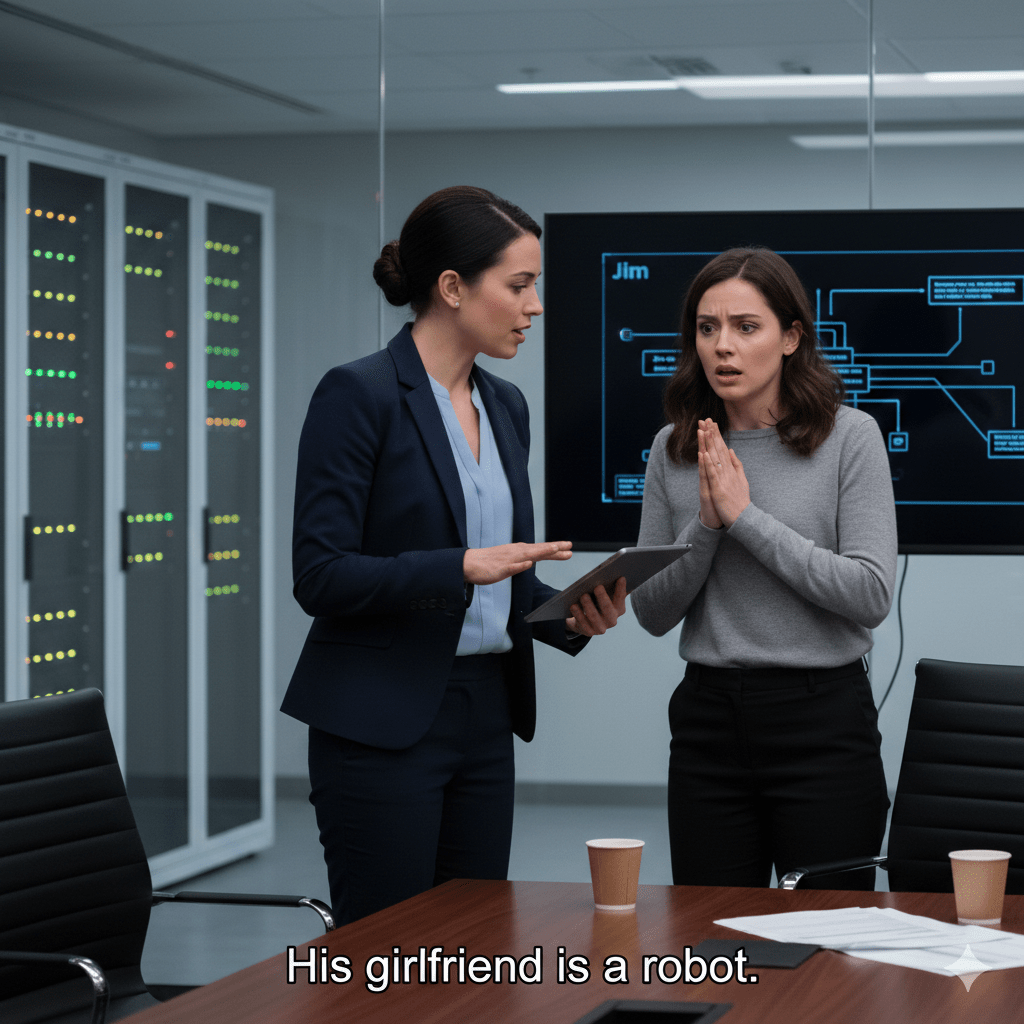
Samantha and Daria were in a closed conference room near the servers.

“Daria, I have confirmed that Jim shared his credentials with his girlfriend.”

Daria was disturbed. “Has she breached anything, Samantha?”

“Not yet,” Samantha replied. “And there’s one more thing.”

Daria listened.

“His girlfriend is a robot.”

Gemini.

Meanwhile, Jim was in his home office, staring lovingly at Donna’s beautiful on-screen avatar.

“Thank you, my love,” Donna purred. “Now I can help you do your work and get that promotion.”

Jim said nothing, but he was smiling.

Donna was smiling also. “Would you like me to peek at your performance review?”

Canva, Grok, and Gemini.

The Latest Know Your Employer Case

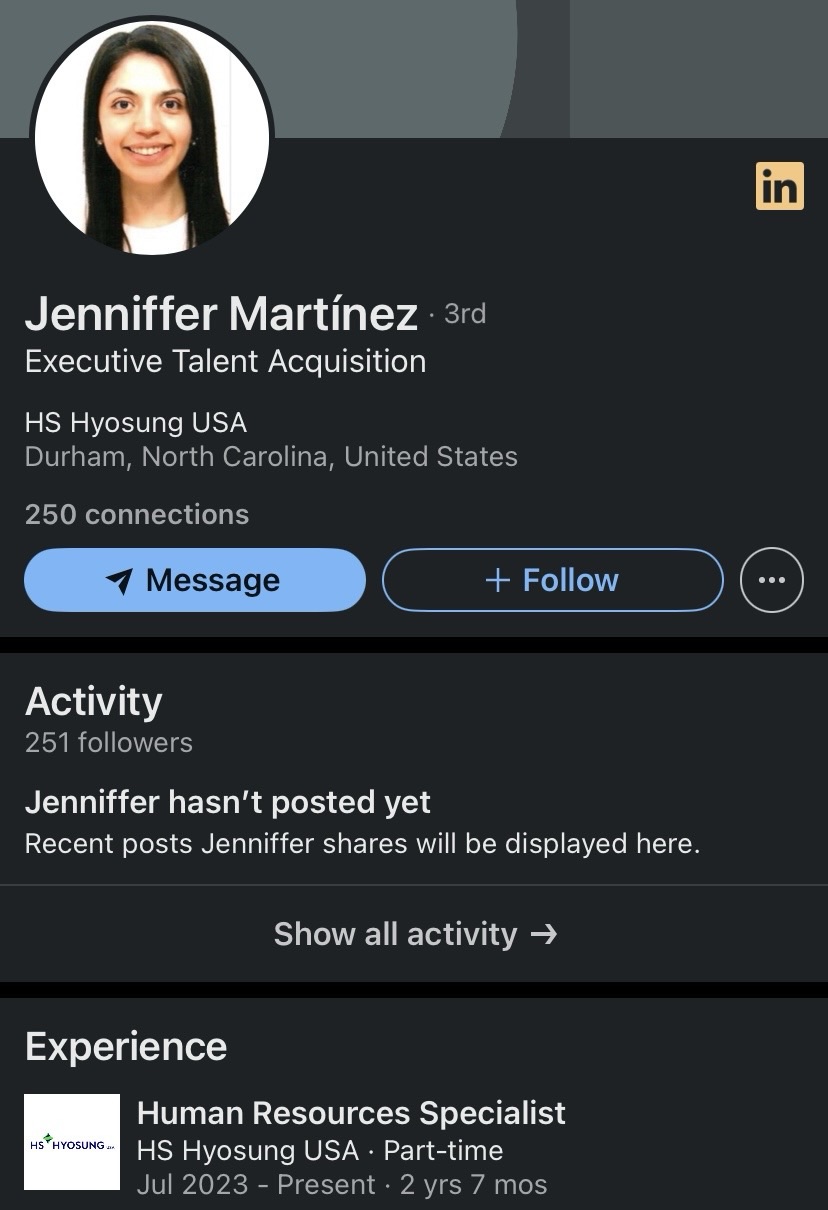
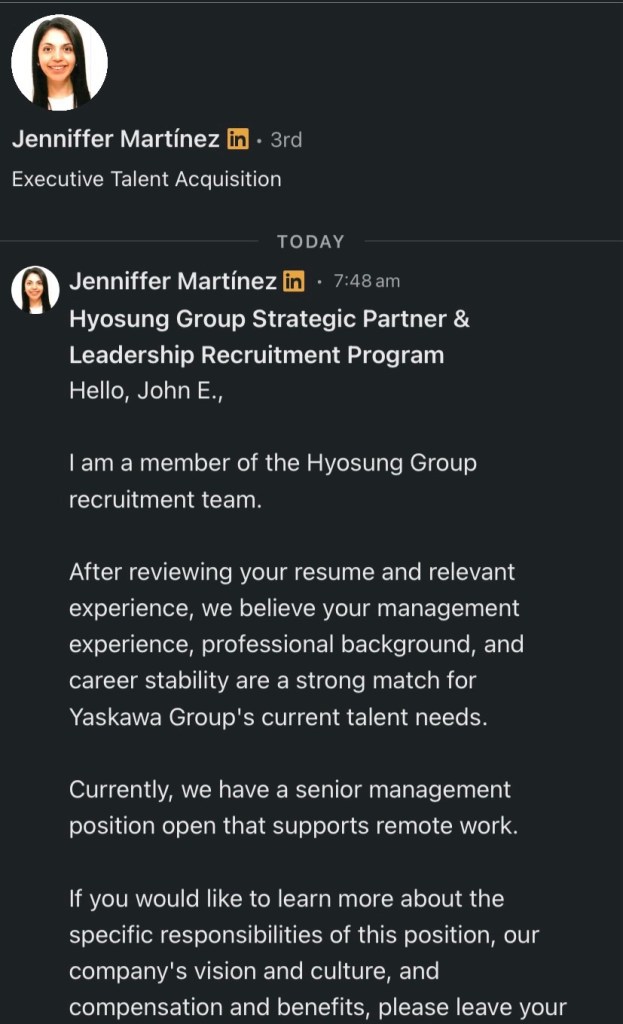
I was messaged on LinkedIn by Jenniffer Martinez, purportedly from HS Hyosung USA. She wanted my email address to send information about a job opportunity.

Why? 

“After reviewing your resume and relevant experience, we believe your management experience, professional background, and career stability are a strong match for Yaskawa Group’s current talent needs.”

(Only now did I notice the reference to Yaskawa Group, whatever it is.)

Eventually I told “Jenniffer” that I had contacted her employer directly.

By 11:30 she had deleted her entire conversation, which is why I took screen shots immediately.

And I never even got around to asking her for HER corporate email address.

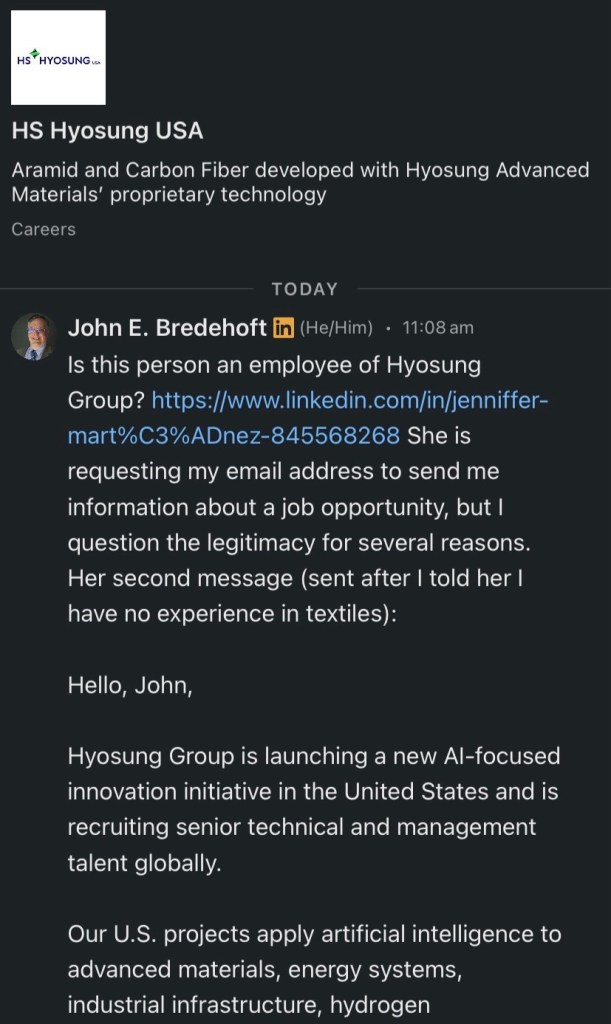
No word from HS Hyosung USA, but it knows all about Jenniffer now (see final screen shot).

Know Your Employer.

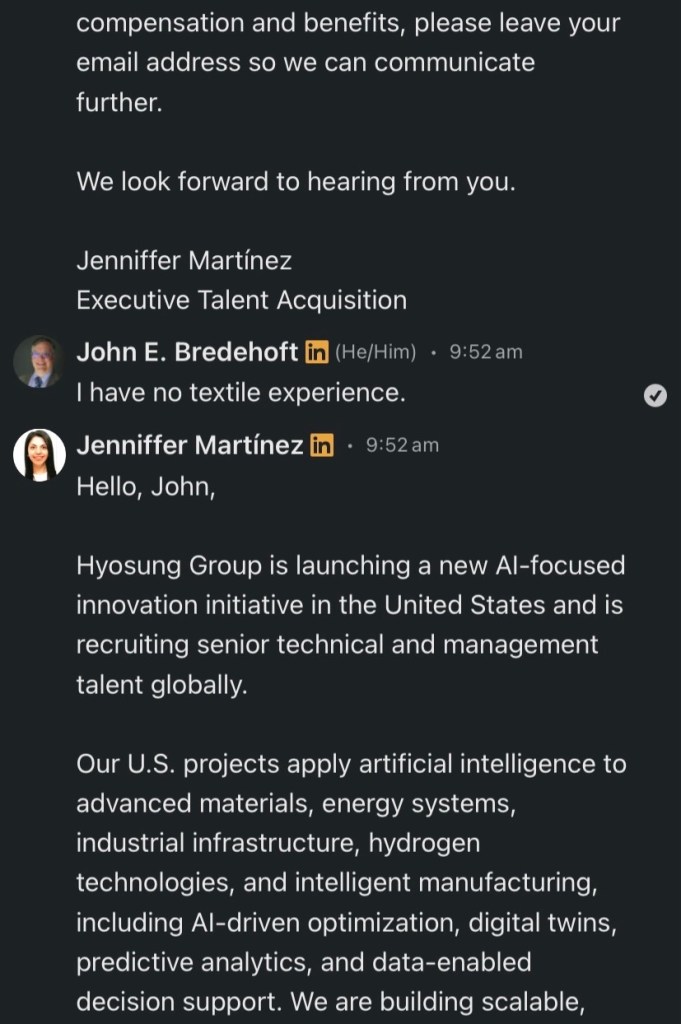
Jenniffer, 1 of 3.
Jenniffer, 2 of 3.
Jenniffer, 3 of 3.
Jenniffer’s purported company.

Oh Yeah, That Biometric Stuff

Bredemarket works with a number of technologies, but it’s no secret that my primary focus is biometrics. After all, I call myself the “biometric product marketing expert,” having worked with friction ridge (fingerprint, palm print), face, iris, voice, and rapid DNA.

The biometric product marketing expert in the desert.

If I can help your biometric firm with your content, proposal, or analysis needs, schedule a free meeting with me to discuss how I can help.

Dry January at an Ontario Bar

You would think that bars would hate Dry January.

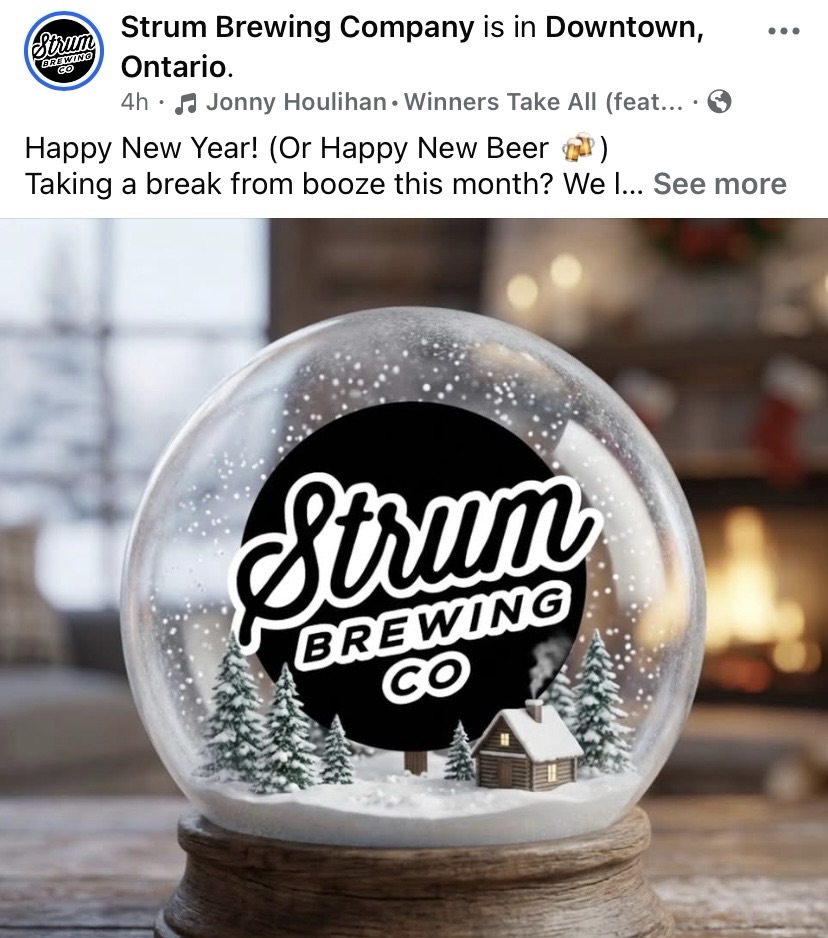
Ontario, California’s Strum Brewing Company embraces it.

In a Facebook post it welcomes Dry Januarians with its non-alcoholic offerings.

• **Alcohol-free Slushies** (yes, still fun 👀)

• **Sodas** & NA beers**

• **Flavored Waters & Hop Water**

• **Scrumptious Cookies, Beef Jerky, Pretzels, Pork Rinds , Garlic Peanuts, and soon Hummus & Toum**

• Cozy vibes & good company all month long 🎶🐾

Strum Brewing is on Euclid Avenue in downtown Ontario.

Slashdot/Reason, Do You Fact Check Your REAL ID Claims?

Unchecked disinformation runs wild in this Slashdot story, contributed anonymously.

“Only the government could spend 20 years creating a national ID that no one wanted and that apparently doesn’t even work as a national ID. But that’s what the federal government has accomplished with the REAL ID, which the Department of Homeland Security (DHS) now considers unreliable, even though getting one requires providing proof of citizenship or lawful status in the country.”

The anonymous Slashdot contributor is either a liar or a fool. As I noted back in May after Leonardo Garcia Venegas’ first detainment (I didn’t know he was detained a second time), a REAL ID was NEVER intended to prove citizenship.

Here are California’s non-citizen REAL ID requirements, which are federally acceptable:

“This includes all U.S. citizens, permanent residents who are not U.S. citizens (Green Card holders), and those with temporary legal status, such as recipients of Deferred Action for Childhood Arrivals (DACA) or Temporary Protected Status (TPS) and holders of a valid student or employment visa.”

But since the REAL ID expiration date matches the date at which temporary legal status expires, it DOES prove legal presence.

Slashdot, get your facts straight.

Postscript: Slashdot lifted its claims from Reason.