You’ve probably gathered that I don’t just post here on the Bredemarket blog.
These are some recent musical shorts—some with Canva-provided music, others with Google Lyria-generated music—that I have posted to YouTube since April.

Identity/biometrics/technology marketing and writing services
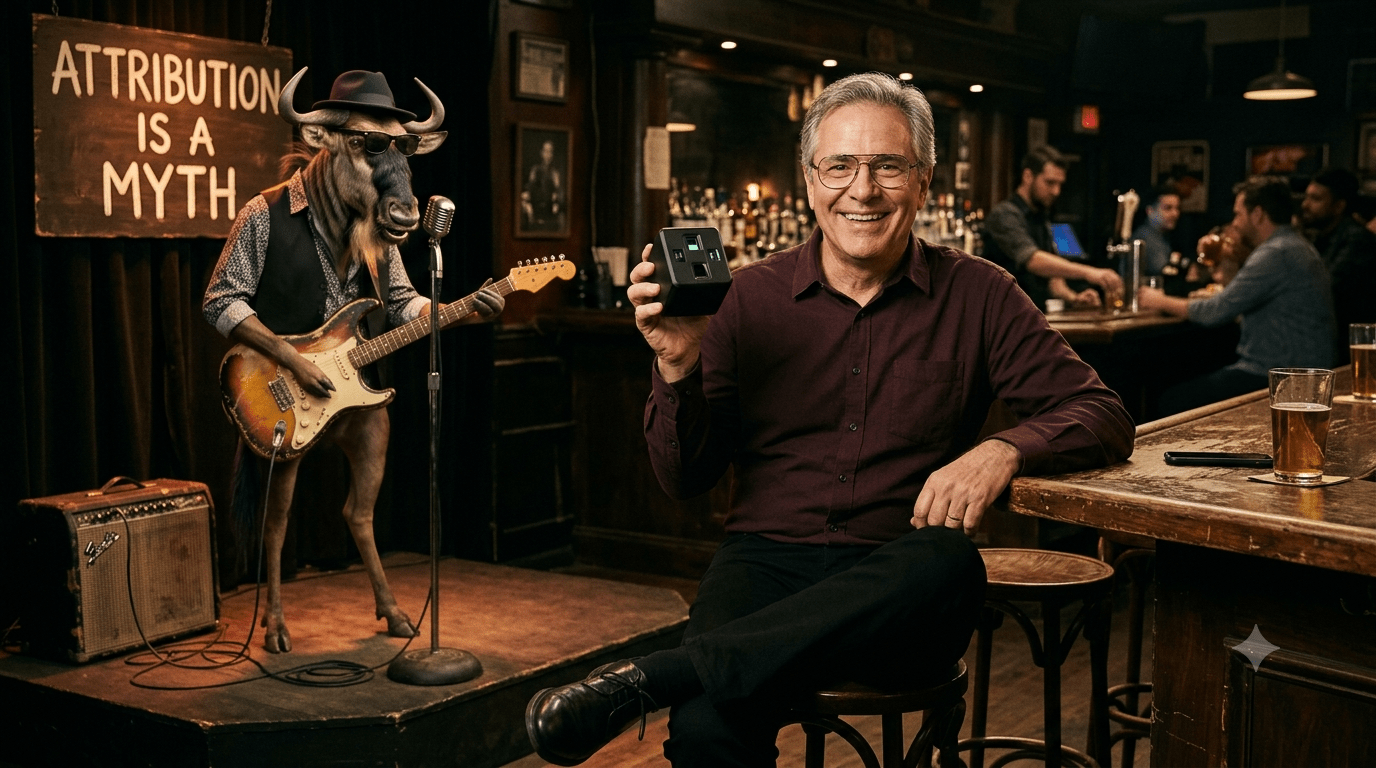
You’ve probably gathered that I don’t just post here on the Bredemarket blog.
These are some recent musical shorts—some with Canva-provided music, others with Google Lyria-generated music—that I have posted to YouTube since April.
I created this (again with Canva, Google Gemini, and Google Lyria) for self-promotion.

“Lost Recognition” illustrates that facial recognition isn’t always available.
Technologically, this video was assembled in Canva using images from Google Gemini and audio (without the video) from Google Lyria.
But who cares?
I don’t create videos for Bredemarket clients, but I do provide words that address prospect needs…such as the requirement to let a person access a building on a dark night.
Talk to me about the words I can create for you.
And if you’re interested in using the “Lost Recognition” audio, here it is. Because it’s AI-generated, I can’t copyright it.

Here’s my new Google Lyria tire intelligence (TI) song, based upon my earlier post “How to Educate Yourself About TI: The Nexus.”
I was unable to create a three-minute version, so I reverted back to the 30-second length.
Compare to the TI song that I shared earlier.
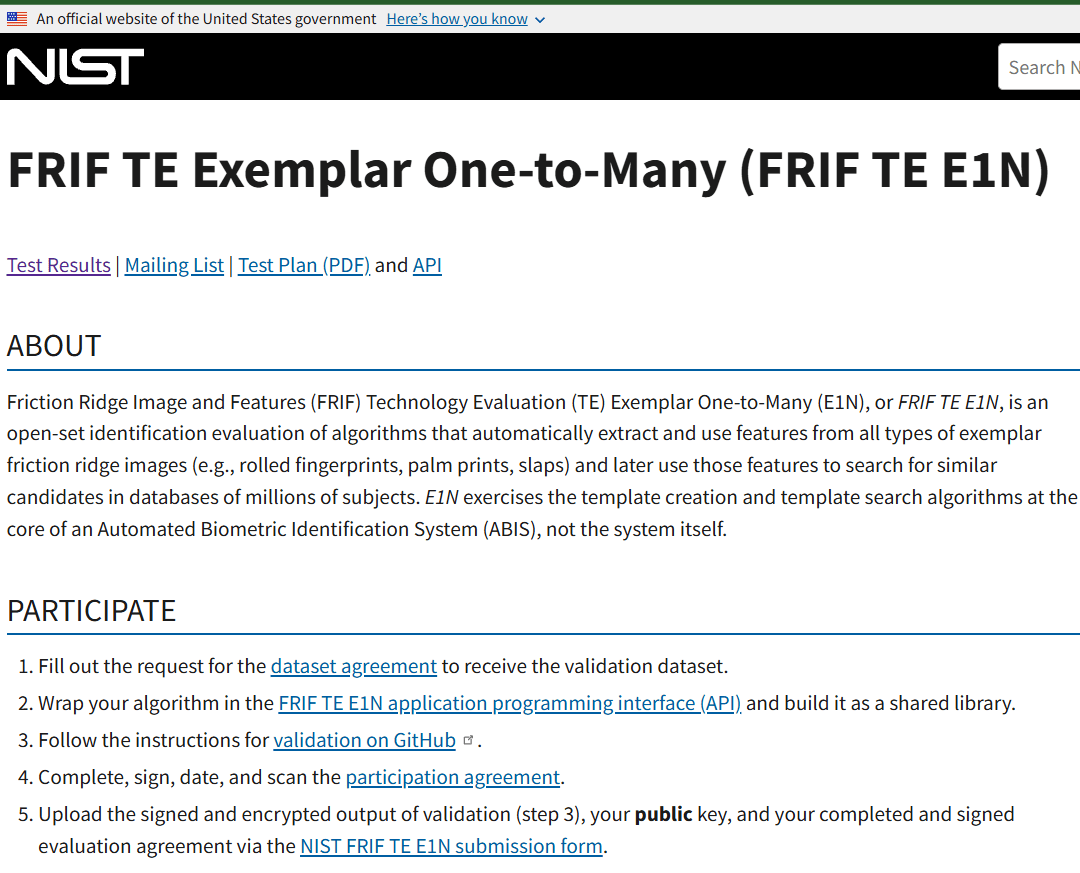
ROC (previously known as Rank One Computing) posted this about its latest resukts in the NIST Friction Ridge Image and Features Technology Evaluation Exemplar One-to-Many (FRIF TE E1N) evaluation.
“ROC’s performance in the NIST FRIF TE E1N evaluation, including #1 global ranking in Class B slap fingerprints, a critical capture format for high-scale civil and government identity programs, proves that American technology can now lead at the highest levels of global biometric performance….
“The NIST Friction Ridge Image and Features Technology Evaluation Exemplar One-to-Many evaluation, known as NIST FRIF TE E1N, evaluates one-to-many fingerprint identification at massive scale, testing how accurately algorithms can identify a subject from large enrollment repositories. Across the evaluation, ROC delivered top-tier performance in every category tested, including Class A, Class B, and Class C. “
As with every NIST biometric test, FRIF yields a massive amount of data. Just looking at the Class B slap data alone, here is what you can find, showing the top 7 entries out of 12 for the Class B Left Slap FNIR (another acronym: false negativce identification rate) at rank less than or equal to 10. Even this view excludes all other slap data and all other ranking data (1, 2, and 5).
(Data captured Friday, May 29, 2026 and may become outdated when new algorithms are tested.)
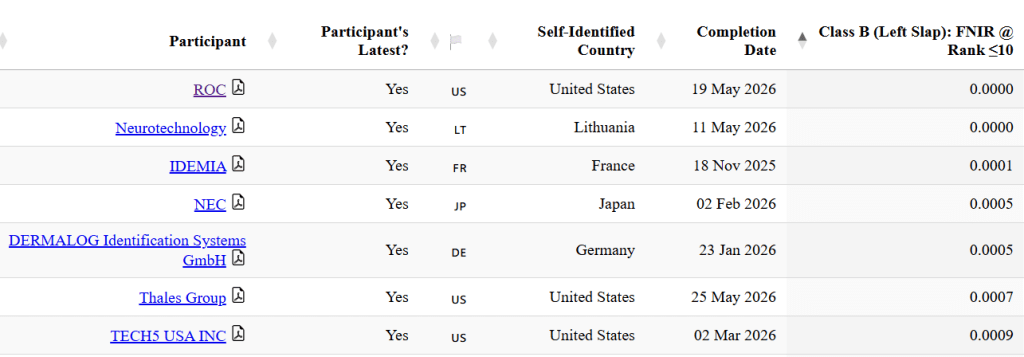
With this massive wealth of data, just about every vendor probably performed well in something, which is why ROC took the time to point out why Class B slap results are important.
“ROC’s most significant milestone came in Class B slap fingerprints. This performance is especially important for high-scale ABIS environments, including national ID programs, border management, civil enrollment, and high-stakes criminal justice workflows, where handling immense scale without sacrificing accuracy is mandatory.”
Although ROC may be the only entity trumpeting May results, other vendors have promotede earlier NIST FRIF TE E1N achievements, including IDEMIA, Identy.IO, Innovatrics, and Neurotechnology.
But they’re foreign. (As is Thales Group, for those keeping score.)

A Google Lyria song about privacy. Even though modern privacy laws did not exist in 1930s Dust Bowl Oklahoma.

From a recent Identity Jedi post.
“NHI visibility and AI agent visibility feel like the same problem. They’re not. A service account is relatively static. It was created for a purpose, it has credentials, it authenticates to something. You can find it, document it, rotate its credentials, put it in a vault. That’s a solvable problem with existing tooling.
“An AI agent is different in almost every dimension that matters. It’s dynamic. It’s often ephemeral. It doesn’t have a fixed identity. It borrows one, or several. It makes decisions at runtime about what it needs to access. And it operates at machine speed, which means by the time your SIEM fires an alert, the transaction is already done.”

After encountering yet another Facebook post that seemed to go on forever, I asked Google Gemini the “why” question.
But note the last sentence of my prompt.
Why do people who use AI authored text for Facebook posts choose text that is twice as long as it needs to be? Answer succinctly.
People generally use overly long AI-generated text for Facebook posts for a few key reasons:

If your prospects don’t know who you are, create customer-focused content that explains how your company can solve prospect problems—and increase awareness of the company’s solutions.
Because product invisibility is (usually) bad.
For the longer, more bombastic version of this post, click here.
And to get my help in content creation, click here.

There’s privacy, and there’s privacy. And this post, unlike the last one, is set on the other side of the Atlantic.
In October 2025, Interpol issued a red notice for the Chief Executive Officer of currency exchange Cinkciarz after Polish authorities charged him with orchestrating a fraud and money laundering scheme.
In May, United States authorities detained the CEO pending a Polish extradition request.
Naturally, the ongoing affair is being heavily reported in the Polish media…minus one teeny tiny detail.
The CEO’s last name.
Polish publications only identify him as “Marcin P.” due to Polish privacy laws.
The U.S. Marshals Service is under no obligation to comply with these laws, and printed the CEO’s last name in its media release. But on the slight chance that a Polish citizen may be reading the Bredemarket blog, I won’t reprint it here.
Of course, Marcin has not been convicted of a crime. But if he is eventually convicted. Polish law WILL allow publication of his last name.
Unless he lodges a request for GDPR “right of erasure,” a right that has been upheld in Luxembourg.
“The case concerns the former president of a trade union organisation from 1985 to 2002, against whom charges were brought for forgery, abuse of trust, fraud and theft. The case involved several million ‘Luxembourg Francs’ (the Euro banknotes were introduced in 2002) and hundreds of victims. The individual had confessed and was sentenced in 2007 for various offences to a prison sentence of six years, with a two-year suspended sentence….
“A TV program was broadcast in 2018, followed by a radio show in 2022. In the meantime, the individual filed a legal request in 2020 to prohibit the media outlet ‘from mentioning the name and publishing the image of the claimant on its TV broadcasts, radio programs, and websites in connection with its activities related to […], under penalty of a fine’….
“[T]he Court of Appeal found that the dissemination of the image and the publication of the name and surname were not necessary to achieve the goal of information.”
To date, I know of no case in the United States in which a convicted criminal’s name has been suppressed.
To date.

 Bredemarket