I think someone was trying to make a political point here.
34 USC 61101 was created under the Trump Administration-supported One Big Beautiful Bill Act (OBBBA). It is administered within the U.S. Department of Justice and provides state and local entities with federal reimbursement funds for particular purposes.
The Attorney General shall use amounts appropriated or otherwise made available for the Fund for grants to eligible States, State agencies, and units of local government, pursuant to their existing statutory authorities, for any of the following purposes:
(1) Locating and apprehending aliens who have committed a crime under Federal, State, or local law, in addition to being unlawfully present in the United States.
(2) Collection and analysis of law enforcement investigative information within the United States to counter gang or other criminal activity.
(3) Investigating and prosecuting-
(A) crimes committed by aliens within the United States; and
(B) drug and human trafficking crimes committed within the United States.
(4) Court operations related to the prosecution of-
(A) crimes committed by aliens; and
(B) drug and human trafficking crimes.
(5) Temporary criminal detention of aliens.
(6) Transporting aliens described in paragraph (1) within the United States to locations related to the apprehension, detention, and prosecution of such aliens.
(7) Vehicle maintenance, logistics, transportation, and other support provided to law enforcement agencies by a State agency to enhance the ability to locate and apprehend aliens who have committed crimes under Federal, State, or local law, in addition to being unlawfully present in the United States.
Oh, and the fund has a name.
It’s called the “Bridging Immigration-related Deficits Experienced Nationwide Reimbursement” Fund.
Or, if you just want to use the acronym, it’s “BIDEN.”
By a remarkable coincidence, the predecessor to the current U.S. President has the last name “BIDEN.”
The impressive AFIS purchased in 1998 but never implemented
I was a Printrak employee in 1998 when we signed a huge (for us) contract for US$45 million. We were a subcontractor to Siemens Nixdorf, but since the contract was for a national Automated Fingerprint Identification System, and Printrak built and sold Automated Fingerprint Identification Systems, our portion of the contract was substantial. Well, seemingly substantial; we’ll get to that.
And because Printrak was a publicly traded company (with the ticker symbol AFIS), I was certain the investor community would love this.
It didn’t. I recall that our stock price actually went down the day of the announcement.
But the system was still impressive. In those days most AFIS were law enforcement systems, although there were tentative efforts to use fingerperints for welfare benefits distribution. The Siemens-Printrak system for Argentina was something else entirely.
“When citizens enroll for a new ID card–the country already has an identification system–their fingerprints will be taken on paper, then scanned digitally and added to a massive database. They will then be issued a card with a bar code that will access their prints. These cards, available to all Argentine citizens, will be used to confirm their identity when they apply for jobs, school, immigration status and voting.”
Too bad it was never built.
Google Gemini.
The first issue: the cost
Part of the reason that the system was never built was because of a change of governments in Argentina. As later reported by the U.S. Department of Justice (I’ll say why DOJ got involved in a minute):
“In May 1999, according to the indictment, the Argentine government suspended the DNI [Documentos Nacionales de Identidad] project, due in part to instability in the local economy and an impending presidential election.”
A new government took power in that election, headed by Fernando de la Rúa. This new administration questioned the US$1 billion cost. (Printrak’s portion of the project was relatively small.) Eventually in May 2001 the entire project was terminated.
By that time Printrak was no longer an independent company, having been acquired by Motorola in 2000. But the people who didn’t buy Printrak stock in 1998 made the right decision.
They definitely did.
The second issue: the massive bribery scheme
This is out of scope for this particular Bredemarket post, which concentrates on companies that buy things and don’t use them, but there was an even bigger problem with the Siemens project. It turns out that Siemens officials paid more in bribes to Argentine officials (US$100 million) than the amount that Printrak was supposed to get (US$45 million).
“[D]uring the bidding and implementation phases of the project, the defendants and their co-conspirators caused Siemens to commit to paying nearly $100 million in bribes to sitting officials of the Argentine government, members of the opposition party and candidates for office who were likely to come to power during the performance of the project.”
(After the change in government) “members of the conspiracy allegedly committed Siemens to paying additional bribes to the incoming officials and to satisfying existing obligations to officials of the outgoing administration, many of whom remained in influential positions within the government.”
“When the project was terminated in May 2001, members of the conspiracy allegedly responded with a multi-faceted strategy to overcome the termination. According to the indictment, the conspirators sought to recover the anticipated proceeds of the DNI project, notwithstanding the termination, by causing Siemens AG to file a fraudulent arbitration claim against the Republic of Argentina in Washington, D.C. The claim alleged wrongful termination of the contract for the DNI project and demanded nearly $500 million in lost profits and expenses.”
“In four installments between 2002 and 2007, members of the conspiracy allegedly caused Siemens to pay approximately $28 million in further satisfaction of the obligations.”
This was not known until about a decade later, after guilty pleas in 2008 from Siemens and its Argentina subsidiary regarding criminal violations of the Foreign Corrupt Practice Act (the fraudulent arbitration claim), the 2011 indictment of eight former executives and agents of Siemens, the convictions of three of them (Truppel, Reichert, and Bock), and a civil settlement with a fourth (Sharef). The other four avoided setting foot in a U.S. courtroom because of extradition issues.
And all this took a long time. Reichert’s conviction occurred 20 years after the initial award.
But I seem to have strayed from my original topic.
When companies buy something but people never implement it
Forget everything I just said. For purposes of this post, the Argentine government spent a billion dollars on a system, and decided a few months later to not implement it.
This happens all too often. A company buys something and then says “nah.” Sometimes the company still has to pay for the product even though it never implemented it.
Why don’t companies buy something they paid for? I easily identified five fatal issues.
Issue 1: They bought it by mistake
In 2015 my then-employer MorphoTrak went through some significant transitions. One affected me personally: I moved out of proposals into strategic/product marketing. The others tangentially affected me, as two of my marketing superiors were informed that their services to MorphoTrak would no longer be needed after several months, and another marketing expert left a competitor and joined MorphoTrak.
At the time MorphoTrak had an annual contract with a services company. I won’t name the company, but when you put a heat source next to a block of ice, something happens. This annual contract had an auto-renew policy, and the company informed the known officials that this auto-renew was coming.
The known officials being the two marketing superiors who had already left MorphoTrak, and therefore never responded to the hot ice company.
Neither I nor the new executive from the competitor knew about the auto-renew policy. By the time I contacted the company and said we didn’t want to renew, the company icily informed me, “You already did.”
So I immediately cancelled the contract, ensuring that it wouldn’t auto renew a year later. And even though we were paying for nearly a year of the services, I never used them.
Issue 2: The users didn’t care what the company mandated
In theory, large organizations have a defined process for deciding which products to adopt, and which to not adopt.
For example (and this is based upon a real situation albeit anonymous), a company may mandate that all employees use Asana to track projects. The company buys a corporate Asana license covering all employees.
So an employee starts a project and tells the team that the work will be tracked in Asana.
The decision is not universally accepted.
“Asana sucks! Monday is much better!”
“I’m tracking all my stuff in Trello, and I’m not going to change platforms just for your dumb project!”
“Five years ago we used Microsoft Project for everything, I still use it, and the VP of Product loves my reports. If we don’t use Project she’ll ignore our work.”
“Why are you idiots using project management software? You can do this in Microsoft Excel. Just look at this-“
“A Redmond slave? You can do this in Google Sheets!”
“Can’t we just take care of this via email?”
Google Gemini.
So the Asana license sits unused as the project people use other means. Some already paid for by the company. Some via free versions. And some via purchases that their managers habitually approve.
Issue 3: No benefit to the employee
When decisions flow down, resistance flows up.
Let’s say management needs information about the work habits of hourly employees. Management wants this so they don’t overpay employees.
So management mandates a time clock system. When employees arrive at work they clock in. When they leave they clock out.
What benefit does this provide the employee? For some employees it actually hurts them. Jim the employee who habitually arrives at 8:05, or Grace the employee who habitually leaves at 4:55, actually lose from this new product.
Until Jim and Grace get together and start thinking.
When Grace arrives, she clocks in both herself and Jim before 8.
When Jim leaves, he clocks out both himself and Grace after 5.
Google Gemini.
And now you know why we have biometric time clocks.
Monica had been a latent examiner for 30 years when her boss made the announcement that the company had awarded the latest AFIS bid to NEC.
Which meant that Monica would no longer use the IDEMIA software. Successor to the MorphoTrak software. Successor to the Motorola software. Successor to the Printrak software.
Google Gemini.
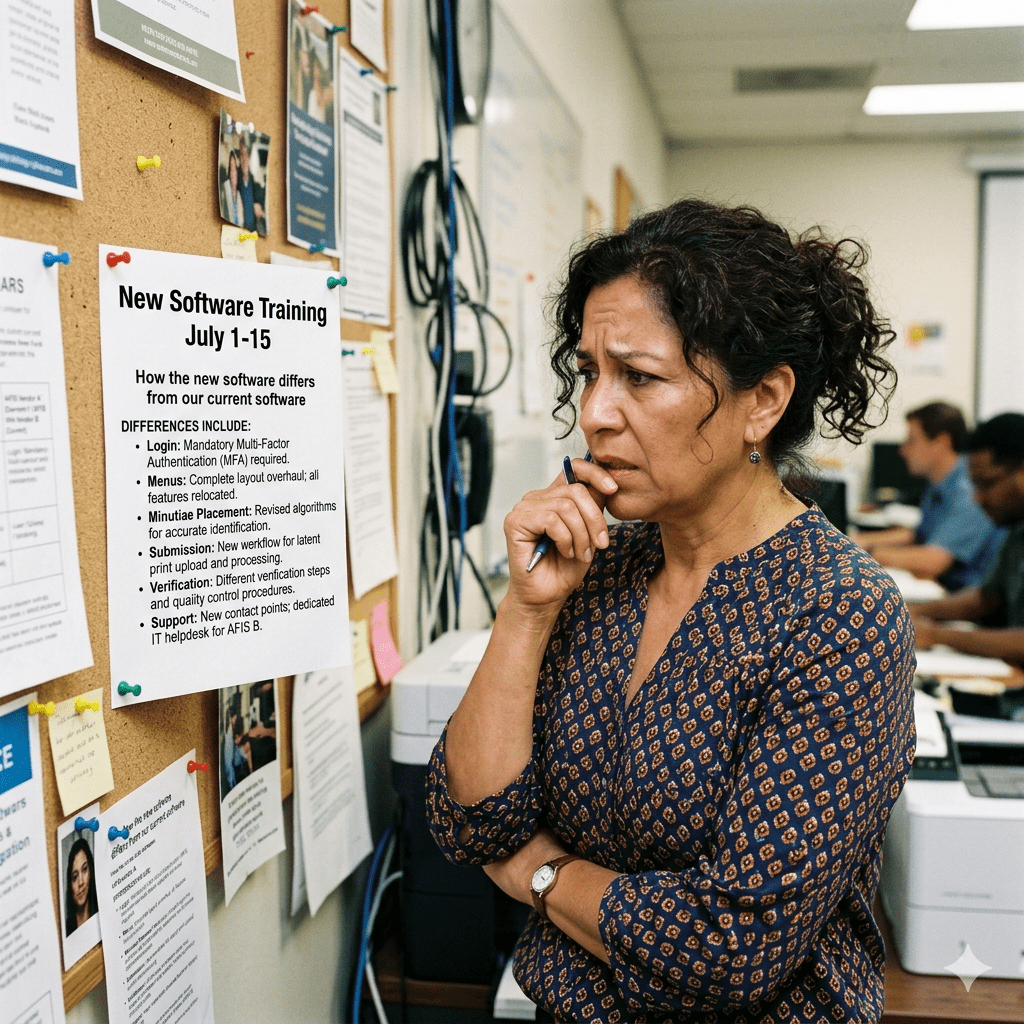
Monica was then informed that mandatory training would take place in three months. Including how to place minutiae in the new system.
She muttered under her breath, saddened that she couldn’t retire in the next three months and avoid putting up with this nonsense.
Issue 5: Leadership doesn’t care about the new tool
But before Monica could stew over that, she received an urgent email from her boss.
“How many hours did you work last week?”
“45. I already entered them in Workday.”
Thankfully, Monica’s employer didn’t use time and attendance machines. You just entered your hours into the official corporate application, in this case Workday.
The boss then sent a follow-up.
“In the future, please send your hours to me via email.”
When leadership mandates a particular process (in this case to enter hours in Workday), but leadership itself doesn’t follow the process, employees get the message.
How do you get people to use mandated and purchased products?
I recently had a conversation with a services company that provides its services to secondary companies. In some cases, the company even donates the necessary hardware and software to the secondary companies.
Having no idea whether the secondary company will even use the donation, or let it gather dust.
For project success, you want adoption. Champions who will encourage others to use your product. Steps to remove roadblocks to using the product.
Internal go-to-market
This is why the best go-to-market projects have both an external AND an internal component.
Externally, the company has to convince prospects that the new product meets their needs and provides real benefits.
Internally, the company has to enable sales by explaining why the new product is important, how the prospects will benefit from it, and how sales itself will benefit by learning how to sell it.
If your go-to-market doesn’t address internal stakeholders, then they won’t learn how to sell or support your product, and the product willl fail.
Do you want your employees to push your new product? Bredemarket will apply its product marketing expertise to plan and provide both external and internal collateral for a go-to-market plan. Let’s talk about your needs and the possibilities.
There’s privacy, and there’s privacy. And this post, unlike the last one, is set on the other side of the Atlantic.
In October 2025, Interpol issued a red notice for the Chief Executive Officer of currency exchange Cinkciarz after Polish authorities charged him with orchestrating a fraud and money laundering scheme.
Naturally, the ongoing affair is being heavily reported in the Polish media…minus one teeny tiny detail.
The CEO’s last name.
Polish publications only identify him as “Marcin P.” due to Polish privacy laws.
The U.S. Marshals Service is under no obligation to comply with these laws, and printed the CEO’s last name in its media release. But on the slight chance that a Polish citizen may be reading the Bredemarket blog, I won’t reprint it here.
But Marcin P. is only a suspect
Of course, Marcin has not been convicted of a crime. But if he is eventually convicted. Polish law WILL allow publication of his last name.
“The case concerns the former president of a trade union organisation from 1985 to 2002, against whom charges were brought for forgery, abuse of trust, fraud and theft. The case involved several million ‘Luxembourg Francs’ (the Euro banknotes were introduced in 2002) and hundreds of victims. The individual had confessed and was sentenced in 2007 for various offences to a prison sentence of six years, with a two-year suspended sentence….
“A TV program was broadcast in 2018, followed by a radio show in 2022. In the meantime, the individual filed a legal request in 2020 to prohibit the media outlet ‘from mentioning the name and publishing the image of the claimant on its TV broadcasts, radio programs, and websites in connection with its activities related to […], under penalty of a fine’….
“[T]he Court of Appeal found that the dissemination of the image and the publication of the name and surname were not necessary to achieve the goal of information.”
To date, I know of no case in the United States in which a convicted criminal’s name has been suppressed.
Don’t get violent at a Transportation Security Administration (TSA) checkpoint. If you do, you may not fly anywhere…or drive or walk anywhere either.
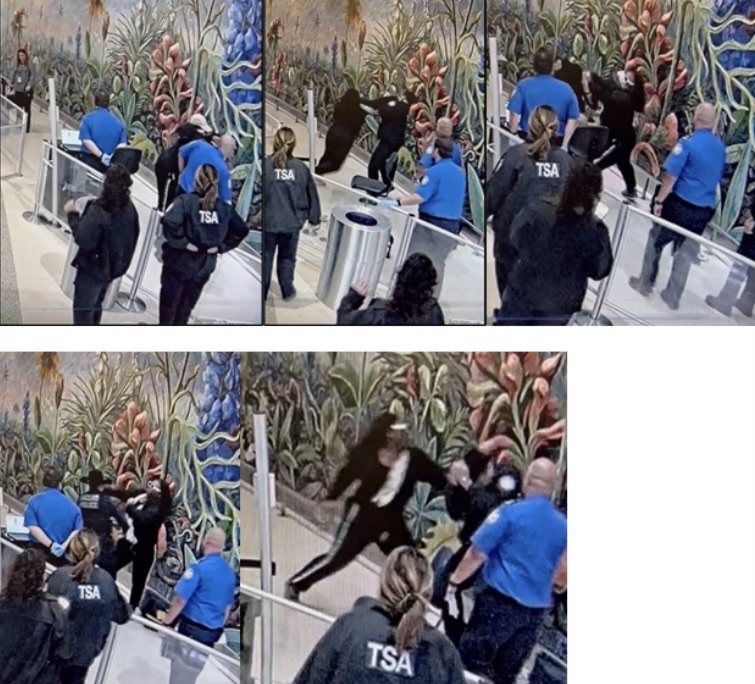
Here’s the story of a man named Idress Vinay Solomon who was preparing to board a Southwest Airlines flight from Dallas’ Love Field to Oakland on March 10. Somehow Mr. Solomon missed the memo that you need a REAL ID or equivalent to board a plane. Something that has been discussed for decades, since passage of the Real ID Act of 2005.
But as readers of the Bredemarket blog know, despite years of declarations that you must have a REAL ID to fly, you don’t need one. The TSA launched ConfirmID this year, an alternate identity confirmation service for those who don’t have approved identity documentation. You pay $45, and TSA confirms your identity via other methods.
“[T]he Oakland resident allegedly started reacting aggressively and attacked the officers present. During this incident, he punched a [Dallas Police Department] officer multiple times, resulting in the officer suffering an “orbital blowout fracture” in his left eye.”
“A blowout fracture is the most common type of orbital fracture. This fracture is a break along the floor or thin inner wall of your eye socket. Getting hit in the eye with something like a fist or a baseball most often causes blowout fractures.”
The Cleveland Clinic does not indicate whether iris identification is affected by blunt force trauma.
But let’s return to “Love” Field.
The police officer was hospitalized, and Solomon remains in custody. If convicted, he could face up to 20 years in federal prison, as confirmed by the Department of Justice.
“Violent conduct perpetrated against TSA and law enforcement officers will never be tolerated in the Northern District of Texas,” said U.S. Attorney Ryan Raybould. “We will prosecute such offenses to the fullest extent to seek justice for the victims here and to deter others from resorting to aggressive attacks against officers responsible for ensuring the public’s safety while traveling.”
The Bureau of Alcohol, Tobacco, Firearms and Explosives (ATF, a legacy acronym) is part of the Department of Justice (moved from Treasury when Homeland Security was created). One of its duties is to administer the regulations from the National Firearms Act (NFA) of 1934.
In the course of its duties, ATF fingerprints certain gun owners.
As Bayometric notes in a detailed article, there are two ways to generate the fingerprint cards required by ATF: traditional ink fingerprinting to create an FD-258 card, and live scan fingerprinting to create one or more FD-258 cards. Although the latter is more expensive (even a non-ruggedized live scan station is much more expensive than an ink pad), live scans measure quality immediately and are less suspectible to operator error.
But why even worry about FD-258 cards? ATF supports an eForms service which allows you to submit prints electronically like everyone else does.
Then again, if you’re suspicious of Big Brother, you may opt for non-electronic inked fingerprints.
When the United States was attacked on September 11, 2001—an attack that caused NATO to invoke Article 5, but I digress—Congress and the President decided that the proper response was to reorganize the government and place homeland security efforts under a single Cabinet secretary. While we may question the practical wisdom of that move, the intent was to ensure that the U.S. Government mounted a coordinated response to that specific threat.
Today Americans face the threat of fraud. Granted it isn’t as showy as burning buildings, but fraud clearly impacts many if not most of us. My financial identity has been compromised multiple times in the last several years, and yours probably has also.
But don’t expect Congress and the President to create a single Department of Anti-Fraud any time soon.
Because this is government-wide and necessarily complex, the bill will be referred to at least THREE House Committees:
“Referred to the Committee on Oversight and Government Reform, and in addition to the Committees on Financial Services, and Energy and Commerce, for a period to be subsequently determined by the Speaker, in each case for consideration of such provisions as fall within the jurisdiction of the committee concerned.”
“9 (9) The National Institute of Standards and 10 Technology (NIST) was directed in the CHIPS and 11 Science Act of 2022 to launch new work to develop 12 a framework of common definitions and voluntary 13 guidance for digital identity management systems, 14 including identity and attribute validation services 15 provided by Federal, State, and local governments, 16 and work is underway at NIST to create this guid 17 ance. However, State and local agencies lack re 18 sources to implement this new guidance, and if this 19 does not change, it will take decades to harden defi 20 ciencies in identity infrastructure.”
Even in the preamble the bill mentions NIST, part of the U.S. Department of Commerce, and the individual states, after mentioning the U.S. Department of the Treasury (FinCEN) earlier in the bill.
But let’s get to the meat of the bill:
“3 SEC. 3. IDENTITY FRAUD PREVENTION INNOVATION 4 GRANTS. 5 (a) IN GENERAL.—The Secretary of the Treasury 6 shall, not later than 1 year after the date of the enactment 7 of this section, establish a grant program to provide iden 8 tity fraud prevention innovation grants to States.”
The specifics:
The states can use the grants to develop mobile driver’s licenses “and other identity credentials.”
They can also use the grants to protect individuals from deepfake attacks.
Another purpose is to develop “interoperable solutions.”
A fourth is to replace vulnerable legacy systems.
The final uses are to make sure the federal government gets its money, because that’s the important thing to Congress.
But there are some limitations in how the funds are spent.
They can’t be used to require mDLs or eliminate physical driver’s licenses.
They can’t be used to “support the issuance of drivers licenses or identity credentials to unauthorized immigrants.” (I could go off on a complete tangent here, but for now I’ll just say that this prevents a STATE from issuing such an identity credential.)
The bill is completely silent on REAL ID, therefore not mandating that everyone HAS to get a REAL ID.
And everything else
So although the bill claims to implement a government-wide solution, the only legislative changes to the federal government involve a single department, Treasury.
But Treasury (FinCEN plus IRS) and the tangentially-mentioned Commerce (NIST) aren’t the only Cabinet departments and independent agencies involved in anti-fraud efforts. Others include:
The Department of Homeland Security, through the Secret Service and every enforcement agency that checks identities at U.S. borders and other locations.
The Federal Trade Commission (FTC).
The Social Security Admistration. Not that SSNs are a national ID…but they de facto are.
And that’s just one example of how anti-fraud efforts are siloed. Much of this is unavoidable in our governmental system (regardless of political parties), in which states and federal government agencies constantly war against each other.
What happens, for example, if the Secret Service decides that the states (funded by Treasury) or the FBI (part of Justice) are impeding its anti-fraud efforts?
Or if someone complains about NIST listing evil Commie Chinese facial recognition algorithms that COULD fight fraud?
Despite what Biometric Update and the Congresspeople say, we do NOT have a government-wide anti-fraud solution.
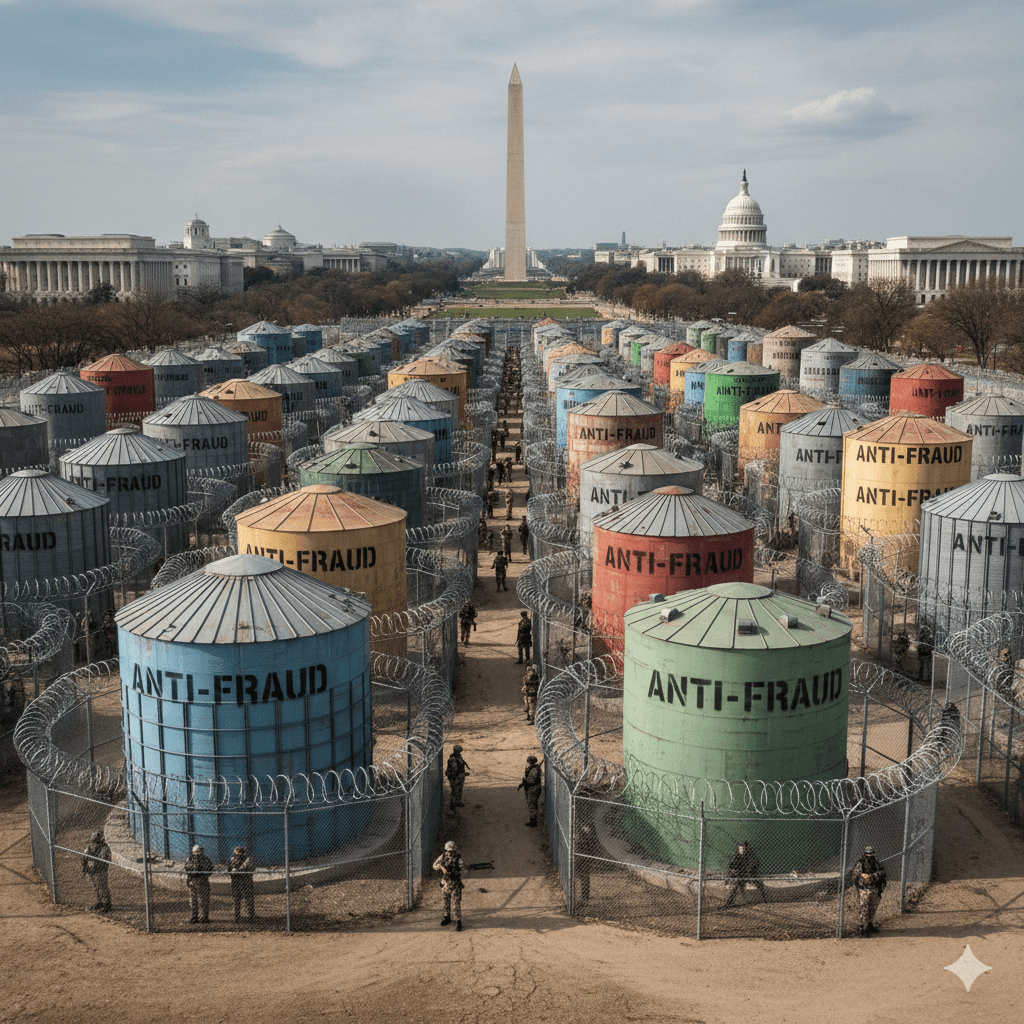
(And yes, I know that the Capitol is not north of the Washington Monument…yet.)
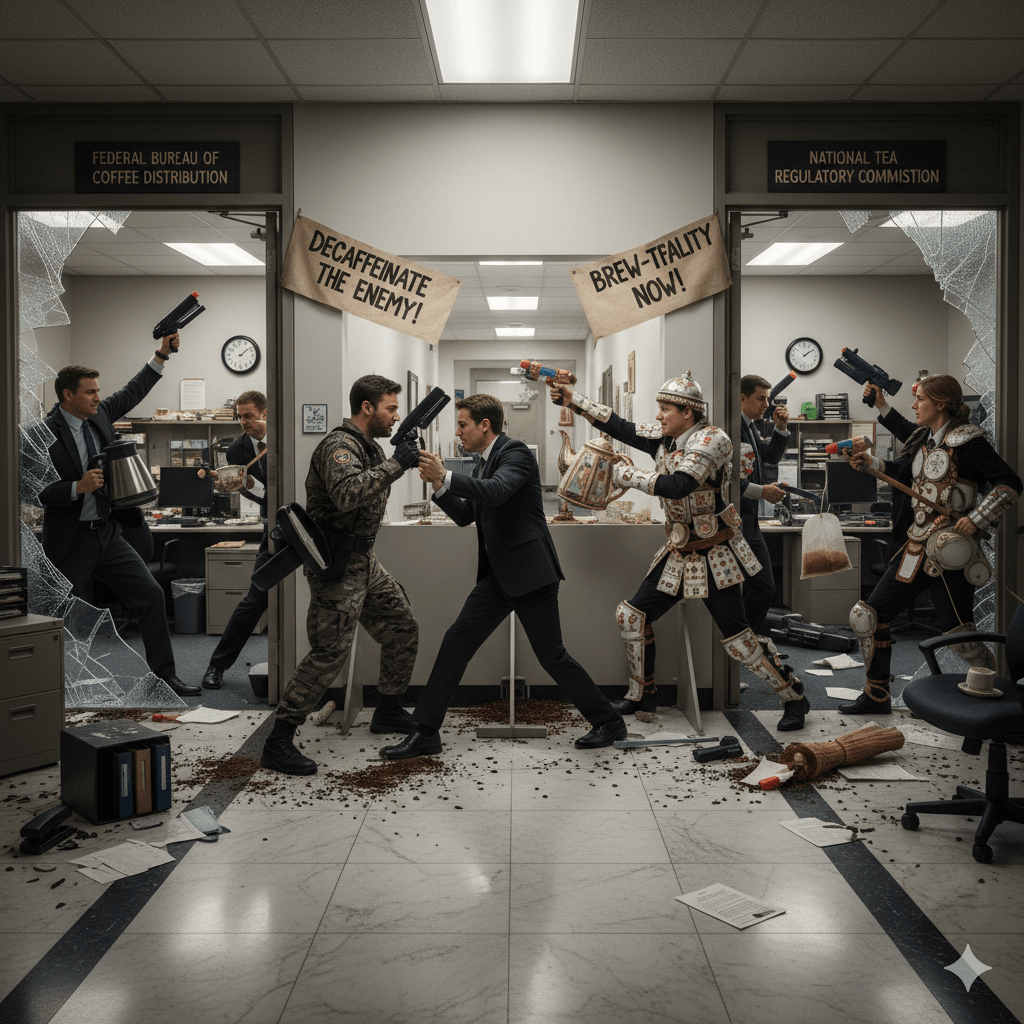
If you’ve read a few hundred job descriptions, one phrase that you’ll often see is “cross-functional collaboration.” The theory is that the employee (for example, a senior product marketing manager) will seamlessly work with marketing, product, R&D, customer success, sales, finance, legal, and everyone else, all working together for the good of the company.
But the world usually doesn’t work like that. YOUR department is great. The other departments are the bozos.
Google Gemini.
There’s actually a benefit to this when you look at government agencies. If you believe that “the government that governs least” is preferable to Big Brother, then the fact that multiple agencies DON’T gang up against you is a good thing. You don’t want to be chased by the FBI and the CIA and the BBC and B.B. King and Doris Day. And Matt Busby.
But there are times when government agencies work together, usually when facing a common threat. Sometimes this is good…and sometimes it isn’t. Let’s look at two examples and see where they fall in the spectrum.
The Central Intelligence Agency and the Federal Bureau of Investigation in 1972
Normally bureaucrats are loyal to their agency, to the detriment of other agencies. This is especially true when the agencies are de facto competitors.
In theory, and certainly in the 1970s, the Central Intelligence Agency (CIA) and the Federal Bureau of Investigation (FBI) have completely separate spheres of operation. But on the highest level they perform the same function: catch bad people. And each agency certainly wants to take the credit when a bad person is caught. Conversely, if one of the agencies has a bad person, the other one usually works to expose it.
Usually.
A few of you are old enough to remember a third-rate burglary in Washington, DC in 1972. The burglary took place at a political party office in some hotel or another. We now know with the benefit of hindsight that the FBI-CIA rivalry worked. Bob Woodward learned a few days after the break-in that two of the alleged burglars were connected to E. Howard Hunt, a former CIA operative. Who told Woodward?
“Woodward, we now know, had been tipped off by Mark Felt, the deputy director of the FBI. The Bureau had itself become involved in the investigation of a mere burglary because once the police found wiretapping equipment, the investigation fell under its remit.”
Google Gemini.
This is how it should work. Although the mere fact that Hunt knew Bernard Barker and Eugenio Martinez was not a crime, the FBI was certainly bound to investigate the matter.
Until it wasn’t.
“Richard Nixon and senior White House personnel including Chief-of-Staff Bob Haldeman and domestic policy tsar John Ehrlichman devised a strategy to block the investigation. This began to unfold as early as June 23, a mere three days after the break-in. That day, Haldeman proposed to Nixon to “have [Vernon] Walters [deputy director of the CIA] call Pat Gray [director of the FBI] and just say ‘stay the h*ll out of this’ on grounds of ‘national interest.’”
This recorded conversation would become very important two years later, but back in 1972 very few people knew about it. And very few people knew that Gray “destroyed secret documents removed from Howard Hunt’s safe.”
Think about it. If Richard Nixon hadn’t recorded his own conversations, we may have never learned that the CIA partially neutralized an FBI investigation.
But other instances of cross-functional collaboration come to light in other ways.
Immigration and Customs Enforcement and the Transportation Security Administration before 2026
The FBI-CIA episode of 1972 was an aberration. Normally agencies don’t cooperate, even when massive amounts of effort are performed to make them work together.
One prime example was the creation of the Department of Homeland Security (DHS) in 2002-2003. Because it was believed that 9/11 happened because relevant agencies were scattered all over the government, Congress and the President performed a massive reorganization. This affected the Departments of Agriculture, Energy, Health and Human Services, Justice, Transportation, and Treasury.
For our discussion:
The Department of Justice lost the Immigration and Naturalization Service (INS), which was broken up into three separate agencies within DHS. One of these is Immigration and Customs Enforcement, or ICE. Perhaps you’ve heard of it.
The relatively new Transportation Security Administration (TSA) was moved from the Department of Transportation to DHS.
The theory, of course, is that once all these agencies were under the DHS umbrella, they would magically work together to stop the evil terrorists. However, each of the component agencies had vastly different missions. Here is the mission of the TSA:
“Protect the nation’s transportation systems to ensure freedom of movement for people and commerce.”
Well, “freedom of movement” is not the primary part of ICE’s mission:
“Protect America through criminal investigations and enforcing immigration laws to preserve national security and public safety.”
While these missions are not mutually exclusive, the difference in emphasis is apparent. And the agencies competed.
Some of you may remember air marshals. After 9/11, some airline flight passengers were actually air marshals, but the passengers (and any terrorists) didn’t know which flights had air marshals or who they were.
Google Gemini.
The Federal Air Marshal Service (FAMS) was part of the Transportation Security Administration.
“Homeland Security Secretary Tom Ridge announced [in September 2003] that the federal air marshals program will move from the Transportation Security Administration to the Bureau of Immigration and Customs Enforcement (ICE).”
The idea was to concentrate all enforcement operations in one agency, to protect FAMS from uncertain TSA funding, and to allow ICE agents to be cross-trained as air marshals. But this didn’t happen, so two years later FAMS moved from ICE back to TSA.
And both agencies went on their merry little ways.
Immigration and Customs Enforcement and the Transportation Security Administration in 2026
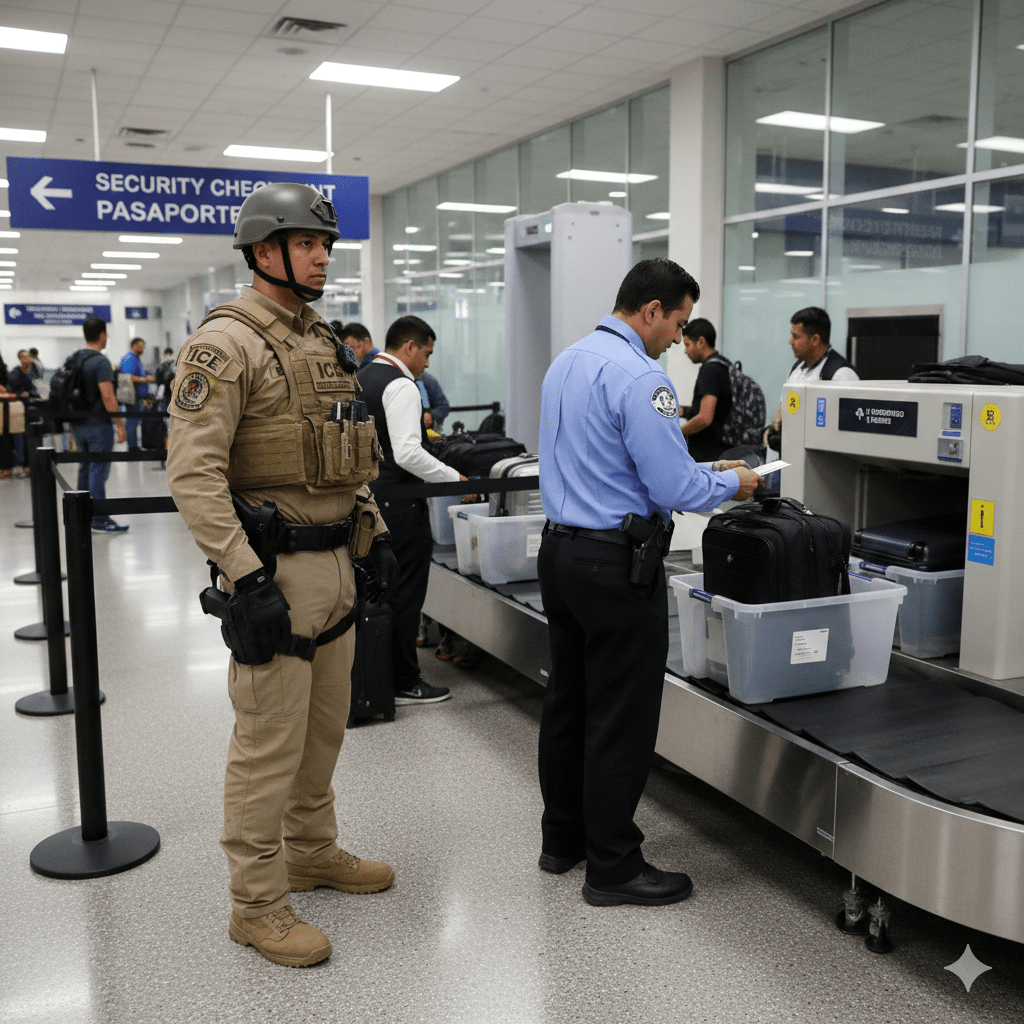
“When Transportation Security Administration (TSA) Acting Director Ha Nguyen McNeill was pressed [by the House Committee on Homeland Security] on reports that ICE is using domestic flight passenger information to support deportation operations, she did not deny cooperation. Instead, she defended it as legitimate intra-departmental coordination and framed it as part of DHS’s overall mission set.
“In response to lawmakers’ questions, McNeill said TSA assistance to ICE is ‘absolutely within our authorities’ when it involves sharing passenger information for immigration enforcement operations.”
McNeill effectively said that TSA doesn’t dump its data on ICE, but responds to individual ICE inquiries.
“Airport travel…becomes a choke point for detentions – no longer just transportation, but a compliance checkpoint for civil enforcement, re-engineering mobility into an enforcement tool.”
Do U.S. government agencies simply run roughshod over your privacy rights?
Not exactly.
Government agencies are required to issue Privacy Impact Assessments (PIAs) for their projects.
The Federal Bureau of Investigation alone has issued over 60 PIAs.
For example, here is the PIA for CODIS, the Combined National Deoxyribonucleic Acid (DNA) Index System (CODIS).
And if anything needs a PIA, it’s CODIS, since it potentially contains your personally identifiable information…and the personally identifiable information of your relatives.
The PIAs themselves are detailed. The CODIS PIA includes 8 sections with 19 pages of questions and responses. For example, here is the response in section 8 regarding privacy:
The type, quantity, and sources of information collected by FBI CODIS are necessary to identify crime scene offenders, missing persons, or unidentified human remains, or to link multiple crime scenes. Such information is only further disseminated for these purposes. Moreover, NDIS does not store State Identification Number/Universal Control Number or otherwise collect, handle, disseminate, or store contributors’ names. Therefore, CODIS DNA profiles and pedigrees can only be matched to a named individual by the submitting Criminal Justice Agency forensic laboratory, independent of NDIS.
The privacy risks associated with the collection and maintenance of FBI CODIS information are inaccurate information, unauthorized access, and unauthorized disclosures.
The privacy risks associated with the access and use of FBI CODIS information are unauthorized access, unauthorized (or overly broad) disclosures, and loss of data.
The privacy risks associated with the dissemination of FBI CODIS information are the risks of unauthorized disclosures and loss of data.
The risks of unauthorized access, unauthorized disclosures, loss of data and inaccurate information are mitigated by the quality assurance standards promulgated by the FBI pursuant to the Federal DNA Identification Act. These risks are further mitigated by the system, physical access, network-infrastructure, auditing and quality assurance controls, as described more specifically in Sections 6.1 and 6.2, which are in compliance with FIPS Publication 199, as applicable.
The risk of inaccurate information is also specifically mitigated through the identity verification process performed by participating Criminal Justice Agency forensic laboratories to confirm a potential match. The identity must be confirmed prior to the disclosure of any personally identifiable information to the law enforcement entity who submitted the DNA sample.
Lastly, notice is provided as described in Section 5.1.
“About 27.6 million people around the globe are ensnared by modern slavery, which refers to people being forced to work and losing their freedom due to imprisonment, threats of violence, debt bondage, or retention of their identity papers, according to the United Nations’ International Labor Organization.”
“As proven at trial, between 2006 and May 2018, [Nicole] Daedone and [Rachel] Cherwitz obtained the labor and services of multiple young women who had turned to OneTaste for healing and spirituality by coercing them to perform labor, including sexual labor, for the defendants’ benefit.”
“n 2017, Ms. Daedone sold OneTaste for $12 million, prosecutors said. The former OneTaste.us website now directs visitors to The Eros Platform, a community that still promotes it affiliation with Daedone, Cherwitz and and their Orgasmic Meditation practice. The Eros Coaching Collective still advertises a three-session OM training package for $525.”
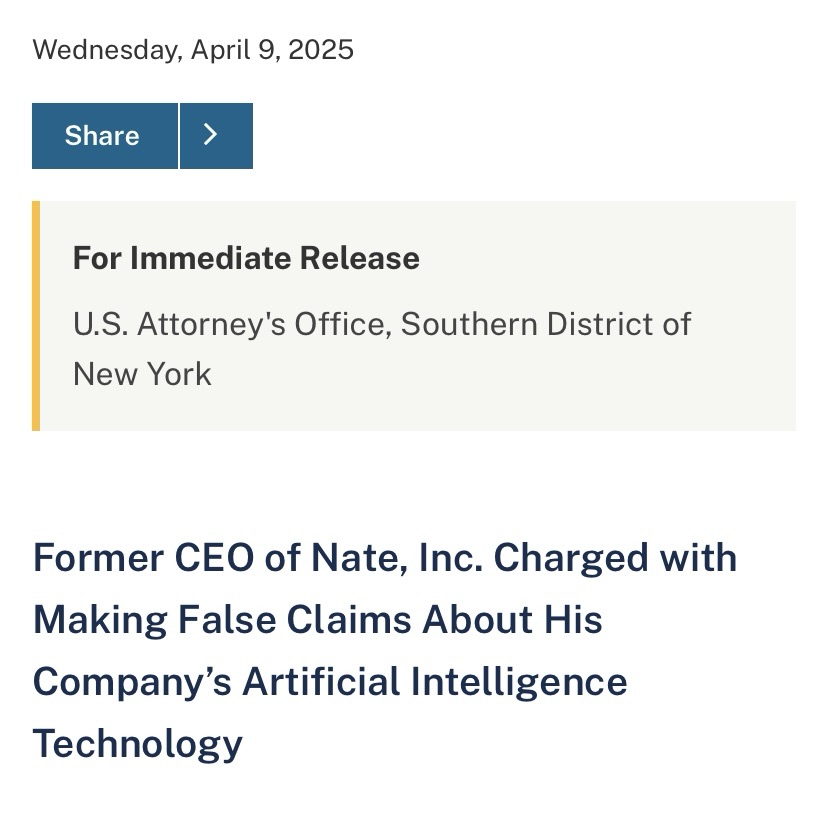
H/T Donal Greene for this story of non-person entities that were really people.
“The nate app purported to take care of the remainder of the checkout process through AI: selecting the appropriate size, entering billing and shipping information, and confirming the purchase….In truth, nate relied heavily on teams of human workers—primarily located overseas—to manually process transactions in secret, mimicking what users believed was being done by automation.”











 Bredemarket