Do you want your company’s message to appear in your blog…someday?
If it’s acceptable to your company to get a message out within 90 days, then don’t even bother to read the rest of this post. It’s going to sound ridiculous to you, and probably pretty scary, and frankly it will seem rather rushed.
But could you put me in contact with your competitors? Because while you’re delaying, your competitors are acting.
And can get messages out within 14 days.
(Day 1) Your competitor and its writer decide on the topic, goal, benefits, and target audience (and, if necessary, outline, section sub-goals, relevant examples, and relevant key words/hashtags, and interim and final due dates).
(Days 2-4) Then the writer puts a draft together for your competitor’s review, ideally within three calendar days.
(Days 5-7) The competitor reviews it, ideally within three calendar days. (Yes, I know that such projects sometimes end up on a company’s back burner and aren’t reviewed until a month later, but what if your competitor is motivated?)
(Days 8-10) The writer makes some final changes, again within three days.
(Days 11-13) The competitor approves the final changes, again within three days.
(Day 14) The competitor loads the text into its blog software, adds any necessary images, creates promotional posts on social media (often the original writer can draft those when they draft the blog post itself)…and THE BLOG POST IS LIVE.
So while you’re deciding when you will decide whether you want to say something, your competitor has already said it.
But iBeta isn’t the only entity performing PAD Level 3 testing.
FaceTec’s algorithm received PAD Level 3 confirmation from BixeLab in October.
Aware received a similar confirmation in November.
Will PAD Level 3 become the new floor for liveness detection? It depends upon your needs. Here’s how Mantra explains the difference between levels 2 and 3.
Level 2 (L2):
More realistic spoofs-high-quality 3D masks, composite fingers, better materials. Harder to detect, but still lab-craft attacks.
The “serious resources” part is key. Fraudsters will only spend “serious resources” if the target is valuable enough.
But will consumers perceive that THEIR data is valuable enough to warrant Level 3 liveness detection? And avoid the solutions with “only” Level 2 conformance?
[O]ur research suggests that in 2025, the actual number of touchpoints before a sale varies between 1 and 50, depending on the prospect’s buying stage:
Inactive customers only need 1–3 touches on average
A warm inbound lead will need 5–12 touches
A cold prospect can require 20–50 touches
So I came up with a bright idea: just repeat my message: “Identity, biometric, and technology marketing leaders should use Bredemarket’s marketing and writing services for their content, proposal, and analysis needs.”
And repeat it 50 times. (Preferably in a shorter form.)
But before applying my mad copy/paste skillz, I checked…and Email Tool Tester also notes that product marketing doesn’t work that way either. Specifically, you need multiple touchpoints, and multiple TYPES of touchpoints, to ensure your message resonates with your hungry people.
Which means that Bredemarket needs to use multiple methods to communicate with my prospects.
I recently completed a long piece of content for a client, and flagged six sections that the client can share as shorter pieces of content. That’s seven pieces for the price of one. (And two touchpoints. 48 to go.)
The mood at the time was that the world was changing and generative AI bots and non-person entities could replace people.
Yes, I am familiar with the party line that AI wouldn’t replace anyone, but would empower everyone to do their jobs more effectively.
The layoff trackers told a different story.
As did the AI gurus who proclaimed that many jobs would soon be obsolete.
Strangely enough, “AI guru” was not one of the jobs that was going away. Which is odd. It seems to me that giving inspirational talks would be the perfect job for a non-person entity.
But many people agreed that entry-level jobs were ripe for rightsizing, meaning that those at the beginnings of their careers would have a much harder time finding work.
“Hardware giant IBM plans to triple entry-level hiring in the U.S. in 2026, according to reporting from Bloomberg. Nickle LaMoreaux, IBM’s chief human resource officer, announced the initiative….’And yes, it’s for all these jobs that we’re being told AI can do,’ LaMoreaux said.”
Because IBM has separated what AI can do from what it can’t do. IBM’s new positions are “less focused on areas AI can actually automate — like coding — and more focused on people-forward areas like engaging with customers.”
Guess what? Bots are not engaging. Well, maybe they’re more engaging than AI gurus…
Can you use people?
But I will go one step further and claim that human product marketers and content writers are more engaging than bot product marketers and content writers.
Believe me, I’ve tested this. Bredebot can fake 30 years of experience, but it’s not genuine.
If you want to engage with your prospects, don’t assign the job to a bot. That’s human work.
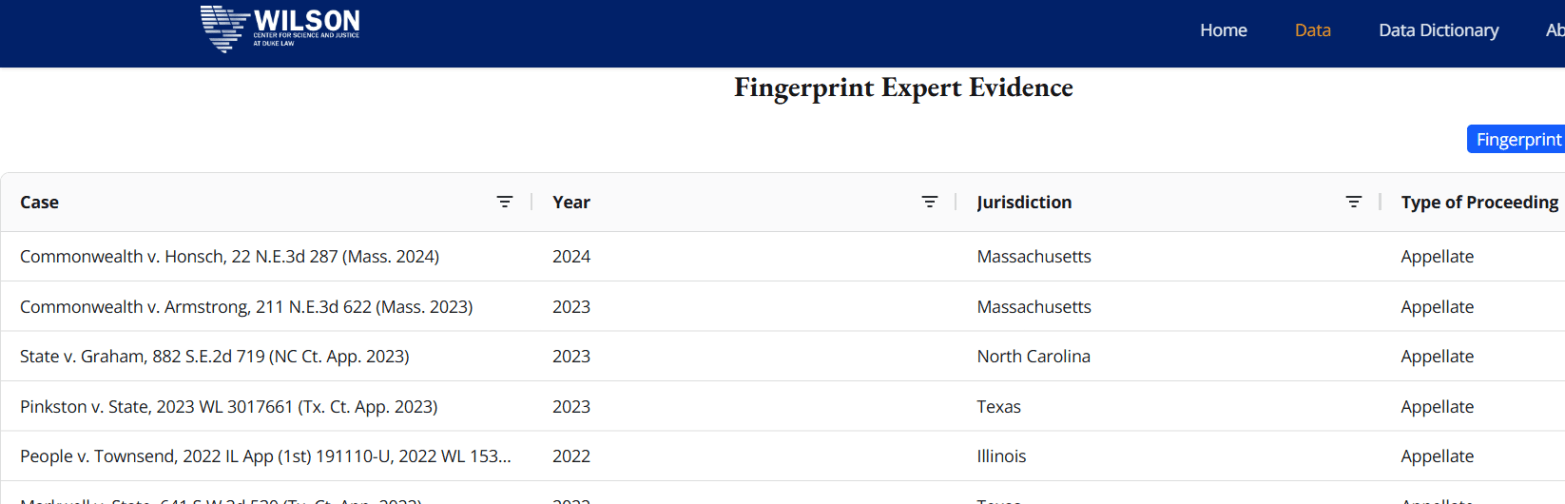
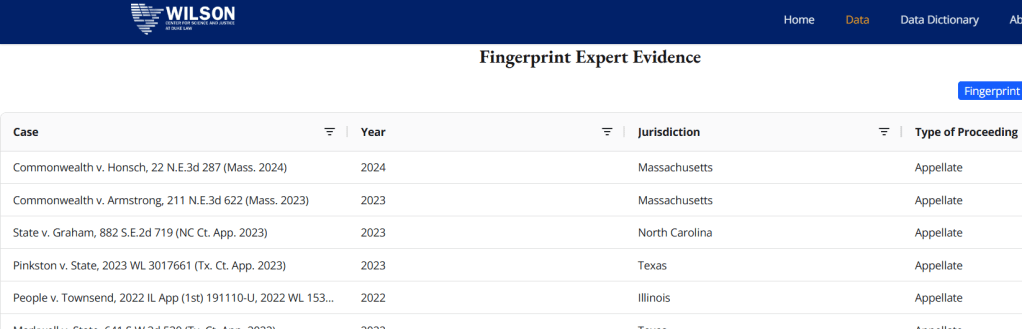
For…a long time I’ve been talking about whether fingerprint evidence is accepted in court. But until now I never had access to an easy-to-use database of court cases.
Here’s an example of the case details for the (current) most recent record:
Case
Commonwealth v. Honsch, 22 N.E.3d 287 (Mass. 2024)
Year
2024
Jurisdiction
Massachusetts
Type of Proceeding
Appellate
Other fields
CourtSupreme Judicial Court of Massachusetts, Hampden
Expert Evidence Ruling Reversing or Affirming on AppealAdmitted
RulingCorrect to admit
Type of EvidenceFingerprint
Defense or Prosecution ExpertProsecution
Summary of Reasons for Ruling
The Commonwealth here presented two latent print analysts as experts. One multiple times that it was his “scientific opinion” that there were three latent prints that were “identified to” the palms of the defendant. The term “scientific” to describe his opinion “arguably verged on suggesting that the ACE-V process is more scientific than warranted,” and there was one instance in which Dolan testified without using the term “opinion.” The court concludes that there was no error because, “viewed as a whole,” his testimony was largely expressed in terms of an “opinion” and his testimony did not claim that the ACE-V process was infallible or absolutely certain.
On the other hand, Pivovar testified that she (i) “identified [a palm print from one of the garbage bags and the print of the defendant’s left palm] as originating from the same source”; (ii) “identif[ied] [another latent print] and the right palm print of [the defendant] as being the same, they originated from the same source”; and (iii) “identif[ied] the [third latent print] as originating from the same source as the right palm of [the defendant] that [she] compared it to.” Pivovar did not frame her testimony in terms of an “opinion” and expressed the identification of the defendant with certainty. This was error. However, the court concluded that Pivovar’s testimony did not likely influence the jury’s conclusion. Defense counsel countered the notion that individualization under the ACE-V methodology is infallible by cross-examining Pivovar on the subjectivity of latent print analysis, the fact that two prints are never identical, and a recent incident in which the Federal Bureau of Investigation erroneously identified a suspect based on an incorrect latent print analysis. The defendant also presented an expert detailing the risks of cognitive bias in latent print analysis. Additionally, the Commonwealth’s other latent print examiner, Dolan, testified as to the same findings as Pivovar. If Pivovar’s testimony had been properly framed as an opinion, there still would have been strong evidence that the prints found at Elizabeth’s crime scene originated from the defendant. Thus, even though we determine that Pivovar’s testimony was erroneously presented as fact, the error did not create a substantial likelihood of a miscarriage of justice.
Some of you knew these deepfake thoughts were coming. Might as well finish side one.
Elton.
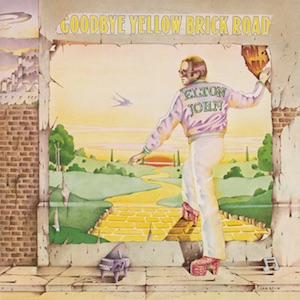
When we last met, I had discussed the othertwo tracks from side one of Elton John’s “Goodbye Yellow Brick Road.” Of course albums no longer have sides, but these three tracks/four songs give an idea of the breadth of Elton John’s first double album.
But this isn’t merely a music review. It also has to satisfy an Important Purpose. So this post about “Bennie and the Jets” will talk about…deepfakes.
Is it live?
After all the negativity that started the album, it was time for a little joy.
Bennie and the Jets.
A happy song about a band.
About fans who read things in magazines.
All topped off by Elton’s charged performance in front of a live, cheering audience.
Um…no.
While Elton John has given many live performances, the recording of “Bennie and the Jets” is not one of them.
“Elton’s producer Gus Dudgeon wanted a live feel on this recording, so he mixed in crowd noise from a show Elton played in 1972 at Royal Festival Hall. He also included a series of whistles from a live concert in Vancouver B.C., and added hand claps and various shouts.”
But in retrospect, I can’t imagine the song as a straight studio recording. Dudgeon was right: it HAD to sound live.
And that “live” performance yielded a bigger surprise…and Reginald Dwight was most surprised of all.
Reginald Dwight, soul god
For those who don’t know who Reginald Dwight is, he was born in 1947 in an English town. A shy boy whose parents divorced in his teens, the most notable aspect of his life was his piano talent. He obviously wasn’t going to become a banker as his father originally intended.
Oh, and one more thing. Dwight was Caucasian. And all of his reinventions, including his adoption of the stage name Elton John, wasn’t going to alter that.
But Elton was pretty fly for a white guy. Worked his way up to musical ladder until he achieved success on his own. First with some notable performances, then some hit albums, then some number ones.
“When Elton recorded “Bennie And The Jets,” MCA, his label, wanted to make the song a single. Elton disagreed vociferously. His pick was “Candle In The Wind”…”
What persuaded Elton to change his mind…at least in the North American market?
“But Elton was swayed when “Bennie And The Jets” started doing well on Detroit R&B radio.”
Yes, R&B. “Bennie and the Jets” reached #15 on Billboard’s R&B charts. Which both pleased and amused Elton.
“What am I going to do on my next American tour? Play the Apollo for a week, open with ‘Bennie,’ and then say, ‘Thanks, you can all go home now.'”
If only there were a forum where he could play a single song for a large black audience…
Don Cornelius was all too happy to provide the forum.
Soul Train.
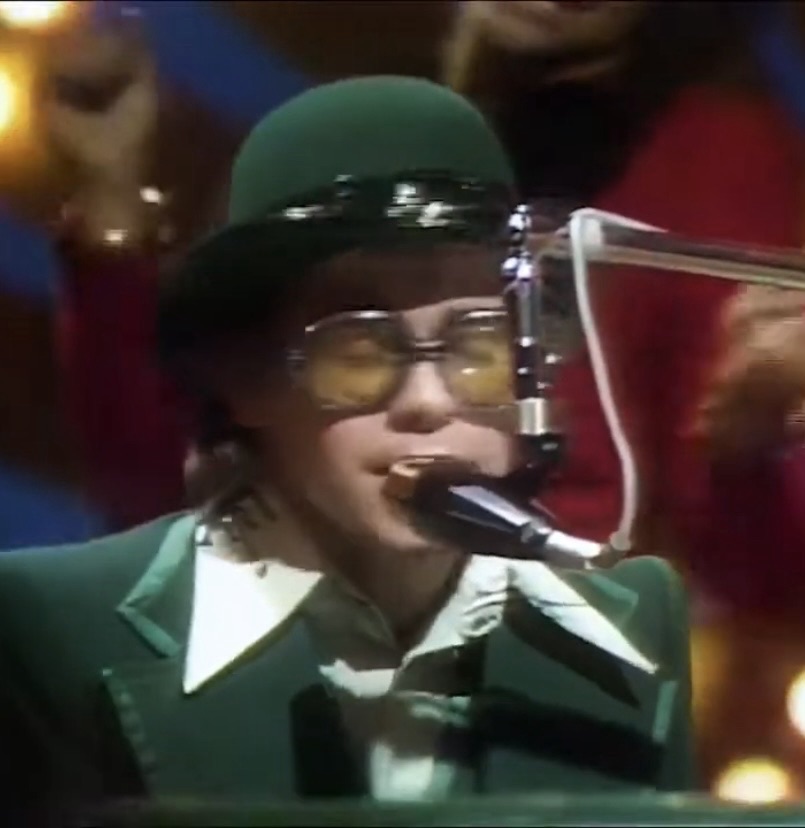
Elton John wasn’t the first white artist to perform on Soul Train, but he was one of the few.
Technically this wasn’t a deepfake; Elton John didn’t pretend to be black. But he clearly absorbed some distinct musical influences: Little Richard, Ray Charles, Aretha Franklin, Fats Domino, Otis Redding, Nina Simone, Marvin Gaye, Wilson Pickett, James Brown, Stevie Wonder, The Temptations, Martha Reeves, Clyde McPhatter, and Sam Cooke. (Google Gemini helped me assemble this list.)
And he wasn’t a one hit wonder. Subsequent Philadelphia-influenced songs “Philadelphia Freedom” and “Mama Can’t Buy You Love” also made the R&B top 40.
Compare with Mick Jagger, who rarely made the R&B charts either as a Rolling Stone or as a solo artist. “Miss You” did, but Jagger’s highest placement was when he guested on the Jacksons’ “State of Shock.”









 Bredemarket