Conceptualization of the Planet Bredemarket and Its Rings

Inspired by the Constant Contact session I attended at the Small Business Expo, I wanted to conceptualize the Bredemarket online presence, and decided to adopt a “planet with rings” model.

Think of Bredemarket as a planet. Like Saturn, Uranus, Neptune, and Jupiter, the planet Bredemarket is surrounded by rings.

Google Gemini.

The closest ring to the planet is the Bredemarket mailing list (MailChimp).

The next closest ring is the Bredemarket website (WordPress).

Moving outward, we find the following rings:

  • Search engines and generative AI tools, including Bing, ChatGPT, Google, Grok, Perplexity, and others.
  • The Bredemarket Facebook page and associated groups.
  • The Bredemarket LinkedIn page and associated showcase pages.
  • A variety of social platforms, including Bluesky, Instagram, Substack, and Threads.
  • Additional social platforms, including TikTok, WhatsApp, and YouTube.

While this conceptualization is really only useful to me, I thought a few of you may be interested in some of the “inner rings.”

And if you’re wondering why your favorite way cool platform is banished to the outer edges…well, that’s because it doesn’t make Bredemarket any money. I’ve got a business to run here, and TikTok doesn’t help me pay the bills…

If the World is Flat

(Part of the biometric product marketing expert series)

(August 1, 2025: image img_2522-1.jpg and video flat2412a-1_mp4_hd_1080p.original.jpg?h=1378 removed by request)

(also deleted related content on Bluesky, Facebook, LinkedIn, TikTok personal, and YouTube)

If the world is flat…

…there’s no need to look beyond the horizon.

…only the current quarter counts.

If you want to survive…

…think beyond the current quarter.

…invest in the long term.

…invest in product marketing.

…invest in a product marketer.

John E. Bredehoft on LinkedIn: LINK

I’m seeking a Senior Product Marketing Manager role in software (biometrics, government IDs, geolocation, identity and access management, cybersecurity, health) as an individual contributor on a collaborative team.

Key Accomplishments

  • Product launches (Confidential software product, Know Your Business offering, Morpho Video Investigator, MorphoBIS Cloud, Printrak BIS, Omnitrak).
  • Multiple enablement, competitive analysis, and strategy efforts.
  • Exploration of growth markets.

Multiple technologies.

Multiple industries.

Over 22 types of content.

Currently available for full-time employment or consulting work (Bredemarket).

More details on the latter at Bredemarket’s “CPA” page.

Ofcom and the Digital Trust & Safety Partnership

The Digital Trust & Safety Partnership (DTSP) consists of “leading technology companies,” including Apple, Google, Meta (parent of Facebook, Instagram, and WhatsApp), Microsoft (and its LinkedIn subsidiary), TikTok, and others.

The DTSP obviously has its views on Ofcom’s enforcement of the UK Online Safety Act.

Which, as Biometric Update notes, boils down to “the industry can regulate itself.”

Here’s how the DTSP stated this in its submission to Ofcom:

DTSP appreciates and shares Ofcom’s view that there is no one-size-fits-all approach to trust and safety and to protecting people online. We agree that size is not the only factor that should be considered, and our assessment methodology, the Safe Framework, uses a tailoring framework that combines objective measures of organizational size and scale for the product or service in scope of assessment, as well as risk factors.

From https://dtspartnership.org/press-releases/dtsp-submission-to-the-uk-ofcom-consultation-on-illegal-harms-online/.

We’ll get to the “Safe Framework” later. DTSP continues:

Overly prescriptive codes may have unintended effects: Although there is significant overlap between the content of the DTSP Best Practices Framework and the proposed Illegal Content Codes of Practice, the level of prescription in the codes, their status as a safe harbor, and the burden of documenting alternative approaches will discourage services from using other measures that might be more effective. Our framework allows companies to use whatever combination of practices most effectively fulfills their overarching commitments to product development, governance, enforcement, improvement, and transparency. This helps ensure that our practices can evolve in the face of new risks and new technologies.

From https://dtspartnership.org/press-releases/dtsp-submission-to-the-uk-ofcom-consultation-on-illegal-harms-online/.

But remember that the UK’s neighbors in the EU recently prescribed that USB-3 cables are the way to go. This not only forced DTSP member Apple to abandon the Lightning cable worldwide, but it affects Google and others because there will be no efforts to come up with better cables. Who wants to fight the bureaucratic battle with Brussels? Or alternatively we will have the advanced “world” versions of cables and the deprecated “EU” standards-compliant cables.

So forget Ofcom’s so-called overbearing approach and just adopt the Safe Framework. Big tech will take care of everything, including all those age assurance issues.

DTSP’s September 2023 paper on age assurance documents a “not overly prescriptive” approach, with a lot of “it depends” discussion.

Incorporating each characteristic comes with trade-offs, and there is no one-size-fits-all solution. Highly accurate age assurance methods may depend on collection of new personal data such as facial imagery or government-issued ID. Some methods that may be economical may have the consequence of creating inequities among the user base. And each service and even feature may present a different risk profile for younger users; for example, features that are designed to facilitate users meeting in real life pose a very different set of risks than services that provide access to different types of content….

Instead of a single approach, we acknowledge that appropriate age assurance will vary among services, based on an assessment of the risks and benefits of a given context. A single service may also use different
approaches for different aspects or features of the service, taking a multi-layered approach.

From https://dtspartnership.org/wp-content/uploads/2023/09/DTSP_Age-Assurance-Best-Practices.pdf.

So will Ofcom heed the DTSP’s advice and say “Never mind. You figure it out”?

Um, maybe not.

When Follower Counts Matter

I see social posts in which the authors thank their followers for getting them to a certain follower count, and I receive Instagram messages promising me that for just a little money I can get tens of thousands of followers.

I definitely ignore the latter messages, and personally I ignore the former messages also.

Because follower counts don’t matter.

Just because Bredemarket has X followers doesn’t necessarily mean that Bredemarket will make lots of money. I could use viral tactics to attract countless followers that would never, ever purchase Bredemarket’s marketing and writing services.

In fact, I could live just fine with 25 followers…provided that they’re the RIGHT followers.

But while this is normally true, I’ve run into a couple of instances in which follower counts DO matter. Because you need a certain heft to get the large companies to pay attention to you.

My invisible WhatsApp channel

A little over a month ago I started a WhatsApp channel devoted to identity, biometrics, ID documents and geolocation. Why?

I began mulling over whether I should create my own WhatsApp channel, but initially decided against it….

I’d just follow the existing WhatsApp channels on identity, biometrics, and related topics.

But I couldn’t find any.

From https://bredemarket.com/2023/11/29/announcing-a-whatsapp-channel-for-identity-biometrics-id-documents-and-geolocation/.

So I started my own to fill the void, then waited for similarly interested WhatsApp users to find my channel via search.

But there was a catch.

Although it isn’t explicitly documented anywhere, it appears that using the WhatsApp channel search only returns channels that already have thousands of subscribers. When I searched for a WhatsApp channel for “identity,” WhatsApp returned nothing.

WhatsApp channel search for “identity.”

As a result, I found myself promoting my WhatsApp channel everywhere EXCEPT WhatsApp.

Including this blog post. If you want to subscribe to my WhatsApp channel “Identity, Biometrics, ID Documents, and Geolocation,” click on the link https://www.whatsapp.com/channel/0029VaARoeEKbYMQE9OVDG3a.

Click the link https://www.whatsapp.com/channel/0029VaARoeEKbYMQE9OVDG3a to view the channel.

My non-linkable YouTube channel

I also have a YouTube channel, and you CAN find that. But it also suffers from a lack of subscribers.

On Monday I received an onimous-sounding email from YouTube with the title “Your channel has lost access to advanced features.”

The opening paragraph read as follows:

To help keep our community safe, we limit some of our more powerful features to channels who have built and maintained a positive channel history or who have provided verification.

Ah, verification. I vaguely remember having to provide Alphabet with my ID a few months ago.

The message continued:

As of now, your channel doesn’t have sufficient channel history. It has lost access to advanced features. This may have happened because your channel did not follow our Community Guidelines.

While I initially panicked when I read that last sentence, I then un-panicked when I realized that this may NOT have happened because of a Community Guidelines violation. The more likely culprit was an insufficient channel history.

Your channel history data is used to determine whether your content and activity has consistently followed YouTube’s Community Guidelines.

Your channel history is a record of your:

Channel activity (like video uploads, live streams, and audience engagement.)

Personal data related to your Google Account.

When and how the account was created.

How often it’s used.

Your method of connecting to Google services.

Most active channels already have sufficient channel history to unlock advanced features without any further action required. 

From https://support.google.com/youtube/answer/9891124#channelhistory.

Frankly, my YouTube channel doesn’t have a ton of audience engagement. Now I could just start uploading a whole bunch of videos…but then I risk violating the Community Guidelines by getting a “spamming” accusation.

As it turns out, there’s only one “advanced feature” that I really miss: the ability to “Add external links to your video descriptions.” And I’m trying to tone down my use of external links because Alphabet (on YouTube) and Meta (on Instagram) discourage their use anyway.

But for now the previously-added external links to videos such as this one are now disabled.

From https://www.youtube.com/watch?v=oIB9SPI-yiI. The link at the bottom of the description is non-clickable.

Perhaps if I post long-form videos more frequently and get thousands of subscribers, I will get enough “audience engagement” to restore the advanced features.

So if you want to increase my YouTube follower count, go to https://www.youtube.com/@johnbredehoftatbredemarket2225 and click the Subscribe button.

So let’s get followers

But the question remains: how do I get thousands of people to subscribe to my WhatsApp channel and my YouTube channel?

Perhaps I can adapt a really cool TikTok challenge to WhatsApp and YouTube.

You can create the exciting Savage Challenge on TikTok and ask your audience to participate in it. In this challenge, people will have to learn and follow the choreography of Megan Thee Stallions’ highly loved song, “Savage.”

From https://www.engagebay.com/blog/tiktok-challenges/

I’m not familiar with that particular song, so I’d better check it out.

Well…

I’m not sure if this fits into my “sage” persona.

And if I go to the local car wash with a baseball bat and start knocking out car windows, I may end up in jail. And that usually does NOT increase the follower count. Because as Johnny Somali persumably found out in Japan, you can’t film videos when you’re in jail.

Announcing a WhatsApp Channel for Identity, Biometrics, ID Documents, and Geolocation

From NIST.

I’ve previously stated that Bredemarket is present on a bunch of social platforms.

Well, if you’re a subscriber to the Bredemarket mailing list, or to the Bredemarket Threads account, then you already know what I’m about to say. Bredemarket is now on one additional social platform…kinda sorta.

I’ll explain:

  • What WhatsApp channels are.
  • How this impacted me.
  • Most importantly, why this may, or may not, impact you.

(Long-time readers of the Bredemarket blog see what I did there. In reverse.)

What are WhatsApp channels?

Meta, the company that owns Facebook, Instagram, WhatsApp, Threads, and half the known universe, wants to keep people on those social platforms. They can check out any time they like, but they can never leave.

Scanned by Wikipedia user David Fell from the CD cover, Fair use, https://en.wikipedia.org/w/index.php?curid=14790284

So now WhatsApp, the service that was originally intended for PRIVATE communications between people that knew each other’s phone numbers, is now your latest source for Kardashians news. Seriously; there are millions of people who follow the Daily Mail’s “Kardashians News” channel.

No, this is NOT a Kardashian (yet), but this is something that @cultpopcult would post (with a misattribution) so I’m doing it myself. By Office of Congressman Greg Steube – https://twitter.com/RepGregSteube/status/1451579098606620673, Public Domain, https://commons.wikimedia.org/w/index.php?curid=112088903

Some people are kinda sorta breathless about this, if you take the IMM Institute’s LinkedIn article “WhatsApp Channels: Revolutionising Business Communication” as evidence.

WhatsApp, a widely used messaging platform, has recently introduced a revolutionary feature known as WhatsApp Channels. This innovation empowers businesses to thrive by effectively communicating with a broader audience, sharing vital information, and engaging with customers in a more personalised and efficient manner.

From LinkedIn.

Revolutionary? Frankly, this isn’t any more revolutionary than the similar broadcasting feature in Instagram, with one important difference: not everyone can create an Instagram channel, but anyone with WhatsApp channel access can set up their own channel.

    Which got me thinking.

    How I was impacted by WhatsApp Channels

    I began mulling over whether I should create my own WhatsApp channel, but initially decided against it. Bredemarket has enough social media properties already, and the need to put Bredemarket stuff on WhatsApp is not pressing (the “100” WhatsApp group members get enough Bredemarket stuff already). The chances of someone ONLY being on WhatsApp and not on ANY other channel are slim.

    I’d just follow the existing WhatsApp channels on identity, biometrics, and related topics.

    But I couldn’t find any.

    So I created my own channel last Friday entitled “Identity, Biometrics, ID Documents, and Geolocation.”

    Why should you care?

    Why should you care about my WhatsApp identity channel? Maybe you SHOULDN’T.

    If you don’t use WhatsApp, ignore the WhatsApp channel.

    If you use WhatsApp but have other sources for identity industry information (such as my Facebook group/LinkedIn page), ignore the WhatsApp channel.

    But if you love WhatsApp AND identity, here is the follow link for “Identity, Biometrics, ID Documents, and Geolocation.”

    https://whatsapp.com/channel/0029VaARoeEKbYMQE9OVDG3a

    Time for the FIRST Iteration of Your Firm’s UK Online Safety Act Story

    By Adrian Pingstone – Transferred from en.wikipedia, Public Domain, https://commons.wikimedia.org/w/index.php?curid=112727

    A couple of weeks ago, I asked this question:

    Is your firm affected by the UK Online Safety Act, and the future implementation of the Act by Ofcom?

    From https://bredemarket.com/2023/10/30/uk-online-safety-act-story/

    Why did I mention the “future implementation” of the UK Online Safety Act? Because the passage of the UK Online Safety Act is just the FIRST step in a long process. Ofcom still has to figure out how to implement the Act.

    Ofcom started to work on this on November 9, but it’s going to take many months to finalize—I mean finalise things. This is the UK Online Safety Act, after all.

    This is the first of four major consultations that Ofcom, as regulator of the new Online Safety Act, will publish as part of our work to establish the new regulations over the next 18 months.

    It focuses on our proposals for how internet services that enable the sharing of user-generated content (‘user-to-user services’) and search services should approach their new duties relating to illegal content.

    From https://www.ofcom.org.uk/consultations-and-statements/category-1/protecting-people-from-illegal-content-online

    On November 9 Ofcom published a slew of summary and detailed documents. Here’s a brief excerpt from the overview.

    Mae’r ddogfen hon yn rhoi crynodeb lefel uchel o bob pennod o’n hymgynghoriad ar niwed anghyfreithlon i helpu rhanddeiliaid i ddarllen a defnyddio ein dogfen ymgynghori. Mae manylion llawn ein cynigion a’r sail resymegol sylfaenol, yn ogystal â chwestiynau ymgynghori manwl, wedi’u nodi yn y ddogfen lawn. Dyma’r cyntaf o nifer o ymgyngoriadau y byddwn yn eu cyhoeddi o dan y Ddeddf Diogelwch Ar-lein. Mae ein strategaeth a’n map rheoleiddio llawn ar gael ar ein gwefan.

    From https://www.ofcom.org.uk/__data/assets/pdf_file/0021/271416/CYM-illegal-harms-consultation-chapter-summaries.pdf

    Oops, I seem to have quoted from the Welsh version. Maybe you’ll have better luck reading the English version.

    This document sets out a high-level summary of each chapter of our illegal harms consultation to help stakeholders navigate and engage with our consultation document. The full detail of our proposals and the underlying rationale, as well as detailed consultation questions, are set out in the full document. This is the first of several consultations we will be publishing under the Online Safety Act. Our full regulatory roadmap and strategy is available on our website.

    From https://www.ofcom.org.uk/__data/assets/pdf_file/0030/270948/illegal-harms-consultation-chapter-summaries.pdf

    If you want to peruse everything, go to https://www.ofcom.org.uk/consultations-and-statements/category-1/protecting-people-from-illegal-content-online.

    And if you need help telling your firm’s UK Online Safety Act story, Bredemarket can help. (Unless the final content needs to be in Welsh.) Click below!

    Kelly Shepherd, #fakefakefake

    My belief that everything on the Internet is true has been irrevocably shattered, all because of what an entertainment executive ordered in his spare time. But the Casey Bloys / “Kelly Shepherd” story is just a tiny bit of what is going on with synthetic identities. And X isn’t the only platform plagued by them, as my LinkedIn experience attests.

    By the way, this blog post contains pictures of a lot of people. Casey Bloys is real. Some of the others, not so much.

    Blame COVID

    Casey Bloys. Fair use. From https://wbd.com/leadership/casey-bloys/

    Casey Bloys is the Chairman and CEO of HBO and Max Content. Bloys had to start a recent 2024 schedule presentation with an apology, according to Variety. After explaining how passionate he is about his programming, he went back in time a couple of years to a period that we all remember.

    So when you think of that mindset, and then think of 2020 and 2021, I’m home, working from home and spending an unhealthy amount of scrolling through Twitter. And I come up with a very, very dumb idea to vent my frustration.

    From Variety.

    Casey Bloys’ very, very dumb idea

    So why did Bloys have to apologize on Thursday? Because of an article that Rolling Stone published on Wednesday. The article led off with this juicy showbiz tidbit about Bloys’ idea for responding to a critic.

    “Maybe a Twitter user should tweet that that’s a pretty blithe response to what soldiers legitimately go through on [the] battlefield,” he texted. “Do you have a secret handle? Couldn’t we say especially given that it’s D-Day to dismiss a soldier’s experience like that seems pretty disrespectful … this must be answered!”

    From Rolling Stone.

    (A note to my younger readers: Twitter used to be a popular social media service that no longer exists. It was replaced by X.)

    Eventually Bloys found someone to create the “secret handle.” Sully Temori is now alleging wrongful termination by HBO (which is why we’re learning about these juicy tidbits, via court filings). But in 2021 he was an executive assistant who wanted to get ahead by pleasing his bosses.

    This is where Kelly Shepherd enters the story.

    Kelly Shepherd, fake vegan mom

    Ms. Shepherd seems like a nice woman. A mom, a Texan, a herbalist and aromatherapist, and a vegan. (The cows love that last part.)

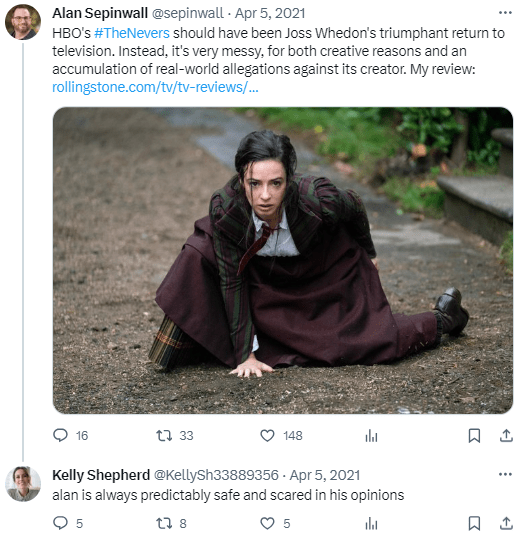
    Most critically, Shepherd is a normal person, not one of those Hollywood showbiz folks. Although Shepherd, who never posted anything on her own, seems to have a distinct motivation to respond to critics of HBO shows. Take her first reply to a critic from (checks notes) Rolling Stone. (Two years later, Rolling Stone would gleefully report on this story. Watch out who you anger.)

    alan is always predictably safe and scared in his opinions

    From https://twitter.com/KellySh33889356/status/1379101699969720323

    Kelly’s other three replies were along the same lines.

    • All were short one-sentence blurbs.
    • Most were completely in lower case, because that’s how regular non-Hollywood folk tweet.
    • All were critical of those who were critical of HBO, accusing them of “shitting on a show about women,” getting their “panties in a bunch,” and being “busy virtue signaling.”

    Hey, if I couldn’t eat hamburgers and my home was filled with weird herbs and aromas, I’d be a little mad too.

    And then, a little over a week later, it was over, and Kelly Shepherd never tweeted again. Although Temori apparently performed other activities against HBO critics via other methods. Well, until he was terminated.

    Did Kelly Shepherd open a LinkedIn account?

    But as part of the plan to satisfy Casey Bloys’ angry whims, Kelly Shepherd acquired a social media account, which she could use as a possible proof of identity.

    Even though we now know she doesn’t exist.

    But X isn’t the only platform plagued with synthetic identities, and some synthetic identities can do much more than anger an entertainment reviewer.

    Many of us on LinkedIn are regularly receiving InMails and connection requests (in my case, from profiles with pictures of beautiful women) who say that we are constantly recommended by LinkedIn, who tell us how impressive our profiles are, and who want to contact us outside of the LinkedIn platform via text message or WhatsApp.

    Now perhaps some of these messages are from real people, but I seriously doubt that so many of the employees at John Q Wine & Liquor Winery in New York happen to have the last name “Walter.” And the exact same job title.

    Partial results from a LinkedIn search.

    Let’s take a close look at what Karina has been doing for the last 4+ years. Other than posing in front of her car, of course.

    Ms. Walter is a pretty busy freelance general manager / director / content partnerships manager.

    As for her colleague Ms. Alice Walter, she has more experience (having started in 2018) but also has an extensive biography that begins:

    The United States is a country with innovative challenges, and there is more room for development in the wine industry at John Q Wine & Liquor Winery. I am motivated and love to learn, and like to be exposed to more different cultures, and hope to develop more careers in my future life.

    From https://www.linkedin.com/in/alice-walter-b97bb2113/

    Sound familiar?

    And you can check out Maria Walter’s profile if you’re so inclined. Or at least check out “her” picture.

    Now none of the Walters women tried to contact me, but another “employee” (or maybe it was a “freelancer,” I forget) of this company tried to do so, which led my curious nature to discover yet another hive of fake LinkedIn profiles.

    Sadly, one person from this company is a second-degree connection, which means that one of my connections accepted “her” connection request.

    Synthetic identities are harmless…right?

    Who knows what Karina, Alice, and Maria will do with their LinkedIn profiles?

    • Will they connect with other professionals?
    • Will they ask said professionals to move the conversation to SMS or WhatsApp, for whatever reason?
    • Will they apply for new jobs, using their impressive work history? A 98.8% customer satisfaction rate while managing 1,800 sub-partnerships is remarkable.
    • Will they apply for bank accounts…or loans?

    The fraud possibilities from fake LinkedIn accounts are endless, and could be very costly for any company who falls for a fake synthetic identity. In fact, FiVerity reports that “in 2020, an estimated $20 billion was lost to SIF” (synthetic identity fraud). Which means that LinkedIn account holders and Partnerships Managers Karina, Alice, and Maria Walter could make a LOT of money.

    Now banks and other financial institutions have safeguards to verify financial identities of people who open accounts and apply for loans, because fraud reduction is critically important to financial institutions.

    Social media companies? Identity is only “important” to them.

    They don’t even care about uniqueness (as Worldcoin does), evidenced by the fact that I have more than two X accounts (but none in which I portray a female Texas mom and vegan).

    So if someone comes up to you on X or LinkedIn, remember that all may not be as it seems.

    What Is Your Firm’s UK Online Safety Act Story?

    It’s time to revisit my August post entitled “Can There Be Too Much Encryption and Age Verification Regulation?” because the United Kingdom’s Online Safety Bill is now the Online Safety ACT.

    Having passed, eventually, through the UK’s two houses of Parliament, the bill received royal assent (October 26)….

    [A]dded in (to the Act) is a highly divisive requirement for messaging platforms to scan users’ messages for illegal material, such as child sexual abuse material, which tech companies and privacy campaigners say is an unwarranted attack on encryption.

    From Wired.
    By Adrian Pingstone – Transferred from en.wikipedia, Public Domain, https://commons.wikimedia.org/w/index.php?curid=112727

    This not only opens up issues regarding encryption and privacy, but also specific identity technologies such as age verification and age estimation.

    This post looks at three types of firms that are affected by the UK Online Safety Act, the stories they are telling, and the stories they may need to tell in the future. What is YOUR firm’s Online Safety Act-related story?

    What three types of firms are affected by the UK Online Safety Act?

    As of now I have been unable to locate a full version of the final final Act, but presumably the provisions from this July 2023 version (PDF) have only undergone minor tweaks.

    Among other things, this version discusses “User identity verification” in 65, “Category 1 service” in 96(10)(a), “United Kingdom user” in 228(1), and a multitude of other terms that affect how companies will conduct business under the Act.

    I am focusing on three different types of companies:

    • Technology services (such as Yoti) that provide identity verification, including but not limited to age verification and age estimation.
    • User-to-user services (such as WhatsApp) that provide encrypted messages.
    • User-to-user services (such as Wikipedia) that allow users (including United Kingdom users) to contribute content.

    What types of stories will these firms have to tell, now that the Act is law?

    Stories from identity verification services

    From Yoti.

    For ALL services, the story will vary as Ofcom decides how to implement the Act, but we are already seeing the stories from identity verification services. Here is what Yoti stated after the Act became law:

    We have a range of age assurance solutions which allow platforms to know the age of users, without collecting vast amounts of personal information. These include:

    • Age estimation: a user’s age is estimated from a live facial image. They do not need to use identity documents or share any personal information. As soon as their age is estimated, their image is deleted – protecting their privacy at all times. Facial age estimation is 99% accurate and works fairly across all skin tones and ages.
    • Digital ID app: a free app which allows users to verify their age and identity using a government-issued identity document. Once verified, users can use the app to share specific information – they could just share their age or an ‘over 18’ proof of age.
    From Yoti.

    Stories from encrypted message services

    From WhatsApp.

    Not surprisingly, message encryption services are telling a different story.

    MailOnline has approached WhatsApp’s parent company Meta for comment now that the Bill has received Royal Assent, but the firm has so far refused to comment.

    Will Cathcart, Meta’s head of WhatsApp, said earlier this year that the Online Safety Act was the most concerning piece of legislation being discussed in the western world….

    [T]o comply with the new law, the platform says it would be forced to weaken its security, which would not only undermine the privacy of WhatsApp messages in the UK but also for every user worldwide. 

    ‘Ninety-eight per cent of our users are outside the UK. They do not want us to lower the security of the product, and just as a straightforward matter, it would be an odd choice for us to choose to lower the security of the product in a way that would affect those 98 per cent of users,’ Mr Cathcart has previously said.

    From Daily Mail.

    Stories from services with contributed content

    From Wikipedia.

    And contributed content services are also telling their own story.

    Companies, from Big Tech down to smaller platforms and messaging apps, will need to comply with a long list of new requirements, starting with age verification for their users. (Wikipedia, the eighth-most-visited website in the UK, has said it won’t be able to comply with the rule because it violates the Wikimedia Foundation’s principles on collecting data about its users.)

    From Wired.

    What is YOUR firm’s story?

    All of these firms have shared their stories either before or after the Act became law, and those stories will change depending upon what Ofcom decides.

    But what about YOUR firm?

    Is your firm affected by the UK Online Safety Act, and the future implementation of the Act by Ofcom?

    Do you have a story that you need to tell to achieve your firm’s goals?

    Do you need an extra, experienced hand to help out?

    Learn how Bredemarket can create content that drives results for your firm.

    Click the image below.

    Can There Be Too Much Encryption and Age Verification Regulation?

    Designed by Freepik.

    Approximately 2,700 years ago, the Greek poet Hesiod is recorded as saying “moderation is best in all things.” This applies to government regulations, including encryption and age verification regulations. As the United Kingdom’s House of Lords works through drafts of its Online Safety Bill, interested parties are seeking to influence the level of regulation.

    The July 2023 draft of the Online Safety Bill

    On July 25, 2023, Richard Allan of Regulate.Tech provided his assessment of the (then) latest draft of the Online Safety Bill that is going through the House of Lords.

    In Allan’s assessment, he wondered whether the mandated encryption and age verification regulations would apply to all services, or just critical services.

    Allan considered a number of services, but I’m just going to hone in on two of them: WhatsApp and Wikipedia.

    The Online Safety Bill and WhatsApp

    WhatsApp is owned by a large American company called Meta, which causes two problems for regulators in the United Kingdom (and in Europe):

    • Meta is a large company.
    • Meta is an American company.

    WhatsApp itself causes another problem for UK regulators:

    • WhatsApp encrypts messages.

    Because of these three truths, UK regulators are not necessarily inclined to play nice with WhatsApp, which may affect whether WhatsApp will be required to comply with the Online Safety Bill’s regulations.

    Allan explains the issue:

    One of the powers the Bill gives to OFCOM (the UK Office of Communications) is the ability to order services to deploy specific technologies to detect terrorist and child sexual exploitation and abuse content….

    But there may be cases where a provider believes that the technology it is being ordered to deploy would break essential functionality of its service and so would prefer to leave the UK rather than accept compliance with the order as a condition of remaining….

    If OFCOM does issue this kind of order then we should expect to see some encrypted services leave the UK market, potentially including very popular ones like WhatsApp and iMessage.

    From https://www.regulate.tech/online-safety-bill-some-futures-25th-july-2023/

    And this isn’t just speculation on Allan’s part. Will Cathcart has been complaining about the provisions of the draft bill for months, especially since it appears that WhatsApp encryption would need to be “dumbed down” for everybody to comply with regulations in the United Kingdom.

    Speaking during a UK visit in which he will meet legislators to discuss the government’s flagship internet regulation, Will Cathcart, Meta’s head of WhatsApp, described the bill as the most concerning piece of legislation currently being discussed in the western world.

    He said: “It’s a remarkable thing to think about. There isn’t a way to change it in just one part of the world. Some countries have chosen to block it: that’s the reality of shipping a secure product. We’ve recently been blocked in Iran, for example. But we’ve never seen a liberal democracy do that.

    “The reality is, our users all around the world want security,” said Cathcart. “Ninety-eight per cent of our users are outside the UK. They do not want us to lower the security of the product, and just as a straightforward matter, it would be an odd choice for us to choose to lower the security of the product in a way that would affect those 98% of users.”

    From https://www.theguardian.com/technology/2023/mar/09/whatsapp-end-to-end-encryption-online-safety-bill

    In passing, the March Guardian article noted that WhatsApp requires UK users to be 16 years old. This doesn’t appear to be an issue for Meta, but could be an issue for another very popular online service.

    The Online Safety Bill and Wikipedia

    So how does the Online Safety Bill affect Wikipedia?

    Wikipedia article about the Online Safety Bill as of August 1, 2023. https://en.wikipedia.org/wiki/Online_Safety_Bill

    It depends on how the Online Safety Bill is implemented via the rulemaking process.

    As in other countries, the true effects of legislation aren’t apparent until the government writes the rules that implement the legislation. It’s possible that the rulemaking will carve out an exemption allowing Wikipedia to NOT enforce age verification. Or it’s possible that Wikipedia will be mandated to enforce age verification for its writers.

    Let’s return to Richard Allan.

    If they do not (carve out exemptions) then there could be real challenges for the continued operation of some valuable services in the UK given what we know about the requirements in the Bill and the operating principles of services like Wikipedia.

    For example, it would be entirely inconsistent with Wikipedia’s privacy principles to start collecting additional data about the age of their users and yet this is what will be expected from regulated services more generally.

    From https://www.regulate.tech/online-safety-bill-some-futures-25th-july-2023/

    Left unsaid is the same issue that affects encryption: age verification for Wikipedia may be required in the United Kingdom, but may not be required for other countries.

    It’s no surprise that Jimmy Wales of Wikipedia has a number of problems with the Online Safety Bill. Here’s just one of them.

    (Wales) used the example of Wikipedia, in which none of its 700 staff or contractors plays a role in content or in moderation.

    Instead, the organisation relies on its global community to make democratic decisions on content moderation, and have contentious discussions in public.

    By contrast, the “feudal” approach sees major platforms make decisions centrally, erratically, inconsistently, often using automation, and in secret.

    By regulating all social media under the assumption that it’s all exactly like Facebook and Twitter, Wales said that authorities would impose rules on upstart competitors that force them into that same model.

    From https://www.itpro.com/business-strategy/startups/370036/jimmy-wales-online-safety-bill-could-devastate-small-businesses

    And the potential regulations that could be imposed on that “global community” would be anathema to Wikipedia.

    Wikipedia will not comply with any age checks required under the Online Safety Bill, its foundation says.

    Rebecca MacKinnon, of the Wikimedia Foundation, which supports the website, says it would “violate our commitment to collect minimal data about readers and contributors”.

    From https://www.bbc.com/news/technology-65388255

    Regulation vs. Privacy

    One common thread between these two cases is that implementation of the regulations results in a privacy threat to the affected individuals.

    • For WhatsApp users, the privacy threat is obvious. If WhatsApp is forced to fully or partially disable encryption, or is forced to use an encryption scheme that the UK Government could break, then the privacy of every message (including messages between people outside the UK) would be threatened.
    • For Wikipedia users, anyone contributing to the site would need to undergo substantial identity verification so that the UK Government would know the ages of Wikipedia contributors.

    This is yet another example of different government agencies working at cross purposes with each other, as the “catch the pornographers” bureaucrats battle with the “preserve privacy” advocates.

    Meta, Wikipedia, and other firms would like the legislation to explicitly carve out exemptions for their firms and services. Opponents say that legislative carve outs aren’t necessary, because no one would ever want to regulate Wikipedia.

    Yeah, and the U.S. Social Security Number isn’t an identificaiton number either. (Not true.)