

I am sharing Bredemarket posts on Substack.
Tag Archives: social media
Friction Is Bad

(NOT part of the biometric product marketing expert series)
Friction is bad.
I know some people think that friction is good, because if you tolerate the friction to get to the thing, then you must really want it.
But more often than not, friction is bad.
Which is why when I create a reel, I try to post the native reel in all places where appropriate.
Take my most recent 8 second “biometric product marketing expert” reel.
- When I posted on Instagram, I shared the reel natively.
- And despite the fact that the Instagram reel automatically shared to Facebook, I also shared it on Facebook natively.
- And of course LinkedIn also got a native version.
- As did Threads.
But you don’t have to leave this blog post to see the original reel.
See how easy a frictionless experience can be?
More here.
Bredemarket’s Five Secrets to Hosting a Successful LinkedIn Audio Event

Bredemarket, the curious wildebeest, wanted to learn more about LinkedIn Audio Events. So I hosted my own. Based upon my now-extensive experience in this medium, I can share my five secrets to hosting a successful LinkedIn Audio Event.
Don’t start early
Um…I failed to do this. The event was supposed to start at 8:00 am Pacific Daylight Time, and I started at 7:58.
Meticulously plan
I didn’t do this either. I scheduled the event at 7:41, 19 minutes before it was supposed to start, and only 17 minutes before it actually started.
Use the best audio equipment for stellar sound
Um…this was on my phone, with no headset.
Host from a quiet place with no distractions
I definitely failed here. I started the event outside the (former) Yangtze Reataurant on very busy Euclid Avenue in Ontario, California. If anyone had joined the last-minute event, they would have heard all sorts of traffic noises.
Have a purpose for the event
This is the only thing I did right. My purpose? To learn the mechanics behind LinkedIn Audio Events. I didn’t learn everything—since I was the only attendee, I couldn’t channel my inner Anna Morgan and invite another speaker to the stage. But I figured out some of the mechanics.
Lessons learned
(Personal preference: I don’t refer to this as a “post mortem.” No one died.)
In addition to the lessons implied above (plan, ensure a superior audio experience, etc.), I learned that you will never get to listen to this morning’s event. LinkedIn doesn’t post recordings of the event after the fact. So I can lie and say that I shared the most scintillating details, even though I didn’t.
But I achieved my purpose, and maybe I will host a real audio event some day.
I did some more experimentation this morning, but my other experiments were live video tests on Facebook, on the Bredemarket page (not the groups; another lesson learned).
Bredemarket’s First Eight Second Video
See this post to understand why the video is only eight seconds long.
As for how I will use this to promote the Bredemarket Identity Firm Services LinkedIn page and Facebook group…I have no words.
Are My 15 Second Videos Too Long?
You’ve probably noticed that I’ve created a lot of Bredemarket videos lately.
- My longer ones last a minute. That’s the length of a video I haven’t shared in the Bredemarket blog (it’s on Instagram) summarizing my client work over the last four years. My early July identity and Inland Empire reels are almost a minute long.
- But I also make much shorter ones that last about 15 seconds, such as a brief identity video (it’s on Instagram also). My repurposed identity and Inland Empire reels are also that length.
But…
Even Bredemarket’s “short” 15 second videos may be TWICE AS LONG as they should be.
The Microsoft 8 second study
In 2015, Time magazine reported on the results of a Microsoft study:
Researchers in Canada surveyed 2,000 participants and studied the brain activity of 112 others using electroencephalograms (EEGs). Microsoft found that since the year 2000 (or about when the mobile revolution began) the average attention span dropped from 12 seconds to eight seconds.
As many noted, a goldfish’s attention span is 9 seconds.

Some argue that the 8 second attention span is not universal and varies according to the task. For example, a 21 minute attention span has been recorded for drivers. If drivers had an 8 second attention span, we would probably all be dead by now.
But watching a video is not a life-or-death situation. Viewers will happily jump away if there’s no reason to watch.
So I have my challenge.
Ironically, I learned about the 8 second rule while watching a LinkedIn Learning course about the 3 minute rule. I haven’t finished the course yet, so I haven’t yet learned how to string someone along for 22.5 8-second segments.
For Your Reading Pleasure: Rewrite, Shorten, and Simplify

This week has been a busy week in Bredemarket-land, including work on some of the following client projects:
- Creating the first deliverable as part of a three-part series of deliverables.
- Reworking that first deliverable for more precision.
- Preparing to start work on the second deliverable.
- Drafting a blog post for a client.
- Gathering information for an email newsletter for a client.
- Following up on a couple of consulting opportunities that take advantage of my identity/biometric expertise.
- Creating a promotional reel based upon the grapes in my backyard. (Yet another reel. I plan to reveal it next week.)
- Engaging in other promotional activities on Bredemarket’s key social media channels.
Plus I’ve been working on some non-Bredemarket deliverables and meetings with a significant time commitment.
But there’s one more Bredemarket deliverable that I haven’t mentioned—because I’m about to discuss it now.
The task
Without going into detail, a client required me to repurpose a piece of third-party government-authored (i.e. non-copyrighted) text, originally written for a particular market.
- Rewrite the content for a different market.
- Shorten the text so it would be more attractive to the new market.
- Simplify the presentation of the text to make it even more attractive to the new market.
The request was clear, and I’ve already completed the first draft of the text and am working on the second draft.
But I wanted to dive into the three steps above—not regarding this particular client writing project, but in a more general way.
Step 1: Rewrite
When you’ve worked in a lot of different industries, you learn that each industry has its own language, including things you say—and things you don’t say.
I’ll give you an example that doesn’t reflect the particular project I was working on, but does reflect why rewriting is often necessary.
When I started in biometrics, the first two industries that I wrote about were law enforcement and benefits administration.

- Law enforcement’s primary purpose is to catch bad people, although sometimes it can exonerate good people. So when you’re talking about law enforcement applications, you frequently use a lot of terms that are negative in nature, such as “surveillance,” “suspect,” and “mugshot.”
- Benefits administration’s primary purpose is to help good people, although sometimes it can catch bad people who steal benefits from good people. So when you’re talking about benefits administration applications, you tend toward more positive terms such as “beneficiary.” And if you take a picture of a beneficiary’s face, for heaven’s sake DON’T REFER TO THE FACIAL IMAGE AS A “MUGSHOT.”

These two examples illustrate why something originally written for “market 1” must often be rewritten for “market 2.”
But sometimes a simple rewrite isn’t enough.
Step 2: Shorten
Now I don’t play in the B2C market in which crisp text is extremely necessary. But it’s needed in the various B2G and B2B markets also—some more than others.
If you are writing for more scientific markets, your readers are more accustomed to reading long, academic, “Sage”-like blocks of text.
But if you are writing for other markets, such as hospitality, your readers not only don’t want to read long blocks of text, but actively despise it.
You need to “get to the point.”
In my particular project, “market 1” was one of those markets that valued long-windedness, while “market 2” clearly didn’t. So I had to cut the text down significantly, using the same techniques that I use when rewriting my “draft 0.5” (which a client NEVER sees) to my “draft 1” (which I turn over to the client).
But sometimes a simple shorten isn’t enough.
Step 3: Simplify
If you know me, you know I’m not graphically inclined.
But I still pay attention to the presentation of my words.
Remember those long blocks of text that I mentioned earlier? One way to break them up is to use bullets.
- Bullets break up long blocks of text into manageable chunks.
- Bullets are easier to read.
So your reader will be very happy.
But as I was editing this particular piece of content, sometimes I ran into long lists of bullets, which weren’t really conducive to the reading experience.
| Question | Answer | What does this mean? |
| Why are long lists of bullets bad? | Because with enough repetition, they’re just as bad as long blocks of text. | Your readers will tune you out. |
| How can you format long lists of bullets into something easier to read? | One way is to convert the bullets into a table with separate entries. | Your readers will enjoy a more attractive presentation. |
| What do tables do for your reader? | They arrange the content in two dimensions rather than one. | The readers’ eyes move in two directions, rather than just one. |
| Hey, wait a minute… | Yeah, I just plugged my seven questions again by intentionally using the first three: why, how, and what. | You can go here to download the e-book “Seven Questions Your Content Creator Should Ask You.” |
So what happened?
After I had moved through the three steps of rewriting, shortening, and simplifying the original content, I had a repurposed piece of content that was much more attractive to the “hungry people” (target audience) who were going to read it.
These people wouldn’t fall asleep while reading the content, and they wouldn’t be offended by some word that didn’t apply to them (such as “mugshot”).
So don’t be afraid to repurpose—even for a completely different market.
I do it all the time.
Look at two of my recent reels. Note the differences. But note the similarities.
So which of Bredemarket’s markets do you think will receive the “grapes” reel?
Stay tuned.
Little 15…Second Reels
Last week I created two promotional reels. You probably saw the reels for my identity/biometric services and Inland Empire services.
I wanted to share the latter on NextDoor, but that service wouldn’t accept the video.
Thinking the 45 second length was the issue, I decided to create a 15 second version of the Inland Empire video…and a 15 second version of the (50 second) identity/biometrics video while I was at it.
For those of you who would like to”a nice surprise…every once in a while.”
By the way, I’m considering creating a new Inland Empire video…with an agricultural theme. (Fruits, not cows.)
Inland Empire Firms: Does Anyone Know Who You Are?

Inland Empire firms: does anyone know who you are?
Who can help your firm create content?
- Blog posts?
- Case studies?
- White papers?
- Social media?
- Market and competitive analyses?
Contact Bredemarket: https://bredemarket.com/contact/
Identity/Biometric Firms: Does Anyone Know Who You Are?

Identity/biometric firms: does anyone know who you are?
Who can help your firm create content?
Who knows identity/biometrics:
- Biometric modalities?
- Verification and authentication factors?
Who can provide content:
- Blog posts?
- Case studies?
- White papers?
- Social media?
- Market and competitive analyses?
I know who can help.
Contact Bredemarket: https://bredemarket.com/contact/
Maximizing Event ROI with the Bredemarket 2800 Medium Writing Service

When your company attends events, you’ll want to maximize your event return on investment (ROI) by creating marketing content that you publish before, during, and after the event.
This is how you do it.
Including:
- The three keys to creating event content.
- How Bredemarket’s service can help you create all the event content you need.
- The two things (first, second) you need to do NOW, well before your event.
And I’ll spill a couple of secrets along the way.
The first secret (about events)
I’m going to share two secrets in this post. OK, maybe they’re not that secret, but you’d think they ARE secrets because no one acknowledges them.
The first one has to do with event attendance. You personally might be awed and amazed when you’re in the middle of an event and surrounded by hundreds, or thousands, or tens of thousands of people. All of whom are admiring your exhibit booth or listening to your CEO speak.

But guess what?
Many, many more people are NOT at the event.
They can’t see your exhibit booth, and can’t hear your speaker. They’re on the outside, TRYING to look in.

And all the money you spent on booth space and travel and light-up pens does NOTHING for the people who aren’t there…
Unless you bring the event to them. Your online content can bring the event to people who were never there.
But you need to plan, create, and approve your content before, during, and after the event. Here’s how you do that.
Three keys to creating event-related content
Yes, you can just show up at an event, take some pictures, and call it a day. But if you want to maximize your event return on investment, you’ll be a bit more deliberate in executive your event content. Ideally you should be:
Planning your event content
Before the event begins, you need to plan your content. While you can certainly create some content on a whim as opportunity strikes, you need to have a basic idea of what content you plan to create.
- Before the event. Why should your prospects and customers care about the event? How will you get prospects and customers to attend the event? What will attendees and non-attendees learn from the event?
- During the event. What event activities require content generation? Who will cover them? How will you share the content?
- After the event. What lessons were learned? How will your prospects and customers benefit from the topics covered at the event? Why should your prospects buy the product you showcased at the event?
Creating your event content
Once you have planned what you want to do, you need to do it. Before, during, and after the event, you may want to create the following types of content:
- Blog posts. These can announce your attendance at the event before it happens, significant goings-on at the event (such as your CEO’s keynote speech or the evening party launching your new product), or lessons learned from the event (what your CEO’s speech or your new product means for your prospects and clients). Blog posts can be created relatively quickly (though not as quick as some social media posts), and definitely benefit your bottom line.
- Social media. Social media such as Facebook, Instagram, and LinkedIn can also be used before, during, and after the event. Social media excels at capturing the atmosphere of the event, as well as significant activities. When done right, it lets people experience the event who were never there.
- E-mails. Don’t forget about e-mails before, during, and after the event. I forgot about e-mails once and paid the price. I attended an event but neglected to tell my e-mail subscribers that I was going to be there. When I got to the event, I realized that hardly any of the attendees understood the product I was offering, and were not the people who were hungry for my product. If I had stocked the event with people from my e-mail list, the event would have been more productive for me.
- Data sheets. Are you announcing a new product at an event? Have the data sheet ready.
- Demonstration scripts. Are you demonstrating a new or existing product at the event? Script out your demonstration so that your demonstrators start with the same content and make the points YOU want them to make.
- Case studies and white papers. While these usually come into play after the event, you may want to release an appropriate case study or white paper before or during the event, tied to the event topic. Are you introducing a new product at an industry conference? Time your product-related white paper for release during the conference. And promote the white paper with blog posts, social media, and e-mails.
- Other types of content. There are many other types of content that you can release before, during, or after an event. Here’s a list of them.
Approving your event content
Make sure that your content approval process is geared for the fast-paced nature of events. I can’t share details, but:
- If your content approval process requires 24 hours, then you can kiss on-site event coverage goodbye. What’s the point in covering your CEO’s Monday 10:00 keynote speech if the content doesn’t appear until 11:00…on Tuesday?
- If your content approval process doesn’t have a timeline, then you can kiss ALL event coverage goodbye. There have been several times when I’ve written blog posts announcing my company’s attendance at an event…and the blog posts weren’t approved until AFTER the event was already over. I salvaged the blog posts via massive rewrites.
So how are you going to generate all this content? This brings us to my proposed solution…and the second secret.
The second secret (about Bredemarket’s service)

The rest of this post talks about one of Bredemarket’s services, the Bredemarket 2800 Medium Writing Service. For those who haven’t heard about it, it’s a service where I provide between 2,800 and 3,200 words of written text.
“But John,” you’re asking. “How is a single block of 3,200 words of text going to help me with my event marketing?”
Time to reveal the second secret…
You can break up those 3,200 words any way you like.
For example, let’s say that you’re planning on attending an event. You could break the text up as follows:
- One 500-word blog post annnouncing your attendance at the event.
- Three 100-word social media posts before the event.
- One 500-word blog post as the event begins.
- One 300-word product data sheet prepared before the event and released on the second day of the event.
- One 500-word blog post announcing the new product.
- Three 100-word social media posts tied to the new product announcement.
- One 500-word post-event blog post with lessons learned.
- Three 100-word social media posts after the event.
For $2,000 (as of June 2024), you can benefit from written text for complete event coverage, arranged in any way you need.
So how can you and your company receive these benefits?
Read about the Bredemarket 2800 Medium Writing Service
First, read the data sheet for the Bredemarket 2800 Medium Writing Service so you understand the offer and process.
Contact Bredemarket…now
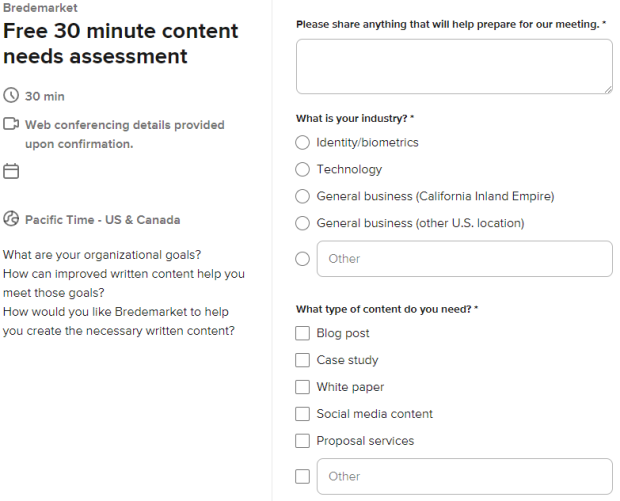
Second, contact Bredemarket to get the content process started well BEFORE your event. Book a meeting with me at calendly.com/bredemarket. Be sure to fill out the information form so I can best help you.
Alternatively, you can
- Email me at john.bredehoft@bredemarket.com.
- Contact me at bredemarket.com/contact/.
But don’t wait. If your event is in September…don’t contact me in October.
 Bredemarket