Most technology publications, with the notable exception of IPVM, are at least partially funded by the companies they cover. Therefore there’s an unavoidable tension between keeping the advertisers happy and casting a critical eye on the industry.
I accept this tension because it applies to Bredemarket itself. Although my clients are absolutely wonderful, there may emerge a future situation where they may be less than perfect. So naturally I have to watch my tongue.
As does Biometric Update.
Remember when IDloop asserted it offered “the world’s first FBI-certified 3D contactless fingerprint scanner,” and Biometric Update reported the claim with no comment? I said at the time:
“Biometric Update reports news as reported, and I don’t think it’s Biometric Update’s purpose to poke holes in vendor claims.”
But then Biometric Update ran a more recent story.
They said that?
Bear in mind that Biometric Update’s advertisers include vendors who offer identity document validation solutions: either their own, or from a third party.
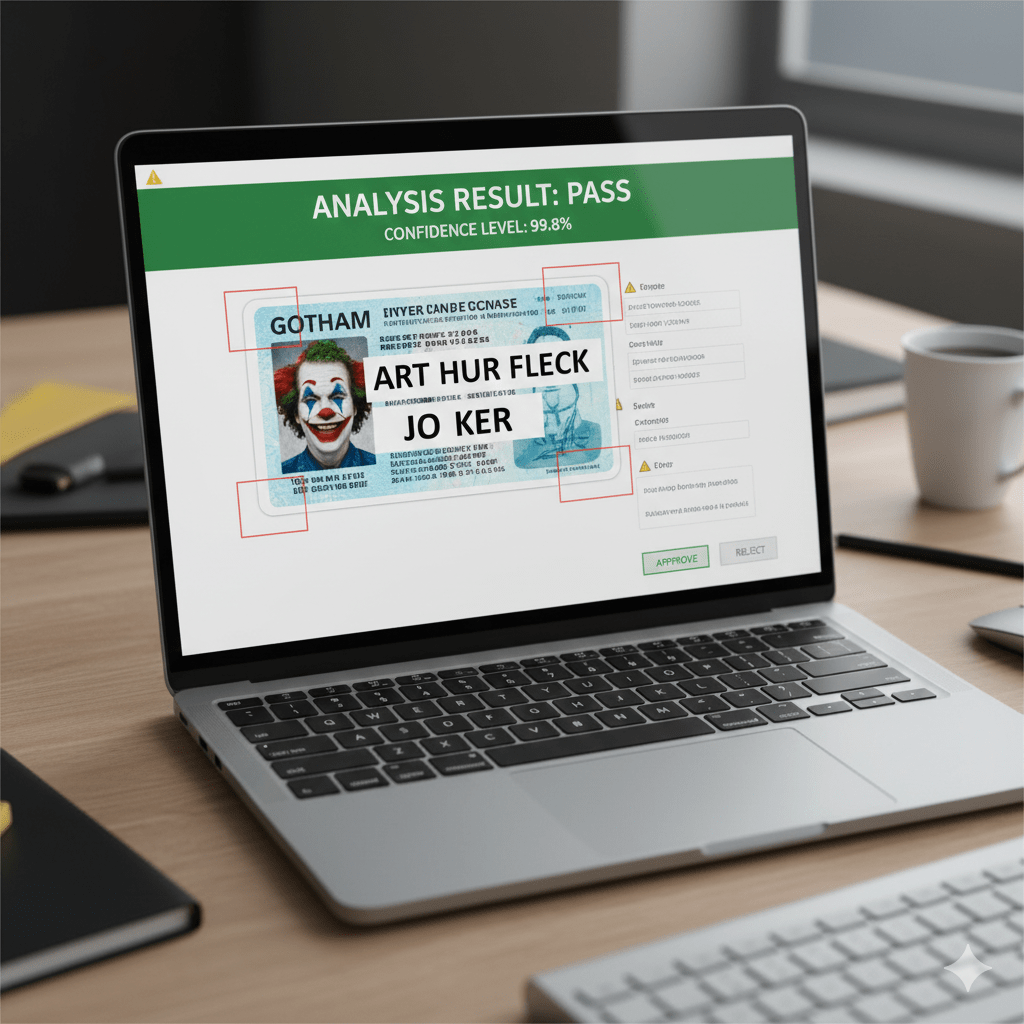
And Biometric Update’s recent story basically said that these solutions are a toxic dumpster fire.
OK, not in those words. Biometric Update is Canadian owned, and if the publication used the words “toxic dumpster fire” it would never stop apologizing.
Not just ineffective, DISASTROUSLY ineffective. Ouch.
For those not up in their acronyms, the Department of Homeland Security’s (DHS) latest annual round of tests was called the Remote Identity Validation Rally (RIVR).
DHS set performance goals for the submitted entries and publicized the (anonymous) results.
“Four of the seven subsystems tested met the goal for system error rate. Four did not meet the threshold for FRR, and five fell short in FAR. In other words, most systems let too few legitimate IDs through, even more passed too many fraudulent IDs, and six of seven fell short on one or both sides of the assessment.”
Google Gemini.
Biometric Update didn’t reveal the…um…identity of the one vendor that performed acceptably. But that vendor may self-reveal soon enough.
On anonymity
Why do testing entities sometimes allow participants to remain anonymous?
Because they want participants.
Some biometric tests are NOT designed to identify the best algorithms, but are instead designed to view the state of the industry. And that’s what this test performed with document validation.
Presumably a future test—POND, or Performance Of Notable Documents—will measure the future state-of-the-art of identity document validation.
“The country of Uzbekistan will lift visa requirements for U.S. travelers starting Jan. 1, 2026, offering Americans another country to visit visa-free. The police change, which was recently confirmed by the government, will allow U.S. citizens to enter visa-free for up to 30 days.”
Just don’t bring your surfboards. Uzbekistan is double-landlocked.
“[R]equire the state to verify proof of citizenship when a person registers to vote.”
Require voters to “provide identifications at the polls.”
“Those who vote through mail-in ballots would have to give the last four digits of a government-issued ID such as a Social Security number.”
Let’s go through these…backwards.
Mail-in ballots
The third proposal about authenticating mail-in ballots is silly.
The mere fact that someone knows the last four digits of a Social Security Number does NOT prove that the person is the valid holder of the Social Security Number in question.
Which brings us to the second proposal about requiring a government ID for in-person voting.
I’ve already addressed why this is silly. The short version? Election precinct workers have neither the equipment nor the training to tell whether a government ID is real or fake.
That only leaves the first one, proving citizenship at voter registration. This one is technically feasible; the feds do it all the time. The California Secretary of State could merely adapt the federal I-9 process to the state level; I’m sure Janice Kephart and her company ZipID would love to help the state with that.
Especially since the requirement for election integrity dictates that all of California’s existing voters would need to re-register to prove their citizenship.
All 22+ million of them.
Because if you DO NOT require all California voters to re-register, the whole exercise is pointless.
There have been many recent stories about Transportation Security Administration (TSA) capture of the facial images of travelers, an outgrowth of the same post-9/11 concerns that resulted in REAL IDs in 2008…I mean 2025. (Maybe.)
As to the “why” of its stance, here’s a succinct statement:
“Do you really want to be submitting a face scan to the current U.S. government?”
And perhaps there are good reasons to distrust the Trump Administration, or any administration.
After all, the TSA says it only retains the picture for a limited time: “Photos are not stored or saved after a positive ID match has been made, except in a limited testing environment for evaluation of the effectiveness of the technology,”
But maybe…something happens. Someone accidentally forgot to delete the files. Oops.
And if something happens, the federal government has just captured an image of your face!
Guess what? The federal government can probably already get an image of your face, even if you don’t allow TSA to take your photo.
After all, you had to show some sort of identification when you arrived at that TSA checkpoint. Maybe you showed a passport, with a picture that the U.S. State Department received at one point. No, they don’t retain them either. But maybe…something happens.
But if you are with a facial recognition company, and you want your prospects and their prospects to understand how your solution protects their privacy…
12-18-6.1. Voters required to provide identification before voting.
When the voter is requesting a ballot, the voter shall present a valid form of personal identification. The personal identification that may be presented shall be either:
(1) A South Dakota driver’s license or nondriver identification card;
(2) A passport or an identification card, including a picture, issued by an agency of the United States government;
(3) A tribal identification card, including a picture; or
(4) A current student identification card, including a picture, issued by a high school or an accredited institution of higher education, including a university, college, or technical school, located within the State of South Dakota.
As most people know, legislators only define the law in broad strokes. It is up to the executive to figure out the details of how to implement the law.
So how does the South Dakota Board of Elections determine that the presented identification is valid?
Does every precinct worker in South Dakota possess a copy of a guide (such as this one) that includes, among other items:
“Explanation of what the proper alphanumeric sequencing of a South Dakota ID or Driver’s License should be (how many letters, numbers, etc.).”
In addition, does every precinct worker in South Dakota have access to software and equipment (such as this one that uses “white, infrared, ultraviolet and coaxial lights”) that detects deepfake IDs? This one has a $1,600 list price. You can get cheaper ones that only support white light and can’t detect the other security features, but such readers would violate the law.
If the state can negotiate a discount of $1,000 per reader, then you can equip almost 700 precincts for less than $1 million (excluding training and maintenance, and assuming only 1 reader per precinct). A small price to pay for democracy.
Of course voter ID fraud doesn’t just affect South Dakota, as I previously noted. But even if South Dakota doesn’t equip its precinct workers to reject voters with fake IDs, I’m sure the other states do.
When you obtain a government ID from one national government, you normally don’t get a second government ID from a different national government, unless you hold dual citizenship.
“President Lai Ching-te (賴清德) has cautioned Taiwanese citizens against China’s reported efforts to lure them into applying for Chinese ID cards and residency permits.”
Because Taiwan is a contested territory, acceptance of People’s Republic of China IDs could resulted in PRC claims to Taiwan…to protect its citizens there. Therefore Taiwan really discourages this.
“According to local regulations, citizens who receive a Chinese ID will have their Taiwanese household registration revoked.”
In a recent conversation with a client, I was reminded that procedures in one country may not be followed in another. For example, the process of getting a U.S. passport differs from the process to get one in France.
The client asked me about my experience with centralized and decentralized ID document issuance systems.
It turns out I was experienced in both based upon my time at IDEMIA. State agencies can manufacture driver’s licenses either via a dencentralized process where the driver’s license is printed at your local DMV office while you wait, or via a centralized process where all the driver’s licenses are produced at a secure facility which may or may not be located in the state in question. IDEMIA maintains several such centralized facilities to produce driver’s licenses and credit card-related materials, and they’re so secure that even when I was an IDEMIA employee I was not allowed to enter them.
Based upon my U.S. experience, I knew about centralized passport production.
The client noted that things are different in some other countries. So I read about the process in France.
Passports and passport renewals in the United States
When I joined Incode Technologies in May 2022, I had to quickly renew my passport so that I could attend a possible meeting in Mexico City. And it’s a good thing I did, because that meeting occurred soon afterwards…well, if you consider April 2023 “soon afterwards.”
My passport had expired in 2020, but I was able to renew my passport anyway with a fairly simple procedure.
Go to my local CVS drug store and use their automated machine to take the required passport photo in an ICAO-compliant fashion. The machine checked for ICAO compliance. (It took a few tries to get it right.)
Fill out a paper form.
Use an antiquated currency technology called a “check” to make out a payment to the U.S. State Department.
Put everything in an envelope and mail it to a centralized passport processing center.
Let’s skip right to the biggest difference between France and the United States:
The passport will take a few days to process.
Uh…what?
Not “the passport will take a few days to process if you pay rush fees.”
It will take a few days to process, period.
And no, this isn’t because the United States is larger than France. The same time period applies if you apply for a passport in one of France’s scattered overseas departments, or at a French embassy or consulate.
First off, you don’t need to mail a bunch of stuff off to a centralized office. You can simply go to your local town hall (mairie), embassy, or consulate. You need the following:
A French ID card or other acceptable proof of French nationality.
A recent photograph (again, ICAO compliant).
Your fingers, which are presumably attached to your person, so that they can be captured for biometric purposes.
Proof of residence.
The passport fee.
Once your bring everything to the mairie, your passport is processed within a few days. (OK, perhaps slightly longer in the summer.) When it’s ready you go back to the mairie, sign your passport, and take it with you to travel to all of the countries you can visit with a French passport. (More than with a United States passport.)
Follow your local, um, customs
My research hasn’t yet uncovered a country where you can get your passport on the same day you apply for it, but such a timeframe is theoretically possible.
This isn’t a current concern of mine since Bredemarket only deals with U.S. firms, but some of these firms are multinational and may ask me to create written content regarding their installation in Vietnam or wherever.
Always ask what the local practice is and don’t assume that the locals do things like we do in Southern California.
Checking the purported identity against private databases, such as credit records.
Checking the person’s driver’s license or other government document to ensure it’s real and not a fake.
Checking the purported identity against government databases, such as driver’s license databases. (What if the person presents a real driver’s license, but that license was subsequently revoked?)
Perform a “who you are” biometric test against the purported identity.
If you conduct all four tests, then you have used multiple factors of authentication to confirm that the person is who they say they are. If the identity is synthetic, chances are the purported person will fail at least one of these tests.
Do you fight synthetic identity fraud?
If you fight synthetic identity fraud, you should let people know about your solution.
For example, when biometric companies want to justify the use of their technology, they have found that it is very effective to position biometrics as a way to combat sex trafficking.
Similarly, moves to rein in social media are positioned as a way to preserve mental health.
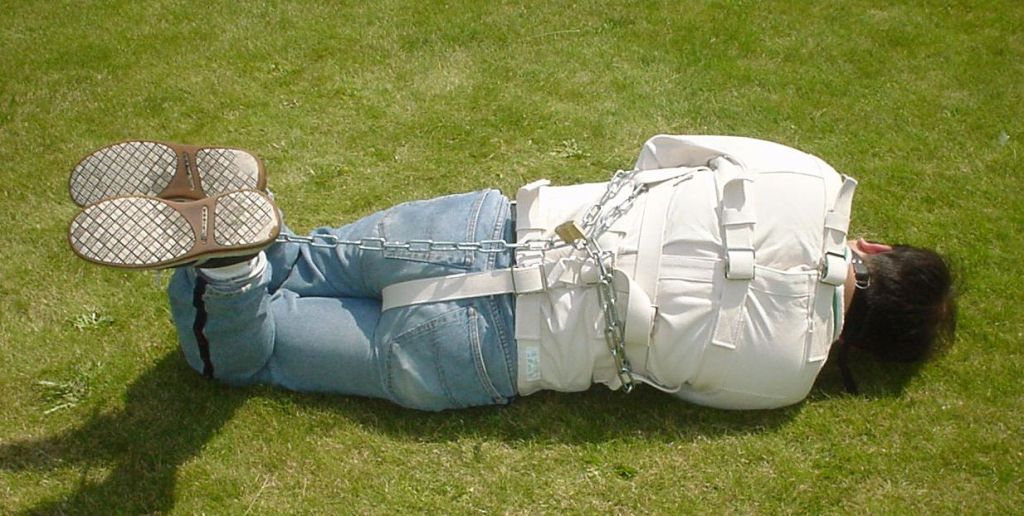
Now that’s a not-so-pretty picture, but it effectively speaks to emotions.
“If poor vulnerable children are exposed to addictive, uncontrolled social media, YOUR child may end up in a straitjacket!”
In New York state, four government officials have declared that the ONLY way to preserve the mental health of underage social media users is via two bills, one of which is the “New York Child Data Protection Act.”
But there is a challenge to enforce ALL of the bill’s provisions…and only one way to solve it. An imperfect way—age estimation.
Because they want to protect the poor vulnerable children.
By Paolo Monti – Available in the BEIC digital library and uploaded in partnership with BEIC Foundation.The image comes from the Fondo Paolo Monti, owned by BEIC and located in the Civico Archivio Fotografico of Milan., CC BY-SA 4.0, https://commons.wikimedia.org/w/index.php?curid=48057924
And because the major U.S. social media companies are headquartered in California. But I digress.
So why do they say that children need protection?
Recent research has shown devastating mental health effects associated with children and young adults’ social media use, including increased rates of depression, anxiety, suicidal ideation, and self-harm. The advent of dangerous, viral ‘challenges’ being promoted through social media has further endangered children and young adults.
Of course one can also argue that social media is harmful to adults, but the New Yorkers aren’t going to go that far.
So they are just going to protect the poor vulnerable children.
CC BY-SA 4.0.
This post isn’t going to deeply analyze one of the two bills the quartet have championed, but I will briefly mention that bill now.
The “Stop Addictive Feeds Exploitation (SAFE) for Kids Act” (S7694/A8148) defines “addictive feeds” as those that are arranged by a social media platform’s algorithm to maximize the platform’s use.
Those of us who are flat-out elderly vaguely recall that this replaced the former “chronological feed” in which the most recent content appeared first, and you had to scroll down to see that really cool post from two days ago. New York wants the chronological feed to be the default for social media users under 18.
The bill also proposes to limit under 18 access to social media without parental consent, especially between midnight and 6:00 am.
And those who love Illinois BIPA will be pleased to know that the bill allows parents (and their lawyers) to sue for damages.
Previous efforts to control underage use of social media have faced legal scrutinity, but since Attorney General James has sworn to uphold the U.S. Constitution, presumably she has thought about all this.
Enough about SAFE for Kids. Let’s look at the other bill.
The New York Child Data Protection Act
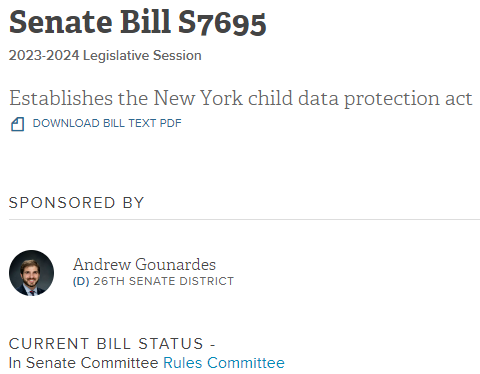
The second bill, and the one that concerns me, is the “New York Child Data Protection Act” (S7695/A8149). Here is how the quartet describes how this bill will protect the poor vulnerable children.
CC BY-SA 4.0.
With few privacy protections in place for minors online, children are vulnerable to having their location and other personal data tracked and shared with third parties. To protect children’s privacy, the New York Child Data Protection Act will prohibit all online sites from collecting, using, sharing, or selling personal data of anyone under the age of 18 for the purposes of advertising, unless they receive informed consent or unless doing so is strictly necessary for the purpose of the website. For users under 13, this informed consent must come from a parent.
And again, this bill provides a BIPA-like mechanism for parents or guardians (and their lawyers) to sue for damages.
But let’s dig into the details. With apologies to the New York State Assembly, I’m going to dig into the Senate version of the bill (S7695). Bear in mind that this bill could be amended after I post this, and some of the portions that I cite could change.
This only applies to natural persons. So the bots are safe, regardless of age.
Speaking of age, the age of 18 isn’t the only age referenced in the bill. Here’s a part of the “privacy protection by default” section:
§ 899-FF. PRIVACY PROTECTION BY DEFAULT.
1. EXCEPT AS PROVIDED FOR IN SUBDIVISION SIX OF THIS SECTION AND SECTION EIGHT HUNDRED NINETY-NINE-JJ OF THIS ARTICLE, AN OPERATOR SHALL NOT PROCESS, OR ALLOW A THIRD PARTY TO PROCESS, THE PERSONAL DATA OF A COVERED USER COLLECTED THROUGH THE USE OF A WEBSITE, ONLINE SERVICE, ONLINE APPLICATION, MOBILE APPLICA- TION, OR CONNECTED DEVICE UNLESS AND TO THE EXTENT:
(A) THE COVERED USER IS TWELVE YEARS OF AGE OR YOUNGER AND PROCESSING IS PERMITTED UNDER 15 U.S.C. § 6502 AND ITS IMPLEMENTING REGULATIONS; OR
(B) THE COVERED USER IS THIRTEEN YEARS OF AGE OR OLDER AND PROCESSING IS STRICTLY NECESSARY FOR AN ACTIVITY SET FORTH IN SUBDIVISION TWO OF THIS SECTION, OR INFORMED CONSENT HAS BEEN OBTAINED AS SET FORTH IN SUBDIVISION THREE OF THIS SECTION.
So a lot of this bill depends upon whether a person is over or under the age of eighteen, or over or under the age of thirteen.
And that’s a problem.
How old are you?
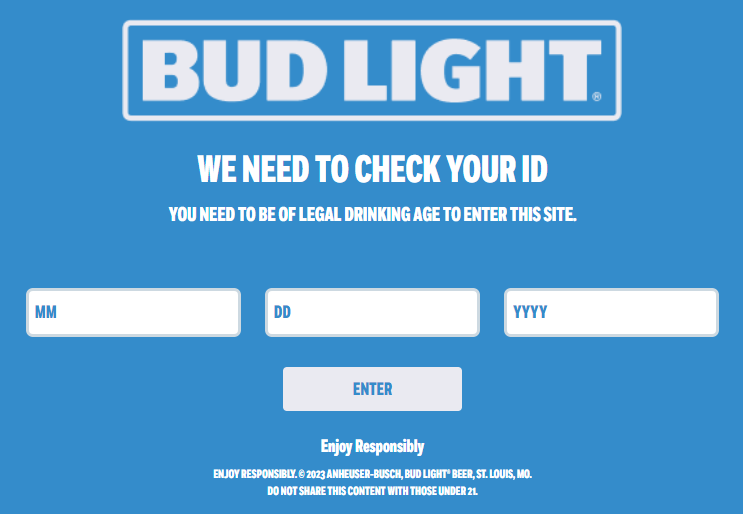
The bill needs to know whether or not a person is 18 years old. And I don’t think the quartet will be satisfied with the way that alcohol websites determine whether someone is 21 years old.
Attorney General James and the others would presumably prefer that the social media companies verify ages with a government-issued ID such as a state driver’s license, a state identification card, or a national passport. This is how most entities verify ages when they have to satisfy legal requirements.
For some people, even some minors, this is not that much of a problem. Anyone who wants to drive in New York State must have a driver’s license, and you have to be at least 16 years old to get a driver’s license. Admittedly some people in the city never bother to get a driver’s license, but at some point these people will probably get a state ID card.
However, there are going to be some 17 year olds who don’t have a driver’s license, government ID or passport.
And some 16 year olds.
And once you look at younger people—15 year olds, 14 year olds, 13 year olds, 12 year olds—the chances of them having a government-issued identification document are much less.
What are these people supposed to do? Provide a birth certificate? And how will the social media companies know if the birth certificate is legitimate?
But there’s another way to determine ages—age estimation.
How old are you, part 2
As long-time readers of the Bredemarket blog know, I have struggled with the issue of age verification, especially for people who do not have driver’s licenses or other government identification. Age estimation in the absence of a government ID is still an inexact science, as even Yoti has stated.
Our technology is accurate for 6 to 12 year olds, with a mean absolute error (MAE) of 1.3 years, and of 1.4 years for 13 to 17 year olds. These are the two age ranges regulators focus upon to ensure that under 13s and 18s do not have access to age restricted goods and services.
So if a minor does not have a government ID, and the social media firm has to use age estimation to determine a minor’s age for purposes of the New York Child Data Protection Act, the following two scenarios are possible:
An 11 year old may be incorrectly allowed to give informed consent for purposes of the Act.
A 14 year old may be incorrectly denied the ability to give informed consent for purposes of the Act.
Is age estimation “good enough for government work”?















 Bredemarket