Is the Quantum Security Threat Solved Before It Arrives? Probably Not.

I’ll confess: there is a cybersecurity threat so…um…threatening that I didn’t even want to think about it.

You know the drill. The bad people use technology to come up with some security threat, and then the good people use technology to thwart it.

That’s what happens with antivirus. That’s what happens with deepfakes.

But I kept on hearing rumblings about a threat that would make all this obsolete.

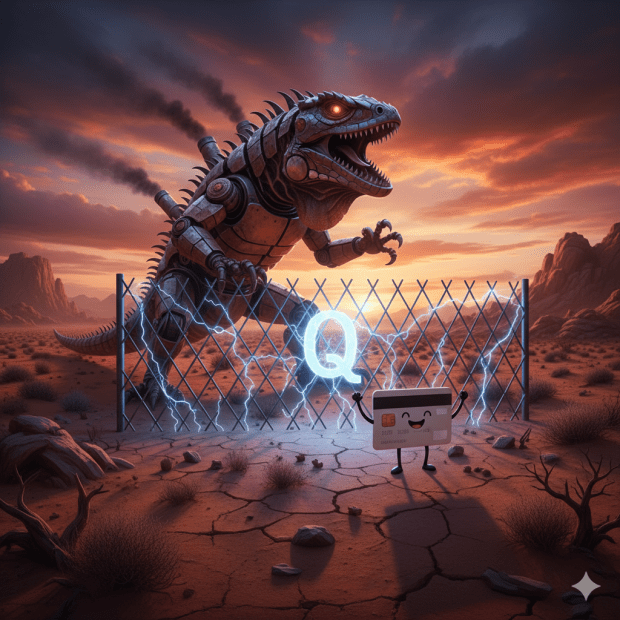
The quantum threat and the possible 2029 “Q Day”

Today’s Q word is “quantum.”

But with great power comes great irresponsibility. Gartner said it:

“By 2029, ‘advances in quantum computing will make conventional asymmetric cryptography unsafe to use,’ Gartner said in a study.”

Frankly, this frightened me. Think of the possibilities that come from calculation superpowers. Brute force generation of passcodes, passwords, fingerprints, faces, ID cards, or whatever is necessary to hack into a security system. A billion different combinations? No problem.

So much for your unbreakable security system.

Thales implementation of NIST FIPS 204

Unless Thales has started to solve the problem. This is what Thales said:

“The good news is that technology companies, governments and standards agencies are well aware of the deadline. They are working on defensive strategies to meet the challenge — inventing cryptographic algorithms that run not just on quantum computers but on today’s conventional components.

“This technology has a name: post-quantum cryptography.

“There have already been notable breakthroughs. In the last few days, Thales launched a quantum-resistant smartcard: MultiApp 5.2 Premium PQC. It is the first smartcard to be certified by ANSSI, France’s national cybersecurity agency.

“The product uses new generation cryptographic signatures to protect electronic ID cards, health cards, driving licences and more from attacks by quantum computers.”

So what’s so special about the technology in the MultiApp 5.2 Premium PQC?

Thales used the NIST “FIPS 204 standard to define a digital signature algorithm for a new quantum-resistant smartcard: MultiApp 5.2 Premium PQC.”

Google Gemini.

The NIST FIPS 204 standard, “Module-Lattice-Based Digital Signature Standard,” can be found here. This is the abstract:

“Digital signatures are used to detect unauthorized modifications to data and to authenticate the identity of the signatory. In addition, the recipient of signed data can use a digital signature as evidence in demonstrating to a third party that the signature was, in fact, generated by the claimed signatory. This is known as non-repudiation since the signatory cannot easily repudiate the signature at a later time. This standard specifies ML-DSA, a set of algorithms that can be used to generate and verify digital signatures. ML-DSA is believed to be secure, even against adversaries in possession of a large-scale quantum computer.”

ML-DSA stands for “Module-Lattice-Based Digital Signature Algorithm.”

Google Gemini.

Now I’ll admit I don’t know a lattice from a vertical fence post, especially when it comes to quantum computing, so I’ll have to take NIST’s word for it that modules and lattice are super-good security.

Certification, schmertification

The Thales technology was then tested by researchers to determine its Evaluation Assurance Level (EAL). The result? “Thales’ product won EAL6+ certification (the highest is EAL7).” (TechTarget explains the 7 evaluation assurance levels here.)

France’s national cybersecurity agency (ANSSI) then certified it.

However…

…remember that certifications mean squat.

For all we know, the fraudsters have already broken the protections in the FIPS 204 standard.

Google Gemini.

And the merry-go-round between fraudsters and fraud fighters continues.

If you need help spreading the word about YOUR anti-fraud solution, quantum or otherwise, schedule a free meeting with Bredemarket.

Reducing Biometric Marketing Internal Bias By Using Bredemarket

Identity/biometric marketing leaders continuously talk about how their companies have reduced bias in their products. But have they reduced bias in their own marketing to ensure it resonates with prospects?

I recently talked about the problem of internal bias:

“Marketers are driven to accentuate the positive about their companies. Perhaps the company has a charismatic founder who repeatedly emphasizes how ‘insanely great’ his company is and who talked about ‘bozos.’ (Yeah, there was a guy who did both of those.) 

“And since marketers are often mandated to create both external and internal sales enablement content, their view of their own company and their own product is colored.”

Let’s look at two examples of biometric marketing internal bias…and how to overcome it.

Google Gemini.

Internal bias at Company A

  • Company A does not participate in the U.S. National Institute of Standards and Technology (NIST) Face Recognition Technology Evaluation (FRTE) for technical reasons. 
  • As a result, the company’s marketing machine constantly discredits NIST FRTE, and the company culture is permeated with a “NIST is stupid” mentality. 
  • All well and good…until it runs into that one prospect who asks, “Why are you scared to measure yourself against the competition? Does your algorithm suck that bad?”

Internal bias at Company B

  • Company B, on the other hand, participates in FRTE, FATE, FRIF (previously FpVTE), and every other NIST test imaginable. 
  • This company’s marketing machine declares its superiority as a top tier biometric vendor, supported by outside independent evidence. 
  • All well and good…until it runs into that one prospect who declares, “That’s just federal government test data. How will you perform in our benchmark using our real data and real computers?”

Internal bias at Bredemarket 

Well, I have my admittedly biased solution to prevent companies from tumbling into groupthink, drinking of Kool-Aid, and market irrelevance.

Contract with an outside biometric product marketing expert. (I just happen to know one…me.)

Google Gemini.

I haven’t spent 30 years immersed in your insular culture. I’ve heard all the marketing-speak from different companies, and I’ve written the marketing-speak for nearly two dozen of them. I can ensure that your content resonates with your external customers and prospects, not only with your employees.

All well and good…until…

Reducing internal bias at Bredemarket 

“But John, what about your own biases? IDEMIA, Motorola, Incode, and other employers paid you for 25 years! You probably have an established process that you use to prepare andouillette at home, based upon a recipe from 2019!”

Google Gemini.

I don’t…but point taken. So how do I minimize my own biases?

My breadth of experience lessens the biases from my past. Look at my market-speak from 1994 to 2023, in order:

  • We are Printrak, a nimble private company that will dominate AFIS with our client-server solution.
  • We are Printrak (stock symbol AFIS) a well-funded public company that will dominate AFIS, mugshot, computer aided dispatch, and microfiche.
  • We are Motorolans, and our multi-tier Digital Justice Solution has a superior architecture to that of Sagem Morpho and others.
  • We are MorphoTrak, bringing together the best technologies from MetaMorpho and Printrak BIS, plus superior French technology for secure credentials and road safety…unencumbered by the baggage that weighs down MorphoTrust.
  • We are IDEMIA North America, bringing together the best technologies from MorphoTrust and MorphoTrak for ABIS, driver’s licenses, and enrollment, coupled with the resources from the rest of IDEMIA, a combined unbreakable force.
  • We are Incode, not weighed down with the baggage of the old dinosaurs, and certainly not a participant in the surveillance market.

Add all the different messaging of Bredemarket’s clients, plus my continuous improvement (hello MOTO) of my capabilities, and I will ensure that my content, proposals, and analysis does not trap you in a dead end.

Reducing internal bias at your company 

Are you ready to elevate your company with the outside perspective of a biometric product marketing expert?

Let’s talk (a free meeting). You explain, I ask questions, we agree on a plan, and then I act.

Schedule a meeting at https://bredemarket.com/mark/

I’m a Barbie Girl

So I just finished writing some technical content for a blog post, and for other purposes.

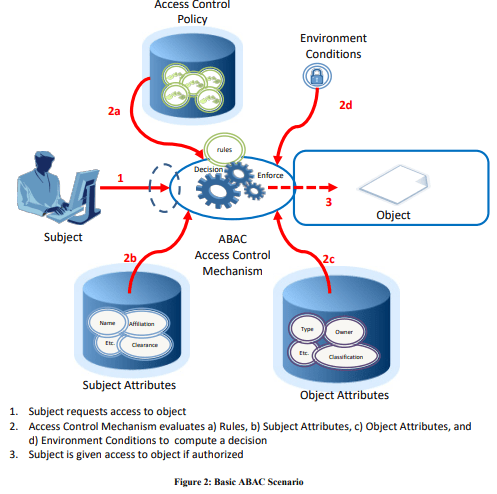
The content relates to a publication (the 2017 version of Special Publication 800-63A) from the National Institute of Standards and Technology, or NIST.

(Note to self: gotta check the new version.)

I figure that after the work day is done, the NISTies turn to less strenuous tasks.

And so shall I.

Bredemarket Identity Assurance Level 3 (IAL3) Posts Over the Years

I’m preparing to promote four of my Identity Assurance Level 3 (IAL3) Bredemarket blog posts on my social media channels. You know, the posts that discuss in-person and remote supervised identity proofing. But I said to myself, “Self, why not re-promote them on the blog also?”

12/3/2020 IAL3 post

From the Bredemarket blog, December 2020:

“The U.S. National Institute of Standards and Technology has defined ‘identity assurance levels’ (IALs) that can be used when dealing with digital identities. It’s helpful to review how NIST has defined the IALs.”

“Identity assurance levels (IALs) and digital identity”: https://bredemarket.com/2020/12/03/identity-assurance-levels-ials-and-digital-identity/

7/19/2023 IAL3 post

From the Bredemarket blog, July 2023:

“If we ignore IAL1 and concentrate on IAL2 and IAL3, we can see one difference between the two. IAL2 allows remote, unsupervised identity proofing, while IAL3 requires (in practice) that any remote identity proofing is supervised.”

“The Difference Between Identity Assurance Levels 2 and 3”: https://bredemarket.com/2023/07/19/ial2-vs-ial3/

8/11/2025 IAL3 post

From the Bredemarket blog, August 2025:

“I’ve talked about Identity Assurance Levels 1, 2, and 3 on several occasions…..But as usually happens, IAL2 is yesterday’s news. Because biometric tech always gets harder better faster stronger.”

“Identity Assurance Level 3 (IAL3): When Identity Assurance Level 2 (IAL2) Isn’t Good Enough”: https://bredemarket.com/2025/08/11/ial3-when-ial2-isnt-good-enough/

9/17/2025 IAL3 post

From the Bredemarket blog, September 2025:

“Governments aren’t the only entities that need to definitively know identities in critically important situations.

“What about banks and other financial institutions, which are required by law to know their customers?

“Now the bank assumed a level of risk by [accepting a Bredemarket client check in a remote unsupervised manner] especially since the deposited check would not be in the bank’s physical possession after the deposit was completed.

“But guess what? The risk was acceptable for my transactions. I’m disclosing Bredemarket company secrets, but that client never wrote me a million dollar check.

“What about remote supervised transactions at financial institutions, where you are not physically present, but someone at the bank remotely sees you and everything you do?

“It turns out that the identity verification providers support video sessions between businesses (such as banks) and their customers.”

“Unlocking High-Value Financial Transactions: The Critical Role of Identity Assurance Level 3 (IAL3)”: https://bredemarket.com/2025/09/17/financial-ial3/

The “How” of IAL3 Supervised Remote Identity Proofing

If the subject of identity proofing is remote, how do you supervise it? Here’s what NIST says:

“The camera(s) a CSP [Credential Service Provider] employs to monitor the actions taken by a remote applicant during the identity proofing session should be positioned in such a way that the upper body, hands, and face of the applicant are visible at all times. Additionally, the components of the remote identity proofing station (including such things as keyboard, fingerprint capture device, signature pad, and scanner, as applicable) should be arranged such that all interactions with these devices is within the field of view. This may require more than one camera to view both the applicant and the room itself.”

If you’re not familiar with the difference between supervised and unsupervised remote identity proofing, please read “The Difference Between Identity Assurance Levels 2 and 3.”

In Health, Benefits of Identity Assurance Level 2 (IAL2) are CLEAR

Is the medical facility working with the right patient?

Hackensack Meridian Health in New Jersey claims that it knows who its patients are. It has partnered with CLEAR for patient identification, according to AInvest. Among the listed benefits of the partnership are enhanced security:

“CLEAR1 meets NIST’s Identity Assurance Level 2 (IAL2) standards, a rare feat in the healthcare sector, ensuring robust protection against fraud.”

But is IAL2 that rare in healthcare?

Other vendors, such as Proof, ID.me, and Nametag certainly talk about it.

And frankly (if you ignore telehealth) the healthcare field is ripe for IAL3 implementation.

If you are a healthcare solution marketer, you’re NOT with CLEAR, and you’re angry that AInvest claims that IAL2 is “a rare feat” in healthcare…

Is your IAL2 healthcare solution hidden in the shadows? Imagen 4.

…then you need to get the word out about your solution.

And Bredemarket can help. Schedule a free meeting with me.

Battling deepfakes with…IAL3?

(Picture designed by Freepik.)

The information in this post is taken from the summary of this year’s Biometrics Institute Industry Survey and is presented under the following authority:

“You are welcome to use the information from this survey with a reference to its source, Biometrics Institute Industry Survey 2025. The full report, slides and graphics are available to Biometrics Institute members.”

But even the freebie stuff is valuable, including this citation of two concerns expressed by survey respondents:

“Against a backdrop of ongoing concerns around deepfakes, 85%
agreed or agreed strongly that deepfake technology poses a
significant threat to the future of biometric recognition, which
was similar to 2024.
“And two thirds of respondents (67%) agreed or agreed strongly
that supervised biometric capture is crucial to safeguard against
spoofing and injection attacks.”

Supervised biometric capture? Where have we heard that before?

IAL3 requires “[p]hysical presence” for identity proofing. However, the proofing agent may “attend the identity proofing session via a CSP-controlled kiosk or device.” In other words, supervised enrollment.

Now remote supervised enrollment and even in-person supervised enrollment is not a 100.00000% guard against deepfakes. The subject could be wearing a REALLY REALLY good mask. But it’s better than unsupervised enrollment.

How does your company battle deepfakes?

How do you tell your clients about your product?

Do you need product marketing assistance? Talk to Bredemarket.

Why is Morph Detection Important?

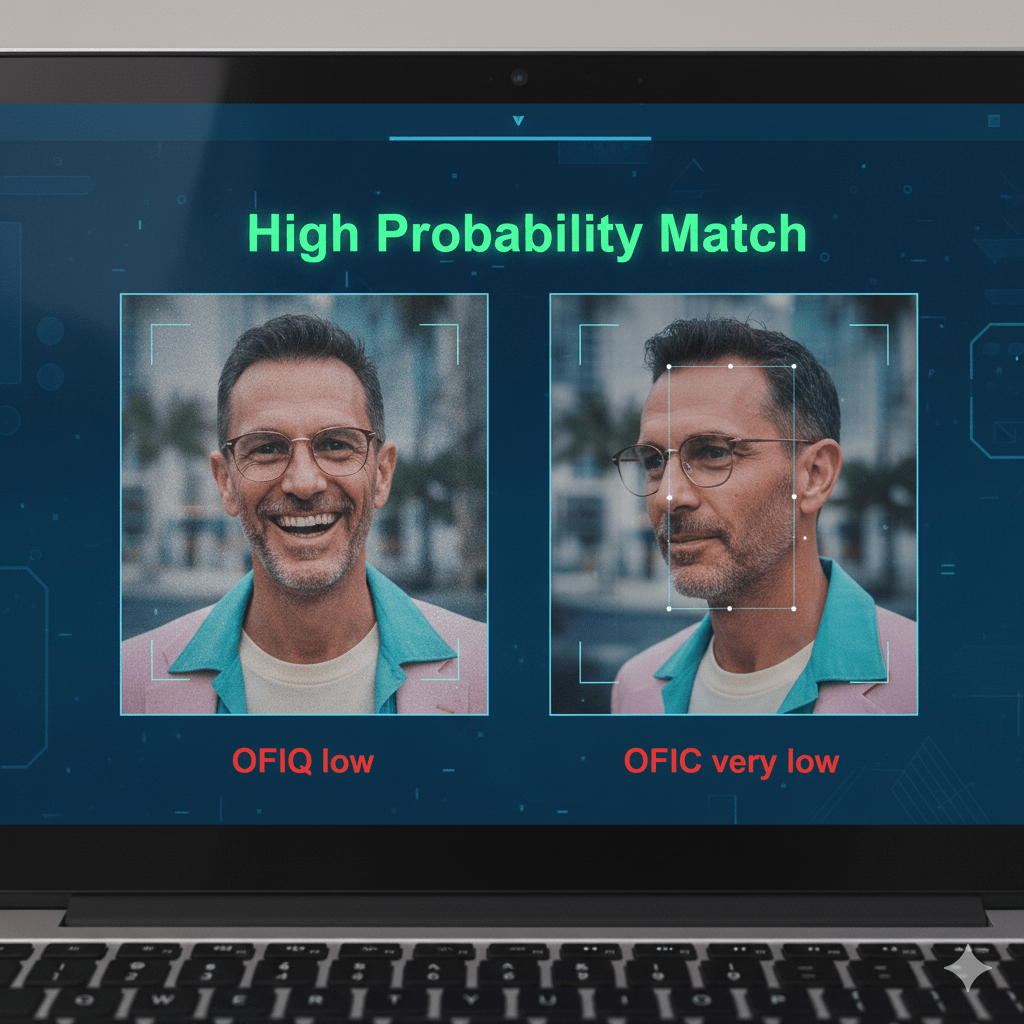
We’re all familiar with the morphing of faces from subject 1 to subject 2, in which there is an intermediate subject 1.5 that combines the features of both of them. But did you know that this simple trick can form the basis for fraudulent activity?

Back in the 20th century, morphing was primarily used for entertainment purposes. Nothing that would make you cry, even though there were shades of gray in the black or white representations of the morphed people.

Godley and Creme, “Cry.”
Michael Jackson, “Black or White.” (The full version with the grabbing.) The morphing begins about 5 1/2 minutes into the video.

But Godley, Creme, and Jackson weren’t trying to commit fraud. As I’ve previously noted, a morphed picture can be used for fraudulent activity. Let me illustrate this with a visual example. Take a look at the guy below.

From NISTIR 8584.

Does this guy look familiar to you? Some of you may think he kinda sorta looks like one person, while others may think he kinda sorta looks like a different person.

The truth is, the person above does not exist. This is actually a face morph of two different people.

From NISTIR 8584.

Now imagine a scenario in which a security camera is patrolling the entrance to the Bush ranch in Crawford, Texas. But instead of having Bush’s facial image in the database, someone has tampered with the database and inserted the “Obushama” image instead…and that image is similar enough to Barack Obama to allow Obama to fraudulently enter Bush’s ranch.

Or alternative, the “Obushama” image is used to create a new synthetic identity, unconnected to either of the two.

But what if you could detect that a particular facial image is not a true image of a person, but some type of morph attempt? NIST has a report on this:

“To address this issue, the National Institute of Standards and Technology (NIST) has released guidelines that can help organizations deploy and use modern detection methods designed to catch morph attacks before they succeed.”

The report, “NIST Interagency Report NISTIR 8584, Face Analysis Technology Evaluation (FATE) MORPH Part 4B: Considerations for Implementing Morph Detection in Operations,” is available in PDF form at https://doi.org/10.6028/NIST.IR.8584.

And a personal aside to anyone who worked for Safran in the early 2010s: we’re talking about MORPH detection, not MORPHO detection. I kept on mistyping the name as I wrote this.

An IMEI Number Is NOT Unique to Each Mobile Phone

(Imagen 3)

Have you ever used the phrase “sort of unique”? Something is either unique or it isn’t. And International Mobile Equipment Identity (IMEI) numbers fail the uniquness test.

Claims that International Mobile Equipment Identity (IMEI) numbers are unique

Here’s what a few companies say about the IMEI number on each mobile phone. Emphasis mine.

  • Thales: “The IMEI (International Mobile Equipment Identity) number is a unique 15-digit serial number for identifying a device; every mobile phone in the world has one.”
  • Verizon: “An IMEI stands for International Mobile Equipment Identity. Think of it as your phone’s fingerprint — it’s a 15-digit number unique to each device.”
  • Blue Goat Cyber: “In today’s interconnected world, where our smartphones have become an indispensable part of our lives, it is essential to understand the concept of IMEI – the International Mobile Equipment Identity. This unique identifier plays a crucial role in various aspects of our mobile devices, from security to tracking and repairs.”

These and other descriptions of the IMEI prominently use the word “unique.” Not “sort of unique,” but “unique.”

Which means (for non-person entities, just like persons) that if someone can find a SINGLE reliable instance of more than one mobile phone having the same IMEI number, then the claim of uniqueness falls apart completely.

Examples of non-uniqueness of IMEI numbers on mobile phones

People who claim IMEI uniqueness obviously didn’t read my Bredemarket blog post of April 1, in which I WASN’T fooling.

  • I talked about an incident in India in which a cyber fraud operation “specialised in IMEI cloning.”
  • And an incident in Canada in which someone was scammed out of C$1,000, even though the phone had a valid IMEI.

IMEICheck.net even tells you (at a high level) how to clone an IMEI. It’s not easy, but it’s not impossible.

“In theory, hackers can clone a phone using its IMEI, but this requires significant effort. They need physical access to the device or SIM card to extract data, typically using specialized tools.

“The cloning process involves copying the IMEI and other credentials necessary to create a functional duplicate of the phone. However, IMEI number security features in modern devices are designed to prevent unauthorized cloning.”

So don’t claim an IMEI is unique when there is evidence to the contrary. As I said in my April post:

NOTHING provides 100.00000% security. Not even an IMEI number.”

What does this mean for your identity product?

If you offer an identity product, educate your prospects and avoid unsupportable claims. While a few prospects may be swayed by “100%” claims, the smarter ones will appreciate more supportable statements, such as “Our facial recognition algorithm demonstrated a 0.0022 false non-match rate in the mugshot:mugshot NIST FRTE 1:1 laboratory testing.”

When you are truthful in educating your prospects, they will (apologizes in advance for using this overused word) trust you and become more inclined to buy from you.

If you need help in creating content (blog posts, case studies, white papers, proposals, and many more), work with Bredemarket to create the customer-focused content you need. Book a free meeting with me.

What is the Proper Identity Assurance Level (IAL) for Employer Identification Number (EIN) Assignment?

(Imagen 4)

In the latest Know Your Business brouhaha, the Treasury Inspector General for Tax Administration (TIGTA) has questioned some potential gaps in the assignment of an Employer Identification Number, or EIN.

It seems that some so-called “businesses” are using an EIN as a facade for illegal activity…and insufficient identity assurance is preventing the fraudsters from being caught.

Obtaining Employer Identification Numbers to commit tax fraud

What is an EIN? In the same way that U.S. citizens have Social Security Numbers, U.S. businesses have Employer Identification Numbers. It’s not a rigorous process to get an EIN; heck, Bredemarket has one.

But maybe it needs to be a little more rigorous, according to TIGTA.

“EINs are targeted and used by unscrupulous individuals to commit fraud. In July 2021, we reported that there were hundreds of potentially fraudulent claims for employer tax credits….Further, in April 2024, our Office of Investigations announced that it helped prevent $3.5 billion from potentially being paid to fraudsters. Our special agents identified a scheme where individuals obtained an EIN for the sole purpose of filing business tax returns to improperly claim pandemic-related tax credits.”

Yes, that’s $3.5 billion with a B. That’s a lot of fraud.

Perhaps the pandemic has come and gone, but the temptation to file fraudulent business tax returns with an improperly-obtained EIN continues.

Facade.

Enter the Identity Assurance Level

So how does the Internal Revenue Service (IRS) gatekeep the assignment of EINs?

By specifying an Identity Assurance Level (IAL) before assigning an EIN.

Specifically, Identity Assurance Level 1.

“In December 2024, the IRS completed the annual reassessment of the Mod IEIN system. The IRS rated the identity proofing and authentication requirements at Level 1 (the same level as the initial assessment in January 2020).”

IAL1 doesn’t “assure” anything…except continued tax fraud

If you’ve read the Bredemarket blog or other biometric publications, you know that IAL1 is, if I may use a technical term, a “nothingburger.” The National Institute of Standards and Technology (NIST) says this about IAL1:

“There is no requirement to link the applicant to a specific real-life identity. Any attributes provided in conjunction with the subject’s activities are self-asserted or should be treated as self-asserted (including attributes a CSP asserts to an RP). Self-asserted attributes are neither validated nor verified.”

If that isn’t a shady way to identity a business, I don’t know what is.

Would IAL2 or IAL3 be better for EIN assignment?

These days it’s probably unreasonable to require every business to use Identity Assurance Level 3 (discussed in the Bredemarket post “Identity Assurance Level 3 (IAL3): When Identity Assurance Level 2 (IAL2) Isn’t Good Enough“) to obtain an EIN. As a reminder, IAL3 requires either in-person or supervised proof of identity.

But I agree with TIGTA’s assertion that Identity Assurance Level 2, with actual evidence of the real-world identity, should be the minimum.

Does your firm offer an IAL2/IAL3 product?

And if your identity/biometric firm offers a product that conforms to IAL2 or IAL3, and you need assistance creating product marketing content, talk to Bredemarket.