“Is this part of a large multi-faceted campaign, like a go-to-market omnichannel effort?”
“Oh, no, nothing like that. Just a message related to the upcoming July 4 holiday.”
“OK. How about if we publish your message six months from now, in late December?”
Um…
I think we can do better than that.
Blogging gives you the perfect vehicle to respond to current events and immediate needs.
Provided you prepare beforehand by answering questions such as these:
Why is this important to the reader?
How will this help my business?
What exactly am I talking about?
Once you answer these and other questions, you can draft your blog post, review it, finalize it, and publish it. All within days…or within hours if it’s critically important.
Because I knew two people (long gone) at Company X, so the company came to mind.
Who runs marketing at Company X?
Because the open position was not an executive position, I searched LinkedIn for the company’s Chief Marketing Officer, or what the cool kids call the CMO. Anyone applying for the open position would want to talk to the CMO.
But I found:
No CMO on LinkedIn.
No Head of Marketing on LinkedIn.
No marketing head on Company X’s About Us page.
CMO-less.
But they’re hiring…a marketing manager.
Normally companies hire a marketing head, then let them build out their team. But in this case, Company X is starting in the middle by hiring a non-executive marketing manager.
Or maybe not.
The CxxO and double duty
There’s a chance that one of the other executives at Company X is wearing the marketing hat, in addition to their other duties.
This isn’t unusual in small startups, after all.
CxxO.
Now this makes it difficult for people outside the company who want to speak to the marketing head.
But who cares if it’s difficult for outsiders?
Yes it makes it hard for a marketing jobseeker to determine who the hiring authority is for an open marketing position.
And yes (because this blog is all about me) it makes it difficult for a product marketing consultant to pitch their services…especially when the two original contacts have left the company.
Making it hard for outsiders is actually GOOD for the company. Pesky outsiders can be pesky, especially if they’re calling at all hours and bumping their emails.
Who runs marketing at Company U?
But what’s happening on the inside of Company X, or at Company U (your company)?
Who determines what the marketing manager is supposed to do?
Who determines if the marketing manager is a success or failure?
From the perspective of Bredemarket, I am much better off when a prospect company has a clear plan of how it can use my content-proposal-analysis services.
Um, how do you know that you will blow the world away?
“Our leader says so. And she knows what she’s talking about. She attended Stanford.”
But is anyone checking your assumptions?
“Of course. All 23 employees…forget I said that number.”
But what about your prospects? What are they saying?
“We know they will love it!”
Did they say they will love it?
“We know they will!”
What if the prospects learn about your stealth product and decide it sucks? And all the years you’ve spent developing in isolation are in vain because of a lack of true customer focus?
“That won’t happen. Our leader knows what she’s talking about. She founded one successful company, and uses that experience to guide us remotely from Texas.”
Who is this leader?
“Elizabeth Holmes. Have you heard of her?”
Elizabeth Holmes picture public domain.
Ending the Isolation
There are potentially valid reasons for entering stealth mode, including protecting trade secrets and keeping the competition away.
But…there is a risk if you also keep the prospects away from your stealth mode operations and fail to engage with them. Who knows—maybe your prospects might have some ideas of what they need, and that information might be good to know. Your unicorn rockstar fearless dear leader may not know EVERYTHING.
If you want to work out a strategy for getting prospects engaged, let me ask you a few questions. Book a free meeting at https://bredemarket.com/cpa/
You can bet that I paid attention to AKings’ latest post after I saw how it began:
“Indiana. The Crossroads of America. A place where colossal semi-trucks roar in from the north, south, east, west, and every conceivable direction in between, like a great migration of diesel-belching wildebeests on their way to deliver vital supplies.”
Bredemarket’s self-promotional content is replete with wildebeests, iguanas, and wombats. Much of this was from an urge to differentiate from those who eat their own dog food. So Bredemarket ate its own iguana food, then its own wildebeest food.
But “wildebeest trucker” is a new one on me.
How do you differentiate your marketing content from that of your competitors?
Or do you eat their dog food?
But goin’ back to Indiana, AKings’ post is a literal tour of the state over a year, including an encounter with angry union members in Kokomo (not that Kokomo). Recommended reading.
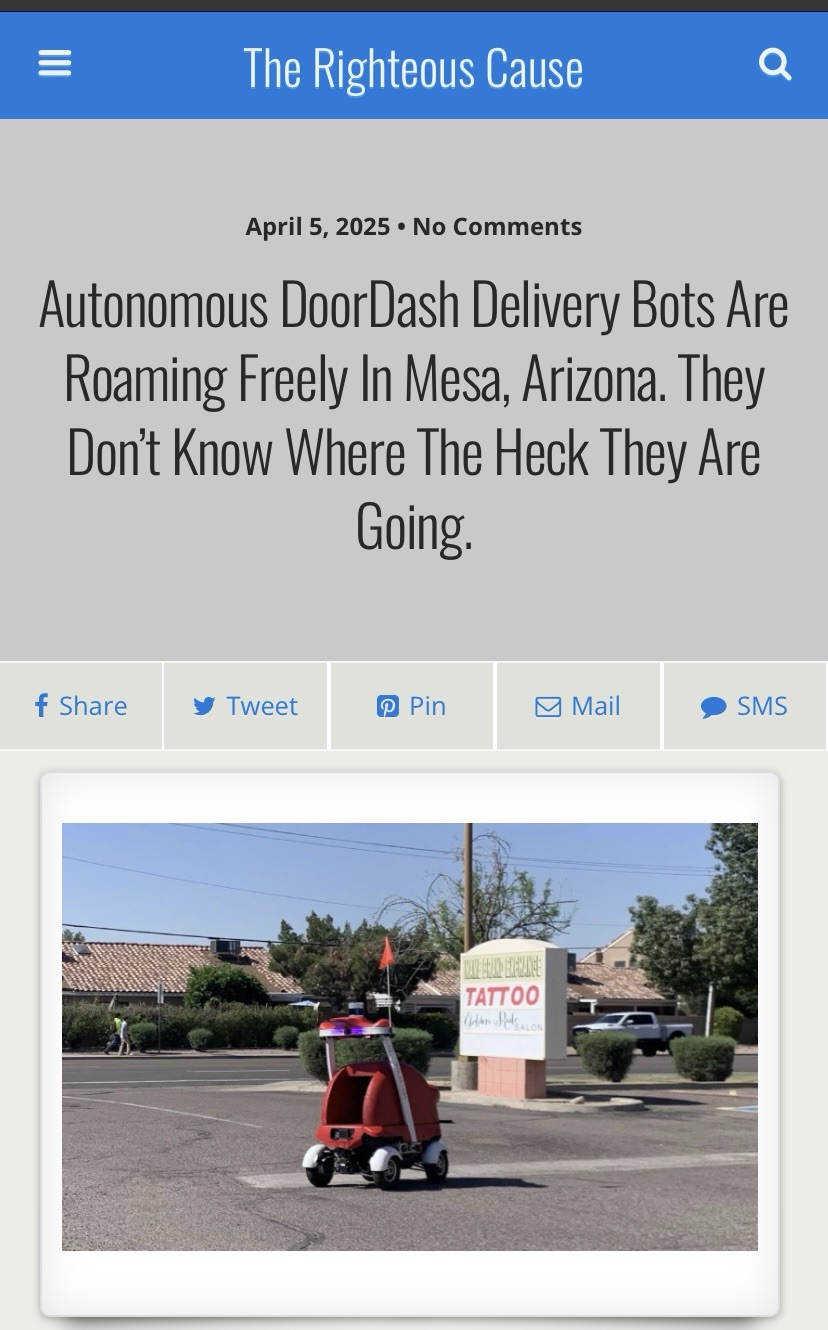
So the delivery bot set out to deliver packages to a hungry customer.
“Anyway … I followed my little friend after it picked up an order from IHOP. Enjoy our strange little jaunt.”
I won’t give it away, other than to comment that AI is like a drug-using teenager who only half listens to you. (I’ve said this before, stealing the idea from Steve Craig and Maxine Most.)
Yes, I know that marketing personas are representations of your hungry people (target audience) that wonderfully focus the mind on the people interested in your product or service. But if we’re being honest with ourselves, a software purchase is not greatly influenced by a non-person entity’s go-to coffee shop order.
Or whether the purchasing manager is 28 or 68.
So don’t go overboard in persona development.
That is all.
Except for the Bredemarket content-proposal-analysis promo.
I’m a member of a local Facebook “news” group, and the group just emphatically stated that expression of opinions is NOT allowed in that group.
Because facts are free of bias. (Supposedly. I should address that topic in another post.)
Because this post includes two contentious opinions, it’s no surprise that I will NEVER share this post in that local news group. Their loss.
Actually the post is off-topic for the news group anyway. But as you will see, it is entirely on-topic for Bredemarket. I’ll explain, after I discuss a couple of songs and their singers.
Two Facts and One Opinion About “Girl from the North Country”
“Girl from the North Country” is a Bob Dylan song, which he started writing in 1962 while in England. The song was recorded in New York in 1963 and released that same year on the album “The Freewheelin’ Bob Dylan.”
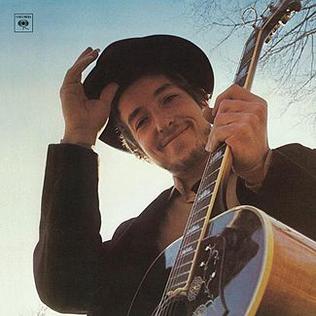
I care about Dylan’s cover of his own song, released several years later on the 1969 album “Nashville Skyline.” But Dylan had a special guest on this album: Johnny Cash.
Here are two facts about the 1969 version:
Bob Dylan has a distinctive voice.
Johnny Cash has a distinctive voice.
These are facts, not opinions, since I am not casting a value judgement on whether they are any good at singing. For the record, I love Bob Dylan’s solo songs, and I love Johnny Cash’s solo songs.
Now my opinion: the 1969 version of “Girl from the North Country” is an unmitigated disaster, because the distinctive voices do not blend at all.
If you’ve never heard this version of the song, let me provide a play-by-play account.
The song begins with Dylan and Cash strumming their guitars, accompanied by a backing band of Nashville stars. (Not Starrs.)
Dylan then sings the first verse, in a lower key than his original version, and the listeners were introduced to the newest version of Bob Dylan. Shed of a rock band, he has not returned to his early folk days, but appears in a new version of a peaceful, satisfied country crooner. More versions of Dylan were to follow.
Then we get the second verse, in which Johnny Cash picks up the story about the girl. Cash himself appears in a new guise, having moved beyond the Memphis rockabilly sound and the horn-infused “Ring of Fire” sound. Cash now entered a period in which he associated with people such as Dylan who were leap years away from both traditional country and the newer countrypolitan sound. Cash, like Dylan, would continue to travel all over the musical map, gaining fame at the end of his life by covering Nine Inch Nails.
Back to 1969. After Cash sings the second verse, Dylan returns to sing the third. Everything is going fine so far.
Then (again, in my opinion) all hell breaks loose at the 1:52 mark in the song, because now the two sing together.
Sort of.
Cash starts singing the fourth verse, Dylan joins in a second later, and then they kinda sorta sing the words of the fourth and fifth verses at kinda sorta the same time, with some harmonizing—some intentional, some unintentional when they couldn’t hit the notes. Hear the result on YouTube.
Now I will admit that my negative opinion of the Dylan-Cash duet on “Girl of the North Country” is not universal. A high school friend who shall remain anonymous (just call her “Editor Extraordinaire” and old school Rick Dees fan) thinks this version is charming. I find it amusing in a not-so-good way.
As far as I’m concerned, this collaboration didn’t work.
Which brings us to Christina Aguilera.
Three Facts and One Opinion About “Birds of Prey”
In 2010 Aguilera released her sixth album, “Bionic,” a massive 18-track album featuring a more electronic sound and numerous collaborations with Nicki Minaj, Sia, Linda Perry, and others.
I care about the Deluxe edition, with an even more massive total of 23 tracks.
One of which was co-written and produced by the (then) four members of the UK band Ladytron. As OC Weekly (R.I.P.) documented at the time, Aguilera was a fan of the quartet:
Ladytron followers were startled to learn that Christina Aguilera was not only a fan, but had also already worked with the band on a variety of songs to be released in the near future.
“We went in with no expectations; the whole thing was a massive surprise,” explains Wu. “But it was incredible. She was so musically talented, a vocalist who really knows her voice. The first takes sounded really amazing, and while we’d made demos, it was only when her voice was on them that it all came to life.
One of the songs was “Birds of Prey.” Not to be confused with “Bird of Prey” or “Sunset (Bird of Prey),” the Aguilera-Ladytron version builds upon the usual Ladytron vocal delivery from Helen Marine and Mira Aroyo by adding Christina Aguilera to the mix.
Which brings me to my three facts about this song:
Christina Aguilera has a distinctive voice, with a four-octave range that she frequently exercises to the fullest.
Helen Marnie has a distinctive voice, featured as the light “singing voice” of Ladytron.
Mira Aroyo has a distinctive voice, whose spoken word delivery blends with Marnie’s in many classic Ladytron songs. (For example, “Seventeen.”)
In my opinion, this vocal collaboration—unlike the Dylan-Cash one mentioned earlier—works out beautifully. Aguilera naturally opens the song (it’s her album after all), but as the song progresses you hear Marnie lightly chiming in and Aroyo whispering, building up to the closing of the song. Hear it here.
Again, this opinion is not universal—Aroyo in particular is an acquired taste—but the combination seems to work.
But what do “Girl from the North Country” and “Birds of Prey” have to do with B2B sales—whoops, I mean collaboration? And Bredemarket?
The art of collaboration
Bredemarket’s services are built upon the principle that I work together with my clients. My process includes a lot of references to “Bredemarket and you,” because we are both involved in every step, from the seven questions I address at the beginning to the iterative drafts and reviews that occur throughout.
But that isn’t the only way to manage a project, as I noted in June 2023. There are two others.
The first approach is to yield all control to the expert. You sit back, relax, and tell your content marketing consultant to do whatever they want. They provide the text, and you pay the consultant with no questions asked. The content marketing consultant is the pilot here.
The second approach is to retain all control yourself. You tell the content marketing consultant exactly what you want, and exactly what words to say to describe your best-of-breed, game-changing, paradigm-shifting, outcome-optimizing solution. (That last sentence was painful to write, but I did it for you.) The content marketing consultant follows your exact commands and produces the copy with the exact words you want. You are the pilot here.
So which of these two methods is the best way to create content?
When marketers write content for Chief Information Security Officers, we need to ensure they’re listening. The content needs to speak to their concerns. Understanding their emotions helps us to do that.
Tapping into their emotions helps to ensure the CISOs are paying attention, and that the CISOs are not dismissing our content as unimportant and unworthy of their attention. (See what I did there, dear marketer?)
Are our prospects listening to us?
I’ve talked about emotions and content before. My approach is fairly simple, identifying the emotions encountered at two stages of the customer journey:
The negative emotions faced at the “problem” stage. Perhaps fear, anger, or helplessness.
The positive emotions faced at the “results” stage, after you have provided the customer with the solution to their problem. This could be the happiness or satisfaction resulting from hope, accomplishment, or empowerment.
What do CISOs fear?
I’m reworking a client piece targeted to Chief Information Security Officers (CISOs), and I needed to re-examine the things that keep CISOs up at night. I started with a rudimentary list.
Cyberattacks. (Duh.)
Technological complexity.
Resource constraints.
Corporate liability.
Job security.
A good list—well, I think so—but is it good enough? (Or big enough?) The elements are rather abstract, since you can discuss concepts such as “resource constraints” without FEELING them.
What do CISOs really fear?
Maslow’s famous hierarchy of needs is (literally) based upon physiological (survival) and safety needs. Can I translate the abstractions above into something more primal?
Loss of all our information, leaving us dumb and helpless.
Confusion and bewilderment in (as the AI bots are fond of saying) “the ever-changing landscape.”
Overwhelming burnout from too much to do.
No money after being sued into oblivion.
Wandering the streets homeless and starving after losing your job and your income.
How should we express those fears?
Now there are various ways to express those primal fears. I could go for maximum effect (will the wrong decision today leave you homeless and starving tomorrow?), or I could write something a little less dramatic (are you vulnerable to the latest cyber threats?). The words you choose depend on your company’s messaging tone, which is why I recently reshared my original brand archetypes post from August 2021. A Sage will say one thing, a Hero another.
Why?
Anyway, thank you for reading. Writing this helped me, and maybe it gave you some ideas. And if you want to know more about the seven questions I like to ask before creating content (emotions being the 7th), read my ebook on the topic.














 Bredemarket