In healthcare, “adherence” refers to a patient who complies with the recommendations of a medical professional. For example, if a doctor tells a diabetic to lay off the Double Big Gulp soft drinks, the patient should comply. A National Library of Medicine study explains why this is important:
“Patient adherence is vital for the quality of health care outcomes and treatment efficacy, and reduces the economic burden on the healthcare system.”
So if you don’t practice adherence, you could experience adverse health care outcomes…like death.
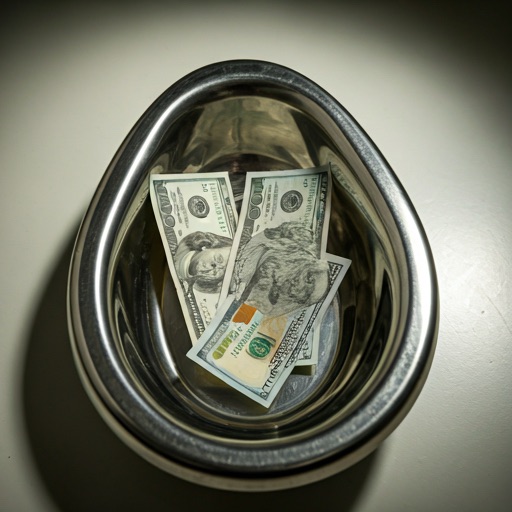
You would think that would be persuasive enough, but we have to mention “the economic burden.” But it’s sadly true. If a patient is treated multiple times for the same preventable condition, that’s money down the drain. Or bedpan.
(Bedpan image from Google Gemini)
But there’s a big hole in adherence measurement.
Adherence measurement
Let’s say you are told to take 4 pills a day for 7 days, and the pharmacy gives you a prescription for 28 pills. A week later all the pills are gone.
Does this demonstrate patient adherence to health instructions?
Absolutely not.
Maybe you flushed all 28 pills down the toilet and didn’t ingest a single one.
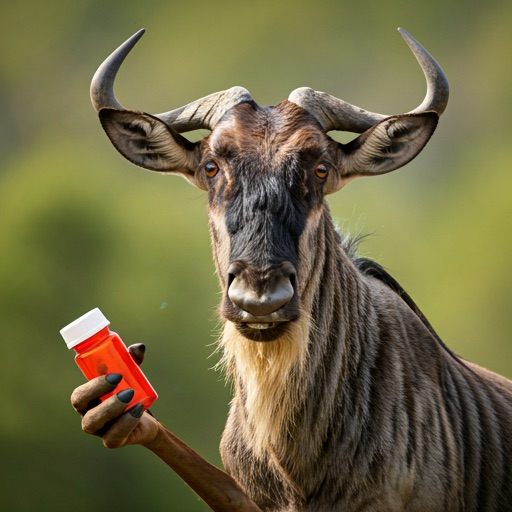
Or maybe you have been giving some pills to your wildebeest.
(Medicated wildebeest image from Google Gemini)
In the ideal world, you would want to ensure that the medication was taken by the correct patient, not by a toilet or a wildebeest.
When adherence identity is important
I will grant that this is ridiculous for a vitamin.
But what about a chemotherapy drug? How will you know that the right patient is taking it and adhering to the medical plan?
Healthcare identity verification and authentication is often substandard, as I noted in a prior Bredemarket blog post entitled “Medical Fraudsters: Birthday Party People.” In too many cases, all you need to know is a patient’s name and birthdate to obtain fraudulent access to the patient’s protected health information (PHI).
But healthcare providers need to identify more than just patients. Providers need to identify their own workers, as well as other healthcare workers.
Know Your Visitor
Healthcare providers also need to identify visitors. When a patient is in a hospital, a rehabilitation facility, or a similar place, loved ones often desire to visit them. (So do hated ones, but we won’t go there now.)
I was recently visiting a loved one in a facility that required identification of visitors. The usual identification method was to present a driver’s license at the desk. The staffer would then print out a paper badge showing the visitor’s name and the validity date.
Like this…
John Bederhoft?
So John “Bederhoft” (sic) enjoyed access that day. Whoops.
Oh, and I could have handed my badge to someone else after a shift change, and no one would have been the wiser.
Let’s apply “somewhat you why”
There’s a more critical question: WHY was John “Berdehoft” visiting (REDACTED PHI)? Was I a relative? A friend? A bill collector?
My proposed sixth factor of identity verification/authentication, “somewhat you why,” would genuinely help here.
Somewhat you why “applies a test of intent or reasonableness to any identification request.”
Maybe I should have said “and” instead of “or.”
Visiting a relative shows intent AND reasonableness.
Visiting a debtor shows intent but (IMHO) does NOT show reasonableness.
Do you need to analyze healthcare identity issues for your healthcare product or service? Or create go-to-market content for the same? Or proposals?
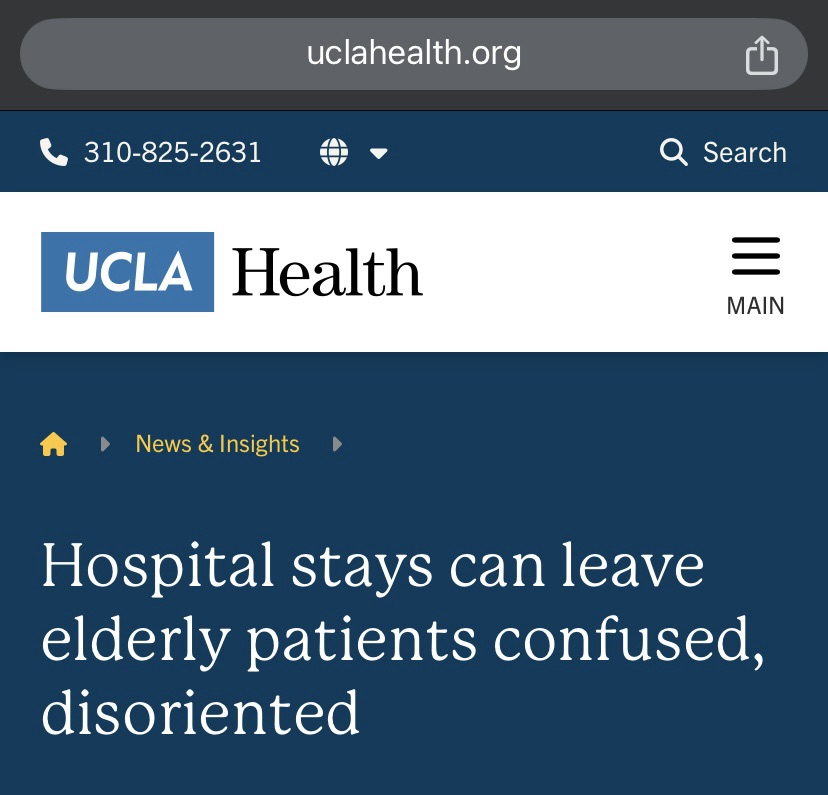
Until recently I had never heard of hospital-acquired delirium before. From UCLA Health:
“(T)he type of confusion you describe isn’t unusual in older adults who have been hospitalized. Sometimes referred to as hospital-acquired delirium, it’s a temporary but severe form of mental impairment that affects up to one-third of patients over the age of 70, particularly those undergoing surgery or those in intensive care. The condition is marked by periods of confused thinking, jumbled memory, difficulty understanding speech, agitation, disorientation and even hallucinations.
“The duration of hospital-acquired delirium can be as brief as a few hours or…can continue for several days.”
Most of you who developed a sudden interest in healthcare this week WON’T be interested in this, so move along.
I’ve added 3 new posts (so far) to the Bredemarket Health page since November 2024:
Dr. Jones MD, NPE
Saving Money When Filling Prescriptions: Not You, The Companies
Medical Fraudsters: Birthday Party People
(And no, I have no real interest in addressing the recent murder of a healthcare executive. It’s a crime. End of discussion.)
I approach health and health product marketing from both an identity and technology perspective, recognizing the similarities and differences between biometrics and biometrics, and between PHI and PII.
For example, I could call a medical provider or go to a pharmacy and say that my name is Donald John Trump.
Do you know how many medical practitioners verify identities?
By asking for the person’s birthdate.
So there is the possibility that a medical practitioner, after I say that I am Donald John Trump, will simply ask for my birthday without a second thought.
I would reply “June 14, 1946.”
And some of these medical practitioners would immediately grant access!
Of course, the number of successful fraudulent accesses goes up substantially when the real person is NOT well known.
Yet birthdates are considered an acceptable form of security in some parts of the medical world.
Healthcare is complicated. When most of us receive prescriptions from our doctor, either the doctor gives us a physical slip of paper with the prescription, or the doctor electronically sends the prescription to your pharmacy of choice. After that, you deal with the pharmacy yourself. Normally it goes smoothly. Sometimes it doesn’t.
Maybe the patient’s insurance company doesn’t cover the prescription, or charges an exorbitant price for it.
Maybe the patient never picks the prescription up. (The industry term is “adherence.”)
There are a lot of companies that want to help drug companies, physicians, and others make this process more seamless and less costly (for example, by maximizing gross-to-net, or GTN).
How many companies want to help? One afternoon I estimated that 30 companies are in this market. Based upon past experience in the identity verification industry (namely, all those battlecards my team created), this means that there are probably really more than 100 companies in the market.
While the companies obviously have to please the patients who need the prescriptions, they’re not critically important because the patients (usually) don’t pay the companies for the improved service.
So the companies have to sell others on their services.
Alto Technologies: “Alto Technologies’ configurable platform integrates hub and dispensing capabilities into an automated and seamless single service provider solution that improves patient experience and reduces administrative burden.”
Medisafe: “Patient support begins with onboarding and continues throughout treatment, with intuitive guidance throughout every encounter. From initial prescription to benefits investigation and authorization to shipment tracking, patients receive streamlined support with educational information and real-time updates.”
Phil: “Streamline medication access for your patients and providers. Our digital hub platform empowers retail and specialty-lite manufacturers with an alternative channel solution…”
Truepill: “Whether you’re an established brand looking to reach your patients directly, or an emerging company planning your go-to-market strategy, Virtual Pharmacy is the digital pharmacy solution built to scale.”
I have a telehealth appointment next week with a medical professional whom I have previously met. And I assume she will participate in the telehealth appointment.
In the future, of course, she may not.
Way back in April 2013, I wrote a tymshft piece entitled “You will still take a cab to the doctor’s office. For a while.” It speculated about a future 2023 medical appointment in which the patient took a driverless cab to a medical facility. In the office, the patient was examined by remote staff…or so she thought.
“Well, I’m glad you’ve gotten used to the procedure,” replied the friendly voice. “I hope you like me!”
“I do,” said Edith. “You’ve been very helpful. But I’ve always wondered exactly WHERE you were. If you were in Los Angeles, or in Mississippi, or perhaps in India or China, or perhaps even in one of the low-cost places such as Chad. If you don’t mind my asking, exactly where ARE you?”
“I don’t mind answering the question,” replied the friendly voice, “and I hope you don’t take my response the wrong way, but I’m not really a person as you understand the term. I’m actually an application within the software package that runs the medical center. But my programmers want me to tell you that they’re really happy to serve you, and that Stanford sucks.” The voice paused for a moment. “I’m sorry, Edith. You have to forgive the programmers – they’re Berkeley grads.”
“Oh,” said Edith after a moment. “This is something new. I’m used to it in banking, but I didn’t realize that a computer program could run an entire medical center. Well…who picks up the trash?”
“That’s an extra question! Just kidding,” replied the friendly voice. “Much of the trash pickup is automated, but we do have a person to supervise the operation. Ron Hussein. You actually know him – he was your cab driver in 2018 when you came here.”
Re-reading this 2013 piece, I was amused at three things I got wrong.
First, Google, Facebook, and Apple did NOT merge to form Gaceapple, “the important merger that saved the tech industry in the United States from extinction.” American tech firms are still powerful…for now.
Second, my assumption of cab companies adopting driverless cars assumed the continued existence of cab companies. Ride share services have reduced the presence of traditional companies dramatically.
Third, my assumption that medical firms would sink untold sums of money into centralized automated medical examination rooms could be questioned…especially for routine appointments like Edith’s. Why not just let Edith’s smartphone—perhaps with a single attachment—gather the data?
Of course, there are medical ethics questions that underlie this entire discussion of remote telehealth and the use of non-person entities (NPEs). And we are struggling with those right now.
In my circles, people generally understand ‘biometrics’ to refer to one of several ways to identify an individual.
But for the folks at Merriam-Webster, this is only a secondary definition of the word “biometrics.” From their perspective, biometrics is primarily biometry, which can refer to “the statistical analysis of biological observations and phenomena” or to “measurement (as by ultrasound or MRI) of living tissue or bodily structures.” In other words, someone’s health, not someone’s identity.
Fun fact: if you go to the International Biometric Society and ask it for its opinion on the most recent FRVT 1:N tests, it won’t have an answer for you.
So Abbott salespeople, real or imagined, won’t be interested in what I’ve been doing for the last 30 years. ‘Cause you know sometimes words have two meanings.
But those of you who use biometrics (and other factors) for individualization WILL be interested. Click on the image to find out more.
Drive content results with Bredemarket Identity Firm Services.
As Identity and biometrics solution providers know, their applications are found in a variety of vertical markets.
A LARGE variety of vertical markets.
Seven of these markets include financial services, travel and hospitality, government services, education, health, criminal applications, and venues. (Among others.)
Which three vertical markets does the Prism Project examine?
To start this post, I’m going to cheat and “appropriate” the work already performed by the Prism Project.
This effort is managed by Maxine Most’s Acuity Market Intelligence and supported by a variety of partners (including industry partners).
The Prism Project has identified 3 (so far) critical vertical markets for identity and biometrics. While this doesn’t pretend to be a comprehensive list, it’s a good starting point to illustrate the breadth of markets that benefit from identity and biometrics.
The Prism Project has already released its report for financial services, which businesses can download here.
The Prism Project has started to develop its report for travel and hospitality. You can preview the report here.
Finally, the Prism Project plans to release a report addressing government services later in the year. For the latest status of this report, visit the Prism Project home page.
As you can see, identity and biometrics apply in wildly diverging vertical markets. You can use identity verification to open a bank account, enter your hotel room, or pay your taxes.
But those aren’t the only markets that use identity and biometrics.
Let me school you on two other markets, education and health
Let’s look at two markets that the Prism Project hasn’t covered…yet.
Education
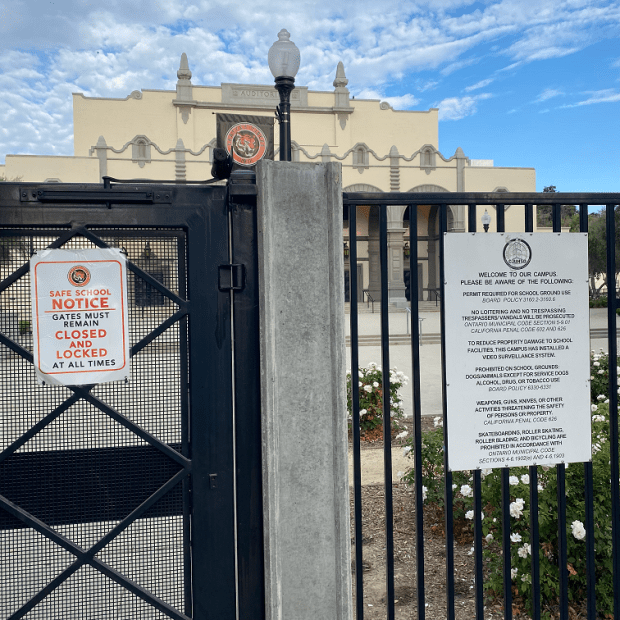
Chaffey High School, Ontario, California.
Another example of a market that uses identity and biometrics is the education market.
Who is allowed on a physical campus? Students? Teachers? Staff? Parents and guardians?
Who is NOT allowed on a physical campus? Expelled students? Fired faculty and staff?
Who is taking that remotely-administered online test?
Bredemarket has written several posts about educational applications for identity and biometrics. You can read all my education writing on Bredemarket’s “Educational Identity” information page.
Health
What, did you expect me to post a Marcus Welby picture here? I’m sharing a real medical professional: Jonas Salk administering the polio vaccine. By Yousuf Karsh, photographer – Wisdom Magazine, Aug. 1956 (Vol 1, No. 8), PD-US, https://en.wikipedia.org/w/index.php?curid=27746788.
Similarly Bredemarket has written several posts about healthcare applications for identity and biometrics, including some that dwell on the unique privacy legislation that covers healthcare. You can read all my health writing on Bredemarket’s “Health” information page. (It’s not called “Health Identity” because healthcare has both identity and technology aspects.)
Another source on finance
By the way, Bredemarket also has a page on “Financial Identity,” but the Prism Project’s content is more comprehensive.
But wait…there’s more!
So this is the point where Ed McMahon intones, “So Acuity Market Intelligence and Bredemarket have identified all five of the markets that benefit from the use of identity and biometrics!”
So let’s look at two more markets that benefit from the use of identity and biometrics-two markets that I know very well from the beginning and end of my time at Printrak/Motorola/MorphoTrak/IDEMIA.
Criminal applications
There are government services, and then there are government services.
I started my biometric journey over 29 years ago when I wrote proposals addressed to law enforcement agencies who wanted to find out who left their fingerprints on a crime scene, and whether the person being arrested was who they said they were.
I don’t know if Maxine Most is going to classify criminal applications as a subset of government services, but there are clear reasons that she may not want to do this.
When you pay your taxes or apply for unemployment benefits, you WANT the biometric system to identify you correctly.
When you steal a car or rob a bank, you do NOT want the biometric system to identify you correctly.
Big difference.
Stadiums, concert halls, and other venues
If someone asked me in late 2019 what my career five year plan was, I would have had a great story to tell.
As I was wrapping up over 24 years in identity and biometrics, I was about to help my then-employer IDEMIA enter a new market, the venue market. This market, which CLEAR was already exploring at the time, replaced the cumbersome ticketing process with the use of frictionless biometrics to enter sports stadiums, concert halls, trade shows, and related venues. Imagine using your face or IDEMIA’s contactless fingerprint solution MorphoWave to enter a venue, enter secure restricted areas, or even order food and beverages.
Imagine the convenience that benefit consumer and venue operator alike.
What could go wrong? I mean, the market was robust, and we certainly would NEVER face a situation in which all the stadiums and all the concert halls and all the trade shows would suddenly close down.
Since early 2020 when a worldwide pandemic DID shut down a lot of things, many identity/biometric firms have entered the venue market with a slew of solutions to benefit fans, teams, and venues alike.
And still more
There are many more vertical markets than these seven, ranging from agriculture to automobile access to computer physical/logical access to construction to customer service (mainly voice) to critical infrastructure to gaming (computer gaming) to gaming (gambling) to the gig economy to manufacturing to real estate to retail to telecommunications to transportation (planes, trains, buses, taxis, and cruise ships).
And all these markets have a biometric story to tell.
Can Bredemarket help you describe how your identity/biometric solution addresses one or more of these markets?
The FBI and others are letting us know that June 3 through June 9 is Medicare Fraud Prevention Week. Pro Seniors:
Fraud costs Medicare an estimated $60 billion per year. It costs Medicare beneficiaries in time, stress, their medical identities, and potentially their health. It costs families, friends, and caregivers in worry and lost work when helping their loved ones recover from falling victim to Medicare fraud.
Of course my primary interest in the topic is ensuring that only the proper people can access Medicare data, preferably through a robust method of identity verification that uses multiple factors.
Not multiple modalities, especially ones that are well-known such as your Social Security Number and your mother’s maiden name.
Multiple factors, such as your government-issued driver’s license, your biometrics, and your geolocation.
For more information, see what these vendors are saying about using biometrics to counter healthcare fraud attempts.










 Bredemarket