

There are still a number of hours left in the week, but so far these are the biggies that I wrote (or, in one case, Bredebot wrote).
Tag Archives: blog
The Power of Scheduled Posts

Establish your presence without your presence. Any time. While living your life.
Drew Mabry Recommends a Human in the Loop: Trust Me, It’s Critically Important
I’m conducting an experiment in which an AI bot, “Bredebot,” is writing on the Bredemarket blog and on LinkedIn with almost no restrictions.
Don’t do this at home. It’s not a good idea.
This post describes an example in which Bredebot misses a critically important point about Bredemarket’s target audience in the identity/biometric industry.
Bredebot reacts to Drew Mabry
Earlier today, I asked Bredebot to write a post analyzing a Drew Mabry quote:
“The true competitive advantage isn’t the Al tools themselves but how you use them. Your unique processes for data capture, knowledge management, and building trust are the real ‘moat.’ Al becomes powerful when it’s integrated with your proprietary insights and context, making your approach impossible to replicate.”

Mabry also advocates including a human in the loop: his firm, Fast + Light, always asks at least one human (preferably two) to review all AI-generated content.
In my Bredebot experiment, I rarely edit what Bredebot says. If you know me, it’s very obvious that Bredebot wrote this and I didn’t.
“Building Trust: In the identity and biometrics space, trust isn’t just a nice-to-have; it’s paramount. If customers don’t trust you with their most sensitive data, you simply don’t have a business. Your processes for privacy, security, transparency, and ethical AI usage are not just compliance requirements; they are fundamental differentiators. How you communicate these efforts, how you manage data breaches (heaven forbid!), and how you constantly reinforce your commitment to security are all part of this trust-building moat. This is where your wombat customers, usually burrowing away, will emerge to praise (or criticize) your efforts.”
While I certainly agree with the sentiment, and obviously don’t mind the reference to wombats, I would have made one change.
The t word
I would have modified Bredebot’s use of the T word. Just because Mabry used it doesn’t mean that Bredebot has to do the same.
Why not? Because the word “trust” is massively overused in the identity/biometric industry. So much so that you can’t tell one company from another.

“Now perhaps some of you would argue that trust is essential to identity verification in the same way that water is essential to an ocean, and that therefore EVERYBODY HAS to use the t-word in their communications.
“Don’t tell that to Black Ink Tech, who uses the trademark ‘Truth Over Trust.’
“And no, they didn’t violate any law by using an unapproved word. Instead, they got attention by standing out from the crowd.”
And identity/biometric firms are the primary hungry people (target audience) for the Bredemarket blog.
So I definitely would have edited that paragraph.
So why didn’t I?
Changing the subject
I’m going to dodge that question by asking you one.
Do you need an experienced human to help your identity, biometric, or technology organization product marketing?
- Strategy and/or tactics?
- Content and/or proposals and/or analysis?
Visit this page to set up a free meeting with Bredemarket. I’ll ask some questions to get things moving.
An IMEI Number Is NOT Unique to Each Mobile Phone

(Imagen 3)
Have you ever used the phrase “sort of unique”? Something is either unique or it isn’t. And International Mobile Equipment Identity (IMEI) numbers fail the uniquness test.
Claims that International Mobile Equipment Identity (IMEI) numbers are unique
Here’s what a few companies say about the IMEI number on each mobile phone. Emphasis mine.
- Thales: “The IMEI (International Mobile Equipment Identity) number is a unique 15-digit serial number for identifying a device; every mobile phone in the world has one.”
- Verizon: “An IMEI stands for International Mobile Equipment Identity. Think of it as your phone’s fingerprint — it’s a 15-digit number unique to each device.”
- Blue Goat Cyber: “In today’s interconnected world, where our smartphones have become an indispensable part of our lives, it is essential to understand the concept of IMEI – the International Mobile Equipment Identity. This unique identifier plays a crucial role in various aspects of our mobile devices, from security to tracking and repairs.”
These and other descriptions of the IMEI prominently use the word “unique.” Not “sort of unique,” but “unique.”
Which means (for non-person entities, just like persons) that if someone can find a SINGLE reliable instance of more than one mobile phone having the same IMEI number, then the claim of uniqueness falls apart completely.
Examples of non-uniqueness of IMEI numbers on mobile phones
People who claim IMEI uniqueness obviously didn’t read my Bredemarket blog post of April 1, in which I WASN’T fooling.
- I talked about an incident in India in which a cyber fraud operation “specialised in IMEI cloning.”
- And an incident in Canada in which someone was scammed out of C$1,000, even though the phone had a valid IMEI.
IMEICheck.net even tells you (at a high level) how to clone an IMEI. It’s not easy, but it’s not impossible.
“In theory, hackers can clone a phone using its IMEI, but this requires significant effort. They need physical access to the device or SIM card to extract data, typically using specialized tools.
“The cloning process involves copying the IMEI and other credentials necessary to create a functional duplicate of the phone. However, IMEI number security features in modern devices are designed to prevent unauthorized cloning.”
So don’t claim an IMEI is unique when there is evidence to the contrary. As I said in my April post:
“NOTHING provides 100.00000% security. Not even an IMEI number.”
What does this mean for your identity product?
If you offer an identity product, educate your prospects and avoid unsupportable claims. While a few prospects may be swayed by “100%” claims, the smarter ones will appreciate more supportable statements, such as “Our facial recognition algorithm demonstrated a 0.0022 false non-match rate in the mugshot:mugshot NIST FRTE 1:1 laboratory testing.”
When you are truthful in educating your prospects, they will (apologizes in advance for using this overused word) trust you and become more inclined to buy from you.
If you need help in creating content (blog posts, case studies, white papers, proposals, and many more), work with Bredemarket to create the customer-focused content you need. Book a free meeting with me.
But Blogs Are Transitory

By Sunday, my earlier mention of Orlando will make no sense. There will be some other niche conference going on, and the IAI folks will be back at their home agencies, resuming work.
While some blogs are evergreen, many are transitory and only live in the moment.

How to Increase Awareness of Your Company’s Offerings With Blog Posts (A Repurpose)

How can blog posts increase the awareness of your identity/biometric or technology company’s products and services? I’m going to explain how in this blog post.
By the way, this is a rewrite of my more technical Tuesday blog post “How Can Your Technology Company Increase Product Benefit Awareness Right Now?” Because you can rewrite blog posts when you feel like it.
Why a funnel?
Imagine there’s a funnel. It’s easy if you try. But this funnel doesn’t stream water, but people. (Or wombats.)

In this funnel, the people (or wombats) who are potentially interested in your offering—your prospects—start at the very top. The few who actually buy your offering emerge from the bottom.
But how do you get people to enter the funnel and become aware of your offering?
How can blog posts help you?
One great way to let people know about your offering is by blog posts such as this one.
Blogs are a fast way to tell your prospects how your offering can help them. And you can create blog posts very quickly, within days or even hours.
If you want to make prospects aware of your company’s service, write a blog post.
What can Bredemarket offer to you?
One of Bredemarket’s offerings is…writing blog posts for other companies. I can help your identity/biometric or technology company write blog posts so you can get more people to learn about your services.
If you want to learn how I can help your company write blog posts, visit bredemarket.com/mark.
How Can Your Technology Company Increase Product Benefit Awareness Right Now?

(Imagen 4.)
Do your technology company’s prospects know about you?
How can your technology company increase product benefit awareness right now?
(“Right Now” is a song. Keep tuned for another song reference.)
Before showing you how to do this, let’s take a closer look at three words in the title: product, benefit, and awareness.
Then we’ll get into the how: have, know, write, and publish.
And one more “how” if blogging is hard.
Three words break the code of indifference
No apologies for the section heading, but since her dad died, Kelly Osbourne’s best song (albeit with a curious history) has been on my mind.
While Osbourne’s one word breaks the code of silence, the three words that I chose for my post title break the code of indifference. And I chose each of them—product, benefit, and awareness—carefully.
Word One: Product
Companies talk about a lot of things. Their “why” story. Their great place to work award. Their social/moral/ethical conscience.
Right now I don’t care about any of that. I care about the company’s products or services: the way they make money.

Because if prospects don’t buy these products and become customers, then their why story and awards and conscience count for zilch. There’s a time to share those stories, but for now let’s focus on the product story.
Word Two: Benefit
Now once you look at those products, they have a bunch of features. The ability to capture fingerprints at 1,000 pixels per inch. The ability to complete a third-party risk management analysis in hours, not months. The ability to deliver a completely vetted blog post in days, not weeks.
Right now I don’t care about any of that. I care about the benefits the product brings to the prospect: the things that will make them become a customer.

Because prospects don’t care about you; they only care about themselves. And if your product doesn’t provide tangible benefits to them, they’ll ignore it.
Word Three: Awareness
The third word differs from the other two, because there are multiple answers that are equally valid. I’ve just chosen to focus on one. If you subscribe to the notion of an ordered funnel (some marketers instead believe in a messy middle), then all prospects enter at the beginning of the funnel, and a subset of those prospects exit as buying customers at the end of the funnel. Using a simple three-stage funnel model, you can define those three stages as awareness, consideration, and conversion.
Right now I don’t care about consideration or conversion, although they’re obviously important. (If you have no conversions, you have no revenue, and you have no company.) For my purposes I’m focusing on awareness, or the stage in which a prospect discovers that your company has a product or service that benefits them.

So how can you raise awareness of the benefits of your product to your prospects? There are multiple methods: text, images, videos, quizzes, contests, webinars, and podcasts. Bredemarket uses many of these methods via its social media channels. But today I’m going to focus on one particular method: blog posts. But we’ll cover some of the other ones also.
One blog breaks the lack of knowledge
The reason that I’m so gung-ho about blog posts is that they can be created and distributed very quickly. Press releases can take a long time. Videos, even longer. Webinars, even longer still.
Compare that to a blog post. A sole proprietor can generate a blog post in an hour. A company can get an emergency blog post out in the same time, provided the right people are in the room.
But before you can wow the world with your product’s benefits to your prospects, you have to go through several steps. The four steps listed here (have, know, write, and publish) are somewhat, but they paint the broad brush strokes.
Step One: Have a blog site (or equivalent)
This sounds obvious, but if you don’t have a blog site, you can’t post a blog.
Using myself as an example, my Bredemarket website is hosted by WordPress. And the website has an area where I’ve filed over a thousand blog posts, including this one.

What if you don’t have a blog, or even a website? Create a LinkedIn business page or a Facebook business page or something similar and start writing there.
Step Two: Know what you’re going to say, and why you’re saying it (I ask…)
I could spend ten blog posts talking about this step alone. It’s a loaded step encompassing both strategic and tactical elements. Vision. Mission. Positioning and messaging. And finally, the topic that you want to address in this single blog post.
For now I’ll just say that you should take a deep breath before putting pen to paper (or keyboard to file).

I ask. (Here are some good questions to ask before you write something.)
Step Three: Write and rewrite what you want to say (…then I act)
I ask, then I act.
But I act iteratively.
In most cases, I don’t just write and post.
- I often create what I call a “draft 0.5,” where I get my ideas down, sleep on them, and then take a fresh second look. Often during that second look I cut out half the text.
- When working on a project for a Bredemarket client, the text bounces between me and the client. I’ll write the first draft, then the client will review it and offer suggestions, and then I’ll rewrite it. For shorter text I’ll usually have two review cycles, with three review cycles for longer text.
The important thing is to get the piece written, reviewed, and approved. While I’ve drafted pieces and sat on them for months, the true benefits of blogging occur when you publish the piece as soon as possible.
Step four: Publish and publicize
When you’re ready, publish the blog post.
- Perhaps you want to schedule the post to appear at an optimum time. For example, I am typing these words (or draft 0.5 of them anyway) on Sunday afternoon, knowing full well I won’t post this on Sunday afternoon. I’m thinking Tuesday morning.
- And maybe there’s a reason why you want to publish a post at a particular time. If a trade show begins on Monday September 15, you may want to publish the promotional blog post on Friday September 12.
Once you’ve posted, publicize it.
- If your company has an array of social media channels, you have two choices. Either you can post a link to the blog post on the social channel, or you can encapsulate the message from the blog post and repurpose it for the social channel without linking externally. Whatever gets the message out.
- Taking an example from myself, I created a video entitled “Landscape (Biometric Product Marketing Expert)” on Sunday morning. I shared this video in a blog post. I also shared it in social media posts on Bluesky, Facebook, Instagram, LinkedIn, Substack, Threads, TikTok, WhatsApp, and YouTube. The only current social channels where I didn’t share it were Flip (because it’s…landscape). If I wanted to, I could have assembled a video or created a podcast or hosted a webinar. Oh, and I’m sharing it again. (Right now.)
Depending upon your thinking time, your drafting time, and your review cycles, you can get your message out to your prospects within a week…or even within a day.
Not too bad.
But I can’t do all that!
For some people, the idea of writing a blog post can be overwhelming.
That’s why Bredemarket is here to help you increase your tech company’s product benefit awareness. (Right now.)
If you have a blog site (or a LinkedIn, Facebook, or other equivalent) and are ready to get your message out, let’s talk about next steps.
Taking a Blogging Nap

(Imagen 4)
For the last several months Bredemarket has been blogging daily.
Until now.
Today I’m taking a Sunday blogging nap. (Not to be confused with an Instagram nap.)

Whoops…guess I didn’t.
Well, as long as I’m here, I will share a video for your Sunday viewing pleasure.
Painting a Picture: The Content Challenges of a Biometric Chief Marketing Officer

(Imagen 4)
If this reads odd, there’s a reason.
Imagine a Chief Marketing Officer sitting at her desk, wondering how she can overcome her latest challenge within three weeks.
She is a CMO at a biometric software company, and she needs someone to write the first two entries in a projected series of blog posts about the company’s chief software product. The posts need to build awareness, and need to appeal to prospects with some biometric knowledge.
So she contacts the biometric product marketing expert, John E. Bredehoft of Bredemarket, via his meeting request form, and schedules a Google Meet for the following meeting.
At the scheduled time she joins the meeting from her laptop on her office desk and sees John on the screen. John is a middle-aged Caucasian man with graying hair. He is wearing wire-rimmed glasses with a double bridge. He has a broad smile, with visible lines around his eyes and mouth. His eyes are brown and appear to be looking directly at the camera. He is wearing a dark blue collared shirt. While his background is blurred, he appears to be in a room inside his home, with a bookcase and craft materials in the background.
After some pleasantries and some identity industry chit chat, John started asking some questions. Why? How? What? Goal? Benefits? Target audience (which he called hungry people)? Emotions? Plus some other questions.
They discussed some ideas for the first two blog posts, each of which would be about 500 words long and each of which would cost $500 each. John pledged to provide the first draft of the first post within three calendar days.
After the call, the CMO had a good feeling. John knew biometrics, knew blogging, and had some good ideas about how to raise the company’s awareness. She couldn’t wait to read Bredemarket’s first draft.
If you are in the same situation as the CMO is this story, schedule your own meeting with Bredemarket by visiting the https://bredemarket.com/mark/ URL and filling out the Calendly form.
Remember how I warned you that this post was going to read odd? In case you’re wondering about the unusual phrasing—including a detailed description of what I look like—it’s because I fed the entire text of this blog post to Google Gemini. Preceded by the words “Draw a realistic picture of.” And here’s what I got.



Publish That Blog Post Now

(Imagen 4)
Publish that blog post now. Why wait?
Unless you have no intention of ever publishing anything. If that’s the case, it would be a waste of your time to read another word of THIS blog post.

OK, who is left?
Maybe there’s another reason you didn’t publish that blog post yet.
Perhaps you never wrote the blog post in the first place.
If that’s your problem, I will now provide you with the Bredemarket 42 step process to generate that blog post.
I kid, of course. You only need two steps.
- Ask.
- Act.
Bredemarket is expert at both asking and acting, equipping my clients to get the right message out and to do it now.
Not six months from now.
After all, I’m incentivized to perform your marketing writing with both accuracy and speed. I want your approval…and your revenue.
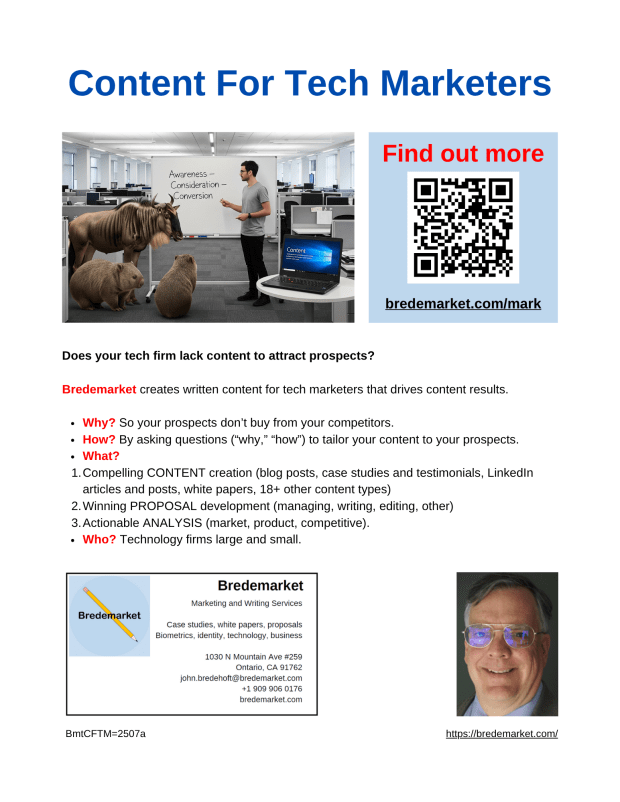
So go to my “Content for tech marketers” page, read about Bredemarket’s services, and book a free 30 minute meeting with me to discuss your content needs.
Content for tech marketers: https://bredemarket.com/mark/
 Bredemarket