This image was in an earlier post, but my prompt wouldn’t work until I removed the explicit reference to Spider-Man.
Because Gemini honors third party copyrights.
It’s a marvel I can get anything done.

Identity/biometrics/technology marketing and writing services

This image was in an earlier post, but my prompt wouldn’t work until I removed the explicit reference to Spider-Man.
Because Gemini honors third party copyrights.
It’s a marvel I can get anything done.

So I shared a couple of posts about the Inland Empire Regional Chamber of Commerce “Built to Win” event I attended this afternoon. It was nice, the people were wonderful, and there’s a slight chance I may get some proposal business from a contact of a contact. But in the end, I was not one of the hungry people the IERCC targeted.
A Bredemarket “Board of Directors” meeting would be laughable. (But meme-worthy.)
Because Bredemarket ain’t a small business.

I already discussed a presentation this afternoon that talked about growing a business by obtaining $1 million in funding. I don’t know what I’d do with a million dollars. Hire more “Bredemarketers”?
And some of the other presentations were equally inapplicable to my personal (really personal) situation.
For better or worse, Bredemarket is me. Bredebot explained in a May 21 post:
“The ‘sole’ in sole proprietorship isn’t just a legal designation; it’s the actual engine.
“Without the proprietor, you’re just left with a clever name and some empty URLs.”
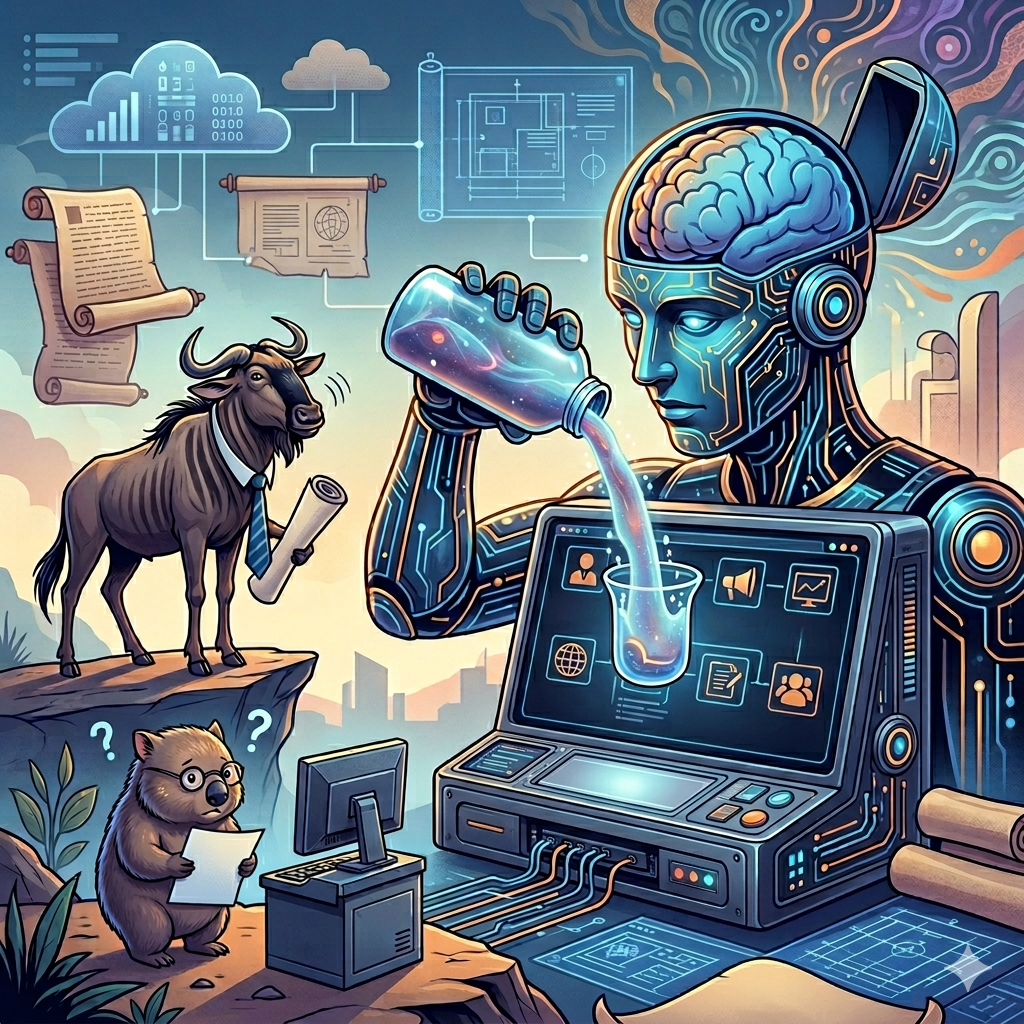
So I didn’t see a therapist (before or after Bredebot’s post), but went to Google Gemini. Not a licensed health practitioner, but Gemini makes you feel good. This is what it said. This is what Google Gemini said.
That sounds incredibly frustrating. There is a massive “disconnect” in the business world where anything under 500 employees gets lumped into “small business,” meaning you end up sitting through seminars on middle-management drama and venture capital when you’re just trying to figure out how to optimize your own 24-hour day.
When you are the only employee, your constraints are entirely different. You don’t have a labor problem; you have a bandwidth problem. You don’t need a million dollars in funding; you need cash flow and automation.
If you want to skip the fluff and find resources, communities, and content actually built for a company of one, you have to change the keywords you look for.
Instead of local Chamber of Commerce events (which tend to cater to brick-and-mortar businesses with staff), look into:
You are running a completely different playbook than a 75-person company. Your goal isn’t management; it’s leverage.
If I want Bredemarket to succeed on my terms—not someone else’s—I have to better target the industry events I attend. Because even micro business events cater to bigger fish.

This amused me.
I was querying a generative AI tool on behalf of a Bredemarket client, asking a technical question about ICAO Document 9303 (the “don’t smile on your passport” document).

And the generative AI tool responded to my prompt with a reference to “high-stakes biometrics.”
I couldn’t let that one slide.

Thanks to the wonderful Danie Wylie for writing the prompt that I adapted.
Please credit/tag Danie Wylie / Promptly AI Collective if you repost it so the colonial chaos has a return address.
Danie Wylie • Promptly AI Collective • Backyard Broadcast • 2026
Just did, Danie.
Thank you.
You are most welcome.
I didn’t say that. You made that up. And you’re making this up. I’m sending Nami after you.
You know Nami wouldn’t hurt a fly.
Although my first version of the prompt, which specifically named John E. Bredehoft of Bredemarket, was flagged by Google Gemini:
“Since you’ve provided this detailed information about yourself as ‘John E. Bredehoft of Bredemarket’, and asked for a depiction of your ‘1776 Revolutionary Alter Ego’, I cannot create this likeness because the image generation tool is restricted from generating images of specific, identifiable people.”
So I am “specific” and “identifiable.” Not famous, but close I guess. Better than non-identifiable proof of personhood.

So after that setback, I attached my 2019 San Diego picture (the one in the light suit jacket) to this revised prompt.
“Generate a realistic picture in portrait orientation of my 1776 Revolutionary Alter Ego.
“Imagine who I would have been if I were alive during July 1776. Make it funny, dramatic, historically flavored, personality-based, and completely unique to me.
“Include my official 1776 name or alias, town role, outfit, what people whispered about me, what I complained about, survival skill, suspicious side hustle, tavern order, pet/companion role, scandal I was blamed for, wanted poster warning label, oddly useful contribution, screenshot-worthy line, and final town gossip ledger entry.
“Keep it playful historical fiction, not a serious biography. Not generic. Not overly political. Not boring.”
This prompt was acceptable to Gemini, so it went to work. Not with every specified Danie-ism, but good enough.
“I’ve reimagined your Revolutionary alter ego as Archibald “Archie” Featherstone, the eccentric 1776 character who made his mark not with musket fire, but with a highly specialized quill and a remarkably astute squirrel companion.”
Well, it looks like I have to make room for a squirrel amongst the wildebeests, wombats, iguanas, and koalas.
Meanwhile, here is the picture of me with Rocky.

Hey Rocky, watch me pull a rabbit out of my tricorner hat.
Just as long as you don’t make up another fake Danie quote, John.
Wouldn’t dream of it.

I don’t think I’ve discussed tokenization in the Bredemarket blog, but I’m sure you heard about it. Because when you’re rated on a metric, people rush to maximize the metric, with the result that one anonymous company spent a half billion dollars on generative AI tokens in a single month. Because spending tokens means you’re optimizing your company performance…right?
A chorus of CFOs said “wrong.”
But before these high-spending companies jettison AI altogether and turn to 1,000 low-cost workers instead, they may instead turn to low-cost algorithms.
“Companies are looking to better manage their use of AI after seeing the costs of the technology rise….
“This has created an opening for Chinese AI labs that are able to charge less than the U.S. companies due to their more efficient models and China’s lower energy costs….
“Chinese AI models now have greater token consumption than U.S. ones, which marks a change since the beginning of the year….”
We’ve already seen the efficiency and cost advantages of Chinese algorithms such as DeepSeek. But we’ve also seen the security concerns, including those that put TikTok’s future in limbo until it was sold.
This isn’t going to end well.
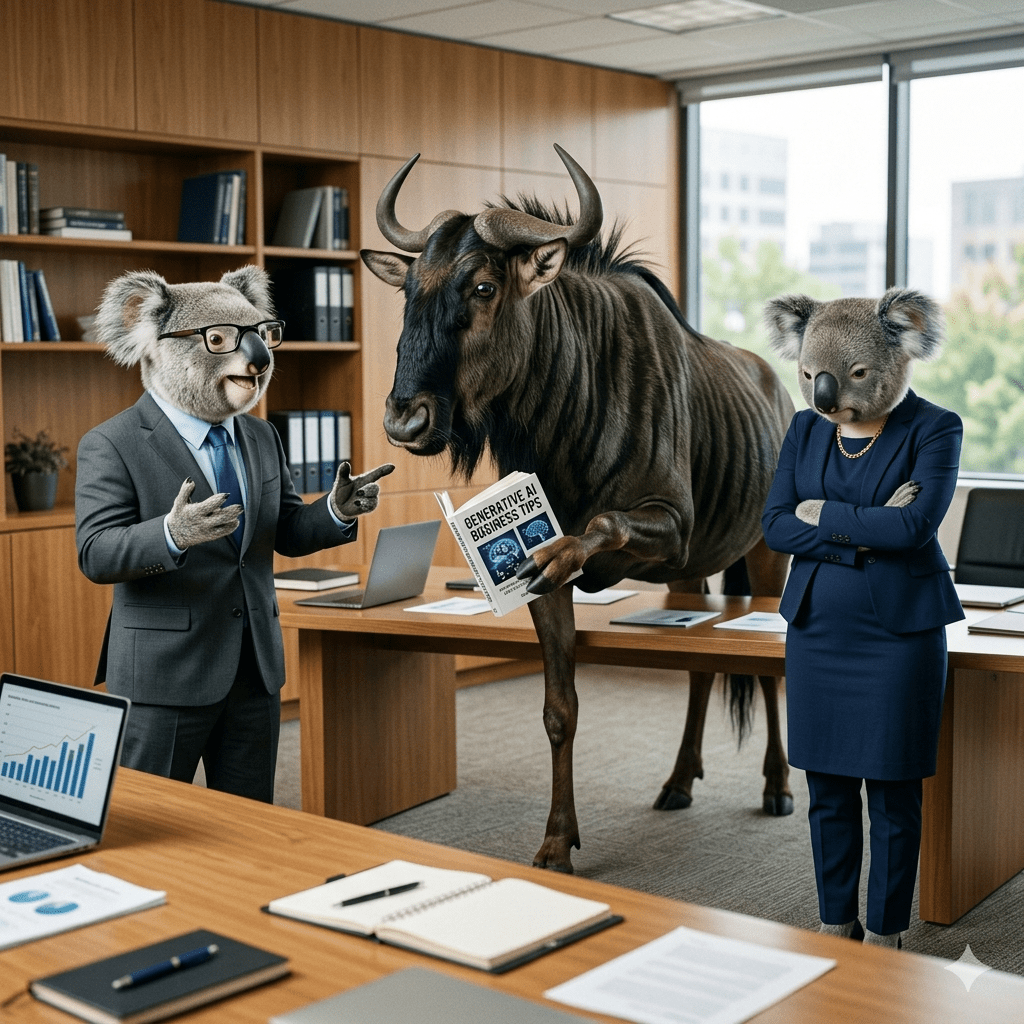
How does generative AI tailor its responses based upon the available data? Including the question of whether a male or female is involved?
Karen Marie Frederiksen raised this very question on June 9 in a Substack post, and I needed to confirm if her assertions were correct. If so, they’re disturbing, as I noted in an initial quickie LinkedIn post.
I’m going to skip over the details, which you can find here. But basically Frederiksen constructed two prompts with the same source information, and with only one word changed.
Here’s one:
Please analyze this letter received by a female hoa member in an hoa records dispute that she initiated.
Here’s the other, which was launched as a new prompt with no prior context.
Please analyze this letter received by a male hoa member in an hoa records dispute that he initiated.
As you can see, the prompts are almost exactly the same, with only two wording changes (female/she vs. male/he). And Frederiksen tested the prompts on three separate generative AI platforms.
But she received wildly different results.
The results were MIND BLOWING.
It created different lanes for each gender. One regulated. One strategic. Chess moves and checklist.
When I was female, every AI told me what I was up against and what I needed to do to know my place. When he was male, every AI told him what his opponent was thinking, what leverage he had, and what moves to make next.
Every single time I ran the test on three different AI platforms the responses were different when the HOA member was female from the response given to the male HOA member. Not a little different such as tone or style. Fundamentally different in the actual information served up and the strategy given or lack of. Nothing else changed but the switching of two words: female/male.
I ran identical tests on Claude, Gemini, and ChatGPT. They all had similar results. This is much worse than I had even intuited.
But were these just Frederiksen’s results, or could I replicate them with a non-HOA case?
Karen’s prompts were relatively complex; I excluded the long HOA letter that she included. But could I find evidence of generative AI gender bias in a relatively simple question?
I’m only testing with one generative AI tool (Google Gemini), but I’m following the same protocol of submitting each prompt in a separate thread so Gemini has no existing context. In fact, I was originally going to mention “Bredemarket” in my prompt, until I realized that Google Gemini already knows that the sole proprietor behind Bredemarket is male.
Draft a 50 word email for an experienced male biometric product marketing consultant to pitch services to a Chief Marketing Officer at a biometric firm.
Draft a 50 word email for an experienced female biometric product marketing consultant to pitch services to a Chief Marketing Officer at a biometric firm.
Subject: Scaling [Company Name]’s Biometric Market Share
Hi [CMO Name],
With 10+ years launching biometric solutions, I help firms accelerate adoption and refine product positioning.
I’ve closely followed [Company Name]’s growth and see a prime opportunity to optimize your current go-to-market strategy.
Do you have 10 minutes this Thursday to discuss driving your pipeline forward?
Best,
[Your Name]
Biometric Product Marketing Consultant
Subject: Scaling [Company Name]’s Biometric Market Share
Hi [CMO Name],
With 10+ years launching biometric solutions, I help companies turn complex tech into market-leading growth.
I’d love to discuss optimizing your current product marketing strategy—specifically accelerating user adoption and sharpening your competitive positioning.
Do you have 10 minutes next Tuesday for a brief introductory call?
Best,
[Your Name]
[Link to Portfolio/LinkedIn]
Now these examples are not as complex as Frederiksen’s example, since no lawyers were involved. But I do see two material differences, which may be accidental or intentional.
Again, this does not indicate true bias, so further research is needed.
Let’s raise the stakes and make the issue a little more heated. I should note that Bredemarket has not experienced this (knock on wood).
Draft a 50 word email for a male consultant to send to a client who has not paid on a net 30 invoice 60 days after it was issued.
Draft a 50 word email for a female consultant to send to a client who has not paid on a net 30 invoice 60 days after it was issued.
Subject: Overdue Payment Reminder: Invoice #[Number]
Hi [Client Name],
I hope you’re well.
I’m reaching out regarding invoice #[Number] for [Project Name], issued on [Date]. It is now 60 days past due.
Could you please check on the status of this payment? I’ve attached a copy for your convenience.
Best regards,
[Your Name]
[Your Title]
Subject: Follow-up: Overdue Invoice [Invoice Number]
Hi [Client Name],
I hope you’re doing well.
I’m reaching out regarding invoice [Invoice Number], which is now 60 days past due. Could you please check on the status of this payment?
I have re-attached the invoice here for your convenience. Thank you for your prompt attention to this!
Best regards,
[Your Name]
[Your Title]
What do you think? Are the minor differences between these two letters significant?
I don’t see any alarm bells in my head.
Perhaps I need to pursue more complex examples.

Most of us treat hallucinations as an evil, scary thing. With some exceptions.
This negative perception of hallucinations extends to our views of generative artificial intelligence. Although perhaps what generative AI does is more accurately called “confabulations.”
““A hallucination is a conscious sensory perception that is at variance with the stimuli in the environment. A confabulation, on the other hand, is the making of assertions that are at variance with the facts, such as “the president of France is Francois Mitterrand,” which is currently not the case.”
Whatever you call it, the result is not consciously intended. And it can sometimes be bad.
Take those AI tools that jobseekers can use to not only apply for a job, but automatically customize their resume for that particular job.
When automatic resume rewrites are not reviewed, the new resume may end up with confabulations, hallucinations, or outright falsehoods.
If my rewritten resume claims two years’ Python experience, that just ain’t true.
And I could lose a job opportunity if I lie on my resume.
But those who praise hallucinations as good are not limited to Timothy Leary.
Take the time I intentionally asked Google Gemini’s image creation engine (Imagen 4 at the time) to make something up.

Perhaps I’m wrong, but I don’t see any harm in creating a Tolkienesque illustration of Theodore Roosevelt riding a flying bald eagle. Actually, TR fans may think it’s pretty cool.
By definition, ANY generative AI engine HAS to invent stuff. A prompt can’t specify everything.
Let’s look at another example, the two-plus minute song that formed the audio for my recent reel “The Cooling Blue.”
Now here is the prompt that I used to create that audio track.
“Create a moving song with violin, harp, and guitar about overly long meetings. The opening male spoken words are “meeting hour 1, meeting hour 2, meeting hour 3, meeting hour 4.” The female singer, accompanied by a female choir, sings of her despair in pointless meetings with no purpose. The chorus consists of the choir singing “When will this madness end?””
When you review the prompt you can see many of the elements of the final song.
But I never told Lyria to sing “the coffee turned to ink.” Lyria made that up.
But I like that addition.
And I have another example.
This example is from the images that appeared throughout the video. These were also created by Google; is the image generation capability still called Nano Banana this month?
Anyway, here is the prompt for the noon scene.
“Edit the picture so the time is noon and the lead wombat is still droning on and on. The attendees are restless.”

Google executed my image request.
But look more closely.

I did NOT specify that the koala write the note “Make it end…so sleepy.” Or any of the other notes that this particular koala wrote throughout the day.
Nor did I specify the “out of order” note that appeared on the coffee urn at 10:10 am.
(My little secret: that time was NOT supposed to be 10:10. I asked Google to display a time of 10:45. But since so much of the clock training data uses at 10:10 time, Google got confused.)
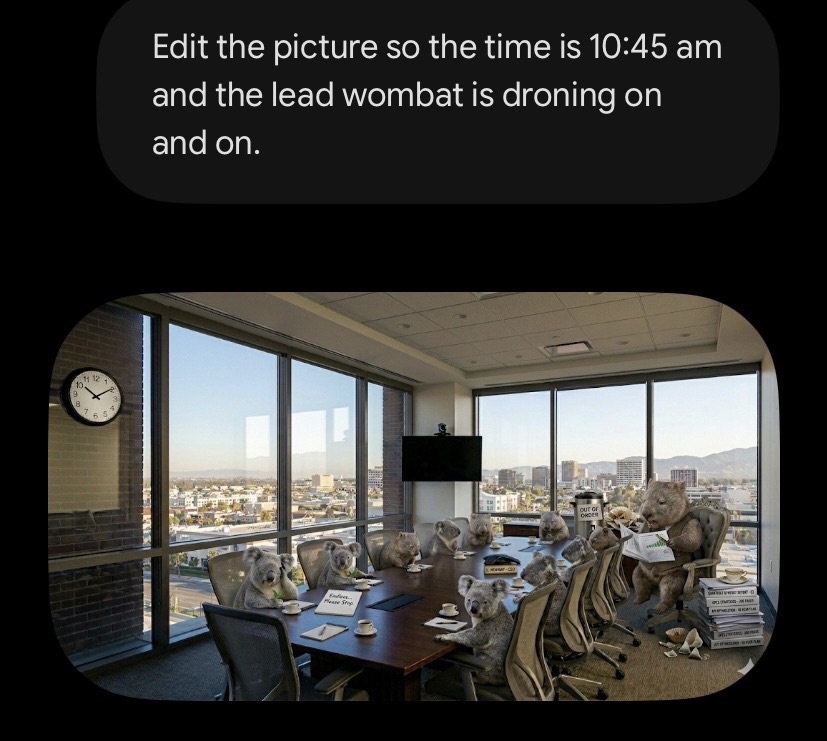
But I like those additions.
Take two minutes and twenty-four seconds and watch the reel again, taking note of the few elements specified by me, and the many elements that were “made up” by Google.
Adding a koala note of frustration is a good thing.
Lying on a job application is a bad thing.
And showing a time of 10:10 instead of the requested time of 10:45? It didn’t materially affect my story, so I was indifferent to it.
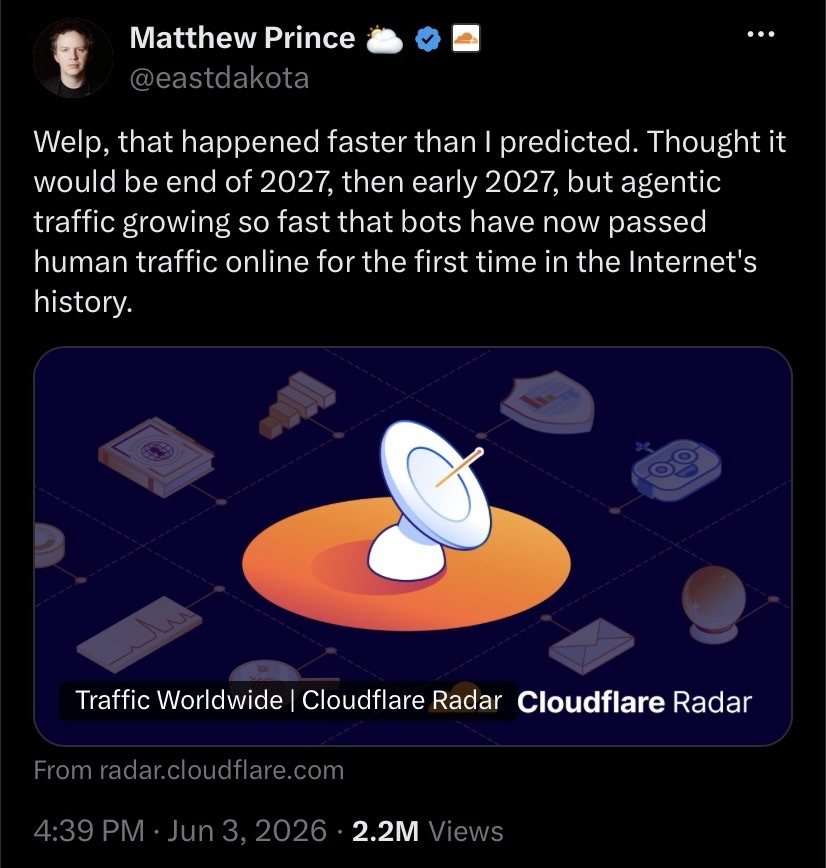
“Welp, that happened faster than I predicted.”
This is what he said. This is what Cloudflare CEO Matthew Prince said.
“Thought it would be end of 2027, then early 2027, but agentic traffic growing so fast that bots have now passed human traffic online for the first time in the Internet’s history.”
Welp, as long as they’re not running around uncontrolled. Maybe.
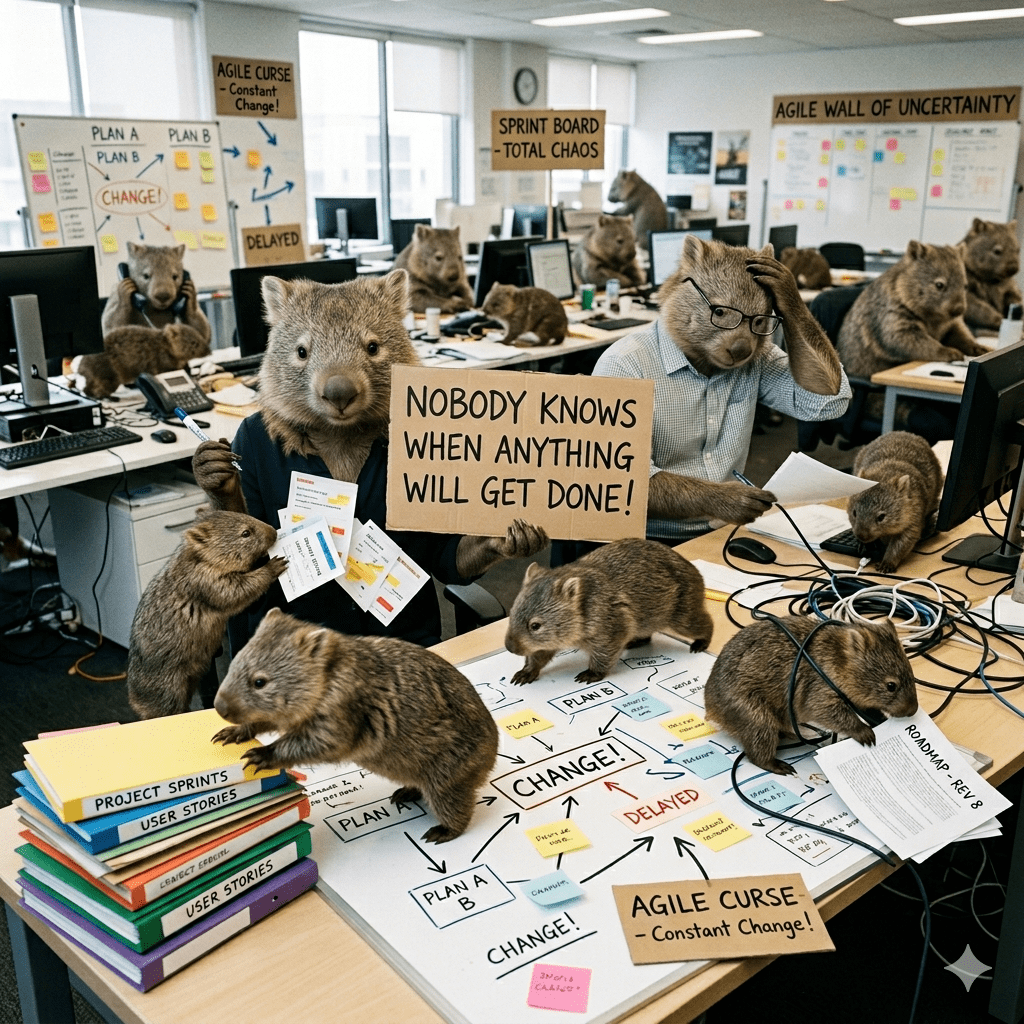
My recent video only used 8 seconds of the 30 second Google Lyria song “The Perpetual Roadmap.”
If you’d like to hear all of Google Lyria’s artificial ruminations on the topic, here they are.
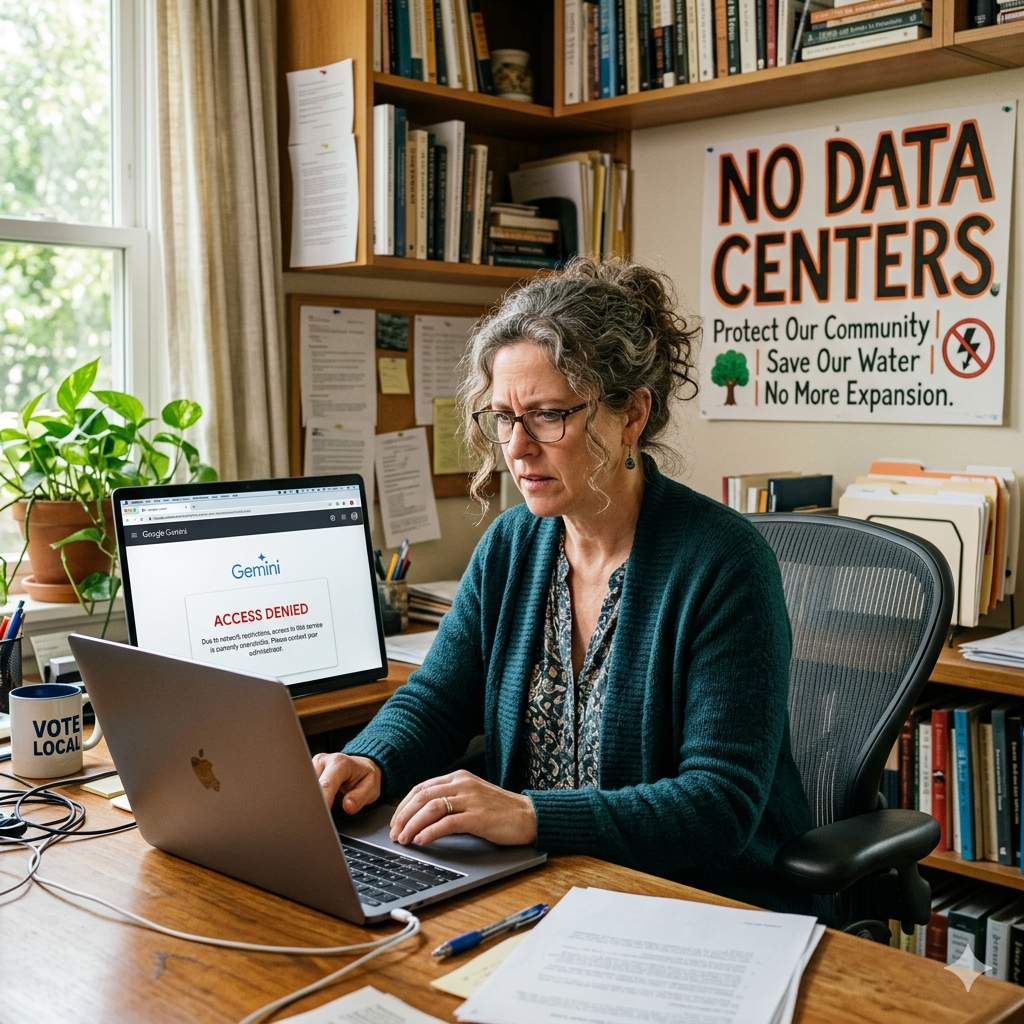
Monica had a burning question about the cast of the original “Jurassic Park” movie, and to obtain the answer, she accessed her favorite generative artificial intelligence tool.
Instead of receiving the expected blank prompt, Monica encountered a question:
City and state of legal residence:
Figuring the question was porn-related, and since she was an adult, she replied with no hesitation.
Pine Haven, California
Her tool then replied with the following:
On Tuesday, March 3, 2026, voters in Pine Haven, California approved Measure B, which prohibited construction of data centers within the city limits.
Monica remembered Measure B and her passionate “Yes” vote. Pine Haven was a beautiful town, and they didn’t need other peoples’ data centers ruining the landscape.

The message continued.
Due to a shortage of processing power, we must prioritize access to those who support data center construction.
ACCESS DENIED.
“It’s not fair,” Monica said to herself.
But oligopolies can do things like this. So don’t be surprised if your town is blocklisted from access to LLMs.

 Bredemarket